fuel YAMAHA WR 450F 2012 User Guide
[x] Cancel search | Manufacturer: YAMAHA, Model Year: 2012, Model line: WR 450F, Model: YAMAHA WR 450F 2012Pages: 96, PDF Size: 2.47 MB
Page 39 of 96
5-1
2
3
456
7
8
9
OPERATION AND IMPORTANT RIDING POINTS
EAU15951
Read the Owner’s Manual carefully to
become familiar with all controls. If
there is a control or function you do not
understand, ask your Yamaha dealer.
WARNING
EWA10271
Failure to familiarize yourself with
the controls can lead to loss of con-
trol, which could cause an accidentor injury.
EAU53110
TIPThis model is equipped with a lean an-
gle sensor to stop the engine in case of
a turnover. To start the engine after a
turnover, be sure to push the main
switch to “OFF” and then to “ON”. Fail-
ing to do so will prevent the engine from
starting even though the engine willcrank when pushing the start switch.
EAU52903
Starting a cold engine In order for the ignition circuit cut-off
system to enable starting, one of the
following conditions must be met:
The transmission is in the neutral
position.
The transmission is in gear with
the clutch lever pulled and the sid-
estand up.
See page 3-19 for more informa-
tion.
1. Push the main swtch to “ON” and make sure that the engine stop
switch is set to “ ”.
The following warning light should
come on for a few seconds, then
go off.
Fuel level warning light
Engine trouble warning light
NOTICE
ECA17781
If a warning light does not come on
initially when the main switch is
pushed to “ON”, or if a warning light
remains on, see page 3-1 for the cor-
responding warning light circuitcheck.
2. Shift the transmission into the neu-
1DX-9-E0.book 1 ページ 2011年10月10日 月曜日 午後2時14分
Page 41 of 96
OPERATION AND IMPORTANT RIDING POINTS
5-3
2
3
456
7
8
9
EAU16671
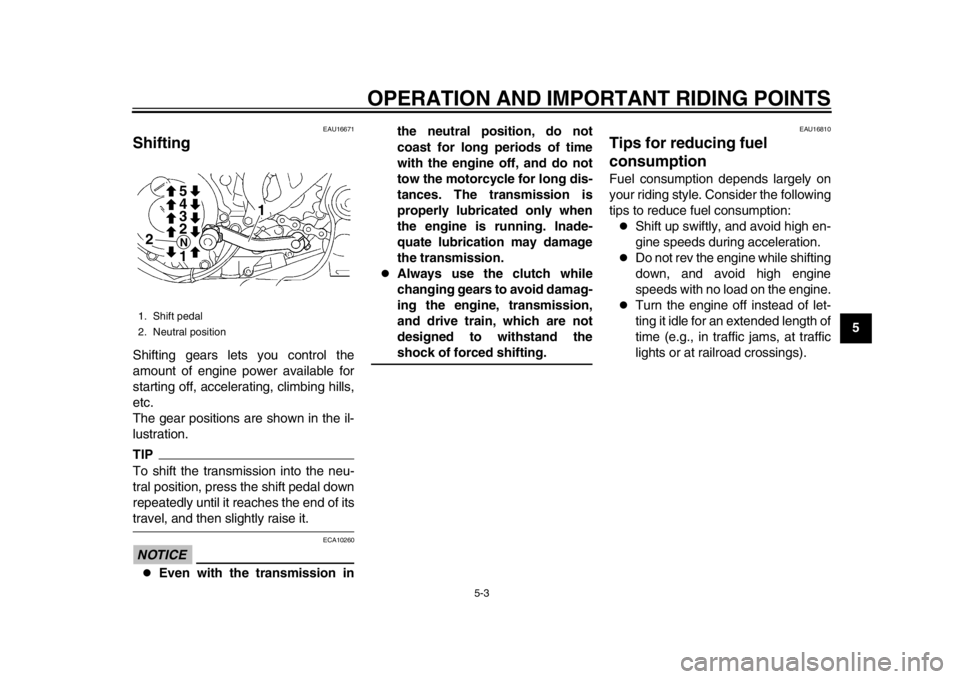
Shifting Shifting gears lets you control the
amount of engine power available for
starting off, accelerating, climbing hills,
etc.
The gear positions are shown in the il-
lustration.TIPTo shift the transmission into the neu-
tral position, press the shift pedal down
repeatedly until it reaches the end of itstravel, and then slightly raise it.NOTICE
ECA10260
Even with the transmission in the neutral position, do not
coast for long periods of time
with the engine off, and do not
tow the motorcycle for long dis-
tances. The transmission is
properly lubricated only when
the engine is running. Inade-
quate lubrication may damage
the transmission.
Always use the clutch while
changing gears to avoid damag-
ing the engine, transmission,
and drive train, which are not
designed to withstand theshock of forced shifting.
EAU16810
Tips for reducing fuel
consumption Fuel consumption depends largely on
your riding style. Consider the following
tips to reduce fuel consumption:
Shift up swiftly, and avoid high en-
gine speeds during acceleration.
Do not rev the engine while shifting
down, and avoid high engine
speeds with no load on the engine.
Turn the engine off instead of let-
ting it idle for an extended length of
time (e.g., in traffic jams, at traffic
lights or at railroad crossings).
1. Shift pedal
2. Neutral position
2 3
4 5N1
1
2
1DX-9-E0.book 3 ページ 2011年10月10日 月曜日 午後2時14分
Page 42 of 96
OPERATION AND IMPORTANT RIDING POINTS
5-4
1
2
3
45
6
7
8
9
EAU52940
Engine break-in
WARNING
EWA10321
Failure to properly maintain the ve-
hicle or performing maintenance ac-
tivities incorrectly may increase
your risk of injury or death during
service or while using the vehicle. If
you are not familiar with vehicle ser-
vice, have a Yamaha dealer performservice.1. Before starting the engine, fill the fuel tank with the fuel.
2. Start and warm up the engine. Check the operation of the controls
and the engine stop switch. (See
page 3-7.) Then, restart the engine
and check its operation within no
more than 5 minutes after it is re-
started.
3. Operate the motorcycle in the low- er gears at moderate throttle open-
ings for five to eight minutes. Stop
the engine.
4. Check how the engine runs when the motorcycle is ridden with the
throttle 1/4 to 1/2 open (low to me-
dium speed) for about one hour. 5. Start the engine and check the op-
eration of the motorcycle through-
out its entire operating range.
Restart the motorcycle and ride it
for about 10 to 15 more minutes.
The motorcycle will now be ready
to ride normally.
After the engine break-in period, thor-
oughly check the motorcycle for loose
parts, oil leakage and any other prob-
lems. Be sure to inspect and make ad-
justments thoroughly, especially cable
and drive chain slack and loose
spokes. In addition, check all fittings
and fasteners for looseness, and tight-
en if necessary.
NOTICE
ECA15560
When any of the following parts
have been replaced, they must
be broken in.
Cylinder or crankshaft:
About one hour of break-in op-
eration is necessary.
Piston, rings or transmission
gears:
These parts require about 30
minutes of break-in operation at
half-throttle or less. Observe the condition of the engine carefully
during operation.
If any engine trouble should oc-
cur during the engine break-in
period, immediately have a
Yamaha dealer check the vehi-cle.
1DX-9-E0.book 4 ページ 2011年10月10日 月曜日 午後2時14分
Page 43 of 96
OPERATION AND IMPORTANT RIDING POINTS
5-5
2
3
456
7
8
9
EAU52410
Parking When parking, stop the engine by
pushing the main switch to “OFF”.
WARNING
EWA10311
Since the engine and exhaust
system can become very hot,
park in a place where pedestri-
ans or children are not likely to
touch them and be burned.
Do not park on a slope or on soft
ground, otherwise the vehicle
may overturn, increasing the
risk of a fuel leak and fire.
Do not park near grass or other
flammable materials whichmight catch fire.
1DX-9-E0.book 5 ページ 2011年10月10日 月曜日 午後2時14分
Page 46 of 96
PERIODIC MAINTENANCE AND ADJUSTMENT
6-3
1
2
3
4
56
7
8
9
EAU52500
TIP
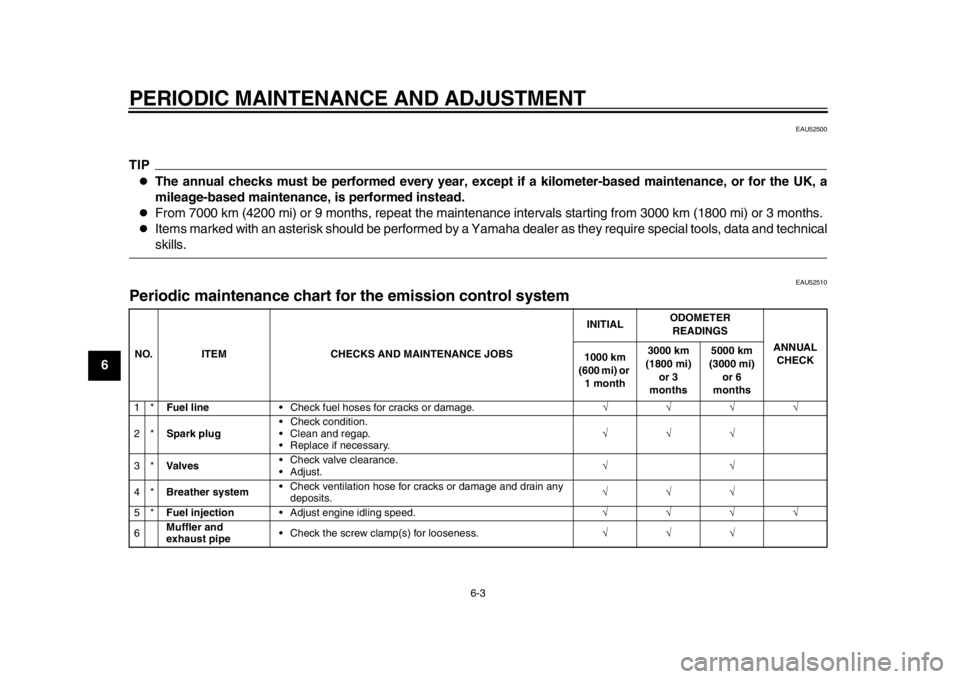
The annual checks must be performed every year, except if a kilometer-based maintenance, or for the UK, a
mileage-based maintenance, is performed instead.
From 7000 km (4200 mi) or 9 months, repeat the maintenance intervals starting from 3000 km (1800 mi) or 3 months.
Items marked with an asterisk should be performed by a Yamaha dealer as they require special tools, data and technicalskills.
EAU52510
Periodic maintenance chart for the emission control system NO. ITEM CHECKS AND MAINTENANCE JOBS INITIAL
ODOMETER
READINGS
ANNUAL CHECK
1000 km
(600 mi) or
1 month 3000 km
(1800 mi) or 3
months 5000 km
(3000 mi) or 6
months
1* Fuel line Check fuel hoses for cracks or damage.
2* Spark plug Check condition.
Clean and regap.
Replace if necessary.
3* Valves Check valve clearance.
Adjust.
4* Breather system Check ventilation hose for cracks or damage and drain any
deposits.
5* Fuel injection Adjust engine idling speed.
6 Muffler and
exhaust pipe Check the screw clamp(s) for looseness.
1DX-9-E0.book 3 ページ 2011年10月10日 月曜日 午後2時14分
Page 61 of 96
PERIODIC MAINTENANCE AND ADJUSTMENT
6-18
2
3
4
567
8
9
EAU21401
Valve clearance The valve clearance changes with use,
resulting in improper air-fuel mixture
and/or engine noise. To prevent this
from occurring, the valve clearance
must be adjusted by a Yamaha dealer
at the intervals specified in the periodic
maintenance and lubrication chart.
EAU52880
Tires To maximize the performance, durabil-
ity, and safe operation of your motorcy-
cle, note the following points regarding
the specified tires.
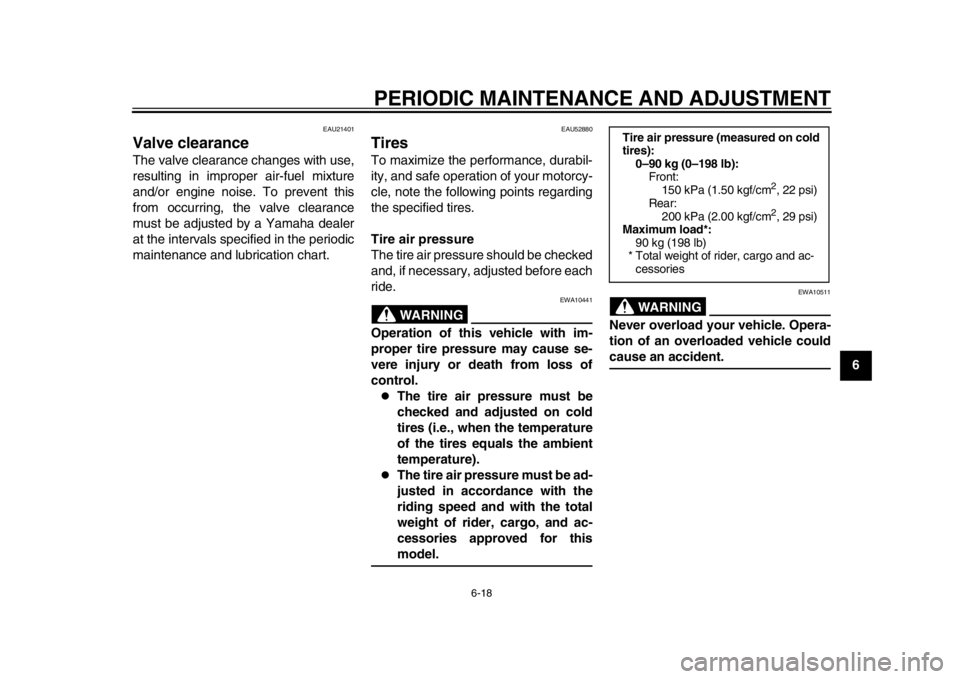
Tire air pressure
The tire air pressure should be checked
and, if necessary, adjusted before each
ride.
WARNING
EWA10441
Operation of this vehicle with im-
proper tire pressure may cause se-
vere injury or death from loss of
control.
The tire air pressure must be
checked and adjusted on cold
tires (i.e., when the temperature
of the tires equals the ambient
temperature).
The tire air pressure must be ad-
justed in accordance with the
riding speed and with the total
weight of rider, cargo, and ac-
cessories approved for thismodel.
WARNING
EWA10511
Never overload your vehicle. Opera-
tion of an overloaded vehicle couldcause an accident.
Tire air pressure (measured on cold
tires):0–90 kg (0–198 lb):Front:
150 kPa (1.50 kgf/cm
2, 22 psi)
Rear: 200 kPa (2.00 kgf/cm2, 29 psi)
Maximum load*: 90 kg (198 lb)
* Total weight of rider, cargo and ac-
cessories
1DX-9-E0.book 18 ページ 2011年10月10日 月曜日 午後2時14分
Page 82 of 96
PERIODIC MAINTENANCE AND ADJUSTMENT
6-39
1
2
3
4
56
7
8
9
EAU25871
Troubleshooting Although Yamaha motorcycles receive
a thorough inspection before shipment
from the factory, trouble may occur dur-
ing operation. Any problem in the fuel,
compression, or ignition systems, for
example, can cause poor starting and
loss of power.
The following troubleshooting charts
represent quick and easy procedures
for checking these vital systems your-
self. However, should your motorcycle
require any repair, take it to a Yamaha
dealer, whose skilled technicians have
the necessary tools, experience, and
know-how to service the motorcycle
properly.
Use only genuine Yamaha replace-
ment parts. Imitation parts may look like
Yamaha parts, but they are often inferi-
or, have a shorter service life and can
lead to expensive repair bills.
WARNING
EWA15141
When checking the fuel system, do
not smoke, and make sure there are
no open flames or sparks in the ar-
ea, including pilot lights from waterheaters or furnaces. Gasoline or
gasoline vapors can ignite or ex-
plode, causing severe injury or
property damage.
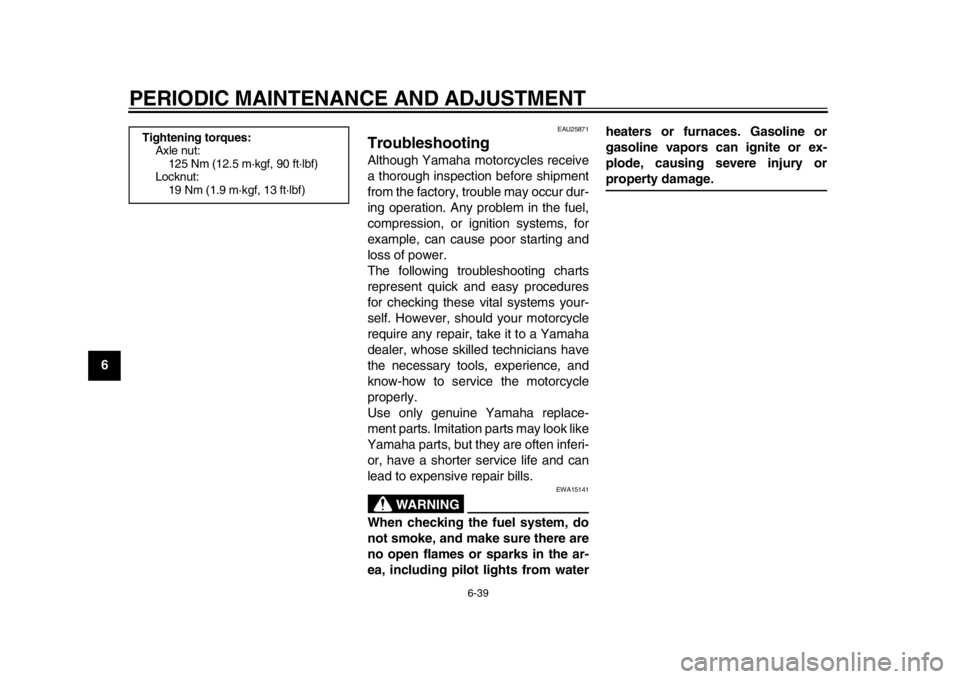
Tightening torques:
Axle nut:125 Nm (12.5 m·kgf, 90 ft·lbf)
Locknut:
19 Nm (1.9 m·kgf, 13 ft·lbf)
1DX-9-E0.book 39 ページ 2011年10月10日 月曜日 午後2時14分
Page 83 of 96
PERIODIC MAINTENANCE AND ADJUSTMENT
6-40
2
3
4
567
8
9
EAU53121
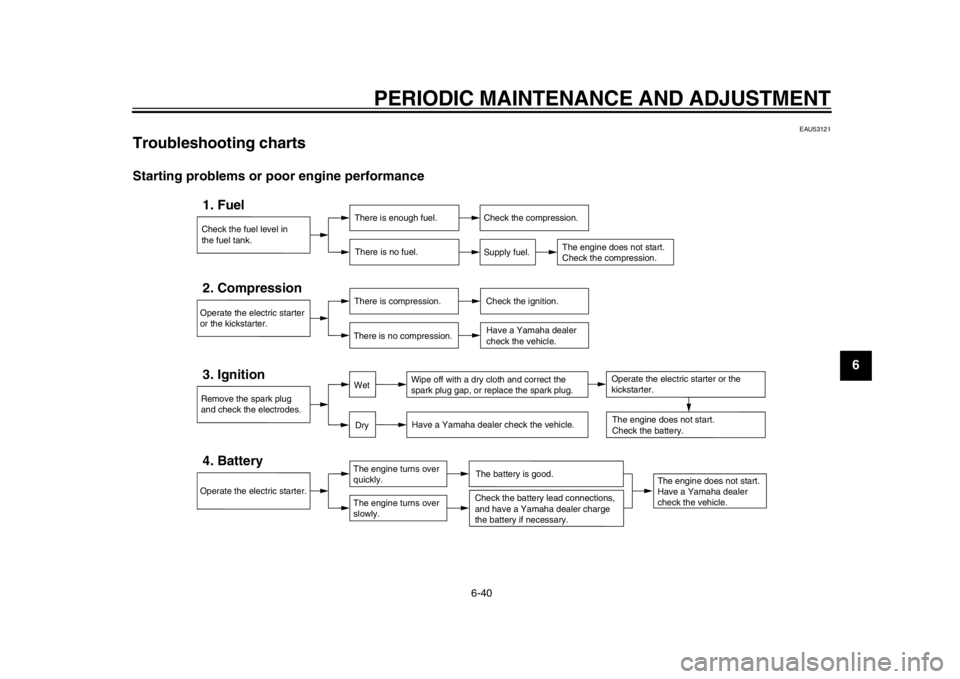
Troubleshooting charts Starting problems or poor engine performance
Check the fuel level in
the fuel tank.1. Fuel
There is enough fuel.There is no fuel.
Check the compression.
Supply fuel.
The engine does not start.
Check the compression.
Operate the electric starter
or the kickstarter.2. Compression
There is compression.
There is no compression.
Check the ignition. Have a Yamaha dealer
check the vehicle.
Remove the spark plug
and check the electrodes.3. Ignition
Wipe off with a dry cloth and correct the
spark plug gap, or replace the spark plug.
Have a Yamaha dealer check the vehicle.
The engine does not start.
Have a Yamaha dealer
check the vehicle.
The engine does not start.
Check the battery.
Operate the electric starter.4. Battery
The engine turns over
quickly.
The engine turns over
slowly.
The battery is good.
DryWet
Operate the electric starter or the
kickstarter.
Check the battery lead connections,
and have a Yamaha dealer charge
the battery if necessary.
1DX-9-E0.book 40 ページ 2011年10月10日 月曜日 午後2時14分
Page 86 of 96
MOTORCYCLE CARE AND STORAGE
7-2
1
2
3
4
5
67
8
9off any detergent residue using
plenty of water, as it is harmful
to plastic parts.
Do not use any harsh chemical
products on plastic parts. Be
sure to avoid using cloths or
sponges which have been in
contact with strong or abrasive
cleaning products, solvent or
thinner, fuel (gasoline), rust re-
movers or inhibitors, brake flu-
id, antifreeze or electrolyte.
Do not use high-pressure wash-
ers or steam-jet cleaners since
they cause water seepage and
deterioration in the following ar-
eas: seals (of wheel and swing-
arm bearings, fork and brakes),
electric components (couplers,
connectors, instruments,
switches and lights), breather
hoses and vents.
For motorcycles equipped with
a windshield: Do not use strong
cleaners or hard sponges as
they will cause dulling or
scratching. Some cleaning com-
pounds for plastic may leave
scratches on the windshield. Test the product on a small hid-
den part of the windshield to
make sure that it does not leave
any marks. If the windshield is
scratched, use a quality plastic
polishing compound after
washing.
After normal use
Remove dirt with warm water, a mild
detergent, and a soft, clean sponge,
and then rinse thoroughly with clean
water. Use a toothbrush or bottlebrush
for hard-to-reach areas. Stubborn dirt
and insects will come off more easily if
the area is covered with a wet cloth for
a few minutes before cleaning.
After riding in the rain, near the sea oron salt-sprayed roadsSince sea salt or salt sprayed on roads
during winter are extremely corrosive in
combination with water, carry out the
following steps after each ride in the
rain, near the sea or on salt-sprayed
roads.TIPSalt sprayed on roads in the winter may
remain well into spring. 1. Clean the motorcycle with cold wa- ter and a mild detergent, after the
engine has cooled down.
NOTICE: Do not use warm water
since it increases the corrosive
action of the salt.
[ECA10791]
2. Apply a corrosion protection spray on all metal, including chrome- and
nickel-plated, surfaces to prevent
corrosion.
After cleaning 1. Dry the motorcycle with a chamois or an absorbing cloth.
2. Immediately dry the drive chain and lubricate it to prevent it from
rusting.
3. Use a chrome polish to shine chrome, aluminum and stain-
less-steel parts, including the ex-
haust system. (Even the thermally
induced discoloring of stain-
less-steel exhaust systems can be
removed through polishing.)
4. To prevent corrosion, it is recom- mended to apply a corrosion pro-
tection spray on all metal,
1DX-9-E0.book 2 ページ 2011年10月10日 月曜日 午後2時14分
Page 87 of 96
MOTORCYCLE CARE AND STORAGE
7-3
2
3
4
5
678
9
including chrome- and nickel-plat-
ed, surfaces.
5. Use spray oil as a universal clean- er to remove any remaining dirt.
6. Touch up minor paint damage caused by stones, etc.
7. Wax all painted surfaces.
8. Let the motorcycle dry completely before storing or covering it.
WARNING
EWA11131
Contaminants on the brakes or tires
can cause loss of control.
Make sure that there is no oil or
wax on the brakes or tires.
If necessary, clean the brake
discs and brake linings with a
regular brake disc cleaner or ac-
etone, and wash the tires with
warm water and a mild deter-
gent. Before riding at higher
speeds, test the motorcycle’s
braking performance and cor-nering behavior.
NOTICE
ECA10800
Apply spray oil and wax spar-
ingly and make sure to wipe off any excess.
Never apply oil or wax to any
rubber and plastic parts, but
treat them with a suitable care
product.
Avoid using abrasive polishing
compounds as they will wearaway the paint.
TIP
Consult a Yamaha dealer for ad-
vice on what products to use.
Washing, rainy weather or humid
climates can cause the headlight
lens to fog. Turning the headlight
on for a short period of time will
help remove the moisture from thelens.
EAU43202
Storage Short-term
Always store your motorcycle in a cool,
dry place and, if necessary, protect it
against dust with a porous cover. Be
sure the engine and the exhaust sys-
tem are cool before covering the motor-
cycle.NOTICE
ECA10810
Storing the motorcycle in a
poorly ventilated room or cover-
ing it with a tarp, while it is still
wet, will allow water and humid-
ity to seep in and cause rust.
To prevent corrosion, avoid
damp cellars, stables (because
of the presence of ammonia)
and areas where strong chemi-cals are stored.
Long-term
Before storing your motorcycle for sev-
eral months: 1. Follow all the instructions in the “Care” section of this chapter.
2. Fill up the fuel tank and add fuel
1DX-9-E0.book 3 ページ 2011年10月10日 月曜日 午後2時14分