check engine YAMAHA WR 450F 2012 Owner's Manual
[x] Cancel search | Manufacturer: YAMAHA, Model Year: 2012, Model line: WR 450F, Model: YAMAHA WR 450F 2012Pages: 96, PDF Size: 2.47 MB
Page 57 of 96
PERIODIC MAINTENANCE AND ADJUSTMENT
6-14
2
3
4
567
8
9
into the radiator until it is full.
7. Install the radiator cap, start the engine, let it idle for several min-
utes, and then turn it off.
8. Remove the radiator cap to check the coolant level in the radiator. If
necessary, add sufficient coolant
until it reaches the bottom of the
radiator filler neck, and then install
the radiator cap.
9. Start the engine, and then check the vehicle for coolant leakage. If
coolant is leaking, have a Yamaha
dealer check the cooling system.
EAU52932
Cleaning the air filter element
and check hose The air filter element should be cleaned
or replaced at the intervals specified in
the periodic maintenance and lubrica-
tion chart. Clean or, if necessary, re-
place the air filter element more
frequently if you are riding in unusually
wet or dusty areas. In addition, the air
filter check hose must be frequently
checked and cleaned if necessary.
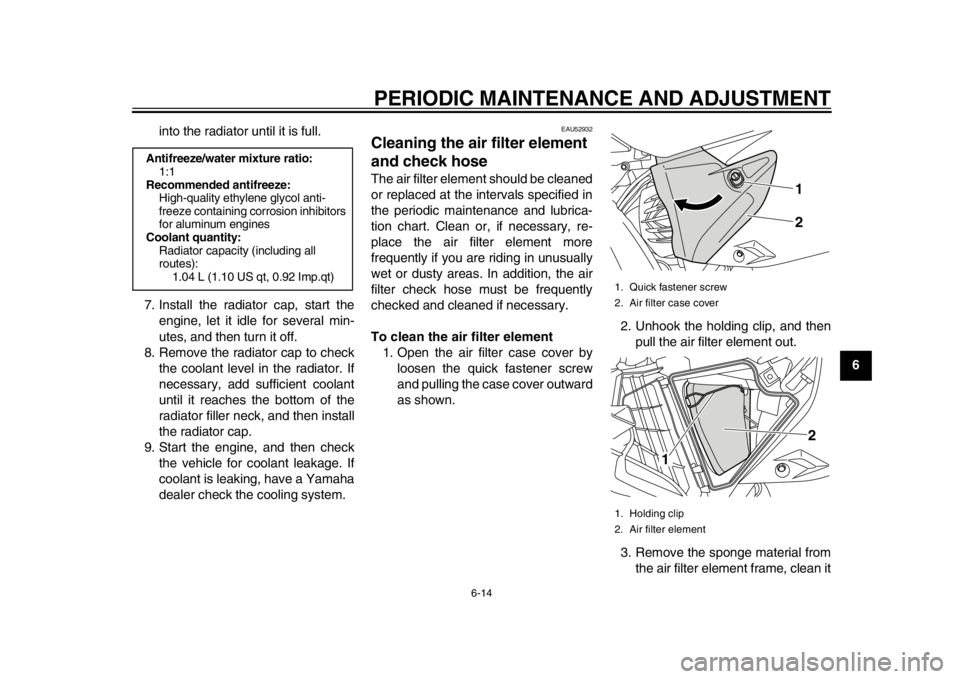
To clean the air filter element1. Open the air filter case cover by loosen the quick fastener screw
and pulling the case cover outward
as shown. 2. Unhook the holding clip, and then
pull the air filter element out.
3. Remove the sponge material from the air filter element frame, clean it
Antifreeze/water mixture ratio:1:1
Recommended antifreeze:
High-quality ethylene glycol anti-
freeze containing corrosion inhibitors
for aluminum engines
Coolant quantity: Radiator capacity (including all
routes): 1.04 L (1.10 US qt, 0.92 Imp.qt)
1. Quick fastener screw
2. Air filter case cover
1. Holding clip
2. Air filter element
12
1 2
1DX-9-E0.book 14 ページ 2011年10月10日 月曜日 午後2時14分
Page 60 of 96
PERIODIC MAINTENANCE AND ADJUSTMENT
6-17
1
2
3
4
56
7
8
9
EAU52460
Adjusting the engine idling
speed The engine idling speed must be
checked and, if necessary, adjusted as
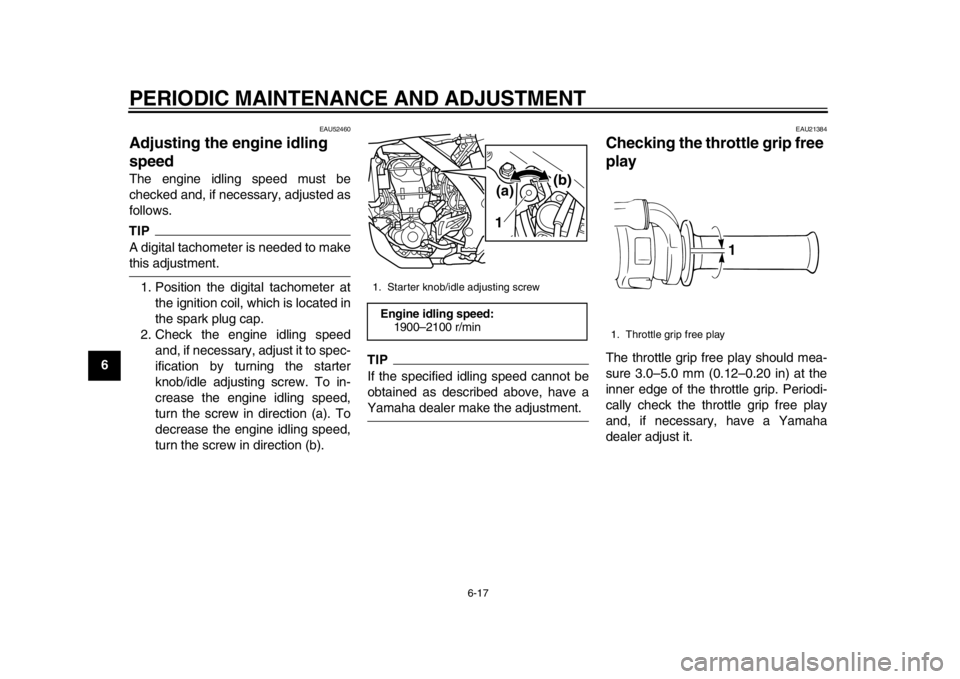
follows.TIPA digital tachometer is needed to makethis adjustment.1. Position the digital tachometer at the ignition coil, which is located in
the spark plug cap.
2. Check the engine idling speed and, if necessary, adjust it to spec-
ification by turning the starter
knob/idle adjusting screw. To in-
crease the engine idling speed,
turn the screw in direction (a). To
decrease the engine idling speed,
turn the screw in direction (b).
TIPIf the specified idling speed cannot be
obtained as described above, have aYamaha dealer make the adjustment.
EAU21384
Checking the throttle grip free
play The throttle grip free play should mea-
sure 3.0–5.0 mm (0.12–0.20 in) at the
inner edge of the throttle grip. Periodi-
cally check the throttle grip free play
and, if necessary, have a Yamaha
dealer adjust it.
1. Starter knob/idle adjusting screwEngine idling speed:1900–2100 r/min
1(a)
(b)
1. Throttle grip free play
1
1DX-9-E0.book 17 ページ 2011年10月10日 月曜日 午後2時14分
Page 61 of 96
PERIODIC MAINTENANCE AND ADJUSTMENT
6-18
2
3
4
567
8
9
EAU21401
Valve clearance The valve clearance changes with use,
resulting in improper air-fuel mixture
and/or engine noise. To prevent this
from occurring, the valve clearance
must be adjusted by a Yamaha dealer
at the intervals specified in the periodic
maintenance and lubrication chart.
EAU52880
Tires To maximize the performance, durabil-
ity, and safe operation of your motorcy-
cle, note the following points regarding
the specified tires.
Tire air pressure
The tire air pressure should be checked
and, if necessary, adjusted before each
ride.
WARNING
EWA10441
Operation of this vehicle with im-
proper tire pressure may cause se-
vere injury or death from loss of
control.
The tire air pressure must be
checked and adjusted on cold
tires (i.e., when the temperature
of the tires equals the ambient
temperature).
The tire air pressure must be ad-
justed in accordance with the
riding speed and with the total
weight of rider, cargo, and ac-
cessories approved for thismodel.
WARNING
EWA10511
Never overload your vehicle. Opera-
tion of an overloaded vehicle couldcause an accident.
Tire air pressure (measured on cold
tires):0–90 kg (0–198 lb):Front:
150 kPa (1.50 kgf/cm
2, 22 psi)
Rear: 200 kPa (2.00 kgf/cm2, 29 psi)
Maximum load*: 90 kg (198 lb)
* Total weight of rider, cargo and ac-
cessories
1DX-9-E0.book 18 ページ 2011年10月10日 月曜日 午後2時14分
Page 69 of 96
PERIODIC MAINTENANCE AND ADJUSTMENT
6-26
2
3
4
567
8
9
EAU23025
Cleaning and lubricating the
drive chain The drive chain must be cleaned and
lubricated at the intervals specified in
the periodic maintenance and lubrica-
tion chart, otherwise it will quickly wear
out, especially when riding in dusty or
wet areas. Service the drive chain as
follows.NOTICE
ECA10583
The drive chain must be lubricated
after washing the motorcycle, ridingin the rain or riding in wet areas.
1. Clean the drive chain with kero- sene and a small soft brush.
NOTICE: To prevent damaging
the O-rings, do not clean the
drive chain with steam cleaners,
high-pressure washers or inap-
propriate solvents.
[ECA11121]
2. Wipe the drive chain dry.
3. Thoroughly lubricate the drive chain with a special O-ring chain
lubricant. NOTICE: Do not use
engine oil or any other lubri-
cants for the drive chain, as they may contain substances that
could damage the O-rings.
[ECA11111]
EAU23095
Checking and lubricating the
cables The operation of all control cables and
the condition of the cables should be
checked before each ride, and the ca-
bles and cable ends should be lubricat-
ed if necessary. If a cable is damaged
or does not move smoothly, have a
Yamaha dealer check or replace it.
WARNING! Damage to the outer
housing of cables may result in in-
ternal rusting and cause interfer-
ence with cable movement. Replace
damaged cables as soon as possi-
ble to prevent unsafe condi-
tions.
[EWA10711]
Recommended lubricant:
Yamaha Chain and Cable Lube or
engine oil
1DX-9-E0.book 26 ページ 2011年10月10日 月曜日 午後2時14分
Page 72 of 96
PERIODIC MAINTENANCE AND ADJUSTMENT
6-29
1
2
3
4
56
7
8
9
EAU23272
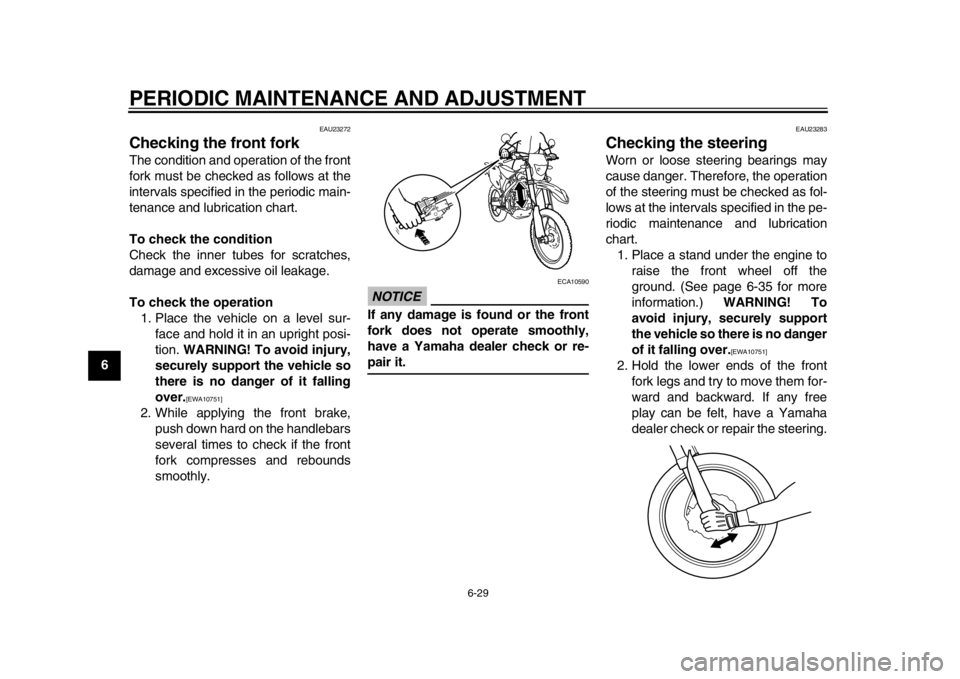
Checking the front fork The condition and operation of the front
fork must be checked as follows at the
intervals specified in the periodic main-
tenance and lubrication chart.
To check the condition
Check the inner tubes for scratches,
damage and excessive oil leakage.
To check the operation1. Place the vehicle on a level sur- face and hold it in an upright posi-
tion. WARNING! To avoid injury,
securely support the vehicle so
there is no danger of it falling
over.
[EWA10751]
2. While applying the front brake, push down hard on the handlebars
several times to check if the front
fork compresses and rebounds
smoothly.
NOTICE
ECA10590
If any damage is found or the front
fork does not operate smoothly,
have a Yamaha dealer check or re-pair it.
EAU23283
Checking the steering Worn or loose steering bearings may
cause danger. Therefore, the operation
of the steering must be checked as fol-
lows at the intervals specified in the pe-
riodic maintenance and lubrication
chart.1. Place a stand under the engine to raise the front wheel off the
ground. (See page 6-35 for more
information.) WARNING! To
avoid injury, securely support
the vehicle so there is no danger
of it falling over.
[EWA10751]
2. Hold the lower ends of the front fork legs and try to move them for-
ward and backward. If any free
play can be felt, have a Yamaha
dealer check or repair the steering.
1DX-9-E0.book 29 ページ 2011年10月10日 月曜日 午後2時14分
Page 78 of 96
PERIODIC MAINTENANCE AND ADJUSTMENT
6-35
1
2
3
4
56
7
8
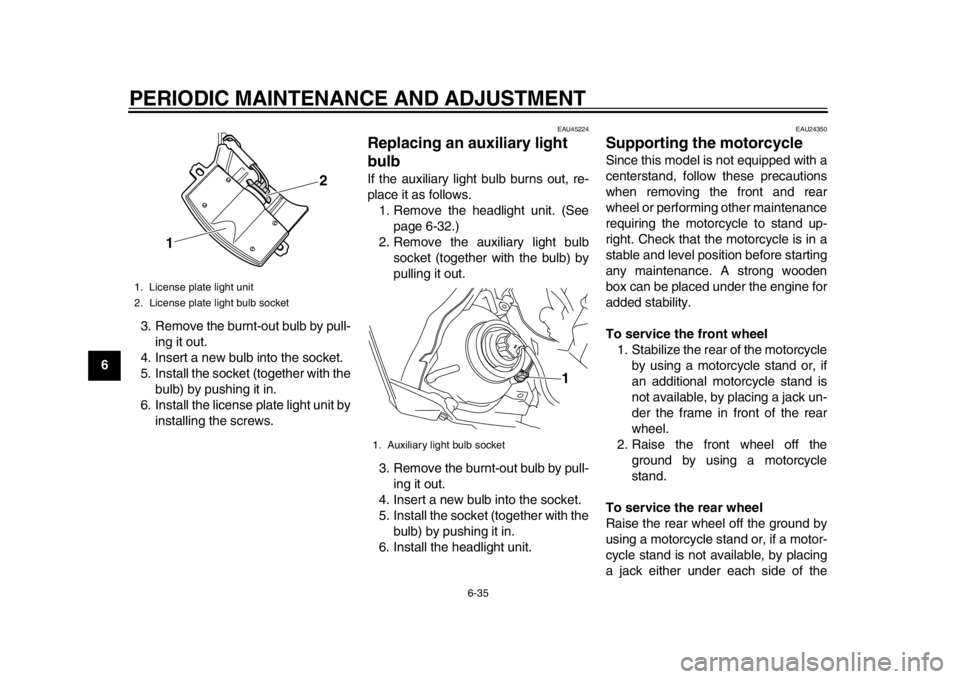
93. Remove the burnt-out bulb by pull-
ing it out.
4. Insert a new bulb into the socket.
5. Install the socket (together with the bulb) by pushing it in.
6. Install the license plate light unit by installing the screws.
EAU45224
Replacing an auxiliary light
bulb If the auxiliary light bulb burns out, re-
place it as follows.1. Remove the headlight unit. (See page 6-32.)
2. Remove the auxiliary light bulb socket (together with the bulb) by
pulling it out.
3. Remove the burnt-out bulb by pull- ing it out.
4. Insert a new bulb into the socket.
5. Install the socket (together with the bulb) by pushing it in.
6. Install the headlight unit.
EAU24350
Supporting the motorcycle Since this model is not equipped with a
centerstand, follow these precautions
when removing the front and rear
wheel or performing other maintenance
requiring the motorcycle to stand up-
right. Check that the motorcycle is in a
stable and level position before starting
any maintenance. A strong wooden
box can be placed under the engine for
added stability.
To service the front wheel 1. Stabilize the rear of the motorcycle by using a motorcycle stand or, if
an additional motorcycle stand is
not available, by placing a jack un-
der the frame in front of the rear
wheel.
2. Raise the front wheel off the ground by using a motorcycle
stand.
To service the rear wheel
Raise the rear wheel off the ground by
using a motorcycle stand or, if a motor-
cycle stand is not available, by placing
a jack either under each side of the
1. License plate light unit
2. License plate light bulb socket
1 2
1. Auxiliary light bulb socket
1
1DX-9-E0.book 35 ページ 2011年10月10日 月曜日 午後2時14分
Page 83 of 96
PERIODIC MAINTENANCE AND ADJUSTMENT
6-40
2
3
4
567
8
9
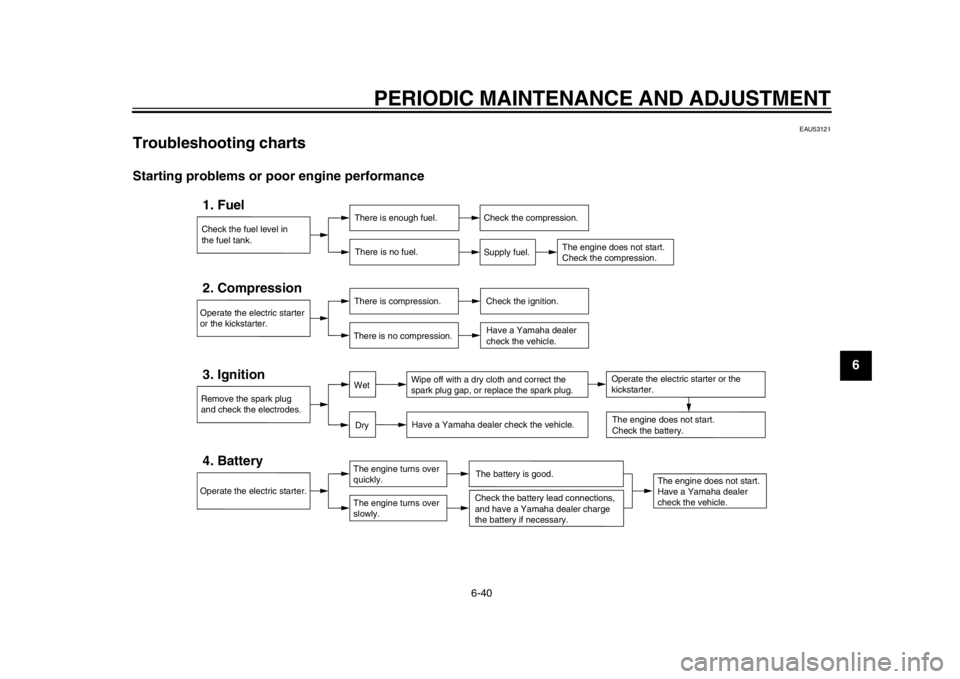
EAU53121
Troubleshooting charts Starting problems or poor engine performance
Check the fuel level in
the fuel tank.1. Fuel
There is enough fuel.There is no fuel.
Check the compression.
Supply fuel.
The engine does not start.
Check the compression.
Operate the electric starter
or the kickstarter.2. Compression
There is compression.
There is no compression.
Check the ignition. Have a Yamaha dealer
check the vehicle.
Remove the spark plug
and check the electrodes.3. Ignition
Wipe off with a dry cloth and correct the
spark plug gap, or replace the spark plug.
Have a Yamaha dealer check the vehicle.
The engine does not start.
Have a Yamaha dealer
check the vehicle.
The engine does not start.
Check the battery.
Operate the electric starter.4. Battery
The engine turns over
quickly.
The engine turns over
slowly.
The battery is good.
DryWet
Operate the electric starter or the
kickstarter.
Check the battery lead connections,
and have a Yamaha dealer charge
the battery if necessary.
1DX-9-E0.book 40 ページ 2011年10月10日 月曜日 午後2時14分
Page 84 of 96
PERIODIC MAINTENANCE AND ADJUSTMENT
6-41
1
2
3
4
56
7
8
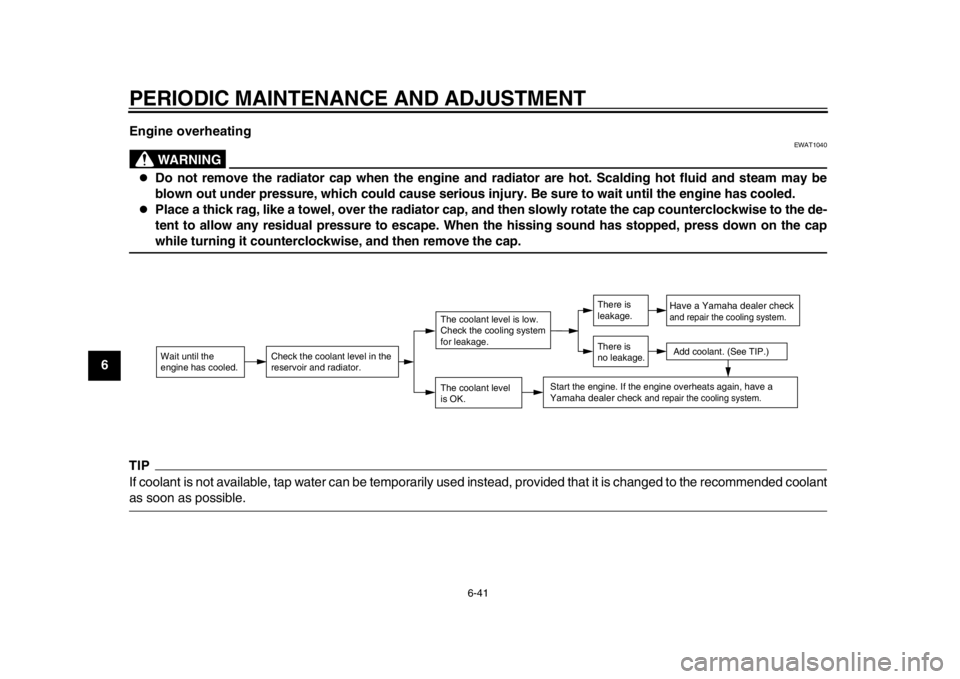
9Engine overheating
WARNING
EWAT1040
Do not remove the radiator cap when the engine and radiator are hot. Scalding hot fluid and steam may be
blown out under pressure, which could cause serious injury. Be sure to wait until the engine has cooled.
Place a thick rag, like a towel, over the radiator cap, and then slowly rotate the cap counterclockwise to the de-
tent to allow any residual pressure to escape. When the hissing sound has stopped, press down on the capwhile turning it counterclockwise, and then remove the cap.
TIPIf coolant is not available, tap water can be temporarily us
ed instead, provided that it is changed to the recommended coolantas soon as possible.
Wait until the
engine has cooled.
Check the coolant level in the
reservoir and radiator.
The coolant level
is OK.The coolant level is low.
Check the cooling system
for leakage.
Have a Yamaha dealer checkand repair the cooling system.Add coolant. (See TIP.)
Start the engine. If the engine overheats again,
have a
Yamaha dealer check
and repair the cooling system.
There is
leakage.
There is
no leakage.
1DX-9-E0.book 41 ページ 2011年10月10日 月曜日 午後2時14分
Page 88 of 96
MOTORCYCLE CARE AND STORAGE
7-4
1
2
3
4
5
67
8
9stabilizer (if available) to prevent
the fuel tank from rusting and the
fuel from deteriorating.
3. Perform the following steps to pro- tect the cylinder, piston rings, etc.
from corrosion.
a. Remove the spark plug cap and spark plug.
b. Pour a teaspoonful of engine oil into the spark plug bore.
c. Install the spark plug cap onto the spark plug, and then place
the spark plug on the cylinder
head so that the electrodes are
grounded. (This will limit spark-
ing during the next step.)
d. Turn the engine over several times with the starter. (This will
coat the cylinder wall with oil.)
e. Remove the spark plug cap from the spark plug, and then
install the spark plug and the
spark plug cap. WARNING! To
prevent damage or injury
from sparking, make sure to
ground the spark plug elec-
trodes while turning the en-
gine over.
[EWA10951]
4. Lubricate all control cables and the pivoting points of all levers and
pedals as well as of the sidestand/
centerstand.
5. Check and, if necessary, correct the tire air pressure, and then lift
the motorcycle so that both of its
wheels are off the ground. Alterna-
tively, turn the wheels a little every
month in order to prevent the tires
from becoming degraded in one
spot.
6. Cover the muffler outlet with a plastic bag to prevent moisture
from entering it.
7. Remove the battery and fully charge it. Store it in a cool, dry
place and charge it once a month.
Do not store the battery in an ex-
cessively cold or warm place [less
than 0 C (30 F) or more than 30
C (90 F)]. For more information
on storing the battery, see page
6-30.
TIPMake any necessary repairs beforestoring the motorcycle.
1DX-9-E0.book 4 ページ 2011年10月10日 月曜日 午後2時14分
Page 93 of 96

INDEX
AAir filter element and check hose,
cleaning ................................................. 6-14
Auxiliary light bulb, replacing ................... 6-35BBattery ..................................................... 6-30
Brake and clutch levers, checking and lubricating .............................................. 6-27
Brake fluid, changing ............................... 6-24
Brake fluid level, checking ....................... 6-23
Brake lever ................................................ 3-8
Brake lever free play, checking ............... 6-21
Brake light switches ................................. 6-22
Brake pedal ............................................... 3-9
Brake pedal, checking and lubricating ..... 6-28CCables, checking and lubricating ............. 6-26
Care ........................................................... 7-1
Catalytic converter ................................... 3-11
Clutch lever................................................ 3-8
Clutch lever free play, adjusting .............. 6-20
Coolant .................................................... 6-12DDimmer switch ........................................... 3-7
Drive chain, cleaning and lubricating ....... 6-26
Drive chain slack ..................................... 6-24EEngine break-in ......................................... 5-4
Engine idling speed ................................. 6-17
Engine oil and oil filter element.................. 6-8
Engine, starting a warm ............................. 5-2
Engine stop switch..................................... 3-7
Engine trouble warning light ...................... 3-2
FFront and rear brake pads, checking ...... 6-22
Front fork, adjusting ................................ 3-14
Front fork, bleeding ................................. 3-15
Front fork, checking................................. 6-29
Fuel ......................................................... 3-10
Fuel consumption, tips for reducing .......... 5-3
Fuel level warning light .............................. 3-2
Fuel tank breather hose .......................... 3-11
Fuel tank cap............................................. 3-9
Fuse, replacing........................................ 6-31HHandlebar switches ................................... 3-7
Headlight bulb, replacing......................... 6-32
High beam indicator light ........................... 3-2
Horn switch ............................................... 3-7IIdentification numbers ............................... 9-1
Ignition circuit cut-off system ................... 3-19
Indicator lights and warning lights ............. 3-1KKickstarter ............................................... 3-12LLicense plate light bulb, replacing ........... 6-34MMain switch ............................................... 3-1
Maintenance and lubricatio n, periodic....... 6-4
Maintenance, emission control system ..... 6-3
Matte color, caution ................................... 7-1
Model label ................................................ 9-1
Multi-function display................................. 3-2NNeutral indicator light ................................ 3-1
PPanel, removing and installing ...................6-7
Parking.......................................................5-5
Part locations .............................................2-1SSafety information ......................................1-1
Seat ......................................................... 3-13
Shifting .......................................................5-3
Shift pedal ..................................................3-8
Shift pedal, checking................................ 6-22
Shock absorber assembly, adjusting .......3-16
Sidestand .................................................3-18
Sidestand, checking and lubricating ........6-28
Spark plug, checking .................................6-7
Specifications.............................................8-1
Starter knob .............................................3-12
Starting a cold engine ................................5-1
Start switch ................................................3-7
Steering, checking ................................... 6-29
Steering lock ............................................3-13
Storage ......................................................7-3
Supporting the motorcycle .......................6-35
Swingarm pivots, lubricating .................... 6-28TTail/brake light ......................................... 6-33
Throttle grip and cable, checking and lubricating ..............................................6-27
Throttle grip free play, checking............... 6-17
Tires ......................................................... 6-18
Tool kit .......................................................6-2
Troubleshooting ....................................... 6-39
Troubleshooting charts ............................6-40
Turn signal indicator light ...........................3-1
Turn signal light bul b, replacing ............... 6-34
1DX-9-E0.book 2 ページ 2011年10月10日 月曜日 午後2時14分