warning YAMAHA WR 450F 2013 Owner's Manual
[x] Cancel search | Manufacturer: YAMAHA, Model Year: 2013, Model line: WR 450F, Model: YAMAHA WR 450F 2013Pages: 98, PDF Size: 2.59 MB
Page 44 of 98
6-1
1
2
3
4
56
7
8
9
PERIODIC MAINTENANCE AND ADJUSTMENT
EAU17244
Periodic inspection, adjustment, and lu-
brication will keep your vehicle in the
safest and most efficient condition pos-
sible. Safety is an obligation of the vehi-
cle owner/operator. The most important
points of vehicle inspection, adjust-
ment, and lubrication are explained on
the following pages.
The intervals given in the periodic
maintenance charts should be simply
considered as a general guide under
normal riding conditions. However, de-
pending on the weather, terrain, geo-
graphical location, and individual use,
the maintenance intervals may need to
be shortened.
WARNING
EWA10321
Failure to properly maintain the ve-
hicle or performing maintenance ac-
tivities incorrectly may increase
your risk of injury or death during
service or while using the vehicle. If
you are not familiar with vehicle ser-
vice, have a Yamaha dealer performservice.
WARNING
EWA15122
Turn off the engine when performing
maintenance unless otherwise
specified.
A running engine has moving
parts that can catch on body
parts or clothing and electrical
parts that can cause shocks or
fires.
Running the engine while ser-
vicing can lead to eye injury,
burns, fire, or carbon monoxide
poisoning – possibly leading to
death. See page 1-2 for more in-
formation about carbon monox-ide.WARNING
EWA15460
Brake discs, calipers, drums, and
linings can become very hot during
use. To avoid possible burns, let
brake components cool beforetouching them.
EAU17302
Emission controls not only function to
ensure cleaner air, but are also vital to
proper engine operation and maximum
performance. In the following periodic
maintenance charts, the services relat-
ed to emissions control are grouped
separately. These services require
specialized data, knowledge, and
equipment. Maintenance, replacement,
or repair of the emission control devic-
es and systems may be performed by
any repair establishment or individual
that is certified (if applicable). Yamaha
dealers are trained and equipped to
perform these particular services.
1DX-9-E1.book 1 ページ 2012年7月31日 火曜日 午前9時31分
Page 51 of 98
PERIODIC MAINTENANCE AND ADJUSTMENT
6-8
2
3
4
567
8
9
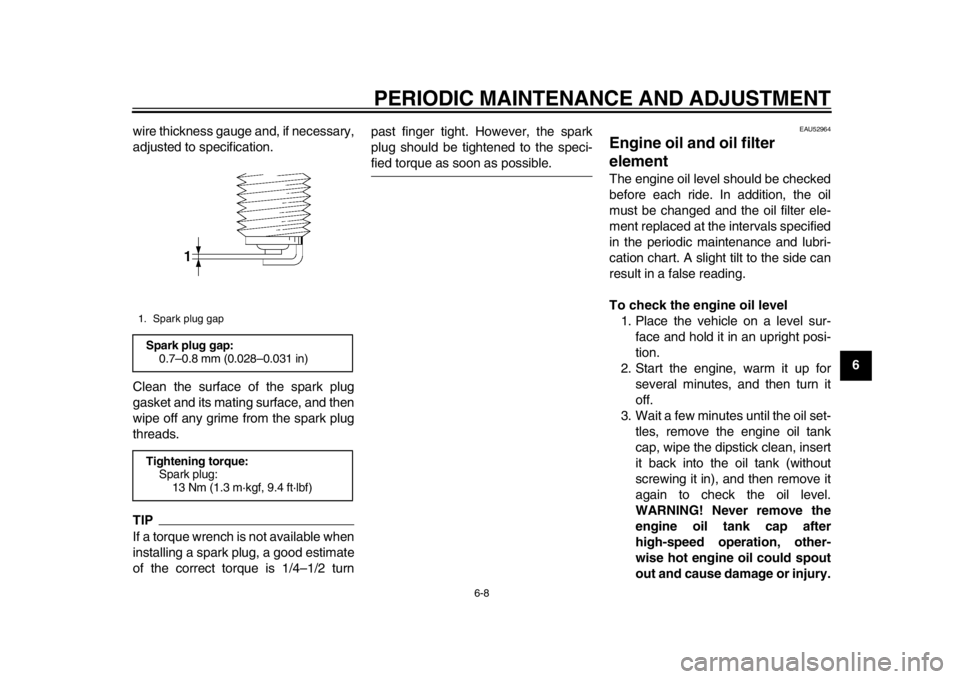
wire thickness gauge and, if necessary,
adjusted to specification.
Clean the surface of the spark plug
gasket and its mating surface, and then
wipe off any grime from the spark plug
threads.
TIPIf a torque wrench is not available when
installing a spark plug, a good estimate
of the correct torque is 1/4–1/2 turn past finger tight. However, the spark
plug should be tightened to the speci-
fied torque as soon as possible.
EAU52964
Engine oil and oil filter
element The engine oil level should be checked
before each ride. In addition, the oil
must be changed and the oil filter ele-
ment replaced at the intervals specified
in the periodic maintenance and lubri-
cation chart. A slight tilt to the side can
result in a false reading.
To check the engine oil level
1. Place the vehicle on a level sur- face and hold it in an upright posi-
tion.
2. Start the engine, warm it up for several minutes, and then turn it
off.
3. Wait a few minutes until the oil set- tles, remove the engine oil tank
cap, wipe the dipstick clean, insert
it back into the oil tank (without
screwing it in), and then remove it
again to check the oil level.
WARNING! Never remove the
engine oil tank cap after
high-speed operation, other-
wise hot engine oil could spout
out and cause damage or injury.
1. Spark plug gapSpark plug gap:0.7–0.8 mm (0.028–0.031 in)
Tightening torque: Spark plug: 13 Nm (1.3 m·kgf, 9.4 ft·lbf)
1DX-9-E1.book 8 ページ 2012年7月31日 火曜日 午前9時31分
Page 55 of 98
PERIODIC MAINTENANCE AND ADJUSTMENT
6-12
2
3
4
567
8
9
mix any chemical additives. Do
not use oils with a diesel speci-
fication of “CD” or oils of a high-
er quality than specified. In
addition, do not use oils labeled
“ENERGY CONSERVING II” or
higher.
Make sure that no foreign mate-rial enters the crankcase.
13. Start the engine, and then let it idle for several minutes while checking
it for oil leakage. If oil is leaking, im-
mediately turn the engine off and
check for the cause.
14. Turn the engine off, wait a few min- utes until the oil settles, and then
check the oil level and correct it if
necessary.
15. Install the engine guard by install- ing the bolts.
NOTICE
ECA11231
After changing the engine oil, make
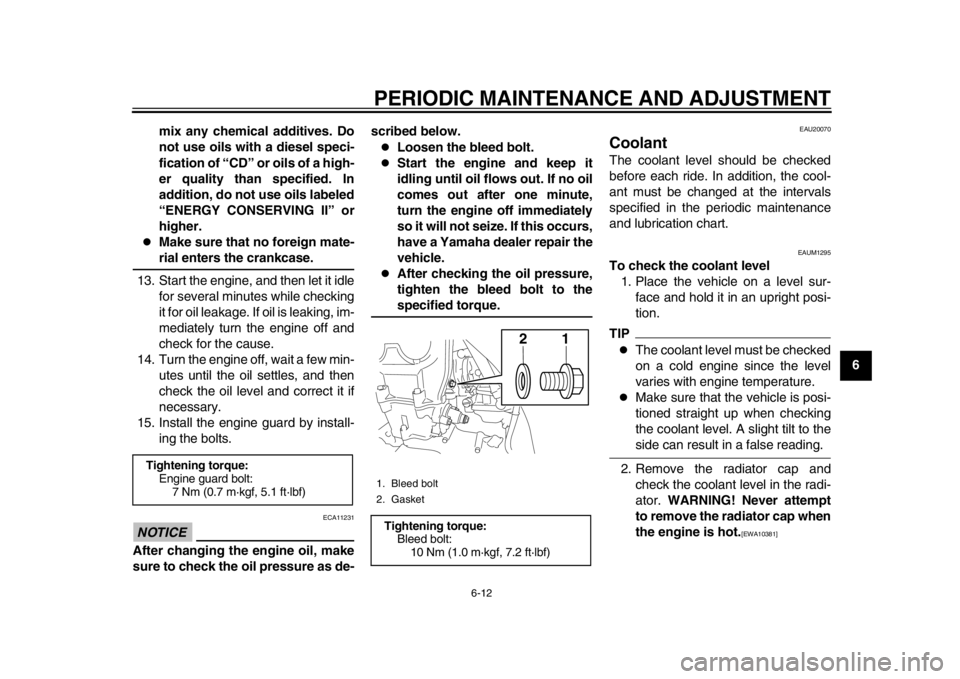
sure to check the oil pressure as de- scribed below.
Loosen the bleed bolt.
Start the engine and keep it
idling until oil flows out. If no oil
comes out after one minute,
turn the engine off immediately
so it will not seize. If this occurs,
have a Yamaha dealer repair the
vehicle.
After checking the oil pressure,
tighten the bleed bolt to thespecified torque.
EAU20070
Coolant The coolant level should be checked
before each ride. In addition, the cool-
ant must be changed at the intervals
specified in the periodic maintenance
and lubrication chart.
EAUM1295
To check the coolant level
1. Place the vehicle on a level sur- face and hold it in an upright posi-
tion.TIP
The coolant level must be checked
on a cold engine since the level
varies with engine temperature.
Make sure that the vehicle is posi-
tioned straight up when checking
the coolant level. A slight tilt to theside can result in a false reading.
2. Remove the radiator cap and check the coolant level in the radi-
ator. WARNING! Never attempt
to remove the radiator cap when
the engine is hot.
[EWA10381]
Tightening torque: Engine guard bolt:
7 Nm (0.7 m·kgf, 5.1 ft·lbf)
1. Bleed bolt
2. GasketTightening torque:Bleed bolt:10 Nm (1.0 m·kgf, 7.2 ft·lbf)
21
1DX-9-E1.book 12 ページ 2012年7月31日 火曜日 午前9時31分
Page 56 of 98
PERIODIC MAINTENANCE AND ADJUSTMENT
6-13
1
2
3
4
56
7
8
9
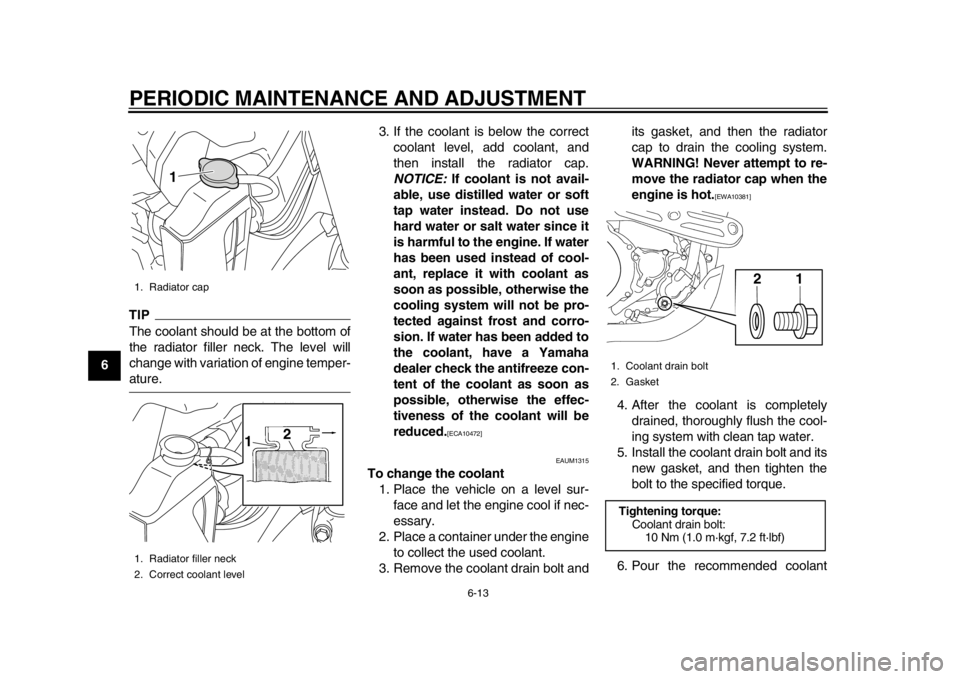
TIPThe coolant should be at the bottom of
the radiator filler neck. The level will
change with variation of engine temper-ature.3. If the coolant is below the correct
coolant level, add coolant, and
then install the radiator cap.
NOTICE: If coolant is not avail-
able, use distilled water or soft
tap water instead. Do not use
hard water or salt water since it
is harmful to the engine. If water
has been used instead of cool-
ant, replace it with coolant as
soon as possible, otherwise the
cooling system will not be pro-
tected against frost and corro-
sion. If water has been added to
the coolant, have a Yamaha
dealer check the antifreeze con-
tent of the coolant as soon as
possible, otherwise the effec-
tiveness of the coolant will be
reduced.
[ECA10472]
EAUM1315
To change the coolant 1. Place the vehicle on a level sur- face and let the engine cool if nec-
essary.
2. Place a container under the engine to collect the used coolant.
3. Remove the coolant drain bolt and its gasket, and then the radiator
cap to drain the cooling system.
WARNING! Never attempt to re-
move the radiator cap when the
engine is hot.
[EWA10381]
4. After the coolant is completely drained, thoroughly flush the cool-
ing system with clean tap water.
5. Install the coolant drain bolt and its new gasket, and then tighten the
bolt to the specified torque.
6. Pour the recommended coolant
1. Radiator cap
1. Radiator filler neck
2. Correct coolant level
1
2
1
1. Coolant drain bolt
2. GasketTightening torque:
Coolant drain bolt:10 Nm (1.0 m·kgf, 7.2 ft·lbf)
21
1DX-9-E1.book 13 ページ 2012年7月31日 火曜日 午前9時31分
Page 58 of 98
PERIODIC MAINTENANCE AND ADJUSTMENT
6-15
1
2
3
4
56
7
8
9with solvent, and then squeeze the
remaining solvent out.
WARNING!
Use only a dedicated parts
cleaning solvent. To avoid the
risk of fire or explosion, do not
use gasoline or solvents with a
low flash point.
[EWA10431]
NOTICE:
To avoid damaging the foam
material, handle it gently and
carefully, and do not twist or
wring it.
[ECA10511]
4. Apply oil of the recommended type
to the entire surface of the sponge
material, and then squeeze the ex-
cess oil out.
TIPThe sponge material should be wet butnot dripping.
5. Pull the sponge material over the air filter element frame.TIP
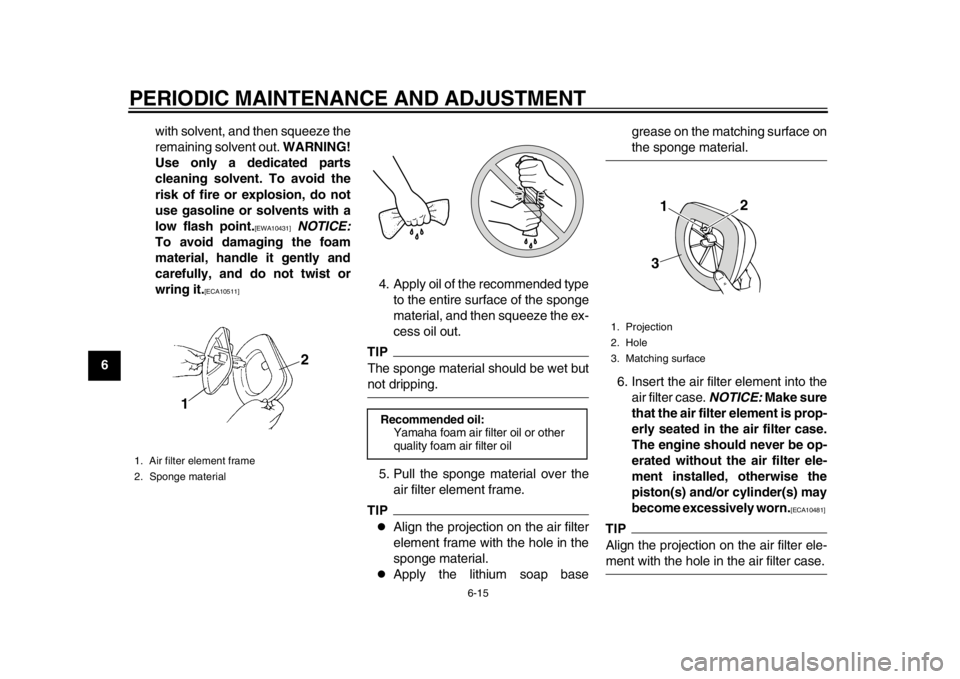
Align the projection on the air filter
element frame with the hole in the
sponge material.
Apply the lithium soap base grease on the matching surface on
the sponge material.
6. Insert the air filter element into the air filter case. NOTICE: Make sure
that the air filter element is prop-
erly seated in the air filter case.
The engine should never be op-
erated without the air filter ele-
ment installed, otherwise the
piston(s) and/or cylinder(s) may
become excessively worn.
[ECA10481]
TIPAlign the projection on the air filter ele-ment with the hole in the air filter case.
1. Air filter element frame
2. Sponge material
1 2
Recommended oil:
Yamaha foam air filter oil or other
quality foam air filter oil
1. Projection
2. Hole
3. Matching surface
1 23
1DX-9-E1.book 15 ページ 2012年7月31日 火曜日 午前9時31分
Page 61 of 98
PERIODIC MAINTENANCE AND ADJUSTMENT
6-18
2
3
4
567
8
9
EAU21401
Valve clearance The valve clearance changes with use,
resulting in improper air-fuel mixture
and/or engine noise. To prevent this
from occurring, the valve clearance
must be adjusted by a Yamaha dealer
at the intervals specified in the periodic
maintenance and lubrication chart.
EAU52881
Tires Tires are the only contact between the
vehicle and the road. Safety in all con-
ditions of riding depends on a relatively
small area of road contact. Therefore, it
is essential to maintain the tires in good
condition at all times and replace them
at the appropriate time with the speci-
fied tires.
Tire air pressure
The tire air pressure should be checked
and, if necessary, adjusted before each
ride.
WARNING
EWA10441
Operation of this vehicle with im-
proper tire pressure may cause se-
vere injury or death from loss of
control.
The tire air pressure must be
checked and adjusted on cold
tires (i.e., when the temperature
of the tires equals the ambient
temperature).
The tire air pressure must be ad-
justed in accordance with the
riding speed and with the totalweight of rider, cargo, and ac-
cessories approved for this
model.WARNING
EWA10511
Never overload your vehicle. Opera-
tion of an overloaded vehicle couldcause an accident.
Tire air pressure (measured on cold
tires):
0–90 kg (0–198 lb):Front: 150 kPa (1.50 kgf/cm
2, 22 psi)
Rear: 200 kPa (2.00 kgf/cm2, 29 psi)
Maximum load*:
90 kg (198 lb)
* Total weight of rider, cargo and ac- cessories
1DX-9-E1.book 18 ページ 2012年7月31日 火曜日 午前9時31分
Page 62 of 98
PERIODIC MAINTENANCE AND ADJUSTMENT
6-19
1
2
3
4
56
7
8
9Tire inspection
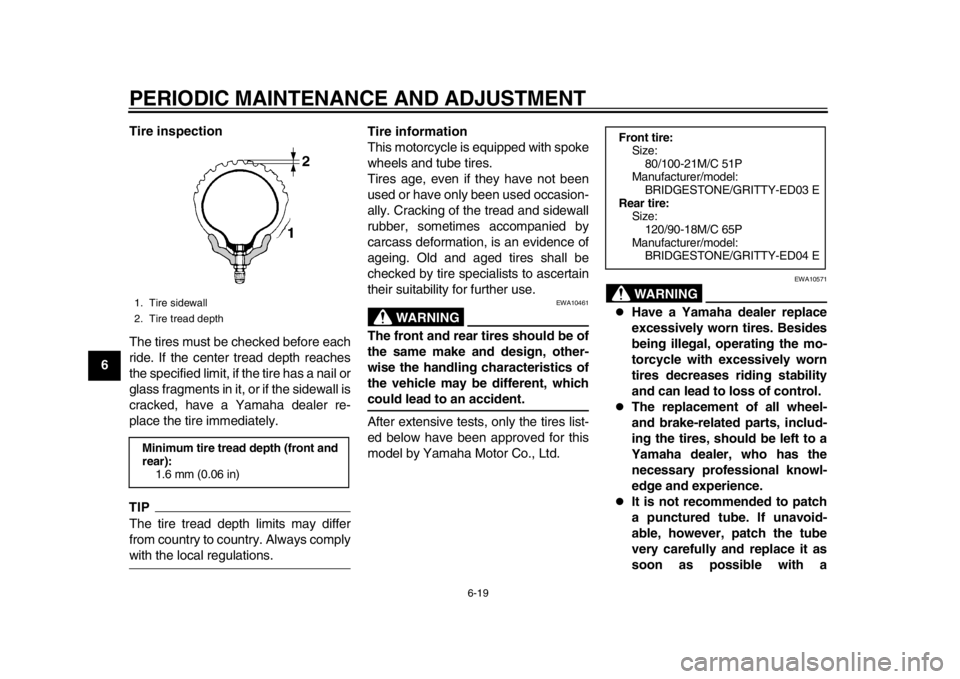
The tires must be checked before each
ride. If the center tread depth reaches
the specified limit, if the tire has a nail or
glass fragments in it, or if the sidewall is
cracked, have a Yamaha dealer re-
place the tire immediately.
TIPThe tire tread depth limits may differ
from country to country. Always complywith the local regulations. Tire information
This motorcycle is equipped with spoke
wheels and tube tires.
Tires age, even if they have not been
used or have only been used occasion-
ally. Cracking of the tread and sidewall
rubber, sometimes accompanied by
carcass deformation, is an evidence of
ageing. Old and aged tires shall be
checked by tire specialists to ascertain
their suitability for further use.
WARNING
EWA10461
The front and rear tires should be of
the same make and design, other-
wise the handling characteristics of
the vehicle may be different, whichcould lead to an accident.
After extensive tests, only the tires list-
ed below have been approved for this
model by Yamaha Motor Co., Ltd.
WARNING
EWA10571
Have a Yamaha dealer replace
excessively worn tires. Besides
being illegal, operating the mo-
torcycle with excessively worn
tires decreases riding stability
and can lead to loss of control.
The replacement of all wheel-
and brake-related parts, includ-
ing the tires, should be left to a
Yamaha dealer, who has the
necessary professional knowl-
edge and experience.
It is not recommended to patch
a punctured tube. If unavoid-
able, however, patch the tube
very carefully and replace it as
soon as possible with a
1. Tire sidewall
2. Tire tread depthMinimum tire tread depth (front and
rear):
1.6 mm (0.06 in)
Front tire: Size:80/100-21M/C 51P
Manufacturer/model:
BRIDGESTONE/GRITTY-ED03 E
Rear tire: Size:
120/90-18M/C 65P
Manufacturer/model: BRIDGESTONE/GRITTY-ED04 E
1DX-9-E1.book 19 ページ 2012年7月31日 火曜日 午前9時31分
Page 63 of 98
PERIODIC MAINTENANCE AND ADJUSTMENT
6-20
2
3
4
567
8
9
high-quality product.
Ride at moderate speeds after
changing a tire since the tire
surface must first be “broken
in” for it to develop its optimalcharacteristics.
EAU21943
Spoke wheels
WARNING
EWA10610
The wheels on this model are not de-
signed for use with tubeless tires.
Do not attempt to use tubeless tireson this model.
To maximize the performance, durabil-
ity, and safe operation of your motorcy-
cle, note the following points regarding
the specified wheels.
The wheel rims should be checked
for cracks, bends, warpage or oth-
er damage, and the spokes for
looseness or damage before each
ride. If any damage is found, have
a Yamaha dealer replace the
wheel. Do not attempt even the
smallest repair to the wheel. A de-
formed or cracked wheel must be
replaced.
The wheel should be balanced
whenever either the tire or wheel
has been changed or replaced. An
unbalanced wheel can result in
poor performance, adverse han-
dling characteristics, and a short-
ened tire life.
EAU52911
Adjusting the cl
utch lever free
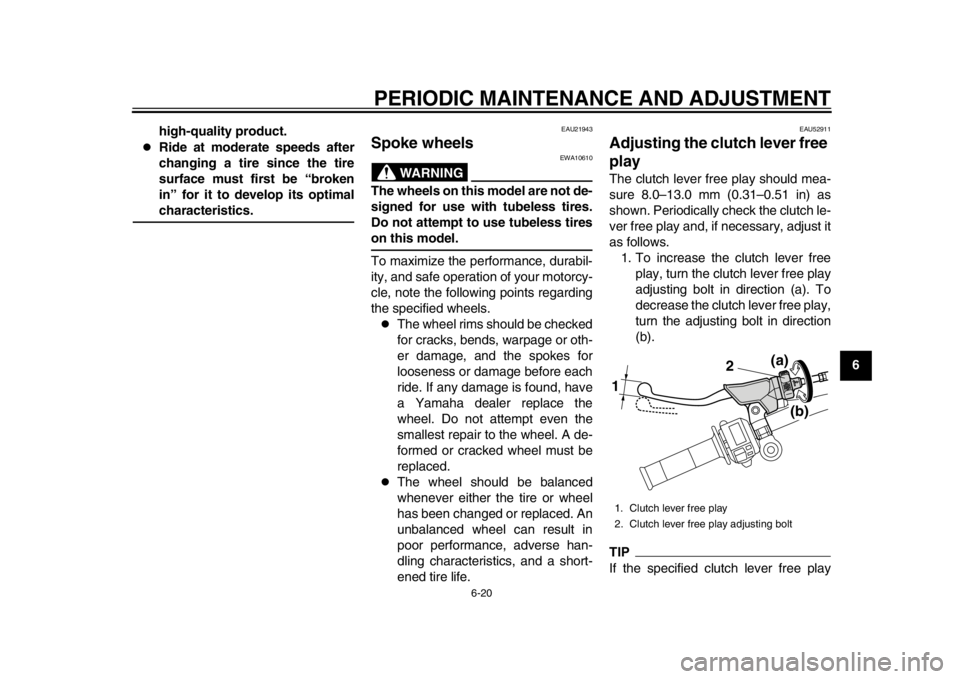
play The clutch lever free play should mea-
sure 8.0–13.0 mm (0.31–0.51 in) as
shown. Periodically check the clutch le-
ver free play and, if necessary, adjust it
as follows.
1. To increase the clutch lever free play, turn the clutch lever free play
adjusting bolt in direction (a). To
decrease the clutch lever free play,
turn the adjusting bolt in direction
(b).TIPIf the specified clutch lever free play1. Clutch lever free play
2. Clutch lever free play adjusting bolt1
(a)
(b)
2
1DX-9-E1.book 20 ページ 2012年7月31日 火曜日 午前9時31分
Page 64 of 98
PERIODIC MAINTENANCE AND ADJUSTMENT
6-21
1
2
3
4
56
7
8
9could be obtained as described above,
skip steps 2–5.
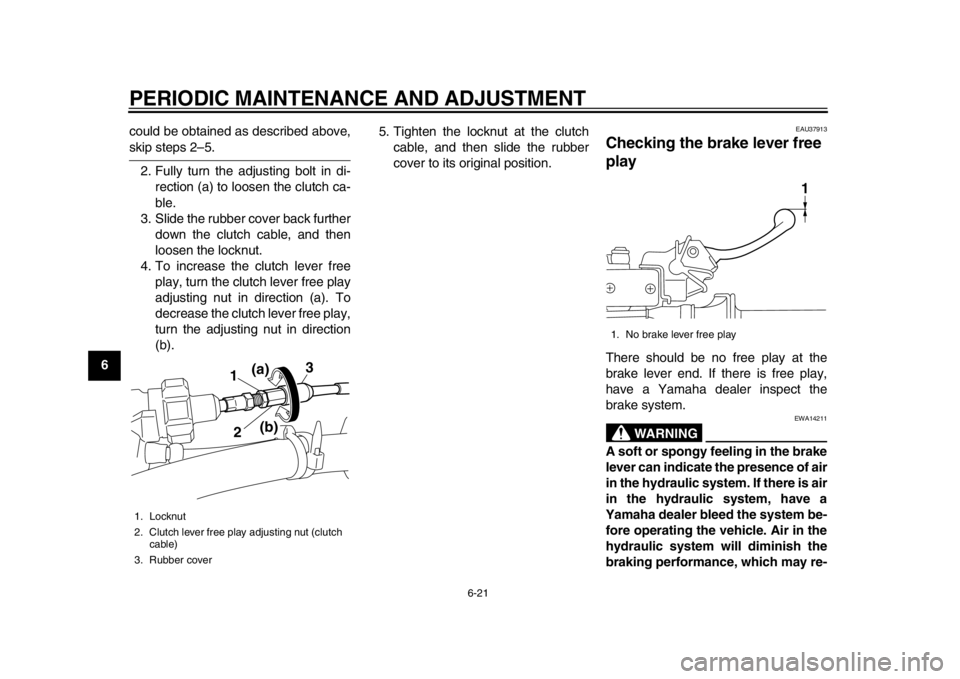
2. Fully turn the adjusting bolt in di- rection (a) to loosen the clutch ca-
ble.
3. Slide the rubber cover back further down the clutch cable, and then
loosen the locknut.
4. To increase the clutch lever free play, turn the clutch lever free play
adjusting nut in direction (a). To
decrease the clutch lever free play,
turn the adjusting nut in direction
(b). 5. Tighten the locknut at the clutch
cable, and then slide the rubber
cover to its original position.
EAU37913
Checking the brake lever free
play There should be no free play at the
brake lever end. If there is free play,
have a Yamaha dealer inspect the
brake system.
WARNING
EWA14211
A soft or spongy feeling in the brake
lever can indicate the presence of air
in the hydraulic system. If there is air
in the hydraulic system, have a
Yamaha dealer bleed the system be-
fore operating the vehicle. Air in the
hydraulic system will diminish the
braking performance, which may re-
1. Locknut
2. Clutch lever free play adjusting nut (clutch
cable)
3. Rubber cover
1
2 (a)
(b)
3
1. No brake lever free play
1
1DX-9-E1.book 21 ページ 2012年7月31日 火曜日 午前9時31分
Page 67 of 98
PERIODIC MAINTENANCE AND ADJUSTMENT
6-24
2
3
4
567
8
9
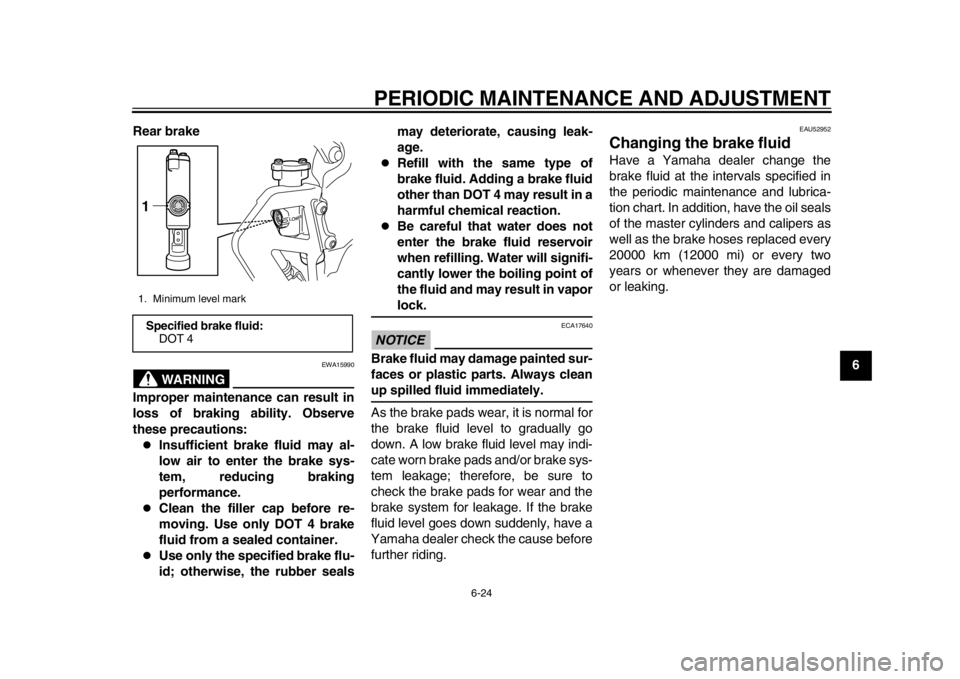
Rear brake
WARNING
EWA15990
Improper maintenance can result in
loss of braking ability. Observe
these precautions:
Insufficient brake fluid may al-
low air to enter the brake sys-
tem, reducing braking
performance.
Clean the filler cap before re-
moving. Use only DOT 4 brake
fluid from a sealed container.
Use only the specified brake flu-
id; otherwise, the rubber seals may deteriorate, causing leak-
age.
Refill with the same type of
brake fluid. Adding a brake fluid
other than DOT 4 may result in a
harmful chemical reaction.
Be careful that water does not
enter the brake fluid reservoir
when refilling. Water will signifi-
cantly lower the boiling point of
the fluid and may result in vaporlock.
NOTICE
ECA17640
Brake fluid may damage painted sur-
faces or plastic parts. Always cleanup spilled fluid immediately.
As the brake pads wear, it is normal for
the brake fluid level to gradually go
down. A low brake fluid level may indi-
cate worn brake pads and/or brake sys-
tem leakage; therefore, be sure to
check the brake pads for wear and the
brake system for leakage. If the brake
fluid level goes down suddenly, have a
Yamaha dealer check the cause before
further riding.
EAU52952
Changing the brake fluid Have a Yamaha dealer change the
brake fluid at the intervals specified in
the periodic maintenance and lubrica-
tion chart. In addition, have the oil seals
of the master cylinders and calipers as
well as the brake hoses replaced every
20000 km (12000 mi) or every two
years or whenever they are damaged
or leaking.
1. Minimum level markSpecified brake fluid:
DOT 41
1DX-9-E1.book 24 ページ 2012年7月31日 火曜日 午前9時31分