ABS YAMAHA WR 450F 2016 User Guide
[x] Cancel search | Manufacturer: YAMAHA, Model Year: 2016, Model line: WR 450F, Model: YAMAHA WR 450F 2016Pages: 426, PDF Size: 10.86 MB
Page 107 of 426

PRE-OPERATION INSPECTION AND MAINTENANCE
3-9
EAS2GC1079
PRE-OPERATION INSPECTION AND MAINTENANCE
Before riding for break-in operation, practice or a race, make sure the machine is in good operating
condition.
Before using this machine, check the following points.
EAS2GC1080GENERAL INSPECTION AND MAINTENANCE
TIP
Perform usual maintenance enough so that, in the race course, a confirmation of that and simple set-
ting adjustments may only be left, in order to get enough time to use effectively.ITEM inspect Page
Coolant Check that coolant is filled up to the radiator cap.
Check the cooling system for leakage. 3-10 – 12
Fuel Check that a fresh gasoline is filled in the fuel tank.
Check the fuel line for leakage. 1-28
Engine oil Check that the oil level is correct. Check the crank-
case and oil line for leakage. 3-16 – 18
Gear shifter and clutch Check that gears can be shifted correctly in order and
that the clutch operates smoothly. 3-12 – 13
Throttle grip/Housing Check that the throttle grip operation and free play
are correctly adjusted. Lubricate the throttle grip and
housing, if necessary. 3-13 – 14
Brakes Check the play of front brake and effect of front and
rear brake. 3-25 – 31
Drive chain Check drive chain slack and alignment. Check that
the drive chain is lubricated properly. 3-31
5-69 – 70
Wheels Check for excessive wear and tire pressure. Check
for loose spokes and have no excessive play. 3-36 – 37
Steering Check that the handlebar can be turned smoothly and
have no excessive play. 3-37 – 38
Front forks and rear
shock absorber Check that they operate smoothly and there is no oil
leakage.
3-31 – 36
Cables (wires) Check that the clutch and throttle cables move
smoothly. Check that they are not caught when the
handlebars are turned or when the front forks travel
up and down.
—
Exhaust pipe Check that the exhaust pipe is tightly mounted and
has no cracks. 3-15 – 16
Rear wheel sprocket Check that the rear wheel sprocket tightening bolt is
not loose. 5-10 – 11
Lubrication Check for smooth operation. Lubricate if necessary. 3-14
3-38 – 39
Bolts and nuts Check the chassis and engine for loose bolts and
nuts. 1-32 – 33
Lead connectors Check that the AC magneto, ECU and ignition coil are
connected tightly. 1-9 – 12
Settings Is the machine set suitably for the condition of the rac-
ing course and weather or by taking into account the
results of test runs before racing? Are inspection and
maintenance completely done?
4-1 – 8
Page 132 of 426
CHASSIS
3-34
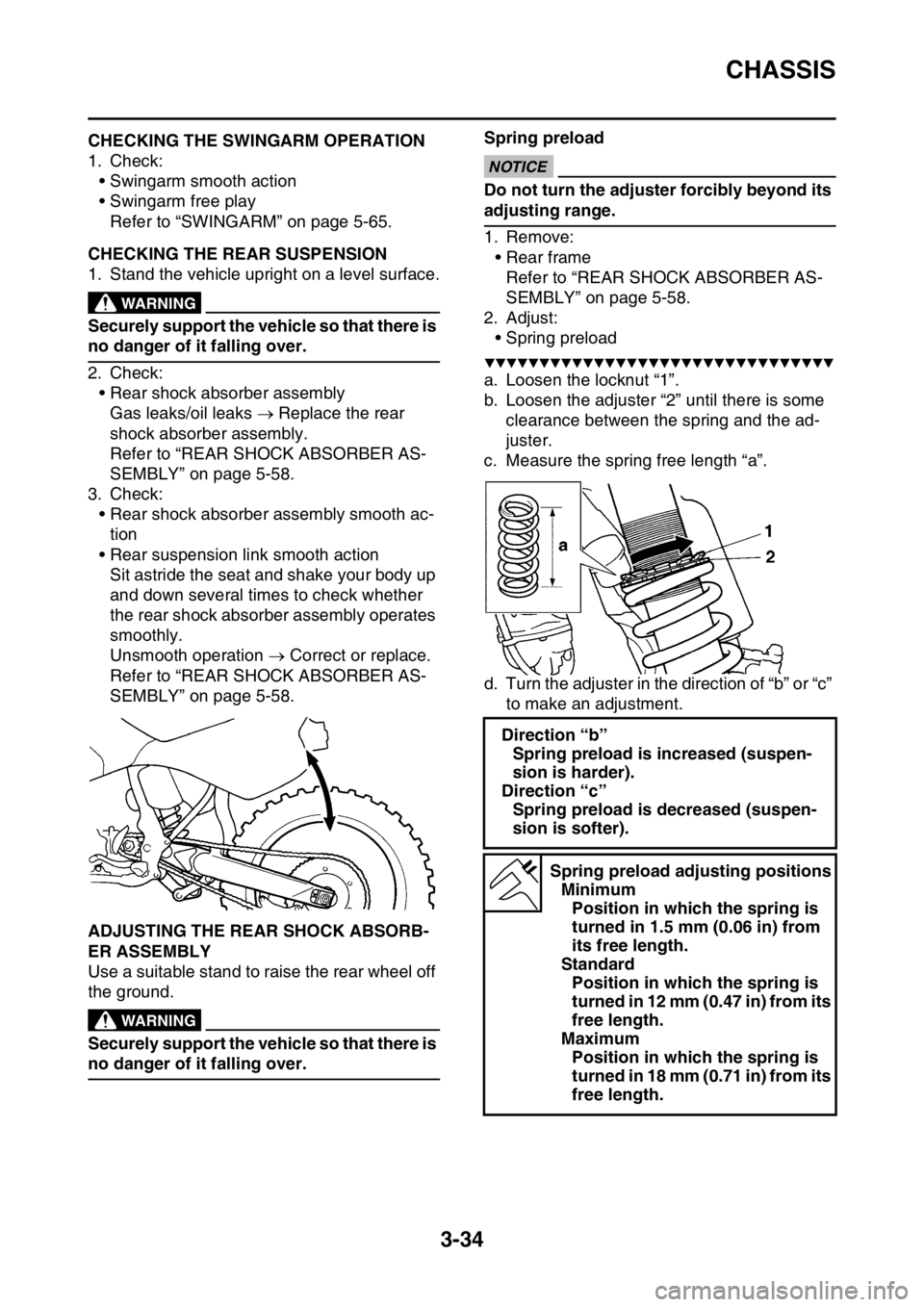
EAS2GC1116CHECKING THE SWINGARM OPERATION
1. Check:• Swingarm smooth action
• Swingarm free playRefer to “SWINGARM” on page 5-65.
EAS2GC1117CHECKING THE REAR SUSPENSION
1. Stand the vehicle upright on a level surface.
EWA
WARNING
Securely support the vehicle so that there is
no danger of it falling over.
2. Check:• Rear shock absorber assemblyGas leaks/oil leaks Replace the rear
shock absorber assembly.
Refer to “REAR SHOCK ABSORBER AS-
SEMBLY” on page 5-58.
3. Check: • Rear shock absorber assembly smooth ac-tion
• Rear suspension link smooth action Sit astride the seat and shake your body up
and down several times to check whether
the rear shock absorber assembly operates
smoothly.
Unsmooth operation Correct or replace.
Refer to “REAR SHOCK ABSORBER AS-
SEMBLY” on page 5-58.
EAS2GC1118ADJUSTING THE REAR SHOCK ABSORB-
ER ASSEMBLY
Use a suitable stand to raise the rear wheel off
the ground.
EWA
WARNING
Securely support the vehicle so that there is
no danger of it falling over. Spring preload
ECA
NOTICE
Do not turn the adjuster forcibly beyond its
adjusting range.
1. Remove:
• Rear frameRefer to “REAR SHOCK ABSORBER AS-
SEMBLY” on page 5-58.
2. Adjust: • Spring preload
▼▼▼▼▼▼▼▼▼▼▼▼▼▼▼▼▼▼▼▼▼▼▼▼▼▼▼▼▼▼▼▼
a. Loosen the locknut “1”.
b. Loosen the adjuster “2” until there is some clearance between the spring and the ad-
juster.
c. Measure the spring free length “a”.
d. Turn the adjuster in the direction of “b” or “c” to make an adjustment.
Direction “b”Spring preload is increased (suspen-
sion is harder).
Direction “c” Spring preload is decreased (suspen-
sion is softer).
Spring preload adjusting positionsMinimum Position in which the spring is
turned in 1.5 mm (0.06 in) from
its free length.
Standard Position in which the spring is
turned in 12 mm (0.47 in) from its
free length.
Maximum Position in which the spring is
turned in 18 mm (0.71 in) from its
free length.
Page 133 of 426
CHASSIS
3-35
TIP
• Be sure to remove all dirt and mud from around the locknut and adjusting ring before
adjustment.
• The length of the spring (installed) changes
1.5 mm (0.06 in) per turn of the adjusting ring.
e. Tighten the locknut.
▲▲▲▲▲▲▲▲▲▲▲▲▲▲▲▲▲▲▲▲▲▲▲▲▲▲▲▲▲▲▲▲
3. Install: • Rear frameRefer to “REAR SHOCK ABSORBER AS-
SEMBLY” on page 5-58.
Rebound damping
ECA
NOTICE
Do not turn the adjuster forcibly beyond its
adjusting range.
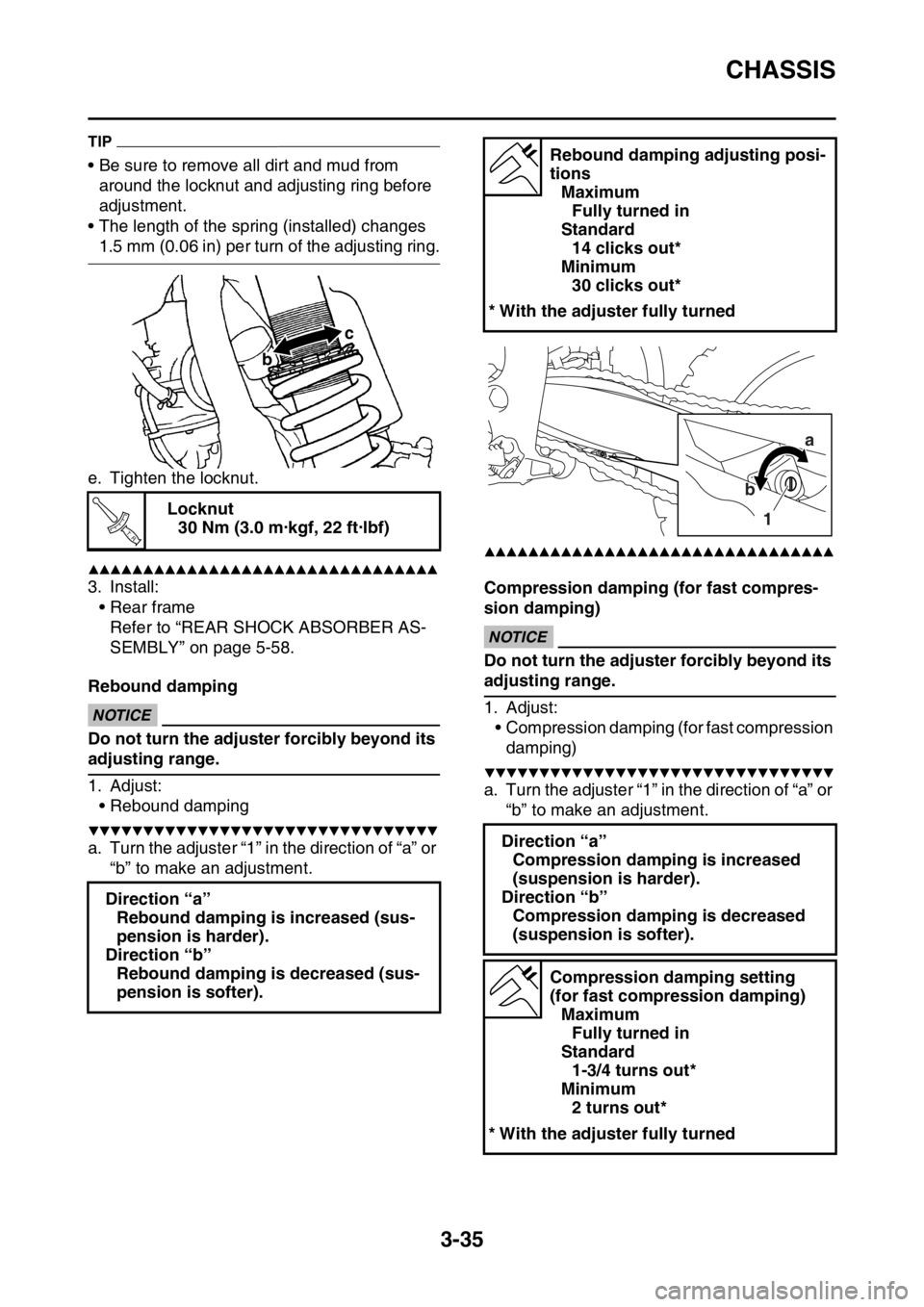
1. Adjust: • Rebound damping
▼▼▼▼▼▼▼▼▼▼▼▼▼▼▼▼▼▼▼▼▼▼▼▼▼▼▼▼▼▼▼▼
a. Turn the adjuster “1” in the direction of “a” or “b” to make an adjustment.
▲▲▲▲▲▲▲▲▲▲▲▲▲▲▲▲▲▲▲▲▲▲▲▲▲▲▲▲▲▲▲▲
Compression damping (for fast compres-
sion damping)
ECA
NOTICE
Do not turn the adjuster forcibly beyond its
adjusting range.
1. Adjust:
• Compression damping (for fast compression damping)
▼▼▼▼▼▼▼▼▼▼▼▼▼▼▼▼▼▼▼▼▼▼▼▼▼▼▼▼▼▼▼▼
a. Turn the adjuster “1” in the direction of “a” or “b” to make an adjustment.
Locknut
30 Nm (3.0 m·kgf, 22 ft·lbf)
Direction “a” Rebound damping is increased (sus-
pension is harder).
Direction “b” Rebound damping is decreased (sus-
pension is softer).
c
b
T R..
Rebound damping adjusting posi-
tions Maximum Fully turned in
Standard 14 clicks out*
Minimum 30 clicks out*
* With the adjuster fully turned
Direction “a”Compression damping is increased
(suspension is harder).
Direction “b” Compression damping is decreased
(suspension is softer).
Compression damping setting
(for fast compression damping)Maximum Fully turned in
Standard 1-3/4 turns out*
Minimum 2 turns out*
* With the adjuster fully turned
a
b
1
Page 141 of 426

4
TUNING
CHASSIS.......................................................................................................... 4-1
SELECTION OF THE SECONDARY REDUCTION RATIO
(SPROCKET) ............................................................................................ 4-1
DRIVE AND REAR WHEEL SPROCKETS SETTING PARTS .................. 4-1
TIRE PRESSURE............................. .......................................................... 4-1
FRONT FORK SETTING............................................................................ 4-2
CHANGE IN AMOUNT AND CHARACTERISTICS OF FORK OIL............ 4-2
SETTING OF SPRING AFTER REPLACEMENT ...................................... 4-2
FRONT FORK SETTING PARTS............................................................... 4-3
REAR SUSPENSION SETTING ................................................................ 4-3
CHOOSING SET LENGTH ........................................................................ 4-3
SETTING OF SPRING AFTER REPLACEMENT ...................................... 4-4
REAR SHOCK ABSORBER SETT ING PARTS ......................................... 4-4
SUSPENSION SETTING (FRONT FORK)................................................. 4-6
SUSPENSION SETTING (REAR SHOCK ABSORBER) ........................... 4-7
Page 144 of 426
CHASSIS
4-3
TIP
Generally a stiff spring gives a stiff riding feel-
ing. Rebound damping tends to become weak-
er, resulting in lack of a sense of contact with
the road surface or in a vibrating handlebar.
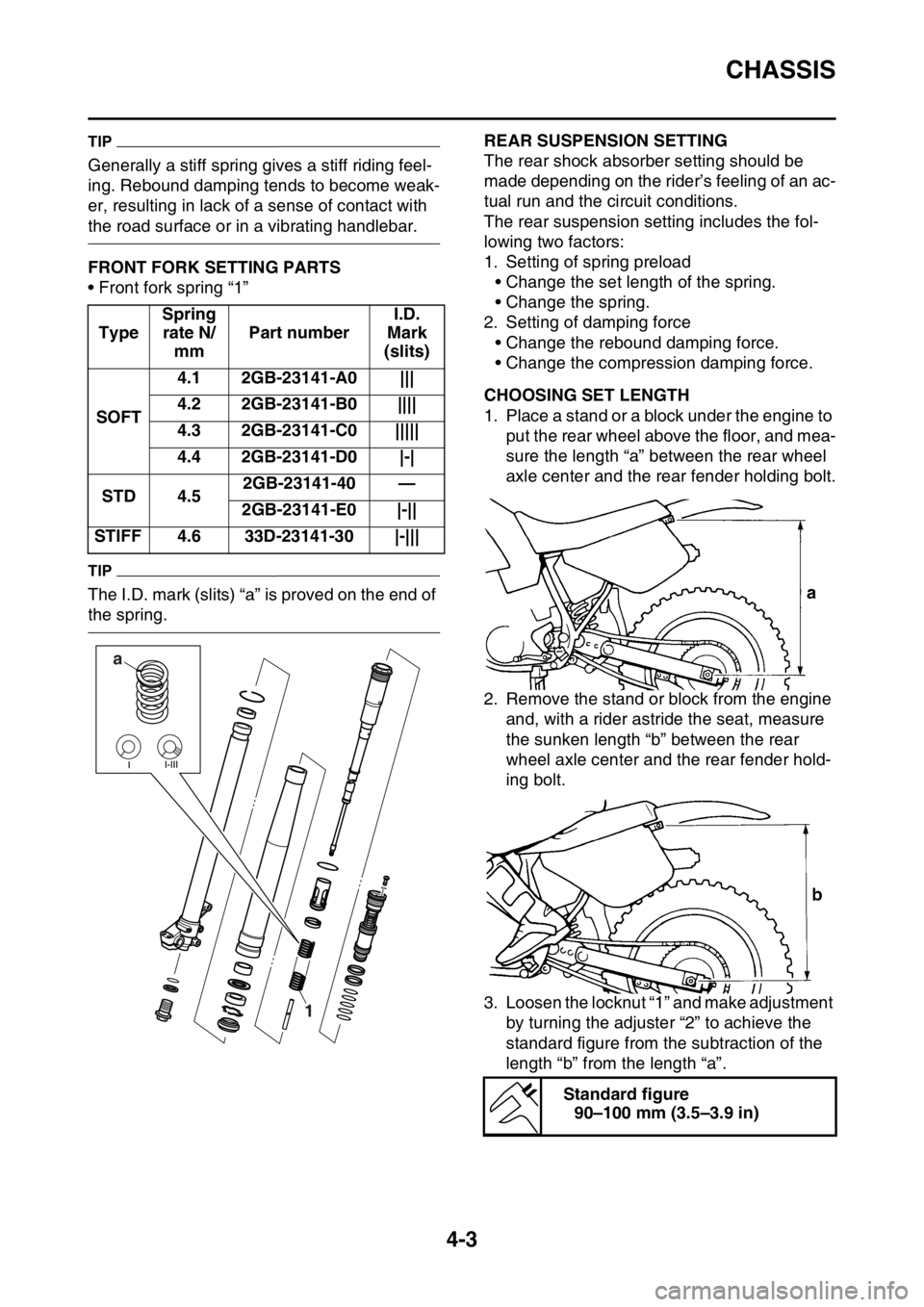
EAS2GC1143FRONT FORK SETTING PARTS
• Front fork spring “1”
TIP
The I.D. mark (slits) “a” is proved on the end of
the spring.
EAS2GC1144REAR SUSPENSION SETTING
The rear shock absorber setting should be
made depending on the rider’s feeling of an ac-
tual run and the circuit conditions.
The rear suspension setting includes the fol-
lowing two factors:
1. Setting of spring preload • Change the set length of the spring.
• Change the spring.
2. Setting of damping force
• Change the rebound damping force.
• Change the compression damping force.
EAS2GC1145CHOOSING SET LENGTH
1. Place a stand or a block under the engine to put the rear wheel above the floor, and mea-
sure the length “a” between the rear wheel
axle center and the rear fender holding bolt.
2. Remove the stand or block from the engine and, with a rider astride the seat, measure
the sunken length “b” between the rear
wheel axle center and the rear fender hold-
ing bolt.
3. Loosen the locknut “1” and make adjustment by turning the adjuster “2” to achieve the
standard figure from the subtraction of the
length “b” from the length “a”.
Type
Spring
rate N/ mm Part number I.D.
Mark
(slits)
SOFT 4.1 2GB-23141-A0 |||
4.2 2GB-23141-B0 ||||
4.3 2GB-23141-C0 |||||
4.4 2GB-23141-D0 |-|
STD 4.5 2GB-23141-40 —
2GB-23141-E0 |-||
STIFF 4.6 33D-23141-30 |-|||
a
1
Standard figure90–100 mm (3.5–3.9 in)
Page 145 of 426
CHASSIS
4-4
TIP
• If the machine is new and after it is broken in, the same set length of the spring may change
because of the initial fatigue, etc. of the
spring. Therefore, be sure to make reevalua-
tion.
• If the standard figure cannot be achieved by adjusting the adjuster and changing the set
length, replace the spri ng with an optional one
and make readjustment.
EAS2GC1146SETTING OF SPRING AFTER REPLACE-
MENT
After replacement, be sure to adjust the spring
to the set length [sunken length 90–100 mm
(3.5–3.9 in)] and set it.
1. Use of soft spring
• Adjust to decrease rebound damping force to compensate for less spring load. Run with
the rebound damping force adjuster one or
two clicks turned out, and readjust it to suit
your preference.
2. Use of stiff spring • Adjust to increase rebound damping force to
compensate for greater spring load. Run
with the rebound damping force adjuster
one or two clicks turned in, and readjust it to
suit your preference.
TIP
Adjusting the rebound damping force will be fol-
lowed more or less by a change in the com-
pression damping force. For correction, adjust
to decrease compression damping force.
EWA
WARNING
When using a rear shock absorber other
than currently installed, use the one whose
overall length “a” does not exceed the stan-
dard as it may result in faulty performance.
Never use one whose overall length is
greater than standard.
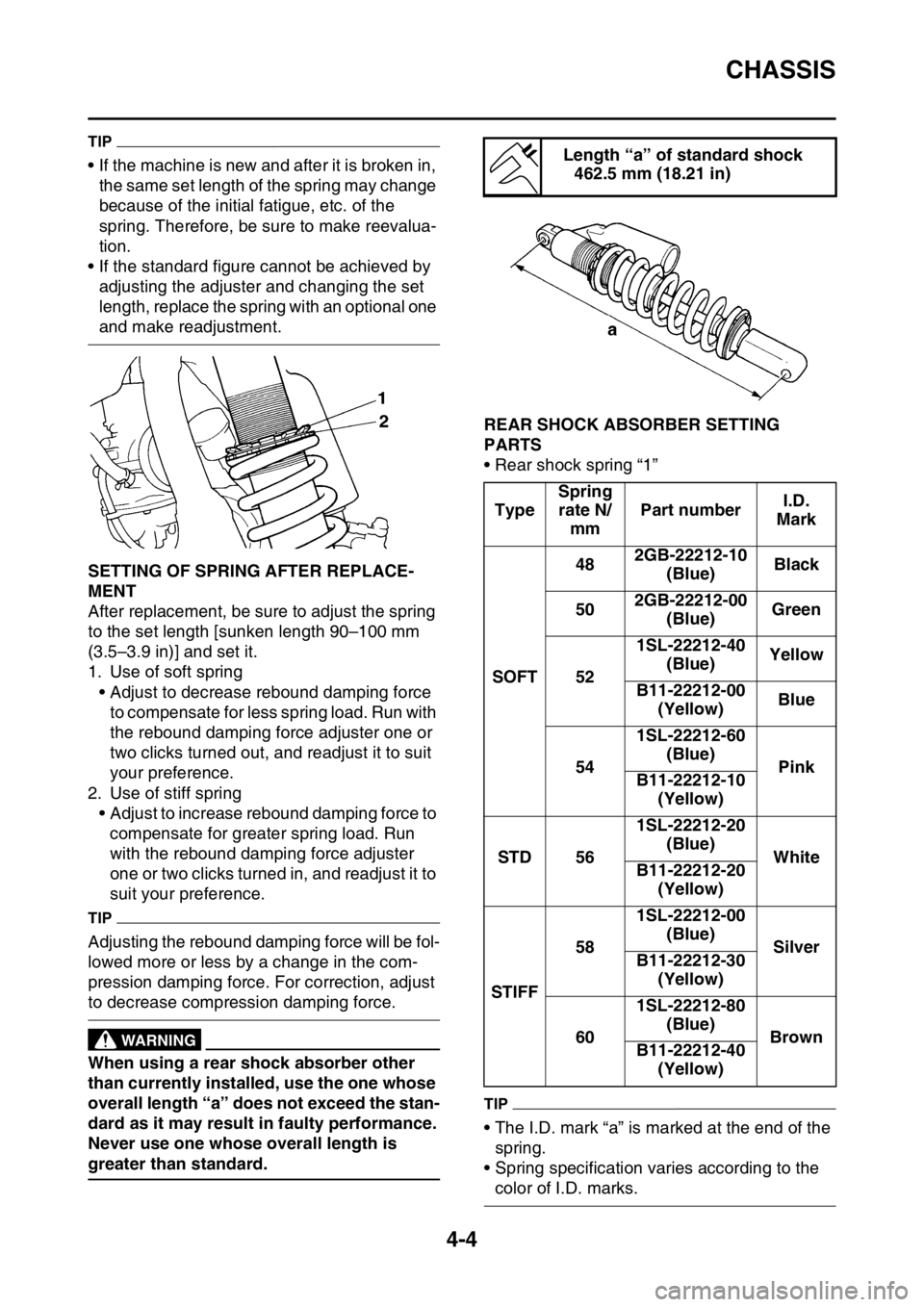
EAS2GC1147REAR SHOCK ABSORBER SETTING
PARTS
• Rear shock spring “1”
TIP
• The I.D. mark “a” is marked at the end of the spring.
• Spring specification varies according to the
color of I.D. marks.
Length “a” of standard shock 462.5 mm (18.21 in)
Type Spring
rate N/ mm Part number
I.D.
Mark
SOFT 48
2GB-22212-10
(Blue) Black
50 2GB-22212-00
(Blue) Green
52 1SL-22212-40
(Blue) Yellow
B11-22212-00 (Yellow) Blue
54 1SL-22212-60
(Blue) Pink
B11-22212-10
(Yellow)
STD 56 1SL-22212-20
(Blue) White
B11-22212-20
(Yellow)
STIFF 58
1SL-22212-00
(Blue) Silver
B11-22212-30
(Yellow)
60 1SL-22212-80
(Blue) Brown
B11-22212-40
(Yellow)
Page 146 of 426
CHASSIS
4-5
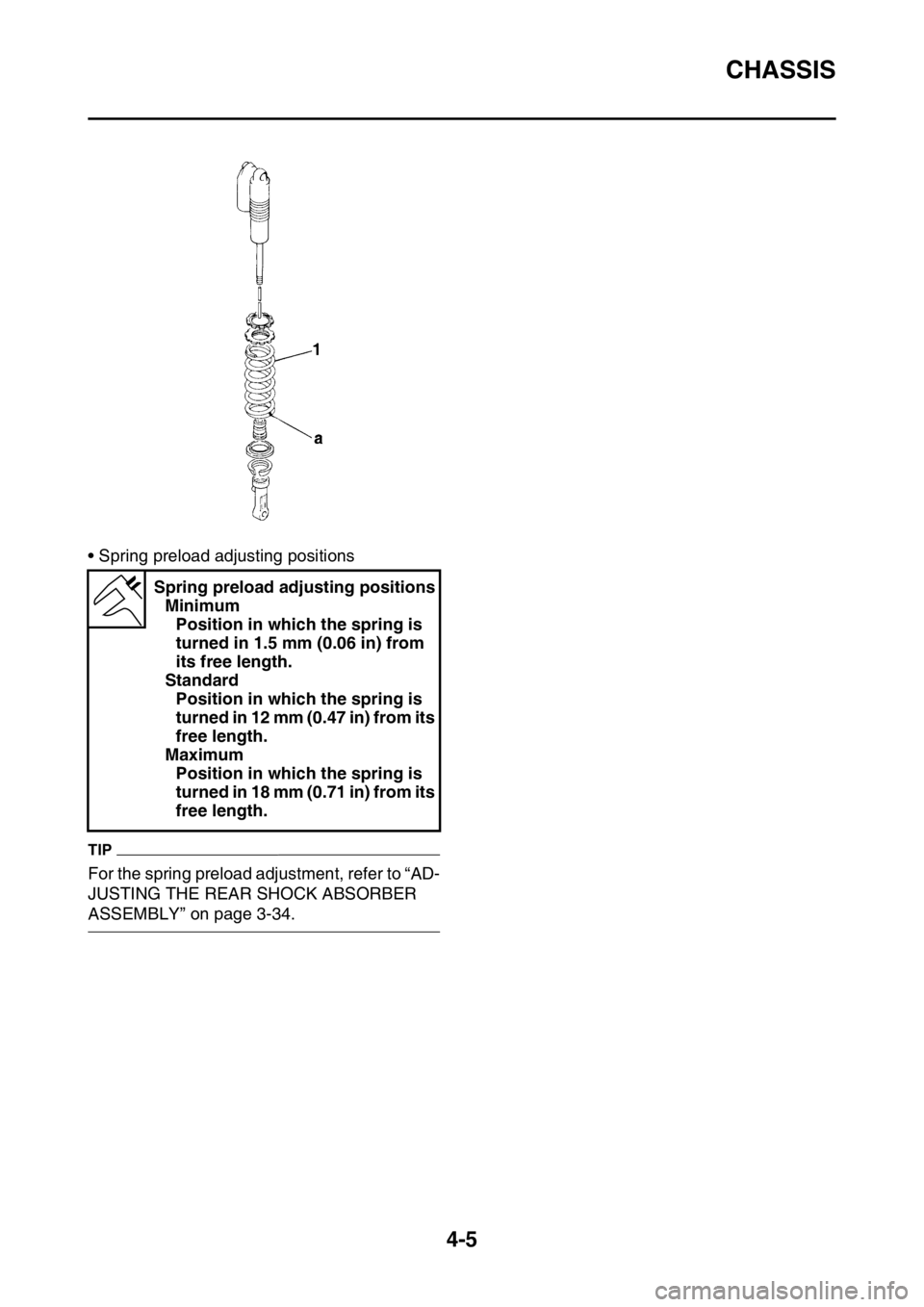
• Spring preload adjusting positions
TIP
For the spring preload adjustment, refer to “AD-
JUSTING THE REAR SHOCK ABSORBER
ASSEMBLY” on page 3-34.Spring preload adjusting positions
MinimumPosition in which the spring is
turned in 1.5 mm (0.06 in) from
its free length.
Standard Position in which the spring is
turned in 12 mm (0.47 in) from its
free length.
Maximum Position in which the spring is
turned in 18 mm (0.71 in) from its
free length.
Page 147 of 426
CHASSIS
4-6
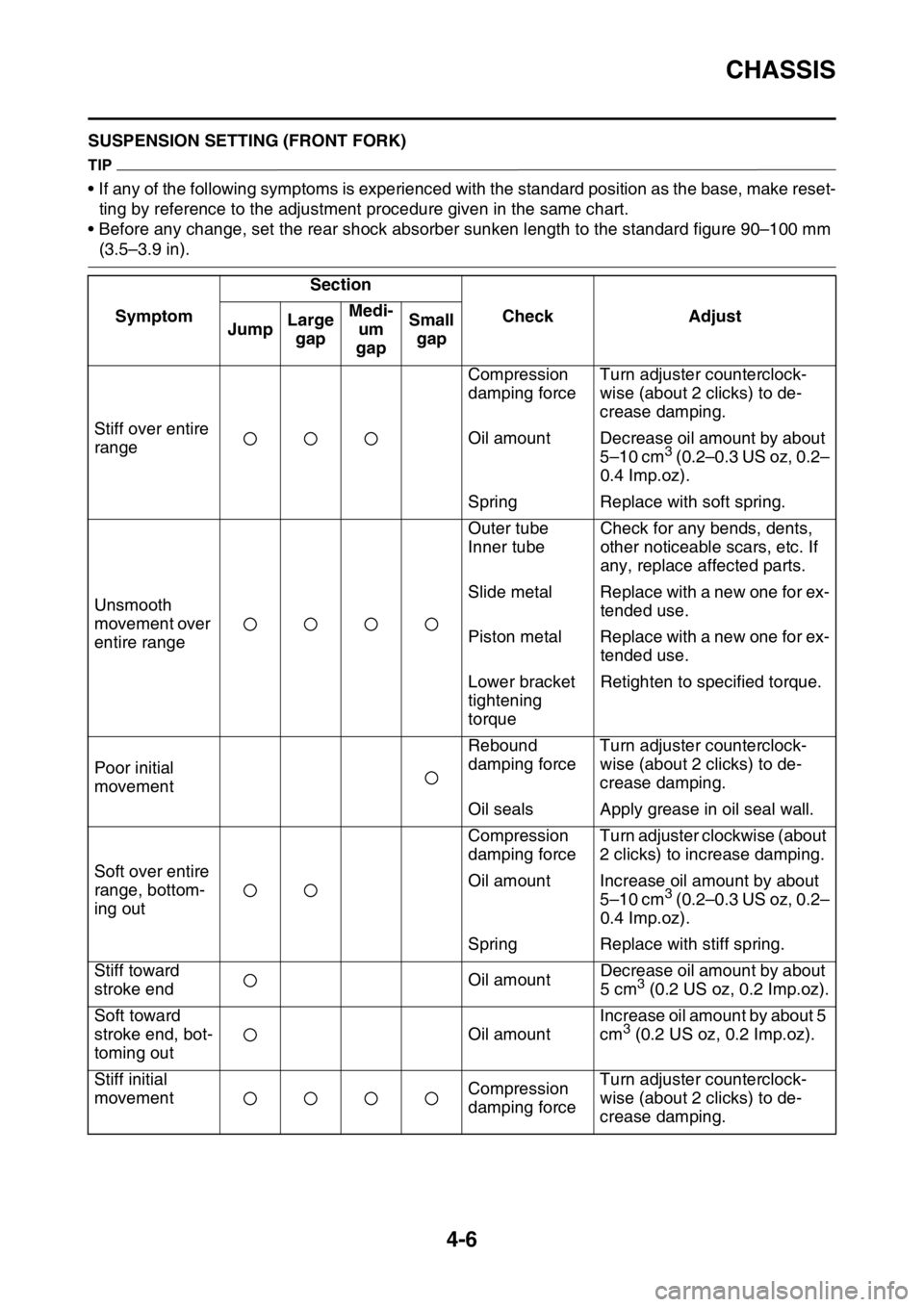
EAS2GC1148SUSPENSION SETTING (FRONT FORK)
TIP
• If any of the following symptoms is experienced with the standard position as the base, make reset-ting by reference to the adjustment procedure given in the same chart.
• Before any change, set the rear shock absor ber sunken length to the standard figure 90–100 mm
(3.5–3.9 in).
Symptom Section
CheckAdjust
Jump Large
gap Medi-
um
gap Small
gap
Stiff over entire
range Compression
damping force
Turn adjuster counterclock-
wise (about 2 clicks) to de-
crease damping.
Oil amount Decrease oil amount by about 5–10 cm
3 (0.2–0.3 US oz, 0.2–
0.4 Imp.oz).
Spring Replace with soft spring.
Unsmooth
movement over
entire range Outer tube
Inner tube
Check for any bends, dents,
other noticeable scars, etc. If
any, replace affected parts.
Slide metal Replace with a new one for ex- tended use.
Piston metal Replace with a new one for ex- tended use.
Lower bracket
tightening
torque Retighten to specified torque.
Poor initial
movement Rebound
damping force
Turn adjuster counterclock-
wise (about 2 clicks) to de-
crease damping.
Oil seals Apply grease in oil seal wall.
Soft over entire
range, bottom-
ing out Compression
damping force
Turn adjuster clockwise (about
2 clicks) to increase damping.
Oil amount Increase oil amount by about 5–10 cm
3 (0.2–0.3 US oz, 0.2–
0.4 Imp.oz).
Spring Replace with stiff spring.
Stiff toward
stroke end Oil amountDecrease oil amount by about
5 cm
3 (0.2 US oz, 0.2 Imp.oz).
Soft toward
stroke end, bot-
toming out Oil amountIncrease oil amount by about 5
cm
3 (0.2 US oz, 0.2 Imp.oz).
Stiff initial
movement Compression
damping forceTurn adjuster counterclock-
wise (about 2 clicks) to de-
crease damping.
Page 148 of 426
CHASSIS
4-7
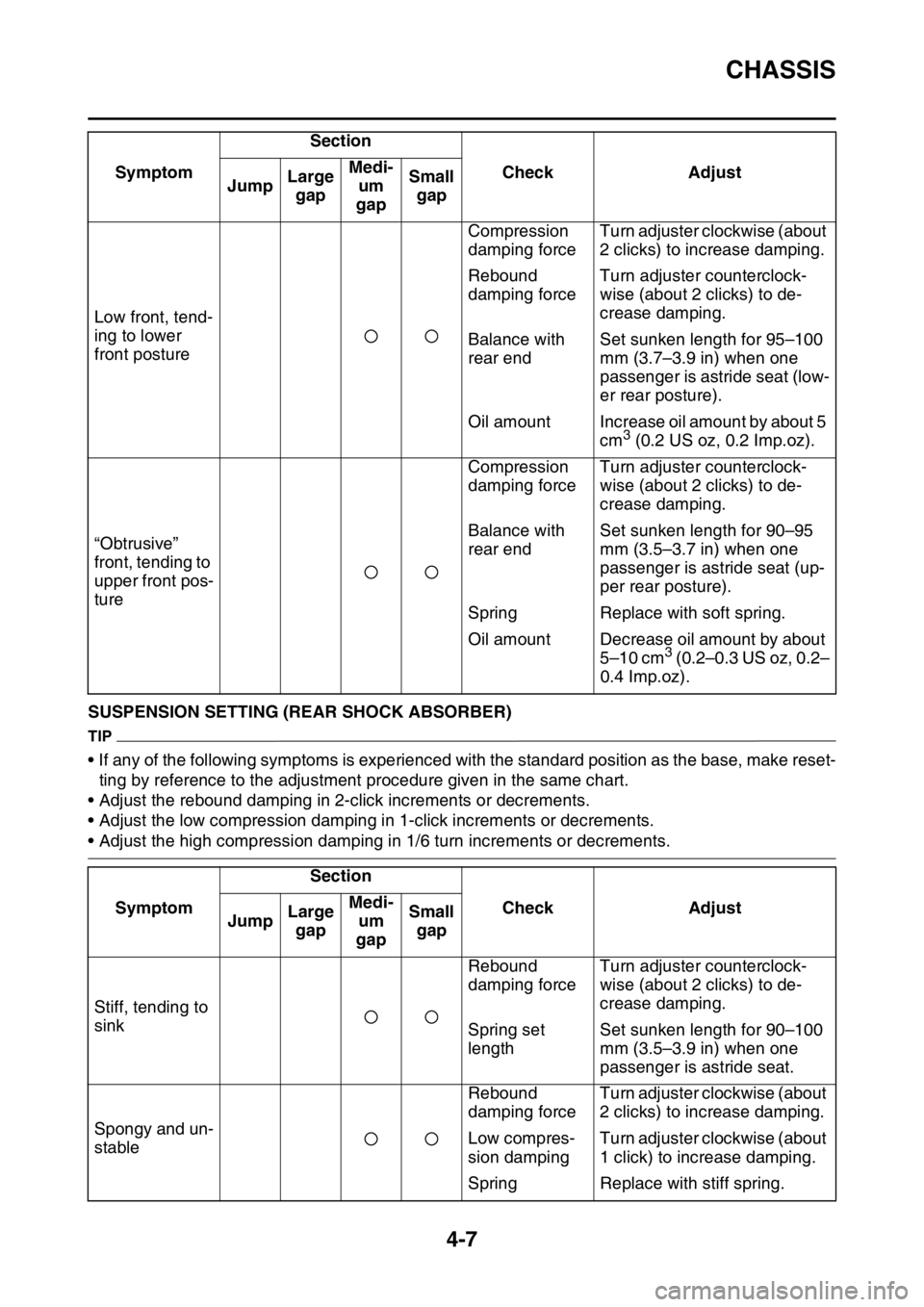
EAS2GC1149SUSPENSION SETTING (REAR SHOCK ABSORBER)
TIP
• If any of the following symptoms is experienced with the standard position as the base, make reset-ting by reference to the adjustment procedure given in the same chart.
• Adjust the rebound damping in 2- click increments or decrements.
• Adjust the low compression damping in 1-click increments or decrements.
• Adjust the high compression damping in 1/6 turn increments or decrements.Low front, tend-
ing to lower
front posture
Compression
damping force
Turn adjuster clockwise (about
2 clicks) to increase damping.
Rebound
damping force Turn adjuster counterclock-
wise (about 2 clicks) to de-
crease damping.
Balance with
rear end Set sunken length for 95–100
mm (3.7–3.9 in) when one
passenger is astride seat (low-
er rear posture).
Oil amount Increase oil amount by about 5 cm
3 (0.2 US oz, 0.2 Imp.oz).
“Obtrusive”
front, tending to
upper front pos-
ture Compression
damping force
Turn adjuster counterclock-
wise (about 2 clicks) to de-
crease damping.
Balance with
rear end Set sunken length for 90–95
mm (3.5–3.7 in) when one
passenger is astride seat (up-
per rear posture).
Spring Replace with soft spring.
Oil amount Decrease oil amount by about 5–10 cm
3 (0.2–0.3 US oz, 0.2–
0.4 Imp.oz).
Symptom Section
Check Adjust
Jump Large
gap Medi-
um
gap Small
gap
Stiff, tending to
sink Rebound
damping force
Turn adjuster counterclock-
wise (about 2 clicks) to de-
crease damping.
Spring set
length Set sunken length for 90–100
mm (3.5–3.9 in) when one
passenger is astride seat.
Spongy and un-
stable Rebound
damping force
Turn adjuster clockwise (about
2 clicks) to increase damping.
Low compres-
sion damping Turn adjuster clockwise (about
1 click) to increase damping.
Spring Replace with stiff spring.
Symptom
Section
Check Adjust
Jump Large
gap Medi-
um
gap Small
gap
Page 152 of 426

HANDLEBAR................................................................................................. 5-33
REMOVING THE HANDLEBAR ............................................................... 5-35
CHECKING THE HANDLEBAR ............................................................... 5-35
INSTALLING THE HANDLEBAR ............................................................. 5-35
FRONT FORK ................................................................................................. 5-40
REMOVING THE FRONT FORK LEGS ................................................... 5-42
DISASSEMBLING THE FRONT FO RK LEGS ......................................... 5-42
CHECKING THE FRONT FORK LEGS ................................................... 5-43
ASSEMBLING THE FRONT FORK LEGS ............................................... 5-44
INSTALLING THE FRONT FORK LEGS ................................................. 5-50
STEERING HEAD ........................................................................................... 5-53
REMOVING THE LOWER BRACKET...................................................... 5-55
CHECKING THE STEERING HEAD ........................................................ 5-55
INSTALLING THE STEERING HEAD ...................................................... 5-55
REAR SHOCK ABSORBER ASSEMBLY ..................................................... 5-58
HANDLING THE REAR SHOCK ABSORBER ......................................... 5-61
DISPOSING OF A REAR SH OCK ABSORBER ...................................... 5-61
REMOVING THE REAR SHOCK ABSORBER ASSEMBLY.................... 5-61
REMOVING THE BEARING..................................................................... 5-61
CHECKING THE REAR SHOCK ABSORBER ASSEMBLY .................... 5-62
CHECKING THE CONNECTING ARM AND RELAY ARM ...................... 5-62
INSTALLING THE RELAY ARM............................................................... 5-62
INSTALLING THE REAR SHOCK ABSORBER ASSEMBLY .................. 5-63
SWINGARM .................................................................................................... 5-65
REMOVING THE SWINGARM................................................................. 5-66
REMOVING THE BEARING..................................................................... 5-66
CHECKING THE SWINGARM ................................................................. 5-66
INSTALLING THE SWINGARM ............................................................... 5-67
CHAIN DRIVE ................................................................................................. 5-68
REMOVING THE DRIVE CHAIN.............................................................. 5-69
CHECKING THE DRIVE CHAIN .............................................................. 5-69
CHECKING THE DRIVE SPROCKET...................................................... 5-70
CHECKING THE REAR WHEEL SPROCKET ......................................... 5-70
INSTALLING THE DRIVE CHAIN ............................................................ 5-70