Fuel stop YAMAHA WR 450F 2016 User Guide
[x] Cancel search | Manufacturer: YAMAHA, Model Year: 2016, Model line: WR 450F, Model: YAMAHA WR 450F 2016Pages: 426, PDF Size: 10.86 MB
Page 359 of 426

FUEL INJECTION SYSTEM
9-29
1. Joint connector
2. Joint connector
3. Joint connector
4. AC magneto
7. Main relay
9. Battery
10.Frame ground
11.Starter relay
12.Main fuse
15.Indicator light
16.Engine trouble warning light
22.ECU (engine control unit)
25.Injector
30.Joint connector
31.Intake air temperature sensor
32.Coolant temperature sensor
33.Throttle position sensor
34.Intake air pressure sensor
35.Lean angle sensor
36.Engine stop switch
37.Neutral switch
38.Diode
39.Starting circuit cut-off relay
40.Clutch switch
42.Joint connector
48.Frame ground
50.Negative battery lead
Page 360 of 426

FUEL INJECTION SYSTEM
9-30
EAS2GC1375ECU SELF-DIAGNOSTIC FUNCTION
The ECU is equipped with a self-diagnostic function in order to ensure that the fuel injection system
is operating normally. If this function detects a malfunction in the system, it immediately operates the
engine under substitute characteristics and illuminat es the engine trouble warning light to alert the
rider that a malfunction has occurred in the syst em. Once a malfunction has been detected, a fault
code number is stored in the memory of the ECU.
• To inform the rider that the fuel injection system is not functioning, the engine trouble warning light
flashes while the start switch is being pushed to start the engine.
• If a malfunction is detected in the system by th e self-diagnostic function, the ECU provides an ap-
propriate substitute characteristic operation, and al erts the rider of the detected malfunction by illu-
minating the engine trouble warning light.
Engine trouble warning light indication and fuel injection system operation
* The warning light flashes when any one of the foll owing conditions is present and the start switch
is pushed:
Checking the engine trouble warning light
The engine trouble warning light comes on for around 2 seconds when pushing the start switch to
turn on the meter light and the engine trouble warning light comes on while the start switch is being
pushed. Warning light indica-
tion ECU operation Fuel injection opera-
tion Vehicle operation
Flashing* Warning provided when unable to start
engine Operation stopped Cannot be operated
Remains on Malfunction detected Operated with substi- tute characteristics in
accordance with the
description of the mal-
functionCan or cannot be oper-
ated depending on the
fault code
12: Crankshaft position sensor 41: Lean angle sensor (open or short circuit)
30: Lean angle sensor (latch up detected) 50: ECU internal malfunction
(faulty ECU memory)
33: Ignition coil (Malfunction detected in the primary wire
of the ignition coil)
a. The meter light does not come on.
b. The meter light comes on.
c. Light OFF
d. Light ON for 2 seconds
ab
cd c
Page 361 of 426

FUEL INJECTION SYSTEM
9-31
ECU detects an abnormal signal from a sensor
If the ECU detects an abnormal signal from a sensor while the vehicle is being driven, the ECU illu-
minates the engine trouble warning light and provides the engine with alternate operating instructions
that are appropriate for the type of malfunction.
When an abnormal signal is received from a sensor, the ECU processes the specified values that are
programmed for each sensor in order to provide the engine with alternate operating instructions that
enable the engine to continue operating or stop operating, depending on the conditions.
EAS2GC1376TROUBLESHOOTING METHOD
The engine operation is not normal and the engine trouble warning light comes on.
1. Check: • Fault code number
▼▼▼▼▼▼▼▼▼▼▼▼▼▼▼▼▼▼▼▼▼▼▼▼▼▼▼▼▼▼▼▼▼▼▼▼▼▼▼▼▼▼▼▼▼▼▼▼▼▼▼▼▼▼▼▼▼▼▼▼▼▼▼▼▼▼▼▼
a. Connect the Yamaha diagnostic tool. Refer to “YAMAHA DIAGNOSTIC TOOL” on page 9-32.
b. Check the fault code number disp layed on the Yamaha diagnostic tool.
c. Identify the faulty system with the fault code number.
d. Identify the probable cause of the malfunction.
▲▲▲▲▲▲▲▲▲▲▲▲▲▲▲▲▲▲▲▲▲▲▲▲▲▲▲▲▲▲▲▲▲▲▲▲▲▲▲▲▲▲▲▲▲▲▲▲▲▲▲▲▲▲▲▲▲▲▲▲▲▲▲▲▲▲▲▲
2. Check and repair the probable cause of the malfunction.
3. Perform the reinstatement action for the fuel injection system. Refer to “Confirmation of service
completion” in the appropriate table in “TROUBLESHOOTING DETAILS” on page 9-35.
4. After pushing the engine stop switch, push the start switch to check whether the fault code no. is
displayed.
TIP
If another fault code number is displayed, repeat steps (1) to (4) until no fault code number is dis-
played.
5. Erase the malfunction history in the diagnostic mode. Refer to “SENSOR OPERATION TABLE”
(Diagnostic code No.62).
TIP
Turning off the meter light will not erase the malfunction history.
The engine operation is not normal, but the engine trouble warning light does not come on.
1. Check the operation of the following sensors an d actuators in the diagnostic mode. Refer to
“TROUBLESHOOTING DETAILS” on page 9-35.
If a malfunction is detected in the sensors or ac tuators, repair or replace all faulty parts.
If no malfunction is detected in the sensors and ac tuators, check and repair the inner parts of the
engine. Fault code No. No fault code No.
Check and repair. Refer to “TROUBLESHOOT-
ING DETAILS” on page 9-35.
Monitor the operation of the sensors and actua-
tors in the diagnostic mode. Refer to “TROU-
BLESHOOTING DETAILS” on page 9-35 and
“LIST OF SELF-DIAGNOSTIC AND FAIL-SAFE
ACTIONS” on page 10-5. Check and repair.
01: Throttle position sensor signal (throttle angle)
30: Ignition coil
36: Injector
Page 368 of 426
FUEL INJECTION SYSTEM
9-38
TIP
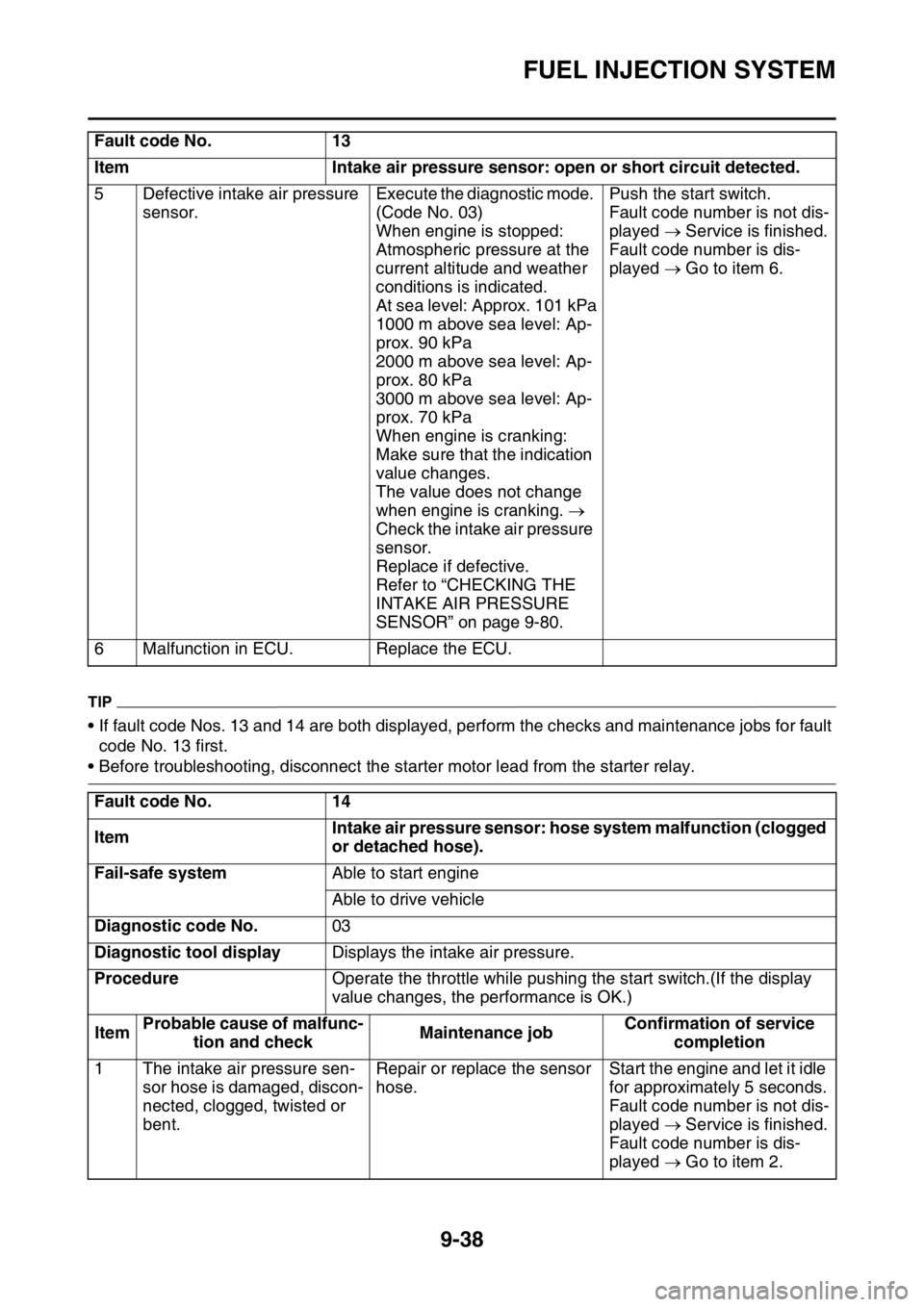
• If fault code Nos. 13 and 14 are both displayed, perform the checks and maintenance jobs for fault
code No. 13 first.
• Before troubleshooting, disconnect the star ter motor lead from the starter relay.
5 Defective intake air pressure
sensor. Execute the diagnostic mode.
(Code No. 03)
When engine is stopped:
Atmospheric pressure at the
current altitude and weather
conditions is indicated.
At sea level: Approx. 101 kPa
1000 m above sea level: Ap-
prox. 90 kPa
2000 m above sea level: Ap-
prox. 80 kPa
3000 m above sea level: Ap-
prox. 70 kPa
When engine is cranking:
Make sure that the indication
value changes.
The value does not change
when engine is cranking.
Check the intake air pressure
sensor.
Replace if defective.
Refer to “CHECKING THE
INTAKE AIR PRESSURE
SENSOR” on page 9-80. Push the start switch.
Fault code number is not dis-
played
Service is finished.
Fault code number is dis-
played Go to item 6.
6 Malfunction in ECU. Replace the ECU.
Fault code No. 14
Item Intake air pressure sensor: hose system malfunction (clogged
or detached hose).
Fail-safe system Able to start engine
Able to drive vehicle
Diagnostic code No. 03
Diagnostic tool display Displays the intake air pressure.
Procedure Operate the throttle while pushing the start switch.(If the display
value changes, the performance is OK.)
Item Probable cause of malfunc-
tion and check Maintenance jobConfirmation of service
completion
1 The intake air pressure sen- sor hose is damaged, discon-
nected, clogged, twisted or
bent. Repair or replace the sensor
hose.
Start the engine and let it idle
for approximately 5 seconds.
Fault code number is not dis-
played
Service is finished.
Fault code number is dis-
played Go to item 2.
Fault code No. 13
Item Intake air pressure sensor: open or short circuit detected.
Page 369 of 426
FUEL INJECTION SYSTEM
9-39
TIP
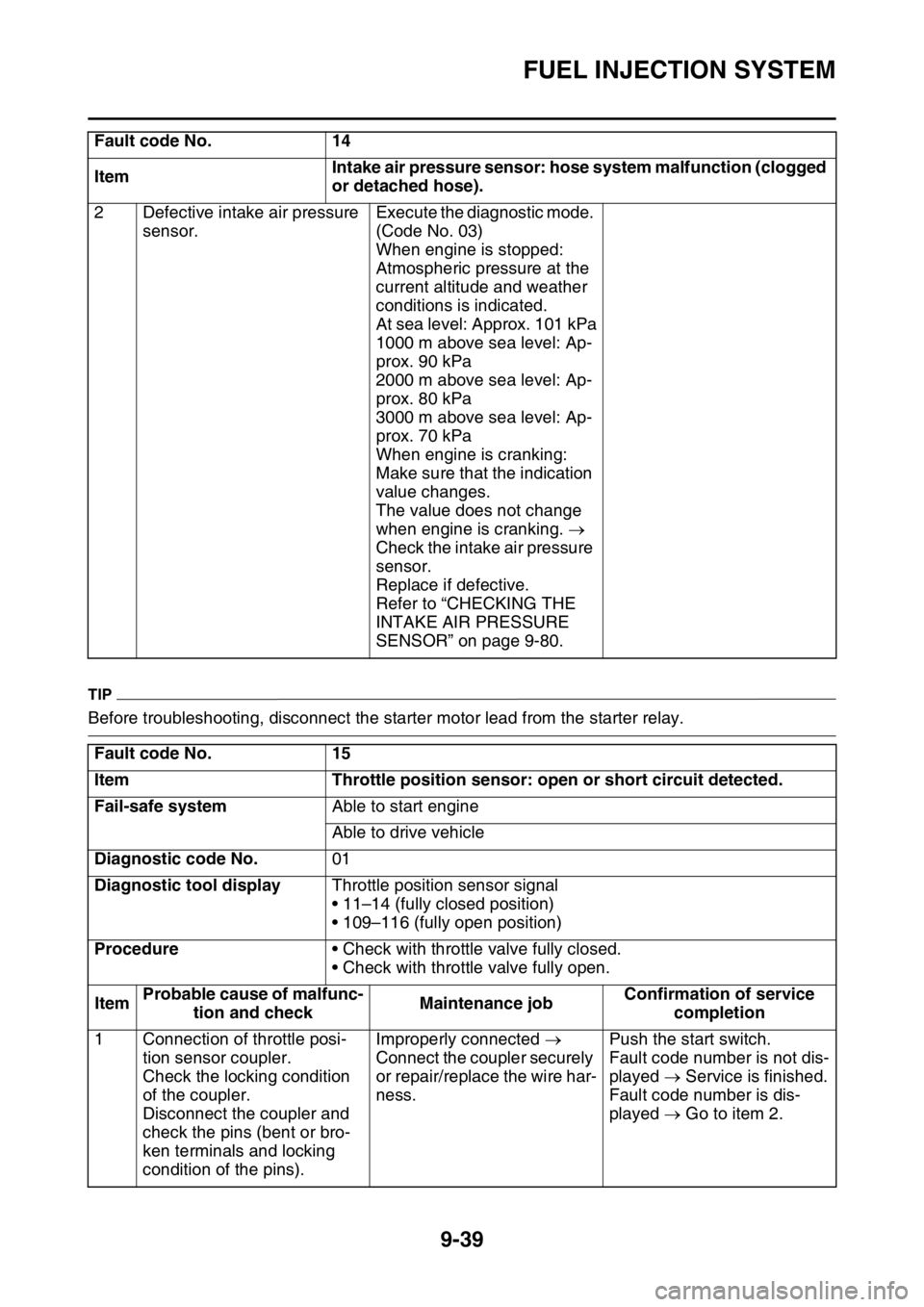
Before troubleshooting, disconnect the starter motor lead from the starter relay.
2 Defective intake air pressure
sensor. Execute the diagnostic mode.
(Code No. 03)
When engine is stopped:
Atmospheric pressure at the
current altitude and weather
conditions is indicated.
At sea level: Approx. 101 kPa
1000 m above sea level: Ap-
prox. 90 kPa
2000 m above sea level: Ap-
prox. 80 kPa
3000 m above sea level: Ap-
prox. 70 kPa
When engine is cranking:
Make sure that the indication
value changes.
The value does not change
when engine is cranking.
Check the intake air pressure
sensor.
Replace if defective.
Refer to “CHECKING THE
INTAKE AIR PRESSURE
SENSOR” on page 9-80.
Fault code No. 15
Item Throttle position sensor: open or short circuit detected.
Fail-safe system Able to start engine
Able to drive vehicle
Diagnostic code No. 01
Diagnostic tool display Throttle position sensor signal
• 11–14 (fully closed position)
• 109–116 (fully open position)
Procedure • Check with throttle valve fully closed.
• Check with throttle valve fully open.
Item Probable cause of malfunc-
tion and check Maintenance jobConfirmation of service
completion
1 Connection of throttle posi- tion sensor coupler.
Check the locking condition
of the coupler.
Disconnect the coupler and
check the pins (bent or bro-
ken terminals and locking
condition of the pins). Improperly connected
Connect the coupler securely
or repair/replace the wire har-
ness. Push the start switch.
Fault code number is not dis-
played
Service is finished.
Fault code number is dis-
played Go to item 2.
Fault code No.
14
Item Intake air pressure sensor: hose system malfunction (clogged
or detached hose).
Page 380 of 426

FUEL INJECTION SYSTEM
9-50
TIP
Before troubleshooting, disconnect the starter motor lead from the starter relay.
Fault code No. 44
Item EEPROM fault code number: an error is detected while read-
ing or writing on EEPROM.
Fail-safe system Able/Unable to start engine
Able/Unable to drive vehicle
Diagnostic code No. 60
Diagnostic tool display EEPROM fault code display
• 00: No fault
• 01: CO adjustment value
• 07: Setting tool adjustment values 0–8 for fuel injection amount or
ignition timing
Procedure —
Item Probable cause of malfunc-
tion and check Maintenance jobConfirmation of service
completion
1 Locate the malfunction Ex ecute the diagnostic mode
(Code No. 60).
00: Go to item 4.
01: Go to item 2.
07: Go to item 3. —
2 “01” is indicated in Diagnostic mode (Code No. 60) EEP-
ROM data error for adjust-
ment of CO concentration Change the CO concentra-
tion, and rewrite in EEPROM.
After this adjustment, push
the engine stop switch, then
push the start switch.
Memory not recovered
Re-
place the ECU. Push the start switch.
Fault code number is not dis-
played
Service is finished.
Fault code number is dis-
played Repeat the proce-
dure in item 1. If the same
number is indicated, perform
the procedure in item 4.
3 “07” is indicated in Diagnostic mode (Code No. 60) EEP-
ROM data error for setting
tool adjustment values for
fuel injection amount or igni-
tion timing. Erase the setting map in the
diagnostic mode (diagnostic
code No. 65).
Push the start switch.
Fault code number is not dis-
played
Service is finished.
Fault code number is dis-
played Repeat the proce-
dure in item 1. If the same
number is indicated, perform
the procedure in item 4.
4 Malfunction in ECU. Replace the ECU.
Page 387 of 426

FUEL PUMP SYSTEM
9-57
1. Joint connector
2. Joint connector
9. Battery
10.Frame ground
11.Starter relay
12.Main fuse
22.ECU (engine control unit)
26.Fuel pump
30.Joint connector
36.Engine stop switch
48.Frame ground
50.Negative battery lead
Page 388 of 426

FUEL PUMP SYSTEM
9-58
EAS2GC1381TROUBLESHOOTING
The fuel pump fails to operate.
TIP
Before troubleshooting, remove the following part(s):
1. Seat
2. Side cover (left/right)
3. Air scoop (left/right)
4. Fuel tank1. Check the fuse. Refer to “CHECKING THE FUSES”
on page 9-68. NG
Replace the fuse(s).
OK
2. Check the battery. Refer to “CHECKING AND
CHARGING THE BATTERY” on
page 9-69. NG
• Clean the battery terminals.
• Recharge or replace the battery.
OK
3. Check the engine stop switch. Refer to “CHECKING THE
SWITCHES” on page 9-64. NG
Replace the engine stop switch.
OK
4. Check fuel pressure. Refer to “CHECKING THE FUEL
PRESSURE” on page 8-5. NG
Replace the fuel pump.
OK
5. Check the fuel pump system wire harness connections.
Refer to “CIRCUIT DIAGRAM” on
page 9-56. NG
Properly connect or repair the fuel pump
system’s wiring.
OK
Replace the ECU.
Page 414 of 426
TROUBLESHOOTING
10-1
EAS2GC1406
TROUBLESHOOTING
EAS2GC1407GENERAL INFORMATION
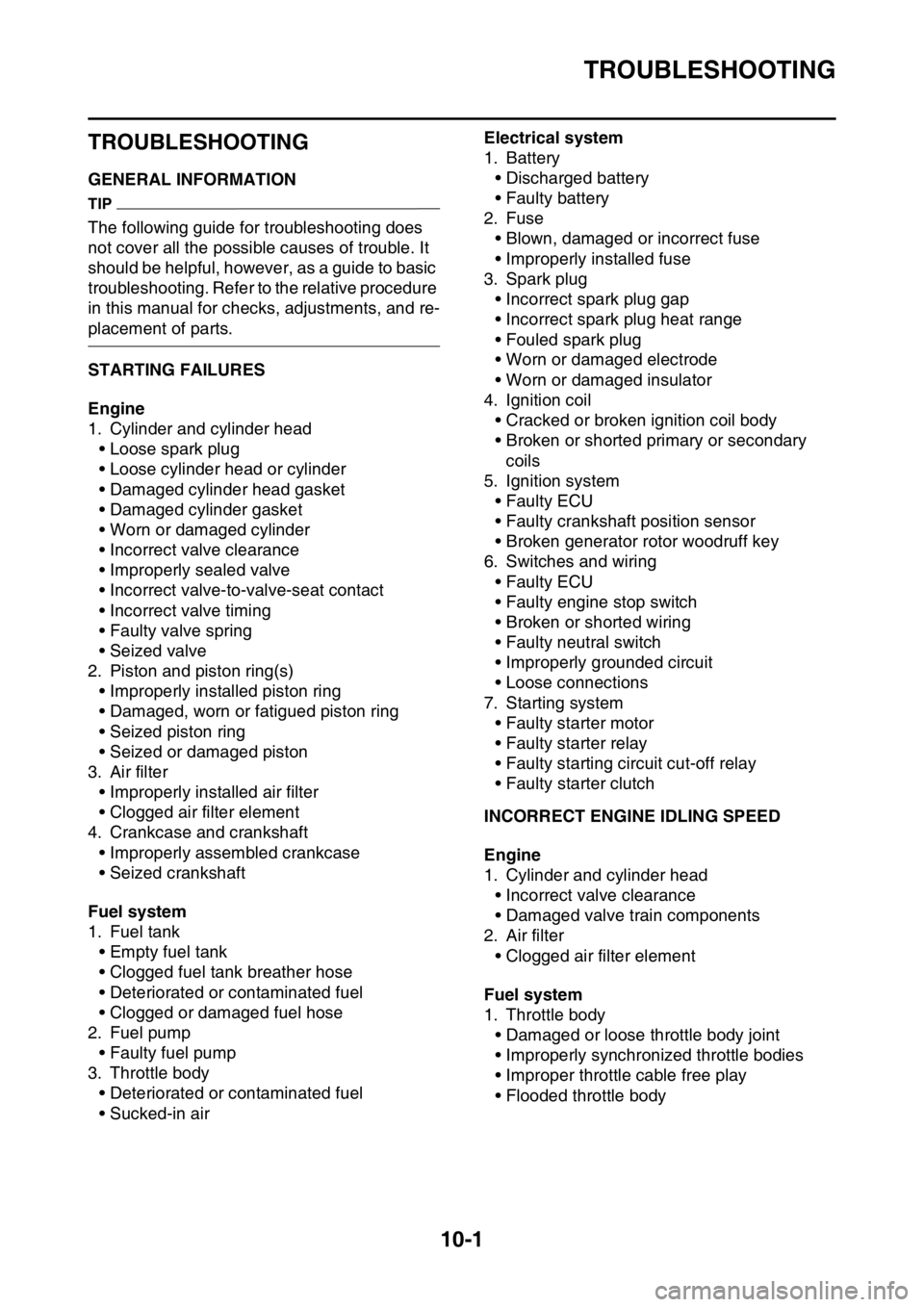
TIP
The following guide for troubleshooting does
not cover all the possible causes of trouble. It
should be helpful, however, as a guide to basic
troubleshooting. Refer to the relative procedure
in this manual for checks, adjustments, and re-
placement of parts.
EAS2GC1408STARTING FAILURES
Engine
1. Cylinder and cylinder head• Loose spark plug
• Loose cylinder head or cylinder
• Damaged cylinder head gasket
• Damaged cylinder gasket
• Worn or damaged cylinder
• Incorrect valve clearance
• Improperly sealed valve
• Incorrect valve-to-valve-seat contact
• Incorrect valve timing
• Faulty valve spring
• Seized valve
2. Piston and piston ring(s) • Improperly installed piston ring
• Damaged, worn or fatigued piston ring
• Seized piston ring
• Seized or damaged piston
3. Air filter • Improperly installed air filter
• Clogged air filter element
4. Crankcase and crankshaft • Improperly assembled crankcase
• Seized crankshaft
Fuel system
1. Fuel tank • Empty fuel tank
• Clogged fuel tank breather hose
• Deteriorated or contaminated fuel
• Clogged or damaged fuel hose
2. Fuel pump
• Faulty fuel pump
3. Throttle body • Deteriorated or contaminated fuel
• Sucked-in air Electrical system
1. Battery
• Discharged battery
• Faulty battery
2. Fuse • Blown, damaged or incorrect fuse
• Improperly installed fuse
3. Spark plug • Incorrect spark plug gap
• Incorrect spark plug heat range
• Fouled spark plug
• Worn or damaged electrode
• Worn or damaged insulator
4. Ignition coil • Cracked or broken ignition coil body
• Broken or shorted primary or secondary coils
5. Ignition system • Faulty ECU
• Faulty crankshaft position sensor
• Broken generator rotor woodruff key
6. Switches and wiring
• Faulty ECU
• Faulty engine stop switch
• Broken or shorted wiring
• Faulty neutral switch
• Improperly grounded circuit
• Loose connections
7. Starting system • Faulty starter motor
• Faulty starter relay
• Faulty starting circuit cut-off relay
• Faulty starter clutch
EAS2GC1409INCORRECT ENGINE IDLING SPEED
Engine
1. Cylinder and cylinder head• Incorrect valve clearance
• Damaged valve train components
2. Air filter • Clogged air filter element
Fuel system
1. Throttle body • Damaged or loose throttle body joint
• Improperly synchronized throttle bodies
• Improper throttle cable free play
• Flooded throttle body
Page 415 of 426

TROUBLESHOOTING
10-2
Electrical system
1. Battery• Discharged battery
• Faulty battery
2. Spark plug • Incorrect spark plug gap
• Incorrect spark plug heat range
• Fouled spark plug
• Worn or damaged electrode
• Worn or damaged insulator
• Faulty spark plug cap
3. Ignition coil
• Broken or shorted primary or secondary coil
• Cracked or broken ignition coil
4. Ignition system • Faulty ECU
• Faulty crankshaft position sensor
• Broken generator rotor woodruff key
EAS2GC1410POOR MEDIUM-AND-HIGH-SPEED PER-
FORMANCE
Refer to “STARTING FAILURES” on page 10-
1.
Engine
1. Air filter
• Clogged air filter element
Fuel system
1. Fuel pump • Faulty fuel pump
2. Throttle body
• Defective throttle body
3. ECU • Faulty ECU
EAS2GC1411SHIFTING IS DIFFICULT
Refer to “CLUTCH” on page 6-41.
EAS2GC1412SHIFT PEDAL DOES NOT MOVE
Engine
1. Shift shaft
• Bent shift shaft
2. Shift drum and shift forks • Foreign object in a shift drum groove
• Seized shift fork
• Bent shift fork guide bar
3. Transmission
• Seized transmission gear
• Foreign object between transmission gears
• Improperly assembled transmission
EAS2GC1413
JUMPS OUT OF GEAR
Engine
1. Shift shaft• Incorrect shift pedal position
• Improperly returned stopper lever
2. Shift forks
• Worn shift fork
3. Shift drum • Incorrect axial play
• Worn shift drum groove
4. Transmission • Worn gear dog
EAS2GC1414CLUTCH SLIPS
Engine
1. Clutch• Improperly assembled clutch
• Loose or fatigued clutch spring
• Worn friction plate
• Worn clutch plate
2. Engine oil
• Incorrect oil level
• Incorrect oil viscosity (low)
• Deteriorated oil
EAS2GC1415CLUTCH DRAGS
Engine
1. Clutch• Unevenly tensioned clutch springs
• Warped pressure plate
• Bent clutch plate
• Swollen friction plate
• Bent clutch push rod
• Damaged clutch boss
• Burnt primary driven gear bushing
2. Engine oil • Incorrect oil level
• Incorrect oil viscosity (high)
• Deteriorated oil
EAS2GC1416OVERHEATING
Engine
1. Cylinder head and piston• Heavy carbon buildup
• Clogged coolant passages
2. Engine oil
• Incorrect oil level
• Incorrect oil viscosity
• Inferior oil quality