service YAMAHA WR 450F 2016 User Guide
[x] Cancel search | Manufacturer: YAMAHA, Model Year: 2016, Model line: WR 450F, Model: YAMAHA WR 450F 2016Pages: 426, PDF Size: 10.86 MB
Page 99 of 426
PERIODIC MAINTENANCE
3-1
EAS2GC1074
PERIODIC MAINTENANCE
EAS2GC1075INTRODUCTION
This chapter includes all information necessary to perform recommended checks and adjustments.
If followed, these preventive maintenance procedures will ensure more reliable vehicle operation, a
longer service life and reduce the need for costly ov erhaul work. This information applies to vehicles
already in service as well as to new vehicles that are being prepared for sale. All service technicians
should be familiar with this entire chapter.
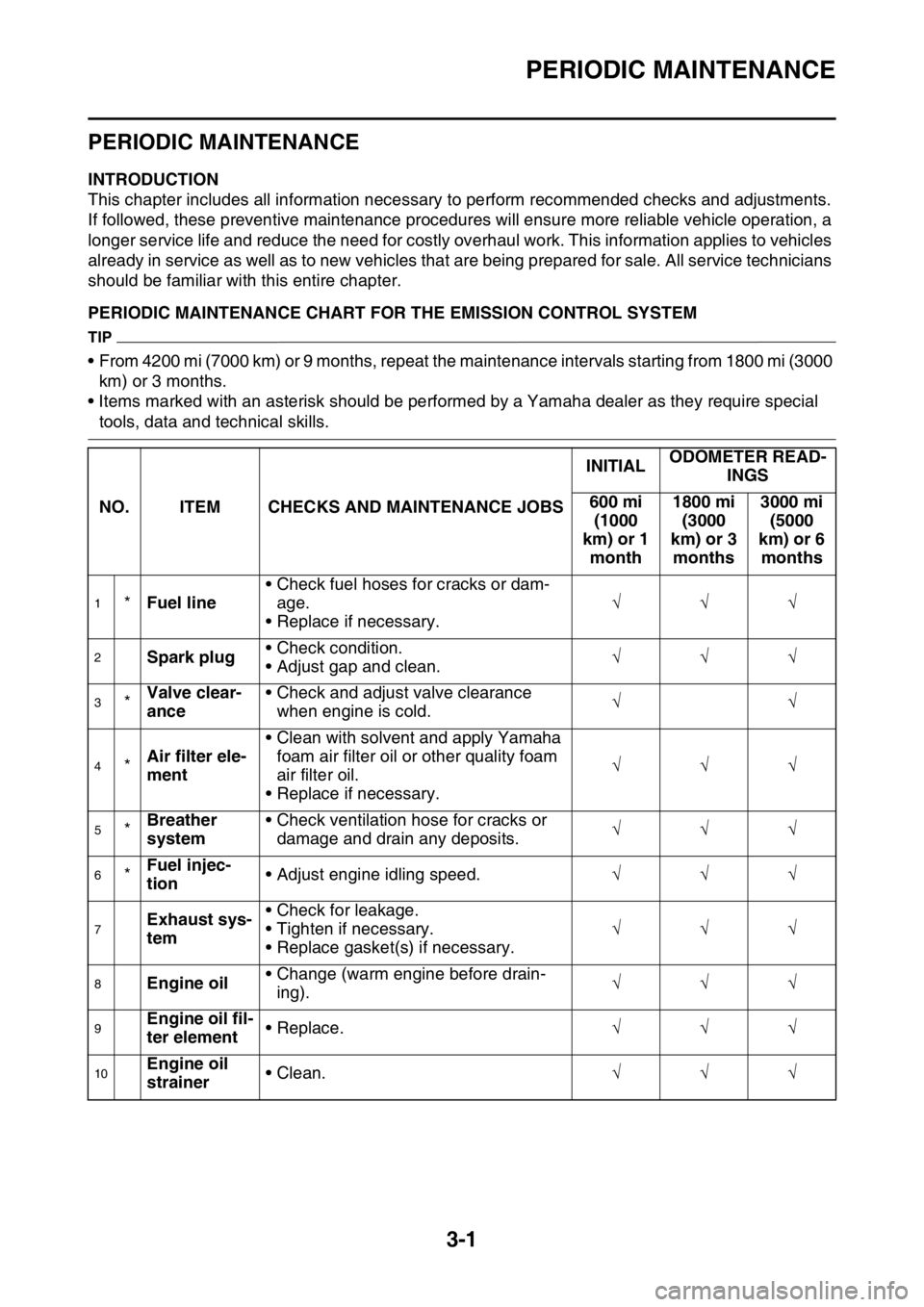
EAS2GC1076PERIODIC MAINTENANCE CHART FOR THE EMISSION CONTROL SYSTEM
TIP
• From 4200 mi (7000 km) or 9 months, repeat the maintenance intervals starting from 1800 mi (3000 km) or 3 months.
• Items marked with an asterisk should be performed by a Yamaha dealer as they require special
tools, data and technical skills.
NO. ITEM CHECKS AND MAINTENANCE JOBS INITIAL
ODOMETER READ-
INGS
600 mi (1000
km) or 1 month 1800 mi
(3000
km) or 3 months 3000 mi
(5000
km) or 6 months
1* Fuel line • Check fuel hoses for cracks or dam-
age.
• Replace if necessary.
2Spark plug
• Check condition.
• Adjust gap and clean.
3*Valve clear-
ance • Check and adjust valve clearance
when engine is cold.
4*Air filter ele-
ment • Clean with solvent and apply Yamaha
foam air filter oil or other quality foam
air filter oil.
• Replace if necessary.
5*
Breather
system • Check ventilation hose for cracks or
damage and drain any deposits.
6*Fuel injec-
tion • Adjust engine idling speed.
7Exhaust sys-
tem• Check for leakage.
• Tighten if necessary.
• Replace gasket(s) if necessary.
8Engine oil
• Change (warm engine before drain-
ing).
9Engine oil fil-
ter element•Replace.
10Engine oil
strainer• Clean.
Page 101 of 426

PERIODIC MAINTENANCE
3-3
TIP
• The air filter needs more frequent service if you are riding in unusually wet or dusty areas.
• Hydraulic brake service• After disassembling the brake master cylinders and calipers, always change the fluid. Regularly check the brake fluid levels and f ill the reservoirs as required.
• Every two years replace the internal components of the brake master cylinders and calipers, and
change the brake fluid.
• Replace the brake hoses every four years and if cracked or damaged.
13
Brake and
clutch lever
pivot shafts • Apply lithium-soap-based grease (all-
purpose grease) lightly.
14Brake pedal
pivot shafts• Apply lithium-soap-based grease (all-
purpose grease) lightly.
15Sidestand
pivot• Check operation.
• Apply lithium-soap-based grease (all-
purpose grease) lightly.
16*
Front fork • Check operation and for oil leakage.
• Replace if necessary.
17*Shock ab-
sorber as-
sembly • Check operation and for oil leakage.
• Replace if necessary.
18*Rear sus-
pension link
pivots • Apply molybdenum disulfide grease
lightly.
19*Control ca-
bles • Apply Yamaha chain and cable lube or
engine oil 10W-30 thoroughly.
20*Throttle grip
housing and
cable • Check operation and free play.
• Adjust the throttle cable free play if
necessary.
• Lubricate the throttle grip housing and cable.
21*
Chassis fas-
teners • Check all chassis fitting and fasteners.
• Correct if necessary.
22Battery• Check terminal for looseness and cor-
rosion.
NO. ITEM CHECKS AND MAINTENANCE JOBS
INITIAL
ODOMETER READ-
INGS
600 mi (1000
km) or 1 month 1800 mi
(3000
km) or 3 months 3000 mi
(5000
km) or 6 months
Page 102 of 426
PERIODIC MAINTENANCE
3-4
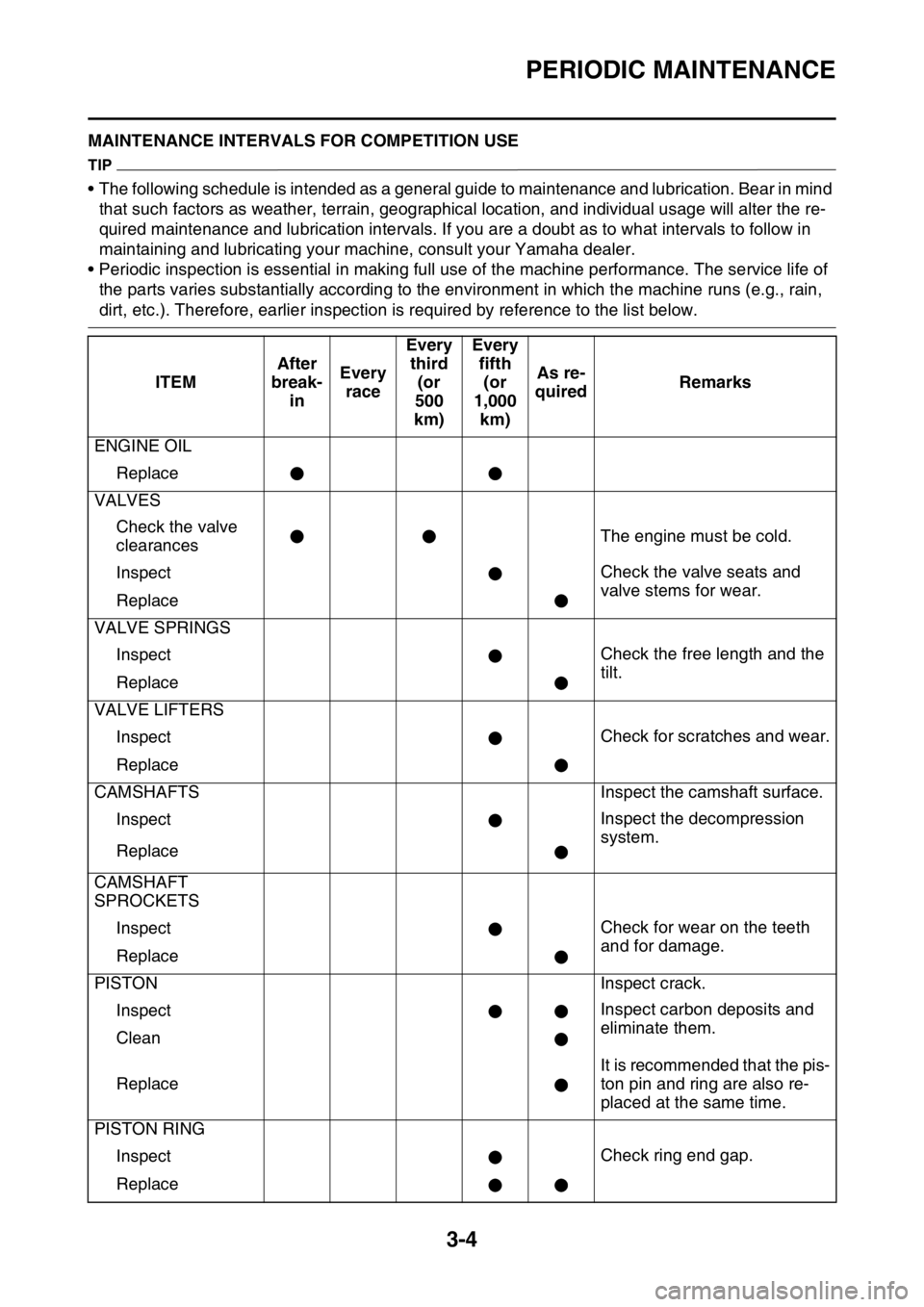
EAS2GC1078MAINTENANCE INTERVALS FOR COMPETITION USE
TIP
• The following schedule is intended as a general guide to maintenance and lubrication. Bear in mind that such factors as weather, terrain, geographical location, and individual usage will alter the re-
quired maintenance and lubrication intervals. If you ar e a doubt as to what intervals to follow in
maintaining and lubricating your ma chine, consult your Yamaha dealer.
• Periodic inspection is essential in making full use of the machine performance. The service life of
the parts varies substantially according to the en vironment in which the machine runs (e.g., rain,
dirt, etc.). Therefore, earlier inspection is required by reference to the list below.
ITEM After
break- in Every
race Every
third (or
500
km) Every
fifth (or
1,000 km) As re-
quired Remarks
ENGINE OIL Replace
VALVES Check the valve
clearances The engine must be cold.
Inspect Check the valve seats and
valve stems for wear.
Replace
VALVE SPRINGS Inspect Check the free length and the
tilt.
Replace
VALVE LIFTERS Inspect Check for scratches and wear.
Replace
CAMSHAFTS Inspect the camshaft surface.
Inspect Inspect the decompression
system.
Replace
CAMSHAFT
SPROCKETS Inspect Check for wear on the teeth
and for damage.
Replace
PISTON Inspect crack.
Inspect Inspect carbon deposits and
eliminate them.
Clean
Replace It is recommended that the pis-
ton pin and ring are also re-
placed at the same time.
PISTON RING
Inspect Check ring end gap.
Replace
Page 115 of 426
ENGINE
3-17
NOTICE
• Since engine oil also lubricates the clutch, the wrong oil types or additives could
cause clutch slippage. Therefore, do not
add any chemical additives.
• Do not allow foreign material to enter the
crankcase.
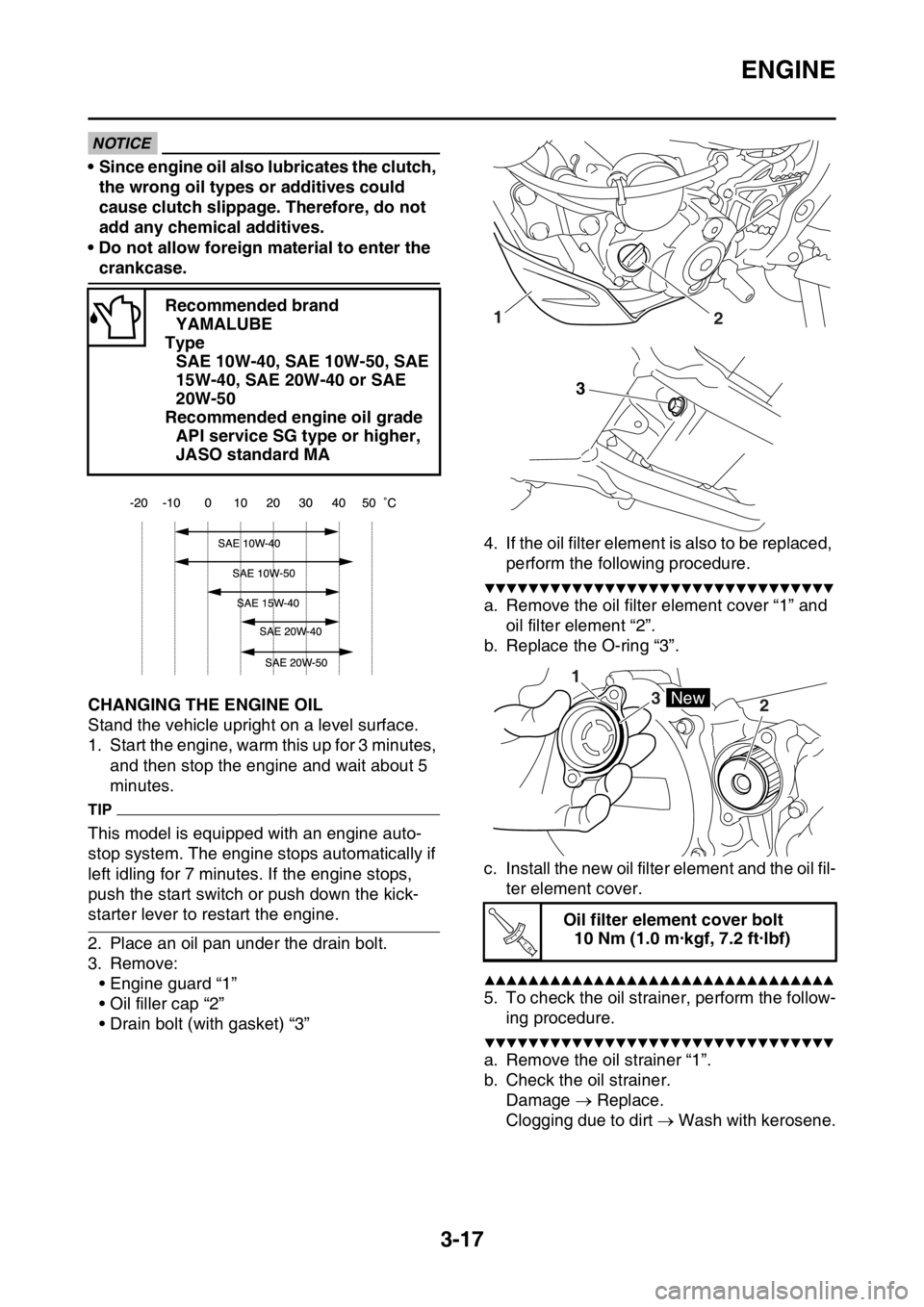
EAS2GC1097CHANGING THE ENGINE OIL
Stand the vehicle upright on a level surface.
1. Start the engine, warm this up for 3 minutes, and then stop the engine and wait about 5
minutes.
TIP
This model is equipped with an engine auto-
stop system. The engine stops automatically if
left idling for 7 minutes. If the engine stops,
push the start switch or push down the kick-
starter lever to restart the engine.
2. Place an oil pan under the drain bolt.
3. Remove:• Engine guard “1”
• Oil filler cap “2”
• Drain bolt (with gasket) “3” 4. If the oil filter element is also to be replaced,
perform the following procedure.
▼▼▼▼▼▼▼▼▼▼▼▼▼▼▼▼▼▼▼▼▼▼▼▼▼▼▼▼▼▼▼▼
a. Remove the oil filter element cover “1” and oil filter element “2”.
b. Replace the O-ring “3”.
c. Install the new oil filter element and the oil fil- ter element cover.
▲▲▲▲▲▲▲▲▲▲▲▲▲▲▲▲▲▲▲▲▲▲▲▲▲▲▲▲▲▲▲▲
5. To check the oil strainer, perform the follow-ing procedure.
▼▼▼▼▼▼▼▼▼▼▼▼▼▼▼▼▼▼▼▼▼▼▼▼▼▼▼▼▼▼▼▼
a. Remove the oil strainer “1”.
b. Check the oil strainer.Damage Replace.
Clogging due to dirt Wash with kerosene.
Recommended brand
YAMALUBE
Type SAE 10W-40, SAE 10W-50, SAE
15W-40, SAE 20W-40 or SAE
20W-50
Recommended engine oil grade API service SG type or higher,
JASO standard MA
Oil filter element cover bolt10 Nm (1.0 m·kgf, 7.2 ft·lbf)
12
3
1
3 2
New
T R..
Page 118 of 426
ENGINE
3-20
EAS2GC1099ADJUSTING THE VALVE CLEARANCE
TIP
• This section is intended for those who have basic knowledge and skill concerning the ser-
vicing of Yamaha motorcycles (e.g., Yamaha
dealers, service engineers, etc.). Those who
have little knowledge and skill concerning ser-
vicing are requested not to undertake inspec-
tion, adjustment, disassembly, or reassembly
only by reference to this manual. It may lead
to servicing trouble and mechanical damage.
• Make sure that the valve clearance is checked or adjusted while the engine is cold
(at room temperature).
• While the valve clearance is checked or ad- justed, make sure that the piston is positioned
in the top dead center (TDC).
1. Remove: • Seat
• Side cover (left/right)
• Air scoop (left/right)Refer to “GENERAL CHASSIS” on page 5-
1.
• Fuel tank
Refer to “FUEL TANK” on page 8-1.
•ECU
2. Remove:
• Spark plug
• Cylinder head coverRefer to “CAMSHAFT” on page 6-11.
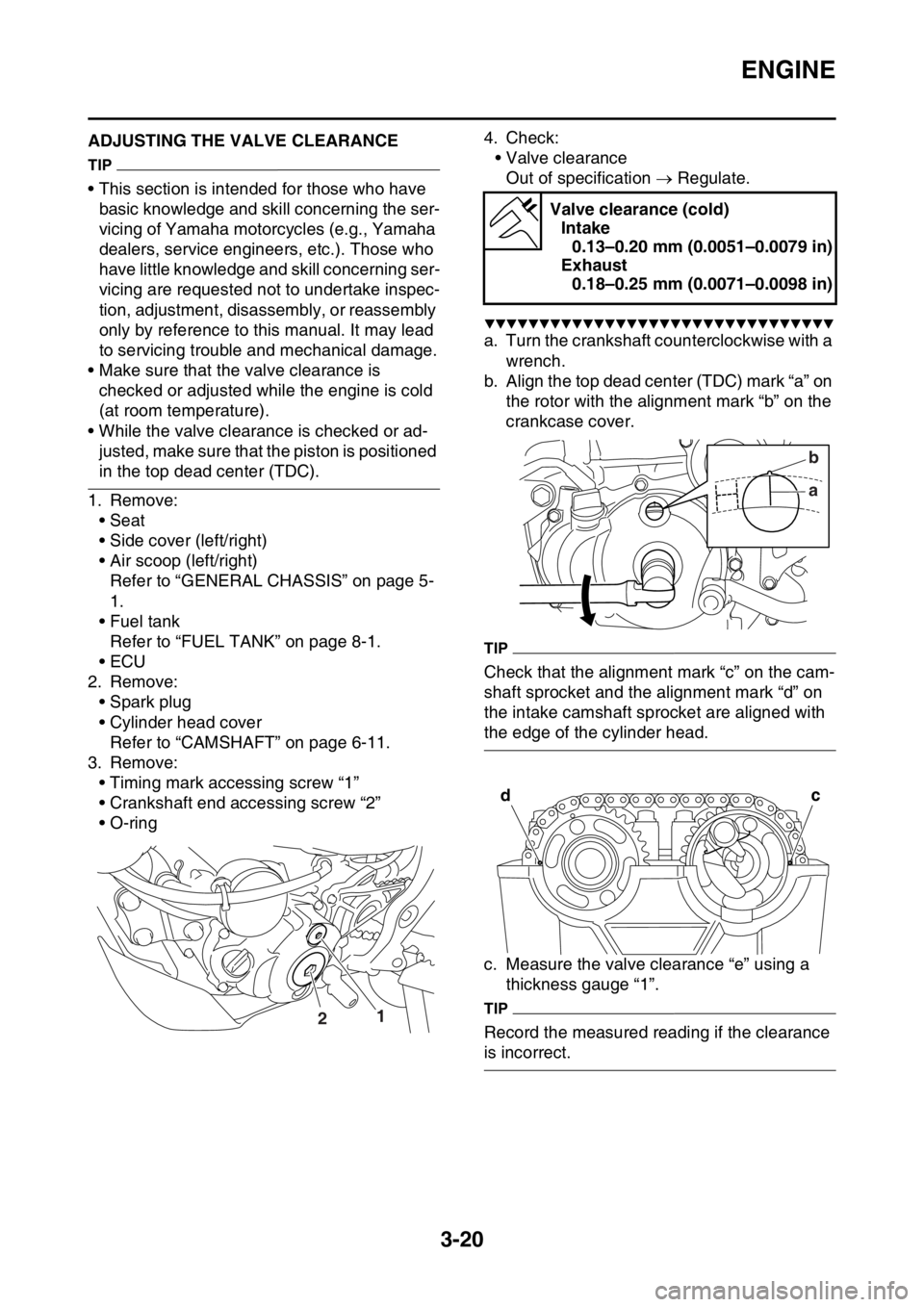
3. Remove: • Timing mark accessing screw “1”
• Crankshaft end accessing screw “2”
• O-ring 4. Check:
• Valve clearanceOut of specification Regulate.
▼▼▼▼▼▼▼▼▼▼▼▼▼▼▼▼▼▼▼▼▼▼▼▼▼▼▼▼▼▼▼▼
a. Turn the crankshaft counterclockwise with a
wrench.
b. Align the top dead center (TDC) mark “a” on the rotor with the alignment mark “b” on the
crankcase cover.
TIP
Check that the alignment mark “c” on the cam-
shaft sprocket and the alignment mark “d” on
the intake camshaft sprocket are aligned with
the edge of the cylinder head.
c. Measure the valve clearance “e” using a
thickness gauge “1”.
TIP
Record the measured reading if the clearance
is incorrect.
12
Valve clearance (cold)Intake 0.13–0.20 mm (0.0051–0.0079 in)
Exhaust 0.18–0.25 mm (0.0071–0.0098 in)
ab
d
c
Page 137 of 426
CHASSIS
3-39
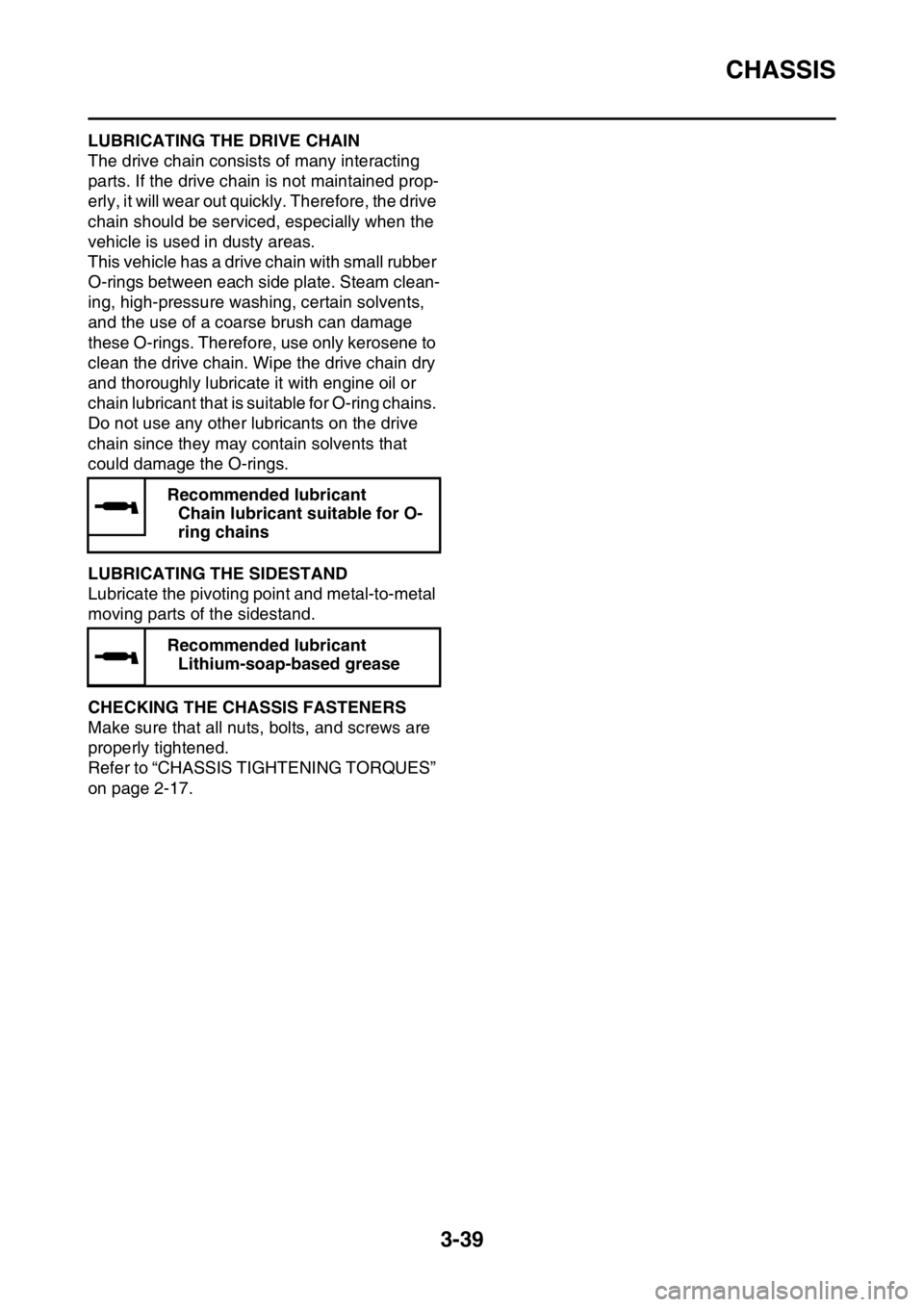
EAS2GC1127LUBRICATING THE DRIVE CHAIN
The drive chain consists of many interacting
parts. If the drive chain is not maintained prop-
erly, it will wear out quickly. Therefore, the drive
chain should be serviced, especially when the
vehicle is used in dusty areas.
This vehicle has a drive chain with small rubber
O-rings between each side plate. Steam clean-
ing, high-pressure washing, certain solvents,
and the use of a coarse brush can damage
these O-rings. Therefore, use only kerosene to
clean the drive chain. Wipe the drive chain dry
and thoroughly lubricate it with engine oil or
chain lubricant that is suitable for O-ring chains.
Do not use any other lubricants on the drive
chain since they may contain solvents that
could damage the O-rings.
EAS2GC1128LUBRICATING THE SIDESTAND
Lubricate the pivoting point and metal-to-metal
moving parts of the sidestand.
EAS2GC1129CHECKING THE CHASSIS FASTENERS
Make sure that all nuts, bolts, and screws are
properly tightened.
Refer to “CHASSIS TIGHTENING TORQUES”
on page 2-17.Recommended lubricant
Chain lubricant suitable for O-
ring chains
Recommended lubricant Lithium-soap-based grease
Page 361 of 426

FUEL INJECTION SYSTEM
9-31
ECU detects an abnormal signal from a sensor
If the ECU detects an abnormal signal from a sensor while the vehicle is being driven, the ECU illu-
minates the engine trouble warning light and provides the engine with alternate operating instructions
that are appropriate for the type of malfunction.
When an abnormal signal is received from a sensor, the ECU processes the specified values that are
programmed for each sensor in order to provide the engine with alternate operating instructions that
enable the engine to continue operating or stop operating, depending on the conditions.
EAS2GC1376TROUBLESHOOTING METHOD
The engine operation is not normal and the engine trouble warning light comes on.
1. Check: • Fault code number
▼▼▼▼▼▼▼▼▼▼▼▼▼▼▼▼▼▼▼▼▼▼▼▼▼▼▼▼▼▼▼▼▼▼▼▼▼▼▼▼▼▼▼▼▼▼▼▼▼▼▼▼▼▼▼▼▼▼▼▼▼▼▼▼▼▼▼▼
a. Connect the Yamaha diagnostic tool. Refer to “YAMAHA DIAGNOSTIC TOOL” on page 9-32.
b. Check the fault code number disp layed on the Yamaha diagnostic tool.
c. Identify the faulty system with the fault code number.
d. Identify the probable cause of the malfunction.
▲▲▲▲▲▲▲▲▲▲▲▲▲▲▲▲▲▲▲▲▲▲▲▲▲▲▲▲▲▲▲▲▲▲▲▲▲▲▲▲▲▲▲▲▲▲▲▲▲▲▲▲▲▲▲▲▲▲▲▲▲▲▲▲▲▲▲▲
2. Check and repair the probable cause of the malfunction.
3. Perform the reinstatement action for the fuel injection system. Refer to “Confirmation of service
completion” in the appropriate table in “TROUBLESHOOTING DETAILS” on page 9-35.
4. After pushing the engine stop switch, push the start switch to check whether the fault code no. is
displayed.
TIP
If another fault code number is displayed, repeat steps (1) to (4) until no fault code number is dis-
played.
5. Erase the malfunction history in the diagnostic mode. Refer to “SENSOR OPERATION TABLE”
(Diagnostic code No.62).
TIP
Turning off the meter light will not erase the malfunction history.
The engine operation is not normal, but the engine trouble warning light does not come on.
1. Check the operation of the following sensors an d actuators in the diagnostic mode. Refer to
“TROUBLESHOOTING DETAILS” on page 9-35.
If a malfunction is detected in the sensors or ac tuators, repair or replace all faulty parts.
If no malfunction is detected in the sensors and ac tuators, check and repair the inner parts of the
engine. Fault code No. No fault code No.
Check and repair. Refer to “TROUBLESHOOT-
ING DETAILS” on page 9-35.
Monitor the operation of the sensors and actua-
tors in the diagnostic mode. Refer to “TROU-
BLESHOOTING DETAILS” on page 9-35 and
“LIST OF SELF-DIAGNOSTIC AND FAIL-SAFE
ACTIONS” on page 10-5. Check and repair.
01: Throttle position sensor signal (throttle angle)
30: Ignition coil
36: Injector
Page 365 of 426

FUEL INJECTION SYSTEM
9-35
6. ConditionThe current conditions are displayed. (Detected/Recovered)
7. Symptom
The symptoms of the detected malfunction are displayed.
8. Diagnosis code The diagnosis codes related to the detected malfunction are displayed.
9. FFD (only for models that can display freeze frame data) The mark “ ” is displayed when the freeze frame data is available.
10.ECU conduction time (hour: minute: second)
The total ECU conduction time (total hours the vehicle’s start switch was ON) when the malfunc-
tion was detected is displayed.
11.Number of main switch operation after detection
The number of times the meter light comes on by pushing the start switch between the malfunction
detection and code reading is displayed.
12.Number of occurrences The number of malfunction occurrences between th e malfunction detection and code reading is
displayed.
EAS2GC1378TROUBLESHOOTING DETAILS
This section describes the measures per fault c ode number displayed on the diagnostic tool. Check
and service the items or components that are the probable cause of the malfunction following the or-
der given.
After the check and service of the malfunctioning part have been completed, reset the diagnostic tool
display according to the reinstatement method.
Fault code No.:
Fault code number displayed on the diagnostic tool when the engine failed to work normally.
Diagnostic code No.:
Diagnostic code number to be used when the diagnostic mode is operated.
Fault code No. 12
Item Crankshaft position sensor: no normal signals are received
from the crankshaft position sensor.
Fail-safe system Unable to start engine
Unable to drive vehicle
Diagnostic code No. —
Diagnostic tool display —
Procedure —
Item Probable cause of malfunc-
tion and check Maintenance jobConfirmation of service
completion
1 Connection of crankshaft po- sition sensor coupler.
Check the locking condition
of the coupler.
Disconnect the coupler and
check the pins (bent or bro-
ken terminals and locking
condition of the pins). Improperly connected
Connect the coupler securely
or repair/replace the wire har-
ness. Crank the engine.
Fault code number is not dis-
played
Service is finished.
Fault code number is dis-
played Go to item 2.
Page 366 of 426

FUEL INJECTION SYSTEM
9-36
2 Connection of wire harness ECU coupler.
Check the locking condition
of the coupler.
Disconnect the coupler and
check the pins (bent or bro-
ken terminals and locking
condition of the pins). Improperly connected
Connect the coupler securely
or repair/replace the wire har-
ness. Crank the engine.
Fault code number is not dis-
played
Service is finished.
Fault code number is dis-
played Go to item 3.
3 Wire harness continuity. Open or short circuit Re-
place the wire harness.
Between the crankshaft posi-
tion sensor coupler and ECU
coupler.
black/blue–black/blue
gray–gray Crank the engine.
Fault code number is not dis-
played
Service is finished.
Fault code number is dis-
played Go to item 4.
4 Installed condition of crank- shaft position sensor.
Check for looseness or
pinching.
Check the gap between the
crankshaft position sensor
and the pickup rotor. Improperly installed sensor
Reinstall or replace the
sensor.
Refer to “GENERATOR AND
STARTER CLUTCH” on
page 6-63. Crank the engine.
Fault code number is not dis-
played
Service is finished.
Fault code number is dis-
played Go to item 5.
5 Defective crankshaft position sensor. Check the crankshaft position
sensor.
Refer to “CHECKING THE
CRANKSHAFT POSITION
SENSOR” on page 9-74. Crank the engine.
Fault code number is not dis-
played
Service is finished.
Fault code number is dis-
played Go to item 6.
6 Malfunction in ECU. Replace the ECU. Fault code No. 12
Item Crankshaft position sensor: no normal signals are received
from the crankshaft position sensor.
Page 367 of 426
FUEL INJECTION SYSTEM
9-37
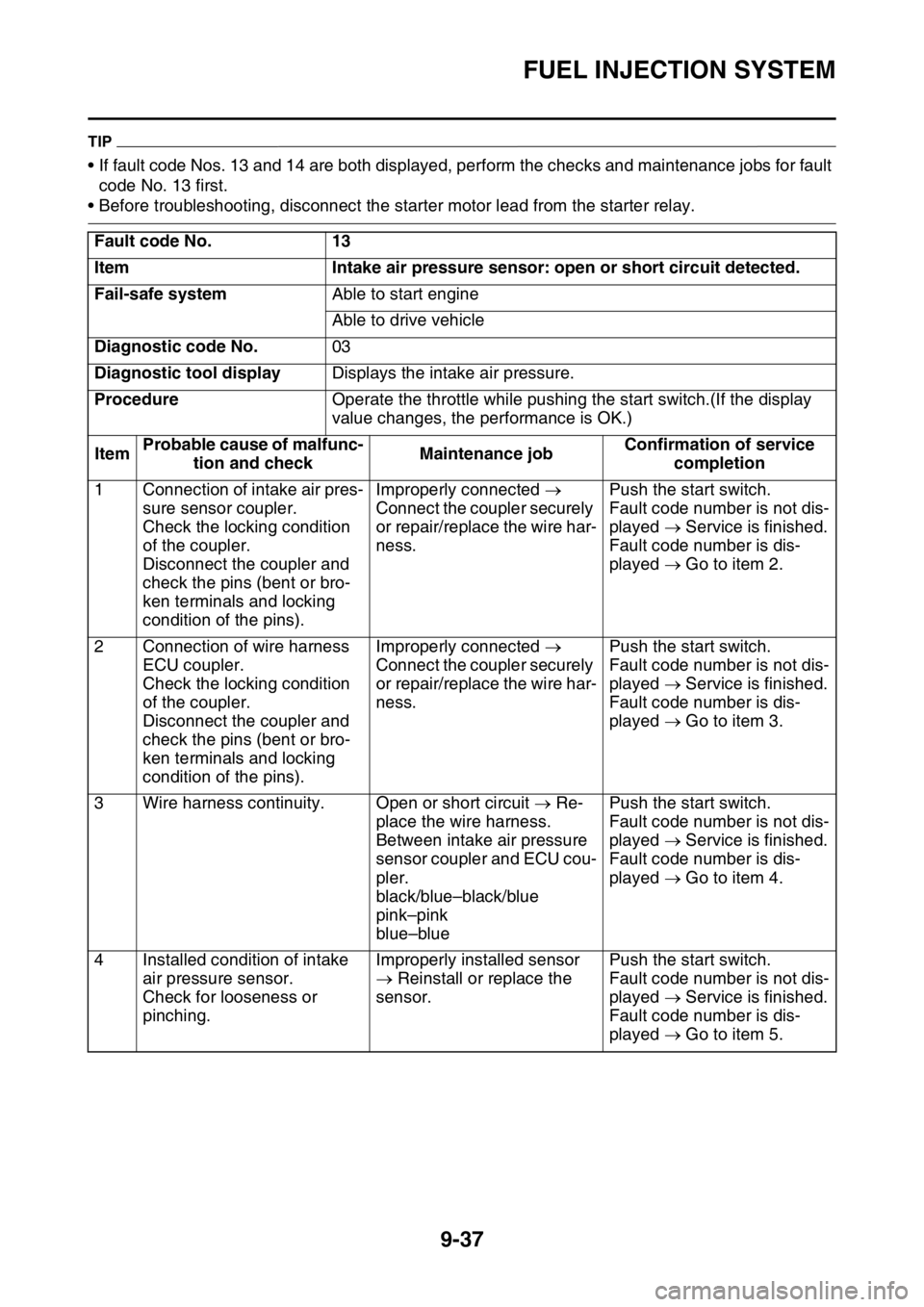
TIP
• If fault code Nos. 13 and 14 are both displayed, perform the checks and maintenance jobs for fault
code No. 13 first.
• Before troubleshooting, disconnect the star ter motor lead from the starter relay.
Fault code No. 13
Item Intake air pressure sensor: open or short circuit detected.
Fail-safe system Able to start engine
Able to drive vehicle
Diagnostic code No. 03
Diagnostic tool display Displays the intake air pressure.
Procedure Operate the throttle while pushing the start switch.(If the display
value changes, the performance is OK.)
Item Probable cause of malfunc-
tion and check Maintenance jobConfirmation of service
completion
1 Connection of intake air pres- sure sensor coupler.
Check the locking condition
of the coupler.
Disconnect the coupler and
check the pins (bent or bro-
ken terminals and locking
condition of the pins). Improperly connected
Connect the coupler securely
or repair/replace the wire har-
ness. Push the start switch.
Fault code number is not dis-
played
Service is finished.
Fault code number is dis-
played Go to item 2.
2 Connection of wire harness ECU coupler.
Check the locking condition
of the coupler.
Disconnect the coupler and
check the pins (bent or bro-
ken terminals and locking
condition of the pins). Improperly connected
Connect the coupler securely
or repair/replace the wire har-
ness. Push the start switch.
Fault code number is not dis-
played
Service is finished.
Fault code number is dis-
played Go to item 3.
3 Wire harness continuity. Open or short circuit Re-
place the wire harness.
Between intake air pressure
sensor coupler and ECU cou-
pler.
black/blue–black/blue
pink–pink
blue–blue Push the start switch.
Fault code number is not dis-
played
Service is finished.
Fault code number is dis-
played Go to item 4.
4 Installed condition of intake air pressure sensor.
Check for looseness or
pinching. Improperly installed sensor
Reinstall or replace the
sensor. Push the start switch.
Fault code number is not dis-
played
Service is finished.
Fault code number is dis-
played Go to item 5.