wheel YAMAHA WR 450F 2016 User Guide
[x] Cancel search | Manufacturer: YAMAHA, Model Year: 2016, Model line: WR 450F, Model: YAMAHA WR 450F 2016Pages: 426, PDF Size: 10.86 MB
Page 69 of 426
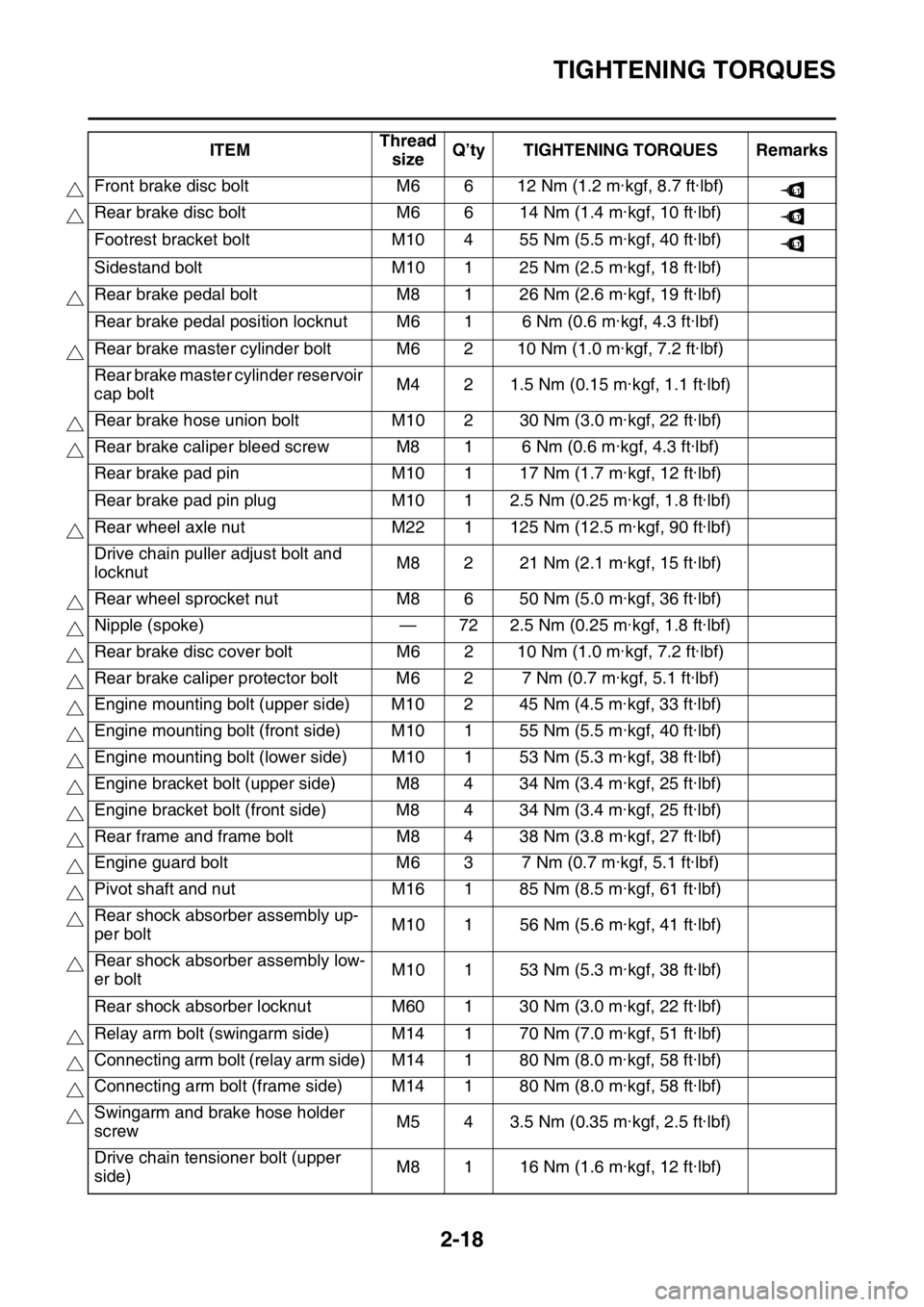
TIGHTENING TORQUES
2-18
Front brake disc boltM6 6 12 Nm (1.2 m·kgf, 8.7 ft·lbf)
Rear brake disc bolt M6 6 14 Nm (1.4 m·kgf, 10 ft·lbf)
Footrest bracket bolt M10 4 55 Nm (5.5 m·kgf, 40 ft·lbf)
Sidestand bolt M10 1 25 Nm (2.5 m·kgf, 18 ft·lbf)
Rear brake pedal bolt M8 1 26 Nm (2.6 m·kgf, 19 ft·lbf)
Rear brake pedal position locknut M6 1 6 Nm (0.6 m·kgf, 4.3 ft·lbf)
Rear brake master cylinder bolt M6 2 10 Nm (1.0 m·kgf, 7.2 ft·lbf)
Rear brake master cylinder reservoir
cap bolt M4 2 1.5 Nm (0.15 m·kgf, 1.1 ft·lbf)
Rear brake hose union bolt M10 2 30 Nm (3.0 m·kgf, 22 ft·lbf)
Rear brake caliper bleed screw M8 1 6 Nm (0.6 m·kgf, 4.3 ft·lbf)
Rear brake pad pin M10 1 17 Nm (1.7 m·kgf, 12 ft·lbf)
Rear brake pad pin plug M10 1 2.5 Nm (0.25 m·kgf, 1.8 ft·lbf)
Rear wheel axle nut M22 1 125 Nm (12.5 m·kgf, 90 ft·lbf)
Drive chain puller adjust bolt and
locknut M8 2 21 Nm (2.1 m·kgf, 15 ft·lbf)
Rear wheel sprocket nut M8 6 50 Nm (5.0 m·kgf, 36 ft·lbf)
Nipple (spoke) — 72 2.5 Nm (0.25 m·kgf, 1.8 ft·lbf)
Rear brake disc cover bolt M6 2 10 Nm (1.0 m·kgf, 7.2 ft·lbf)
Rear brake caliper protector bolt M6 2 7 Nm (0.7 m·kgf, 5.1 ft·lbf)
Engine mounting bolt (upper side) M10 2 45 Nm (4.5 m·kgf, 33 ft·lbf)
Engine mounting bolt (front side) M10 1 55 Nm (5.5 m·kgf, 40 ft·lbf)
Engine mounting bolt (lower side) M10 1 53 Nm (5.3 m·kgf, 38 ft·lbf)
Engine bracket bolt (upper side) M8 4 34 Nm (3.4 m·kgf, 25 ft·lbf)
Engine bracket bolt (front side) M8 4 34 Nm (3.4 m·kgf, 25 ft·lbf)
Rear frame and frame bolt M8 4 38 Nm (3.8 m·kgf, 27 ft·lbf)
Engine guard bolt M6 3 7 Nm (0.7 m·kgf, 5.1 ft·lbf)
Pivot shaft and nut M16 1 85 Nm (8.5 m·kgf, 61 ft·lbf)
Rear shock absorber assembly up-
per bolt M10 1 56 Nm (5.6 m·kgf, 41 ft·lbf)
Rear shock absorber assembly low-
er bolt M10 1 53 Nm (5.3 m·kgf, 38 ft·lbf)
Rear shock absorber locknut M60 1 30 Nm (3.0 m·kgf, 22 ft·lbf)
Relay arm bolt (swingarm side) M14 1 70 Nm (7.0 m·kgf, 51 ft·lbf)
Connecting arm bolt (relay arm side) M14 1 80 Nm (8.0 m·kgf, 58 ft·lbf)
Connecting arm bolt (frame side) M14 1 80 Nm (8.0 m·kgf, 58 ft·lbf)
Swingarm and brake hose holder
screw M5 4 3.5 Nm (0.35 m·kgf, 2.5 ft·lbf)
Drive chain tensioner bolt (upper
side) M8 1 16 Nm (1.6 m·kgf, 12 ft·lbf)
ITEM
Thread
size Q’ty TIGHTENING TORQUES RemarksLT
LT
LT
Page 72 of 426
LUBRICATION POINTS AND LUBRICANT TYPES
2-21
EAS2GC1068
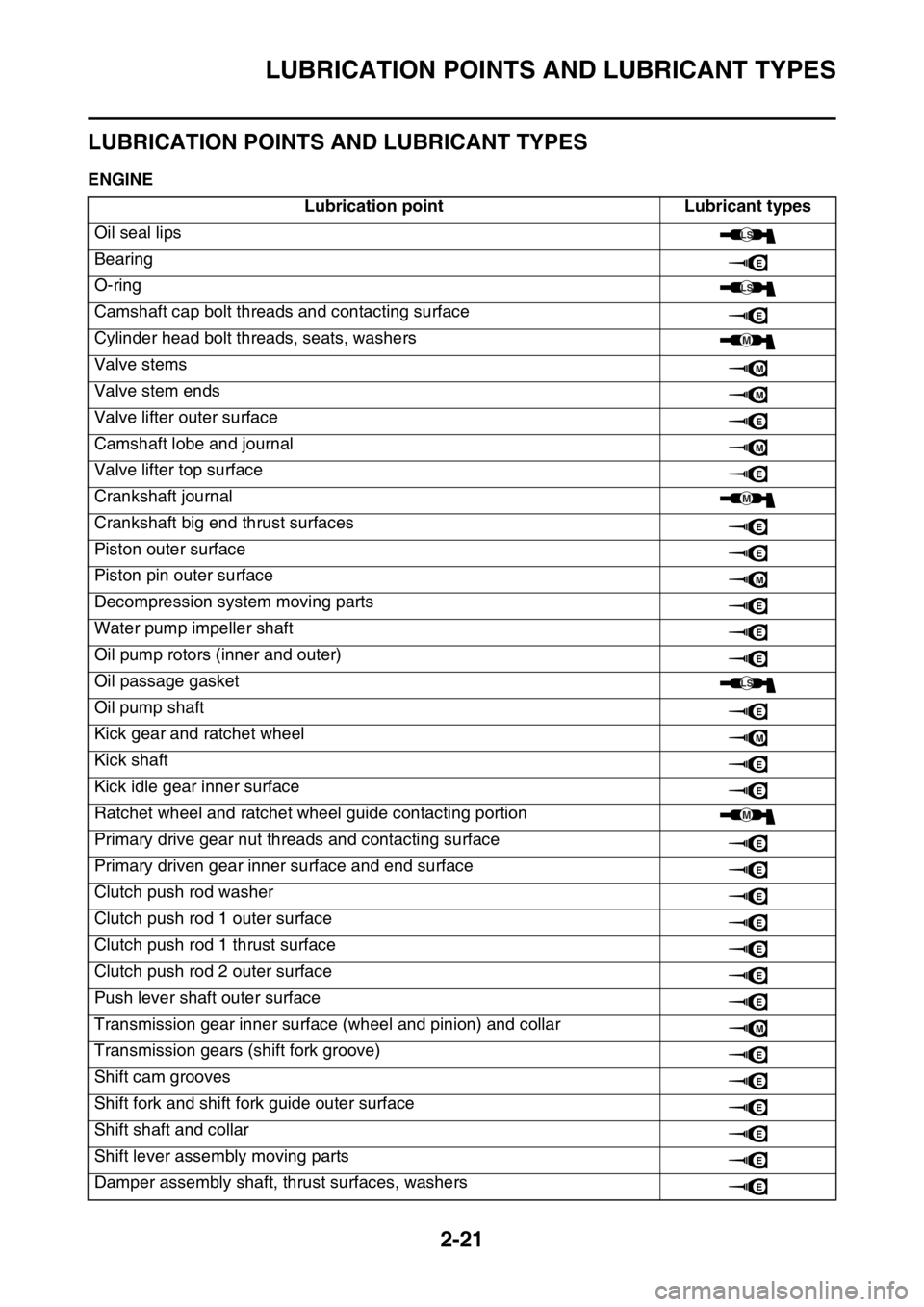
LUBRICATION POINTS AND LUBRICANT TYPES
EAS2GC1069ENGINE
Lubrication point Lubricant types
Oil seal lips
Bearing
O-ring
Camshaft cap bolt threads and contacting surface
Cylinder head bolt threads, seats, washers
Valve stems
Valve stem ends
Valve lifter outer surface
Camshaft lobe and journal
Valve lifter top surface
Crankshaft journal
Crankshaft big end thrust surfaces
Piston outer surface
Piston pin outer surface
Decompression system moving parts
Water pump impeller shaft
Oil pump rotors (inner and outer)
Oil passage gasket
Oil pump shaft
Kick gear and ratchet wheel
Kick shaft
Kick idle gear inner surface
Ratchet wheel and ratchet wheel guide contacting portion
Primary drive gear nut threads and contacting surface
Primary driven gear inner surface and end surface
Clutch push rod washer
Clutch push rod 1 outer surface
Clutch push rod 1 thrust surface
Clutch push rod 2 outer surface
Push lever shaft outer surface
Transmission gear inner surface (wheel and pinion) and collar
Transmission gears (shift fork groove)
Shift cam grooves
Shift fork and shift fork guide outer surface
Shift shaft and collar
Shift lever assembly moving parts
Damper assembly shaft, thrust surfaces, washers
LS
E
LS
E
M
M
M
E
M
E
M
E
E
M
E
E
E
LS
E
M
E
E
M
E
E
E
E
E
E
E
M
E
E
E
E
E
E
Page 73 of 426
LUBRICATION POINTS AND LUBRICANT TYPES
2-22
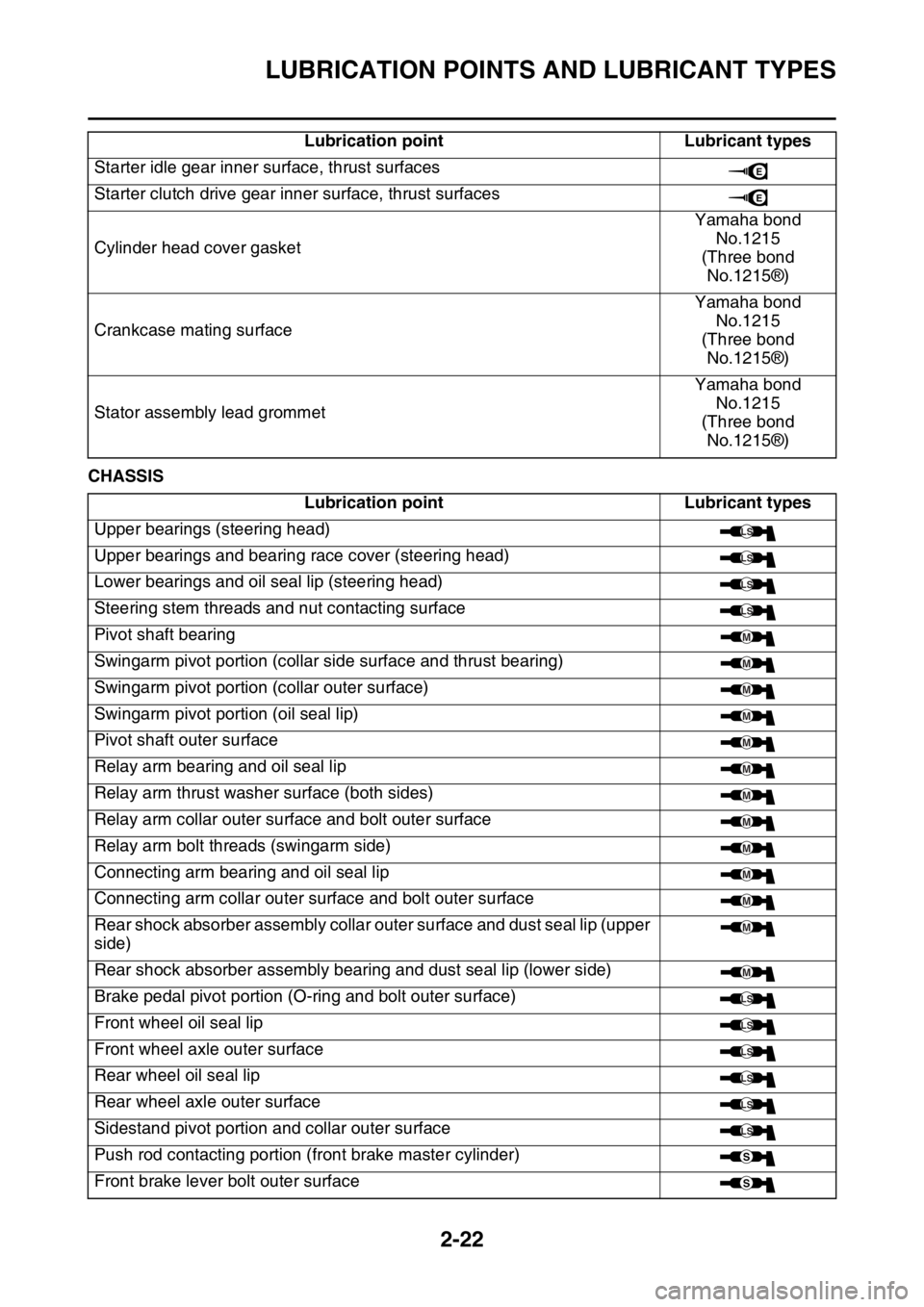
EAS2GC1070CHASSISStarter idle gear inner surface, thrust surfaces
Starter clutch drive gear inner surface, thrust surfaces
Cylinder head cover gasket
Yamaha bond
No.1215
(Three bond No.1215®)
Crankcase mating surface Yamaha bond
No.1215
(Three bond No.1215®)
Stator assembly lead grommet Yamaha bond
No.1215
(Three bond No.1215®)
Lubrication point Lubricant types
Upper bearings (steering head)
Upper bearings and bearing race cover (steering head)
Lower bearings and oil seal lip (steering head)
Steering stem threads and nut contacting surface
Pivot shaft bearing
Swingarm pivot portion (collar side surface and thrust bearing)
Swingarm pivot portion (collar outer surface)
Swingarm pivot portion (oil seal lip)
Pivot shaft outer surface
Relay arm bearing and oil seal lip
Relay arm thrust washer surface (both sides)
Relay arm collar outer surface and bolt outer surface
Relay arm bolt threads (swingarm side)
Connecting arm bearing and oil seal lip
Connecting arm collar outer surface and bolt outer surface
Rear shock absorber assembly collar outer surface and dust seal lip (upper
side)
Rear shock absorber assembly bearing and dust seal lip (lower side)
Brake pedal pivot portion (O-ring and bolt outer surface)
Front wheel oil seal lip
Front wheel axle outer surface
Rear wheel oil seal lip
Rear wheel axle outer surface
Sidestand pivot portion and collar outer surface
Push rod contacting portion (front brake master cylinder)
Front brake lever bolt outer surface Lubrication point
Lubricant types
E
E
LS
LS
LS
LS
M
M
M
M
M
M
M
M
M
M
M
M
M
LS
LS
LS
LS
LS
LS
S
S
Page 98 of 426

ADJUSTING THE REAR SHOCK ABSORBER ASSEMBLY ................... 3-34
CHECKING THE TIRES ........................................................................... 3-36
CHECKING AND TIGHTENING THE SPOKES ....................................... 3-36
CHECKING THE WHEELS ...................................................................... 3-37
CHECKING THE WHEEL BEAR INGS ..................................................... 3-37
CHECKING AND ADJUSTING THE STEERING HEAD .......................... 3-37
CHECKING AND LUBRICATING THE CABLES ..................................... 3-38
LUBRICATING THE LEVERS .................................................................. 3-38
LUBRICATING THE PEDAL .................................................................... 3-38
LUBRICATING THE DRIVE CHAIN ......................................................... 3-39
LUBRICATING THE SIDESTAND............................................................ 3-39
CHECKING THE CHASSIS FASTENERS ............................................... 3-39
ELECTRICAL SYSTEM .................................................................................. 3-40
CHECKING THE SPARK PL UG .............................................................. 3-40
CHECKING THE IGNITION TIMING ........................................................ 3-40
CHECKING AND CHARGING THE BATTERY ........................................ 3-41
REPLACING THE HEADLIGHT BULB..................................................... 3-41
Page 100 of 426

PERIODIC MAINTENANCE
3-2
EAS2GC1077GENERAL MAINTENANCE AND LUBRICATION CHARTNO. ITEM CHECKS AND MAINTENANCE JOBS INITIAL
ODOMETER READ-
INGS
600 mi (1000
km) or 1 month 1800 mi
(3000
km) or 3 months 3000 mi
(5000
km) or 6 months
1Clutch • Check operation.
• Adjust or replace cable.
2*Cooling sys-
tem • Check hoses for cracks of damage.
• Replace if necessary.
• Replace with ethylene glycol anti- freeze coolant every 1 year. Every 1 year
3*Spark arrest-
er • Clean.
4*Front brake • Check operation, fluid level, and for flu-
id leakage.
• Replace brake pads if necessary.
• Replace brake fluid every 1 year. Every 1 year
5* Rear brake • Check operation, fluid level, and for flu-
id leakage.
• Replace brake pads if necessary.
• Replace brake fluid every 1 year. Every 1 year
6* Brake hoses • Check for cracks or damage.
• Replace. Every 4 years
7*Wheels • Check runout, spoke tightness and for
damage.
• Tighten spokes if necessary.
8*
Tires • Check tread depth and for damage.
• Replace if necessary.
• Check air pressure.
• Correct if necessary.
9*
Wheel bear-
ings • Check bearings for smooth operation.
• Replace if necessary.
10*Swingarm
pivot bear-
ings • Check bearing assemblies for loose-
ness.
• Moderately repack with lithium-soap- based grease.
11Drive chain• Check chain slack/alignment and con-
dition.
• Adjust and lubricate chain with a spe- cial O-ring chain lubricant thoroughly. Every ride
12*
Steering
bearings • Check bearing assemblies for loose-
ness.
• Moderately repack with lithium-soap- based grease every 1200 mi (2000
km) or 12 months (whichever comes
first).
Page 106 of 426
PERIODIC MAINTENANCE
3-8
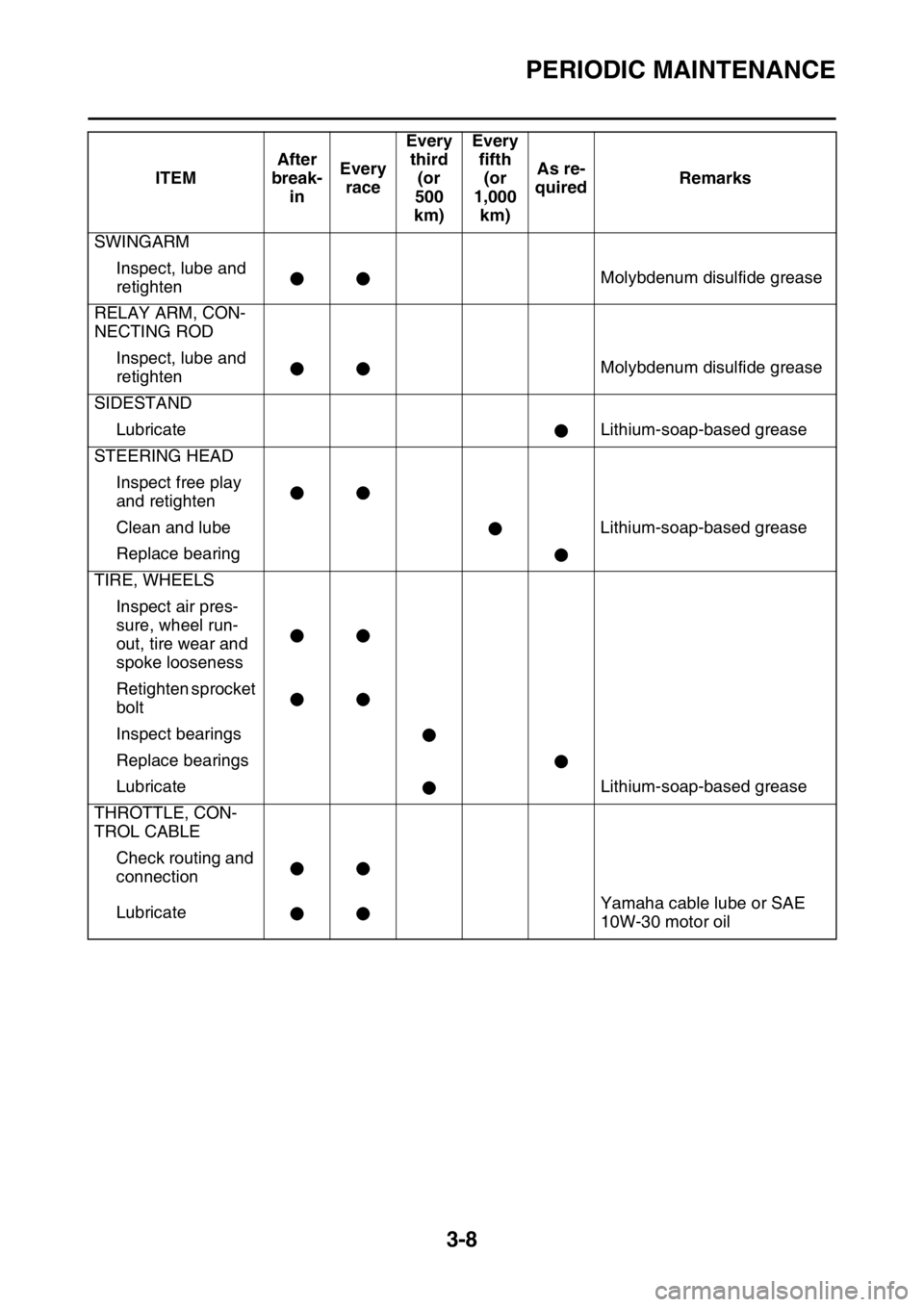
SWINGARMInspect, lube and
retighten Molybdenum disulfide grease
RELAY ARM, CON-
NECTING ROD Inspect, lube and
retighten Molybdenum disulfide grease
SIDESTAND Lubricate Lithium-soap-based grease
STEERING HEAD Inspect free play
and retighten
Clean and lube Lithium-soap-based grease
Replace bearing
TIRE, WHEELS
Inspect air pres-
sure, wheel run-
out, tire wear and
spoke looseness
Retighten sprocket
bolt
Inspect bearings
Replace bearings
Lubricate Lithium-soap-based grease
THROTTLE, CON-
TROL CABLE
Check routing and
connection
Lubricate Yamaha cable lube or SAE
10W-30 motor oil
ITEM
After
break- in Every
race Every
third (or
500
km) Every
fifth (or
1,000 km) As re-
quired Remarks
Page 107 of 426
PRE-OPERATION INSPECTION AND MAINTENANCE
3-9
EAS2GC1079
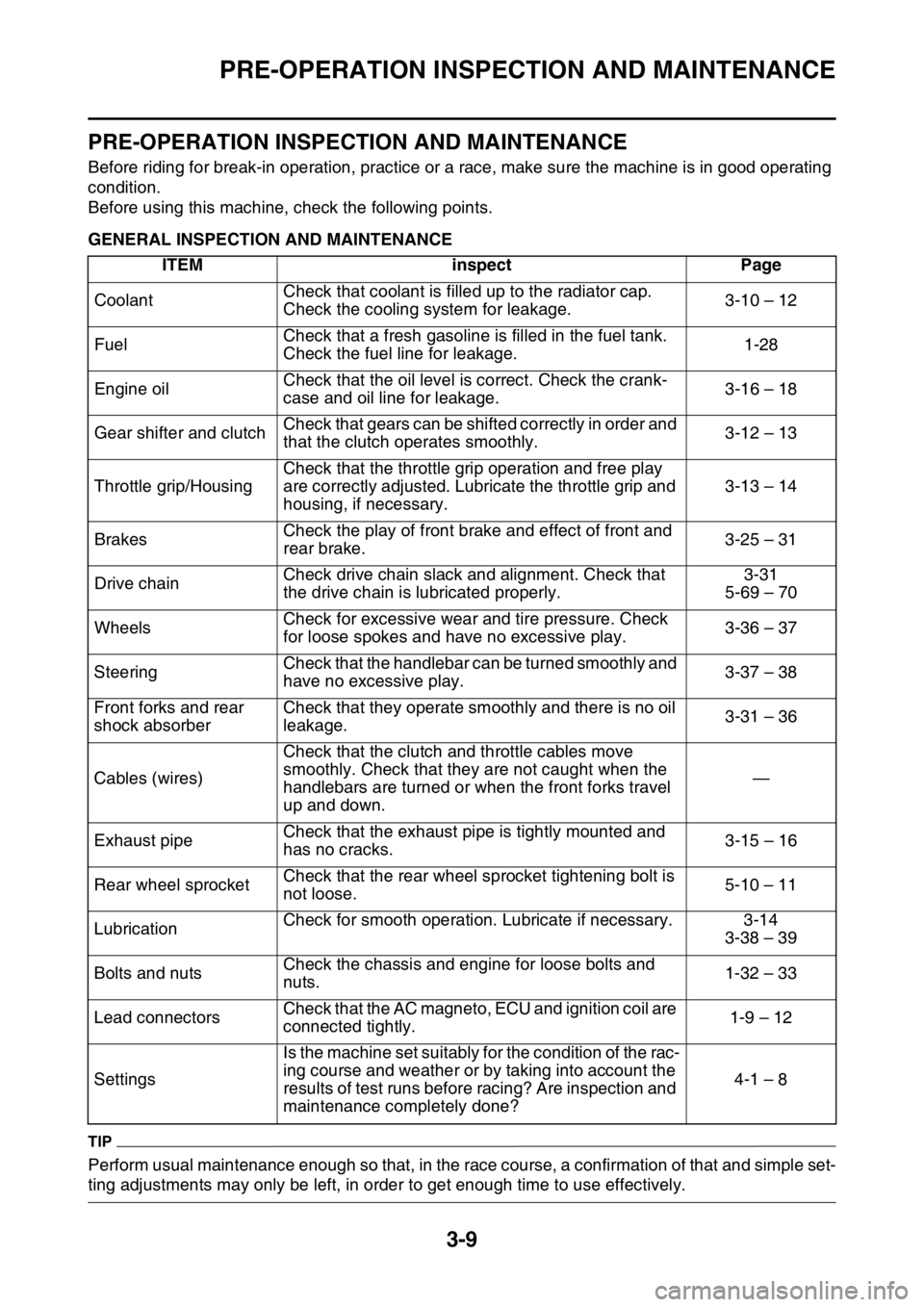
PRE-OPERATION INSPECTION AND MAINTENANCE
Before riding for break-in operation, practice or a race, make sure the machine is in good operating
condition.
Before using this machine, check the following points.
EAS2GC1080GENERAL INSPECTION AND MAINTENANCE
TIP
Perform usual maintenance enough so that, in the race course, a confirmation of that and simple set-
ting adjustments may only be left, in order to get enough time to use effectively.ITEM inspect Page
Coolant Check that coolant is filled up to the radiator cap.
Check the cooling system for leakage. 3-10 – 12
Fuel Check that a fresh gasoline is filled in the fuel tank.
Check the fuel line for leakage. 1-28
Engine oil Check that the oil level is correct. Check the crank-
case and oil line for leakage. 3-16 – 18
Gear shifter and clutch Check that gears can be shifted correctly in order and
that the clutch operates smoothly. 3-12 – 13
Throttle grip/Housing Check that the throttle grip operation and free play
are correctly adjusted. Lubricate the throttle grip and
housing, if necessary. 3-13 – 14
Brakes Check the play of front brake and effect of front and
rear brake. 3-25 – 31
Drive chain Check drive chain slack and alignment. Check that
the drive chain is lubricated properly. 3-31
5-69 – 70
Wheels Check for excessive wear and tire pressure. Check
for loose spokes and have no excessive play. 3-36 – 37
Steering Check that the handlebar can be turned smoothly and
have no excessive play. 3-37 – 38
Front forks and rear
shock absorber Check that they operate smoothly and there is no oil
leakage.
3-31 – 36
Cables (wires) Check that the clutch and throttle cables move
smoothly. Check that they are not caught when the
handlebars are turned or when the front forks travel
up and down.
—
Exhaust pipe Check that the exhaust pipe is tightly mounted and
has no cracks. 3-15 – 16
Rear wheel sprocket Check that the rear wheel sprocket tightening bolt is
not loose. 5-10 – 11
Lubrication Check for smooth operation. Lubricate if necessary. 3-14
3-38 – 39
Bolts and nuts Check the chassis and engine for loose bolts and
nuts. 1-32 – 33
Lead connectors Check that the AC magneto, ECU and ignition coil are
connected tightly. 1-9 – 12
Settings Is the machine set suitably for the condition of the rac-
ing course and weather or by taking into account the
results of test runs before racing? Are inspection and
maintenance completely done?
4-1 – 8
Page 123 of 426
CHASSIS
3-25
EAS2GC1101
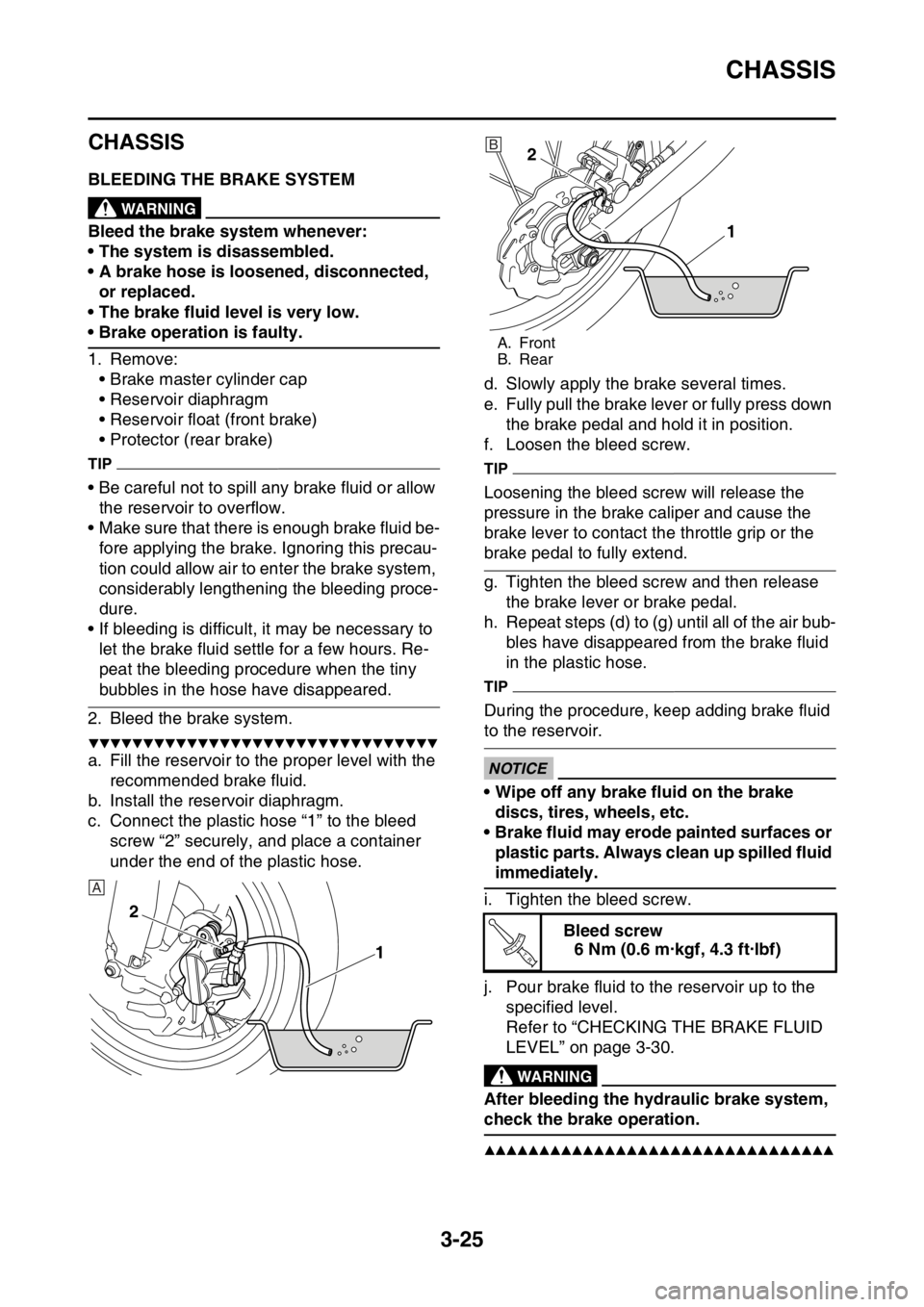
CHASSIS
EAS2GC1102BLEEDING THE BRAKE SYSTEMEWA
WARNING
Bleed the brake system whenever:
• The system is disassembled.
• A brake hose is loosened, disconnected, or replaced.
• The brake fluid level is very low.
• Brake operation is faulty.
1. Remove: • Brake master cylinder cap
• Reservoir diaphragm
• Reservoir float (front brake)
• Protector (rear brake)
TIP
• Be careful not to spill any brake fluid or allow the reservoir to overflow.
• Make sure that there is enough brake fluid be-
fore applying the brake. Ignoring this precau-
tion could allow air to enter the brake system,
considerably lengthening the bleeding proce-
dure.
• If bleeding is difficult, it may be necessary to let the brake fluid settle for a few hours. Re-
peat the bleeding procedure when the tiny
bubbles in the hose have disappeared.
2. Bleed the brake system.
▼▼▼▼▼▼▼▼▼▼▼▼▼▼▼▼▼▼▼▼▼▼▼▼▼▼▼▼▼▼▼▼
a. Fill the reservoir to the proper level with the recommended brake fluid.
b. Install the reservoir diaphragm.
c. Connect the plastic hose “1” to the bleed screw “2” securely, and place a container
under the end of the plastic hose. d. Slowly apply the brake several times.
e. Fully pull the brake lever or fully press down
the brake pedal and hold it in position.
f. Loosen the bleed screw.
TIP
Loosening the bleed screw will release the
pressure in the brake caliper and cause the
brake lever to contact the throttle grip or the
brake pedal to fully extend.
g. Tighten the bleed screw and then release the brake lever or brake pedal.
h. Repeat steps (d) to (g) until all of the air bub- bles have disappeared from the brake fluid
in the plastic hose.
TIP
During the procedure, keep adding brake fluid
to the reservoir.
ECA
NOTICE
• Wipe off any brake fluid on the brake discs, tires, wheels, etc.
• Brake fluid may erode painted surfaces or
plastic parts. Always clean up spilled fluid
immediately.
i. Tighten the bleed screw.
j. Pour brake fluid to the reservoir up to the specified level.
Refer to “CHECKING THE BRAKE FLUID
LEVEL” on page 3-30.
EWA
WARNING
After bleeding the hydraulic brake system,
check the brake operation.
▲▲▲▲▲▲▲▲▲▲▲▲▲▲▲▲▲▲▲▲▲▲▲▲▲▲▲▲▲▲▲▲
1
2
A
A. Front
B. Rear
Bleed screw
6 Nm (0.6 m·kgf, 4.3 ft·lbf)
2
1B
T R..
Page 127 of 426
CHASSIS
3-29
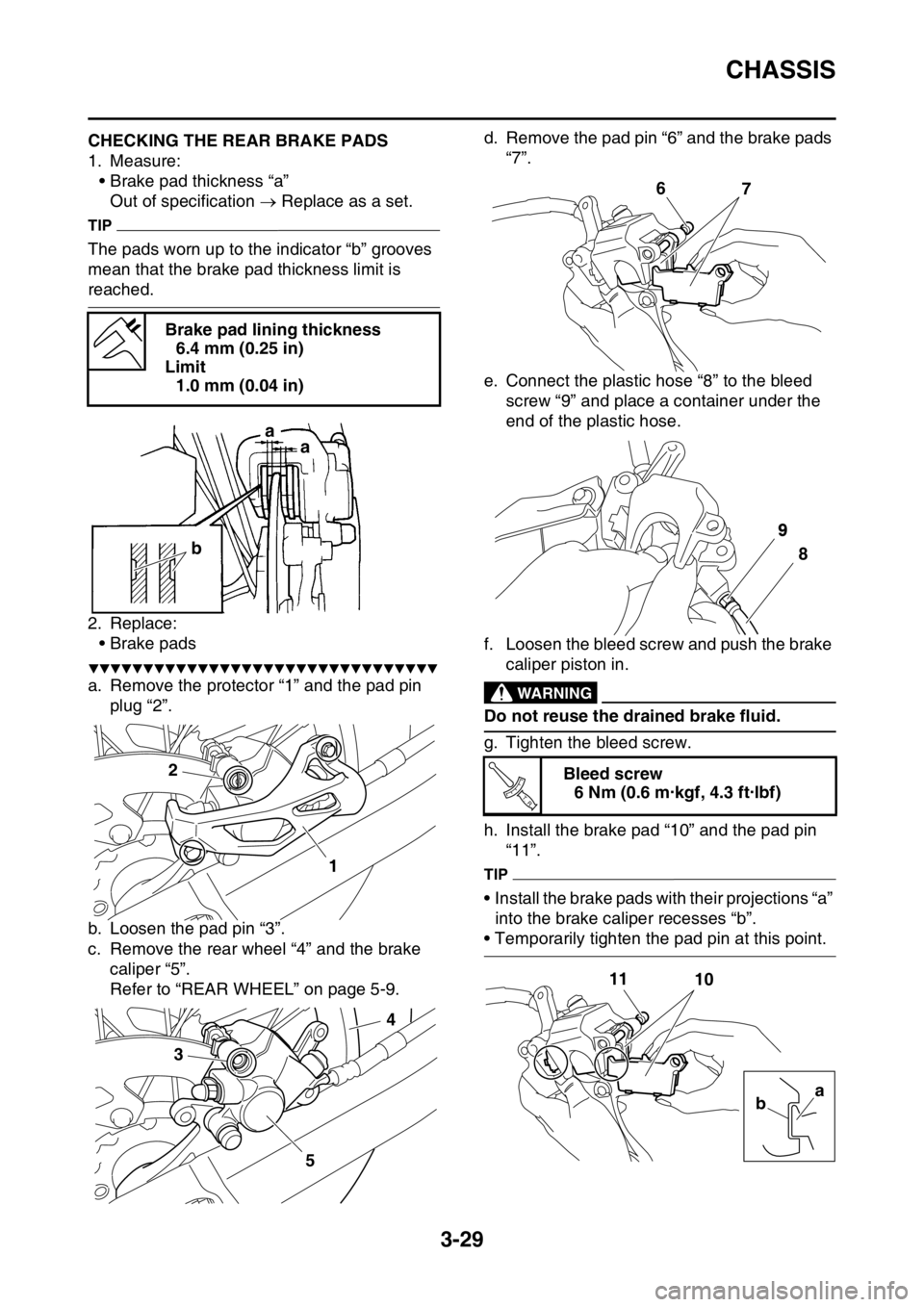
EAS2GC1107CHECKING THE REAR BRAKE PADS
1. Measure:• Brake pad thickness “a”Out of specification Replace as a set.
TIP
The pads worn up to the indicator “b” grooves
mean that the brake pad thickness limit is
reached.
2. Replace:
• Brake pads
▼▼▼▼▼▼▼▼▼▼▼▼▼▼▼▼▼▼▼▼▼▼▼▼▼▼▼▼▼▼▼▼
a. Remove the protector “1” and the pad pin
plug “2”.
b. Loosen the pad pin “3”.
c. Remove the rear wheel “4” and the brake caliper “5”.
Refer to “REAR WHEEL” on page 5-9. d. Remove the pad pin “6” and the brake pads
“7”.
e. Connect the plastic hose “8” to the bleed screw “9” and place a container under the
end of the plastic hose.
f. Loosen the bleed screw and push the brake caliper piston in.EWA
WARNING
Do not reuse the drained brake fluid.
g. Tighten the bleed screw.
h. Install the brake pad “10” and the pad pin “11”.
TIP
• Install the brake pads with their projections “a” into the brake caliper recesses “b”.
• Temporarily tighten the pad pin at this point.
Brake pad lining thickness
6.4 mm (0.25 in)
Limit 1.0 mm (0.04 in)
b a
a
1
2
3
4
5
Bleed screw 6 Nm (0.6 m·kgf, 4.3 ft·lbf)
7
6
9
8
T R..
10
11
a
b
Page 128 of 426
CHASSIS
3-30
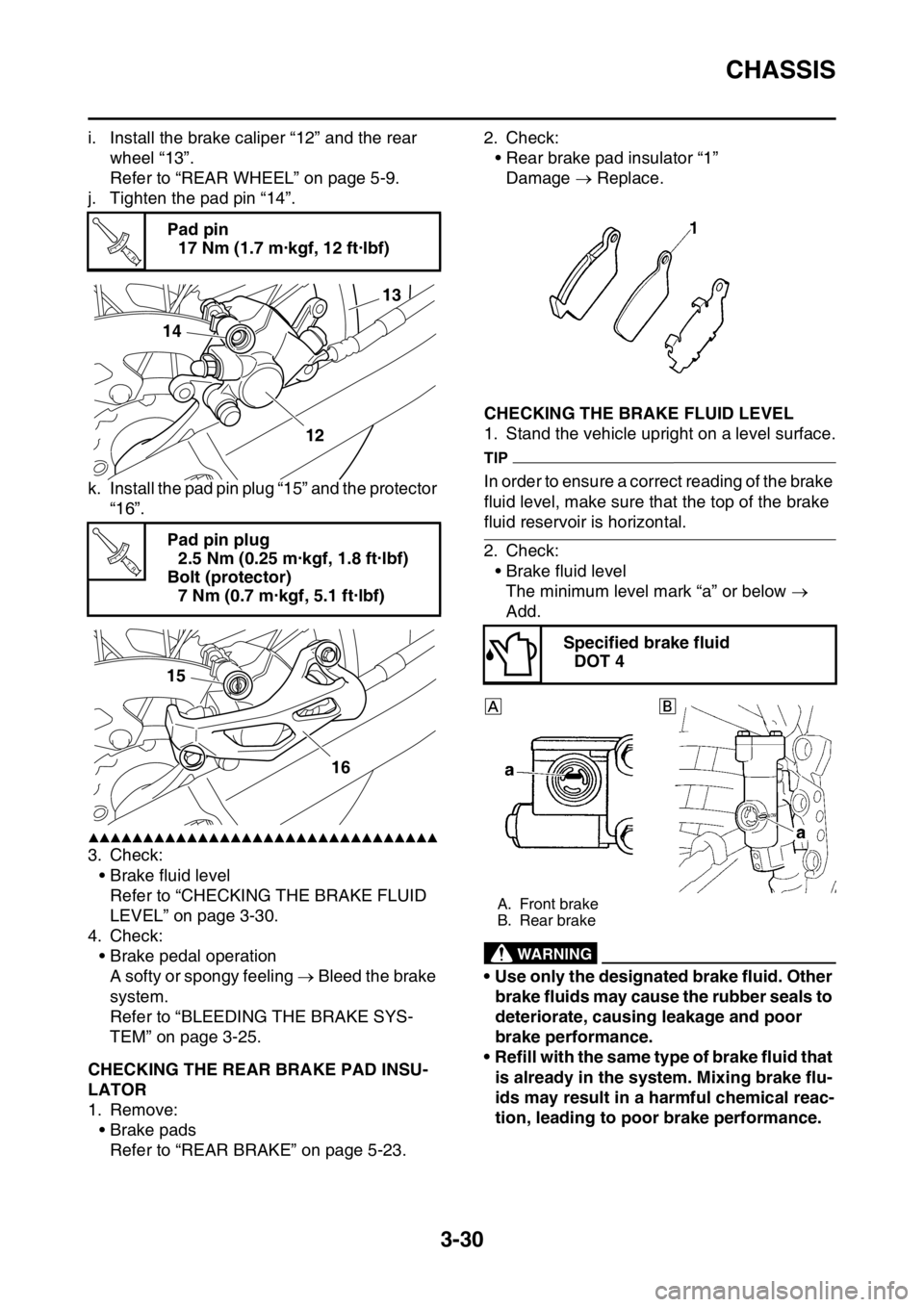
i. Install the brake caliper “12” and the rear wheel “13”.
Refer to “REAR WHEEL” on page 5-9.
j. Tighten the pad pin “14”.
k. Install the pad pin plug “15” and the protector “16”.
▲▲▲▲▲▲▲▲▲▲▲▲▲▲▲▲▲▲▲▲▲▲▲▲▲▲▲▲▲▲▲▲
3. Check:• Brake fluid levelRefer to “CHECKING THE BRAKE FLUID
LEVEL” on page 3-30.
4. Check: • Brake pedal operationA softy or spongy feeling Bleed the brake
system.
Refer to “BLEEDING THE BRAKE SYS-
TEM” on page 3-25.
EAS2GC1108CHECKING THE REAR BRAKE PAD INSU-
LATOR
1. Remove: • Brake padsRefer to “REAR BRAKE” on page 5-23. 2. Check:
• Rear brake pad insulator “1”Damage Replace.
EAS2GC1109CHECKING THE BRAKE FLUID LEVEL
1. Stand the vehicle upright on a level surface.
TIP
In order to ensure a correct reading of the brake
fluid level, make sure that the top of the brake
fluid reservoir is horizontal.
2. Check:
• Brake fluid levelThe minimum level mark “a” or below
Add.
EWA
WARNING
• Use only the designated brake fluid. Other brake fluids may cause the rubber seals to
deteriorate, causing leakage and poor
brake performance.
• Refill with the same type of brake fluid that
is already in the system. Mixing brake flu-
ids may result in a harmful chemical reac-
tion, leading to poor brake performance.
Pad pin
17 Nm (1.7 m·kgf, 12 ft·lbf)
Pad pin plug 2.5 Nm (0.25 m·kgf, 1.8 ft·lbf)
Bolt (protector) 7 Nm (0.7 m·kgf, 5.1 ft·lbf)
T R..
13
14
12
T R..
15 16
Specified brake fluidDOT 4
A. Front brake
B. Rear brake