fuel YAMAHA WR 450F 2016 Repair Manual
[x] Cancel search | Manufacturer: YAMAHA, Model Year: 2016, Model line: WR 450F, Model: YAMAHA WR 450F 2016Pages: 426, PDF Size: 10.86 MB
Page 351 of 426

SIGNALING SYSTEM
9-21
1. Joint connector
2. Joint connector
3. Joint connector
7. Main relay
9. Battery
10.Frame ground
11.Starter relay
12.Main fuse
15.Indicator light
17.Fuel level warning light
18.Resistor
19.Fuel sender
22.ECU (engine control unit)
30.Joint connector
42.Joint connector
46.Speed sensor
47.Multi-function display
48.Frame ground
50.Negative battery lead
Page 352 of 426

SIGNALING SYSTEM
9-22
EAS2GC1369TROUBLESHOOTING
• The speedometer does not operate normally.
• The fuel indicator light does not come on.
TIP
Before troubleshooting, remove the following part (s):
1. Seat
2. Side cover (left/right)
3. Air scoop (left/right)
4. Fuel tank
Check the signaling system
The speedometer fails to operate.
1. Check the fuse.Refer to “CHECKING THE FUSES”
on page 9-68. NG
Replace the fuse(s).
OK
2. Check the battery. Refer to “CHECKING AND
CHARGING THE BATTERY” on
page 9-69. NG
• Clean the battery terminals.
• Recharge or replace the battery.
OK
3. Check the main relay. Refer to “CHECKING THE RE-
LAYS” on page 9-72. NG
Replace the main relay.
OK
4. Check the entire signaling system’s wiring.
Refer to “CIRCUIT DIAGRAM” on
page 9-20. NG
Properly connect or repair the signaling
system’s wiring.
OK
This circuit is OK.
1. Check the speed sensor. Refer to “CHECKING THE SPEED
SENSOR” on page 9-77. NG
Replace the speed sensor.
OK
2. Check the entire signaling system’s wiring.
Refer to “CIRCUIT DIAGRAM” on
page 9-20. NG
Properly connect or repair the signaling
system’s wiring.
OK
Replace the meter assembly.
Page 353 of 426

SIGNALING SYSTEM
9-23
The fuel level warning light fails to come on.
1. Check the fuel sender.Refer to “CHECKING THE FUEL
SENDER” on page 9-77. NG
Replace the fuel sender assembly.
OK
2. Check the resistor. Refer to “CHECKING THE RESIST-
ER” on page 9-77. NG
Replace the resistor.
OK
3. Check the entire signaling system’s wiring.
Refer to “CIRCUIT DIAGRAM” on
page 9-20. NG
Properly connect or repair the signaling
system’s wiring.
OK
Replace the indicator light assembly.
Page 356 of 426
COOLING SYSTEM
9-26
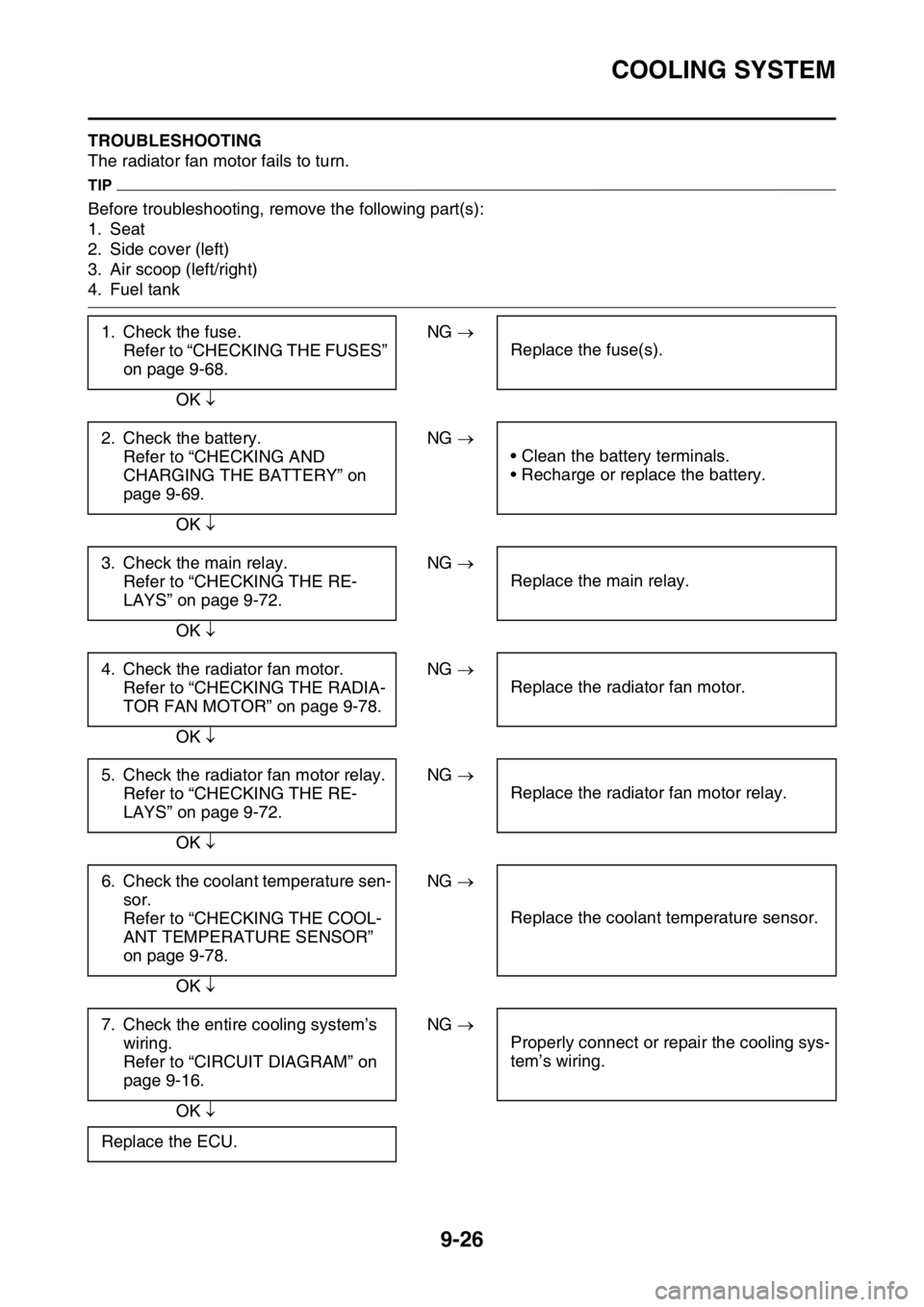
EAS2GC1372TROUBLESHOOTING
The radiator fan motor fails to turn.
TIP
Before troubleshooting, remove the following part(s):
1. Seat
2. Side cover (left)
3. Air scoop (left/right)
4. Fuel tank1. Check the fuse. Refer to “CHECKING THE FUSES”
on page 9-68. NG
Replace the fuse(s).
OK
2. Check the battery. Refer to “CHECKING AND
CHARGING THE BATTERY” on
page 9-69. NG
• Clean the battery terminals.
• Recharge or replace the battery.
OK
3. Check the main relay. Refer to “CHECKING THE RE-
LAYS” on page 9-72. NG
Replace the main relay.
OK
4. Check the radiator fan motor. Refer to “CHECKING THE RADIA-
TOR FAN MOTOR” on page 9-78. NG
Replace the radiator fan motor.
OK
5. Check the radiator fan motor relay. Refer to “CHECKING THE RE-
LAYS” on page 9-72. NG
Replace the radiator fan motor relay.
OK
6. Check the coolant temperature sen- sor.
Refer to “CHECKING THE COOL-
ANT TEMPERATURE SENSOR”
on page 9-78. NG
Replace the coolant temperature sensor.
OK
7. Check the entire cooling system’s wiring.
Refer to “CIRCUIT DIAGRAM” on
page 9-16. NG
Properly connect or repair the cooling sys-
tem’s wiring.
OK
Replace the ECU.
Page 358 of 426
FUEL INJECTION SYSTEM
9-28
FUEL INJECTION SYSTEM
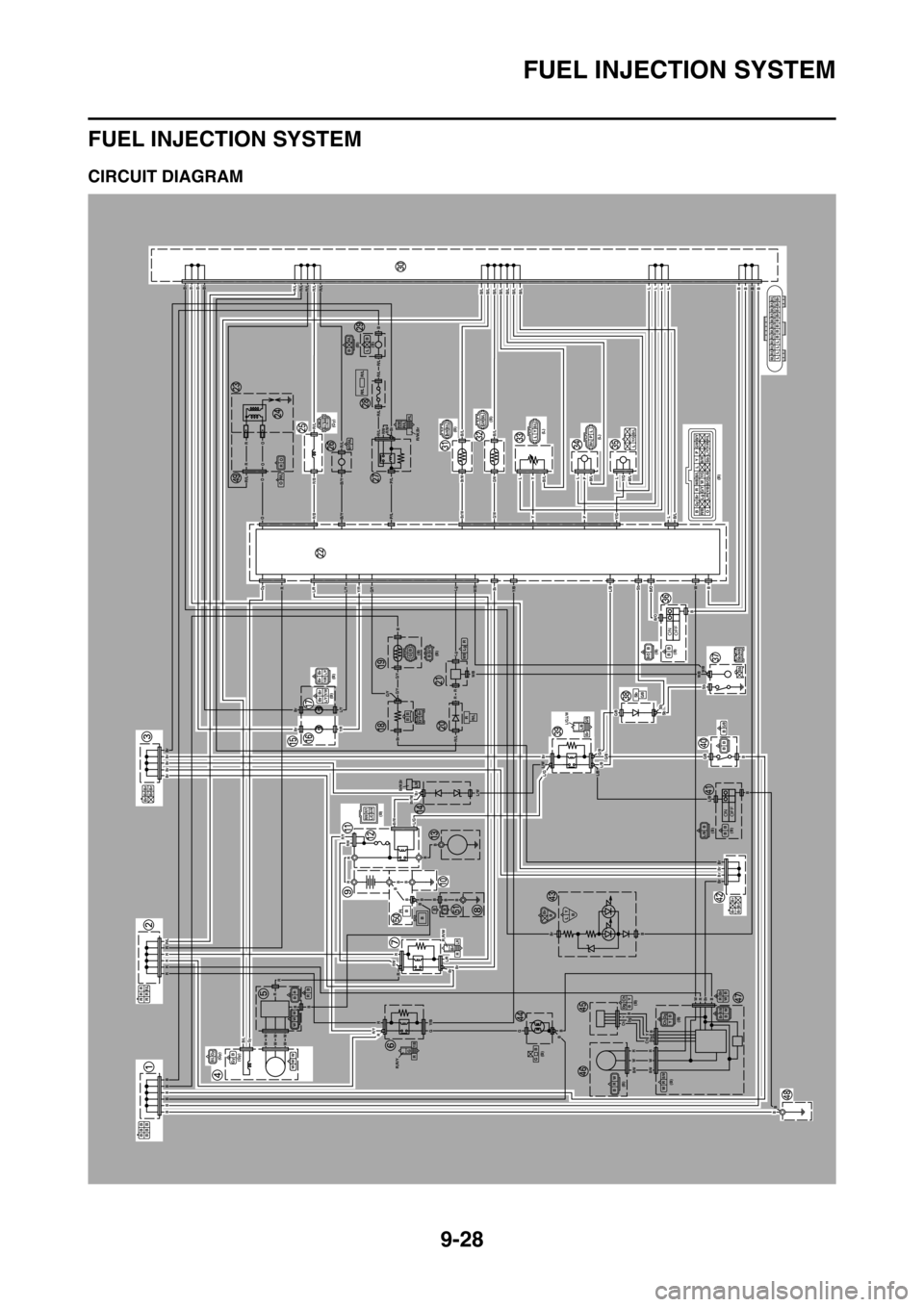
EAS2GC1374CIRCUIT DIAGRAM
ONOFF
ONOFF
BBB
BBB
RRR
RRR/L
Br Br Br
Br Br
(Gy)
(Gy)B/LGyWW W BGy
BR
WW W
BR
R,R/Y
G
R
Y/B
R,R/W
Br
RL/R
(B)R/YR/WBr/WL/G
Br/W,BrL/W
(B)
(B) Br BrL/Y
Y/R
G/YBrBB
BrBrL/YY/W
(B) (B)B BGG/Y
RR/L
RLg
W/B
(B)
BGyBr RW/BB/LLYP
G/WB/Y
R/BLgG/YW
Br/W
OL/RY/BB/OL/BSbY/R
L/Y P/L
Y/G
(Gy)R/L R/BR/LB/Y
R/WR/L
R/W,BrP/L
R/L R/L
(B)
(B) (B)
(L)
(L) (B)
BR/LLBR/L R/L R/L R/L R/L B/L B/L B/L B/L B/L B/L B/LLLLLBBBB
Br Br Br Br
B/LBr/W
B/LG/WLYB/L
B/LPLB/LY/GL
(B)
(B)B/OBBBSbW/B
Sb
SbG/B
L/G,L/WL/BBrG/BG/BB
BB
(B)
(B)L/BBBB
Br Br
Br BrBr
BB
LY
(B)
(B)
(B)
(B)
(B)
GB
ChDg YB
BRW
BrRBW
B/WRW
Ch DgYBBrR/WBW
R
O
OR/L
BB
B
B
BBBBBB
RRRRRR/L
BrBrBrBrBr
Br
Br
BrBrBrBrR/LR/LR/LR/LR/L
B
LLLP
PL
Y
Y
RR
Br
R/LR/L
R/L
P/L
P/L
R/L
R/L
R/LR/B
R/B
L/RL/Y
L/Y
Y/R
Y/R
G/Y
G/YG/Y
G/Y
B/Y
B/Y
R/LB/LB/L
B/LB/LB/LY/G
Y/GB/L
B/OL/BY/BW/B
W/B
G/B
L/B
W/BW/B
L/BL/BL/GL/W
L/W
L/R
Br/W
Br/W
R/W
R/W
R/Y
R/Y
G/BG/B
G/B
B/O
B/LB/LB/LB/LB/LB/LB/L
G/W
G/W
Br/W
Br/W
R/WR/WBr
O
O
RGy
LLLLBBBB
B
B
B
B
BB
B
B
RRWW
Y
Y
Dg
Dg
Ch
Ch
RW
BrBrBrBr
Br
B
W
Sb
SbSb
SbBr
Br
B
Br
Lg
Lg
R/L
R
R
RR
Gy
BB
WWWWWW
R
RRGGBB
B
Y/B
BB
Br
Br
Br
L/G
B/L
B/WB/W
OR
OR
RBBB
B
BBBBB
Page 359 of 426

FUEL INJECTION SYSTEM
9-29
1. Joint connector
2. Joint connector
3. Joint connector
4. AC magneto
7. Main relay
9. Battery
10.Frame ground
11.Starter relay
12.Main fuse
15.Indicator light
16.Engine trouble warning light
22.ECU (engine control unit)
25.Injector
30.Joint connector
31.Intake air temperature sensor
32.Coolant temperature sensor
33.Throttle position sensor
34.Intake air pressure sensor
35.Lean angle sensor
36.Engine stop switch
37.Neutral switch
38.Diode
39.Starting circuit cut-off relay
40.Clutch switch
42.Joint connector
48.Frame ground
50.Negative battery lead
Page 360 of 426

FUEL INJECTION SYSTEM
9-30
EAS2GC1375ECU SELF-DIAGNOSTIC FUNCTION
The ECU is equipped with a self-diagnostic function in order to ensure that the fuel injection system
is operating normally. If this function detects a malfunction in the system, it immediately operates the
engine under substitute characteristics and illuminat es the engine trouble warning light to alert the
rider that a malfunction has occurred in the syst em. Once a malfunction has been detected, a fault
code number is stored in the memory of the ECU.
• To inform the rider that the fuel injection system is not functioning, the engine trouble warning light
flashes while the start switch is being pushed to start the engine.
• If a malfunction is detected in the system by th e self-diagnostic function, the ECU provides an ap-
propriate substitute characteristic operation, and al erts the rider of the detected malfunction by illu-
minating the engine trouble warning light.
Engine trouble warning light indication and fuel injection system operation
* The warning light flashes when any one of the foll owing conditions is present and the start switch
is pushed:
Checking the engine trouble warning light
The engine trouble warning light comes on for around 2 seconds when pushing the start switch to
turn on the meter light and the engine trouble warning light comes on while the start switch is being
pushed. Warning light indica-
tion ECU operation Fuel injection opera-
tion Vehicle operation
Flashing* Warning provided when unable to start
engine Operation stopped Cannot be operated
Remains on Malfunction detected Operated with substi- tute characteristics in
accordance with the
description of the mal-
functionCan or cannot be oper-
ated depending on the
fault code
12: Crankshaft position sensor 41: Lean angle sensor (open or short circuit)
30: Lean angle sensor (latch up detected) 50: ECU internal malfunction
(faulty ECU memory)
33: Ignition coil (Malfunction detected in the primary wire
of the ignition coil)
a. The meter light does not come on.
b. The meter light comes on.
c. Light OFF
d. Light ON for 2 seconds
ab
cd c
Page 361 of 426

FUEL INJECTION SYSTEM
9-31
ECU detects an abnormal signal from a sensor
If the ECU detects an abnormal signal from a sensor while the vehicle is being driven, the ECU illu-
minates the engine trouble warning light and provides the engine with alternate operating instructions
that are appropriate for the type of malfunction.
When an abnormal signal is received from a sensor, the ECU processes the specified values that are
programmed for each sensor in order to provide the engine with alternate operating instructions that
enable the engine to continue operating or stop operating, depending on the conditions.
EAS2GC1376TROUBLESHOOTING METHOD
The engine operation is not normal and the engine trouble warning light comes on.
1. Check: • Fault code number
▼▼▼▼▼▼▼▼▼▼▼▼▼▼▼▼▼▼▼▼▼▼▼▼▼▼▼▼▼▼▼▼▼▼▼▼▼▼▼▼▼▼▼▼▼▼▼▼▼▼▼▼▼▼▼▼▼▼▼▼▼▼▼▼▼▼▼▼
a. Connect the Yamaha diagnostic tool. Refer to “YAMAHA DIAGNOSTIC TOOL” on page 9-32.
b. Check the fault code number disp layed on the Yamaha diagnostic tool.
c. Identify the faulty system with the fault code number.
d. Identify the probable cause of the malfunction.
▲▲▲▲▲▲▲▲▲▲▲▲▲▲▲▲▲▲▲▲▲▲▲▲▲▲▲▲▲▲▲▲▲▲▲▲▲▲▲▲▲▲▲▲▲▲▲▲▲▲▲▲▲▲▲▲▲▲▲▲▲▲▲▲▲▲▲▲
2. Check and repair the probable cause of the malfunction.
3. Perform the reinstatement action for the fuel injection system. Refer to “Confirmation of service
completion” in the appropriate table in “TROUBLESHOOTING DETAILS” on page 9-35.
4. After pushing the engine stop switch, push the start switch to check whether the fault code no. is
displayed.
TIP
If another fault code number is displayed, repeat steps (1) to (4) until no fault code number is dis-
played.
5. Erase the malfunction history in the diagnostic mode. Refer to “SENSOR OPERATION TABLE”
(Diagnostic code No.62).
TIP
Turning off the meter light will not erase the malfunction history.
The engine operation is not normal, but the engine trouble warning light does not come on.
1. Check the operation of the following sensors an d actuators in the diagnostic mode. Refer to
“TROUBLESHOOTING DETAILS” on page 9-35.
If a malfunction is detected in the sensors or ac tuators, repair or replace all faulty parts.
If no malfunction is detected in the sensors and ac tuators, check and repair the inner parts of the
engine. Fault code No. No fault code No.
Check and repair. Refer to “TROUBLESHOOT-
ING DETAILS” on page 9-35.
Monitor the operation of the sensors and actua-
tors in the diagnostic mode. Refer to “TROU-
BLESHOOTING DETAILS” on page 9-35 and
“LIST OF SELF-DIAGNOSTIC AND FAIL-SAFE
ACTIONS” on page 10-5. Check and repair.
01: Throttle position sensor signal (throttle angle)
30: Ignition coil
36: Injector
Page 362 of 426
FUEL INJECTION SYSTEM
9-32
EAS2GC1377YAMAHA DIAGNOSTIC TOOL
This model uses the Yamaha diagnostic tool to identify malfunctions.
For information about using the Yamaha diagnostic tool, refer to the operation manual that is included
with the tool.
FEATURES OF THE YAMAHA DIAGNOSTIC TOOL
A diagnosis can be made more quickly than traditional methods with the Yamaha diagnostic tool.
Using this software, ECU and sensor data, as well as fault diagnosis, vehicle maintenance, and any
necessary information can be recorded and disp layed on your computer screen through a USB
adapter connected to the computer interface with a communication cable connected to the vehicle’s
ECU.
Data obtained in various functions can be saved as vehicle history, and can be accumulated.
FUNCTIONS OF THE YAMAHA DIAGNOSTIC TOOL
However, the diagnostic tool cannot be used to freely change the basic vehicle functions, such as
adjusting the ignition timing.
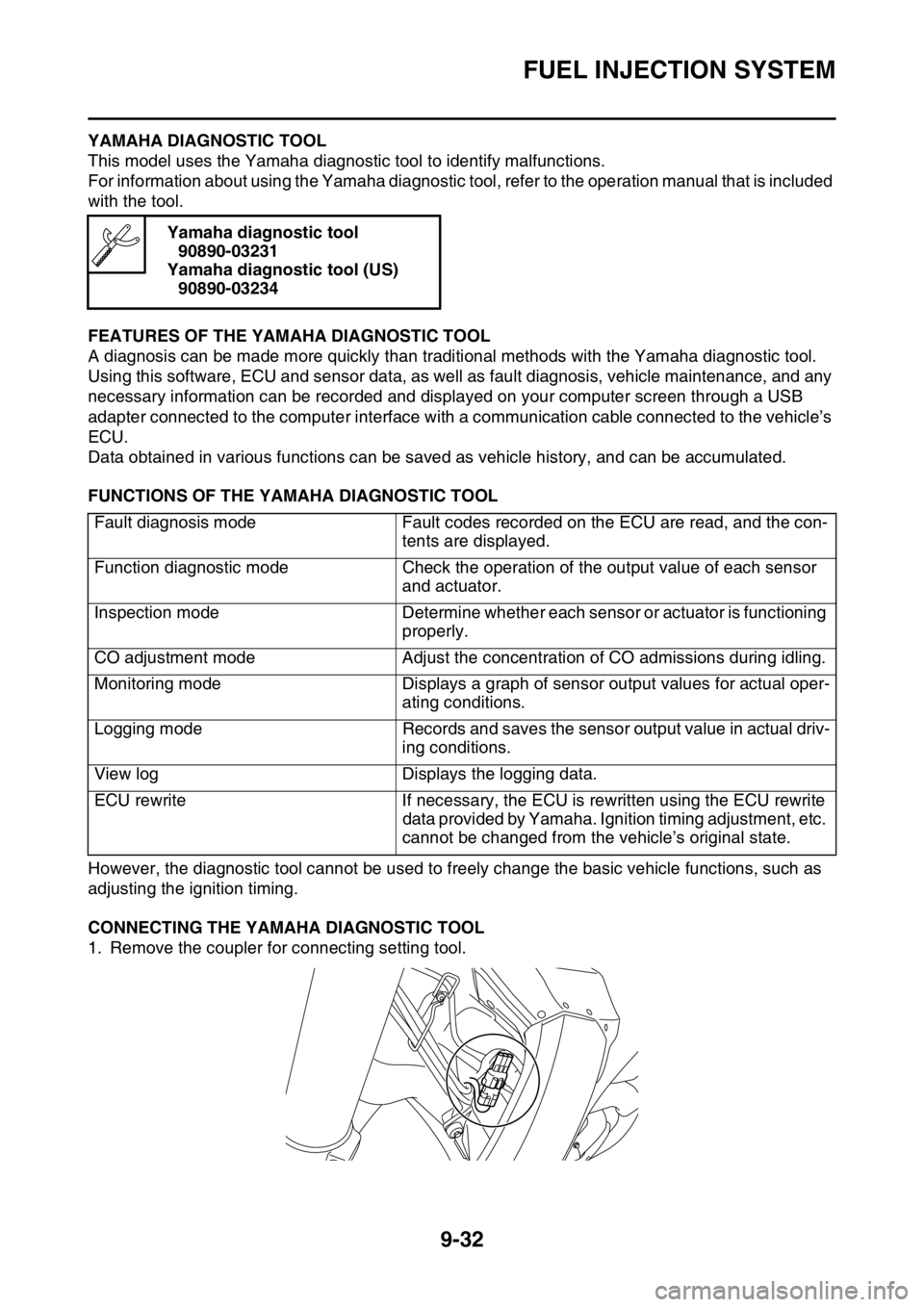
CONNECTING THE YAMAHA DIAGNOSTIC TOOL
1. Remove the coupler for connecting setting tool. Yamaha diagnostic tool
90890-03231
Yamaha diagnostic tool (US) 90890-03234
Fault diagnosis mode Fault codes recorded on the ECU are read, and the con- tents are displayed.
Function diagnostic mode Check the operation of the output value of each sensor
and actuator.
Inspection mode Determine whether each s ensor or actuator is functioning
properly.
CO adjustment mode Adjust the concentration of CO admissions during idling.
Monitoring mode Displays a graph of sensor output values for actual oper-
ating conditions.
Logging mode Records and saves the sensor output value in actual driv-
ing conditions.
View log Displays the logging data.
ECU rewrite If necessary, the ECU is rewritten using the ECU rewrite
data provided by Yamaha. Ignition timing adjustment, etc.
cannot be changed from the vehicle’s original state.
Page 363 of 426
FUEL INJECTION SYSTEM
9-33
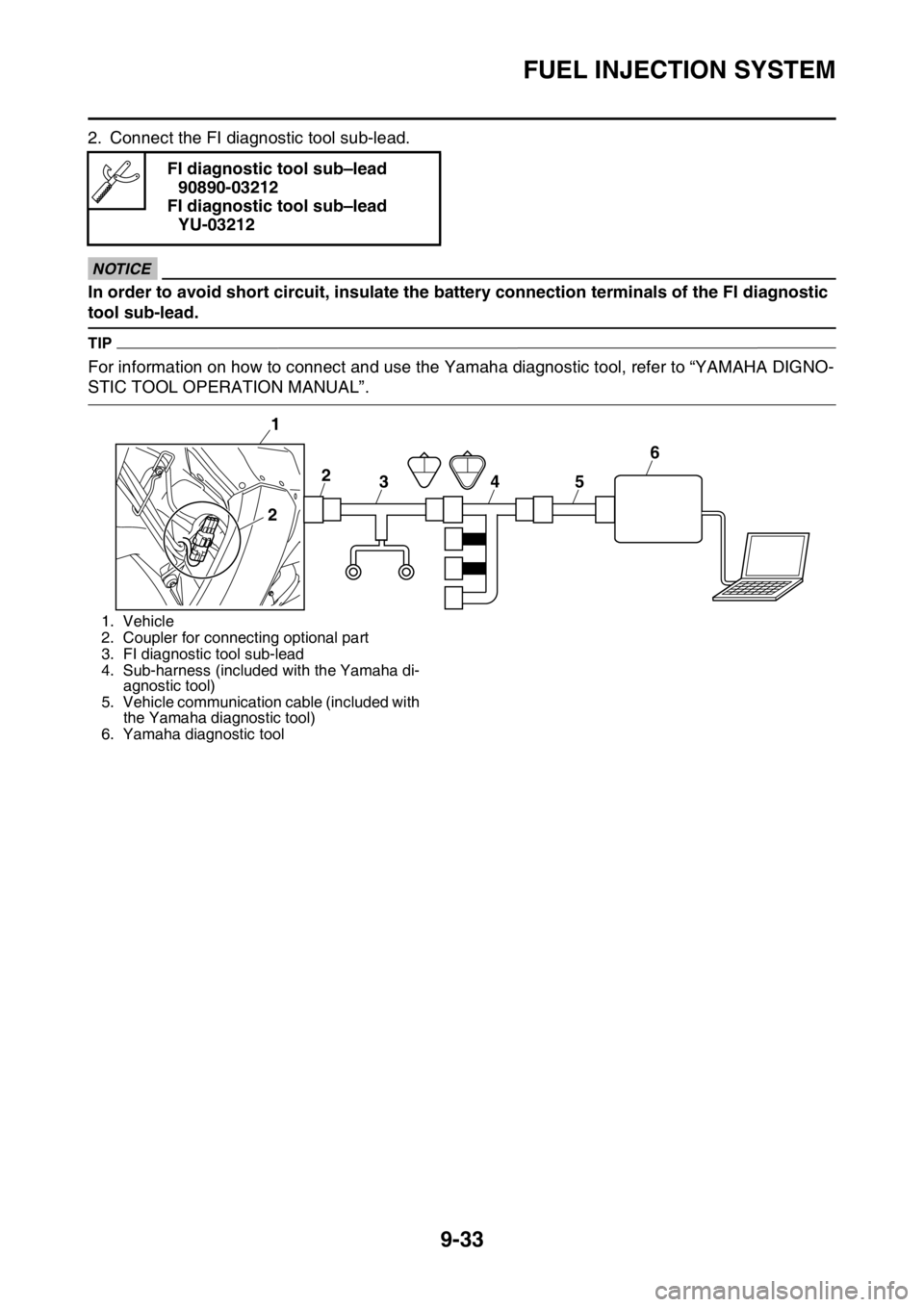
2. Connect the FI diagnostic tool sub-lead.
ECA
NOTICE
In order to avoid short circuit, insulate the battery connection terminals of the FI diagnostic
tool sub-lead.
TIP
For information on how to connect and use the Yamaha diagnostic tool, refer to “YAMAHA DIGNO-
STIC TOOL OPERATION MANUAL”.FI diagnostic tool sub–lead
90890-03212
FI diagnostic tool sub–lead YU-03212
1. Vehicle
2. Coupler for connecting optional part
3. FI diagnostic tool sub-lead
4. Sub-harness (included with the Yamaha di- agnostic tool)
5. Vehicle communication cable (included with the Yamaha diagnostic tool)
6. Yamaha diagnostic tool
1
2
3
2
456