ABS YAMAHA XJ6-N 2016 User Guide
[x] Cancel search | Manufacturer: YAMAHA, Model Year: 2016, Model line: XJ6-N, Model: YAMAHA XJ6-N 2016Pages: 104, PDF Size: 2.91 MB
Page 28 of 104
Instrument and control functions
3-14
3
EAU51802
ABS (for ABS mo dels)
The Yamaha ABS (Anti-lock Brake
System) features a dual electronic con-
trol system, which acts on the front and
rear brakes independently.
Operate the brakes with ABS as you
would conventional brakes. If the ABS
is activated, a pulsating sensation may
be felt at the brake lever or brake ped-
al. In this situation, continue to apply
the brakes and let the ABS work; do
not “pump” the brakes as this will re-
duce braking effectiveness.
WARNING
EWA16051
Always keep a sufficient distance
from the vehicle ahea d to match the
ri din g speed even with ABS.
The ABS performs best with
lon g b rakin g d istances.
On certain surfaces, such as
rou gh or g ravel roa ds, the b rak-
in g d istance may be lon ger with
the ABS than without.
The ABS is monitored by an ECU,
which will revert the system to conven-
tional braking if a malfunction occurs.
TIP
The ABS performs a self-diagno-
sis test each time the vehicle first
starts off after the key is turned to
“ON” and the vehicle has traveled
at a speed of 10 km/h (6 mi/h) or
higher. During this test, a “click-
ing” noise can be heard from un-
der the seat, and if the brake lever
or brake pedal is even slightly ap-
plied, a vibration can be felt at the
lever and pedal, but these do not
indicate a malfunction.
This ABS has a test mode which
allows the owner to experience
the pulsation at the brake lever or
brake pedal when the ABS is op-
erating. However, special tools are
required, so please consult your
Yamaha dealer.
NOTICE
ECA16121
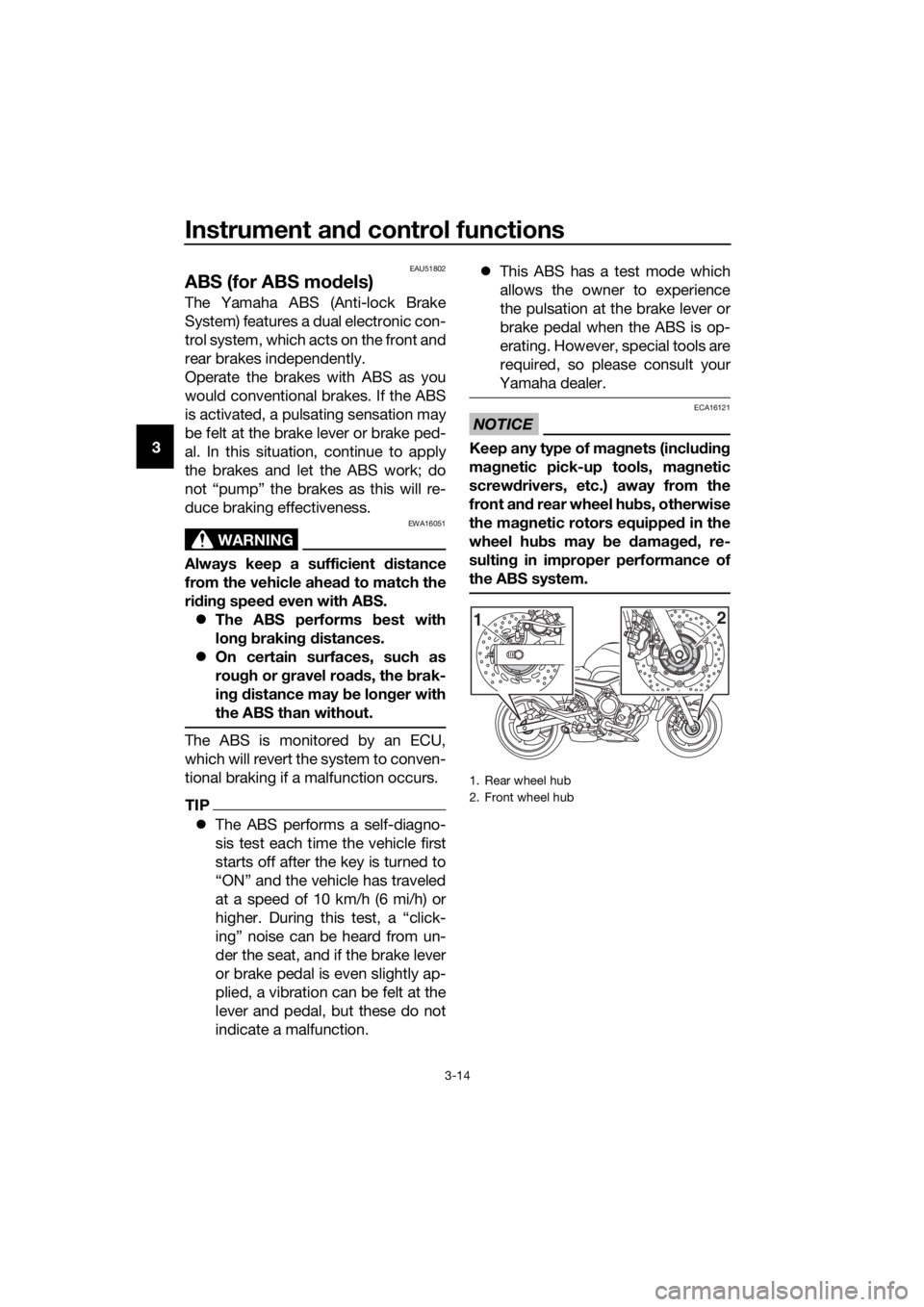
Keep any type of mag nets (includin g
ma gnetic pick-up tools, ma gnetic
screwd rivers, etc.) away from the
front an d rear wheel hu bs, otherwise
the ma gnetic rotors equippe d in the
wheel hu bs may be damag ed , re-
sultin g in improper performance of
the ABS system.
1. Rear wheel hub
2. Front wheel hub
12
UB61E1E0.book Page 14 Wednesday, October 21, 2015 11:19 AM
Page 35 of 104
Instrument and control functions
3-21
3
EAU47001
A djustin g the shock a bsor ber
assem bly
This shock absorber assembly is
equipped with a spring preload adjust-
ing ring.
NOTICE
ECA10102
To avoi d d amag ing the mechanism,
d o not attempt to turn beyon d the
maximum or minimum settin gs.
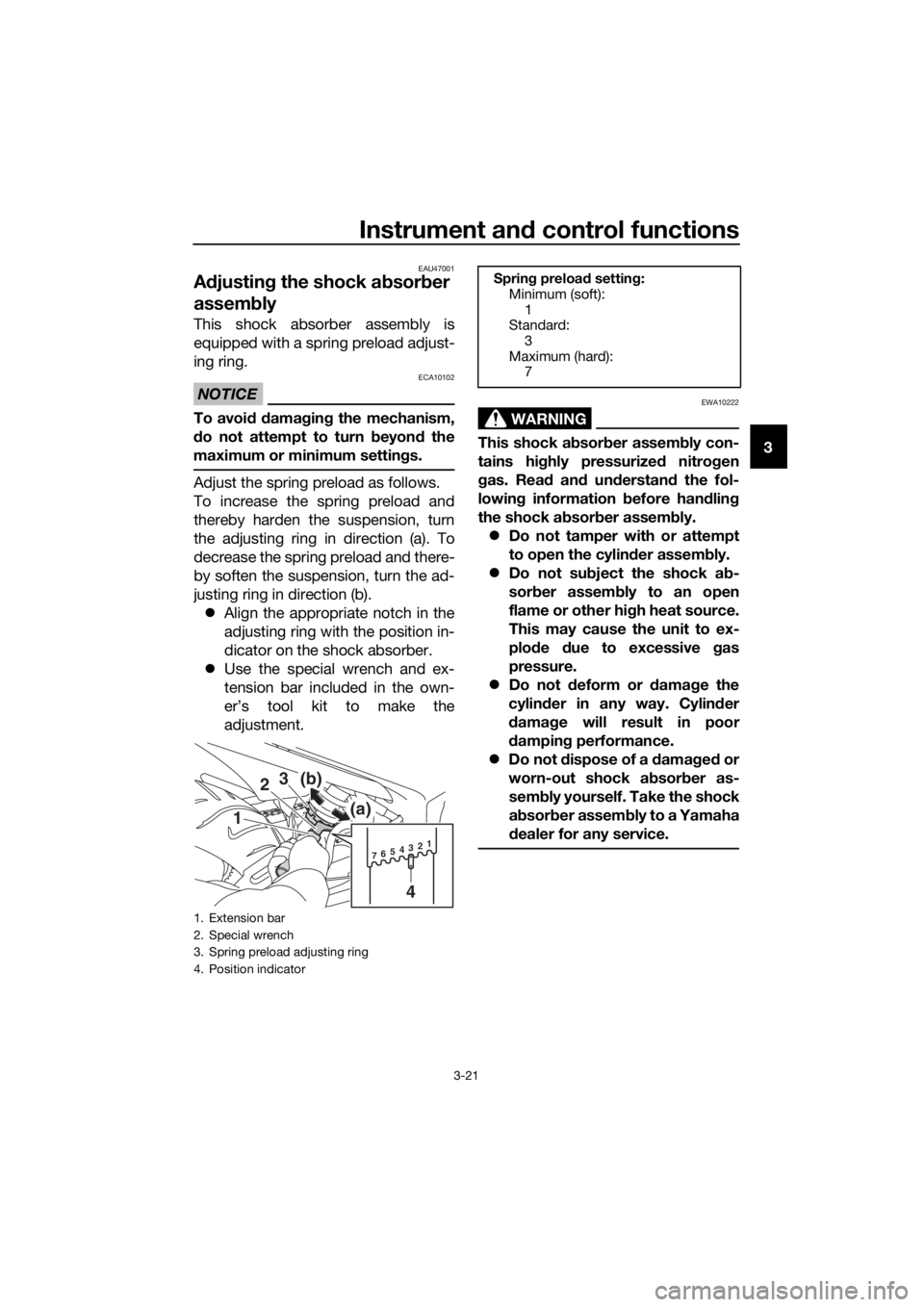
Adjust the spring preload as follows.
To increase the spring preload and
thereby harden the suspension, turn
the adjusting ring in direction (a). To
decrease the spring preload and there-
by soften the suspension, turn the ad-
justing ring in direction (b).
Align the appropriate notch in the
adjusting ring with the position in-
dicator on the shock absorber.
Use the special wrench and ex-
tension bar included in the own-
er’s tool kit to make the
adjustment.
WARNING
EWA10222
This shock ab sorber assem bly con-
tains hig hly pressurize d nitro gen
g as. Rea d an d un derstan d the fol-
lowin g information before han dlin g
the shock a bsor ber assem bly.
Do not tamper with or attempt
to open the cylind er assembly.
Do not su bject the shock a b-
sor ber assem bly to an open
flame or other hi gh heat source.
This may cause the unit to ex-
plo de due to excessive gas
pressure.
Do not deform or damag e the
cylin der in any way. Cylin der
d amag e will result in poor
d ampin g performance.
Do not dispose of a d amaged or
worn-out shock a bsor ber as-
sem bly
yourself. Take the shock
a b sor ber assem bly to a Yamaha
d ealer for any service.
1. Extension bar
2. Special wrench
3. Spring preload adjusting ring
4. Position indicator
1
2
3
4
5
6
7
1 2
3(a)
(b)
4
Sprin
g preloa d settin g:
Minimum (soft): 1
Standard:
3
Maximum (hard): 7
UB61E1E0.book Page 21 Wednesday, October 21, 2015 11:19 AM
Page 41 of 104
Operation and important ri din g points
5-2
5
EAU51792
Startin g the eng ine
In order for the ignition circuit cut-off
system to enable starting, one of the
following conditions must be met:
The transmission is in the neutral
position.
The transmission is in gear with
the clutch lever pulled and the
sidestand up.
See page 3-22 for more informa-
tion.
1. Turn the key to “ON” and make sure that the engine stop switch is
set to “ ”.
The following warning lights and
indicator light should come on for
a few seconds, then go off. Oil level warning light
Coolant temperature warning
light
Engine trouble warning light
Immobilizer system indicator
light
NOTICE
ECA17671
If the ab ove warnin g li ghts or in dica-
tor li ght do not come on initially
when the key is turned to “ON”, or if
a warnin g or in dicator li ght remains
on, see pa ge 3-4 for the correspon d-
in g warnin g an d in dicator li ght cir-
cuit check.
For ABS models:
The ABS warning light should
come on when the main switch is
turned to “ON” and then go off af-
ter traveling at a speed of 10 km/h
(6 mi/h) or higher.
NOTICE
ECA17682
If the ABS warnin g li ght does not
come on an d then go off as ex-
plained above, see pa ge 3-4 for the
warnin g li ght circuit check.
2. Shift the transmission into the
neutral position. The neutral indi-
cator light should come on. If not,
ask a Yamaha dealer to check the
electrical circuit.
3. Start the engine by pushing the start switch.
If the engine fails to start, release
the start switch, wait a few sec-
onds, and then try again. Each
starting attempt should be as
short as possible to preserve the
battery. Do not crank the engine
more than 10 seconds on any one
attempt.
NOTICE
ECA11043
For maximum en gine life, never ac-
celerate har d when the en gine is
col d!
UB61E1E0.book Page 2 Wednesday, October 21, 2015 11:19 AM
Page 67 of 104
Periodic maintenance an d a djustment
6-23
6
EAU37914
Checkin g the brake lever free
play
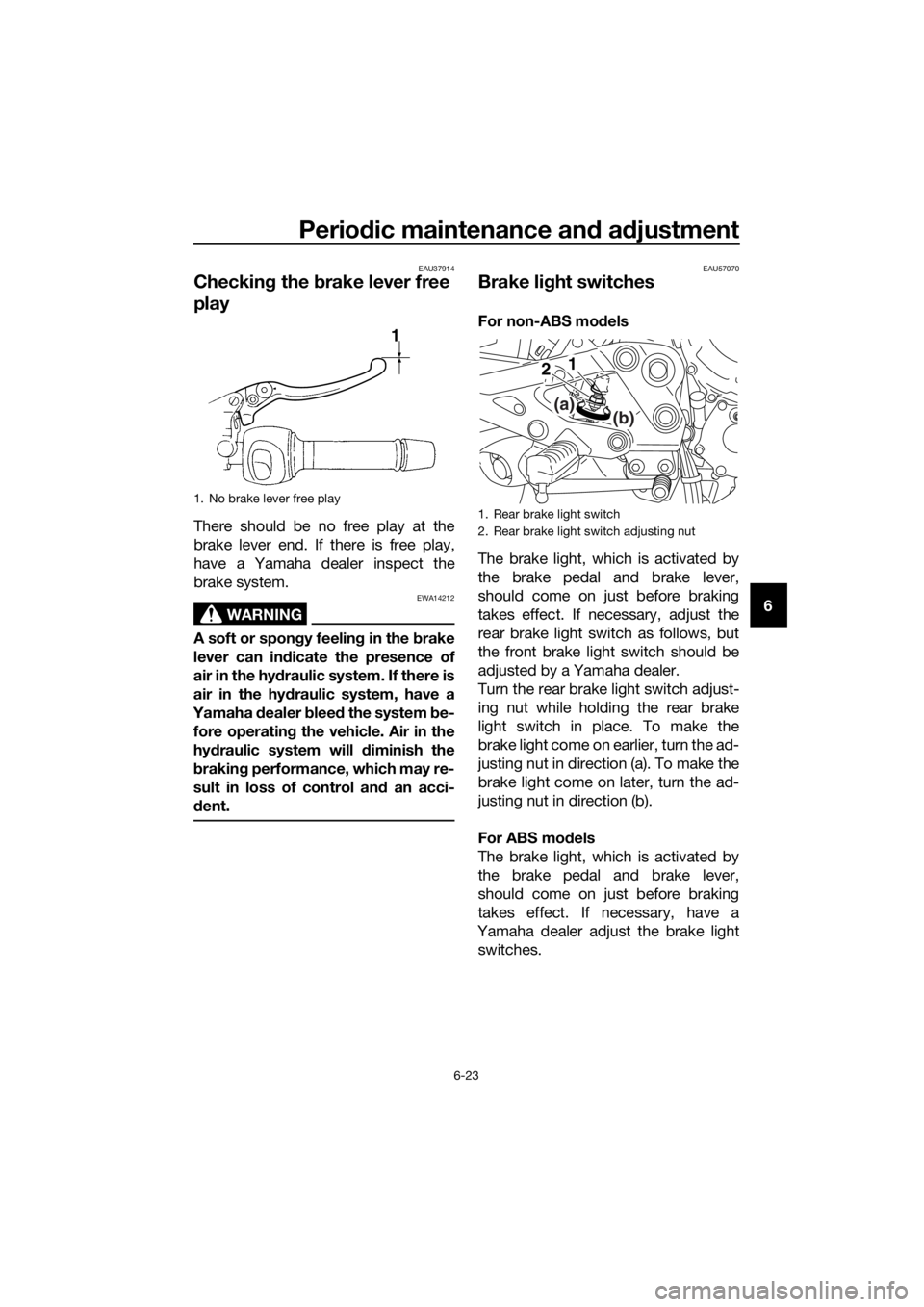
There should be no free play at the
brake lever end. If there is free play,
have a Yamaha dealer inspect the
brake system.
WARNING
EWA14212
A soft or spon gy feelin g in the b rake
lever can in dicate the presence of
air in the hy draulic system. If there is
air in the hy draulic system, have a
Yamaha dealer blee d the system be-
fore operatin g the vehicle. Air in the
hy draulic system will diminish the
b rakin g performance, which may re-
sult in loss of control an d an acci-
d ent.
EAU57070
Brake li ght switches
For non-ABS mo dels
The brake light, which is activated by
the brake pedal and brake lever,
should come on just before braking
takes effect. If necessary, adjust the
rear brake light switch as follows, but
the front brake light switch should be
adjusted by a Yamaha dealer.
Turn the rear brake light switch adjust-
ing nut while holding the rear brake
light switch in place. To make the
brake light come on earlier, turn the ad-
justing nut in direction (a). To make the
brake light come on later, turn the ad-
justing nut in direction (b).
For ABS mo dels
The brake light, which is activated by
the brake pedal and brake lever,
should come on just before braking
takes effect. If necessary, have a
Yamaha dealer adjust the brake light switches.
1. No brake lever free play
1
1. Rear brake light switch
2. Rear brake light switch adjusting nut
1
2
(a)
(b)
UB61E1E0.book Page 23 Wednesday, October 21, 2015 11:19 AM
Page 69 of 104
Periodic maintenance an d a djustment
6-25
6
EAU43113
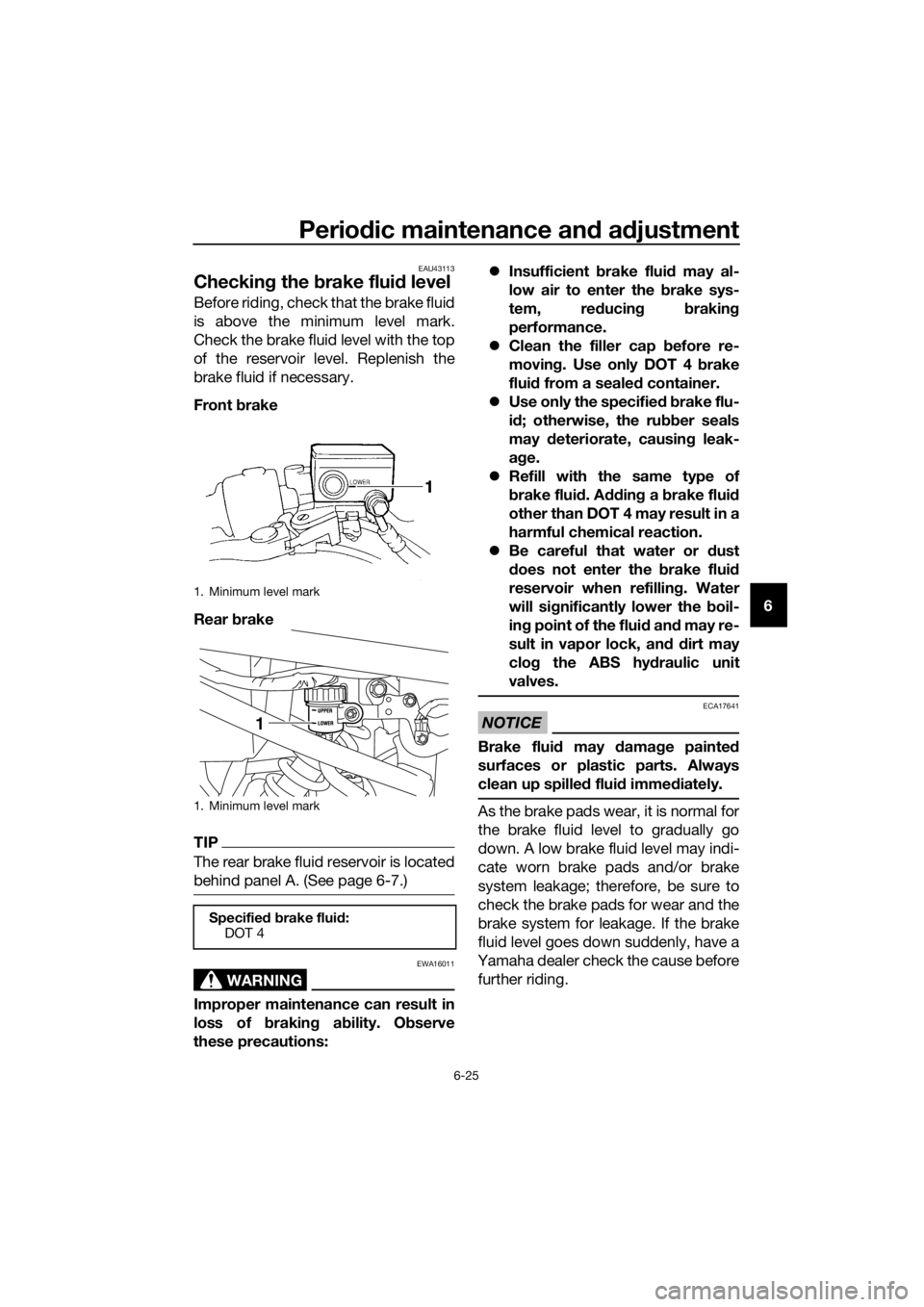
Checkin g the brake flui d level
Before riding, check that the brake fluid
is above the minimum level mark.
Check the brake fluid level with the top
of the reservoir level. Replenish the
brake fluid if necessary.
Front brake
Rear brake
TIP
The rear brake fluid reservoir is located
behind panel A. (See page 6-7.)
WARNING
EWA16011
Improper maintenance can result in
loss of brakin g a bility. O bserve
these precautions:
Insufficient brake flui d may al-
low air to enter the brake sys-
tem, re ducin g brakin g
performance.
Clean the filler cap before re-
moving . Use only DOT 4 b rake
flui d from a seale d container.
Use only the specifie d b rake flu-
i d ; otherwise, the ru bber seals
may deteriorate, causin g leak-
a g e.
Refill with the same type of
brake flui d. A ddin g a brake flui d
other than DOT 4 may result in a
harmful chemical reaction.
Be careful that water or dust
d oes not enter the brake flui d
reservoir when refilling . Water
will si gnificantly lower the boil-
in g point of the flui d an d may re-
sult in vapor lock, an d d ir t may
clo g th
e ABS hy draulic unit
valves.
NOTICE
ECA17641
Brake flui d may d amage painte d
surfaces or plastic parts. Always
clean up spille d flui d imme diately.
As the brake pads wear, it is normal for
the brake fluid level to gradually go
down. A low brake fluid level may indi-
cate worn brake pads and/or brake
system leakage; therefore, be sure to
check the brake pads for wear and the
brake system for leakage. If the brake
fluid level goes down suddenly, have a
Yamaha dealer check the cause before further riding.
1. Minimum level mark
1. Minimum level mark
Specified b rake flui d:
DOT 4
1
UB61E1E0.book Page 25 Wednesday, October 21, 2015 11:19 AM
Page 79 of 104
Periodic maintenance an d a djustment
6-35
6
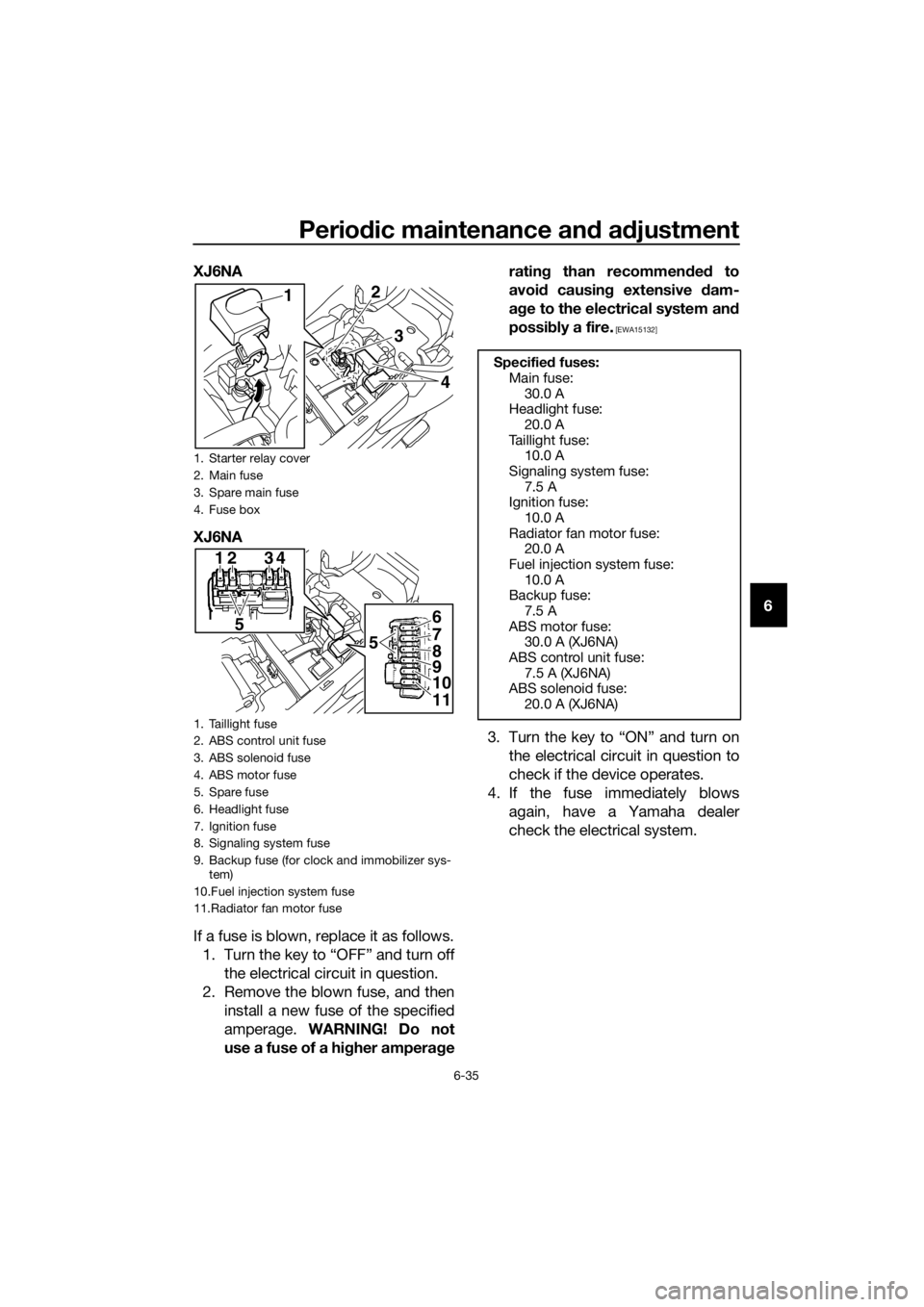
XJ6NA
XJ6NA
If a fuse is blown, replace it as follows.
1. Turn the key to “OFF” and turn off the electrical circuit in question.
2. Remove the blown fuse, and then install a new fuse of the specified
amperage. WARNING! Do not
use a fuse of a hi gher ampera ge ratin
g than recommen ded to
avoi d causin g extensive dam-
a g e to the electrical system an d
possi bly a fire.
[EWA15132]
3. Turn the key to “ON” and turn on
the electrical circuit in question to
check if the device operates.
4. If the fuse immediately blows again, have a Yamaha dealer
check the electrical system.
1. Starter relay cover
2. Main fuse
3. Spare main fuse
4. Fuse box
1. Taillight fuse
2. ABS control unit fuse
3. ABS solenoid fuse
4. ABS motor fuse
5. Spare fuse
6. Headlight fuse
7. Ignition fuse
8. Signaling system fuse
9. Backup fuse (for clock and immobilizer sys-tem)
10.Fuel injection system fuse
11.Radiator fan motor fuse
2
4
3
1
1
5 56
7
8
9
10
11
234
Specified
fuses:
Main fuse: 30.0 A
Headlight fuse:
20.0 A
Taillight fuse: 10.0 A
Signaling system fuse: 7.5 A
Ignition fuse:
10.0 A
Radiator fan motor fuse: 20.0 A
Fuel injection system fuse: 10.0 A
Backup fuse:
7.5 A
ABS motor fuse: 30.0 A (XJ6NA)
ABS control unit fuse: 7.5 A (XJ6NA)
ABS solenoid fuse:
20.0 A (XJ6NA)
UB61E1E0.book Page 35 Wednesday, October 21, 2015 11:19 AM
Page 85 of 104
Periodic maintenance an d a djustment
6-41
6
EAU44792
Front wheel (for non-ABS
mo dels)
WARNING
EWA14841
For the ABS mo del, have a Yamaha
d ealer remove an d install the wheel.
EAU56270
To remove the front wheel
WARNING
EWA10822
To avoi d injury, securely support the
vehicle so there is no d anger of it
fallin g over.
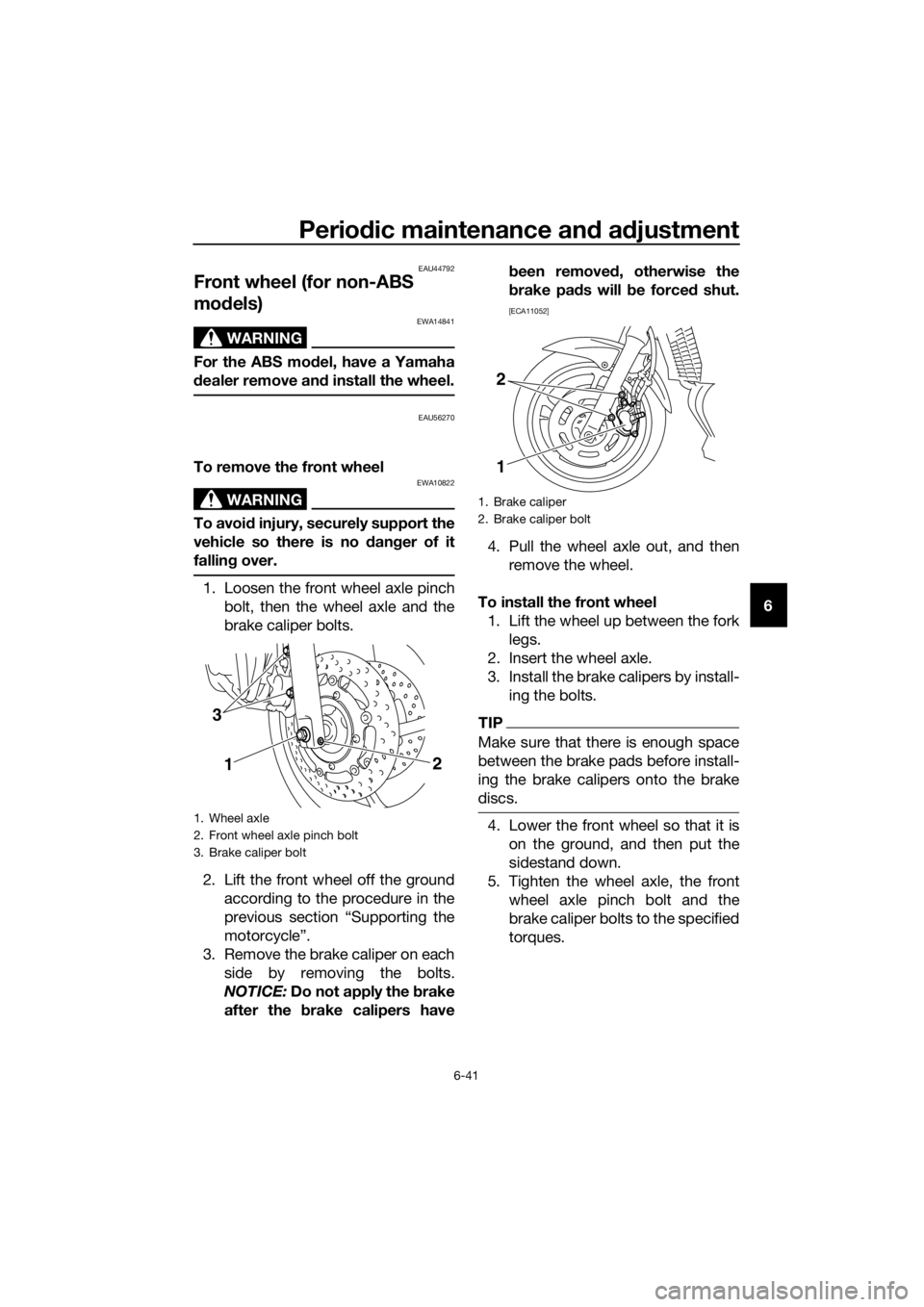
1. Loosen the front wheel axle pinch
bolt, then the wheel axle and the
brake caliper bolts.
2. Lift the front wheel off the ground according to the procedure in the
previous section “Supporting the
motorcycle”.
3. Remove the brake caliper on each side by removing the bolts.
NOTICE: Do not apply the b rake
after the b rake calipers have b
een removed , otherwise the
b rake pa ds will be forced shut.
[ECA11052]
4. Pull the wheel axle out, and then
remove the wheel.
To install the front wheel 1. Lift the wheel up between the fork legs.
2. Insert the wheel axle.
3. Install the brake calipers by install- ing the bolts.
TIP
Make sure that there is enough space
between the brake pads before install-
ing the brake calipers onto the brake
discs.
4. Lower the front wheel so that it ison the ground, and then put the
sidestand down.
5. Tighten the wheel axle, the front wheel axle pinch bolt and the
brake caliper bolts to the specified
torques.1. Wheel axle
2. Front wheel axle pinch bolt
3. Brake caliper bolt
1
3
2
1. Brake caliper
2. Brake caliper bolt
1 2
UB61E1E0.book Page 41 Wednesday, October 21, 2015 11:19 AM
Page 86 of 104
Periodic maintenance an d a djustment
6-42
6 6. Push down hard on the handlebar
several times to check for proper
fork operation.
EAU44802
Rear wheel (for non-ABS
mo dels)
WARNING
EWA14841
For the ABS mo del, have a Yamaha
d ealer remove an d install the wheel.
EAU56662
To remove the rear wheel
WARNING
EWA10822
To avoi d injury, securely support the
vehicle so there is no dan ger of it
fallin g over.
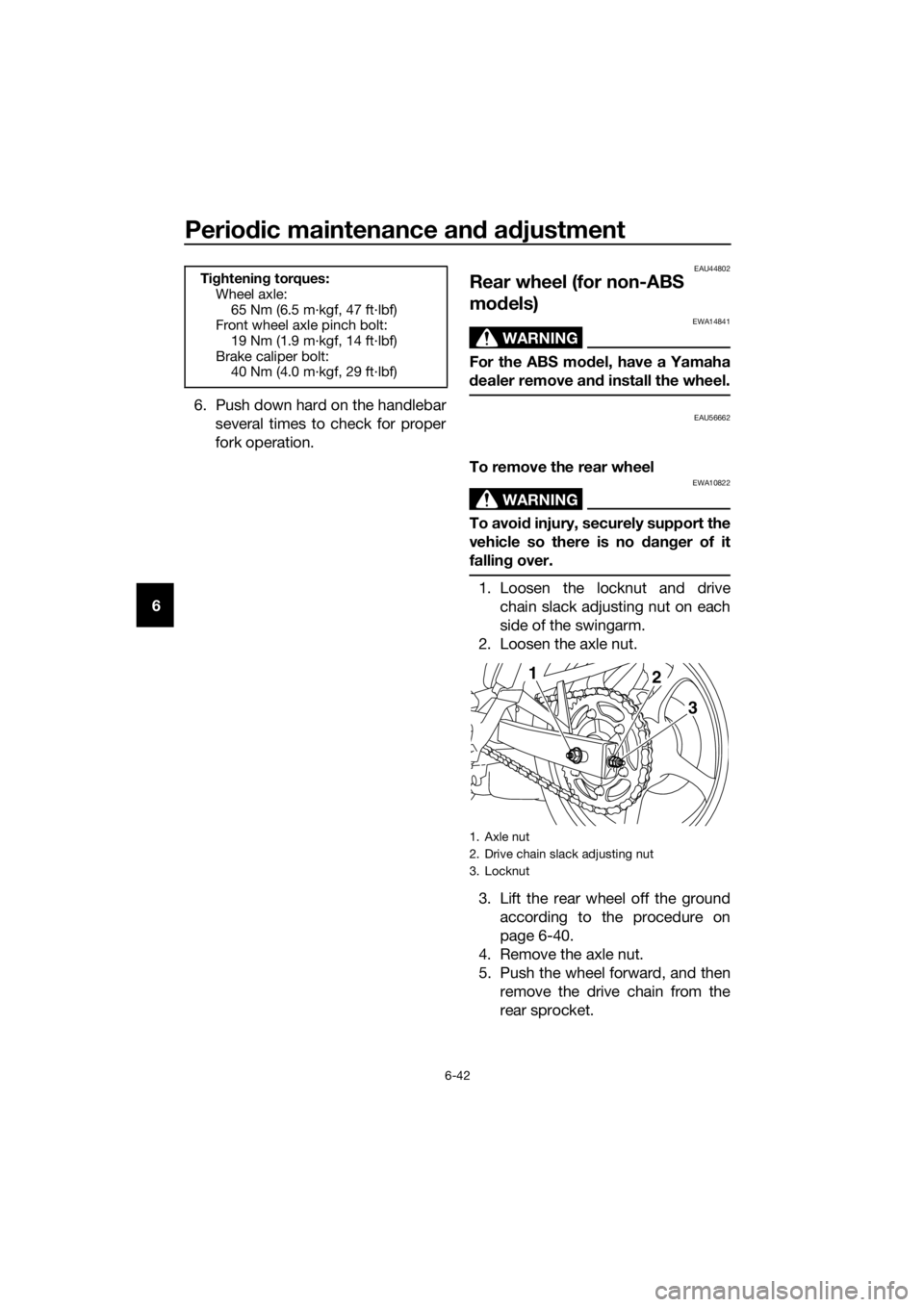
1. Loosen the locknut and drive
chain slack adjusting nut on each
side of the swingarm.
2. Loosen the axle nut.
3. Lift the rear wheel off the ground according to the procedure on
page 6-40.
4. Remove the axle nut.
5. Push the wheel forward, and then remove the drive chain from the
rear sprocket.
Tightenin g torques:
Wheel axle: 65 Nm (6.5 m·kgf, 47 ft·lbf)
Front wheel axle pinch bolt:
19 Nm (1.9 m·kgf, 14 ft·lbf)
Brake caliper bolt: 40 Nm (4.0 m·kgf, 29 ft·lbf)
1. Axle nut
2. Drive chain slack adjusting nut
3. Locknut
1
3
2
UB61E1E0.book Page 42 Wednesday, October 21, 2015 11:19 AM
Page 93 of 104
Motorcycle care and stora ge
7-3
7
2. Apply a corrosion protection spray
on all metal, including chrome-
and nickel-plated, surfaces to pre-
vent corrosion.
After cleaning 1. Dry the motorcycle with a chamois or an absorbing cloth.
2. Immediately dry the drive chain and lubricate it to prevent it from
rusting.
3. Use a chrome polish to shine chrome, aluminum and stainless-
steel parts, including the exhaust
system. (Even the thermally in-
duced discoloring of stainless-
steel exhaust systems can be re-
moved through polishing.)
4. To prevent corrosion, it is recom- mended to apply a corrosion pro-
tection spray on all metal,
including chrome- and nickel-plat-
ed, surfaces.
5. Use spray oil as a universal clean- er to remove any remaining dirt.
6. Touch up minor paint damage caused by stones, etc.
7. Wax all painted surfaces.
8. Let the motorcycle dry completely before storing or covering it.
WARNING
EWA11132
Contaminants on the brakes or tires
can cause loss of control. Make sure that there is no oil or
wax on the brakes or tires.
If necessary, clean the b rake
d iscs an d b rake linin gs with a
re gular brake disc cleaner or
acetone, an d wash the tires with
warm water an d a mil d d eter-
g ent. Before ri din g at hi gher speed
s, test the motorcycle’s
b rakin g performance an d cor-
nering b ehavior.
NOTICE
ECA10801
Apply spray oil an d wax spar-
in gly an d make sure to wipe off
any excess.
Never apply oil or wax to any
rubber an d plastic parts, b ut
treat them with a suita ble care
prod uct.
Avoi d using abrasive polishin g
compoun ds as they will wear
away the paint.
TIP
Consult a Yamaha dealer for ad-
vice on what products to use.
Washing, rainy weather or humid
climates can cause the headlight
lens to fog. Turning the headlight
on for a short period of time will
help remove the moisture from the
lens.
UB61E1E0.book Page 3 Wednesday, October 21, 2015 11:19 AM
Page 97 of 104

Specifications
8-2
8
2nd:1.947 (37/19)
3rd: 1.556 (28/18)
4th:
1.333 (32/24)
5th: 1.190 (25/21)
6th: 1.083 (26/24)
Chassis:
Frame type:Diamond
Caster angle: 26.0 °
Trail: 103 mm (4.1 in)
Front tire:
Type:Tubeless
Size: 120/70 ZR17M/C (58W)
Manufacturer/model:
BRIDGESTONE/BT021F
Manufacturer/model: DUNLOP/SPORTMAX-ROADSMART
Rear tire:
Type:
Tubeless
Size: 160/60 ZR17M/C (69W)
Manufacturer/model: BRIDGESTONE/BT021R
Manufacturer/model:
DUNLOP/SPORTMAX-ROADSMART
Loa din g:
Maximum load:
190 kg (419 lb) (XJ6NA)
195 kg (430 lb) (XJ6N)
(Total weight of rider, passenger, cargo
and accessories)
Tire air pressure (measure d on col d
tires):
Up to 90 kg (198 lb) load:
Front: 225 kPa (2.25 kgf/cm², 33 psi)
Rear: 250 kPa (2.50 kgf/cm², 36 psi) 90 kg (198 lb) load - maximum load:
Front:
250 kPa (2.50 kgf/cm², 36 psi)
Rear: 290 kPa (2.90 kgf/cm², 42 psi)
Front wheel:
Wheel type:
Cast wheel
Rim size: 17M/C x MT3.50
Rear wheel:
Wheel type:
Cast wheel
Rim size:
17M/C x MT4.50
Front brake:
Type:
Hydraulic dual disc brake
Specified brake fluid:
DOT 4
Rear brake:
Type:
Hydraulic single disc brake
Specified brake fluid:
DOT 4
Front suspension:
Type:Telescopic fork
Spring:
Coil spring
Shock absorber: Hydraulic damper
Wheel travel: 130 mm (5.1 in)
Rear suspension:
Type:Swingarm
Spring: Coil spring
Shock absorber:
Gas-hydraulic damper
Wheel travel: 130 mm (5.1 in)
Electrical system:
System voltage:
12 V
Ignition system: TCI
Charging system: AC magneto
UB61E1E0.book Page 2 Wednesday, October 21, 2015 11:19 AM