ABS YAMAHA XJ6F 2016 User Guide
[x] Cancel search | Manufacturer: YAMAHA, Model Year: 2016, Model line: XJ6F, Model: YAMAHA XJ6F 2016Pages: 104, PDF Size: 2.88 MB
Page 28 of 104
Instrument and control functions
3-14
3
EAU51802
ABS (for ABS mo dels)
The Yamaha ABS (Anti-lock Brake
System) features a dual electronic con-
trol system, which acts on the front and
rear brakes independently.
Operate the brakes with ABS as you
would conventional brakes. If the ABS
is activated, a pulsating sensation may
be felt at the brake lever or brake ped-
al. In this situation, continue to apply
the brakes and let the ABS work; do
not “pump” the brakes as this will re-
duce braking effectiveness.
WARNING
EWA16051
Always keep a sufficient distance
from the vehicle ahea d to match the
ri din g speed even with ABS.
The ABS performs best with
lon g b rakin g d istances.
On certain surfaces, such as
rou gh or g ravel roa ds, the b rak-
in g d istance may be lon ger with
the ABS than without.
The ABS is monitored by an ECU,
which will revert the system to conven-
tional braking if a malfunction occurs.
TIP
The ABS performs a self-diagno-
sis test each time the vehicle first
starts off after the key is turned to
“ON” and the vehicle has traveled
at a speed of 10 km/h (6 mi/h) or
higher. During this test, a “click-
ing” noise can be heard from un-
der the seat, and if the brake lever
or brake pedal is even slightly ap-
plied, a vibration can be felt at the
lever and pedal, but these do not
indicate a malfunction.
This ABS has a test mode which
allows the owner to experience
the pulsation at the brake lever or
brake pedal when the ABS is op-
erating. However, special tools are
required, so please consult your
Yamaha dealer.
NOTICE
ECA16121
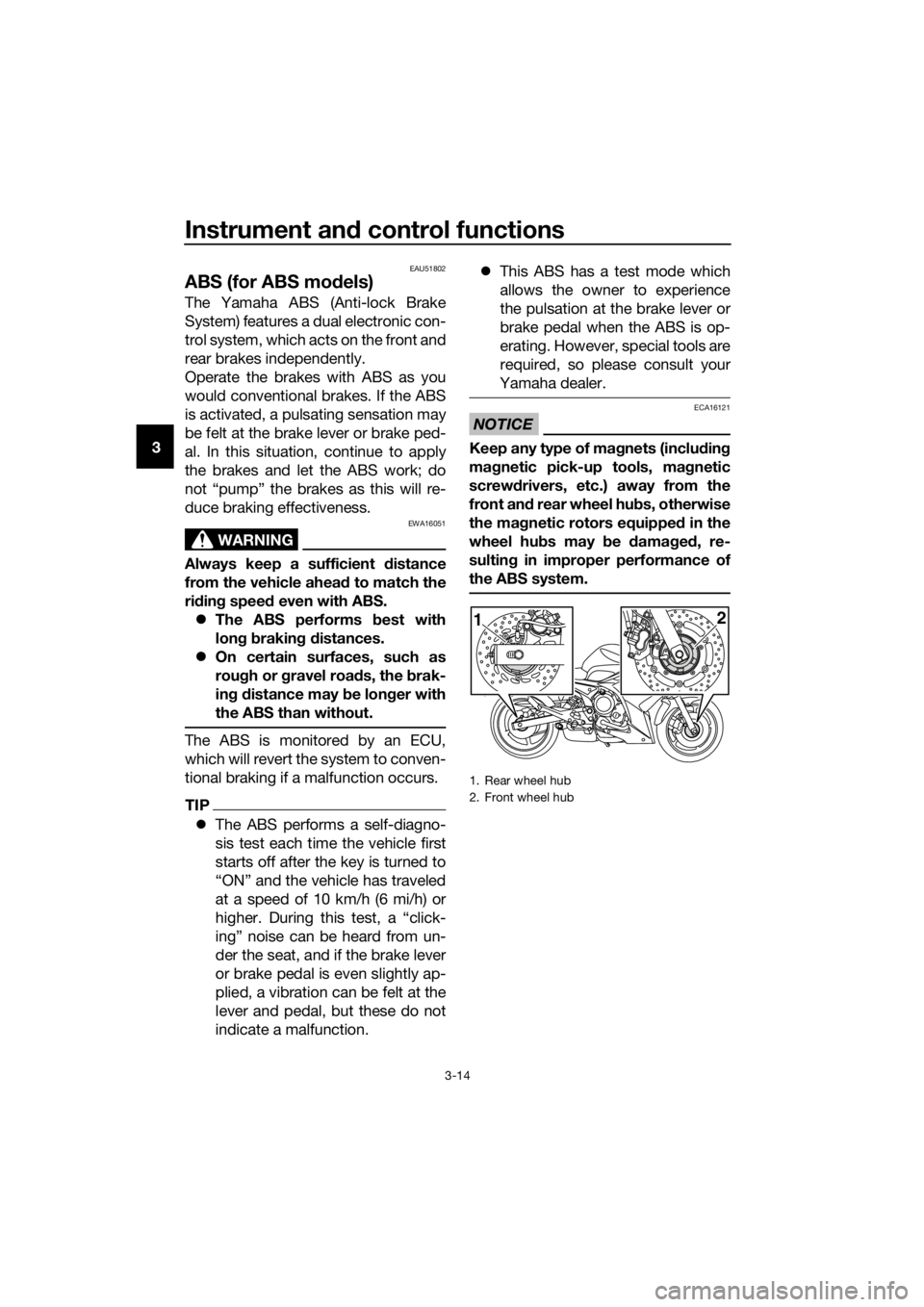
Keep any type of mag nets (includin g
ma gnetic pick-up tools, ma gnetic
screwd rivers, etc.) away from the
front an d rear wheel hu bs, otherwise
the ma gnetic rotors equippe d in the
wheel hu bs may be damag ed , re-
sultin g in improper performance of
the ABS system.
1. Rear wheel hub
2. Front wheel hub
12
UBS1E0E0.book Page 14 Thursday, October 8, 2015 3:40 PM
Page 35 of 104
Instrument and control functions
3-21
3
EAU47261
Rear view mirrors
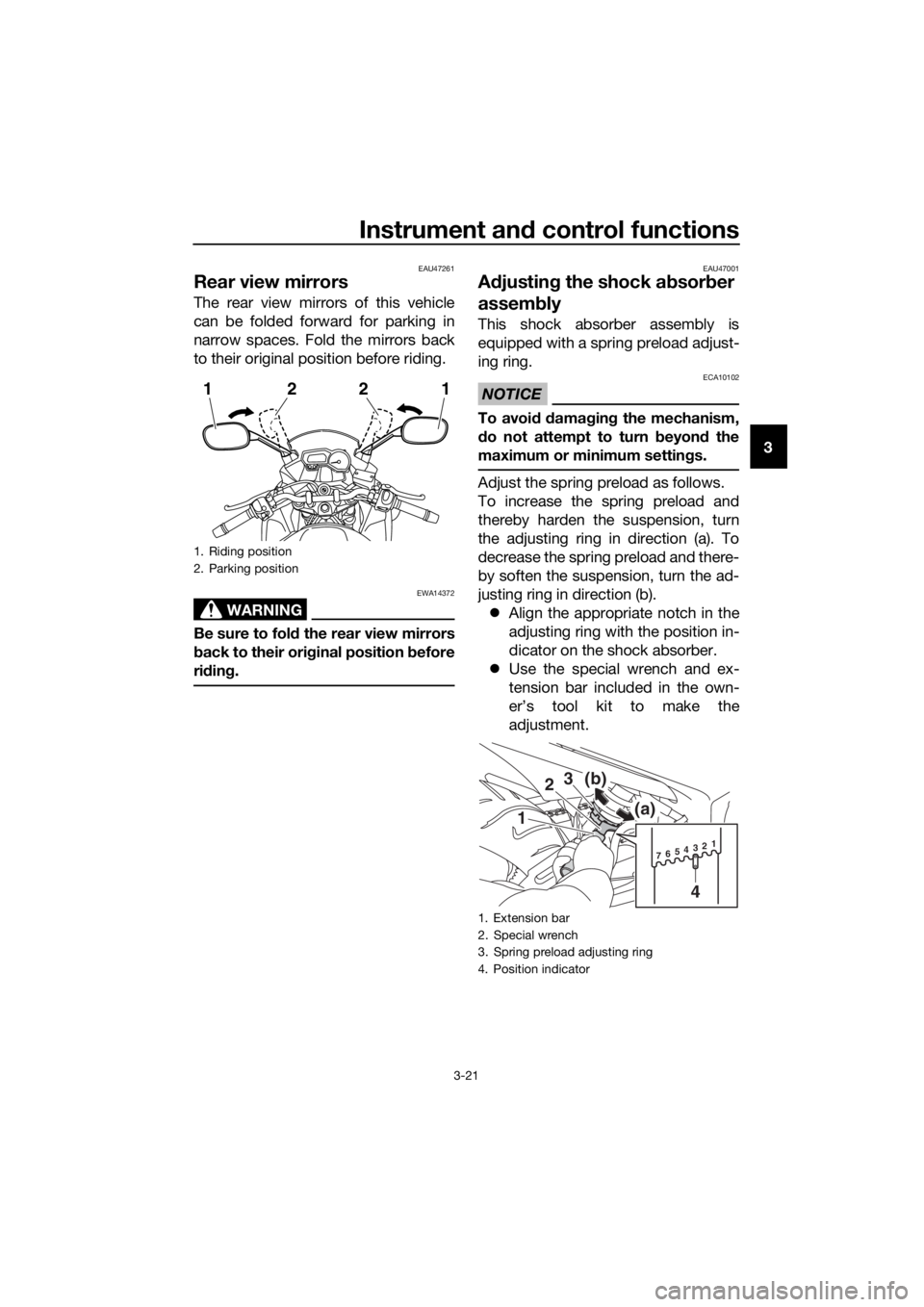
The rear view mirrors of this vehicle
can be folded forward for parking in
narrow spaces. Fold the mirrors back
to their original position before riding.
WARNING
EWA14372
Be sure to fol d the rear view mirrors
b ack to their ori ginal position before
ri din g.
EAU47001
A djustin g the shock a bsor ber
assem bly
This shock absorber assembly is
equipped with a spring preload adjust-
ing ring.
NOTICE
ECA10102
To avoi d d amag ing the mechanism,
d o not attempt to turn b eyond the
maximum or minimum settin gs.
Adjust the spring preload as follows.
To increase the spring preload and
thereby harden the suspension, turn
the adjusting ring in direction (a). To
decrease the spring preload and there-
by soften the suspension, turn the ad-
justing ring in direction (b).
Align the appropriate notch in the
adjusting ring with the position in-
dicator on the shock absorber.
Use the special wrench and ex-
tension bar included in the own-
er’s tool kit to make the
adjustment.
1. Riding position
2. Parking position
121
2
1. Extension bar
2. Special wrench
3. Spring preload adjusting ring
4. Position indicator
1
2
3
4
5
6
7
1 2
3(a)
(b)
4
UBS1E0E0.book Page 21 Thursday, October 8, 2015 3:40 PM
Page 42 of 104
Operation and important rid ing points
5-2
5
EAU51792
Startin g the en gine
In order for the ignition circuit cut-off
system to enable starting, one of the
following conditions must be met:
The transmission is in the neutral
position.
The transmission is in gear with
the clutch lever pulled and the
sidestand up.
See page 3-23 for more informa-
tion.
1. Turn the key to “ON” and make sure that the engine stop switch is
set to “ ”.
The following warning lights and
indicator light should come on for
a few seconds, then go off. Oil level warning light
Coolant temperature warning
light
Engine trouble warning light
Immobilizer system indicator
light
NOTICE
ECA17671
If the a bove warnin g li ghts or in dica-
tor li ght do not come on initially
when the key is turned to “ON”, or if
a warnin g or in dicator li ght remains
on, see pa ge 3-4 for the correspon d-
in g warnin g an d in dicator li ght cir-
cuit check.
For ABS models:
The ABS warning light should
come on when the main switch is
turned to “ON” and then go off af-
ter traveling at a speed of 10 km/h
(6 mi/h) or higher.
NOTICE
ECA17682
If the ABS warnin g li ght does not
come on an d then g o off as ex-
plained above, see pag e 3-4 for the
warnin g lig ht circuit check.
2. Shift the transmission into the
neutral position. The neutral indi-
cator light should come on. If not,
ask a Yamaha dealer to check the
electrical circuit.
3. Start the engine by pushing the start switch.
If the engine fails to start, release
the start switch, wait a few sec-
onds, and then try again. Each
starting attempt should be as
short as possible to preserve the
battery. Do not crank the engine
more than 10 seconds on any one
attempt.
NOTICE
ECA11043
For maximum eng ine life, never ac-
celerate har d when the en gine is
col d!
UBS1E0E0.book Page 2 Thursday, October 8, 2015 3:40 PM
Page 70 of 104
Periodic maintenance an d a djustment
6-25
6
EAU57070
Brake li ght switches
For non-ABS mo dels
The brake light, which is activated by
the brake pedal and brake lever,
should come on just before braking
takes effect. If necessary, adjust the
rear brake light switch as follows, but
the front brake light switch should be
adjusted by a Yamaha dealer.
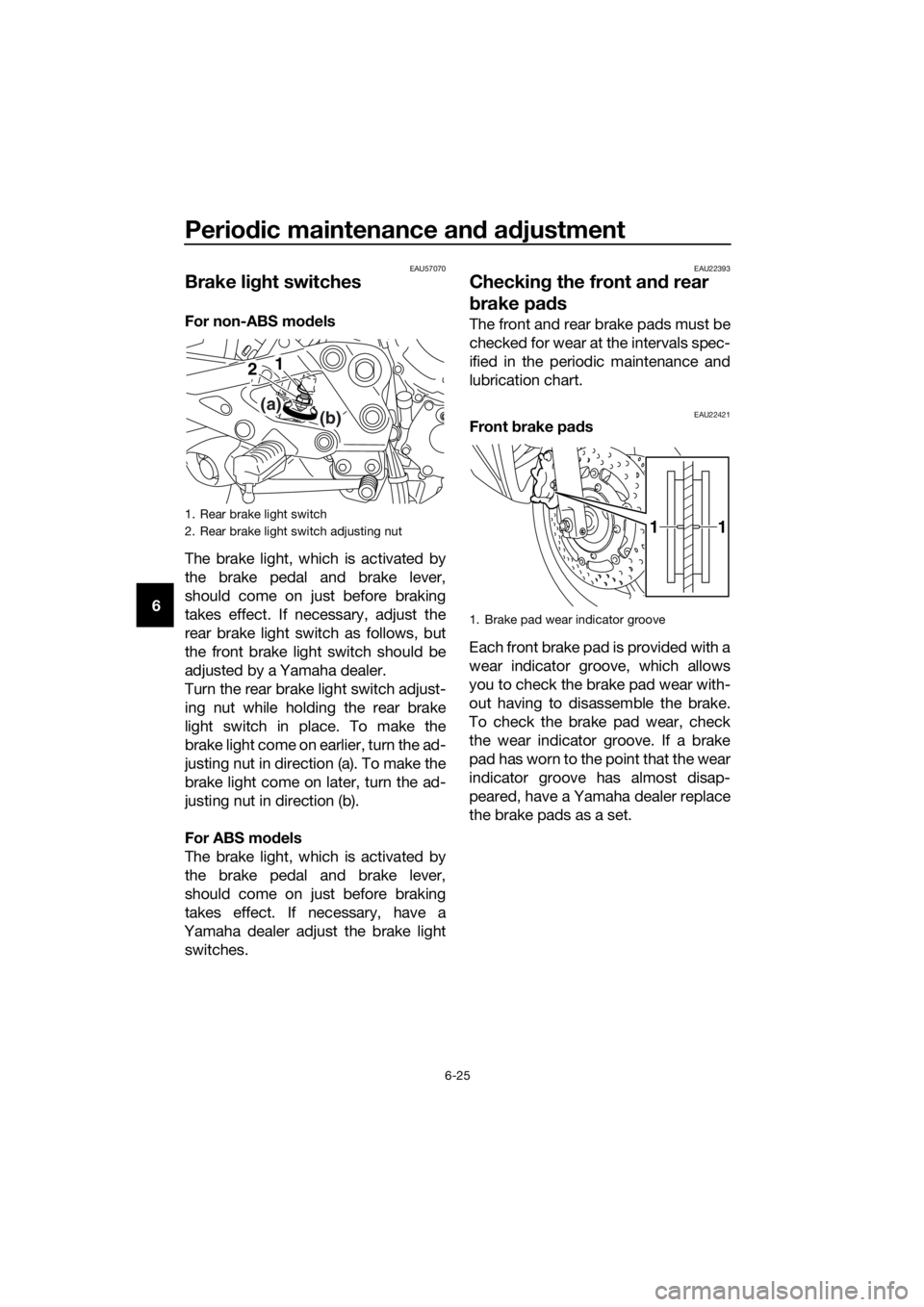
Turn the rear brake light switch adjust-
ing nut while holding the rear brake
light switch in place. To make the
brake light come on earlier, turn the ad-
justing nut in direction (a). To make the
brake light come on later, turn the ad-
justing nut in direction (b).
For ABS mo dels
The brake light, which is activated by
the brake pedal and brake lever,
should come on just before braking
takes effect. If necessary, have a
Yamaha dealer adjust the brake light switches.
EAU22393
Checkin g the front an d rear
b rake pa ds
The front and rear brake pads must be
checked for wear at the intervals spec-
ified in the periodic maintenance and
lubrication chart.
EAU22421Front brake pa ds
Each front brake pad is provided with a
wear indicator groove, which allows
you to check the brake pad wear with-
out having to disassemble the brake.
To check the brake pad wear, check
the wear indicator groove. If a brake
pad has worn to the point that the wear
indicator groove has almost disap-
peared, have a Yamaha dealer replace
the brake pads as a set.
1. Rear brake light switch
2. Rear brake light switch adjusting nut
1
2
(a)
(b)
1. Brake pad wear indicator groove
11
UBS1E0E0.book Page 25 Thursday, October 8, 2015 3:40 PM
Page 72 of 104
Periodic maintenance an d a djustment
6-27
6
Insufficient brake flui d may al-
low air to enter the brake sys-
tem, re ducing brakin g
performance.
Clean the filler cap before re-
movin g. Use only DOT 4 b rake
flui d from a seale d container.
Use only the specifie d b rake flu-
i d ; otherwise, the ru bber seals
may deteriorate, causin g leak-
a g e.
Refill with the same type of
brake flui d. A ddin g a b rake flui d
other than DOT 4 may result in a
harmful chemical reaction.
Be careful that water or dust
d oes not enter the brake flui d
reservoir when refillin g. Water
will si gnificantly lower the boil-
in g point of the flui d an d may re-
sult in vapor lock, an d d irt may
clo g the ABS hy draulic unit
valves.
NOTICE
ECA17641
Brake flui d may damag e painte d
surfaces or plastic parts. Always
clean up spille d flui d imme diately.
As the brake pads wear, it is normal for
the brake fluid level to gradually go
down. A low brake fluid level may indi-
cate worn brake pads and/or brake
system leakage; therefore, be sure to
check the brake pads for wear and the
brake system for leakage. If the brake
fluid level goes down suddenly, have a
Yamaha dealer check the cause before further riding.
EAU22733
Chan gin g the brake flui d
Have a Yamaha dealer change the
brake fluid at the intervals specified in
the periodic maintenance and lubrica-
tion chart. In addition, have the oil seals
of the master cylinders and calipers as
well as the brake hoses replaced at the
intervals listed below or whenever they
are damaged or leaking.
Oil seals: Replace every two
years.
Brake hoses: Replace every four
years.
UBS1E0E0.book Page 27 Thursday, October 8, 2015 3:40 PM
Page 81 of 104
Periodic maintenance an d a djustment
6-36
6
EAU47174
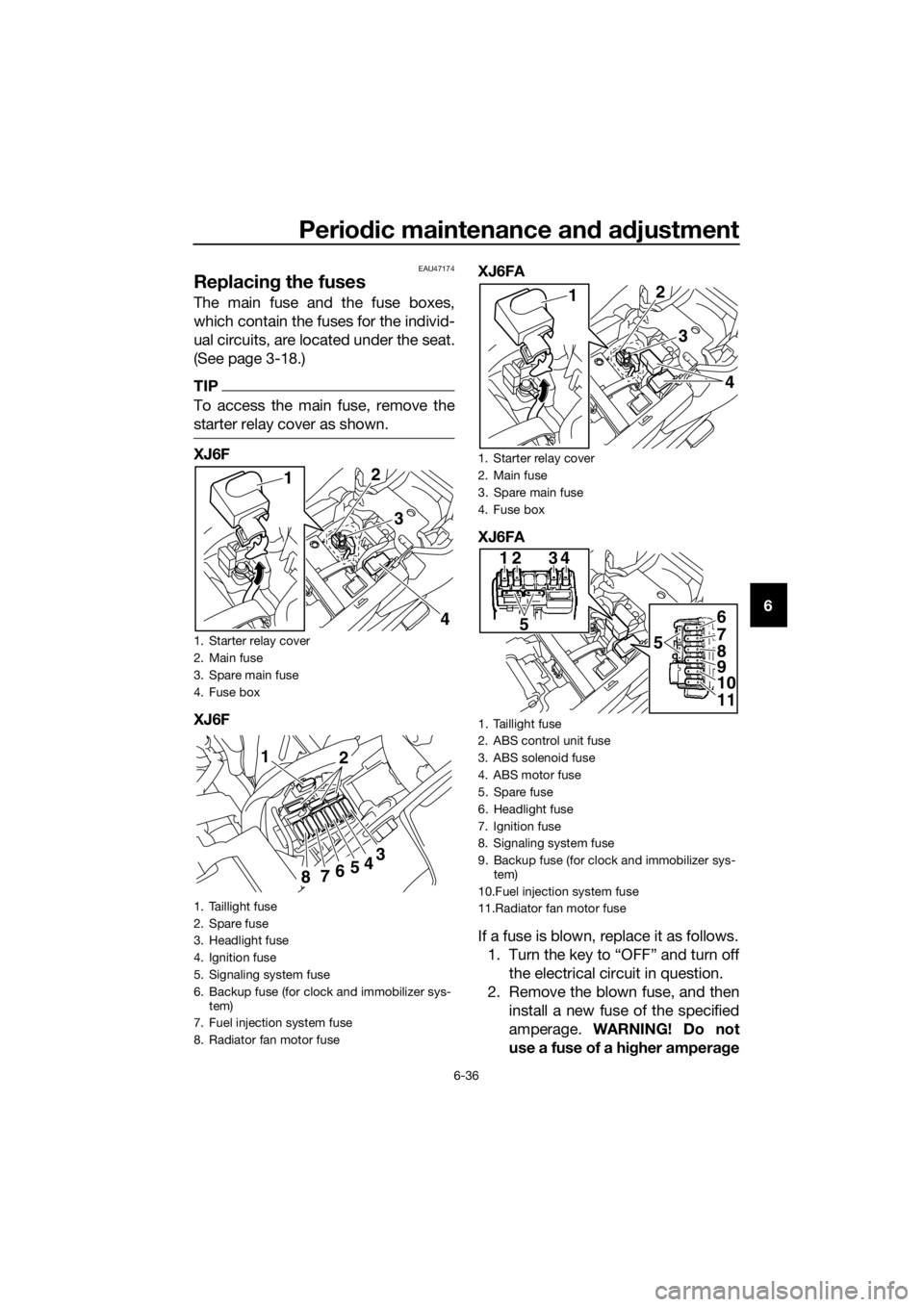
Replacin g the fuses
The main fuse and the fuse boxes,
which contain the fuses for the individ-
ual circuits, are located under the seat.
(See page 3-18.)
TIP
To access the main fuse, remove the
starter relay cover as shown.
XJ6F
XJ6F XJ6FA
XJ6FA
If a fuse is blown, replace it as follows.
1. Turn the key to “OFF” and turn off the electrical circuit in question.
2. Remove the blown fuse, and then install a new fuse of the specified
amperage. WARNING! Do not
use a fuse of a hi gher ampera ge
1. Starter relay cover
2. Main fuse
3. Spare main fuse
4. Fuse box
1. Taillight fuse
2. Spare fuse
3. Headlight fuse
4. Ignition fuse
5. Signaling system fuse
6. Backup fuse (for clock and immobilizer sys-
tem)
7. Fuel injection system fuse
8. Radiator fan motor fuse
2
4
3
1
1
2
3
4
5
6
7
8
1. Starter relay cover
2. Main fuse
3. Spare main fuse
4. Fuse box
1. Taillight fuse
2. ABS control unit fuse
3. ABS solenoid fuse
4. ABS motor fuse
5. Spare fuse
6. Headlight fuse
7. Ignition fuse
8. Signaling system fuse
9. Backup fuse (for clock and immobilizer sys-
tem)
10.Fuel injection system fuse
11.Radiator fan motor fuse
2
4
3
1
1
5 56
7
8
9
10
11
234
UBS1E0E0.book Page 36 Thursday, October 8, 2015 3:40 PM
Page 82 of 104
![YAMAHA XJ6F 2016 User Guide Periodic maintenance an d a djustment
6-37
6 ratin
g than recommen ded to
avoi d causin g extensive d am-
a g e to the electrical system an d
possi bly a fire.
[EWA15132]
3. Turn the key to “ON”](/img/51/52639/w960_52639-81.png "YAMAHA XJ6F 2016 User Guide Periodic maintenance an d a djustment
6-37
6 ratin
g than recommen ded to
avoi d causin g extensive d am-
a g e to the electrical system an d
possi bly a fire.
[EWA15132]
3. Turn the key to “ON”")
Periodic maintenance an d a djustment
6-37
6 ratin
g than recommen ded to
avoi d causin g extensive d am-
a g e to the electrical system an d
possi bly a fire.
[EWA15132]
3. Turn the key to “ON” and turn on
the electrical circuit in question to
check if the device operates.
4. If the fuse immediately blows again, have a Yamaha dealer
check the electrical system.
EAU47412
Replacin g the hea dlig ht bul b
This model is equipped with a halogen
bulb headlight. If the headlight bulb
burns out, replace it as follows.
NOTICE
ECA10651
Take care not to d amage the follow-
in g parts:
Hea dlig ht bul b
Do not touch the glass part of
the hea dlig ht bul b to keep it free
from oil, otherwise the transpar-
ency of the glass, the luminosity
of the b ulb, an d the b ulb life will
b e ad versely affected . Thor-
ou ghly clean off any d irt and fin-
g erprints on the hea dlig ht bul b
usin g a cloth moistene d with al-
cohol or thinner.
Hea dlig ht lens
Do not affix any type of tinted
film or stickers to the head light
lens.
Do not use a hea dlig ht bul b of a
watta ge hi gher than specifie d.
1. Remove cowlings A and C. (See
page 6-7.)
2. Disconnect the headlight coupler, and then remove the headlight
bulb cover.
Specifie d fuses:
Main fuse: 30.0 A
Headlight fuse:
20.0 A
Taillight fuse: 10.0 A
Signaling system fuse: 7.5 A
Ignition fuse:
10.0 A
Radiator fan motor fuse: 20.0 A
Fuel injection system fuse: 10.0 A
Backup fuse:
7.5 A
ABS motor fuse: 30.0 A (XJ6FA)
ABS control unit fuse: 7.5 A (XJ6FA)
ABS solenoid fuse:
20.0 A (XJ6FA)
1. Do not touch the glass part of the bulb.
UBS1E0E0.book Page 37 Thursday, October 8, 2015 3:40 PM
Page 85 of 104
Periodic maintenance an d a djustment
6-40
6
EAU24314
Replacin g the license plate
li g ht bul b
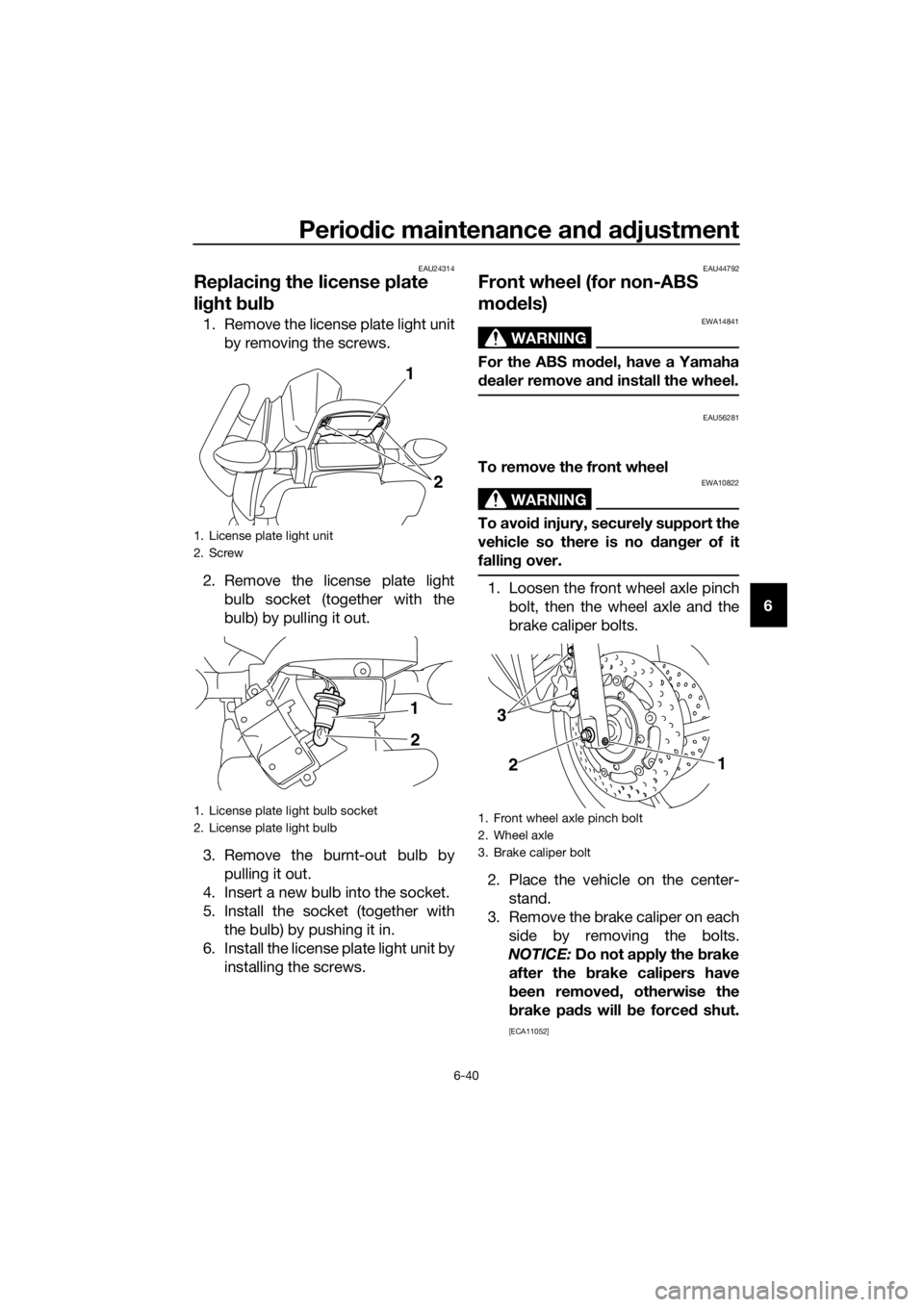
1. Remove the license plate light unit
by removing the screws.
2. Remove the license plate light bulb socket (together with the
bulb) by pulling it out.
3. Remove the burnt-out bulb by pulling it out.
4. Insert a new bulb into the socket.
5. Install the socket (together with the bulb) by pushing it in.
6. Install the license plate light unit by installing the screws.
EAU44792
Front wheel (for non-ABS
mo dels)
WARNING
EWA14841
For the ABS mo del, have a Yamaha
d ealer remove an d install the wheel.
EAU56281
To remove the front wheel
WARNING
EWA10822
To avoi d injury, securely support the
vehicle so there is no dan ger of it
fallin g over.
1. Loosen the front wheel axle pinch
bolt, then the wheel axle and the
brake caliper bolts.
2. Place the vehicle on the center- stand.
3. Remove the brake caliper on each side by removing the bolts.
NOTICE: Do not apply the brake
after the brake calipers have
b een removed , otherwise the
b rake pa ds will be forced shut.
[ECA11052]
1. License plate light unit
2. Screw
1. License plate light bulb socket
2. License plate light bulb
2
1
1
2
1. Front wheel axle pinch bolt
2. Wheel axle
3. Brake caliper bolt
2
3
1
UBS1E0E0.book Page 40 Thursday, October 8, 2015 3:40 PM
Page 87 of 104
Periodic maintenance an d a djustment
6-42
6
EAU44802
Rear wheel (for non-ABS
mo dels)
WARNING
EWA14841
For the ABS mo del, have a Yamaha
d ealer remove an d install the wheel.
EAU56672
To remove the rear wheel
WARNING
EWA10822
To avoi d injury, securely support the
vehicle so there is no d anger of it
fallin g over.
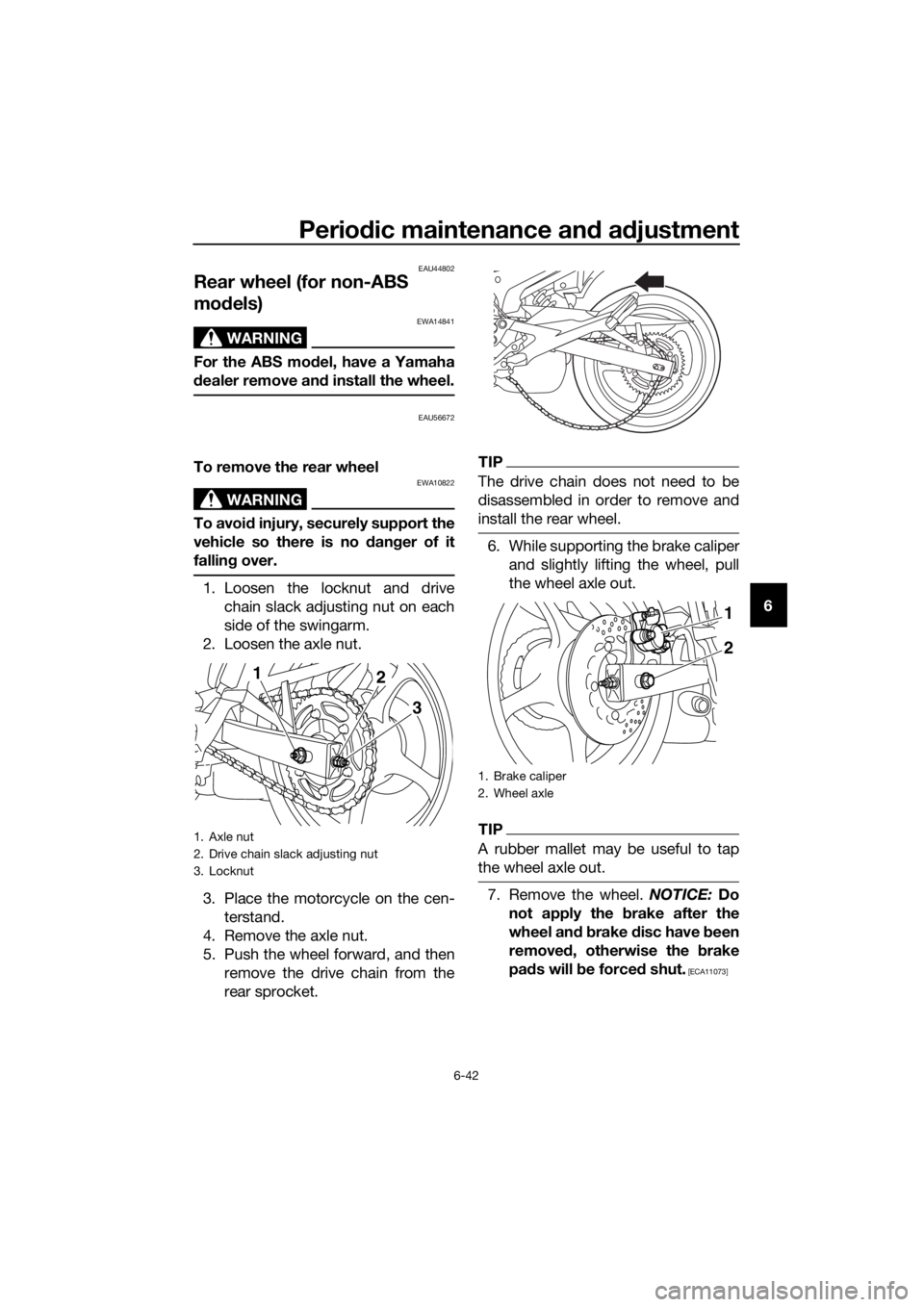
1. Loosen the locknut and drive
chain slack adjusting nut on each
side of the swingarm.
2. Loosen the axle nut.
3. Place the motorcycle on the cen- terstand.
4. Remove the axle nut.
5. Push the wheel forward, and then remove the drive chain from the
rear sprocket.
TIP
The drive chain does not need to be
disassembled in order to remove and
install the rear wheel.
6. While supporting the brake caliperand slightly lifting the wheel, pull
the wheel axle out.
TIP
A rubber mallet may be useful to tap
the wheel axle out.
7. Remove the wheel. NOTICE: Do
not apply the b rake after the
wheel an d b rake disc have been
remove d, otherwise the brake
pa ds will be forced shut.
[ECA11073]
1. Axle nut
2. Drive chain slack adjusting nut
3. Locknut
1
3
2
1. Brake caliper
2. Wheel axle
1
2
UBS1E0E0.book Page 42 Thursday, October 8, 2015 3:40 PM
Page 93 of 104
Motorcycle care and stora ge
7-3
7
2. Apply a corrosion protection spray
on all metal, including chrome-
and nickel-plated, surfaces to pre-
vent corrosion.
Cleaning the windshield
Avoid using any alkaline or strong acid
cleaner, gasoline, brake fluid, or any
other solvent. Clean the windshield
with a cloth or sponge dampened with
a mild detergent, and then wash it off
thoroughly with water. For additional
cleaning, use Yamaha Windshield
Cleaner or another high-quality wind-
shield cleaner. Some cleaning com-
pounds for plastics may leave
scratches on the windshield. Before
using such cleaners, test an area of the
windshield which does not affect your
visibility and which cannot be easily
recognized.
After cleaning 1. Dry the motorcycle with a chamois or an absorbing cloth.
2. Immediately dry the drive chain and lubricate it to prevent it from
rusting.
3. Use a chrome polish to shine chrome, aluminum and stainless-
steel parts, including the exhaust
system. (Even the thermally in-
duced discoloring of stainless-
steel exhaust systems can be re-
moved through polishing.)
4. To prevent corrosion, it is recom- mended to apply a corrosion pro-
tection spray on all metal,
including chrome- and nickel-plat-
ed, surfaces.
5. Use spray oil as a universal clean- er to remove any remaining dirt. 6. Touch up minor paint damage
caused by stones, etc.
7. Wax all painted surfaces.
8. Let the motorcycle dry completely before storing or covering it.WARNING
EWA11132
Contaminants on the b rakes or tires
can cause loss of control. Make sure that there is no oil or
wax on the brakes or tires.
If necessary, clean the brake
d iscs an d b rake linin gs with a
re gular brake disc cleaner or
acetone, an d wash the tires with
warm water an d a mil d d eter-
g ent. Before ri din g at hi gher
speed s, test the motorcycle’s
b rakin g performance an d cor-
nering b ehavior.
NOTICE
ECA10801
Apply spray oil an d wax spar-
in gly an d make sure to wipe off
any excess.
Never apply oil or wax to any
rubber an d plastic parts, b ut
treat them with a suita ble care
prod uct.
Avoi d using abrasive polishin g
compoun ds as they will wear
away the paint.
TIP
Consult a Yamaha dealer for ad-
vice on what products to use.
Washing, rainy weather or humid
climates can cause the headlight
lens to fog. Turning the headlight
UBS1E0E0.book Page 3 Thursday, October 8, 2015 3:40 PM