lock YAMAHA XJ900S 2001 User Guide
[x] Cancel search | Manufacturer: YAMAHA, Model Year: 2001, Model line: XJ900S, Model: YAMAHA XJ900S 2001Pages: 100, PDF Size: 10.87 MB
Page 63 of 100
PERIODIC MAINTENANCE AND MINOR REPAIR
6-20
6
EAU00687
Wheels To maximize the performance, durabil-
ity, and safe operation of your motor-
cycle, note the following points
regarding the specified wheels.l
The wheel rims should be checked
for cracks, bends or warpage be-
fore each ride. If any damage is
found, have a Yamaha dealer re-
place the wheel. Do not attempt
even the smallest repair to the
wheel. A deformed or cracked
wheel must be replaced.
l
The wheel should be balanced
whenever either the tire or wheel
has been changed or replaced. An
unbalanced wheel can result in
poor performance, adverse han-
dling characteristics, and a short-
ened tire life.
l
Ride at moderate speeds after
changing a tire since the tire sur-
face must first be “broken in” for it to
develop its optimal characteristics.
EAU00694
Adjusting the clutch lever free
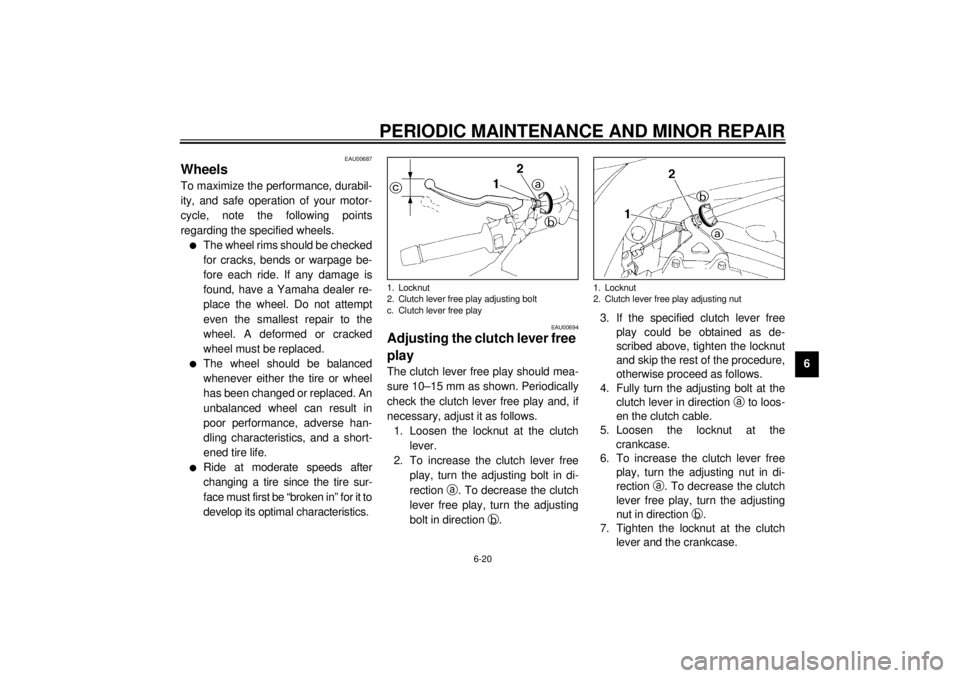
play The clutch lever free play should mea-
sure 10–15 mm as shown. Periodically
check the clutch lever free play and, if
necessary, adjust it as follows.
1. Loosen the locknut at the clutch
lever.
2. To increase the clutch lever free
play, turn the adjusting bolt in di-
rection
a. To decrease the clutch
lever free play, turn the adjusting
bolt in direction
b.3. If the specified clutch lever free
play could be obtained as de-
scribed above, tighten the locknut
and skip the rest of the procedure,
otherwise proceed as follows.
4. Fully turn the adjusting bolt at the
clutch lever in direction
a to loos-
en the clutch cable.
5. Loosen the locknut at the
crankcase.
6. To increase the clutch lever free
play, turn the adjusting nut in di-
rection
a. To decrease the clutch
lever free play, turn the adjusting
nut in direction
b.
7. Tighten the locknut at the clutch
lever and the crankcase.1. Locknut
2. Clutch lever free play adjusting bolt
c. Clutch lever free play
1. Locknut
2. Clutch lever free play adjusting nut
E_4km.book Page 20 Thursday, September 7, 2000 9:32 AM
Page 65 of 100
PERIODIC MAINTENANCE AND MINOR REPAIR
6-22
6
EAU03682
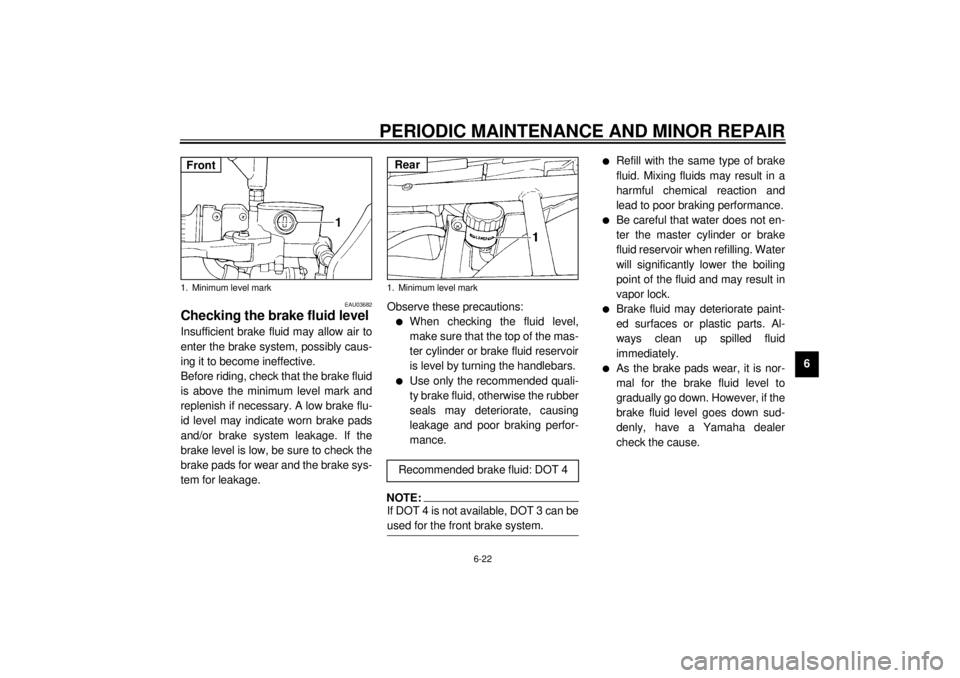
Checking the brake fluid level Insufficient brake fluid may allow air to
enter the brake system, possibly caus-
ing it to become ineffective.
Before riding, check that the brake fluid
is above the minimum level mark and
replenish if necessary. A low brake flu-
id level may indicate worn brake pads
and/or brake system leakage. If the
brake level is low, be sure to check the
brake pads for wear and the brake sys-
tem for leakage.Observe these precautions:
l
When checking the fluid level,
make sure that the top of the mas-
ter cylinder or brake fluid reservoir
is level by turning the handlebars.
l
Use only the recommended quali-
ty brake fluid, otherwise the rubber
seals may deteriorate, causing
leakage and poor braking perfor-
mance.
NOTE:@ If DOT 4 is not available, DOT 3 can be
used for the front brake system. @
l
Refill with the same type of brake
fluid. Mixing fluids may result in a
harmful chemical reaction and
lead to poor braking performance.
l
Be careful that water does not en-
ter the master cylinder or brake
fluid reservoir when refilling. Water
will significantly lower the boiling
point of the fluid and may result in
vapor lock.
l
Brake fluid may deteriorate paint-
ed surfaces or plastic parts. Al-
ways clean up spilled fluid
immediately.
l
As the brake pads wear, it is nor-
mal for the brake fluid level to
gradually go down. However, if the
brake fluid level goes down sud-
denly, have a Yamaha dealer
check the cause.
1. Minimum level markFront
1. Minimum level markRecommended brake fluid: DOT 4Rear
E_4km.book Page 22 Thursday, September 7, 2000 9:32 AM
Page 72 of 100
PERIODIC MAINTENANCE AND MINOR REPAIR
6-29
6
EAU01110
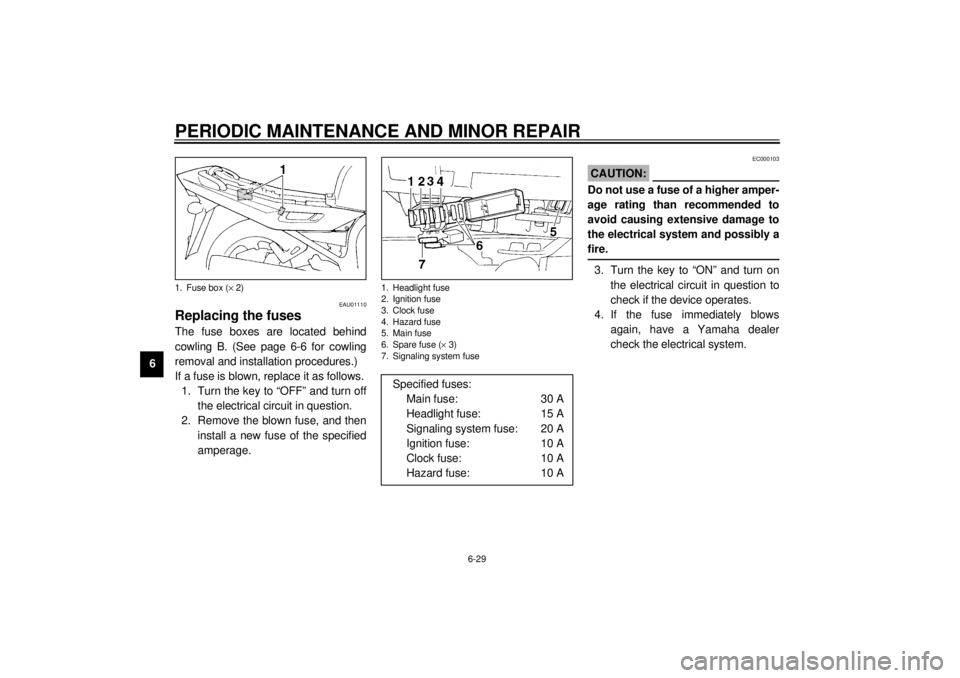
Replacing the fuses The fuse boxes are located behind
cowling B. (See page 6-6 for cowling
removal and installation procedures.)
If a fuse is blown, replace it as follows.
1. Turn the key to “OFF” and turn off
the electrical circuit in question.
2. Remove the blown fuse, and then
install a new fuse of the specified
amperage.
EC000103
CAUTION:@ Do not use a fuse of a higher amper-
age rating than recommended to
avoid causing extensive damage to
the electrical system and possibly a
fire. @3. Turn the key to “ON” and turn on
the electrical circuit in question to
check if the device operates.
4. If the fuse immediately blows
again, have a Yamaha dealer
check the electrical system.
1. Fuse box (´ 2)
1. Headlight fuse
2. Ignition fuse
3. Clock fuse
4. Hazard fuse
5. Main fuse
6. Spare fuse (´ 3)
7. Signaling system fuse
Specified fuses:
Main fuse: 30 A
Headlight fuse: 15 A
Signaling system fuse: 20 A
Ignition fuse: 10 A
Clock fuse: 10 A
Hazard fuse: 10 A
E_4km.book Page 29 Thursday, September 7, 2000 9:32 AM
Page 91 of 100

SPECIFICATIONS
8-4
8
Headlight typeQuar tz bulb (halogen)
Bulb voltage, wattage ´ quantity
Headlight 12 V, 60/55 W ´ 1
Tail/brake light 12 V, 5/21 W ´ 1
Auxiliary light 12 V, 4 W ´ 1
Turn signal light 12 V, 21 W ´ 4
Meter lighting 12 V, 3.4 W ´ 4
Neutral indicator light 12 V, 3.4 W ´ 1
High beam indicator light 12 V, 3.4 W ´ 1
Oil level warning light 12 V, 3.4 W ´ 1
Turn signal indicator light 12 V, 3.4 W ´ 2
Fuel level warning light 12 V, 3.4 W ´ 1
Fuses
Main fuse 30 A
Signaling system fuse 20 A
Headlight fuse 15 A
Hazard fuse 10 A
Ignition fuse 10 A
Clock fuse 10 A
E_4km.book Page 4 Thursday, September 7, 2000 9:32 AM
Page 96 of 100
10-INDEXAAir filter element, cleaning ...................... 6-13
Anti-theft alarm ........................................3-5BBattery ................................................... 6-27
Brake and clutch levers, checking and
lubricating ............................................ 6-24
Brake and shift pedals, checking and
lubricating ............................................ 6-24
Brake fluid, changing ............................. 6-23
Brake fluid level, checking...................... 6-22
Brake lever...............................................3-8
Brake light switch (rear), adjusting ......... 6-21
Brake pads, checking............................. 6-21
Brake pedal..............................................3-8CCables, checking and lubricating............ 6-23
Carburetors, adjusting............................ 6-15
Care.........................................................7-1
Centerstand and sidestand,
checking and lubricating ...................... 6-25
Clock .......................................................3-5
Clutch lever ..............................................3-7
Clutch lever free play, adjusting ............. 6-20
Conversion table ......................................8-5
Cowlings, removing and installing ............6-5DDimmer switch .........................................3-6
EEngine break-in ....................................... 5-4
Engine oil and oil filter cartridge ............... 6-8
Engine stop switch................................... 3-7FFinal gear oil .......................................... 6-11
Front fork, adjusting ............................... 3-13
Front fork, checking ............................... 6-25
Fuel ......................................................... 3-9
Fuel consumption, tips for reducing ......... 5-4
Fuel gauge .............................................. 3-5
Fuel level warning light ............................ 3-2
Fuel tank breather hose
(Germany only) ................................... 3-10
Fuel tank cap ........................................... 3-9
Fuses, replacing .................................... 6-29HHandlebar switches ................................. 3-6
Hazard switch .......................................... 3-6
Headlight bulb, replacing ....................... 6-30
Helmet holder ........................................ 3-11
High beam indicator light ......................... 3-3
Horn switch ............................................. 3-6IIdentification numbers ............................. 9-1
Idling speed, adjusting ........................... 6-15
Ignition circuit cut-off system.................. 3-15
Indicator and warning lights ..................... 3-2KKey identification number ........................ 9-1
LLight switch ..............................................3-7MMain switch/steering lock .........................3-1
Model label ..............................................9-2NNeutral indicator light ...............................3-3OOil level warning light ...............................3-3PParking.....................................................5-5
Part locations ...........................................2-1
Pass switch ..............................................3-6
Periodic maintenance and lubrication
chart ......................................................6-2
Pre-operation check list ............................4-1SSafety information ....................................1-1
Seat .......................................................3-11
Self-diagnosis device ...............................3-4
Shifting .....................................................5-3
Shift pedal ................................................3-8
Shift points (for Switzerland only) .............5-4
Shock absorber assembly, adjusting ......3-13
Sidestand ...............................................3-15
Spark plugs, checking ..............................6-7
Specifications ...........................................8-1
Speedometer unit.....................................3-3
Starter (choke) lever...............................3-10
Starting a cold engine ..............................5-1
E_4km.book Page 1 Thursday, September 7, 2000 9:32 AM