lights YAMAHA XJ900S 2001 Owners Manual
[x] Cancel search | Manufacturer: YAMAHA, Model Year: 2001, Model line: XJ900S, Model: YAMAHA XJ900S 2001Pages: 100, PDF Size: 10.87 MB
Page 15 of 100
3
INSTRUMENT AND CONTROL FUNCTIONS
Main switch/steering lock ..................................... 3-1
Indicator and warning lights ................................ 3-2
Speedometer unit ................................................ 3-3
Tachometer .......................................................... 3-4
Self-diagnosis device ........................................... 3-4
Anti-theft alarm (optional) .................................... 3-5
Fuel gauge ........................................................... 3-5
Clock .................................................................... 3-5
Handlebar switches ............................................. 3-6
Clutch lever .......................................................... 3-7
Shift pedal ............................................................ 3-8
Brake lever .......................................................... 3-8Brake pedal ......................................................... 3-8
Fuel tank cap ...................................................... 3-9
Fuel ..................................................................... 3-9
Fuel tank breather hose (for Germany only) ..... 3-10
Starter (choke) lever .......................................... 3-10
Seat ................................................................... 3-11
Helmet holder .................................................... 3-11
Storage compartment ....................................... 3-12
Adjusting the front fork ...................................... 3-13
Adjusting the shock absorber assembly ............ 3-13
Sidestand .......................................................... 3-15
Ignition circuit cut-off system ............................. 3-15
E_4km.book Page 1 Thursday, September 7, 2000 9:32 AM
Page 17 of 100
INSTRUMENT AND CONTROL FUNCTIONS
3-2
3
EAU01590
(Parking)
The steering is locked, and the taillight
and auxiliary light are on, but all other
electrical systems are off. The key can
be removed.
The steering must be locked before the
key can be turned to “ ”.
ECA00043
CAUTION:@ Do not use the parking position for
an extended length of time, other-
wise the battery may discharge. @
EAU03034
Indicator and warning lights
EAU03299
Turn signal indicator lights
“” / “”
The corresponding indicator light flash-
es when the turn signal switch is
pushed to the left or right.
EAU03680
Fuel level warning light “ ”
This warning light comes on when the
fuel level drops below approximately
5 L. When this occurs, refuel as soon
as possible.
The electrical circuit of the warning light
can be checked according to the fol-
lowing procedure.
1. Set the engine stop switch to “ ”
and turn the key to “ON”.
2. Shift the transmission into the neu-
tral position or pull the clutch lever.
3. Push the start switch. If the warn-
ing light does not come on, have a
Yamaha dealer check the electri-
cal circuit.
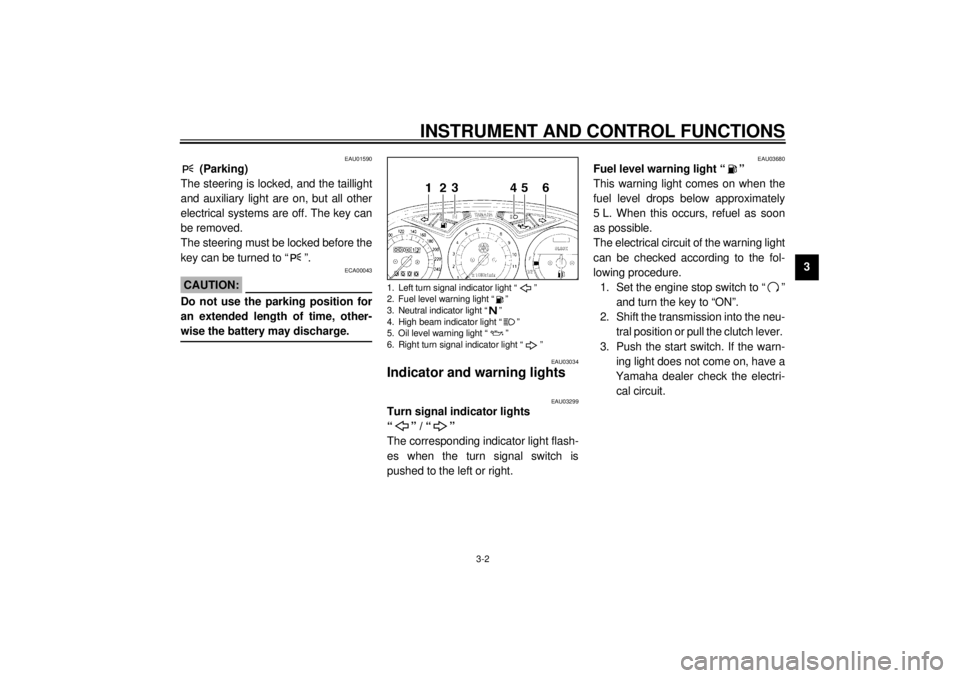
1. Left turn signal indicator light “ ”
2. Fuel level warning light “ ”
3. Neutral indicator light “ ”
4. High beam indicator light “ ”
5. Oil level warning light “ ”
6. Right turn signal indicator light “ ”
E_4km.book Page 2 Thursday, September 7, 2000 9:32 AM
Page 21 of 100
INSTRUMENT AND CONTROL FUNCTIONS
3-6
3
EAU00118
Handlebar switches
EAU00120
Pass switch “PASS”
Press this switch to flash the headlight.
EAU00144
Hazard switch “ ”
With the key in the “ON” or “ ” posi-
tion, use this switch to turn on the haz-
ard light (simultaneous flashing of all
turn signal lights).The hazard light is used in case of an
emergency or to warn other drivers
when your motorcycle is stopped
where it might be a traffic hazard.
EC000006
CAUTION:@ Do not use the hazard light for an ex-
tended length of time, otherwise the
battery may discharge. @
EAU00127
Turn signal switch
To signal a right-hand turn, push this
switch to “ ”. To signal a left-hand
turn, push this switch to “ ”. When
released, the switch returns to the cen-
ter position. To cancel the turn signal
lights, push the switch in after it has re-
turned to the center position.
EAU00129
Horn switch “ ”
Press this switch to sound the horn.
EAU00121
Dimmer switch
Set this switch to “ ” for the high
beam and to “ ” for the low beam.
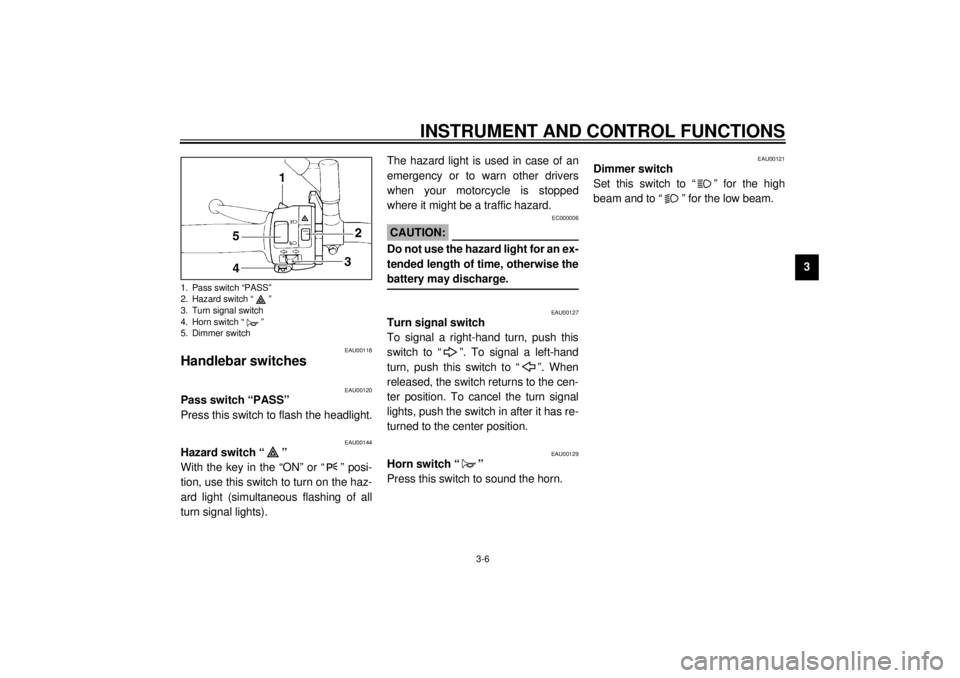
1. Pass switch “PASS”
2. Hazard switch “ ”
3. Turn signal switch
4. Horn switch “ ”
5. Dimmer switch
E_4km.book Page 6 Thursday, September 7, 2000 9:32 AM
Page 35 of 100
PRE-OPERATION CHECKS
4-2
4
NOTE:@ Pre-operation checks should be made each time the motorcycle is used. Such an inspection can be accomplished in a very
short time; and the added safety it assures is more than worth the time involved. @
EWA00033
WARNING
@ If any item in the Pre-operation check list is not working properly, have it inspected and repaired before operating
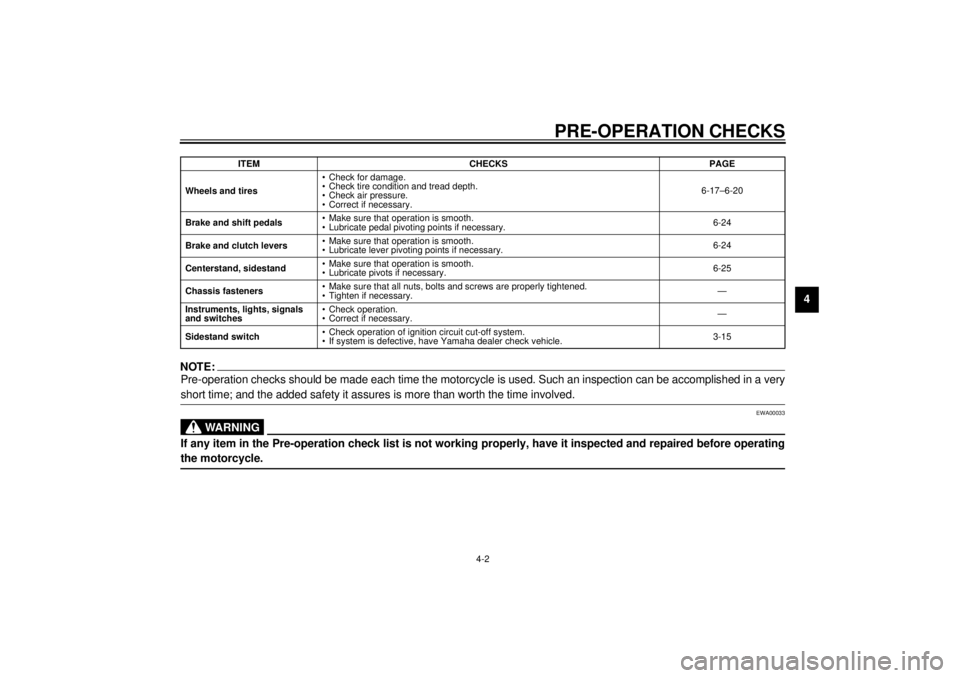
the motorcycle. @Wheels and tires• Check for damage.
• Check tire condition and tread depth.
• Check air pressure.
• Correct if necessary.6-17–6-20
Brake and shift pedals• Make sure that operation is smooth.
• Lubricate pedal pivoting points if necessary.6-24
Brake and clutch levers• Make sure that operation is smooth.
• Lubricate lever pivoting points if necessary.6-24
Centerstand, sidestand• Make sure that operation is smooth.
• Lubricate pivots if necessary.6-25
Chassis fasteners• Make sure that all nuts, bolts and screws are properly tightened.
• Tighten if necessary.—
Instruments, lights, signals
and switches• Check operation.
• Correct if necessary.—
Sidestand switch• Check operation of ignition circuit cut-off system.
• If system is defective, have Yamaha dealer check vehicle.3-15 ITEM CHECKS PAGE
E_4km.book Page 2 Thursday, September 7, 2000 9:32 AM
Page 41 of 100
OPERATION AND IMPORTANT RIDING POINTS
5-4
5
EAU02941
Recommended shift points
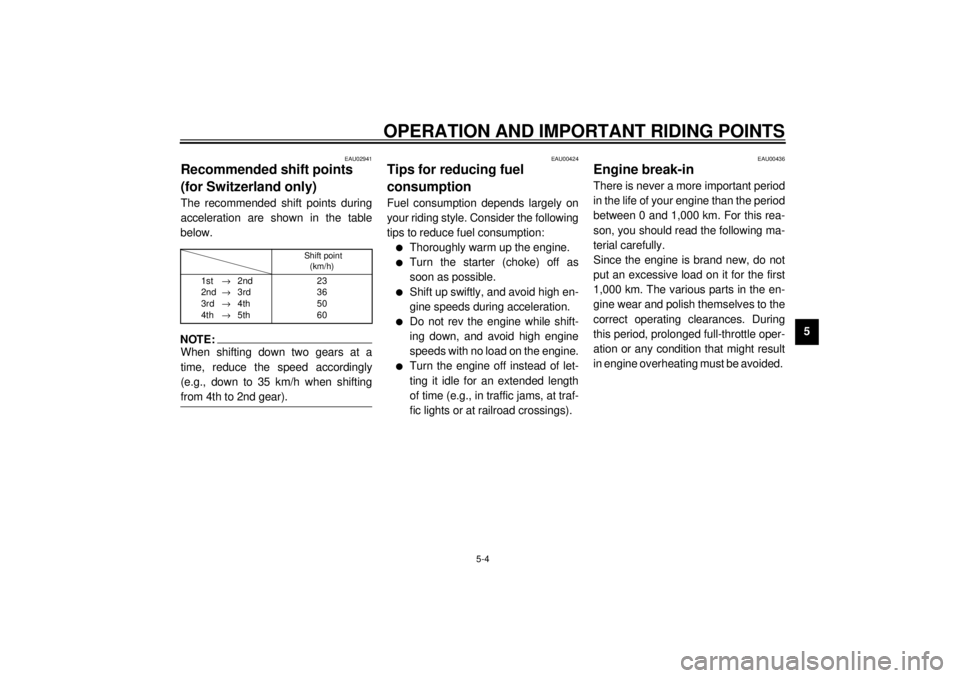
(for Switzerland only) The recommended shift points during
acceleration are shown in the table
below.CF-01ENOTE:@ When shifting down two gears at a
time, reduce the speed accordingly
(e.g., down to 35 km/h when shifting
from 4th to 2nd gear). @
EAU00424
Tips for reducing fuel
consumption Fuel consumption depends largely on
your riding style. Consider the following
tips to reduce fuel consumption:l
Thoroughly warm up the engine.
l
Turn the starter (choke) off as
soon as possible.
l
Shift up swiftly, and avoid high en-
gine speeds during acceleration.
l
Do not rev the engine while shift-
ing down, and avoid high engine
speeds with no load on the engine.
l
Turn the engine off instead of let-
ting it idle for an extended length
of time (e.g., in traffic jams, at traf-
fic lights or at railroad crossings).
EAU00436
Engine break-in There is never a more important period
in the life of your engine than the period
between 0 and 1,000 km. For this rea-
son, you should read the following ma-
terial carefully.
Since the engine is brand new, do not
put an excessive load on it for the first
1,000 km. The various parts in the en-
gine wear and polish themselves to the
correct operating clearances. During
this period, prolonged full-throttle oper-
ation or any condition that might result
in engine overheating must be avoided.
Shift point
(km/h)
1st®2nd
2nd®3rd
3rd®4th
4th®5th23
36
50
60
E_4km.book Page 4 Thursday, September 7, 2000 9:32 AM
Page 47 of 100
PERIODIC MAINTENANCE AND MINOR REPAIR
6-4
6
EAU03541
NOTE:@l
The air filter needs more frequent service if you are riding in unusually wet or dusty areas.
l
Hydraulic brake service
• Regularly check and, if necessary, correct the brake fluid level.
• Every two years replace the internal components of the brake master cylinder and caliper, and change the brake fluid.
• Replace the brake hoses every four years and if cracked or damaged.
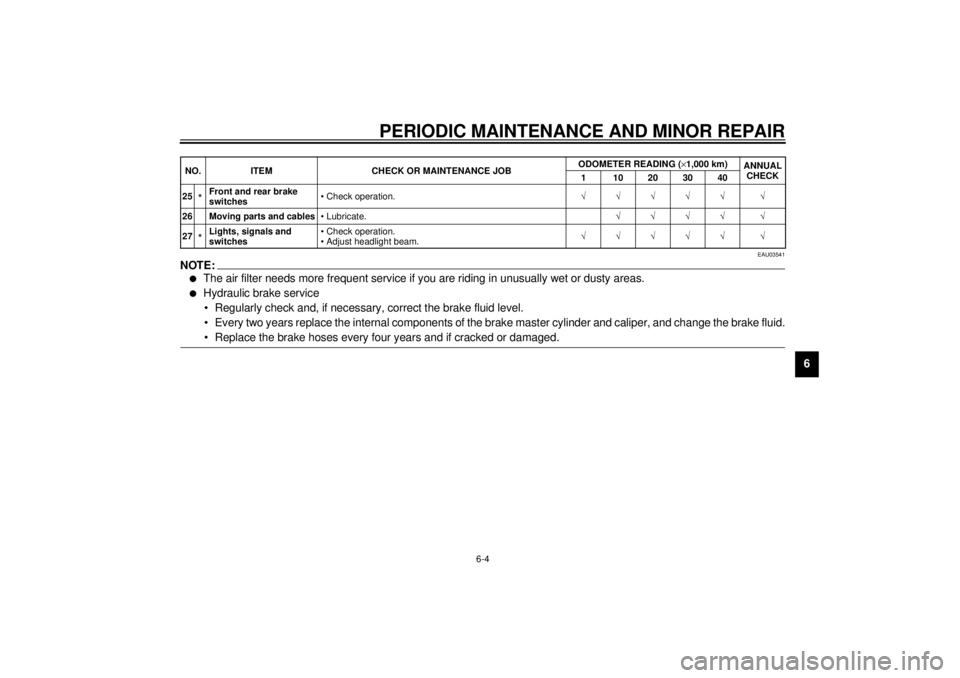
@25
*Front and rear brake
switches• Check operation.ÖÖÖÖÖ Ö
26 Moving parts and cables• Lubricate.ÖÖÖÖ Ö
27*Lights, signals and
switches• Check operation.
• Adjust headlight beam.ÖÖÖÖÖ Ö NO. ITEM CHECK OR MAINTENANCE JOBODOMETER READING (´1,000 km)
ANNUAL
CHECK
1 10203040
E_4km.book Page 4 Thursday, September 7, 2000 9:32 AM
Page 73 of 100
PERIODIC MAINTENANCE AND MINOR REPAIR
6-30
6
EAU00829
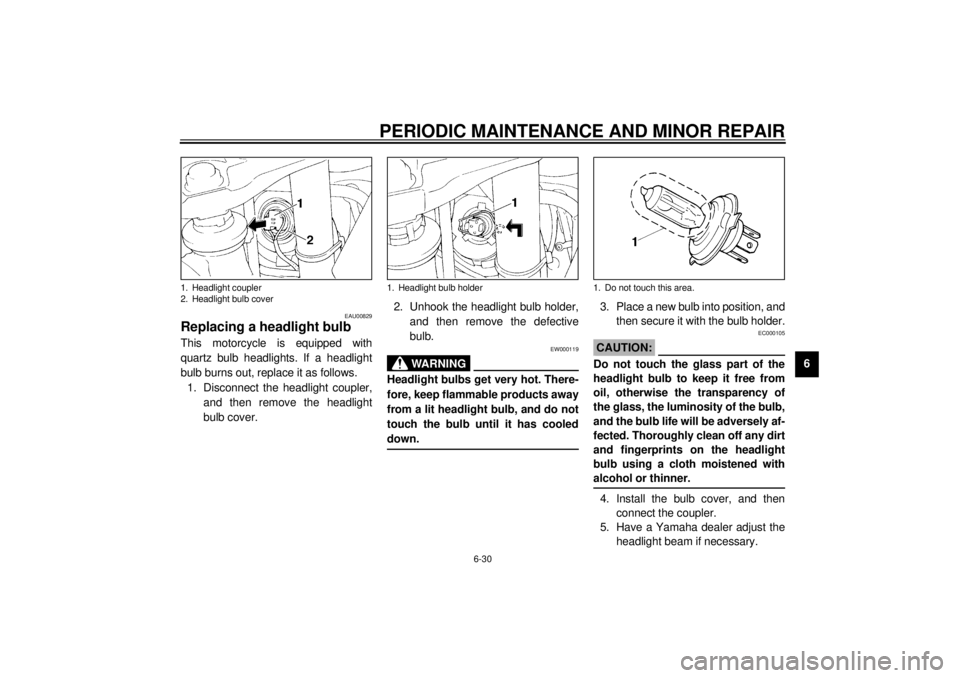
Replacing a headlight bulb This motorcycle is equipped with
quartz bulb headlights. If a headlight
bulb burns out, replace it as follows.
1. Disconnect the headlight coupler,
and then remove the headlight
bulb cover.2. Unhook the headlight bulb holder,
and then remove the defective
bulb.
EW000119
WARNING
@ Headlight bulbs get very hot. There-
fore, keep flammable products away
from a lit headlight bulb, and do not
touch the bulb until it has cooled
down. @
3. Place a new bulb into position, and
then secure it with the bulb holder.
EC000105
CAUTION:@ Do not touch the glass part of the
headlight bulb to keep it free from
oil, otherwise the transparency of
the glass, the luminosity of the bulb,
and the bulb life will be adversely af-
fected. Thoroughly clean off any dirt
and fingerprints on the headlight
bulb using a cloth moistened with
alcohol or thinner. @4. Install the bulb cover, and then
connect the coupler.
5. Have a Yamaha dealer adjust the
headlight beam if necessary.
1. Headlight coupler
2. Headlight bulb cover
1. Headlight bulb holder
1. Do not touch this area.
E_4km.book Page 30 Thursday, September 7, 2000 9:32 AM
Page 83 of 100
MOTORCYCLE CARE AND STORAGE
7-2
7
l
Do not use any harsh chemical
products on plastic parts. Be
sure to avoid using cloths or
sponges which have been in
contact with strong or abrasive
cleaning products, solvent or
thinner, fuel (gasoline), rust re-
movers or inhibitors, brake flu-
id, antifreeze or electrolyte.
l
Do not use high-pressure wash-
ers or steam-jet cleaners since
they cause water seepage and
deterioration in the following ar-
eas: seals (of wheel and swing-
arm bearings, fork and brakes),
electric components (couplers,
connectors, instruments, switch-
es and lights), breather hoses
and vents.
l
For motorcycles equipped with
a windshield: Do not use strong
cleaners or hard sponges as
they will cause dulling or
scratching. Some cleaning
compounds for plastic may
leave scratches on the wind-
shield. Test the product on a
small hidden part of the wind-
shield to make sure that it does
not leave any marks. If the wind-
shield is scratched, use a quali-
ty plastic polishing compound
after washing.
@After normal useRemove dirt with warm water, a mild
detergent, and a soft, clean sponge,
and then rinse thoroughly with clean
water. Use a toothbrush or bottlebrush
for hard-to-reach areas. Stubborn dirt
and insects will come off more easily if
the area is covered with a wet cloth for
a few minutes before cleaning.After riding in the rain, near the sea or
on salt-sprayed roadsSince sea salt or salt sprayed on roads
during winter are extremely corrosive in
combination with water, carry out the
following steps after each ride in the
rain, near the sea or on salt-sprayed
roads.NOTE:@ Salt sprayed on roads in the winter may
remain well into spring. @1. Clean the motorcycle with cold
water and a mild detergent, after
the engine has cooled down.
ECA00012
CAUTION:@ Do not use warm water since it in-
creases the corrosive action of the
salt. @2. After drying the motorcycle, apply
a corrosion protection spray on all
metal, including chrome- and nick-
el-plated, surfaces to prevent
corrosion.
E_4km.book Page 2 Thursday, September 7, 2000 9:32 AM
Page 96 of 100
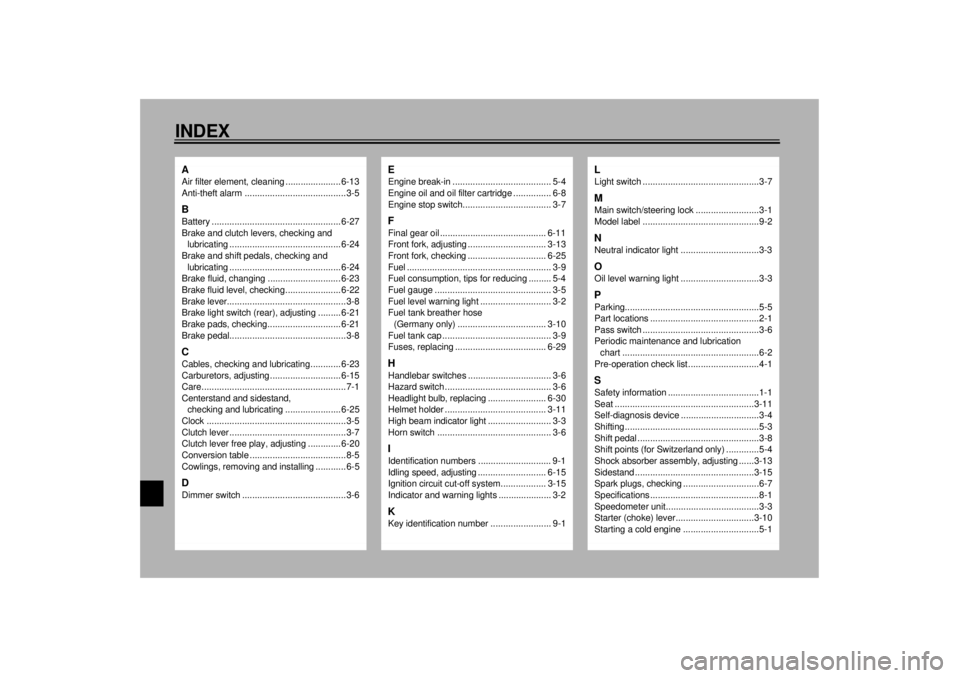
10-INDEXAAir filter element, cleaning ...................... 6-13
Anti-theft alarm ........................................3-5BBattery ................................................... 6-27
Brake and clutch levers, checking and
lubricating ............................................ 6-24
Brake and shift pedals, checking and
lubricating ............................................ 6-24
Brake fluid, changing ............................. 6-23
Brake fluid level, checking...................... 6-22
Brake lever...............................................3-8
Brake light switch (rear), adjusting ......... 6-21
Brake pads, checking............................. 6-21
Brake pedal..............................................3-8CCables, checking and lubricating............ 6-23
Carburetors, adjusting............................ 6-15
Care.........................................................7-1
Centerstand and sidestand,
checking and lubricating ...................... 6-25
Clock .......................................................3-5
Clutch lever ..............................................3-7
Clutch lever free play, adjusting ............. 6-20
Conversion table ......................................8-5
Cowlings, removing and installing ............6-5DDimmer switch .........................................3-6
EEngine break-in ....................................... 5-4
Engine oil and oil filter cartridge ............... 6-8
Engine stop switch................................... 3-7FFinal gear oil .......................................... 6-11
Front fork, adjusting ............................... 3-13
Front fork, checking ............................... 6-25
Fuel ......................................................... 3-9
Fuel consumption, tips for reducing ......... 5-4
Fuel gauge .............................................. 3-5
Fuel level warning light ............................ 3-2
Fuel tank breather hose
(Germany only) ................................... 3-10
Fuel tank cap ........................................... 3-9
Fuses, replacing .................................... 6-29HHandlebar switches ................................. 3-6
Hazard switch .......................................... 3-6
Headlight bulb, replacing ....................... 6-30
Helmet holder ........................................ 3-11
High beam indicator light ......................... 3-3
Horn switch ............................................. 3-6IIdentification numbers ............................. 9-1
Idling speed, adjusting ........................... 6-15
Ignition circuit cut-off system.................. 3-15
Indicator and warning lights ..................... 3-2KKey identification number ........................ 9-1
LLight switch ..............................................3-7MMain switch/steering lock .........................3-1
Model label ..............................................9-2NNeutral indicator light ...............................3-3OOil level warning light ...............................3-3PParking.....................................................5-5
Part locations ...........................................2-1
Pass switch ..............................................3-6
Periodic maintenance and lubrication
chart ......................................................6-2
Pre-operation check list ............................4-1SSafety information ....................................1-1
Seat .......................................................3-11
Self-diagnosis device ...............................3-4
Shifting .....................................................5-3
Shift pedal ................................................3-8
Shift points (for Switzerland only) .............5-4
Shock absorber assembly, adjusting ......3-13
Sidestand ...............................................3-15
Spark plugs, checking ..............................6-7
Specifications ...........................................8-1
Speedometer unit.....................................3-3
Starter (choke) lever...............................3-10
Starting a cold engine ..............................5-1
E_4km.book Page 1 Thursday, September 7, 2000 9:32 AM
Page 97 of 100
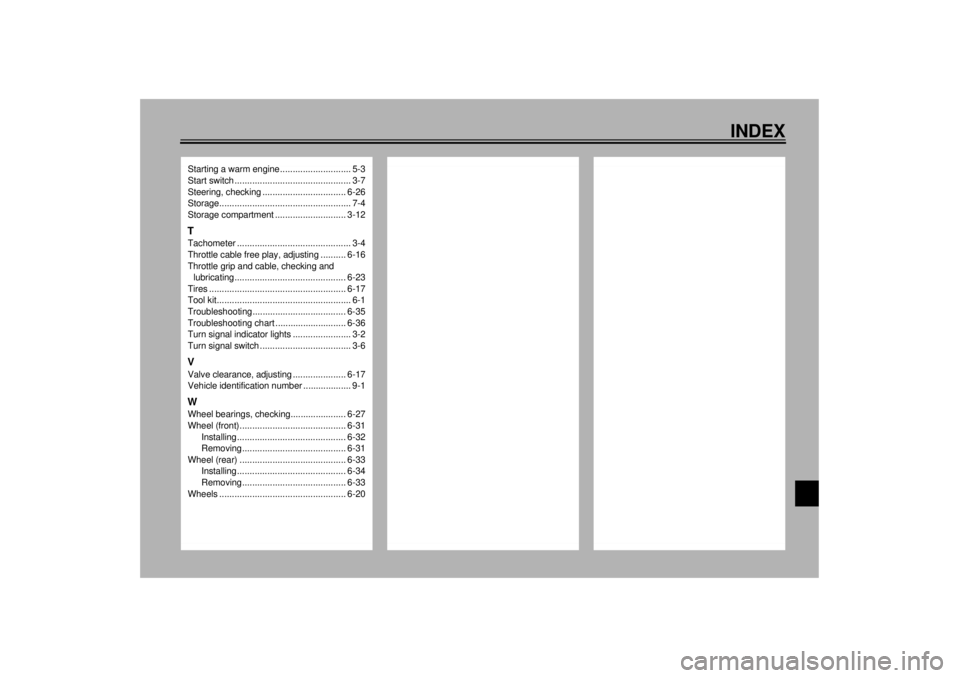
INDEX
Starting a warm engine ............................ 5-3
Start switch .............................................. 3-7
Steering, checking ................................. 6-26
Storage.................................................... 7-4
Storage compartment ............................ 3-12TTachometer ............................................. 3-4
Throttle cable free play, adjusting .......... 6-16
Throttle grip and cable, checking and
lubricating............................................ 6-23
Tires ...................................................... 6-17
Tool kit..................................................... 6-1
Troubleshooting..................................... 6-35
Troubleshooting chart ............................ 6-36
Turn signal indicator lights ....................... 3-2
Turn signal switch .................................... 3-6VValve clearance, adjusting ..................... 6-17
Vehicle identification number ................... 9-1WWheel bearings, checking...................... 6-27
Wheel (front).......................................... 6-31
Installing........................................... 6-32
Removing......................................... 6-31
Wheel (rear) .......................................... 6-33
Installing........................................... 6-34
Removing......................................... 6-33
Wheels .................................................. 6-20
E_4km.book Page 2 Thursday, September 7, 2000 9:32 AM