engine YAMAHA XL 1200 2001 Workshop Manual
[x] Cancel search | Manufacturer: YAMAHA, Model Year: 2001, Model line: XL 1200, Model: YAMAHA XL 1200 2001Pages: 131, PDF Size: 8.12 MB
Page 87 of 131
3-30
E
EJU00621
Stopping the watercraft
The watercraft is not equipped with a sep-
arate braking system. It is stopped by water
resistance when the throttle lever is
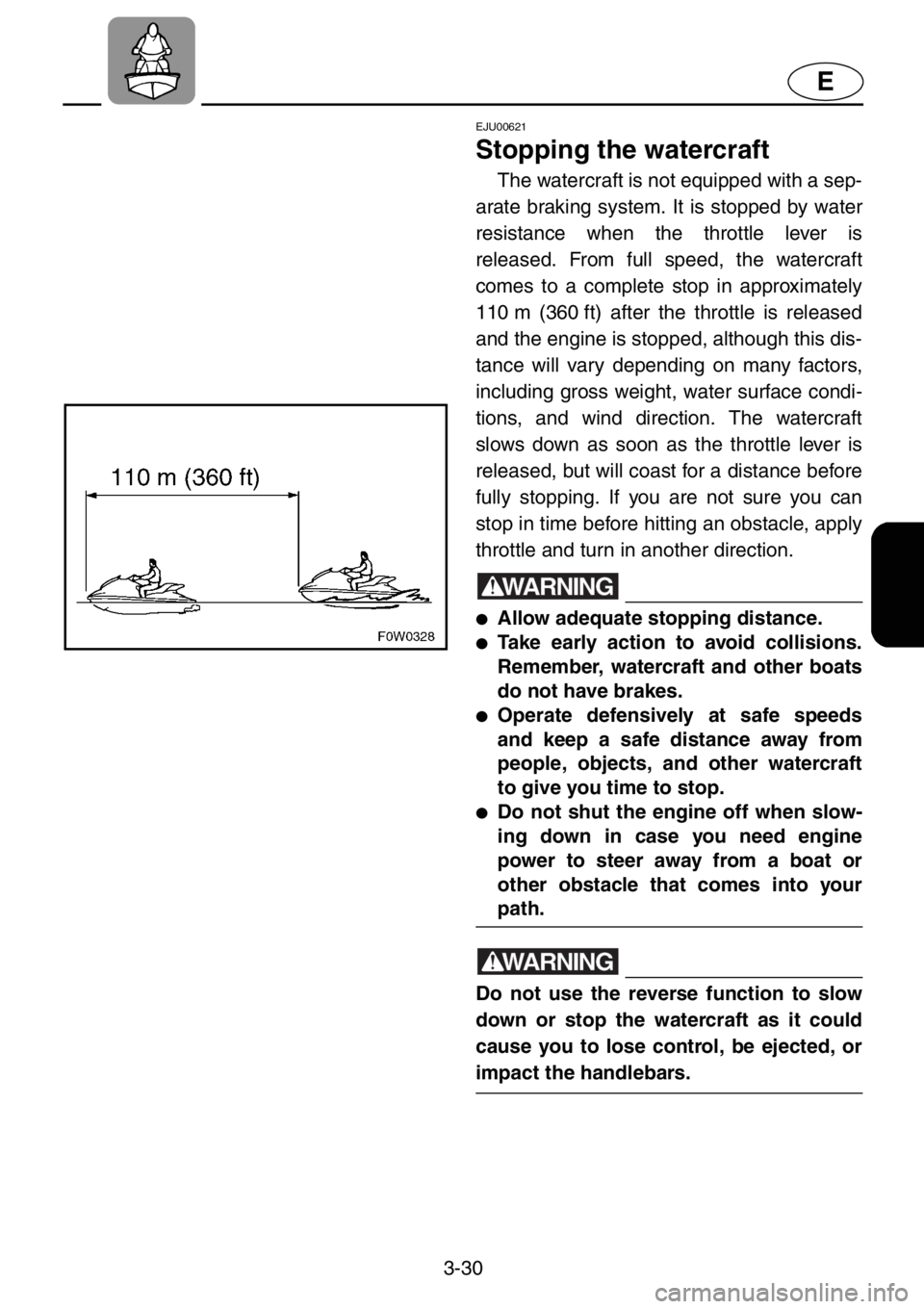
released. From full speed, the watercraft
comes to a complete stop in approximately
110 m (360 ft) after the throttle is released
and the engine is stopped, although this dis-
tance will vary depending on many factors,
including gross weight, water surface condi-
tions, and wind direction. The watercraft
slows down as soon as the throttle lever is
released, but will coast for a distance before
fully stopping. If you are not sure you can
stop in time before hitting an obstacle, apply
throttle and turn in another direction.
WARNING
●Allow adequate stopping distance.
●Take early action to avoid collisions.
Remember, watercraft and other boats
do not have brakes.
●Operate defensively at safe speeds
and keep a safe distance away from
people, objects, and other watercraft
to give you time to stop.
●Do not shut the engine off when slow-
ing down in case you need engine
power to steer away from a boat or
other obstacle that comes into your
path.
WARNING
Do not use the reverse function to slow
down or stop the watercraft as it could
cause you to lose control, be ejected, or
impact the handlebars.
Page 88 of 131
3-31
E
EJU00635
Beaching the watercraft
1. Make sure no obstructions, boats or
swimmers are near the beach. Release
the throttle lever about 110 m (360 ft)
before you reach the intended beaching
area.
2. Approach the beach slowly and stop the
engine before reaching land. Remem-
ber: you need throttle to steer.
3. Get off the watercraft and pull it up on
the beach.
CAUTION:
Small pebbles, sand, seaweed, and other
debris can be pulled into the jet intake
and impair or damage the impeller.
Always stop the engine and get off
before beaching the watercraft.
EJU00505
Docking the watercraft
1. Make sure that no obstructions, boats or
swimmers are close to the watercraft.
Reduce speed about 110 m (360 ft)
away from the dock.
2. Slowly approach the dock and stop the
engine just before coming alongside it.
Page 89 of 131
3-32
E
EJU00006n
Reverse on waterways
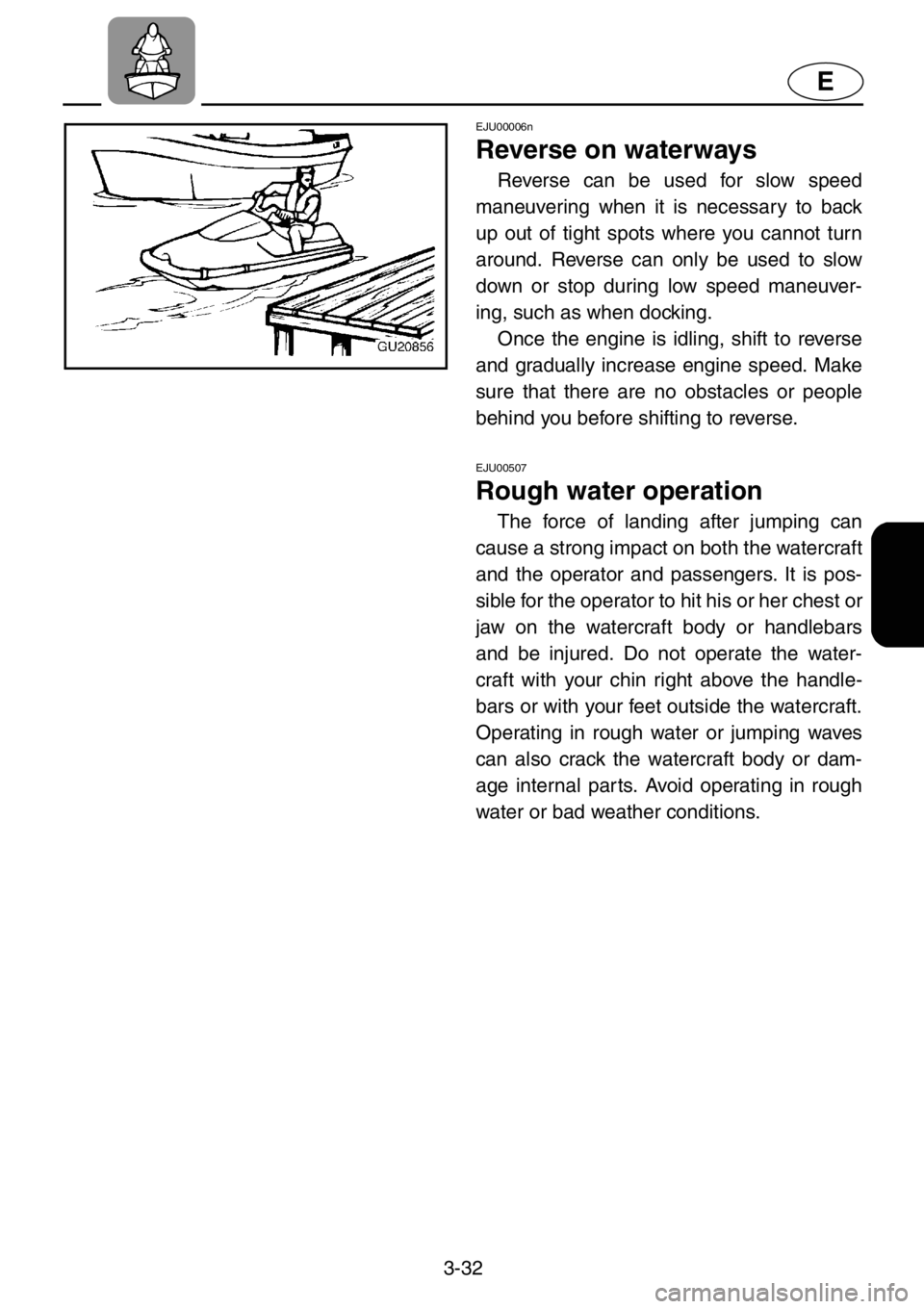
Reverse can be used for slow speed
maneuvering when it is necessary to back
up out of tight spots where you cannot turn
around. Reverse can only be used to slow
down or stop during low speed maneuver-
ing, such as when docking.
Once the engine is idling, shift to reverse
and gradually increase engine speed. Make
sure that there are no obstacles or people
behind you before shifting to reverse.
EJU00507
Rough water operation
The force of landing after jumping can
cause a strong impact on both the watercraft
and the operator and passengers. It is pos-
sible for the operator to hit his or her chest or
jaw on the watercraft body or handlebars
and be injured. Do not operate the water-
craft with your chin right above the handle-
bars or with your feet outside the watercraft.
Operating in rough water or jumping waves
can also crack the watercraft body or dam-
age internal parts. Avoid operating in rough
water or bad weather conditions.
Page 90 of 131
3-33
E
EJU00691a
Post-operation checks
Always perform the following post-opera-
tion checks after operating the watercraft.
1. Remove the watercraft from the water.
2. Wash down the hull, handlebars, and jet
unit with fresh water.
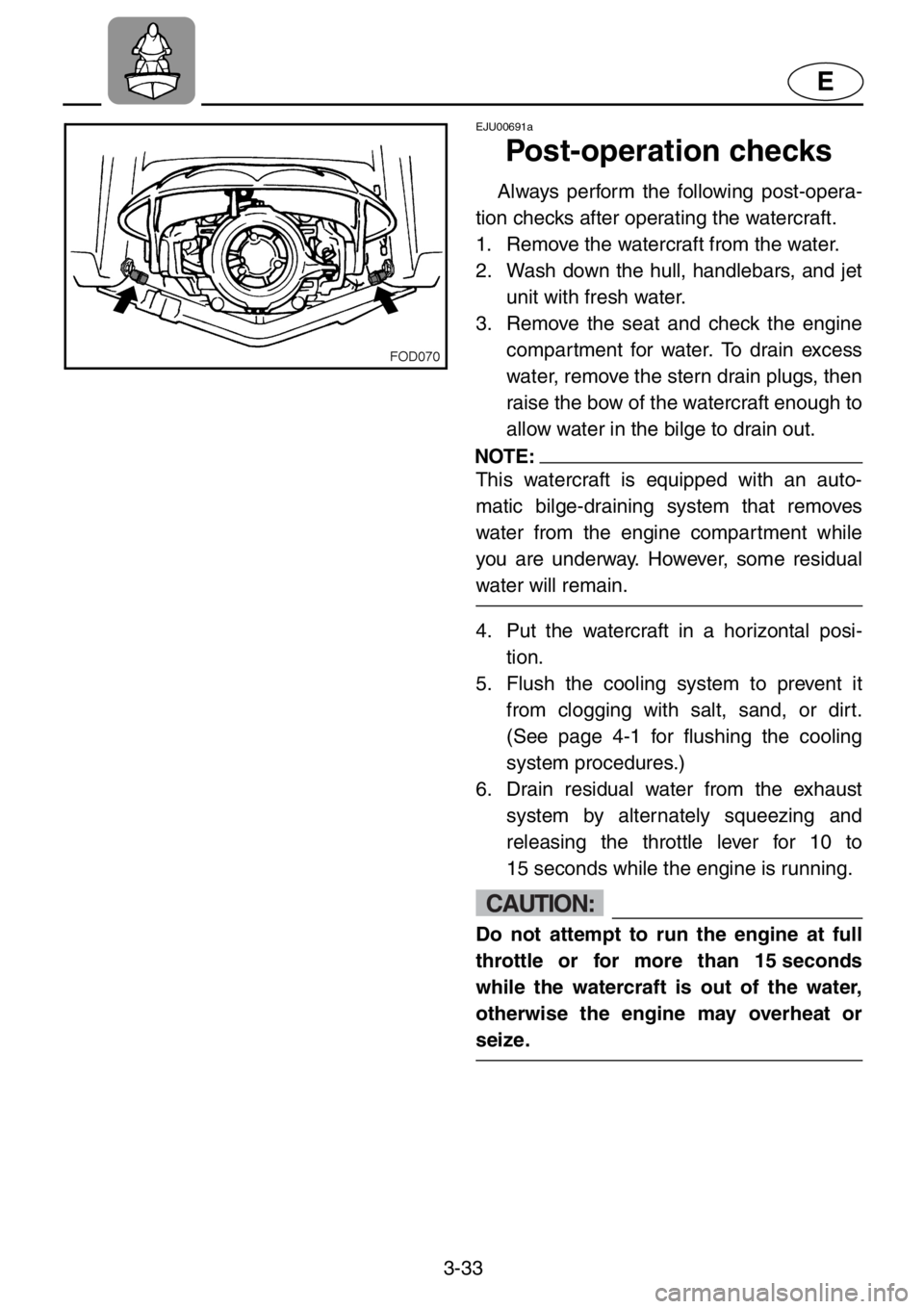
3. Remove the seat and check the engine
compartment for water. To drain excess
water, remove the stern drain plugs, then
raise the bow of the watercraft enough to
allow water in the bilge to drain out.
NOTE:
This watercraft is equipped with an auto-
matic bilge-draining system that removes
water from the engine compartment while
you are underway. However, some residual
water will remain.
4. Put the watercraft in a horizontal posi-
tion.
5. Flush the cooling system to prevent it
from clogging with salt, sand, or dirt.
(See page 4-1 for flushing the cooling
system procedures.)
6. Drain residual water from the exhaust
system by alternately squeezing and
releasing the throttle lever for 10 to
15 seconds while the engine is running.
CAUTION:
Do not attempt to run the engine at full
throttle or for more than 15 seconds
while the watercraft is out of the water,
otherwise the engine may overheat or
seize.
Page 91 of 131
3-34
E
7. If the watercraft will be stored for a week
or more, lubricate internal engine com-
ponents to help prevent corrosion. (See
page 4-3 for lubrication procedures.)
8. Rinse the engine and engine compart-
ment with a small amount of water.
CAUTION:
Do not use high pressure when rinsing
the engine or engine compartment as
severe engine damage could result.
9. Wipe the engine and engine compart-
ment dry with a clean cloth (repeat
step 3, if necessary).
10. Wipe the hull, handlebars, and jet unit
dry with a clean cloth.
11. Spray a rust inhibitor on metallic parts to
minimize corrosion.
12. Allow the engine compartment to air dry
completely before reinstalling the seat.
Page 92 of 131
3-35
E
EJU00679
Transporting
WARNING
Always place the fuel cock knob in the
“OFF” position when transporting the
watercraft, otherwise fuel could leak out
into the engine or engine compartment,
which would create a fire hazard.
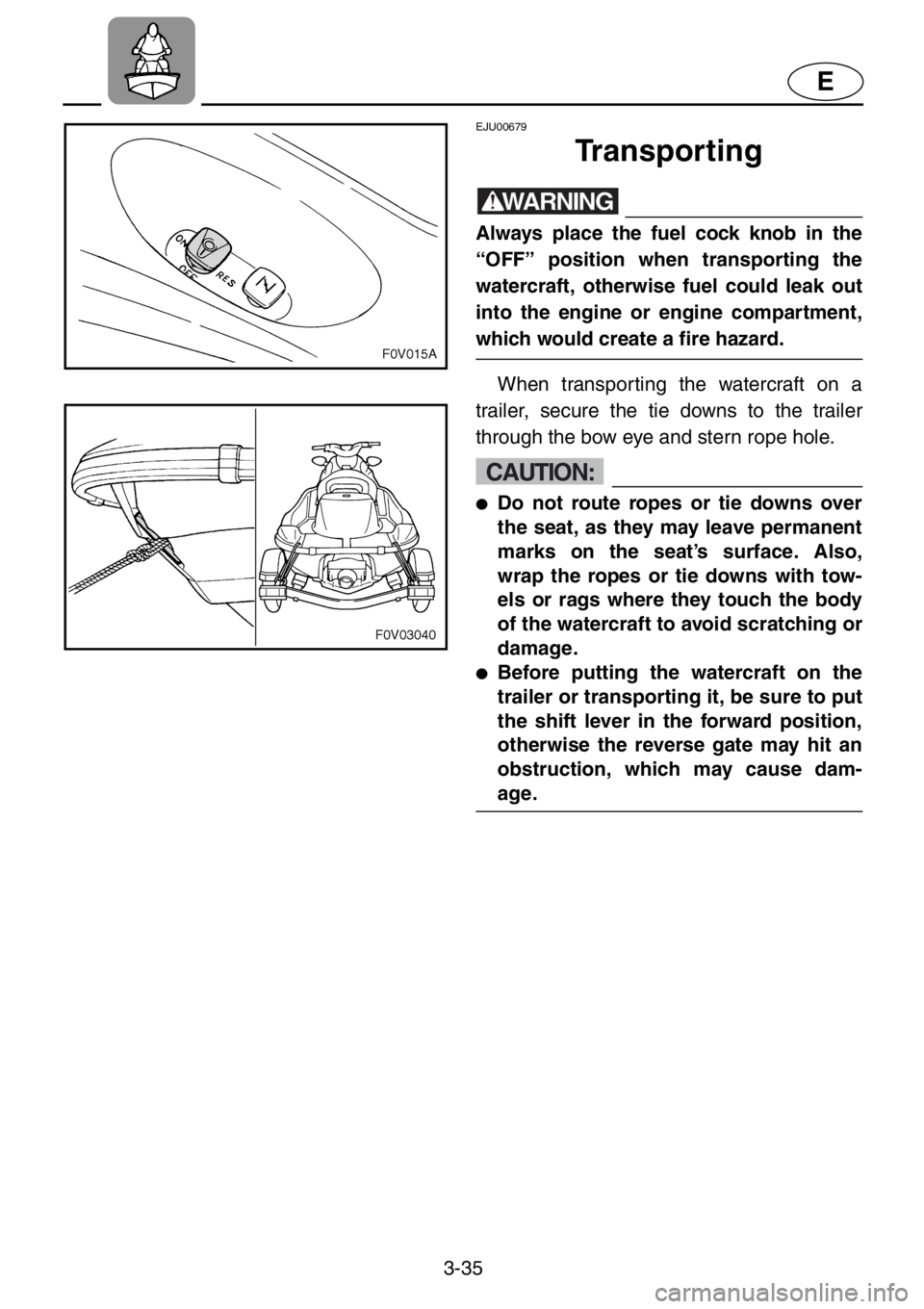
When transporting the watercraft on a
trailer, secure the tie downs to the trailer
through the bow eye and stern rope hole.
CAUTION:
●Do not route ropes or tie downs over
the seat, as they may leave permanent
marks on the seat’s surface. Also,
wrap the ropes or tie downs with tow-
els or rags where they touch the body
of the watercraft to avoid scratching or
damage.
●Before putting the watercraft on the
trailer or transporting it, be sure to put
the shift lever in the forward position,
otherwise the reverse gate may hit an
obstruction, which may cause dam-
age.
Page 94 of 131
4-1
E
EJU00516a
Storage
WARNING
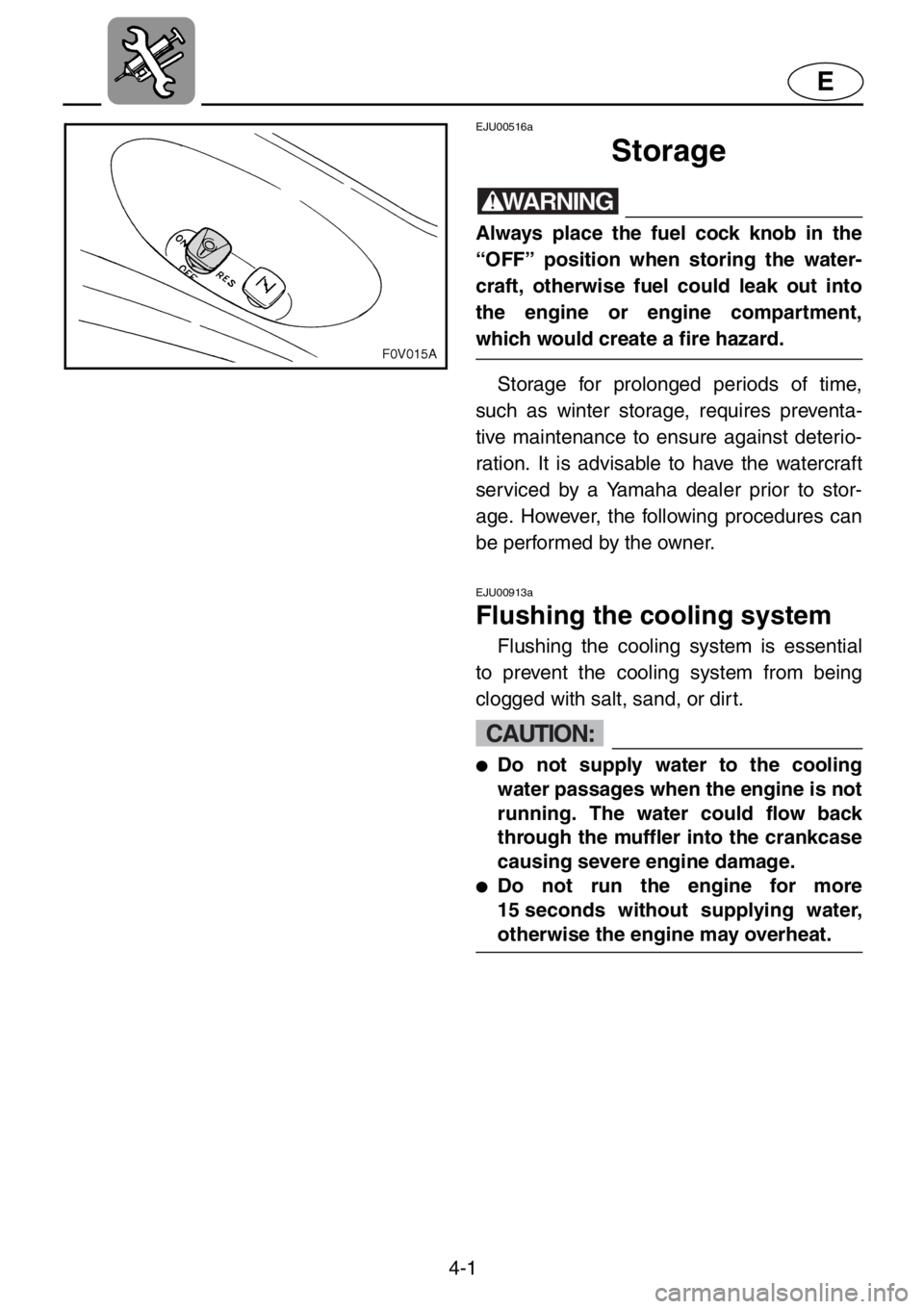
Always place the fuel cock knob in the
“OFF” position when storing the water-
craft, otherwise fuel could leak out into
the engine or engine compartment,
which would create a fire hazard.
Storage for prolonged periods of time,
such as winter storage, requires preventa-
tive maintenance to ensure against deterio-
ration. It is advisable to have the watercraft
serviced by a Yamaha dealer prior to stor-
age. However, the following procedures can
be performed by the owner.
EJU00913a
Flushing the cooling system
Flushing the cooling system is essential
to prevent the cooling system from being
clogged with salt, sand, or dirt.
CAUTION:
●Do not supply water to the cooling
water passages when the engine is not
running. The water could flow back
through the muffler into the crankcase
causing severe engine damage.
●Do not run the engine for more
15 seconds without supplying water,
otherwise the engine may overheat.
Page 95 of 131
4-2
E
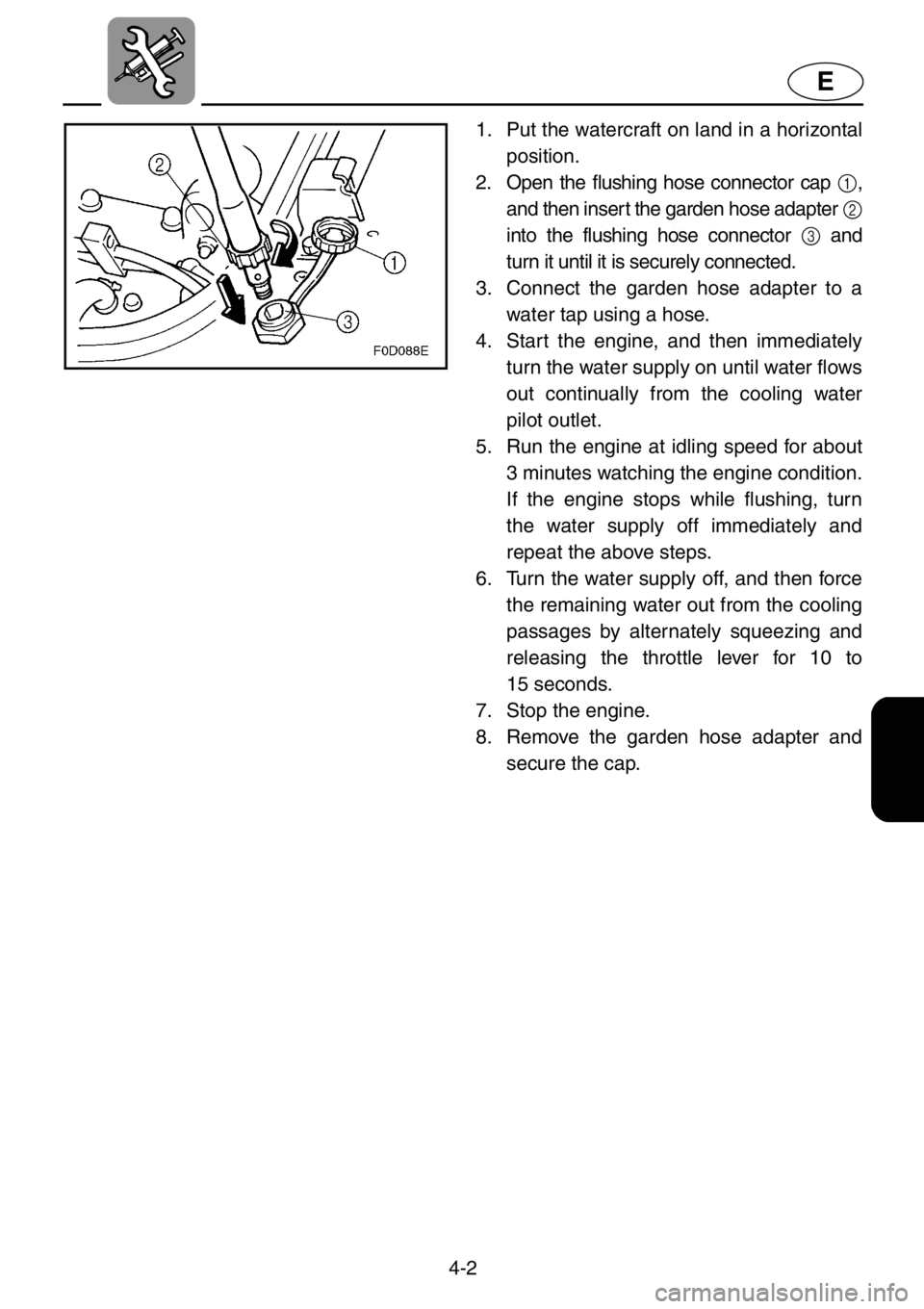
1. Put the watercraft on land in a horizontal
position.
2. Open the flushing hose connector cap 1,
and then inser t the garden hose adapter
2
into the flushing hose connector 3 and
turn it until it is securely connected.
3. Connect the garden hose adapter to a
water tap using a hose.
4. Start the engine, and then immediately
turn the water supply on until water flows
out continually from the cooling water
pilot outlet.
5. Run the engine at idling speed for about
3 minutes watching the engine condition.
If the engine stops while flushing, turn
the water supply off immediately and
repeat the above steps.
6. Turn the water supply off, and then force
the remaining water out from the cooling
passages by alternately squeezing and
releasing the throttle lever for 10 to
15 seconds.
7. Stop the engine.
8. Remove the garden hose adapter and
secure the cap.
Page 96 of 131
4-3
E
EJU00526a
Lubrication
1. Remove the spark plugs and pour
approximately one tablespoon of oil into
each cylinder.
2. Grease the spark plug threads and rein-
stall the spark plugs.
3. Crank the engine within 3 seconds using
the starter switch.
4. Lubricate all cables such as the throttle,
choke, and steering cables.
5. Lubricate the areas of the watercraft
specified under Lubrication points on
page 4-15.
EJU00528b
Fuel system
WARNING
Gasoline is highly flammable and explo-
sive. A fire or explosion can cause
severe injury or death. Shut off the
engine. Do not smoke. Avoid spilling
gasoline.
1. Place the fuel cock in the OFF position.
2. Drain the fuel tank by using a siphon.
Page 98 of 131

4-5
E
EJU00531
Cleaning the watercraft
Clean the watercraft before storing for a
long period.
1. Wash down the hull, handlebars, and
drive unit with fresh water.
2. Rinse the engine and bilge area with
fresh water. Drain off all water and wipe
up remaining moisture with clean, dry
rags.
3. Spray the engine’s exterior with a rust
inhibitor or lubricant.
4. Wax the hull with a non-abrasive wax.
5. Wipe all vinyl and rubber components,
such as the seat and engine compart-
ment seals, with a vinyl protectant.