warning light YAMAHA XMAX 125 2013 Owners Manual
[x] Cancel search | Manufacturer: YAMAHA, Model Year: 2013, Model line: XMAX 125, Model: YAMAHA XMAX 125 2013Pages: 96, PDF Size: 4.83 MB
Page 6 of 96

TABLE OF CONTENTSSAFETY INFORMATION ..................1-1
Further safe-riding points ................1-5
DESCRIPTION ..................................2-1
Left view ..........................................2-1
Right view ........................................2-3
Controls and instruments.................2-5
INSTRUMENT AND CONTROL
FUNCTIONS.......................................3-1
Immobilizer system .........................3-1
Main switch/steering lock ................3-2
Indicator lights and
warning lights ..............................3-4
Speedometer ..................................3-5
Tachometer ....................................3-6
Multi-function display ......................3-6
Anti-theft alarm (optional) .............3-11
Handlebar switches ......................3-11
Front brake lever ..........................3-12
Rear brake lever ...........................3-13
ABS (for ABS models) ..................3-13
Fuel tank cap ................................3-14
Fuel ...............................................3-15
Catalytic converters ......................3-16
Securing bracket ...........................3-17
Seat ..............................................3-17
Storage compartments .................3-18
Travel trunk ..................................3-19
Adjusting the shock absorber
assemblies ................................3-20Sidestand ..................................... 3-21
Ignition circuit cut-off system ........ 3-21
Auxiliary DC jack .......................... 3-23
FOR YOUR SAFETY –
PRE-OPERATION CHECKS............. 4-1
OPERATION AND IMPORTANT
RIDING POINTS................................. 5-1
Starting the engine ......................... 5-1
Starting off ...................................... 5-2
Acceleration and deceleration ........ 5-3
Braking ........................................... 5-3
Tips for reducing fuel
consumption ............................... 5-4
Engine break-in .............................. 5-4
Parking ........................................... 5-5
PERIODIC MAINTENANCE AND
ADJUSTMENT................................... 6-1
Owner’s tool kit ............................... 6-2
Periodic maintenance chart for the
emission control system ............. 6-3
General maintenance and
lubrication chart .......................... 6-4
Removing and installing
the cowling and panel ................. 6-8
Checking the spark plug ................. 6-9
Engine oil ..................................... 6-10
Final transmission oil .................... 6-13
Coolant ......................................... 6-14Air filter and V-belt case air filter
elements ................................... 6-16
Adjusting the throttle grip free
play ........................................... 6-17
Valve clearance ........................... 6-18
Tires ............................................. 6-18
Cast wheels ................................. 6-20
Checking the front and
rear brake lever free play ......... 6-21
Checking the front and
rear brake pads ........................ 6-21
Checking the brake fluid level ...... 6-22
Changing the brake fluid .............. 6-24
Checking and lubricating
the cables ................................. 6-24
Checking and lubricating
the throttle grip and cable ......... 6-24
Lubricating the front and
rear brake levers ...................... 6-25
Checking and lubricating the
centerstand and sidestand ....... 6-25
Checking the front fork ................. 6-26
Checking the steering .................. 6-27
Checking the wheel bearings ....... 6-27
Battery ......................................... 6-27
Replacing the fuses ..................... 6-29
Replacing a headlight bulb .......... 6-30
Replacing a front turn signal light
bulb ........................................... 6-31
Replacing a tail/brake light bulb or
a rear turn signal light bulb ....... 6-31U2ABE2E0.book Page 1 Thursday, August 30, 2012 2:36 PM
Page 20 of 96
INSTRUMENT AND CONTROL FUNCTIONS
3-2
3
●
Keep other immobilizer system
keys away from the main switch
as they may cause signal inter-
ference.
EAU10472
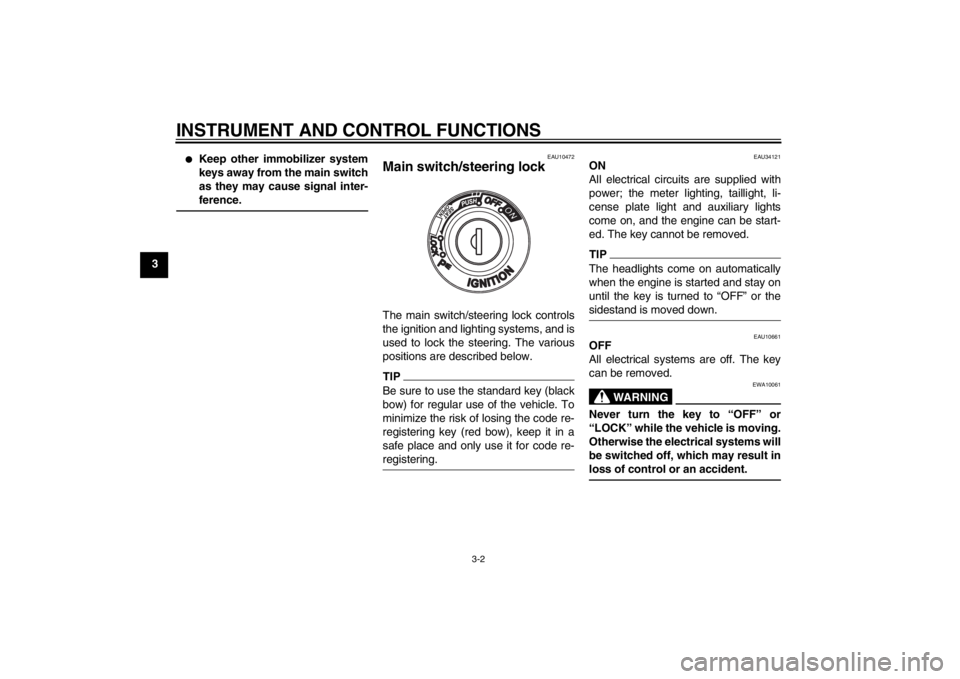
Main switch/steering lock The main switch/steering lock controls
the ignition and lighting systems, and is
used to lock the steering. The various
positions are described below.TIPBe sure to use the standard key (black
bow) for regular use of the vehicle. To
minimize the risk of losing the code re-
registering key (red bow), keep it in a
safe place and only use it for code re-
registering.
EAU34121
ON
All electrical circuits are supplied with
power; the meter lighting, taillight, li-
cense plate light and auxiliary lights
come on, and the engine can be start-
ed. The key cannot be removed.TIPThe headlights come on automatically
when the engine is started and stay on
until the key is turned to “OFF” or the
sidestand is moved down.
EAU10661
OFF
All electrical systems are off. The key
can be removed.
WARNING
EWA10061
Never turn the key to “OFF” or
“LOCK” while the vehicle is moving.
Otherwise the electrical systems will
be switched off, which may result in
loss of control or an accident.
U2ABE2E0.book Page 2 Thursday, August 30, 2012 2:36 PM
Page 22 of 96
INSTRUMENT AND CONTROL FUNCTIONS
3-4
3
EAU49392
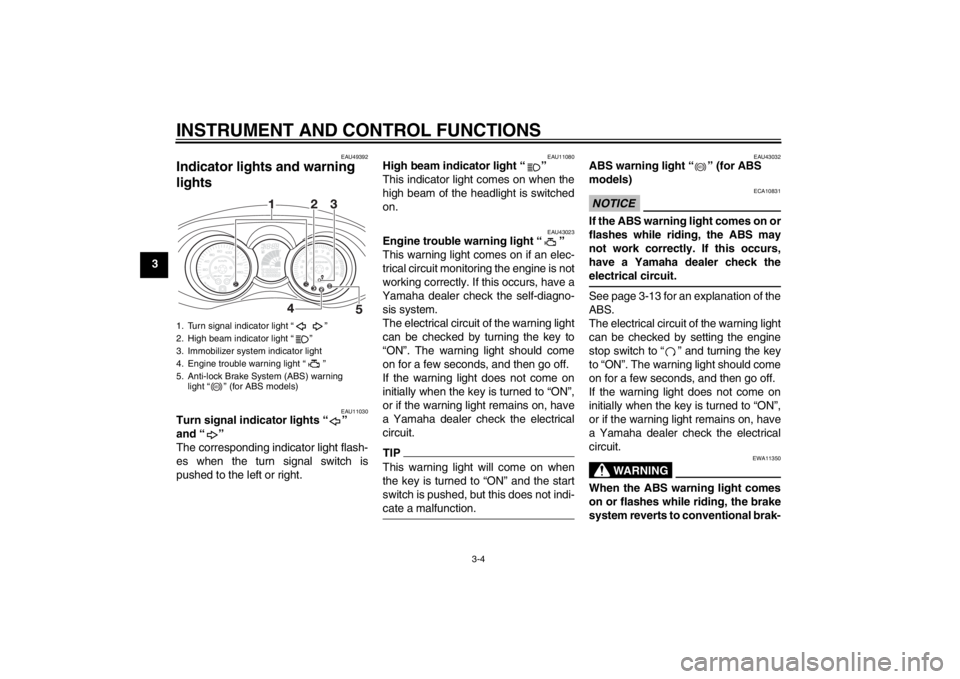
Indicator lights and warning
lights
EAU11030
Turn signal indicator lights “ ”
and “ ”
The corresponding indicator light flash-
es when the turn signal switch is
pushed to the left or right.
EAU11080
High beam indicator light “ ”
This indicator light comes on when the
high beam of the headlight is switched
on.
EAU43023
Engine trouble warning light “ ”
This warning light comes on if an elec-
trical circuit monitoring the engine is not
working correctly. If this occurs, have a
Yamaha dealer check the self-diagno-
sis system.
The electrical circuit of the warning light
can be checked by turning the key to
“ON”. The warning light should come
on for a few seconds, and then go off.
If the warning light does not come on
initially when the key is turned to “ON”,
or if the warning light remains on, have
a Yamaha dealer check the electrical
circuit.TIPThis warning light will come on when
the key is turned to “ON” and the start
switch is pushed, but this does not indi-
cate a malfunction.
EAU43032
ABS warning light “ ” (for ABS
models) NOTICE
ECA10831
If the ABS warning light comes on or
flashes while riding, the ABS may
not work correctly. If this occurs,
have a Yamaha dealer check the
electrical circuit.See page 3-13 for an explanation of the
ABS.
The electrical circuit of the warning light
can be checked by setting the engine
stop switch to “ ” and turning the key
to “ON”. The warning light should come
on for a few seconds, and then go off.
If the warning light does not come on
initially when the key is turned to “ON”,
or if the warning light remains on, have
a Yamaha dealer check the electrical
circuit.
WARNING
EWA11350
When the ABS warning light comes
on or flashes while riding, the brake
system reverts to conventional brak-
1. Turn signal indicator light “ ”
2. High beam indicator light “ ”
3. Immobilizer system indicator light
4. Engine trouble warning light “ ”
5. Anti-lock Brake System (ABS) warning
light “ ” (for ABS models)
ABS
ABS
U2ABE2E0.book Page 4 Thursday, August 30, 2012 2:36 PM
Page 23 of 96
INSTRUMENT AND CONTROL FUNCTIONS
3-5
3 ing. Therefore, be careful not to
cause the wheel to lock during emer-
gency braking.
TIPThe ABS warning light may come on
while accelerating the engine with the
scooter on its centerstand, but this
does not indicate a malfunction.
EAU38624
Immobilizer system indicator light
The electrical circuit of the indicator
light can be checked by turning the key
to “ON”. The indicator light should
come on for a few seconds, and then
go off.
If the indicator light does not come on
initially when the key is turned to “ON”,
or if the indicator light remains on, have
a Yamaha dealer check the electrical
circuit.
When the key is turned to “OFF” and 30
seconds have passed, the indicator
light will start flashing indicating the im-
mobilizer system is enabled. After 24
hours have passed, the indicator light
will stop flashing, however the immobi-
lizer system is still enabled.The self-diagnosis device also detects
problems in the immobilizer system cir-
cuits. (See page 3-9 for an explanation
of the self-diagnosis device.)
EAUS1860
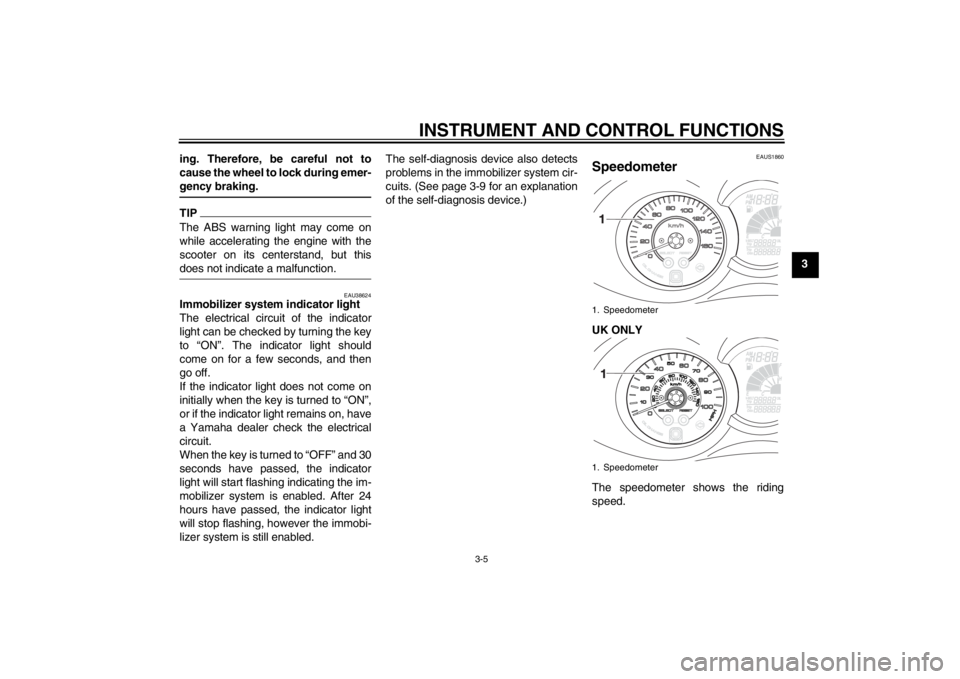
Speedometer UK ONLY
The speedometer shows the riding
speed.1. Speedometer
1. Speedometer
U2ABE2E0.book Page 5 Thursday, August 30, 2012 2:36 PM
Page 30 of 96
INSTRUMENT AND CONTROL FUNCTIONS
3-12
3
EAU12350
Pass switch “ ”
Press this switch to flash the headlight.
EAU12400
Dimmer switch “ / ”
Set this switch to “ ” for the high
beam and to “ ” for the low beam.
EAU12460
Turn signal switch “ / ”
To signal a right-hand turn, push this
switch to “ ”. To signal a left-hand
turn, push this switch to “ ”. When re-
leased, the switch returns to the center
position. To cancel the turn signal
lights, push the switch in after it has re-
turned to the center position.
EAU12500
Horn switch “ ”
Press this switch to sound the horn.
EAU12721
Start switch “ ”
With the sidestand up, push this switch
while applying the front or rear brake to
crank the engine with the starter. See
page 5-1 for starting instructions prior
to starting the engine.
EAU44711
The engine trouble warning light and
ABS warning light (ABS model only)
may come on when the key is turned to
“ON” and the start switch is pushed, but
this does not indicate a malfunction.
EAU12733
Hazard switch “ ”
With the key in the “ON” or “ ” posi-
tion, use this switch to turn on the haz-
ard lights (simultaneous flashing of all
turn signal lights).
The hazard lights are used in case of
an emergency or to warn other drivers
when your vehicle is stopped where it
might be a traffic hazard.NOTICE
ECA10061
Do not use the hazard lights for an
extended length of time with the en-
gine not running, otherwise the bat-
tery may discharge.
EAU12901
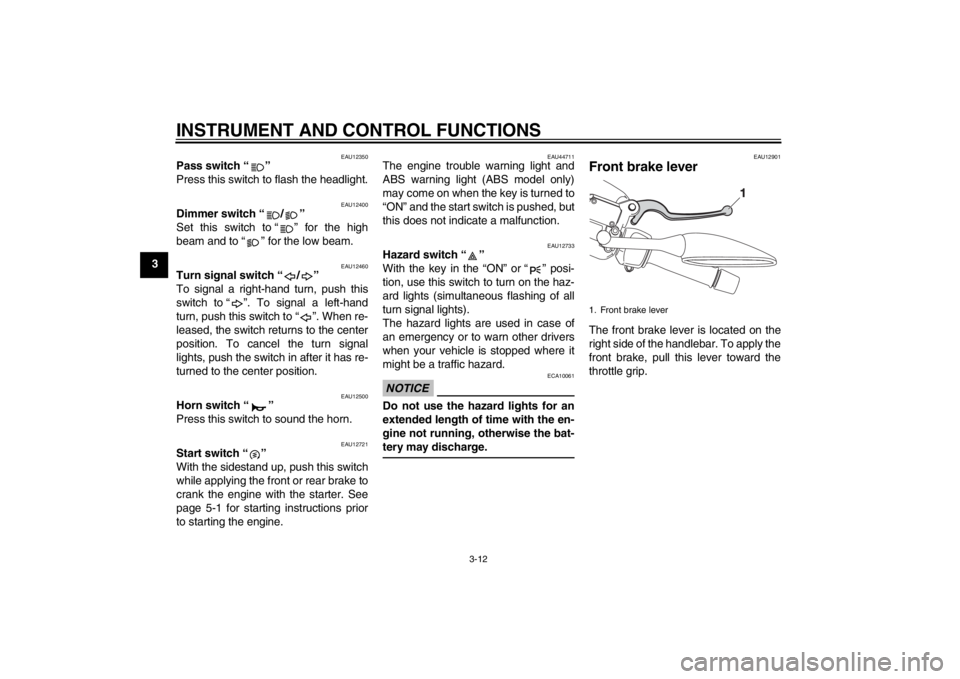
Front brake lever The front brake lever is located on the
right side of the handlebar. To apply the
front brake, pull this lever toward the
throttle grip.1. Front brake lever
U2ABE2E0.book Page 12 Thursday, August 30, 2012 2:36 PM
Page 31 of 96
INSTRUMENT AND CONTROL FUNCTIONS
3-13
3
EAU12951
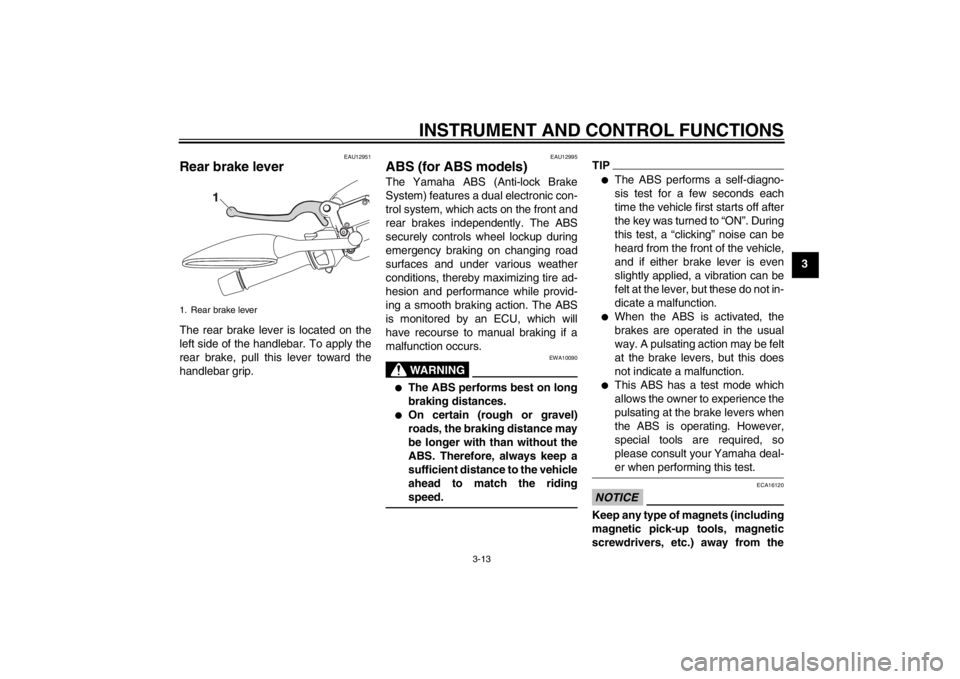
Rear brake lever The rear brake lever is located on the
left side of the handlebar. To apply the
rear brake, pull this lever toward the
handlebar grip.
EAU12995
ABS (for ABS models) The Yamaha ABS (Anti-lock Brake
System) features a dual electronic con-
trol system, which acts on the front and
rear brakes independently. The ABS
securely controls wheel lockup during
emergency braking on changing road
surfaces and under various weather
conditions, thereby maximizing tire ad-
hesion and performance while provid-
ing a smooth braking action. The ABS
is monitored by an ECU, which will
have recourse to manual braking if a
malfunction occurs.
WARNING
EWA10090
●
The ABS performs best on long
braking distances.
●
On certain (rough or gravel)
roads, the braking distance may
be longer with than without the
ABS. Therefore, always keep a
sufficient distance to the vehicle
ahead to match the riding
speed.
TIP●
The ABS performs a self-diagno-
sis test for a few seconds each
time the vehicle first starts off after
the key was turned to “ON”. During
this test, a “clicking” noise can be
heard from the front of the vehicle,
and if either brake lever is even
slightly applied, a vibration can be
felt at the lever, but these do not in-
dicate a malfunction.
●
When the ABS is activated, the
brakes are operated in the usual
way. A pulsating action may be felt
at the brake levers, but this does
not indicate a malfunction.
●
This ABS has a test mode which
allows the owner to experience the
pulsating at the brake levers when
the ABS is operating. However,
special tools are required, so
please consult your Yamaha deal-
er when performing this test.
NOTICE
ECA16120
Keep any type of magnets (including
magnetic pick-up tools, magnetic
screwdrivers, etc.) away from the
1. Rear brake lever
U2ABE2E0.book Page 13 Thursday, August 30, 2012 2:36 PM
Page 33 of 96
INSTRUMENT AND CONTROL FUNCTIONS
3-15
3 3. Close the fuel tank cover.
WARNING
EWA11091
Make sure that the fuel tank cap is
properly closed after filling fuel.
Leaking fuel is a fire hazard.
EAU13221
Fuel Make sure there is sufficient gasoline in
the tank.
WARNING
EWA10881
Gasoline and gasoline vapors are
extremely flammable. To avoid fires
and explosions and to reduce the
risk of injury when refueling, follow
these instructions.1. Before refueling, turn off the en-
gine and be sure that no one is sit-
ting on the vehicle. Never refuel
while smoking, or while in the vi-
cinity of sparks, open flames, or
other sources of ignition such as
the pilot lights of water heaters and
clothes dryers.
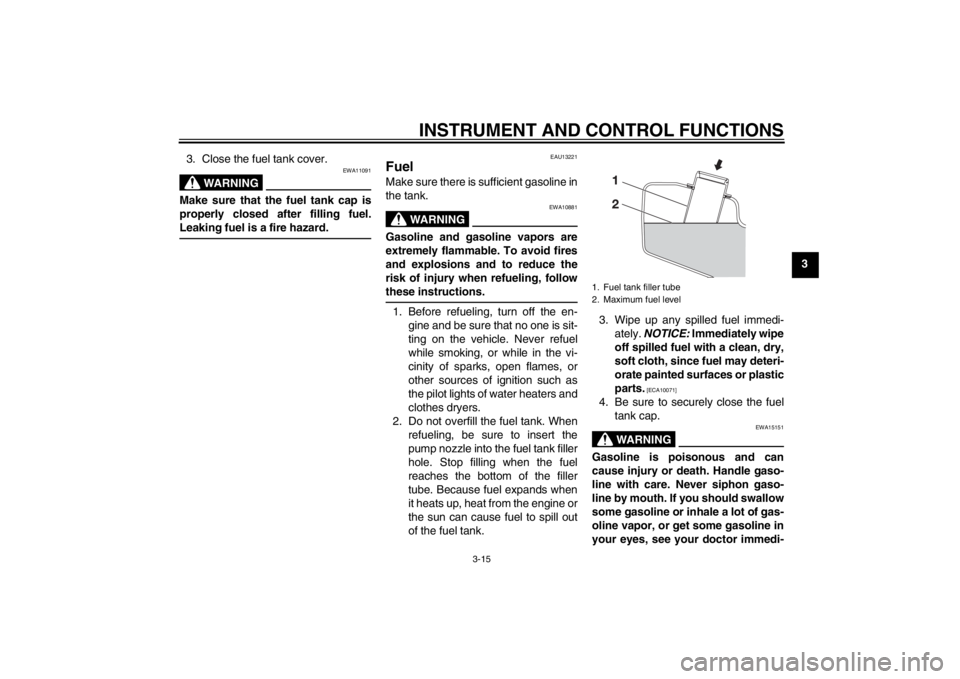
2. Do not overfill the fuel tank. When
refueling, be sure to insert the
pump nozzle into the fuel tank filler
hole. Stop filling when the fuel
reaches the bottom of the filler
tube. Because fuel expands when
it heats up, heat from the engine or
the sun can cause fuel to spill out
of the fuel tank.3. Wipe up any spilled fuel immedi-
ately. NOTICE: Immediately wipe
off spilled fuel with a clean, dry,
soft cloth, since fuel may deteri-
orate painted surfaces or plastic
parts.
[ECA10071]
4. Be sure to securely close the fuel
tank cap.
WARNING
EWA15151
Gasoline is poisonous and can
cause injury or death. Handle gaso-
line with care. Never siphon gaso-
line by mouth. If you should swallow
some gasoline or inhale a lot of gas-
oline vapor, or get some gasoline in
your eyes, see your doctor immedi-1. Fuel tank filler tube
2. Maximum fuel level
U2ABE2E0.book Page 15 Thursday, August 30, 2012 2:36 PM
Page 39 of 96
INSTRUMENT AND CONTROL FUNCTIONS
3-21
3
EAU15305
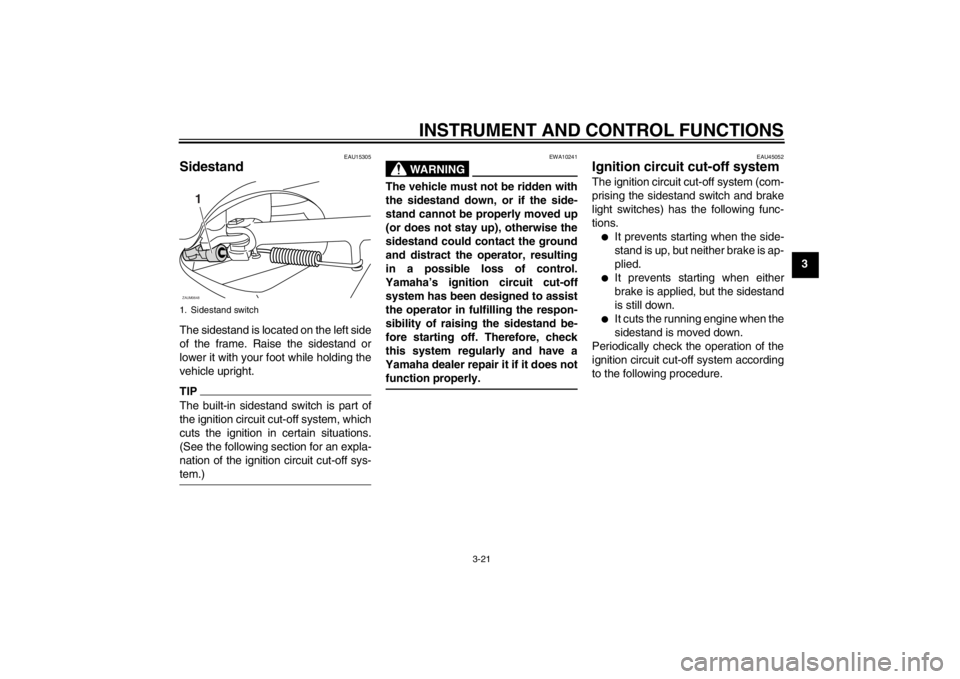
Sidestand The sidestand is located on the left side
of the frame. Raise the sidestand or
lower it with your foot while holding the
vehicle upright.TIPThe built-in sidestand switch is part of
the ignition circuit cut-off system, which
cuts the ignition in certain situations.
(See the following section for an expla-
nation of the ignition circuit cut-off sys-
tem.)
WARNING
EWA10241
The vehicle must not be ridden with
the sidestand down, or if the side-
stand cannot be properly moved up
(or does not stay up), otherwise the
sidestand could contact the ground
and distract the operator, resulting
in a possible loss of control.
Yamaha’s ignition circuit cut-off
system has been designed to assist
the operator in fulfilling the respon-
sibility of raising the sidestand be-
fore starting off. Therefore, check
this system regularly and have a
Yamaha dealer repair it if it does not
function properly.
EAU45052
Ignition circuit cut-off system The ignition circuit cut-off system (com-
prising the sidestand switch and brake
light switches) has the following func-
tions.●
It prevents starting when the side-
stand is up, but neither brake is ap-
plied.
●
It prevents starting when either
brake is applied, but the sidestand
is still down.
●
It cuts the running engine when the
sidestand is moved down.
Periodically check the operation of the
ignition circuit cut-off system according
to the following procedure.
1. Sidestand switchZAUM0648
1
U2ABE2E0.book Page 21 Thursday, August 30, 2012 2:36 PM
Page 44 of 96
OPERATION AND IMPORTANT RIDING POINTS
5-1
5
EAU15951
Read the Owner’s Manual carefully to
become familiar with all controls. If
there is a control or function you do not
understand, ask your Yamaha dealer.
WARNING
EWA10271
Failure to familiarize yourself with
the controls can lead to loss of con-
trol, which could cause an accident
or injury.
EAU48020
TIPThis model is equipped with a lean an-
gle sensor to stop the engine in case of
a turnover. In this case, the multi-func-
tion display indicates error code 30, but
this is not a malfunction. Turn the key to
“OFF” and then to “ON” to clear the er-
ror code. Failing to do so will prevent
the engine from starting even though
the engine will crank when pushing the
start switch.
EAUS1892
Starting the engine NOTICE
ECA10250
See page 5-4 for engine break-in in-
structions prior to operating the ve-
hicle for the first time.In order for the ignition circuit cut-off
system to enable starting, the side-
stand must be up.
See page 3-21 for more information.
1. Turn the key to “ON”.
The following warning light, indica-
tor light and indicators should
come on for a few seconds, then
go off.
●
Engine trouble warning light
●
ABS warning light (for ABS
models)
●
Immobilizer system indicator
light
●
V-belt replacement indicator
●
Oil change indicator
U2ABE2E0.book Page 1 Thursday, August 30, 2012 2:36 PM
Page 45 of 96
OPERATION AND IMPORTANT RIDING POINTS
5-2
5
NOTICE
ECA15024
If a warning light, indicator light or
indicator does not go off, see pages
3-4, 3-6, 3-8, 3-9 or 3-9 for the corre-
sponding warning light, indicator
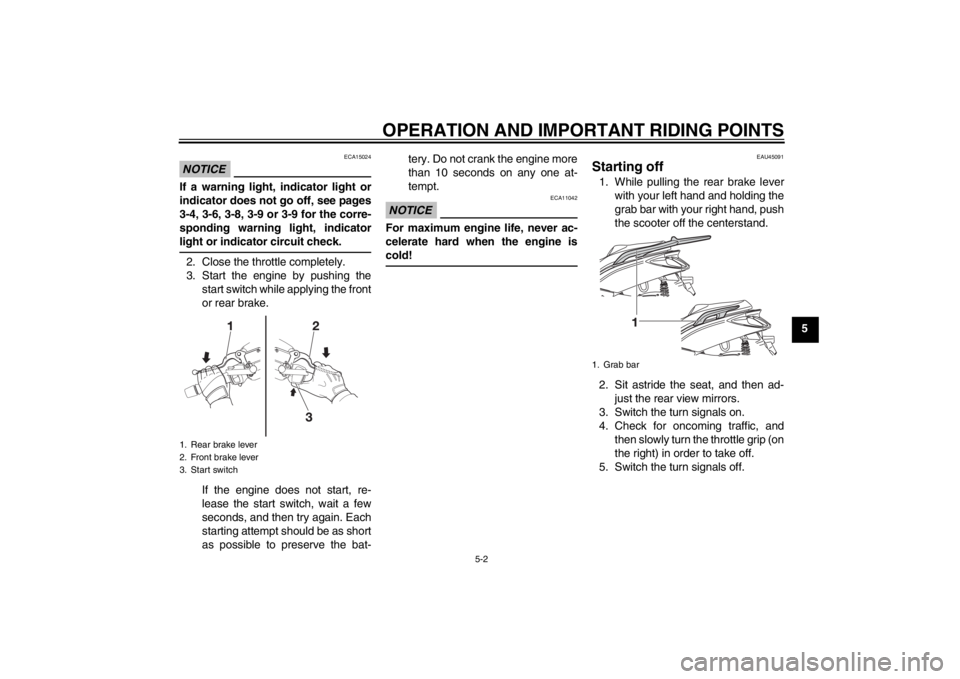
light or indicator circuit check.2. Close the throttle completely.
3. Start the engine by pushing the
start switch while applying the front
or rear brake.
If the engine does not start, re-
lease the start switch, wait a few
seconds, and then try again. Each
starting attempt should be as short
as possible to preserve the bat-tery. Do not crank the engine more
than 10 seconds on any one at-
tempt.
NOTICE
ECA11042
For maximum engine life, never ac-
celerate hard when the engine is
cold!
EAU45091
Starting off 1. While pulling the rear brake lever
with your left hand and holding the
grab bar with your right hand, push
the scooter off the centerstand.
2. Sit astride the seat, and then ad-
just the rear view mirrors.
3. Switch the turn signals on.
4. Check for oncoming traffic, and
then slowly turn the throttle grip (on
the right) in order to take off.
5. Switch the turn signals off.
1. Rear brake lever
2. Front brake lever
3. Start switch
1. Grab bar
U2ABE2E0.book Page 2 Thursday, August 30, 2012 2:36 PM