check engine YAMAHA XMAX 125 2014 User Guide
[x] Cancel search | Manufacturer: YAMAHA, Model Year: 2014, Model line: XMAX 125, Model: YAMAHA XMAX 125 2014Pages: 94, PDF Size: 8.21 MB
Page 41 of 94
FOR YOUR SAFETY – PRE-OPERATION CHECKS
4-1
4
EAU15598
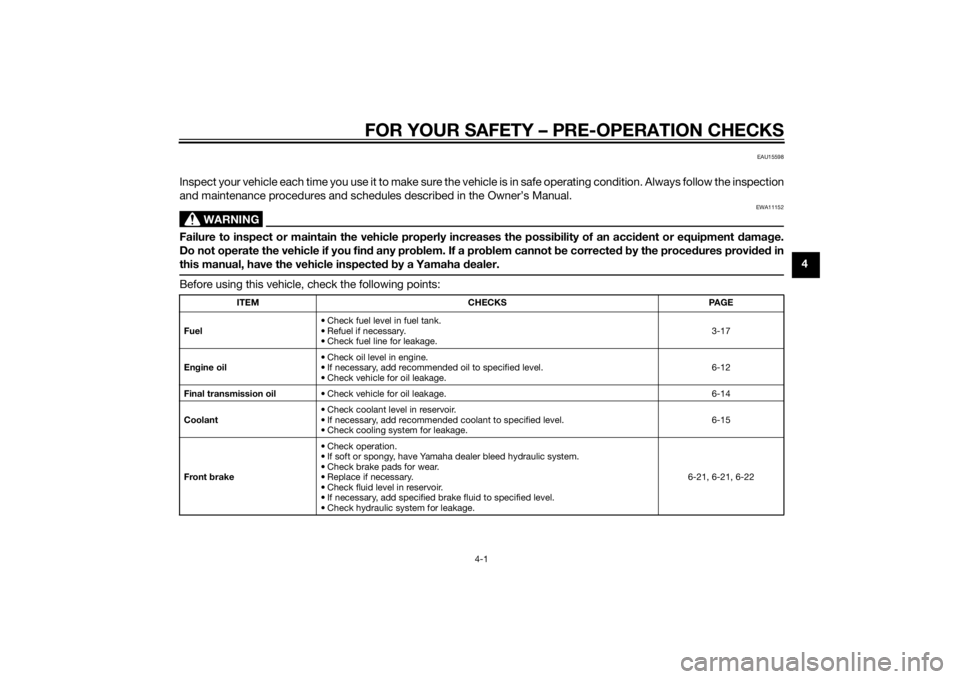
Inspect your vehicle each time you use it to make sure the vehicle is in safe operating condition. Always follow the inspection
and maintenance procedures and schedules described in the Owner’s Manual.
WARNING
EWA11152
Failure to inspect or maintain the vehicle properly increases the possibility of an accident or equipment damage.
Do not operate the vehicle if you find any problem. If a problem cannot be corrected by the procedures provided in
this manual, have the vehicle inspected by a Yamaha dealer.Before using this vehicle, check the following points:
ITEM CHECKS PAGE
Fuel• Check fuel level in fuel tank.
• Refuel if necessary.
• Check fuel line for leakage.3-17
Engine oil• Check oil level in engine.
• If necessary, add recommended oil to specified level.
• Check vehicle for oil leakage.6-12
Final transmission oil• Check vehicle for oil leakage. 6-14
Coolant• Check coolant level in reservoir.
• If necessary, add recommended coolant to specified level.
• Check cooling system for leakage.6-15
Front brake• Check operation.
• If soft or spongy, have Yamaha dealer bleed hydraulic system.
• Check brake pads for wear.
• Replace if necessary.
• Check fluid level in reservoir.
• If necessary, add specified brake fluid to specified level.
• Check hydraulic system for leakage.6-21, 6-21, 6-22
U2DME1E0.book Page 1 Wednesday, October 23, 2013 1:37 PM
Page 44 of 94
OPERATION AND IMPORTANT RIDING POINTS
5-2
5dicator light remains on, see page
3-3 for the corresponding warning
and indicator light circuit check.
For ABS models:The ABS warning light should
come on when the main switch is
turned to “ON” and then go off af-
ter traveling at a speed of 10 km/h
(6 mi/h) or higher.
NOTICE
ECA17682
If the ABS warning light does not
come on and then go off as ex-
plained above, see page 3-3 for the
warning light circuit check.2. Close the throttle completely.
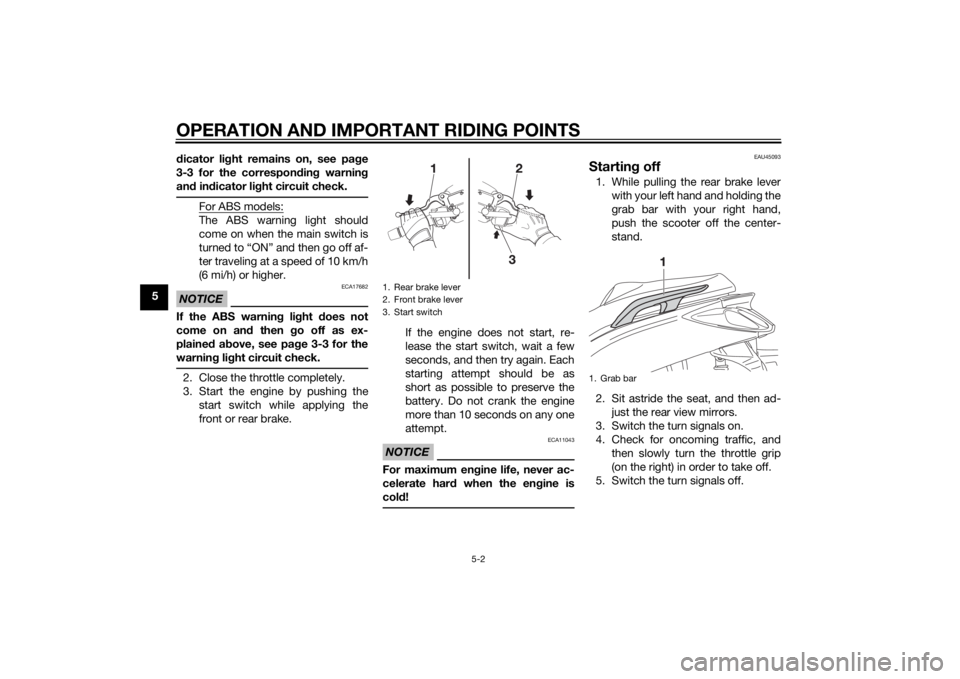
3. Start the engine by pushing the
start switch while applying the
front or rear brake. If the engine does not start, re-
lease the start switch, wait a few
seconds, and then try again. Each
starting attempt should be as
short as possible to preserve the
battery. Do not crank the engine
more than 10 seconds on any one
attempt.
NOTICE
ECA11043
For maximum engine life, never ac-
celerate hard when the engine is
cold!
EAU45093
Starting off1. While pulling the rear brake lever
with your left hand and holding the
grab bar with your right hand,
push the scooter off the center-
stand.
2. Sit astride the seat, and then ad- just the rear view mirrors.
3. Switch the turn signals on.
4. Check for oncoming traffic, and then slowly turn the throttle grip
(on the right) in order to take off.
5. Switch the turn signals off.
1. Rear brake lever
2. Front brake lever
3. Start switch
1. Grab bar
U2DME1E0.book Page 2 Wednesday, October 23, 2013 1:48 PM
Page 46 of 94
OPERATION AND IMPORTANT RIDING POINTS
5-4
5
EAU16821
Tips for reducing fuel con-
sumptionFuel consumption depends largely on
your riding style. Consider the follow-
ing tips to reduce fuel consumption:
Avoid high engine speeds during
acceleration.
Avoid high engine speeds with no
load on the engine.
Turn the engine off instead of let-
ting it idle for an extended length
of time (e.g., in traffic jams, at traf-
fic lights or at railroad crossings).
EAU16831
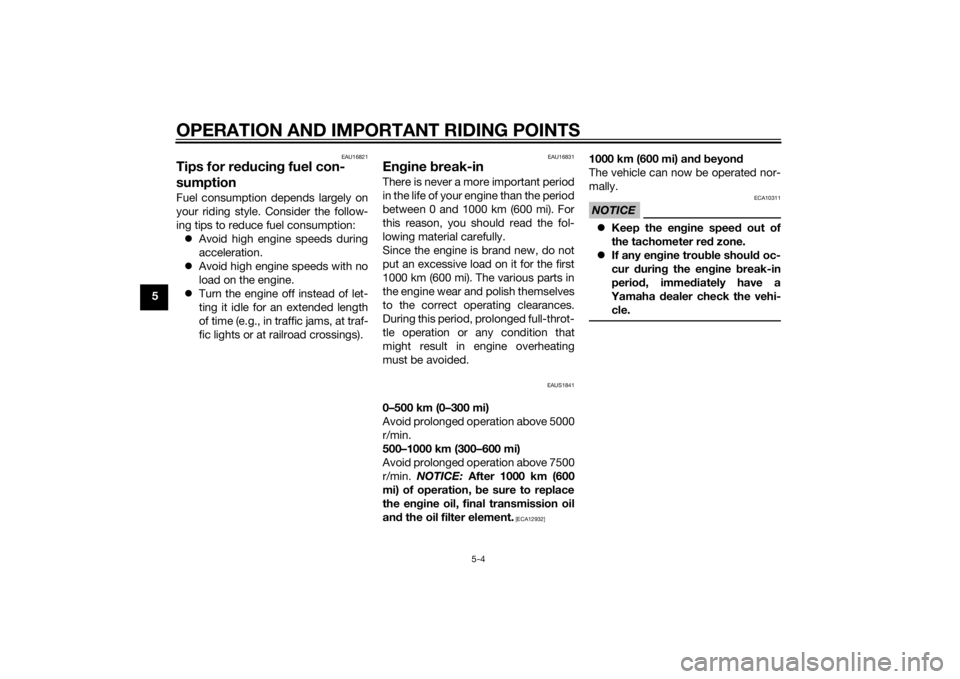
Engine break-inThere is never a more important period
in the life of your engine than the period
between 0 and 1000 km (600 mi). For
this reason, you should read the fol-
lowing material carefully.
Since the engine is brand new, do not
put an excessive load on it for the first
1000 km (600 mi). The various parts in
the engine wear and polish themselves
to the correct operating clearances.
During this period, prolonged full-throt-
tle operation or any condition that
might result in engine overheating
must be avoided.
EAUS1841
0–500 km (0–300 mi)
Avoid prolonged operation above 5000
r/min.
500–1000 km (300–600 mi)
Avoid prolonged operation above 7500
r/min. NOTICE: After 1000 km (600
mi) of operation, be sure to replace
the engine oil, final transmission oil
and the oil filter element.
[ECA12932]
1000 km (600 mi) and beyond
The vehicle can now be operated nor-
mally.NOTICE
ECA10311
Keep the engine speed out of
the tachometer red zone.
If any engine trouble should oc-
cur during the engine break-in
period, immediately have a
Yamaha dealer check the vehi-
cle.
U2DME1E0.book Page 4 Wednesday, October 23, 2013 1:37 PM
Page 50 of 94
PERIODIC MAINTENANCE AND ADJUSTMENT
6-3
6
EAU46872
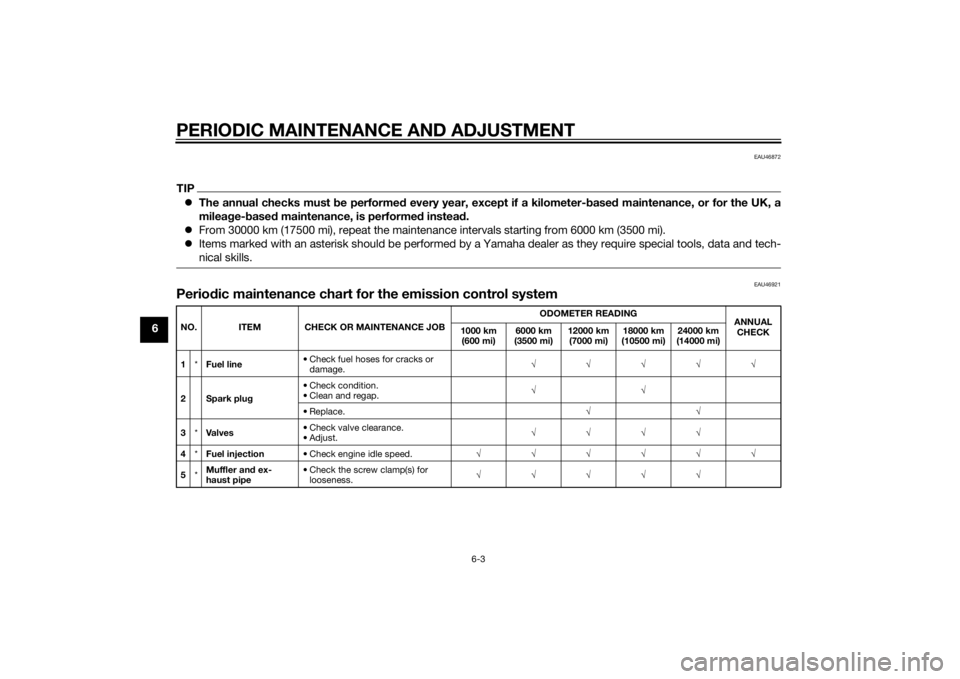
TIPThe annual checks must be performed every year, except if a kilometer-based maintenance, or for the UK, a
mileage-based maintenance, is performed instead.
From 30000 km (17500 mi), repeat the maintenance intervals starting from 6000 km (3500 mi).
Items marked with an asterisk should be performed by a Yamaha dealer as they require special tools, data and tech-
nical skills.
EAU46921
Periodic maintenance chart for the emission control systemNO. ITEM CHECK OR MAINTENANCE JOBODOMETER READING
ANNUAL
CHECK 1000 km
(600 mi)6000 km
(3500 mi)12000 km
(7000 mi)18000 km
(10500 mi)24000 km
(14000 mi)
1*Fuel line• Check fuel hoses for cracks or
damage.√√√√√
2Spark plug• Check condition.
• Clean and regap.√√
• Replace.√√
3*Va l ve s• Check valve clearance.
•Adjust.√√√√
4*Fuel injection• Check engine idle speed.√√√√√√
5*Muffler and ex-
haust pipe• Check the screw clamp(s) for
looseness.√√√√√
U2DME1E0.book Page 3 Wednesday, October 23, 2013 1:37 PM
Page 52 of 94

PERIODIC MAINTENANCE AND ADJUSTMENT
6-5
6
11*Steering bearings• Check bearing play and steering
for roughness.√√√√√
• Lubricate with lithium-soap-
based grease.Every 24000 km (14000 mi)
12*Chassis fasteners• Make sure that all nuts, bolts and
screws are properly tightened.√√√√√
13Front brake lever
pivot shaft• Lubricate with silicone grease.√√√√√
14Rear brake lever
pivot shaft• Lubricate with silicone grease.√√√√√
15Sidestand, center-
stand• Check operation.
• Lubricate with lithium-soap-
based grease.√√√√√
16*Sidestand switch• Check operation.√√√√√√
17*Front fork• Check operation and for oil leak-
age.√√√√
18*Shock absorber as-
semblies• Check operation and shock ab-
sorbers for oil leakage.√√√√
19 Engine oil• Change. (See pages 3-8 and
6-12.)√When the oil change indicator light flashes (5000 km (3000 mi) af-
ter the initial 1000 km [600 mi] and every 6000 km (3500 mi)
thereafter)
• Check oil level and vehicle for oil
leakage.Every 3000 km (1800 mi)√
20Engine oil filter ele-
ment• Replace.√√√ NO. ITEM CHECK OR MAINTENANCE JOBODOMETER READING
ANNUAL
CHECK 1000 km
(600 mi)6000 km
(3500 mi)12000 km
(7000 mi)18000 km
(10500 mi)24000 km
(14000 mi)
U2DME1E0.book Page 5 Wednesday, October 23, 2013 1:37 PM
Page 53 of 94

PERIODIC MAINTENANCE AND ADJUSTMENT
6-6
6
EAU38263
TIPEngine air filter and V-belt air filters
• This model’s engine air filter is equipped with a disposable oil-coated paper element, which must not be cleaned
with compressed air to avoid damaging it.
• The engine air filter element needs to be replaced and the V-belt air filter elements need to be serviced more fre-
quently when riding in unusually wet or dusty areas.21*Cooling system• Check coolant level and vehicle
for coolant leakage.√√√√√
• Change coolant. Every 3 years
22Final transmission
oil• Check vehicle for oil leakage.√√ √
• Change.√√√
23*V-belt• Replace. When the V-belt replacement indicator flashes [every 18000 km (10500 mi)]
24*Front and rear
brake switches• Check operation.√√√√√√
25Moving parts and
cables• Lubricate.√√√√√
26*Throttle grip• Check operation.
• Check throttle grip free play, and
adjust if necessary.
• Lubricate cable and grip housing.√√√√√
27*Lights, signals and
switches• Check operation.
• Adjust headlight beam.√√√√√√ NO. ITEM CHECK OR MAINTENANCE JOBODOMETER READING
ANNUAL
CHECK 1000 km
(600 mi)6000 km
(3500 mi)12000 km
(7000 mi)18000 km
(10500 mi)24000 km
(14000 mi)
U2DME1E0.book Page 6 Wednesday, October 23, 2013 1:37 PM
Page 57 of 94
PERIODIC MAINTENANCE AND ADJUSTMENT
6-10
6
TIPTo install the quick fastener, push the
center pin out so that it will protrude
from the fastener head, insert the fas-
tener into the under cowling, and then
push the protruding pin in until it is
flush with the fastener head.
EAUM3360
Checking the spark plugThe spark plug is an important engine
component, which is easy to check.
Since heat and deposits will cause any
spark plug to slowly erode, the spark
plug should be removed and checked
in accordance with the periodic main-
tenance and lubrication chart. In addi-
tion, the condition of the spark plug
can reveal the condition of the engine.
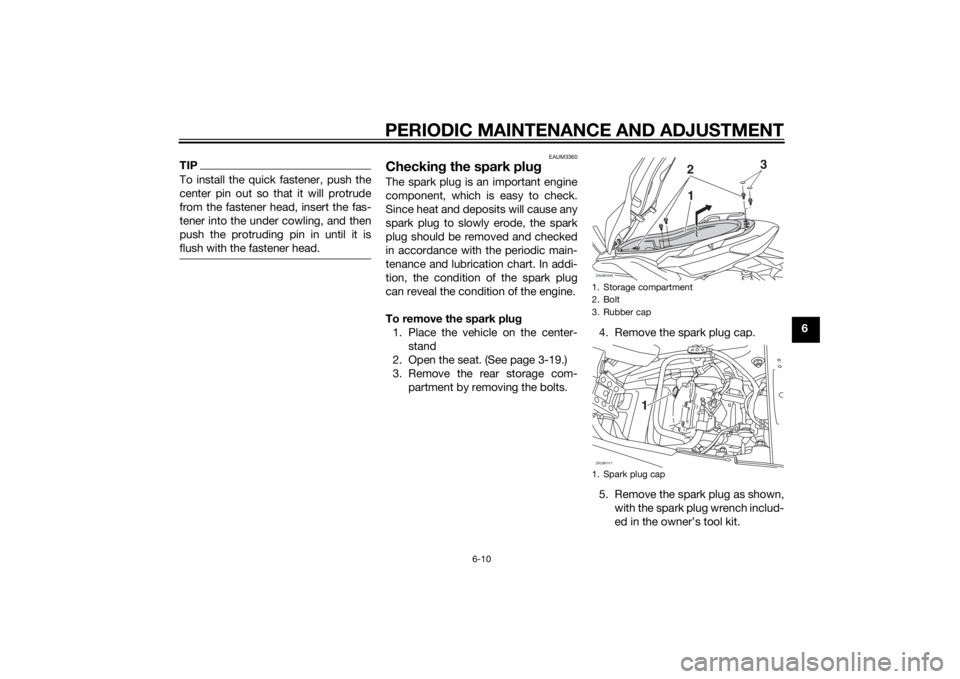
To remove the spark plug
1. Place the vehicle on the center-
stand
2. Open the seat. (See page 3-19.)
3. Remove the rear storage com-
partment by removing the bolts.4. Remove the spark plug cap.
5. Remove the spark plug as shown,
with the spark plug wrench includ-
ed in the owner’s tool kit.
1. Storage compartment
2. Bolt
3. Rubber cap
1. Spark plug capZAUM1040
23
1
ZAUM1117
1
U2DME1E0.book Page 10 Wednesday, October 23, 2013 1:37 PM
Page 58 of 94
PERIODIC MAINTENANCE AND ADJUSTMENT
6-11
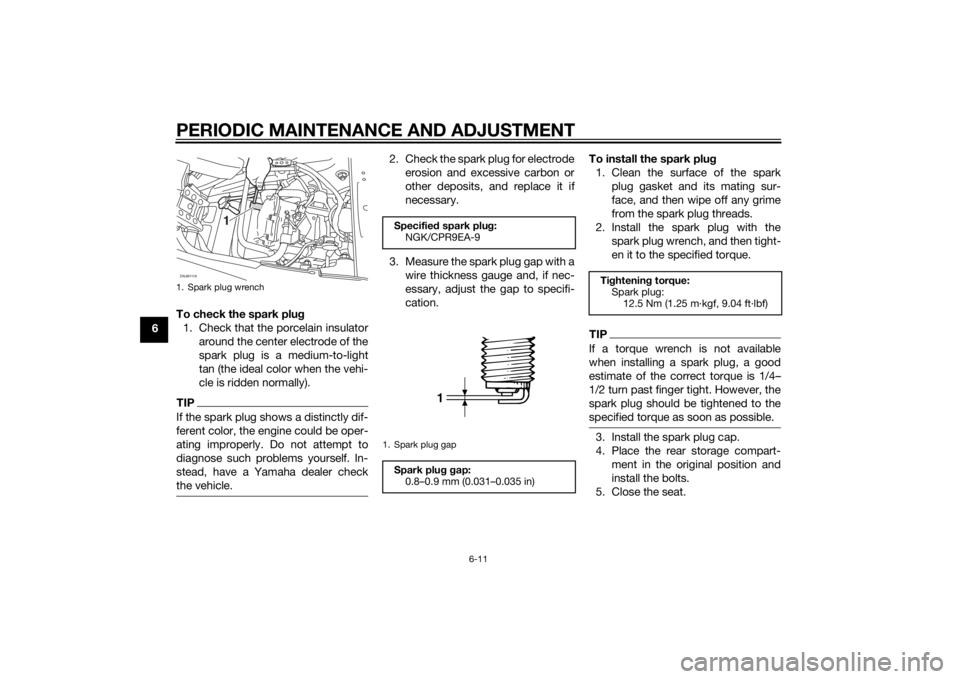
6To check the spark plug
1. Check that the porcelain insulator
around the center electrode of the
spark plug is a medium-to-light
tan (the ideal color when the vehi-
cle is ridden normally).
TIPIf the spark plug shows a distinctly dif-
ferent color, the engine could be oper-
ating improperly. Do not attempt to
diagnose such problems yourself. In-
stead, have a Yamaha dealer check
the vehicle.
2. Check the spark plug for electrode
erosion and excessive carbon or
other deposits, and replace it if
necessary.
3. Measure the spark plug gap with a
wire thickness gauge and, if nec-
essary, adjust the gap to specifi-
cation.To install the spark plug
1. Clean the surface of the spark
plug gasket and its mating sur-
face, and then wipe off any grime
from the spark plug threads.
2. Install the spark plug with the
spark plug wrench, and then tight-
en it to the specified torque.
TIPIf a torque wrench is not available
when installing a spark plug, a good
estimate of the correct torque is 1/4…
1/2 turn past finger tight. However, the
spark plug should be tightened to the
specified torque as soon as possible.3. Install the spark plug cap.
4. Place the rear storage compart-
ment in the original position and
install the bolts.
5. Close the seat.
1. Spark plug wrenchZAUM1118
1
Specified spark plug:
NGK/CPR9EA-91. Spark plug gapSpark plug gap:
0.8–0.9 mm (0.031–0.035 in)
1
Tightening torque:
Spark plug:
12.5 Nm (1.25 m·kgf, 9.04 ft·lbf)
U2DME1E0.book Page 11 Wednesday, October 23, 2013 1:37 PM
Page 59 of 94
PERIODIC MAINTENANCE AND ADJUSTMENT
6-12
6
EAUM3331
Engine oilThe engine oil level should be checked
before each ride. In addition, the oil
must be changed at the intervals spec-
ified in the periodic maintenance and
lubrication chart and when the service
indicator light comes on.
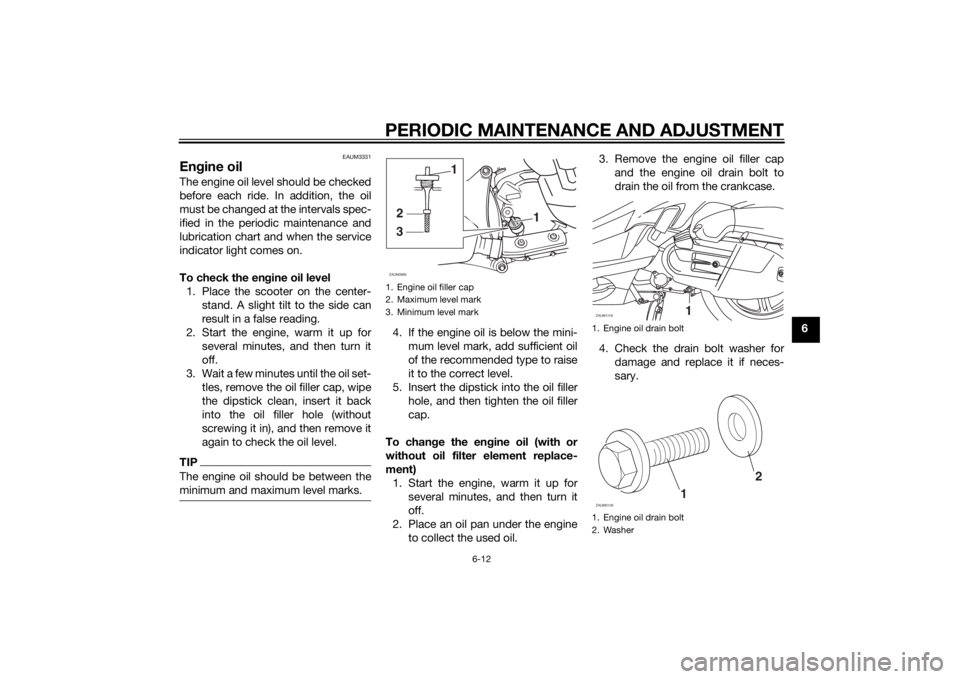
To check the engine oil level
1. Place the scooter on the center-
stand. A slight tilt to the side can
result in a false reading.
2. Start the engine, warm it up for
several minutes, and then turn it
off.
3. Wait a few minutes until the oil set-
tles, remove the oil filler cap, wipe
the dipstick clean, insert it back
into the oil filler hole (without
screwing it in), and then remove it
again to check the oil level.TIPThe engine oil should be between the
minimum and maximum level marks.
4. If the engine oil is below the mini-
mum level mark, add sufficient oil
of the recommended type to raise
it to the correct level.
5. Insert the dipstick into the oil filler
hole, and then tighten the oil filler
cap.
To change the engine oil (with or
without oil filter element replace-
ment)
1. Start the engine, warm it up for
several minutes, and then turn it
off.
2. Place an oil pan under the engine
to collect the used oil.3. Remove the engine oil filler cap
and the engine oil drain bolt to
drain the oil from the crankcase.
4. Check the drain bolt washer for
damage and replace it if neces-
sary.1. Engine oil filler cap
2. Maximum level mark
3. Minimum level mark
1
32
1
ZAUM0685
1. Engine oil drain bolt
1. Engine oil drain bolt
2. WasherZAUM1119
11
2
ZAUM0129
U2DME1E0.book Page 12 Wednesday, October 23, 2013 1:37 PM
Page 60 of 94
PERIODIC MAINTENANCE AND ADJUSTMENT
6-13
6
TIPSkip steps 5–9 if the oil filter element is
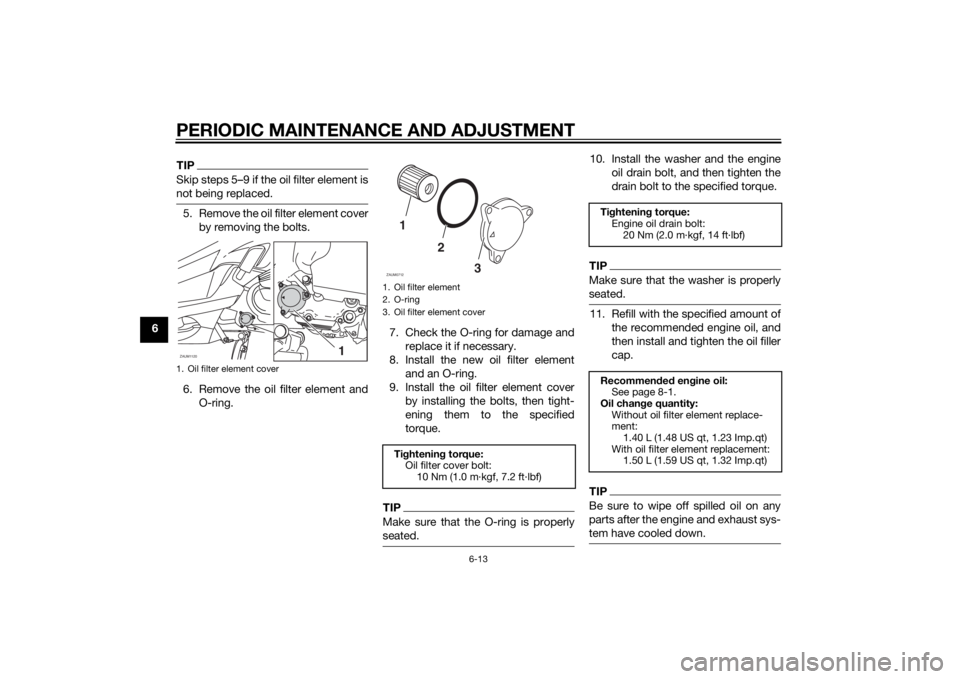
not being replaced.5. Remove the oil filter element cover
by removing the bolts.
6. Remove the oil filter element and
O-ring.7. Check the O-ring for damage and
replace it if necessary.
8. Install the new oil filter element
and an O-ring.
9. Install the oil filter element cover
by installing the bolts, then tight-
ening them to the specified
torque.
TIPMake sure that the O-ring is properly
seated.
10. Install the washer and the engine
oil drain bolt, and then tighten the
drain bolt to the specified torque.TIPMake sure that the washer is properly
seated.11. Refill with the specified amount of
the recommended engine oil, and
then install and tighten the oil filler
cap.TIPBe sure to wipe off spilled oil on any
parts after the engine and exhaust sys-
tem have cooled down.
1. Oil filter element coverZAUM1120
1
1. Oil filter element
2. O-ring
3. Oil filter element coverTightening torque:
Oil filter cover bolt:
10 Nm (1.0 m·kgf, 7.2 ft·lbf)1
2
3
ZAUM0712
Tightening torque:
Engine oil drain bolt:
20 Nm (2.0 m·kgf, 14 ft·lbf)
Recommended engine oil:
See page 8-1.
Oil change quantity:
Without oil filter element replace-
ment:
1.40 L (1.48 US qt, 1.23 Imp.qt)
With oil filter element replacement:
1.50 L (1.59 US qt, 1.32 Imp.qt)
U2DME1E0.book Page 13 Wednesday, October 23, 2013 1:37 PM