fuel YAMAHA XMAX 125 2014 Owner's Manual
[x] Cancel search | Manufacturer: YAMAHA, Model Year: 2014, Model line: XMAX 125, Model: YAMAHA XMAX 125 2014Pages: 94, PDF Size: 8.21 MB
Page 81 of 94
PERIODIC MAINTENANCE AND ADJUSTMENT
6-34
6
EAU42706
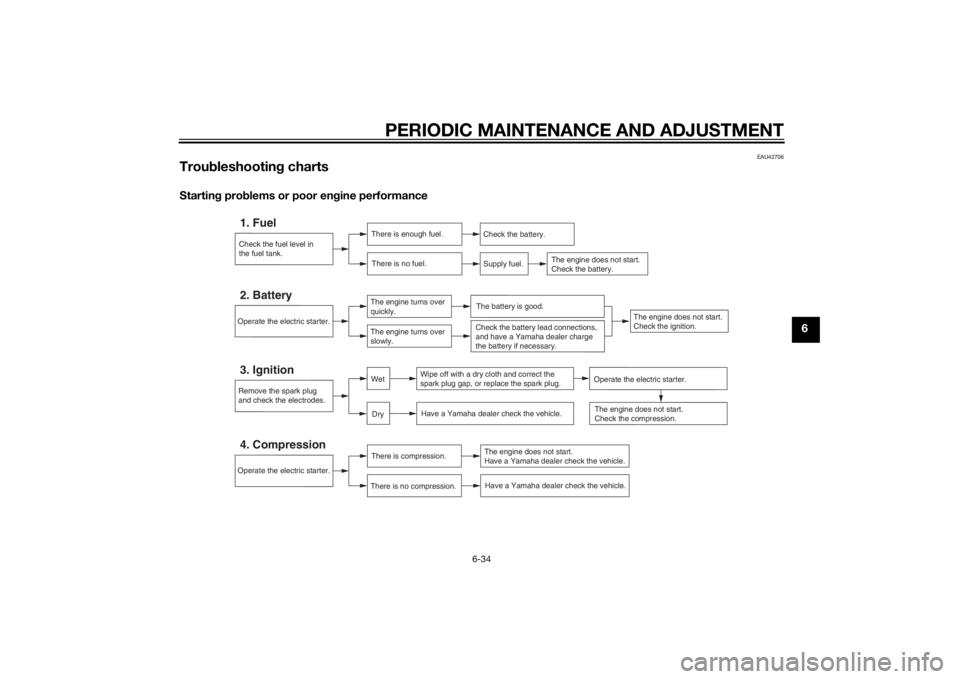
Troubleshooting chartsStarting problems or poor engine performance
Check the fuel level in
the fuel tank.1. Fuel
There is enough fuel.
There is no fuel.
Check the battery.
Supply fuel.
The engine does not start.
Check the battery.
Operate the electric starter.4. Compression
There is compression.
There is no compression.
The engine does not start.
Have a Yamaha dealer check the vehicle.Have a Yamaha dealer check the vehicle.
Remove the spark plug
and check the electrodes.3. Ignition
Wipe off with a dry cloth and correct the
spark plug gap, or replace the spark plug.
Have a Yamaha dealer check the vehicle.
The engine does not start.
Check the compression.
Operate the electric starter.2. Battery
The engine turns over
quickly.
The engine turns over
slowly.
The battery is good.
DryWet
Operate the electric starter.
Check the battery lead connections,
and have a Yamaha dealer charge
the battery if necessary.
The engine does not start.
Check the ignition.
U2DME1E0.book Page 34 Wednesday, October 23, 2013 1:37 PM
Page 84 of 94

SCOOTER CARE AND STORAGE
7-2
7off any detergent residue using
plenty of water, as it is harmful
to plastic parts.
Do not use any harsh chemical
products on plastic parts. Be
sure to avoid using cloths or
sponges which have been in
contact with strong or abrasive
cleaning products, solvent or
thinner, fuel (gasoline), rust re-
movers or inhibitors, brake fluid,
antifreeze or electrolyte.
Do not use high-pressure wash-
ers or steam-jet cleaners since
they cause water seepage and
deterioration in the following ar-
eas: seals (of wheel and swing-
arm bearings, fork and brakes),
electric components (couplers,
connectors, instruments,
switches and lights), breather
hoses and vents.
For scooters equipped with a
windshield: Do not use strong
cleaners or hard sponges as
they will cause dulling
or
scratching. Some cleaning
compounds for plastic may
leave scratches on the wind-shield. Test the product on a
small hidden part of the wind-
shield to make sure that it does
not leave any marks. If the wind-
shield is scratched, use a quality
plastic polishing compound af-
ter washing.
After normal useRemove dirt with warm water, a mild
detergent, and a soft, clean sponge,
and then rinse thoroughly with clean
water. Use a toothbrush or bottlebrush
for hard-to-reach areas. Stubborn dirt
and insects will come off more easily if
the area is covered with a wet cloth for
a few minutes before cleaning.
After riding in the rain, near the sea oron salt-sprayed roadsSince sea salt or salt sprayed on the
roads during winter are extremely cor-
rosive in combination with water, carry
out the following steps after each ride
in the rain, near the sea or on salt-
sprayed roads.
TIPSalt sprayed on roads in the winter
may remain well into spring.1. Clean the scooter with cold water
and a mild detergent after the en-
gine has cooled down. NOTICE:
Do not use warm water since it
increases the corrosive action
of the salt.
[ECA10792]
2. Apply a corrosion protection spray
on all metal, including chrome-
and nickel-plated, surfaces to pre-
vent corrosion.
Cleaning the windshieldAvoid using any alkaline or strong acid
cleaner, gasoline, brake fluid, or any
other solvent. Clean the windshield
with a cloth or sponge dampened with
a mild detergent, and then wash it off
thoroughly with water. For additional
cleaning, use Yamaha Windshield
Cleaner or another high-quality wind-
shield cleaner. Some cleaning com-
pounds for plastics may leave
scratches on the windshield. Before
using such cleaners, test an area of the
U2DME1E0.book Page 2 Wednesday, October 23, 2013 1:37 PM
Page 86 of 94
SCOOTER CARE AND STORAGE
7-4
7
EAU36564
StorageShort-term
Always store your scooter in a cool, dry
place and, if necessary, protect it
against dust with a porous cover. Be
sure the engine and the exhaust sys-
tem are cool before covering the
scooter.NOTICE
ECA10821
Storing the scooter in a poorly
ventilated room or covering it
with a tarp, while it is still wet,
will allow water and humidity to
seep in and cause rust.
To prevent corrosion, avoid
damp cellars, stables (because
of the presence of ammonia)
and areas where strong chemi-
cals are stored.Long-term
Before storing your scooter for several
months:
1. Follow all the instructions in the
“Care” section of this chapter.2. Fill up the fuel tank and add fuel
stabilizer (if available) to prevent
the fuel tank from rusting and the
fuel from deteriorating.
3. Perform the following steps to
protect the cylinder, piston rings,
etc. from corrosion.
a. Remove the spark plug cap
and spark plug.
b. Pour a teaspoonful of engine
oil into the spark plug bore.
c. Install the spark plug cap onto
the spark plug, and then place
the spark plug on the cylinder
head so that the electrodes are
grounded. (This will limit spark-
ing during the next step.)
d. Turn the engine over several
times with the starter. (This will
coat the cylinder wall with oil.)
e. Remove the spark plug cap
from the spark plug, and then
install the spark plug and the
spark plug cap. WARNING! To
prevent damage or injury
from sparking, make sure to
ground the spark plug elec-
trodes while turning the en-
gine over.
[EWA10952]
4. Lubricate all control cables and
the pivoting points of all levers and
pedals as well as of the side-
stand/centerstand.
5. Check and, if necessary, correct
the tire air pressure, and then lift
the scooter so that both of its
wheels are off the ground. Alterna-
tively, turn the wheels a little every
month in order to prevent the tires
from becoming degraded in one
spot.
6. Cover the muffler outlet with a
plastic bag to prevent moisture
from entering it.
7. Remove the battery and fully
charge it. Store it in a cool, dry
place and charge it once a month.
Do not store the battery in an ex-
cessively cold or warm place [less
than 0 °C (30 °F) or more than 30
°C (90 °F)]. For more information
on storing the battery, see page
6-27.TIPMake any necessary repairs before
storing the scooter.
U2DME1E0.book Page 4 Wednesday, October 23, 2013 1:37 PM
Page 87 of 94
SPECIFICATIONS
8-1
8
Dimensions:Overall length:
2160 mm (85.0 in)
Overall width:
790 mm (31.1 in)
Overall height:
1385 mm (54.5 in)
Seat height:
785 mm (30.9 in)
Wheelbase:
1525 mm (60.0 in)
Ground clearance:
125 mm (4.92 in)
Minimum turning radius:
2500 mm (98.4 in)Weight:Curb weight:
YP125R 169 kg (373 lb)
YP125RA 173 kg (381 lb)Engine:Engine type:
Liquid cooled 4-stroke, SOHC
Cylinder arrangement:
Single cylinder
Displacement:
124 cm³
Bore × stroke:
52.0 × 58.6 mm (2.05 × 2.31 in)
Compression ratio:
11.20 : 1
Starting system:
Electric starter
Lubrication system:
Wet sump
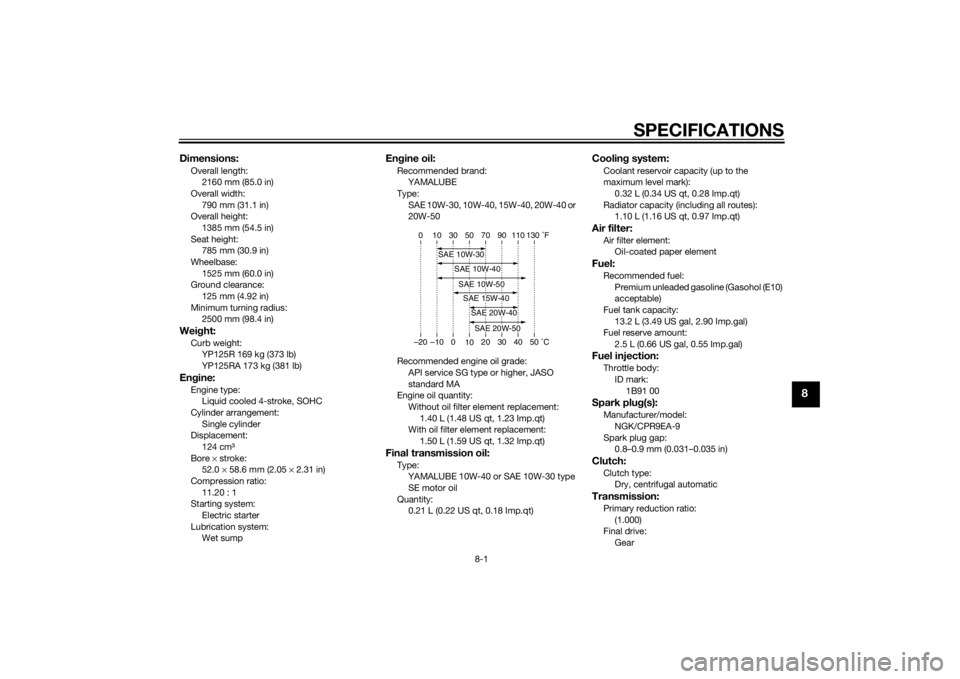
Engine oil:Recommended brand:
YAMALUBE
Type:
SAE 10W-30, 10W-40, 15W-40, 20W-40 or
20W-50
Recommended engine oil grade:
API service SG type or higher, JASO
standard MA
Engine oil quantity:
Without oil filter element replacement:
1.40 L (1.48 US qt, 1.23 Imp.qt)
With oil filter element replacement:
1.50 L (1.59 US qt, 1.32 Imp.qt)Final transmission oil:Type:
YAMALUBE 10W-40 or SAE 10W-30 type
SE motor oil
Quantity:
0.21 L (0.22 US qt, 0.18 Imp.qt)
Cooling system:Coolant reservoir capacity (up to the
maximum level mark):
0.32 L (0.34 US qt, 0.28 Imp.qt)
Radiator capacity (including all routes):
1.10 L (1.16 US qt, 0.97 Imp.qt)Air filter:Air filter element:
Oil-coated paper elementFuel:Recommended fuel:
Premium unleaded gasoline (Gasohol (E10)
acceptable)
Fuel tank capacity:
13.2 L (3.49 US gal, 2.90 Imp.gal)
Fuel reserve amount:
2.5 L (0.66 US gal, 0.55 Imp.gal)Fuel injection:Throttle body:
ID mark:
1B91 00Spark plug(s):Manufacturer/model:
NGK/CPR9EA-9
Spark plug gap:
0.8–0.9 mm (0.031–0.035 in)Clutch:Clutch type:
Dry, centrifugal automaticTransmission:Primary reduction ratio:
(1.000)
Final drive:
Gear
–20 –10 0
1020 30 40 50 C 10 30 50 70 90 110 0 130 F
SAE 10W-30
SAE 15W-40SAE 20W-40SAE 20W-50
SAE 10W-40SAE 10W-50
U2DME1E0.book Page 1 Wednesday, October 23, 2013 1:37 PM
Page 89 of 94

SPECIFICATIONS
8-3
8
Voltage, capacity:
12 V, 8.0 AhHeadlight:Bulb type:
Halogen bulbBulb voltage, wattage × quantity:Headlight:
12 V, 55.0 W × 2
Tail/brake light:
LED
Front turn signal light:
12 V, 10.0 W × 2
Rear turn signal light:
12 V, 10.0 W × 2
Auxiliary light:
12 V, 5.0 W × 2
License plate light:
12 V, 5.0 W × 1
Meter lighting:
LED
High beam indicator light:
LED
Turn signal indicator light:
LED
Fuel level warning light:
LED
Engine trouble warning light:
LED
ABS warning light:
YP125RA LED
Immobilizer system indicator light:
LED
Fuses:Main fuse:
30.0 A
Headlight fuse:
20.0 A
Signaling system fuse:
10.0 A
Ignition fuse:
10.0 A
Radiator fan fuse:
7.5 A
Turn signal light and hazard fuse:
10.0 A
ECU fuse:
10.0 A
ABS control unit fuse:
YP125RA 10.0 A
ABS motor fuse:
YP125RA 30.0 A
ABS solenoid fuse:
YP125RA 20.0 A
Backup fuse:
10.0 A
U2DME1E0.book Page 3 Wednesday, October 23, 2013 1:37 PM
Page 91 of 94

10-1
10
INDEX
AABS (for ABS models) .......................... 3-16
ABS warning light (for ABS models) ....... 3-4
Acceleration and deceleration ................ 5-3
Air filter and V-belt case air filter
elements ............................................. 6-16
Anti-theft alarm (optional) ..................... 3-13
Auxiliary light ........................................ 6-33BBattery .................................................. 6-27
Brake fluid, changing............................ 6-24
Brake fluid level, checking.................... 6-22
Brake lever, front .................................. 3-15
Brake lever, rear ................................... 3-15
Brake levers, lubricating ....................... 6-25
Braking ................................................... 5-3CCables, checking and lubricating ......... 6-24
Care ........................................................ 7-1
Catalytic converters.............................. 3-19
Centerstand and sidestand, checking
and lubricating ................................... 6-25
Coolant ................................................. 6-15DDimmer switch...................................... 3-14EEngine break-in ...................................... 5-4
Engine oil .............................................. 6-12
Engine trouble warning light ................... 3-4FFinal transmission oil ............................ 6-14
Front and rear brake lever free play,
checking ............................................. 6-21
Front and rear brake pads, checking ... 6-21Front fork, checking ............................. 6-26
Front turn signal light ........................... 6-31
Fuel ...................................................... 3-17
Fuel consumption, tips for reducing ...... 5-4
Fuel level warning light........................... 3-4
Fuel tank cap........................................ 3-17
Fuses, replacing ................................... 6-29
HHandlebar switches ............................. 3-14
Hazard switch ...................................... 3-14
Headlight bulb, replacing ..................... 6-30
High beam indicator light ....................... 3-4
Horn switch .......................................... 3-14IIdentification numbers ........................... 9-1
Ignition circuit cut-off system .............. 3-23
Immobilizer system ................................ 3-1
Immobilizer system indicator light ......... 3-5
Indicator lights and warning lights ......... 3-3LLicense plate light bulb, replacing ....... 6-32MMain switch/steering lock ...................... 3-2
Maintenance and lubrication, periodic... 6-4
Maintenance, emission control
system ................................................. 6-3
Matte color, caution ............................... 7-1
Model label............................................. 9-1
Multi-function meter unit ........................ 3-5PPanels, removing and installing ............. 6-8
Parking ................................................... 5-5
Part locations ......................................... 2-1
Pass switch .......................................... 3-14
SSafe-riding points ................................... 1-5
Safety information................................... 1-1
Seat....................................................... 3-19
Shock absorber assemblies,
adjusting ............................................. 3-21
Sidestand.............................................. 3-22
Spark plug, checking ............................ 6-10
Specifications ......................................... 8-1
Starting off .............................................. 5-2
Starting the engine ................................. 5-1
Start switch ........................................... 3-14
Steering, checking ................................ 6-27
Storage ................................................... 7-4
Storage compartments ......................... 3-20TTail/brake light ...................................... 6-31
Throttle grip and cable, checking and
lubricating ........................................... 6-24
Throttle grip free play, checking ........... 6-18
Tires ...................................................... 6-18
Tool kit .................................................... 6-2
Troubleshooting .................................... 6-33
Troubleshooting charts ......................... 6-34
Turn signal indicator lights...................... 3-3
Turn signal light bulb (rear),
replacing ............................................. 6-31
Turn signal switch ................................. 3-14VValve clearance..................................... 6-18
Vehicle identification number ................. 9-1WWheel bearings, checking .................... 6-27
Wheels .................................................. 6-20
U2DME1E0.book Page 1 Wednesday, October 23, 2013 1:37 PM