immobilizer YAMAHA XMAX 125 2017 Owners Manual
[x] Cancel search | Manufacturer: YAMAHA, Model Year: 2017, Model line: XMAX 125, Model: YAMAHA XMAX 125 2017Pages: 96, PDF Size: 8.13 MB
Page 2 of 96

EAU81560
Read this manual carefully before operating this vehicle. This manual
should stay with this vehicle if it is sold.
EAU81570
Declaration of Conformity:
Hereby, YAMAHA MOTOR ELECTRONICS Co., Ltd declares that the radio equip-
ment type, IMMOBILIZER, 37P-00 is in compliance with Directive 2014/53/EU.
The full text of the EU declaration of conformity is available at the following inter-
net address:
https://global.yamaha-motor.com/eu_doc/
Frequency band: 134.2 kHz
The maximum radio frequency power: 49.0 [dBμV/m]
Manufacturer:
YAMAHA MOTOR ELECTRONICS Co., Ltd 1450-6 Mori, Mori-machi, Shuchi-Gun, Shizuoka, 437-0292 Japan
Importer:
YAMAHA MOTOR EUROPE N.V. Koolhovenlaan 101, 1119 NC Schiphol-Rijk, 1117 ZN, Schiphol, the Netherlands
U2DME3E0.book Page 1 Thursday, April 20, 2017 4:47 PM
Page 5 of 96

Table of contents
Safety information............................1-1
Further safe-riding points ................1-5
Description........................................2-1
Left view ..........................................2-1
Right view........................................2-2
Controls and instruments ................2-3
Instrument and control functions....3-1
Immobilizer system .........................3-1
Main switch/steering lock ...............3-2
Indicator lights and warning
lights ............................................3-4
Multi-function meter unit .................3-6
Handlebar switches.......................3-13
Front brake lever ...........................3-14
Rear brake lever ............................3-15
ABS ...............................................3-15
Fuel tank cap.................................3-16
Fuel................................................3-17
Catalytic converters .....................3-18
Seat ...............................................3-19
Storage compartments .................3-20
Adjusting the shock absorber
assemblies .................................3-21
Sidestand ......................................3-22
Ignition circuit cut-off system........3-23
For your safety – pre-operation
checks...............................................4-1
Operation and important riding
points.................................................5-1
Starting the engine ..........................5-2
Starting off.......................................5-3
Acceleration and deceleration.........5-3
Braking ............................................5-4
Tips for reducing fuel
consumption ................................5-5
Engine break-in ...............................5-5
Parking ............................................5-6
Periodic maintenance and
adjustment........................................6-1
Owner’s tool kit ...............................6-2Periodic maintenance chart for the
emission control system.............. 6-3
General maintenance and
lubrication chart........................... 6-4
Removing and installing panels ...... 6-7
Checking the spark plug ................. 6-9
Engine oil ...................................... 6-10
Final transmission oil .................... 6-13
Coolant ......................................... 6-14
Air filter and V-belt case air filter
elements and check hoses........ 6-15
Checking the throttle grip free
play ............................................ 6-17
Valve clearance ............................. 6-17
Tires .............................................. 6-18
Cast wheels .................................. 6-20
Checking the front and rear brake
lever free play ............................ 6-20
Checking the front and rear brake
pads........................................... 6-21
Checking the brake fluid level....... 6-22
Changing the brake fluid............... 6-23
Checking and lubricating the
cables ........................................ 6-24
Checking and lubricating the
throttle grip and cable ............... 6-24
Lubricating the front and rear
brake levers ............................... 6-25
Checking and lubricating the
centerstand and sidestand ........ 6-25
Checking the front fork ................. 6-26
Checking the steering ................... 6-26
Checking the wheel bearings ....... 6-27
Battery .......................................... 6-27
Replacing the fuses ...................... 6-29
Replacing a headlight bulb ........... 6-30
Auxiliary light bulbs ....................... 6-31
Tail/brake light .............................. 6-31
Front turn signal light .................... 6-32
Replacing a rear turn signal light
bulb............................................ 6-32
Replacing the license plate light
bulb............................................ 6-33
Troubleshooting ............................ 6-34
Troubleshooting charts ................. 6-35
U2DME3E0.book Page 1 Friday, June 10, 2016 2:25 PM
Page 15 of 96
Instrument and control functions
3-1
3
EAU10978
Immobilizer system
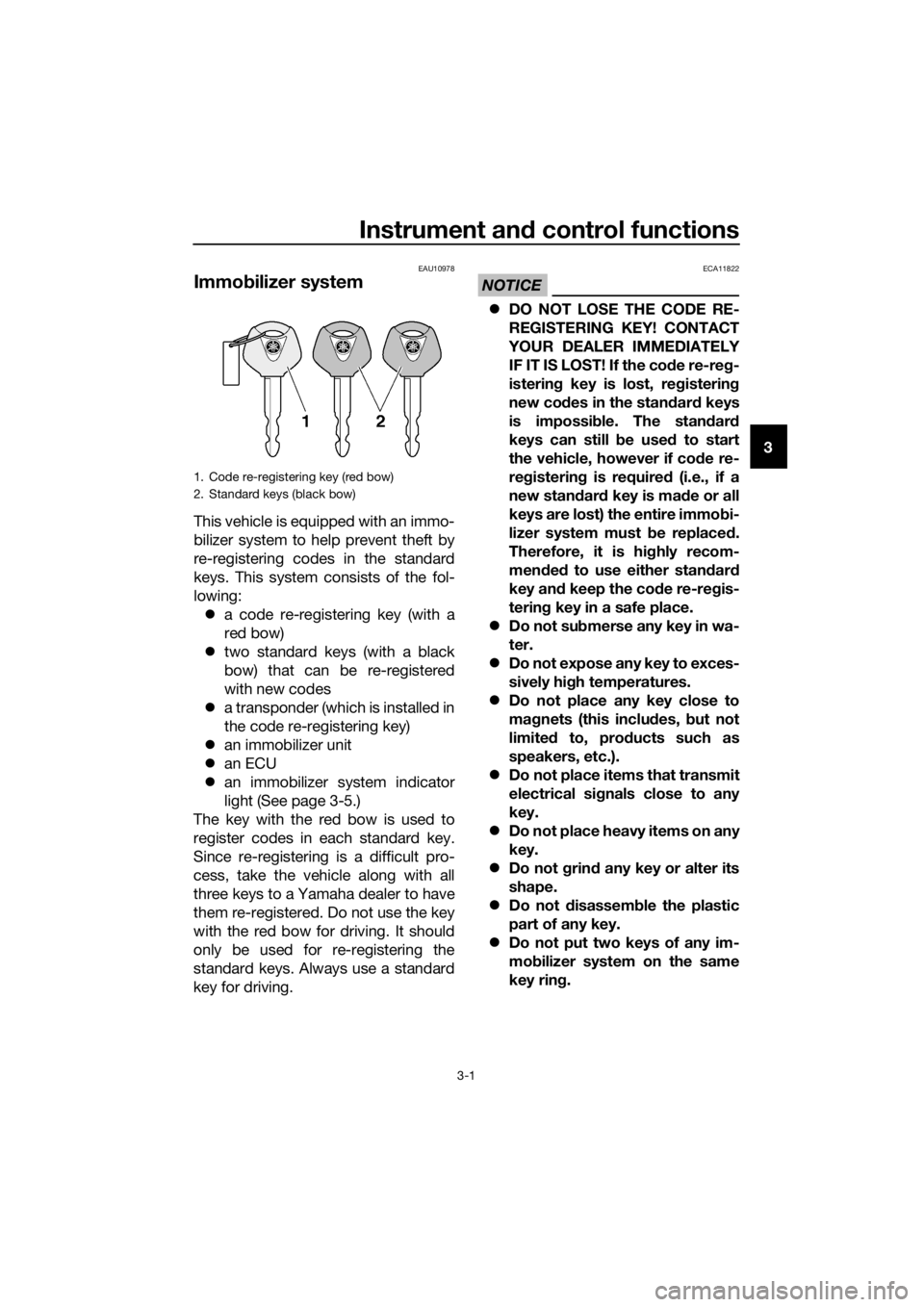
This vehicle is equipped with an immo-
bilizer system to help prevent theft by
re-registering codes in the standard
keys. This system consists of the fol-
lowing:
a code re-registering key (with a
red bow)
two standard keys (with a black
bow) that can be re-registered
with new codes
a transponder (which is installed in
the code re-registering key)
an immobilizer unit
an ECU
an immobilizer system indicator
light (See page 3-5.)
The key with the red bow is used to
register codes in each standard key.
Since re-registering is a difficult pro-
cess, take the vehicle along with all
three keys to a Yamaha dealer to have
them re-registered. Do not use the key
with the red bow for driving. It should
only be used for re-registering the
standard keys. Always use a standard
key for driving.
NOTICE
ECA11822
DO NOT LOSE THE CODE RE-
REGISTERING KEY! CONTACT
YOUR DEALER IMMEDIATELY
IF IT IS LOST! If the code re-reg-
istering key is lost, registering
new codes in the standard keys
is impossible. The standard
keys can still be used to start
the vehicle, however if code re-
registering is required (i.e., if a
new standard key is made or all
keys are lost) the entire immobi-
lizer system must be replaced.
Therefore, it is highly recom-
mended to use either standard
key and keep the code re-regis-
tering key in a safe place.
Do not submerse any key in wa-
ter.
Do not expose any key to exces-
sively high temperatures.
Do not place any key close to
magnets (this includes, but not
limited to, products such as
speakers, etc.).
Do not place items that transmit
electrical signals close to any
key.
Do not place heavy items on any
key.
Do not grind any key or alter its
shape.
Do not disassemble the plastic
part of any key.
Do not put two keys of any im-
mobilizer system on the same
key ring.
1. Code re-registering key (red bow)
2. Standard keys (black bow)
U2DME3E0.book Page 1 Friday, June 10, 2016 2:25 PM
Page 16 of 96
Instrument and control functions
3-2
3Keep the standard keys as well
as keys of other immobilizer
systems away from this vehi-
cle’s code re-registering key.
Keep other immobilizer system
keys away from the main switch
as they may cause signal inter-
ference.
EAU10474
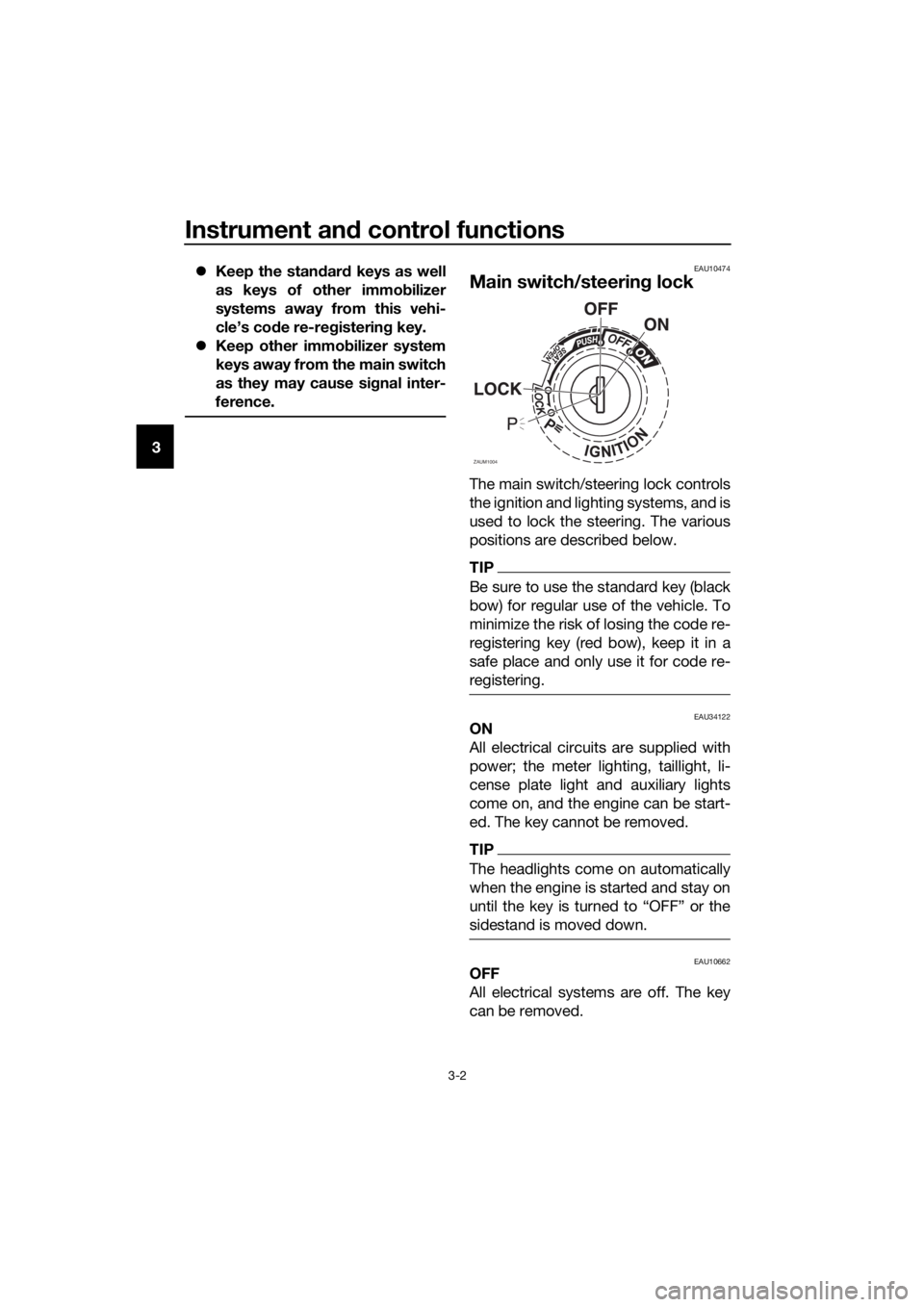
Main switch/steering lock
The main switch/steering lock controls
the ignition and lighting systems, and is
used to lock the steering. The various
positions are described below.
TIP
Be sure to use the standard key (black
bow) for regular use of the vehicle. To
minimize the risk of losing the code re-
registering key (red bow), keep it in a
safe place and only use it for code re-
registering.
EAU34122ON
All electrical circuits are supplied with
power; the meter lighting, taillight, li-
cense plate light and auxiliary lights
come on, and the engine can be start-
ed. The key cannot be removed.
TIP
The headlights come on automatically
when the engine is started and stay on
sidestand is moved down.
EAU10662OFF
All electrical systems are off. The key
can be removed.
ZAUM1004
U2DME3E0.book Page 2 Friday, June 10, 2016 2:25 PM
Page 18 of 96
Instrument and control functions
3-4
3
EAU49399
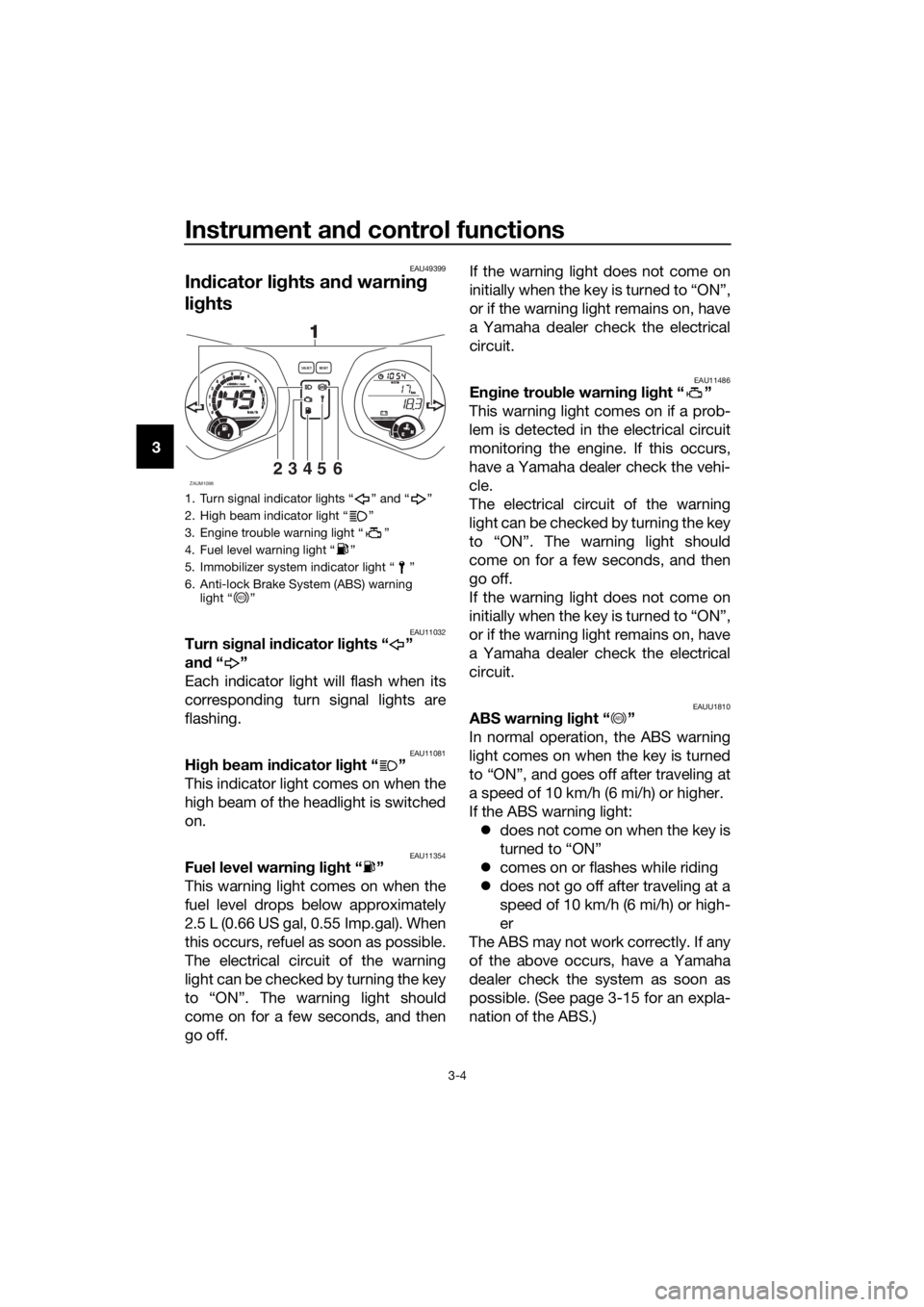
Indicator lights and warning
lights
EAU11032Turn signal indicator lights “ ”
and“”
Each indicator light will flash when its
corresponding turn signal lights are
flashing.
EAU11081High beam indicator light “ ”
This indicator light comes on when the
high beam of the headlight is switched
on.
EAU11354Fuel level warning light “ ”
This warning light comes on when the
fuel level drops below approximately
2.5 L (0.66 US gal, 0.55 Imp.gal). When
this occurs, refuel as soon as possible.
The electrical circuit of the warning
light can be checked by turning the key
to “ON”. The warning light should
come on for a few seconds, and then
go off.If the warning light does not come on
initially when the key is turned to “ON”,
or if the warning light remains on, have
a Yamaha dealer check the electrical
circuit.
EAU11486Engine trouble warning light “ ”
This warning light comes on if a prob-
lem is detected in the electrical circuit
monitoring the engine. If this occurs,
have a Yamaha dealer check the vehi-
cle.
The electrical circuit of the warning
light can be checked by turning the key
to “ON”. The warning light should
come on for a few seconds, and then
go off.
If the warning light does not come on
initially when the key is turned to “ON”,
or if the warning light remains on, have
a Yamaha dealer check the electrical
circuit.
EAUU1810ABS warning light “ ”
In normal operation, the ABS warning
light comes on when the key is turned
to “ON”, and goes off after traveling at
a speed of 10 km/h (6 mi/h) or higher.
If the ABS warning light:
does not come on when the key is
turned to “ON”
comes on or flashes while riding
does not go off after traveling at a
speed of 10 km/h (6 mi/h) or high-
er
The ABS may not work correctly. If any
of the above occurs, have a Yamaha
dealer check the system as soon as
possible. (See page 3-15 for an expla-
nation of the ABS.)
1. Turn signal indicator lights “ ” and “ ”
2. High beam indicator light “ ”
3. Engine trouble warning light “ ”
4. Fuel level warning light “ ”
5. Immobilizer system indicator light “ ”
6. Anti-lock Brake System (ABS) warning
light “ ”
ZAUM109823456
98765432111 10
12
0
1000r/minx
km/h
E
FCH
kmOdoOdoSELECTRESET
11
ABS
ABS
U2DME3E0.book Page 4 Friday, June 10, 2016 2:25 PM
Page 19 of 96
Instrument and control functions
3-5
3
WARNING
EWA16041
If the ABS warning light does not go
off after traveling at a speed of 10
km/h (6 mi/h) or higher, or if the
warning light comes on or flashes
while riding, the brake system re-
verts to conventional braking. If ei-
ther of the above occurs, or if the
warning light does not come on at
all, use extra caution to avoid possi-
ble wheel lock during emergency
braking. Have a Yamaha dealer
check the brake system and electri-
cal circuits as soon as possible.
TIP
The ABS warning light may come on
while accelerating the engine with the
vehicle on its centerstand, but this
does not indicate a malfunction.
EAUM3621Immobilizer system indicator
light “ ”
When the key is turned to “OFF” and
30 seconds have passed, the indicator
light will flash steadily to indicate the
immobilizer system is enabled. After 24
hours have passed, the indicator light
will stop flashing, however the immobi-
lizer system is still enabled.
The electrical circuit of the indicator
light can be checked by turning the key
to “ON”. The indicator light should
come on for a few seconds, and then
go off.
If the indicator light does not come on
initially when the key is turned to “ON”,
if the indicator light remains on, or if the
indicator light flashes in a pattern (if a
problem is detected in the immobilizersystem, the immobilizer system indica-
tor light will flash in a pattern), have a
Yamaha dealer check the vehicle.
TIP
If the immobilizer system indicator light
flashes in the pattern, slowly 5 times
then quickly 2 times, this could be
caused by transponder interference. If
this occurs, try the following.
1. Make sure there are no other im-
mobilizer keys close to the main
switch. Other immobilizer system
keys may cause signal interfer-
ence and prevent the engine from
starting.
2. Use the code re-registering key to
start the engine.
3. If the engine starts, turn it off, and
try starting the engine with the
standard keys.
4. If one or both of the standard keys
do not start the engine, take the
vehicle and all 3 keys to a Yamaha
dealer to have the standard keys
re-registered.
U2DME3E0.book Page 5 Friday, June 10, 2016 2:25 PM
Page 42 of 96
Operation and important riding points
5-2
5
EAUM3850
Starting the engine
NOTICE
ECA10251
See page 5-5 for engine break-in in-
structions prior to operating the ve-
hicle for the first time.
In order for the ignition circuit cut-off
system to enable starting, the side-
stand must be up.
See page 3-23 for more information.
1. Turn the key to “ON”.
The following warning light, indi-
cator light and indicators should
come on for a few seconds, then
go off.
Engine trouble warning light
Immobilizer system indicator
light
V-belt replacement indicator
Oil change indicator
Fuel level warning light
NOTICE
ECA11834
If a warning or indicator light does
not come on initially when the key is
turned to “ON”, or if a warning or in-
dicator light remains on, see page
3-4 for the corresponding warning
and indicator light circuit check.
The ABS warning light should
come on when the main switch is
turned to “ON” and then go off af-
ter traveling at a speed of 10 km/h
(6 mi/h) or higher.
NOTICE
ECA17682
If the ABS warning light does not
come on and then go off as ex-
plained above, see page 3-4 for the
warning light circuit check.
2. Close the throttle completely.
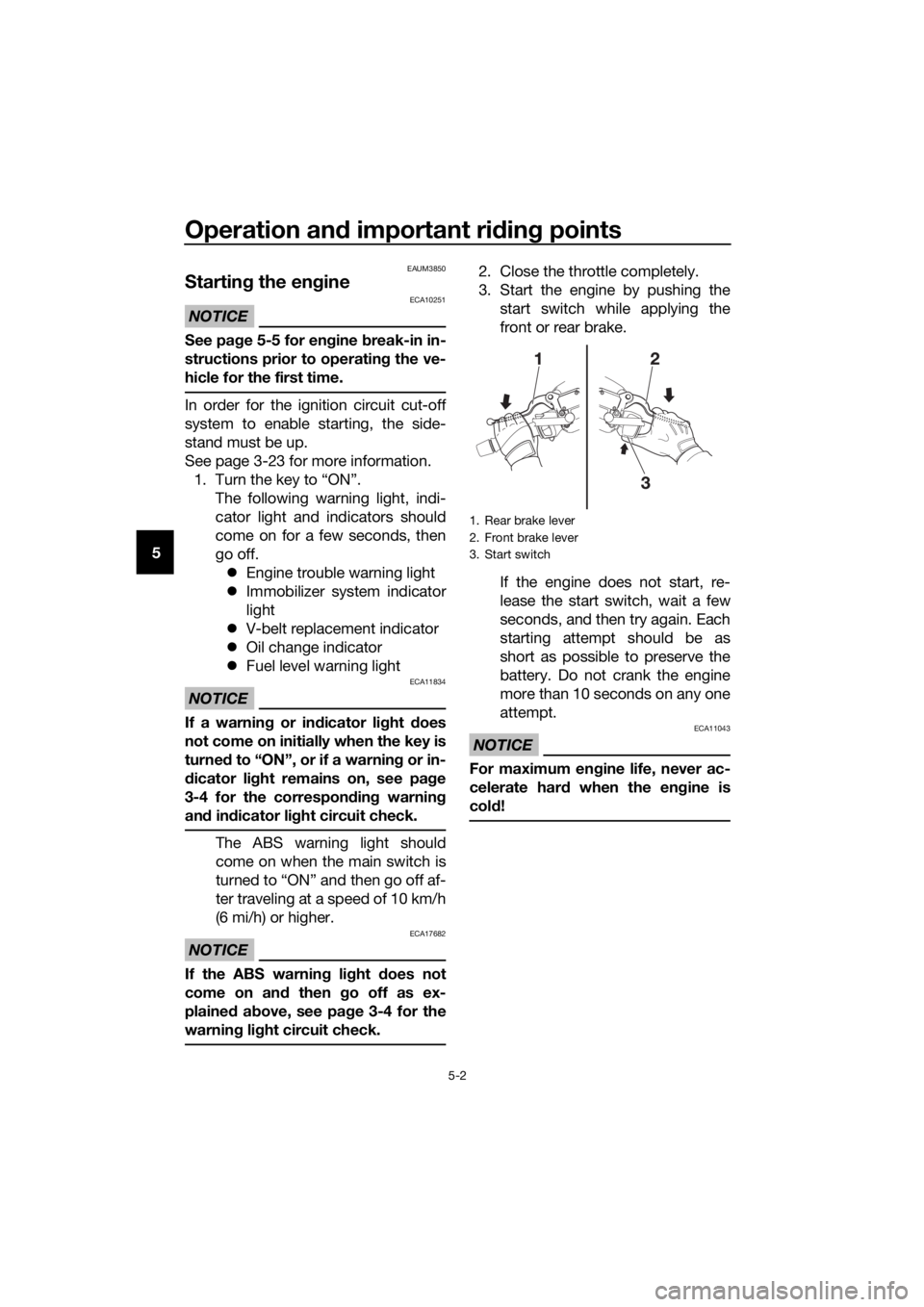
3. Start the engine by pushing the
start switch while applying the
front or rear brake.
If the engine does not start, re-
lease the start switch, wait a few
seconds, and then try again. Each
starting attempt should be as
short as possible to preserve the
battery. Do not crank the engine
more than 10 seconds on any one
attempt.
NOTICE
ECA11043
For maximum engine life, never ac-
celerate hard when the engine is
cold!
1. Rear brake lever
2. Front brake lever
3. Start switch
U2DME3E0.book Page 2 Friday, June 10, 2016 2:25 PM
Page 93 of 96

10-1
10
Index
A
ABS ...................................................... 3-15
ABS warning light ................................... 3-4
Acceleration and deceleration................ 5-3
Air filter and V-belt case air filter
elements ............................................ 6-15
Auxiliary light bulbs .............................. 6-31
B
Battery .................................................. 6-27
Brake fluid, changing ........................... 6-23
Brake fluid level, checking ................... 6-22
Brake lever, front .................................. 3-14
Brake lever, rear ................................... 3-15
Brake levers, lubricating ....................... 6-25
Braking ................................................... 5-4
C
Cables, checking and lubricating ......... 6-24
Care ........................................................ 7-1
Catalytic converters ............................. 3-18
Centerstand and sidestand, checking
and lubricating ................................... 6-25
Coolant ................................................. 6-14
D
Data recording, vehicle .......................... 9-2
Diagnostic connectors ........................... 9-2
Dimmer switch ..................................... 3-13
E
Engine break-in ...................................... 5-5
Engine oil .............................................. 6-10
Engine serial number.............................. 9-1
Engine trouble warning light................... 3-4
F
Final transmission oil ............................ 6-13
Front and rear brake lever free play,
checking............................................. 6-20
Front and rear brake pads, checking ... 6-21
Front fork, checking ............................. 6-26
Front turn signal light ........................... 6-32
Fuel....................................................... 3-17
Fuel consumption, tips for reducing ...... 5-5
Fuel level warning light ........................... 3-4
Fuel tank cap........................................ 3-16
Fuses, replacing ................................... 6-29
H
Handlebar switches.............................. 3-13
Hazard switch ...................................... 3-13
Headlight bulb, replacing ..................... 6-30
High beam indicator light ....................... 3-4
Horn switch .......................................... 3-13
I
Identification numbers ............................ 9-1
Ignition circuit cut-off system ............... 3-23
Immobilizer system ................................. 3-1
Immobilizer system indicator light .......... 3-5
Indicator lights and warning lights .......... 3-4
Info switch ............................................ 3-14
L
License plate light bulb, replacing ........ 6-33
M
Main switch/steering lock ....................... 3-2
Maintenance and lubrication, periodic ... 6-4
Maintenance, emission control
system .................................................. 6-3
Matte color, caution ................................ 7-1
Model label ............................................. 9-1
Multi-function meter unit ........................ 3-6
P
Panels, removing and installing .............. 6-7
Parking .................................................... 5-6
Part locations .......................................... 2-1
Pass switch........................................... 3-13
S
Safe-riding points ................................... 1-5
Safety information................................... 1-1
Seat....................................................... 3-19
Shock absorber assemblies,
adjusting ............................................. 3-21
Sidestand .............................................. 3-22
Spark plug, checking .............................. 6-9
Specifications ......................................... 8-1
Starting off .............................................. 5-3
Starting the engine.................................. 5-2
Start switch ........................................... 3-13
Steering, checking ................................ 6-26
Storage ................................................... 7-4
Storage compartments ......................... 3-20
T
Tail/brake light ...................................... 6-31
Throttle grip and cable, checking and
lubricating ........................................... 6-24
Throttle grip free play, checking ........... 6-17
Tires ...................................................... 6-18
Tool kit .................................................... 6-2
Troubleshooting .................................... 6-34
Troubleshooting charts ......................... 6-35
Turn signal indicator lights ...................... 3-4
Turn signal light bulb (rear), replacing... 6-32
Turn signal switch ................................. 3-13
U2DME3E0.book Page 1 Friday, June 10, 2016 2:25 PM