key YAMAHA XMAX 250 2009 User Guide
[x] Cancel search | Manufacturer: YAMAHA, Model Year: 2009, Model line: XMAX 250, Model: YAMAHA XMAX 250 2009Pages: 92, PDF Size: 4.7 MB
Page 29 of 92
EAUT1040
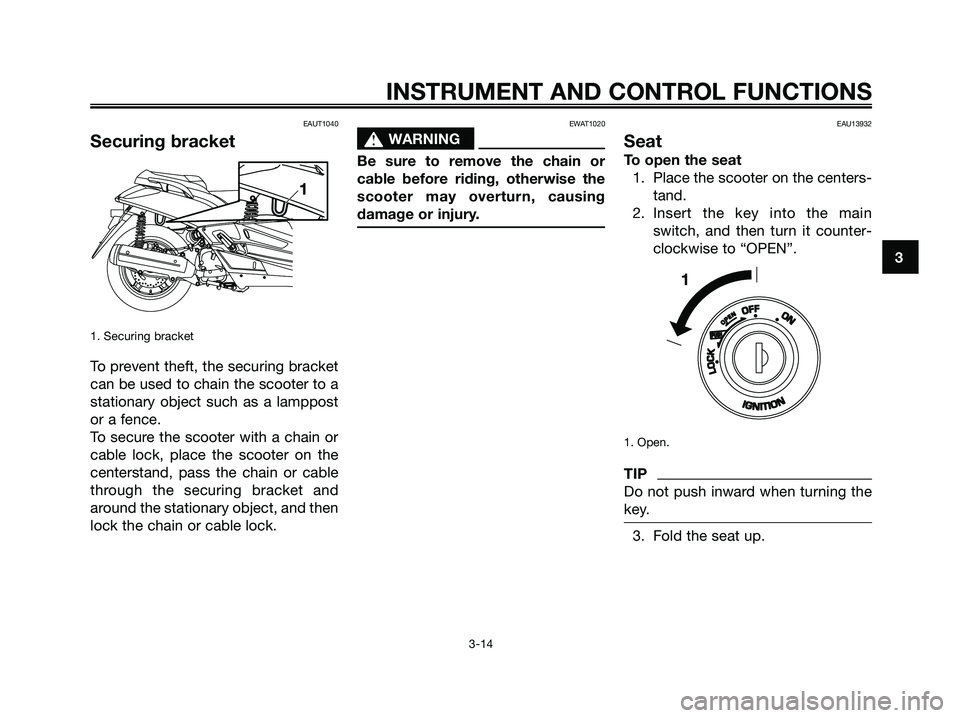
Securing bracket
1. Securing bracket
To prevent theft, the securing bracket
can be used to chain the scooter to a
stationary object such as a lamppost
or a fence.
To secure the scooter with a chain or
cable lock, place the scooter on the
centerstand, pass the chain or cable
through the securing bracket and
around the stationary object, and then
lock the chain or cable lock.
EWAT1020
s s
WARNING
Be sure to remove the chain or
cable before riding, otherwise the
scooter may overturn, causing
damage or injury.
EAU13932
Seat
To open the seat
1. Place the scooter on the centers-
tand.
2. Insert the key into the main
switch, and then turn it counter-
clockwise to “OPEN”.
1. Open.
TIP
Do not push inward when turning the
key.
3. Fold the seat up.
INSTRUMENT AND CONTROL FUNCTIONS
3-14
3
1C0-F8199-E5.QXD 3/10/08 05:56 Página 29
Page 30 of 92
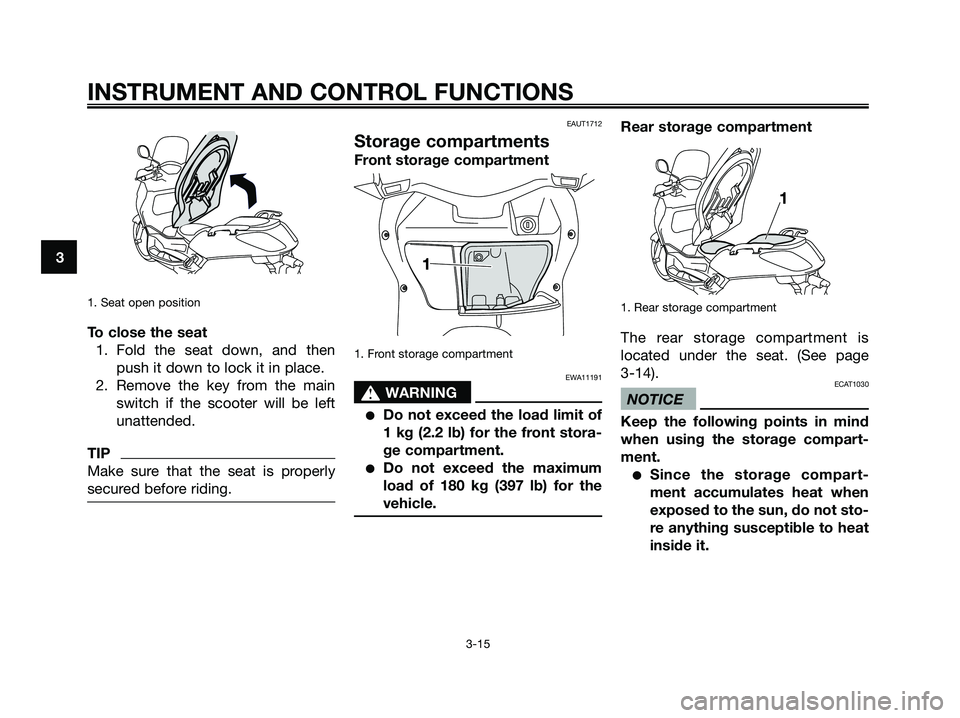
1. Seat open position
To close the seat
1. Fold the seat down, and then
push it down to lock it in place.
2. Remove the key from the main
switch if the scooter will be left
unattended.
TIP
Make sure that the seat is properly
secured before riding.
EAUT1712
Storage compartments
Front storage compartment
1. Front storage compartment
EWA11191
s s
WARNING
●Do not exceed the load limit of
1 kg (2.2 lb) for the front stora-
ge compartment.
●Do not exceed the maximum
load of 180 kg (397 lb) for the
vehicle.
Rear storage compartment
1. Rear storage compartment
The rear storage compartment is
located under the seat. (See page
3-14).
ECAT1030
NOTICE
Keep the following points in mind
when using the storage compart-
ment.
●Since the storage compart-
ment accumulates heat when
exposed to the sun, do not sto-
re anything susceptible to heat
inside it.
INSTRUMENT AND CONTROL FUNCTIONS
3-15
3
1C0-F8199-E5.QXD 3/10/08 05:56 Página 30
Page 31 of 92
●To avoid humidity from sprea-
ding through the storage com-
partment, wrap wet articles in
a plastic bag before storing
them in the compartment.
●Since the storage compart-
ment may get wet while the
scooter is being washed, wrap
any articles stored in the com-
partment in a plastic bag.
●Do not keep anything valuable
or breakable in the storage
compartment.
EWAT1051
s s
WARNING
●Do not exceed the load limit of
5 kg (11 lb) for the rear storage
compartment.
●Do not exceed the maximum
load of 180 kg (397 lb) for the
vehicle.
EAU14541
Storage compartment
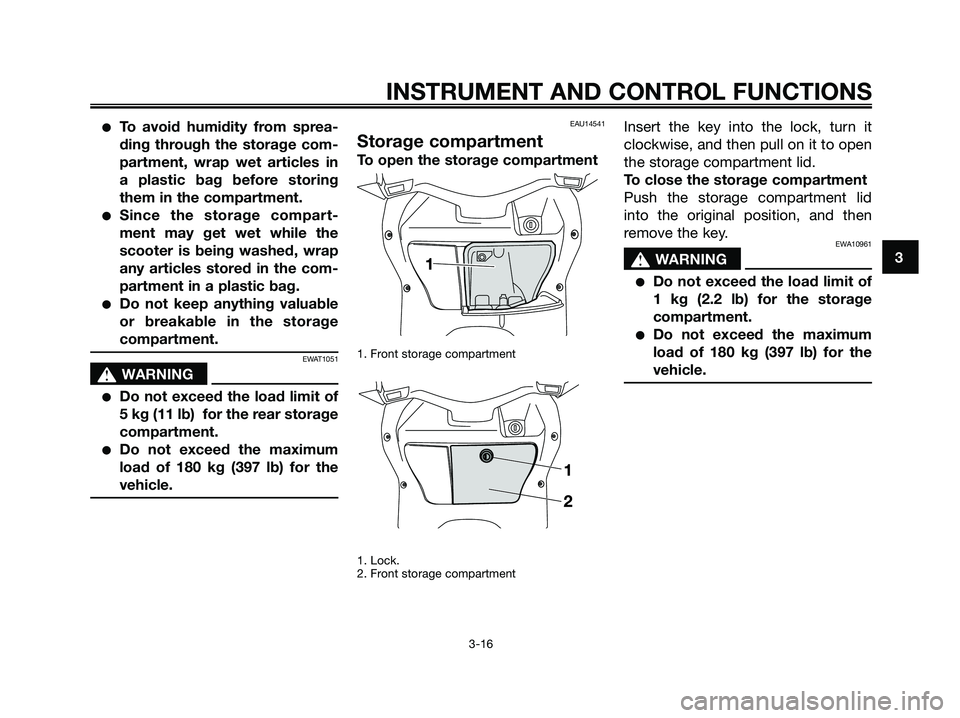
To open the storage compartment
1. Front storage compartment
1. Lock.
2. Front storage compartment
Insert the key into the lock, turn it
clockwise, and then pull on it to open
the storage compartment lid.
To close the storage compartment
Push the storage compartment lid
into the original position, and then
remove the key.
EWA10961
s s
WARNING
●Do not exceed the load limit of
1 kg (2.2 lb) for the storage
compartment.
●Do not exceed the maximum
load of 180 kg (397 lb) for the
vehicle.
INSTRUMENT AND CONTROL FUNCTIONS
3-16
3
1C0-F8199-E5.QXD 3/10/08 05:56 Página 31
Page 35 of 92
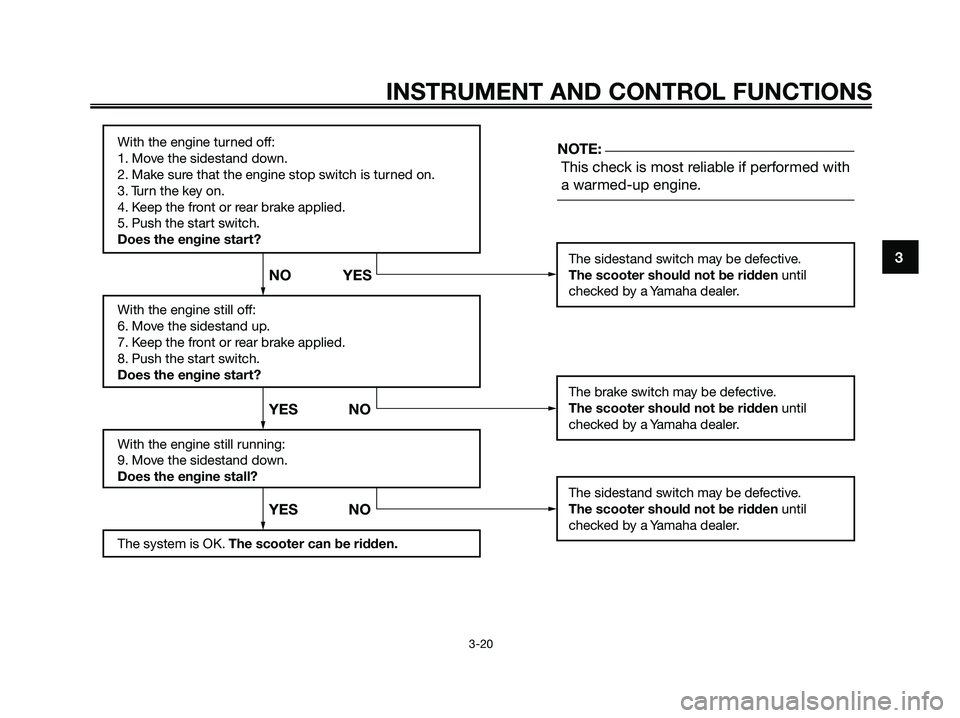
With the engine turned off:
1. Move the sidestand down.
2. Make sure that the engine stop switch is turned on.
3. Turn the key on.
4. Keep the front or rear brake applied.
5. Push the start switch.
Does the engine start?
With the engine still off:
6. Move the sidestand up.
7. Keep the front or rear brake applied.
8. Push the start switch.
Does the engine start?
With the engine still running:
9. Move the sidestand down.
Does the engine stall?
The system is OK. The scooter can be ridden.
This check is most reliable if performed with
a warmed-up engine.
The sidestand switch may be defective.
The scooter should not be ridden until
checked by a Yamaha dealer.
The brake switch may be defective.
The scooter should not be ridden until
checked by a Yamaha dealer.
The sidestand switch may be defective.
The scooter should not be ridden until
checked by a Yamaha dealer.
YES NO YES NO NO YESNOTE:
INSTRUMENT AND CONTROL FUNCTIONS
3-20
3
1C0-F8199-E5.QXD 3/10/08 05:56 Página 35
Page 39 of 92
EAU15951
Read the Owner’s Manual carefully to
become familiar with all controls. If
there is a control or function you do
not understand, ask your Yamaha
dealer.
EWA10271
s s
WARNING
Failure to familiarize yourself with
the controls can lead to loss of
control, which could cause an acci-
dent or injury.
EAU45310
TIP
This model is equipped with a lean
angle sensor to stop the engine in
case of a turnover. To start the engine
after a turnover, be sure to turn the
main switch to “OFF” and then to
“ON”. Failing to do so will prevent the
engine from starting even though the
engine will crank when pushing the
start switch.
EAUM2231
Starting the engineECA10250
NOTICE
See page 5-4 for engine break-in
instructions prior to operating the
vehicle for the first time.
In order for the ignition circuit cut-off
system to enable starting, the sides-
tand must be up.
See page 3-19 for more information.
1. Turn the key to “ON”.
The following warning lights and
indicator light should come on for
a few seconds, then go off.
●Fuel level warning light
●Engine trouble warning light
●Immobilizer system indicator light
ECA11831
NOTICE
If a warning or indicator light does
not go off, see page 3-3 for the
corresponding warning and indica-
tor light circuit check.
2. Close the throttle completely.
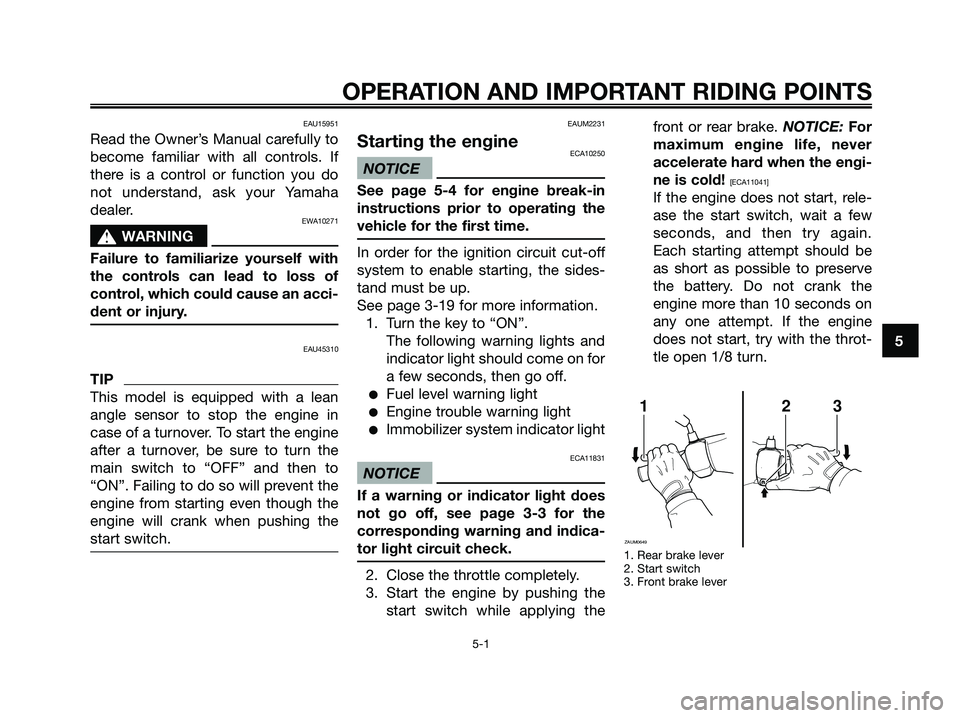
3. Start the engine by pushing the
start switch while applying thefront or rear brake. NOTICE: For
maximum engine life, never
accelerate hard when the engi-
ne is cold!
[ECA11041]
If the engine does not start, rele-
ase the start switch, wait a few
seconds, and then try again.
Each starting attempt should be
as short as possible to preserve
the battery. Do not crank the
engine more than 10 seconds on
any one attempt. If the engine
does not start, try with the throt-
tle open 1/8 turn.
1. Rear brake lever
2. Start switch
3. Front brake lever
123
ZAUM0649
OPERATION AND IMPORTANT RIDING POINTS
5-1
5
1C0-F8199-E5.QXD 3/10/08 05:56 Página 39
Page 42 of 92
EAU16841
Engine break-in
There is never a more important
period in the life of your engine than
the period between 0 and 1600 km
(1000 mi). For this reason, you should
read the following material carefully.
Since the engine is brand new, do not
put an excessive load on it for the first
1600 km (1000 mi). The various parts
in the engine wear and polish them-
selves to the correct operating clea-
rances. During this period, prolonged
full-throttle operation or any condition
that might result in engine overhea-
ting must be avoided.
EAUM2011
0–1000 km (0–600 mi)
●Avoid prolonged operation above
1/3 throttle. NOTICE:After 1000
km (600 mi) of operation, be
sure to replace the engine oil
and final transmission oil.
[ECA11661]
1000–1600 km (600–1000 mi)
●Avoid prolonged operation above
1/2 throttle.
1600 km (1000 mi) and beyond
●The vehicle can now be operated
normally.
ECA10270
NOTICE
If any engine trouble should occur
during the engine break-in period,
immediately have a Yamaha dealer
check the vehicle.
EAU17213
Parking
When parking, stop the engine, and
then remove the key from the main
switch.
EWA10311
s s
WARNING
●Since the engine and exhaust
system can become very hot,
park in a place where pedes-
trians or children are not likely
to touch them and be burned.
●Do not park on a slope or on
soft ground, otherwise the
vehicle may overturn, increa-
sing the risk of a fuel leak and
fire.
●Do not park near grass or other
flammable materials which
might catch fire.
OPERATION AND IMPORTANT RIDING POINTS
5-4
5
1C0-F8199-E5.QXD 3/10/08 05:56 Página 42
Page 66 of 92
EAUT1404
Battery
This model is equipped with a VRLA
(Valve Regulated Lead Acid) battery.
There is no need to check the elec-
trolyte or to add distilled water. Howe-
ver, the battery coupler connection
needs to be checked to make sure
that it is securely connected.
EWA10760
s s
WARNING
●Electrolyte is poisonous and
dangerous since it contains
sulfuric acid, which causes
severe burns. Avoid any con-
tact with skin, eyes or clothing
and always shield your eyes
when working near batteries.
In case of contact, administer
the following FIRST AID.
• EXTERNAL: Flush with plenty
of water.
• INTERNAL: Drink large quan-
tities of water or milk and
immediately call a physician.
• EYES: Flush with water for 15
minutes and seek prompt
medical attention.
●Batteries produce explosive
hydrogen gas. Therefore, keep
sparks, flames, cigarettes, etc.,
away from the battery and pro-
vide sufficient ventilation when
charging it in an enclosed spa-
ce.
●KEEP THIS AND ALL BATTE-
RIES OUT OF THE REACH OF
CHILDREN.
To charge the battery
Have a Yamaha dealer charge the
battery as soon as possible if it seems
to have discharged. Keep in mind that
the battery tends to discharge more
quickly if the vehicle is equipped with
optional electrical accessories.
ECA16520
NOTICE
To charge a VRLA (Valve Regulated
Lead Acid) battery, a special (cons-
tant-voltage) battery charger is
required. Using a conventional bat-
tery charger will damage the bat-
tery. If you do not have access to a
constant-voltage battery charger,
have a Yamaha dealer charge your
battery.
To store the battery
1. If the vehicle will not be used for
more than one month, remove
the battery, fully charge it, and
then place it in a cool, dry place.
NOTICE:When removing the
battery, be sure the key is tur-
ned to “OFF” before discon-
necting the couplers.
[ECA16510]
2. If the battery will be stored for
more than two months, check it
at least once a month and fully
charge it if necessary.
To remove the battery
1. Open the storage compartment.
(See page 3-16).
PERIODIC MAINTENANCE AND ADJUSTMENT
6-24
6
1C0-F8199-E5.QXD 3/10/08 05:56 Página 66
Page 68 of 92
EAU23526
Replacing the fuses
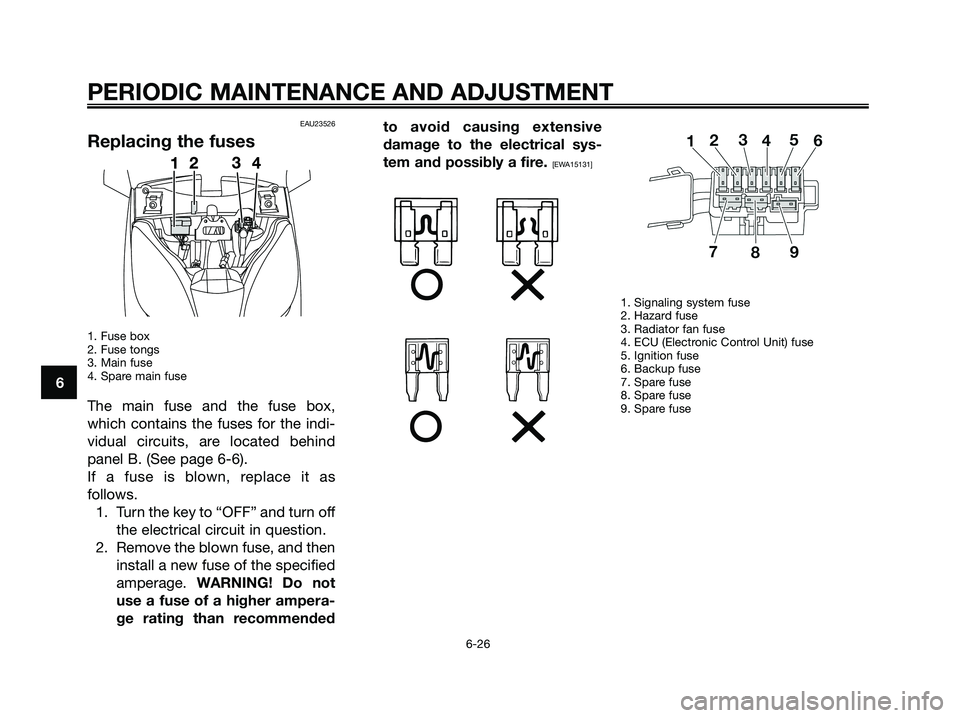
1. Fuse box
2. Fuse tongs
3. Main fuse
4. Spare main fuse
The main fuse and the fuse box,
which contains the fuses for the indi-
vidual circuits, are located behind
panel B. (See page 6-6).
If a fuse is blown, replace it as
follows.
1. Turn the key to “OFF” and turn off
the electrical circuit in question.
2. Remove the blown fuse, and then
install a new fuse of the specified
amperage. WARNING! Do not
use a fuse of a higher ampera-
ge rating than recommendedto avoid causing extensive
damage to the electrical sys-
tem and possibly a fire.
[EWA15131]
1. Signaling system fuse
2. Hazard fuse
3. Radiator fan fuse
4. ECU (Electronic Control Unit) fuse
5. Ignition fuse
6. Backup fuse
7. Spare fuse
8. Spare fuse
9. Spare fuse
PERIODIC MAINTENANCE AND ADJUSTMENT
6-26
6
1C0-F8199-E5.QXD 3/10/08 05:56 Página 68
Page 69 of 92
3. Turn the key to “ON” and turn on
the electrical circuit in question to
check if the device operates.
4. If the fuse immediately blows
again, have a Yamaha dealer
check the electrical system.
EAU23911
Replacing a headlight bulb
This model is equipped with quartz
bulb headlights. If a headlight bulb
burns out, replace it as follows.
ECA10660
NOTICE
Do not touch the glass part of the
headlight bulb to keep it free from
oil, otherwise the transparency of
the glass, the luminosity of the
bulb, and the bulb life will be adver-
sely affected. Thoroughly clean off
any dirt and fingerprints on the
headlight bulb using a cloth mois-
tened with alcohol or thinner.
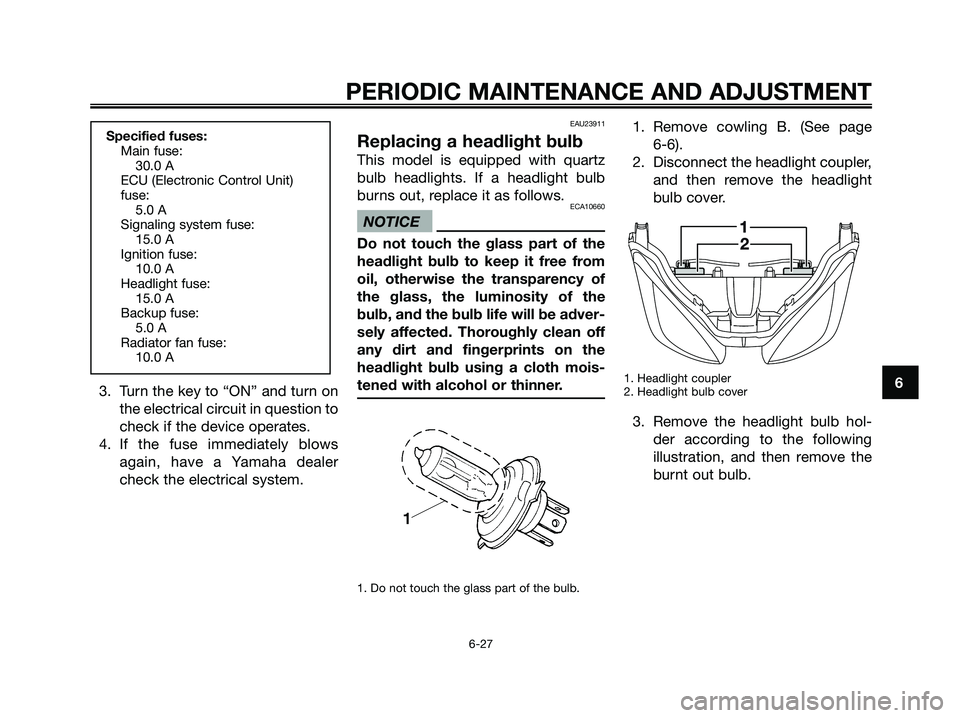
1. Do not touch the glass part of the bulb.
1. Remove cowling B. (See page
6-6).
2. Disconnect the headlight coupler,
and then remove the headlight
bulb cover.
1. Headlight coupler
2. Headlight bulb cover
3. Remove the headlight bulb hol-
der according to the following
illustration, and then remove the
burnt out bulb.
Specified fuses:
Main fuse:
30.0 A
ECU (Electronic Control Unit)
fuse:
5.0 A
Signaling system fuse:
15.0 A
Ignition fuse:
10.0 A
Headlight fuse:
15.0 A
Backup fuse:
5.0 A
Radiator fan fuse:
10.0 A
PERIODIC MAINTENANCE AND ADJUSTMENT
6-27
6
1C0-F8199-E5.QXD 3/10/08 05:56 Página 69
Page 84 of 92
EAU26351
Identification numbers
Record the key identification number,
vehicle identification number and
model label information in the spaces
provided below for assistance when
ordering spare parts from a Yamaha
dealer or for reference in case the
vehicle is stolen.
●KEY IDENTIFICATION NUMBER:
●VEHICLE IDENTIFICATION NUM-
BER:
●MODEL LABEL INFORMATION:
EAU26381
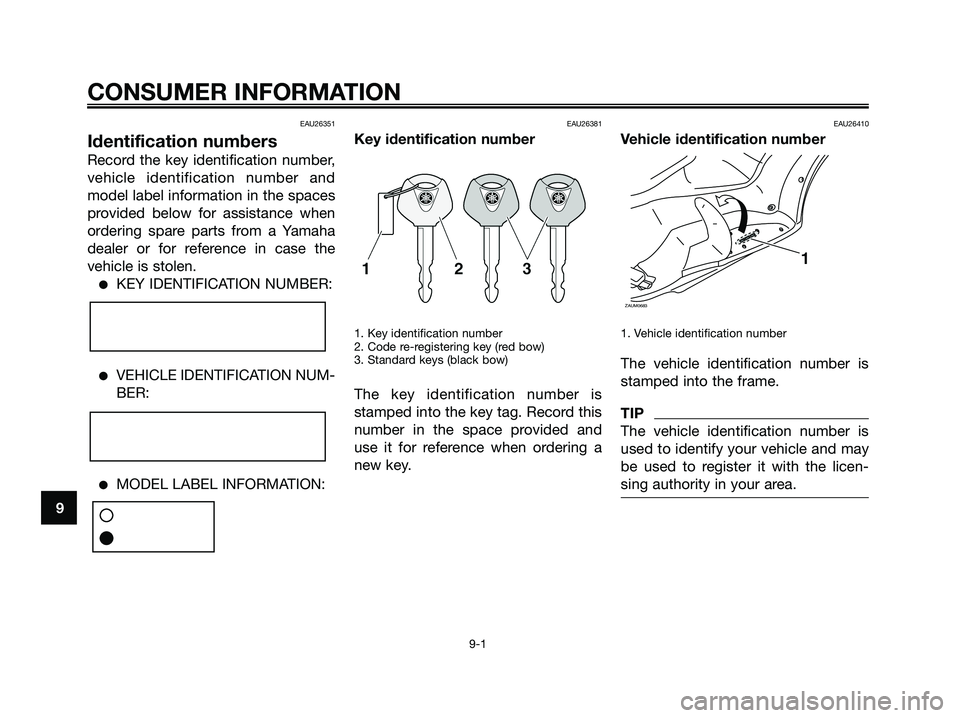
Key identification number
1. Key identification number
2. Code re-registering key (red bow)
3. Standard keys (black bow)
The key identification number is
stamped into the key tag. Record this
number in the space provided and
use it for reference when ordering a
new key.
EAU26410
Vehicle identification number
1. Vehicle identification number
The vehicle identification number is
stamped into the frame.
TIP
The vehicle identification number is
used to identify your vehicle and may
be used to register it with the licen-
sing authority in your area.
ZAUM0683
1
CONSUMER INFORMATION
9-1
9
1C0-F8199-E5.QXD 3/10/08 05:56 Página 84