oil YAMAHA XMAX 250 2009 User Guide
[x] Cancel search | Manufacturer: YAMAHA, Model Year: 2009, Model line: XMAX 250, Model: YAMAHA XMAX 250 2009Pages: 92, PDF Size: 4.7 MB
Page 53 of 92
7. Start the engine, and then let it
idle for several minutes while
checking it for oil leakage. If oil is
leaking, immediately turn the
engine off and check for the cau-
se.
8. Reset the oil change indicator.
(See page 3-6). EAU20064
Final transmission oil
The final transmission case must be
checked for oil leakage before each
ride. If any leakage is found, have a
Yamaha dealer check and repair the
scooter. In addition, the final trans-
mission oil must be changed as
follows at the intervals specified in the
periodic maintenance and lubrication
chart.
1. Start the engine, warm up the
final transmission oil by riding the
scooter for several minutes, and
then stop the engine.
2. Place the scooter on the centers-
tand.
3. Place an oil pan under the final
transmission case to collect the
used oil.
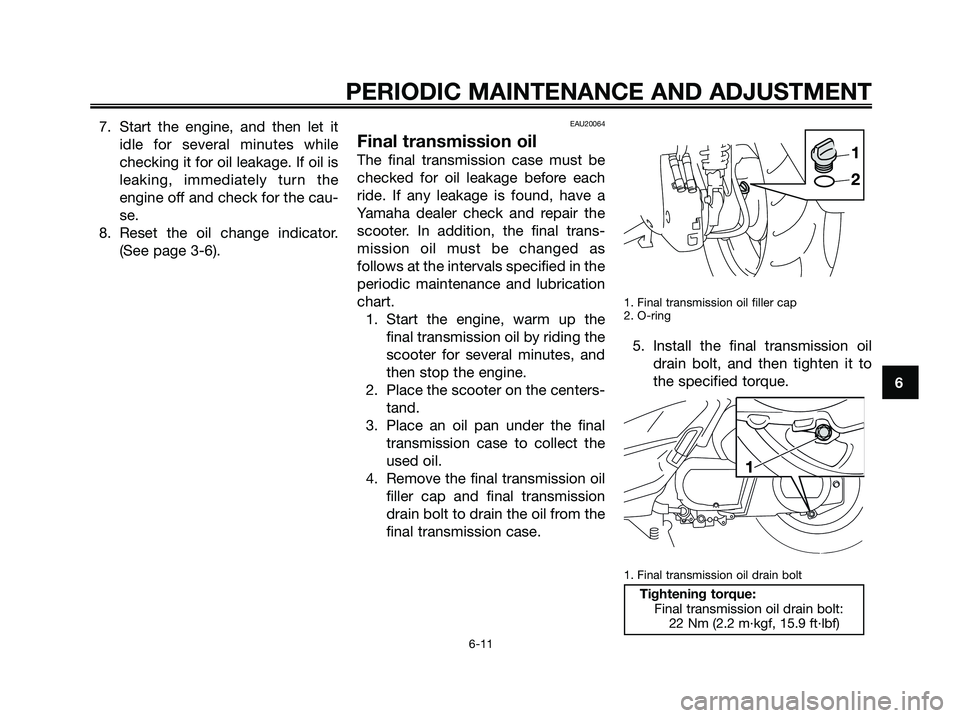
4. Remove the final transmission oil
filler cap and final transmission
drain bolt to drain the oil from the
final transmission case.
1. Final transmission oil filler cap
2. O-ring
5. Install the final transmission oil
drain bolt, and then tighten it to
the specified torque.
1. Final transmission oil drain bolt
Tightening torque:
Final transmission oil drain bolt:
22 Nm (2.2 m·kgf, 15.9 ft·lbf)
PERIODIC MAINTENANCE AND ADJUSTMENT
6-11
6
1C0-F8199-E5.QXD 3/10/08 05:56 Página 53
Page 54 of 92
6. Refill with the specified amount
of the recommended final trans-
mission oil, and then install and
tighten the oil filler cap. WAR-
NING! Make sure that no
foreign material enters the final
transmission case. Make sure
that no oil gets on the tire or
wheel.
[EWA11311]
7. Check the final transmission case
for oil leakage. If oil is leaking,
check for the cause.
EAU20070
Coolant
The coolant level should be checked
before each ride. In addition, the coo-
lant must be changed at the intervals
specified in the periodic maintenance
and lubrication chart.
EAUS1274
To check the coolant level
1. Place the vehicle on a level surfa-
ce and hold it in an upright posi-
tion.
TIP
●The coolant level must be chec-
ked on a cold engine since the
level varies with engine tempera-
ture.
●Make sure that the vehicle is
positioned straight up when
checking the coolant level. A
slight tilt to the side can result in
a false reading.
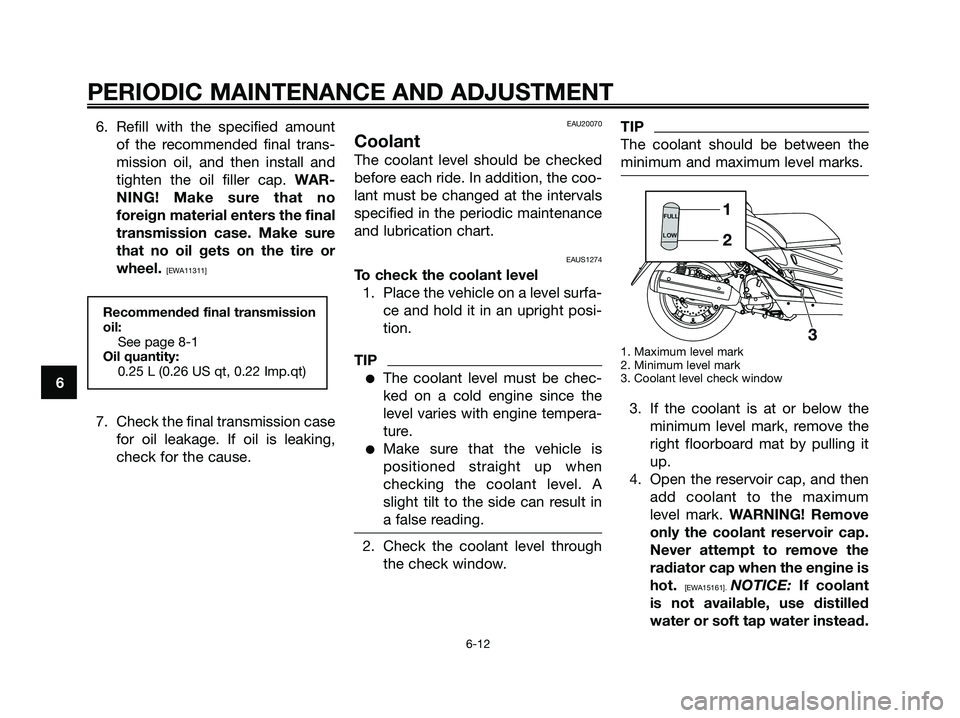
2. Check the coolant level through
the check window.
TIP
The coolant should be between the
minimum and maximum level marks.
1. Maximum level mark
2. Minimum level mark
3. Coolant level check window
3. If the coolant is at or below the
minimum level mark, remove the
right floorboard mat by pulling it
up.
4. Open the reservoir cap, and then
add coolant to the maximum
level mark. WARNING! Remove
only the coolant reservoir cap.
Never attempt to remove the
radiator cap when the engine is
hot.
[EWA15161]. NOTICE: If coolant
is not available, use distilled
water or soft tap water instead.
FULL
LOW
Recommended final transmission
oil:
See page 8-1
Oil quantity:
0.25 L (0.26 US qt, 0.22 Imp.qt)
PERIODIC MAINTENANCE AND ADJUSTMENT
6-12
6
1C0-F8199-E5.QXD 3/10/08 05:56 Página 54
Page 62 of 92
Insufficient brake fluid may allow air
to enter the brake system, possibly
causing it to become ineffective.
Before riding, check that the brake
fluid is above the minimum level mark
and replenish if necessary. A low bra-
ke fluid level may indicate worn brake
pads and/or brake system leakage. If
the brake fluid level is low, be sure to
check the brake pads for wear and
the brake system for leakage.
Observe these precautions:
●When checking the fluid level,
make sure that the top of the bra-
ke fluid reservoir is level.
●Use only the recommended qua-
lity brake fluid, otherwise the rub-
ber seals may deteriorate, cau-
sing leakage and poor braking
performance.
●Refill with the same type of brake
fluid. Mixing fluids may result in a
harmful chemical reaction and
lead to poor braking performan-
ce.
●Be careful that water does not
enter the brake fluid reservoir
when refilling. Water will signifi-
cantly lower the boiling point of
the fluid and may result in vapor
lock.
●Brake fluid may deteriorate pain-
ted surfaces or plastic parts.
Always clean up spilled fluid
immediately.
●As the brake pads wear, it is nor-
mal for the brake fluid level to
gradually go down. However, if
the brake fluid level goes down
suddenly, have a Yamaha dealer
check the cause.
EAU22721
Changing the brake fluid
Have a Yamaha dealer change the
brake fluid at the intervals specified in
the TIP after the periodic maintenan-
ce and lubrication chart. In addition,
have the oil seals of the brake master
cylinder and caliper as well as the
brake hose replaced at the intervals
listed below or whenever they are
damaged or leaking.
●Oil seals: Replace every two
years.
●Brake hose: Replace every four
years.
Recommended brake fluid:
DOT 4
PERIODIC MAINTENANCE AND ADJUSTMENT
6-20
6
1C0-F8199-E5.QXD 3/10/08 05:56 Página 62
Page 63 of 92
EAU23101
Checking and lubricating the
cables
The operation of all control cables
and the condition of the cables
should be checked before each ride,
and the cables and cable ends should
be lubricated if necessary. If a cable is
damaged or does not move smoothly,
have a Yamaha dealer check or repla-
ce it. WARNING! Damage to the
outer sheath may interfere with
proper cable operation and will
cause the inner cable to rust.
Replace a damaged cable as soon
as possible to prevent unsafe con-
ditions.
[EWA10721]EAU23111
Checking and lubricating the
throttle grip and cable
The operation of the throttle grip
should be checked before each ride.
In addition, the cable should be lubri-
cated at the intervals specified in the
periodic maintenance chart.
EAU23172
Lubricating the front and
rear brake levers
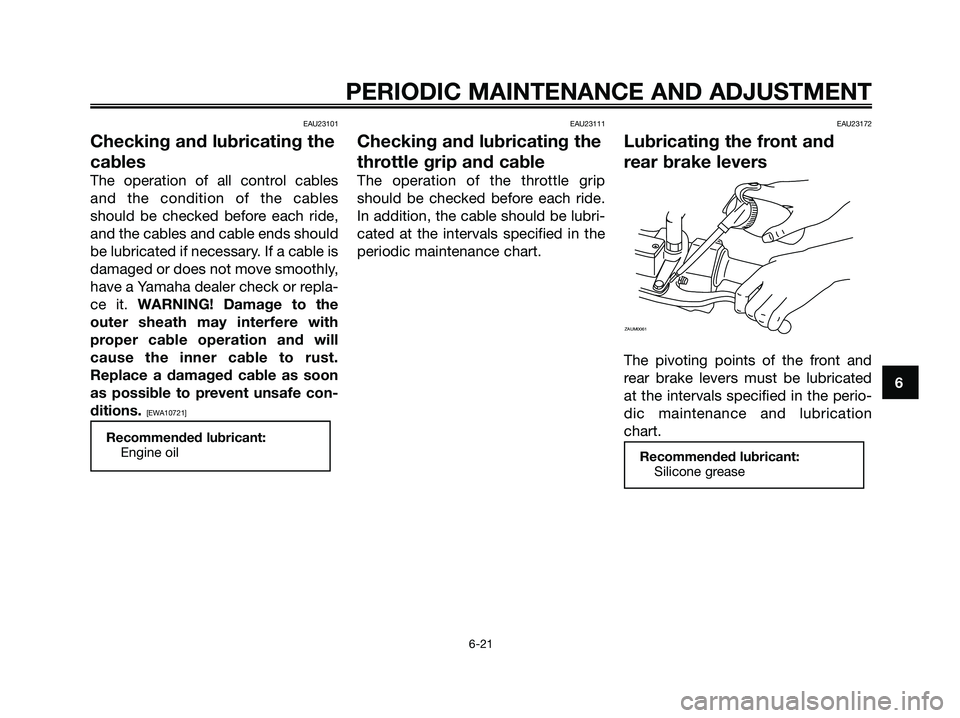
The pivoting points of the front and
rear brake levers must be lubricated
at the intervals specified in the perio-
dic maintenance and lubrication
chart.
Recommended lubricant:
Silicone grease
ZAUM0061
Recommended lubricant:
Engine oil
PERIODIC MAINTENANCE AND ADJUSTMENT
6-21
6
1C0-F8199-E5.QXD 3/10/08 05:56 Página 63
Page 64 of 92
EAU23213
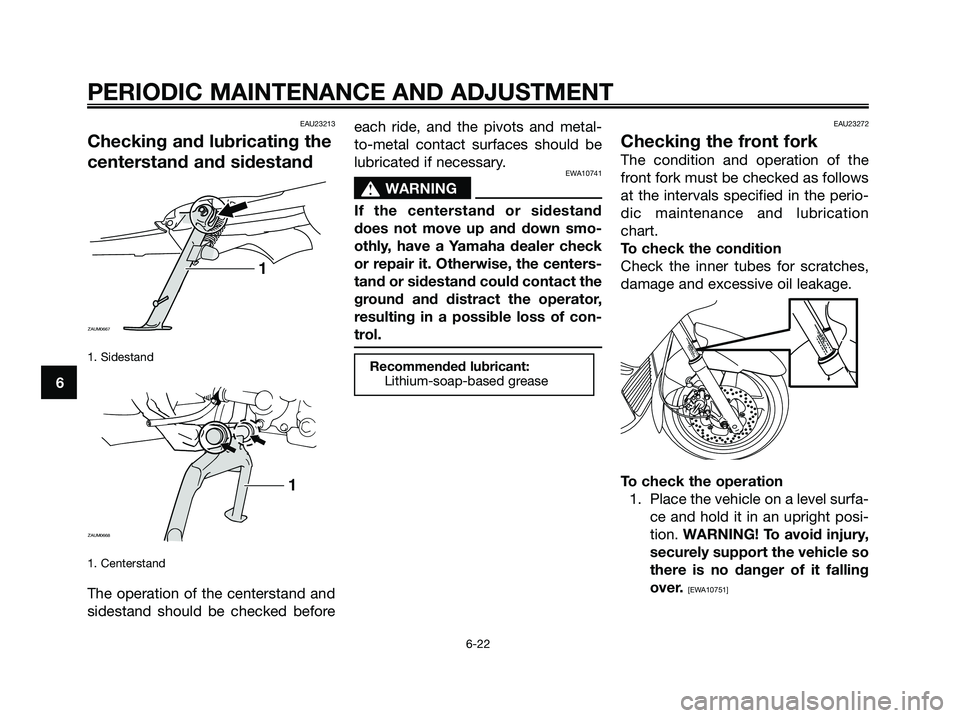
Checking and lubricating the
centerstand and sidestand
1. Sidestand
1. Centerstand
The operation of the centerstand and
sidestand should be checked beforeeach ride, and the pivots and metal-
to-metal contact surfaces should be
lubricated if necessary.
EWA10741
s s
WARNING
If the centerstand or sidestand
does not move up and down smo-
othly, have a Yamaha dealer check
or repair it. Otherwise, the centers-
tand or sidestand could contact the
ground and distract the operator,
resulting in a possible loss of con-
trol.
EAU23272
Checking the front fork
The condition and operation of the
front fork must be checked as follows
at the intervals specified in the perio-
dic maintenance and lubrication
chart.
To check the condition
Check the inner tubes for scratches,
damage and excessive oil leakage.
To check the operation
1. Place the vehicle on a level surfa-
ce and hold it in an upright posi-
tion. WARNING! To avoid injury,
securely support the vehicle so
there is no danger of it falling
over.
[EWA10751]
Recommended lubricant:
Lithium-soap-based grease
1
ZAUM0668
ZAUM0667
1
PERIODIC MAINTENANCE AND ADJUSTMENT
6-22
6
1C0-F8199-E5.QXD 3/10/08 05:56 Página 64
Page 69 of 92
3. Turn the key to “ON” and turn on
the electrical circuit in question to
check if the device operates.
4. If the fuse immediately blows
again, have a Yamaha dealer
check the electrical system.
EAU23911
Replacing a headlight bulb
This model is equipped with quartz
bulb headlights. If a headlight bulb
burns out, replace it as follows.
ECA10660
NOTICE
Do not touch the glass part of the
headlight bulb to keep it free from
oil, otherwise the transparency of
the glass, the luminosity of the
bulb, and the bulb life will be adver-
sely affected. Thoroughly clean off
any dirt and fingerprints on the
headlight bulb using a cloth mois-
tened with alcohol or thinner.
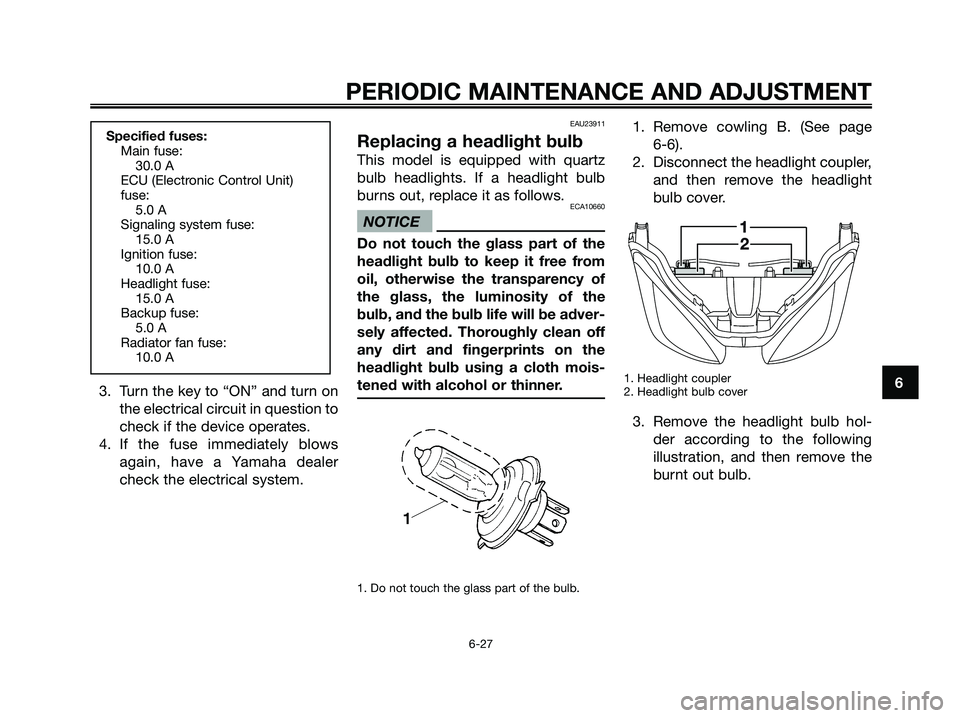
1. Do not touch the glass part of the bulb.
1. Remove cowling B. (See page
6-6).
2. Disconnect the headlight coupler,
and then remove the headlight
bulb cover.
1. Headlight coupler
2. Headlight bulb cover
3. Remove the headlight bulb hol-
der according to the following
illustration, and then remove the
burnt out bulb.
Specified fuses:
Main fuse:
30.0 A
ECU (Electronic Control Unit)
fuse:
5.0 A
Signaling system fuse:
15.0 A
Ignition fuse:
10.0 A
Headlight fuse:
15.0 A
Backup fuse:
5.0 A
Radiator fan fuse:
10.0 A
PERIODIC MAINTENANCE AND ADJUSTMENT
6-27
6
1C0-F8199-E5.QXD 3/10/08 05:56 Página 69
Page 77 of 92
EAU37833
Matte color cautionECA15192
NOTICE
Some models are equipped with
matte colored finished parts. Be
sure to consult a Yamaha dealer for
advice on what products to use
before cleaning the vehicle.
Using a brush, harsh chemical pro-
ducts or cleaning compounds
when cleaning these parts will
scratch or damage their surface.
Wax also should not be applied to
any matte colored finished parts.
EAU26093
Care
While the open design of a scooter
reveals the attractiveness of the tech-
nology, it also makes it more vulnera-
ble. Rust and corrosion can develop
even if high-quality components are
used. A rusty exhaust pipe may go
unnoticed on a car, however, it
detracts from the overall appearance
of a scooter. Frequent and proper
care does not only comply with the
terms of the warranty, but it will also
keep your scooter looking good,
extend its life and optimize its perfor-
mance.
Before cleaning
1. Cover the muffler outlet with a
plastic bag after the engine has
cooled down.
2. Make sure that all caps and
covers as well as all electrical
couplers and connectors, inclu-
ding the spark plug cap, are
tightly installed.
3. Remove extremely stubborn dirt,
like oil burnt onto the crankcase,
with a degreasing agent and abrush, but never apply such pro-
ducts onto seals, gaskets and
wheel axles. Always rinse the dirt
and degreaser off with water.
Cleaning
ECA10782
NOTICE
●Avoid using strong acidic whe-
el cleaners, especially on spo-
ked wheels. If such products
are used on hard-to-remove
dirt, do not leave the cleaner on
the affected area any longer
than instructed. Also, tho-
roughly rinse the area off with
water, immediately dry it, and
then apply a corrosion protec-
tion spray.
●Improper cleaning can damage
plastic parts (such as cowlings,
panels, windshields, headlight
lenses, meter lenses, etc.) and
the mufflers. Use only a soft,
clean cloth or sponge with
water to clean plastic. Howe-
ver, if the plastic parts cannot
be thoroughly cleaned with
water, diluted mild detergent
SCOOTER CARE AND STORAGE
7-1
7
1C0-F8199-E5.QXD 3/10/08 05:56 Página 77
Page 79 of 92
4. Use spray oil as a universal clea-
ner to remove any remaining dirt.
5. Touch up minor paint damage
caused by stones, etc.
6. Wax all painted surfaces.
7. Let the scooter dry completely
before storing or covering it.
EWA10941
s s
WARNING
Contaminants on the brakes or
tires can cause loss of control.
●Make sure that there is no oil or
wax on the brakes or tires. If
necessary, clean the brake
discs and brake linings with a
regular brake disc cleaner or
acetone, and wash the tires
with warm water and a mild
detergent.
●Before operating the scooter
test its braking performance
and cornering behavior.
ECA10800
NOTICE
●Apply spray oil and wax spa-
ringly and make sure to wipe
off any excess.
●Never apply oil or wax to any
rubber and plastic parts, buttreat them with a suitable care
product.
●Avoid using abrasive polishing
compounds as they will wear
away the paint.
TIP
●Consult a Yamaha dealer for
advice on what products to use.
●Washing, rainy weather or humid
climates can cause the headlight
lens to fog. Turning the headlight
on for a short period of time will
help remove the moisture from
the lens.
EAU36561
Storage
Short-term
Always store your scooter in a cool,
dry place and, if necessary, protect it
against dust with a porous cover.
ECA10820
NOTICE
●Storing the scooter in a poorly
ventilated room or covering it
with a tarp, while it is still wet,
will allow water and humidity to
seep in and cause rust.
●To prevent corrosion, avoid
damp cellars, stables (because
of the presence of ammonia)
and areas where strong chemi-
cals are stored.
Long-term
Before storing your scooter for seve-
ral months:
1. Follow all the instructions in the
“Care” section of this chapter.
2. Fill up the fuel tank and add fuel
stabilizer (if available) to prevent
the fuel tank from rusting and the
fuel from deteriorating.
SCOOTER CARE AND STORAGE
7-3
7
1C0-F8199-E5.QXD 3/10/08 05:56 Página 79
Page 80 of 92
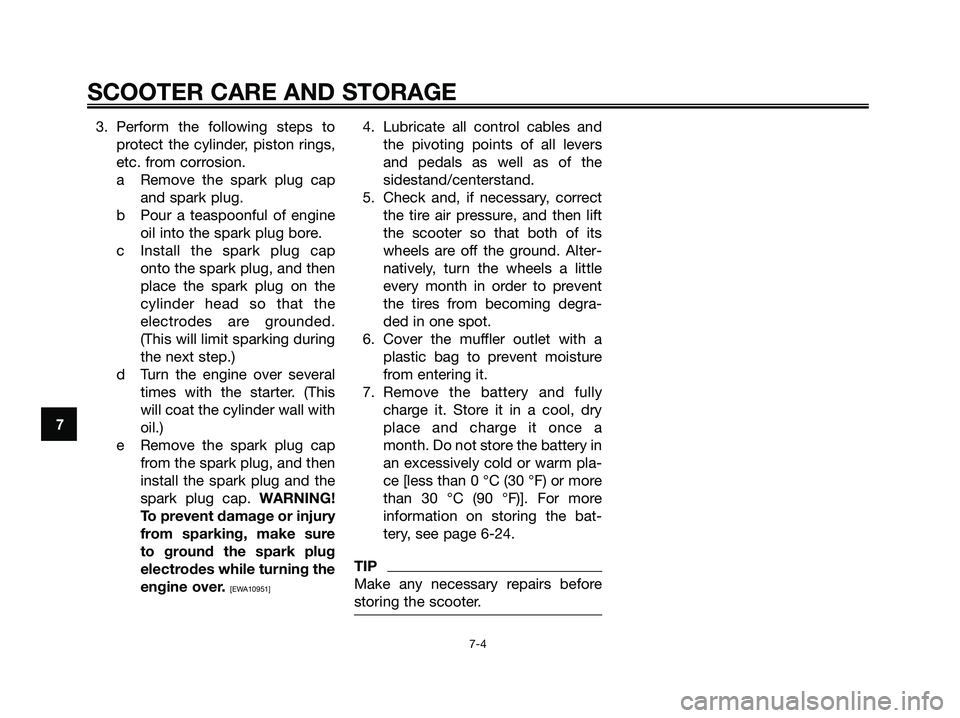
3. Perform the following steps to
protect the cylinder, piston rings,
etc. from corrosion.
a Remove the spark plug cap
and spark plug.
b Pour a teaspoonful of engine
oil into the spark plug bore.
c Install the spark plug cap
onto the spark plug, and then
place the spark plug on the
cylinder head so that the
electrodes are grounded.
(This will limit sparking during
the next step.)
d Turn the engine over several
times with the starter. (This
will coat the cylinder wall with
oil.)
e Remove the spark plug cap
from the spark plug, and then
install the spark plug and the
spark plug cap. WARNING!
To prevent damage or injury
from sparking, make sure
to ground the spark plug
electrodes while turning the
engine over.
[EWA10951]
4. Lubricate all control cables and
the pivoting points of all levers
and pedals as well as of the
sidestand/centerstand.
5. Check and, if necessary, correct
the tire air pressure, and then lift
the scooter so that both of its
wheels are off the ground. Alter-
natively, turn the wheels a little
every month in order to prevent
the tires from becoming degra-
ded in one spot.
6. Cover the muffler outlet with a
plastic bag to prevent moisture
from entering it.
7. Remove the battery and fully
charge it. Store it in a cool, dry
place and charge it once a
month. Do not store the battery in
an excessively cold or warm pla-
ce [less than 0 °C (30 °F) or more
than 30 °C (90 °F)]. For more
information on storing the bat-
tery, see page 6-24.
TIP
Make any necessary repairs before
storing the scooter.
SCOOTER CARE AND STORAGE
7-4
7
1C0-F8199-E5.QXD 3/10/08 05:56 Página 80
Page 81 of 92
Dimensions:Overall length:
2210 mm (87.0 in)
Overall width:
790 mm (31.1 in)
Overall height:
1380 mm (54.3 in)
Seat height:
785 mm (30.9 in)
Wheelbase:
1545 mm (60.8 in)
Ground clearance:
112 mm (4.44 in)
Minimum turning radius:
3650 mm (143.7 in)
Weight:With oil and fuel:
176.0 kg (388 lb)
Engine:Engine type:
Liquid cooled 4-stroke, SOHC
Cylinder arrangement:
Forward-inclined single cylinder
Displacement:
249.7 cm
3
Bore x stroke:
69.0 x 66.8 mm (2.72 x 2.63 in)
Compression ratio:
10.10 :1
Starting system:
Electric starter
Lubrication system:
Wet sump
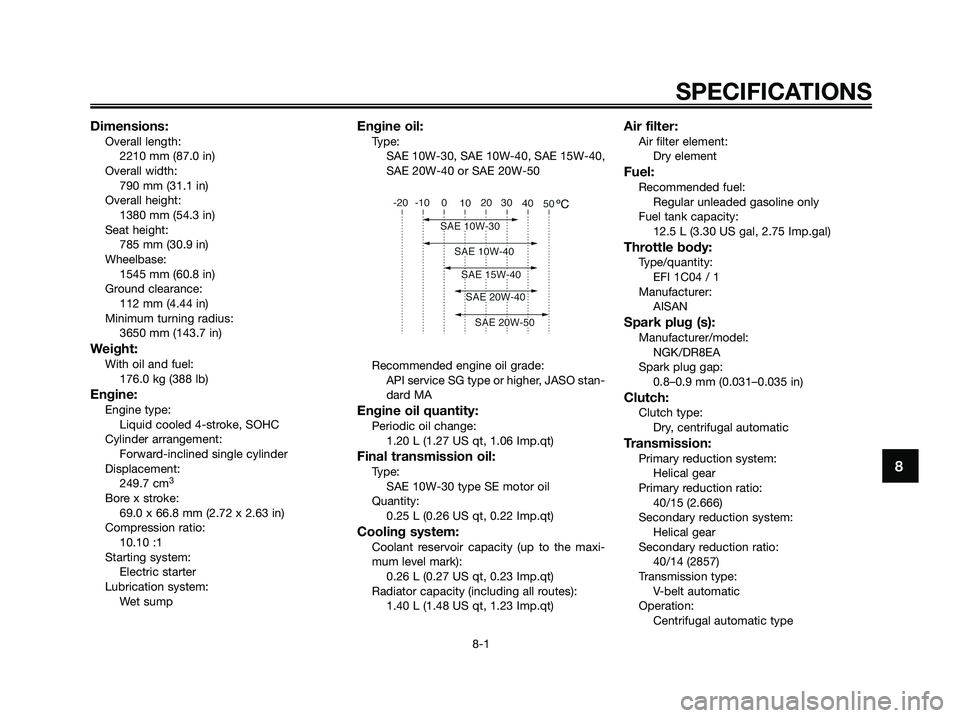
Engine oil:Type:
SAE 10W-30, SAE 10W-40, SAE 15W-40,
SAE 20W-40 or SAE 20W-50
Recommended engine oil grade:
API service SG type or higher, JASO stan-
dard MA
Engine oil quantity:Periodic oil change:
1.20 L (1.27 US qt, 1.06 Imp.qt)
Final transmission oil:Type:
SAE 10W-30 type SE motor oil
Quantity:
0.25 L (0.26 US qt, 0.22 Imp.qt)
Cooling system:Coolant reservoir capacity (up to the maxi-
mum level mark):
0.26 L (0.27 US qt, 0.23 Imp.qt)
Radiator capacity (including all routes):
1.40 L (1.48 US qt, 1.23 Imp.qt)
Air filter:Air filter element:
Dry element
Fuel:Recommended fuel:
Regular unleaded gasoline only
Fuel tank capacity:
12.5 L (3.30 US gal, 2.75 Imp.gal)
Throttle body:Type/quantity:
EFI 1C04 / 1
Manufacturer:
AISAN
Spark plug (s):Manufacturer/model:
NGK/DR8EA
Spark plug gap:
0.8–0.9 mm (0.031–0.035 in)
Clutch:Clutch type:
Dry, centrifugal automatic
Transmission:Primary reduction system:
Helical gear
Primary reduction ratio:
40/15 (2.666)
Secondary reduction system:
Helical gear
Secondary reduction ratio:
40/14 (2857)
Transmission type:
V-belt automatic
Operation:
Centrifugal automatic type
SPECIFICATIONS
8-1
8
1C0-F8199-E5.QXD 3/10/08 05:56 Página 81