brake fluid YAMAHA XMAX 250 2009 Owners Manual
[x] Cancel search | Manufacturer: YAMAHA, Model Year: 2009, Model line: XMAX 250, Model: YAMAHA XMAX 250 2009Pages: 92, PDF Size: 4.7 MB
Page 6 of 92
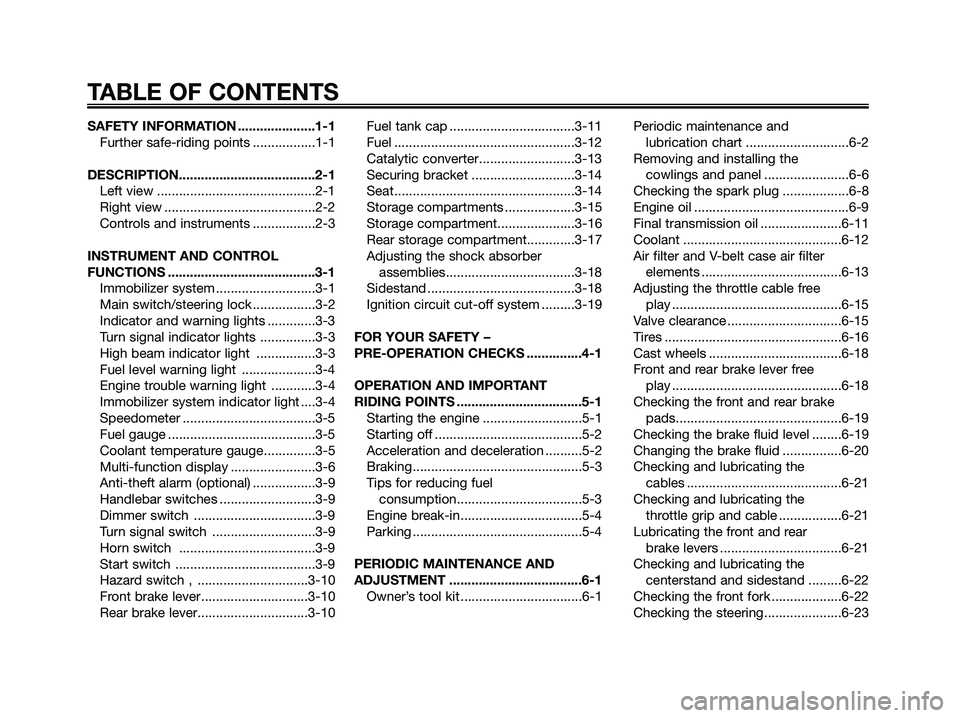
SAFETY INFORMATION .....................1-1
Further safe-riding points .................1-1
DESCRIPTION.....................................2-1
Left view ...........................................2-1
Right view .........................................2-2
Controls and instruments .................2-3
INSTRUMENT AND CONTROL
FUNCTIONS ........................................3-1
Immobilizer system ...........................3-1
Main switch/steering lock .................3-2
Indicator and warning lights .............3-3
Turn signal indicator lights ...............3-3
High beam indicator light ................3-3
Fuel level warning light ....................3-4
Engine trouble warning light ............3-4
Immobilizer system indicator light ....3-4
Speedometer ....................................3-5
Fuel gauge ........................................3-5
Coolant temperature gauge..............3-5
Multi-function display .......................3-6
Anti-theft alarm (optional) .................3-9
Handlebar switches ..........................3-9
Dimmer switch .................................3-9
Turn signal switch ............................3-9
Horn switch .....................................3-9
Start switch ......................................3-9
Hazard switch , ..............................3-10
Front brake lever.............................3-10
Rear brake lever..............................3-10Fuel tank cap ..................................3-11
Fuel .................................................3-12
Catalytic converter..........................3-13
Securing bracket ............................3-14
Seat.................................................3-14
Storage compartments ...................3-15
Storage compartment.....................3-16
Rear storage compartment.............3-17
Adjusting the shock absorber
assemblies...................................3-18
Sidestand ........................................3-18
Ignition circuit cut-off system .........3-19
FOR YOUR SAFETY –
PRE-OPERATION CHECKS ...............4-1
OPERATION AND IMPORTANT
RIDING POINTS ..................................5-1
Starting the engine ...........................5-1
Starting off ........................................5-2
Acceleration and deceleration ..........5-2
Braking..............................................5-3
Tips for reducing fuel
consumption..................................5-3
Engine break-in.................................5-4
Parking ..............................................5-4
PERIODIC MAINTENANCE AND
ADJUSTMENT ....................................6-1
Owner’s tool kit .................................6-1Periodic maintenance and
lubrication chart ............................6-2
Removing and installing the
cowlings and panel .......................6-6
Checking the spark plug ..................6-8
Engine oil ..........................................6-9
Final transmission oil ......................6-11
Coolant ...........................................6-12
Air filter and V-belt case air filter
elements ......................................6-13
Adjusting the throttle cable free
play ..............................................6-15
Valve clearance ...............................6-15
Tires ................................................6-16
Cast wheels ....................................6-18
Front and rear brake lever free
play ..............................................6-18
Checking the front and rear brake
pads.............................................6-19
Checking the brake fluid level ........6-19
Changing the brake fluid ................6-20
Checking and lubricating the
cables ..........................................6-21
Checking and lubricating the
throttle grip and cable .................6-21
Lubricating the front and rear
brake levers .................................6-21
Checking and lubricating the
centerstand and sidestand .........6-22
Checking the front fork ...................6-22
Checking the steering.....................6-23
TABLE OF CONTENTS
1C0-F8199-E5.QXD 3/10/08 05:56 Página 6
Page 37 of 92
FOR YOUR SAFETY – PRE-OPERATION CHECKS
4-2
4
EAU15605
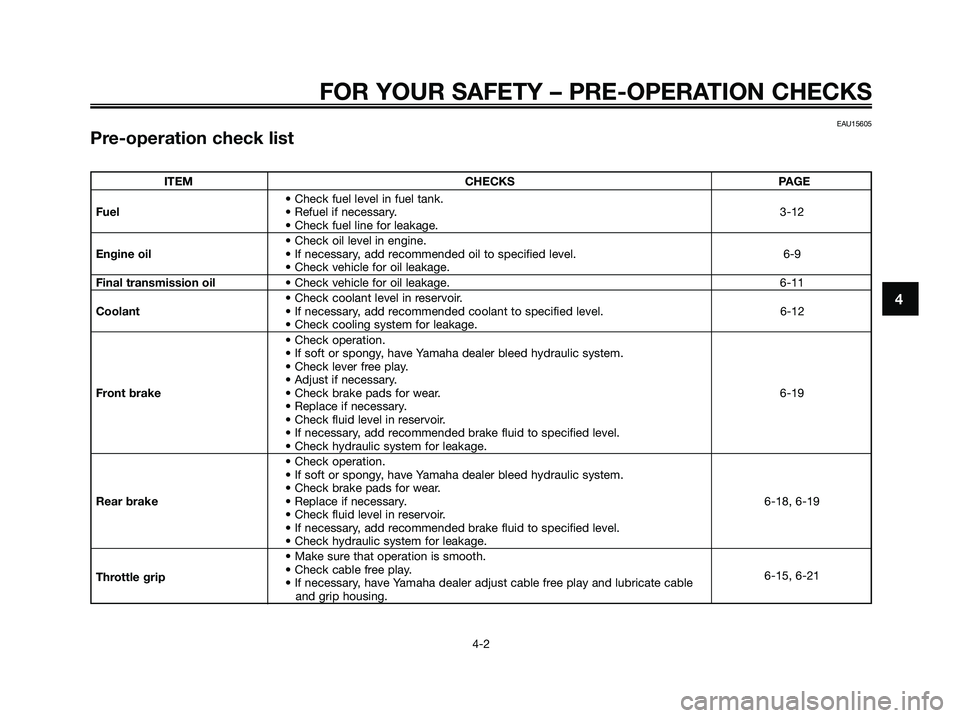
Pre-operation check list
ITEM CHECKS PAGE
• Check fuel level in fuel tank.
Fuel• Refuel if necessary.3-12
• Check fuel line for leakage.
• Check oil level in engine.
Engine oil• If necessary, add recommended oil to specified level. 6-9
• Check vehicle for oil leakage.
Final transmission oil• Check vehicle for oil leakage. 6-11
• Check coolant level in reservoir.
Coolant• If necessary, add recommended coolant to specified level. 6-12
• Check cooling system for leakage.
• Check operation.
• If soft or spongy, have Yamaha dealer bleed hydraulic system.
• Check lever free play.
• Adjust if necessary.
Front brake• Check brake pads for wear. 6-19
• Replace if necessary.
• Check fluid level in reservoir.
• If necessary, add recommended brake fluid to specified level.
• Check hydraulic system for leakage.
• Check operation.
• If soft or spongy, have Yamaha dealer bleed hydraulic system.
• Check brake pads for wear.
Rear brake• Replace if necessary. 6-18, 6-19
• Check fluid level in reservoir.
• If necessary, add recommended brake fluid to specified level.
• Check hydraulic system for leakage.
• Make sure that operation is smooth.
Throttle grip• Check cable free play.
• If necessary, have Yamaha dealer adjust cable free play and lubricate cable 6-15, 6-21
and grip housing.
1C0-F8199-E5.QXD 3/10/08 05:56 Página 37
Page 44 of 92

PERIODIC MAINTENANCE AND ADJUSTMENT
6-2
6
EAU1770A
Periodic maintenance and lubrication chart
TIP
●The annual checks must be performed every year, except if a kilometer-based maintenance, or for the UK,
a mileage-based maintenance, is performed instead.
●From 50000 km (30000 mi), repeat the maintenance intervals starting from 10000 km (6000 mi).
●Items marked with an asterisk should be performed by a Yamaha dealer as they require special tools, data and
technical skills.
ODOMETER READING
CHECK OR ANNUAL
NO. ITEM MAINTENANCE JOB
1000 km 10000 km 20000 km 30000 km 40000 kmCHECK
(600 mi) (6000 mi) (12000 mi) (18000 mi) (24000 mi)
1*Fuel line• Check fuel and vacuum hoses
for cracks or damage.√√√ √√
• Check condition.
2Spark plug• Clean and regap.√√
• Replace.√√
3*Valves• Check valve clearance.
• Adjust.√√
4Air filter element• Replace.√√
5V-belt case air filter
element• Clean.√√√ √
• Check operation, fluid level and
6*Front brakevehicle for fluid leakage.√√ √√ √ √
• Replace brake pads. Whenever worn to the limit
1C0-F8199-E5.QXD 3/10/08 05:56 Página 44
Page 45 of 92
PERIODIC MAINTENANCE AND ADJUSTMENT
6-3
6
ODOMETER READING
CHECK OR ANNUAL
NO. ITEM MAINTENANCE JOB
1000 km 10000 km 20000 km 30000 km 40000 kmCHECK
(600 mi) (6000 mi) (12000 mi) (18000 mi) (24000 mi)
• Check operation, fluid level
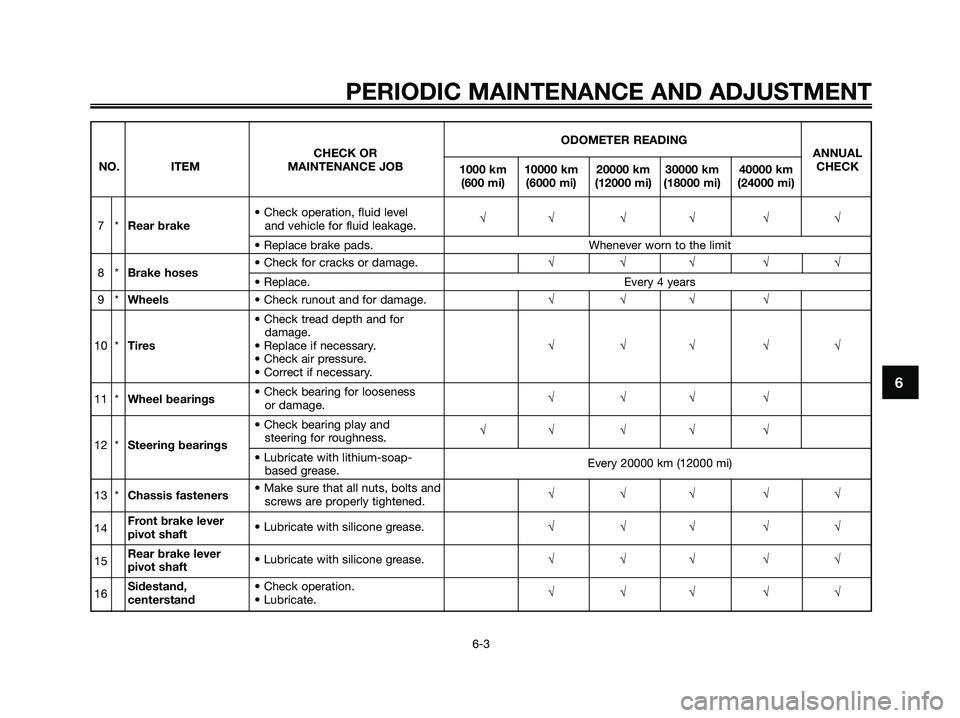
7*Rear brakeand vehicle for fluid leakage.√√ √√ √ √
• Replace brake pads. Whenever worn to the limit
8*Brake hoses• Check for cracks or damage.√√√ √√• Replace. Every 4 years
9*Wheels• Check runout and for damage.√√√ √
• Check tread depth and for
damage.
10 *Tires• Replace if necessary.√√√ √√
• Check air pressure.
• Correct if necessary.
11 *Wheel bearings• Check bearing for looseness
or damage.√√√ √
• Check bearing play and
12 *Steering bearingssteering for roughness.√√ √√ √
• Lubricate with lithium-soap-
based grease.Every 20000 km (12000 mi)
13 *Chassis fasteners• Make sure that all nuts, bolts and
screws are properly tightened.√√√ √√
14Front brake lever
pivot shaft• Lubricate with silicone grease.√√√ √√
15Rear brake lever
pivot shaft• Lubricate with silicone grease.√√√ √√
16Sidestand, • Check operation.
centerstand• Lubricate.√√√ √√
1C0-F8199-E5.QXD 3/10/08 05:56 Página 45
Page 47 of 92
PERIODIC MAINTENANCE AND ADJUSTMENT
6-5
6
ODOMETER READING
CHECK OR ANNUAL
NO. ITEM MAINTENANCE JOB
1000 km 10000 km 20000 km 30000 km 40000 kmCHECK
(600 mi) (6000 mi) (12000 mi) (18000 mi) (24000 mi)
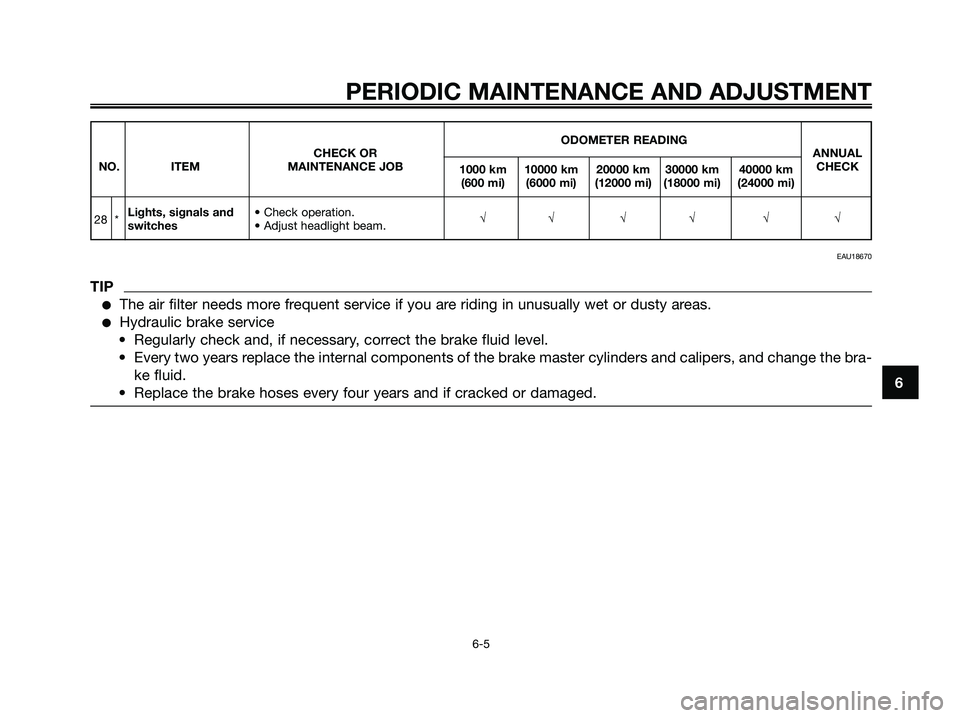
28 *Lights, signals and • Check operation.
switches• Adjust headlight beam.√√ √√ √ √
EAU18670
TIP
●The air filter needs more frequent service if you are riding in unusually wet or dusty areas.
●Hydraulic brake service
• Regularly check and, if necessary, correct the brake fluid level.
• Every two years replace the internal components of the brake master cylinders and calipers, and change the bra-
ke fluid.
• Replace the brake hoses every four years and if cracked or damaged.
1C0-F8199-E5.QXD 3/10/08 05:56 Página 47
Page 61 of 92
EAU22390
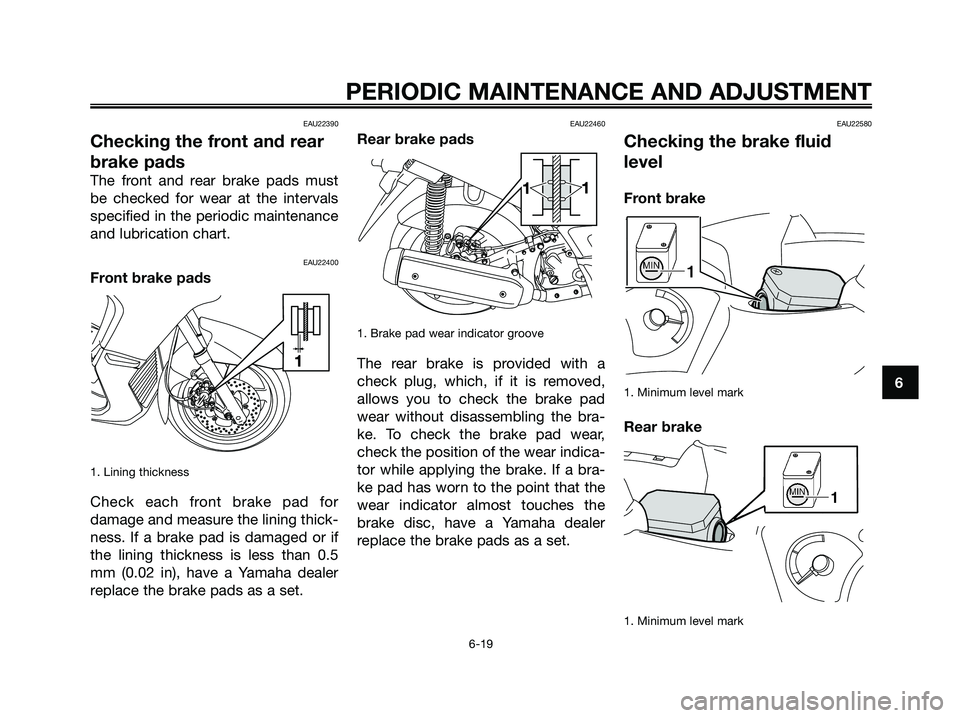
Checking the front and rear
brake pads
The front and rear brake pads must
be checked for wear at the intervals
specified in the periodic maintenance
and lubrication chart.
EAU22400
Front brake pads
1. Lining thickness
Check each front brake pad for
damage and measure the lining thick-
ness. If a brake pad is damaged or if
the lining thickness is less than 0.5
mm (0.02 in), have a Yamaha dealer
replace the brake pads as a set.
EAU22460
Rear brake pads
1. Brake pad wear indicator groove
The rear brake is provided with a
check plug, which, if it is removed,
allows you to check the brake pad
wear without disassembling the bra-
ke. To check the brake pad wear,
check the position of the wear indica-
tor while applying the brake. If a bra-
ke pad has worn to the point that the
wear indicator almost touches the
brake disc, have a Yamaha dealer
replace the brake pads as a set.
EAU22580
Checking the brake fluid
level
Front brake
1. Minimum level mark
Rear brake
1. Minimum level mark
PERIODIC MAINTENANCE AND ADJUSTMENT
6-19
6
1C0-F8199-E5.QXD 3/10/08 05:56 Página 61
Page 62 of 92
Insufficient brake fluid may allow air
to enter the brake system, possibly
causing it to become ineffective.
Before riding, check that the brake
fluid is above the minimum level mark
and replenish if necessary. A low bra-
ke fluid level may indicate worn brake
pads and/or brake system leakage. If
the brake fluid level is low, be sure to
check the brake pads for wear and
the brake system for leakage.
Observe these precautions:
●When checking the fluid level,
make sure that the top of the bra-
ke fluid reservoir is level.
●Use only the recommended qua-
lity brake fluid, otherwise the rub-
ber seals may deteriorate, cau-
sing leakage and poor braking
performance.
●Refill with the same type of brake
fluid. Mixing fluids may result in a
harmful chemical reaction and
lead to poor braking performan-
ce.
●Be careful that water does not
enter the brake fluid reservoir
when refilling. Water will signifi-
cantly lower the boiling point of
the fluid and may result in vapor
lock.
●Brake fluid may deteriorate pain-
ted surfaces or plastic parts.
Always clean up spilled fluid
immediately.
●As the brake pads wear, it is nor-
mal for the brake fluid level to
gradually go down. However, if
the brake fluid level goes down
suddenly, have a Yamaha dealer
check the cause.
EAU22721
Changing the brake fluid
Have a Yamaha dealer change the
brake fluid at the intervals specified in
the TIP after the periodic maintenan-
ce and lubrication chart. In addition,
have the oil seals of the brake master
cylinder and caliper as well as the
brake hose replaced at the intervals
listed below or whenever they are
damaged or leaking.
●Oil seals: Replace every two
years.
●Brake hose: Replace every four
years.
Recommended brake fluid:
DOT 4
PERIODIC MAINTENANCE AND ADJUSTMENT
6-20
6
1C0-F8199-E5.QXD 3/10/08 05:56 Página 62
Page 78 of 92
SCOOTER CARE AND STORAGE
7-2
7with water may be used. Be
sure to rinse off any detergent
residue using plenty of water,
as it is harmful to plastic parts.
●Do not use any harsh chemical
products on plastic parts. Be
sure to avoid using cloths or
sponges which have been in
contact with strong or abrasive
cleaning products, solvent or
thinner, fuel (gasoline), rust
removers or inhibitors, brake
fluid, antifreeze or electrolyte.
●Do not use high-pressure was-
hers or steam-jet cleaners sin-
ce they cause water seepage
and deterioration in the follo-
wing areas: seals (of wheel and
swingarm bearings, fork and
brakes), electric components
(couplers, connectors, instru-
ments, switches and lights),
breather hoses and vents.
●For scooters equipped with a
windshield: Do not use strong
cleaners or hard sponges as
they will cause dulling or scrat-
ching. Some cleaning com-
pounds for plastic may leavescratches on the windshield.
Test the product on a small hid-
den part of the windshield to
make sure that it does not lea-
ve any marks. If the windshield
is scratched, use a quality
plastic polishing compound
after washing.
After normal use
Remove dirt with warm water, a mild
detergent, and a soft, clean sponge,
and then rinse thoroughly with clean
water. Use a toothbrush or bottle-
brush for hard-to-reach areas. Stub-
born dirt and insects will come off
more easily if the area is covered with
a wet cloth for a few minutes before
cleaning.
After riding in the rain, near the sea or
on salt-sprayed roads
Since sea salt or salt sprayed on the
roads during winter are extremely
corrosive in combination with water,
carry out the following steps after
each ride in the rain, near the sea or
on salt-sprayed roads.
TIP
Salt sprayed on roads in the winter
may remain well into spring.
1. Clean the scooter with cold water
and a mild detergent after the
engine has cooled down. WAR-
NING! Do not use warm water
since it increases the corrosive
action of the salt.
[ECA10791]
2. Apply a corrosion protection
spray on all metal, including
chrome- and nickel-plated, surfa-
ces to prevent corrosion.
After cleaning
1. Dry the scooter with a chamois or
an absorbing cloth.
2. Use a chrome polish to shine
chrome, aluminum and stainless-
steel parts, including the exhaust
system. (Even the thermally indu-
ced discoloring of stainless-steel
exhaust systems can be removed
through polishing.)
3. To prevent corrosion, it is recom-
mended to apply a corrosion pro-
tection spray on all metal, inclu-
ding chrome- and nickel-plated,
surfaces.
1C0-F8199-E5.QXD 3/10/08 05:56 Página 78
Page 82 of 92
Chassis:Frame type:
Steel tube underbone
Caster angle:
28.00 º
Trail:
100.0 mm (3.94 in)
Front tire:Type:
Tubeless
Size:
120/70-15 M/C 56S(Michelin -
Continental)
120/70-15 M/C 56P(Pirelli)
Manufacturer/model:
MICHELIN/GOLD STANDARD
Manufacturer/model:
PIRELLI/GTS23
Manufacturer/model:
CONTINENTAL/CONTITWIST TL
Rear tire:Type:
Tubeless
Size:
140/70-14 M/C 68S(Michelin -
Continental)
140/70-14 M/C 68P(Pirelli)
Manufacturer/model:
MICHELIN/GOLD STANDARD
Manufacturer/model:
PIRELLI/GTS24
Manufacturer/model:
CONTINENTAL/CONTITWIST TL
Loading:Maximum load:
180 kg (397 lb)
Tire air pressure (measured on cold
tires):
Loading condition:
0–90 kg (0–198 lb)
Front:
190 kPa (1.90 kgf/cm
2, 28 psi, 1.90 bar)
Rear:
220 kPa (2.20 kgf/cm
2, 32 psi, 2.20 bar)
Loading condition:
90 kg - maximum load
Front:
210 kPa (2.10 kgf/cm
2, 30 psi, 2.10 bar)
Rear:
250 kPa (2.50 kgf/cm
2, 36 psi, 2.50 bar)
Front wheel:Wheel type:
Cast wheel
Rim size:
15 x MT3.5
Rear wheel:Wheel type:
Cast wheel
Rim size:
14 x MT3.75
Front brake:Type:
Single disc brake
Operation:
Right hand operation
Recommended fluid:
DOT 4
Rear brake:Type:
Single disc brake
Operation:
Left hand operation
Recommended fluid:
DOT 4
Front suspension:Type:
Telescopic fork
Spring/shock absorber type:
Coil spring/oil damper
Wheel travel:
94.0 mm (3.70 in)
Rear suspension:Type:
Unit swing
Spring/shock absorber type:
Coil spring/oil damper
Wheel travel:
83.0 mm (3.27 in)
Electrical system:Ignition system:
TCI (digital)
Charging system:
AC magneto
Battery:Model:
YTX9-BS
Voltage, capacity:
12 V, 8.0 Ah
Headlight:Bulb type:
Halogen bulb
SPECIFICATIONS
8-2
8
1C0-F8199-E5.QXD 3/10/08 05:56 Página 82
Page 86 of 92
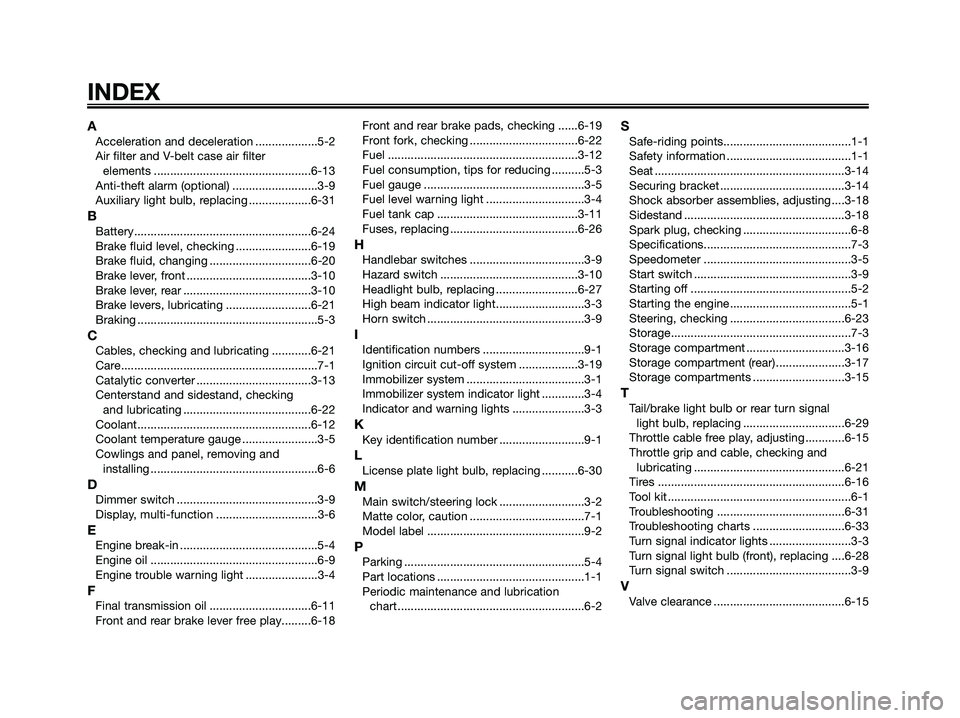
AAcceleration and deceleration ...................5-2
Air filter and V-belt case air filter
elements ................................................6-13
Anti-theft alarm (optional) ..........................3-9
Auxiliary light bulb, replacing ...................6-31
BBattery......................................................6-24
Brake fluid level, checking .......................6-19
Brake fluid, changing ...............................6-20
Brake lever, front ......................................3-10
Brake lever, rear .......................................3-10
Brake levers, lubricating ..........................6-21
Braking .......................................................5-3
CCables, checking and lubricating ............6-21
Care............................................................7-1
Catalytic converter ...................................3-13
Centerstand and sidestand, checking
and lubricating .......................................6-22
Coolant.....................................................6-12
Coolant temperature gauge .......................3-5
Cowlings and panel, removing and
installing ...................................................6-6
DDimmer switch ...........................................3-9
Display, multi-function ...............................3-6
EEngine break-in ..........................................5-4
Engine oil ...................................................6-9
Engine trouble warning light ......................3-4
FFinal transmission oil ...............................6-11
Front and rear brake lever free play.........6-18Front and rear brake pads, checking ......6-19
Front fork, checking .................................6-22
Fuel ..........................................................3-12
Fuel consumption, tips for reducing ..........5-3
Fuel gauge .................................................3-5
Fuel level warning light ..............................3-4
Fuel tank cap ...........................................3-11
Fuses, replacing .......................................6-26
HHandlebar switches ...................................3-9
Hazard switch ..........................................3-10
Headlight bulb, replacing .........................6-27
High beam indicator light...........................3-3
Horn switch ................................................3-9
I
Identification numbers ...............................9-1
Ignition circuit cut-off system ..................3-19
Immobilizer system ....................................3-1
Immobilizer system indicator light .............3-4
Indicator and warning lights ......................3-3
KKey identification number ..........................9-1
LLicense plate light bulb, replacing ...........6-30
MMain switch/steering lock ..........................3-2
Matte color, caution ...................................7-1
Model label ................................................9-2
PParking .......................................................5-4
Part locations .............................................1-1
Periodic maintenance and lubrication
chart .........................................................6-2
SSafe-riding points.......................................1-1
Safety information ......................................1-1
Seat ..........................................................3-14
Securing bracket ......................................3-14
Shock absorber assemblies, adjusting....3-18
Sidestand .................................................3-18
Spark plug, checking .................................6-8
Specifications.............................................7-3
Speedometer .............................................3-5
Start switch ................................................3-9
Starting off .................................................5-2
Starting the engine.....................................5-1
Steering, checking ...................................6-23
Storage.......................................................7-3
Storage compartment ..............................3-16
Storage compartment (rear) .....................3-17
Storage compartments ............................3-15
TTail/brake light bulb or rear turn signal
light bulb, replacing ...............................6-29
Throttle cable free play, adjusting ............6-15
Throttle grip and cable, checking and
lubricating ..............................................6-21
Tires .........................................................6-16
Tool kit ........................................................6-1
Troubleshooting .......................................6-31
Troubleshooting charts ............................6-33
Turn signal indicator lights .........................3-3
Turn signal light bulb (front), replacing ....6-28
Turn signal switch ......................................3-9
VValve clearance ........................................6-15
INDEX
1C0-F8199-E5.QXD 3/10/08 05:56 Página 86