brake YAMAHA XSR 900 2016 User Guide
[x] Cancel search | Manufacturer: YAMAHA, Model Year: 2016, Model line: XSR 900, Model: YAMAHA XSR 900 2016Pages: 106, PDF Size: 7.68 MB
Page 47 of 106

For your safety – pre-operation checks
4-2
1
2
345
6
7
8
9
10
11
12
Rear brake Check operation.
If soft or spongy, have Yamaha dealer bleed hydraulic system.
Check brake pads for wear.
Replace if necessary.
Check fluid level in reservoir.
If necessary, add specified brake fluid to specified level.
Check hydraulic system for leakage. 6-20, 6-21
Clutch Check operation.
Lubricate cable if necessary.
Check lever free play.
Adjust if necessary. 6-19
Throttle grip Make sure that operation is smooth.
Check throttle grip free play.
If necessary, have Yamaha dealer adjust th
rottle grip free play and lubricate cable
and grip housing. 6-15, 6-25
Control cables Make sure that operation is smooth.
Lubricate if necessary. 6-25
Drive chain Check chain slack.
Adjust if necessary.
Check chain condition.
Lubricate if necessary. 6-23, 6-24
Wheels and tires Check for damage.
Check tire condition and tread depth.
Check air pressure.
Correct if necessary. 6-16, 6-18
Brake and shift pedals Make sure that operation is smooth.
Lubricate pedal pivoting points if necessary. 6-26
Brake and clutch levers Make sure that operation is smooth.
Lubricate lever pivoting points if necessary. 6-26
Sidestand Make sure that operation is smooth.
Lubricate pivot if necessary. 6-27
Chassis fasteners Make sure that all nuts, bolts and screws are properly tightened.
Tighten if necessary. —
ITEM CHECKS PAGE
B90-9-E0_1.book 2 ページ 2015年12月15日 火曜日 午後8時5分
Page 51 of 106
Operation and important riding points
5-3
1
2
3
456
7
8
9
10
11
12
NOTICE
ECA10261
Even with the transmission in
the neutral position, do not
coast for long periods of time
with the engine off, and do not
tow the motorcycle for long dis-
tances. The transmission is
properly lubricated only when
the engine is running. Inade-
quate lubrication may damage
the transmission.
Always use the clutch while
changing gears to avoid damag-
ing the engine, transmission,
and drive train, which are not
designed to withstand theshock of forced shifting.
EAU16682
To start out and accelerate 1. Pull the clutch lever to disengage the clutch.
2. Shift the transmission into first gear. The neutral indicator light
should go out.
3. Open the throttle gradually, and at the same time, release the clutch
lever slowly. 4. At the recommended shift points
shown in the following table, close
the throttle, and at the same time,
quickly pull the clutch lever in.
5. Shift the transmission into second gear. (Make sure not to shift the
transmission into the neutral posi-
tion.)
6. Open the throttle part way and gradually release the clutch lever.
7. Follow the same procedure when shifting to the next higher gear.
TIPWhen shifting gears in normal operat-
ing conditions, use the recommendedshift points.
EAU58270
To decelerate1. Release the throttle and apply both the front and the rear brakes
smoothly to slow the motorcycle.
2. At the recommended shift points shown in the following table, shift
to a lower gear.
3. When the motorcycle reaches 25 km/h (16 mph), the engine is about
to stall or runs roughly, pull the clutch lever in, use the brakes to
slow the motorcycle, and continue
to downshift as necessary.
4. Once the motorcycle has stopped, the transmission can be shifted
into the neutral position. The neu-
tral indicator light should come on
and then the clutch lever can be
released.
WARNING
EWA17380
Improper braking can cause
loss of control or traction. Al-
ways use both brakes and apply
them smoothly.
Make sure that the motorcycle
and the engine have sufficiently
slowed before shifting to a low-
er gear. Engaging a lower gear
when the vehicle or engine
speed is too high could make
the rear wheel lose traction or
the engine to over-rev. This
could cause loss of control, an
accident and injury. It could also
cause engine or drive train dam-age.
B90-9-E0_1.book 3 ページ 2015年12月15日 火曜日 午後8時5分
Page 54 of 106
6-1
1
2
3
4
56
7
8
9
10
11
12
Periodic maintenance and adjustment
EAU17246
Periodic inspection, adjustment, and lu-
brication will keep your vehicle in the
safest and most efficient condition pos-
sible. Safety is an obligation of the vehi-
cle owner/operator. The most important
points of vehicle inspection, adjust-
ment, and lubrication are explained on
the following pages.
The intervals given in the periodic
maintenance charts should be simply
considered as a general guide under
normal riding conditions. However, de-
pending on the weather, terrain, geo-
graphical location, and individual use,
the maintenance intervals may need to
be shortened.
WARNING
EWA10322
Failure to properly maintain the ve-
hicle or performing maintenance ac-
tivities incorrectly may increase
your risk of injury or death during
service or while using the vehicle. If
you are not familiar with vehicle ser-
vice, have a Yamaha dealer performservice.
WARNING
EWA15123
Turn off the engine when performing
maintenance unless otherwise
specified.
A running engine has moving
parts that can catch on body
parts or clothing and electrical
parts that can cause shocks or
fires.
Running the engine while ser-
vicing can lead to eye injury,
burns, fire, or carbon monoxide
poisoning – possibly leading to
death. See page 1-2 for more in-
formation about carbon monox-ide.WARNING
EWA15461
Brake discs, calipers, drums, and
linings can become very hot during
use. To avoid possible burns, let
brake components cool beforetouching them.
EAU17303
Emission controls not only function to
ensure cleaner air, but are also vital to
proper engine operation and maximum
performance. In the following periodic
maintenance charts, the services relat-
ed to emissions control are grouped
separately. These services require
specialized data, knowledge, and
equipment. Maintenance, replacement,
or repair of the emission control devic-
es and systems may be performed by
any repair establishment or individual
that is certified (if applicable). Yamaha
dealers are trained and equipped to
perform these particular services.
B90-9-E0_1.book 1 ページ 2015年12月15日 火曜日 午後8時5分
Page 57 of 106

Periodic maintenance and adjustment
6-4
1
2
3
4
567
8
9
10
11
12
EAU1770M
General maintenance an d lubrication chartNO. ITEM CHECK OR MAINTENANCE JOB ODOMETER READING
ANNUAL
CHECK
1000 km
(600 mi) 10000 km
(6000 mi) 20000 km
(12000 mi) 30000 km
(18000 mi) 40000 km
(24000 mi)
1 *Air filter element Replace.
2Clutch Check operation.
Adjust.
3 *Front brake Check operation, fluid level and
vehicle for fluid leakage.
Replace brake pads. Whenever worn to the limit
4 *Rear brake Check operation, fluid level and
vehicle for fluid leakage.
Replace brake pads. Whenever worn to the limit
5 *Brake hoses Check for cracks or damage.
Check for correct routing and
clamping.
Replace. Every 4 years
6 *Brake fluid Change. Every 2 years
7 *Wheels Check runout and for damage.
8 *Tires Check tread depth and for
damage.
Replace if necessary.
Check air pressure.
Correct if necessary.
9 *Wheel bearings Check bearings fo
r looseness or
damage.
10 *Swingarm Check operation and for
excessive play.
Lubricate with lithium-soap-based grease. Every 50000 km (30000 mi)
B90-9-E0_1.book 4 ページ 2015年12月15日 火曜日 午後8時5分
Page 58 of 106

Periodic maintenance and adjustment
6-5
1
2
3
4
56
7
8
9
10
11
12
11 Drive chain Check chain slack, alignment and
condition.
Adjust and lubricate chain with a special O-ring chain lubricant
thoroughly. Every 800 km (500 mi) and after washing the motorcycle, riding in the rain or
riding in wet areas
12 *Steering bearings Check bearing play and steering
for roughness.
Lubricate with lithium-soap-based grease. Every 20000 km (12000 mi)
13 *Chassis fasteners Make sure that all nuts, bolts and
screws are properly tightened.
14 Brake lever pivot
shaft Lubricate with silicone grease.
15 Brake pedal pivot
shaft Lubricate with lithium-soap-based
grease.
16 Clutch lever pivot
shaft Lubricate with lithium-soap-based
grease.
17 Shift pedal pivot
shaft Lubricate with lithium-soap-based
grease.
18 Sidestand Check operation.
Lubricate with lithium-soap-based
grease.
19 *Sidestand switch Check operation.
20 *Front fork Check operation and for oil
leakage.
21 *Shock absorber
assembly Check operation and shock
absorber for oil leakage.
22 *Rear suspension
relay arm and
connecting arm
pivoting points Check operation.
NO. ITEM CHECK OR MAINTENANCE JOB
ODOMETER READING
ANNUAL
CHECK
1000 km
(600 mi) 10000 km
(6000 mi) 20000 km
(12000 mi) 30000 km
(18000 mi) 40000 km
(24000 mi)B90-9-E0_1.book 5 ページ 2015年12月15日 火曜日 午後8時5分
Page 59 of 106

Periodic maintenance and adjustment
6-6
1
2
3
4
567
8
9
10
11
12
23 Engine oil Change.
Check oil level and vehicle for oil
leakage.
24 Engine oil filter
cartridge Replace.
25 *Cooling system Check coolant level and vehicle
for coolant leakage.
Change coolant. Every 3 years
26 *Front and rear brake
switches Check operation.
27 Moving parts and
cables Lubricate.
28 *Throttle grip Check operation.
Check throttle grip free play, and
adjust if necessary.
Lubricate cable and grip housing.
29 *Lights, signals and
switches Check operation.
Adjust headlight beam.
NO. ITEM CHECK OR MAINTENANCE JOB
ODOMETER READING
ANNUAL
CHECK
1000 km
(600 mi) 10000 km
(6000 mi) 20000 km
(12000 mi) 30000 km
(18000 mi) 40000 km
(24000 mi)
B90-9-E0_1.book 6 ページ 2015年12月15日 火曜日 午後8時5分
Page 60 of 106
Periodic maintenance and adjustment
6-7
1
2
3
4
56
7
8
9
10
11
12
EAU18681
TIP
Air filter
This model’s air filter is equipped wi th a disposable oil-coated paper elemen t, which must not be cleaned with com-
pressed air to avoid damaging it.
The air filter element needs to be replaced more fr equently when riding in unusually wet or dusty areas.
Hydraulic brake service
Regularly check and, if necessary, correct the brake fluid level.
Every two years replace the internal components of t he brake master cylinders and calipers, and change the brake
fluid. Replace the brake hoses every four years and if cracked or damaged.
B90-9-E0_1.book 7 ページ 2015年12月15日 火曜日 午後8時5分
Page 70 of 106
Periodic maintenance and adjustment
6-17
1
2
3
4
56
7
8
9
10
11
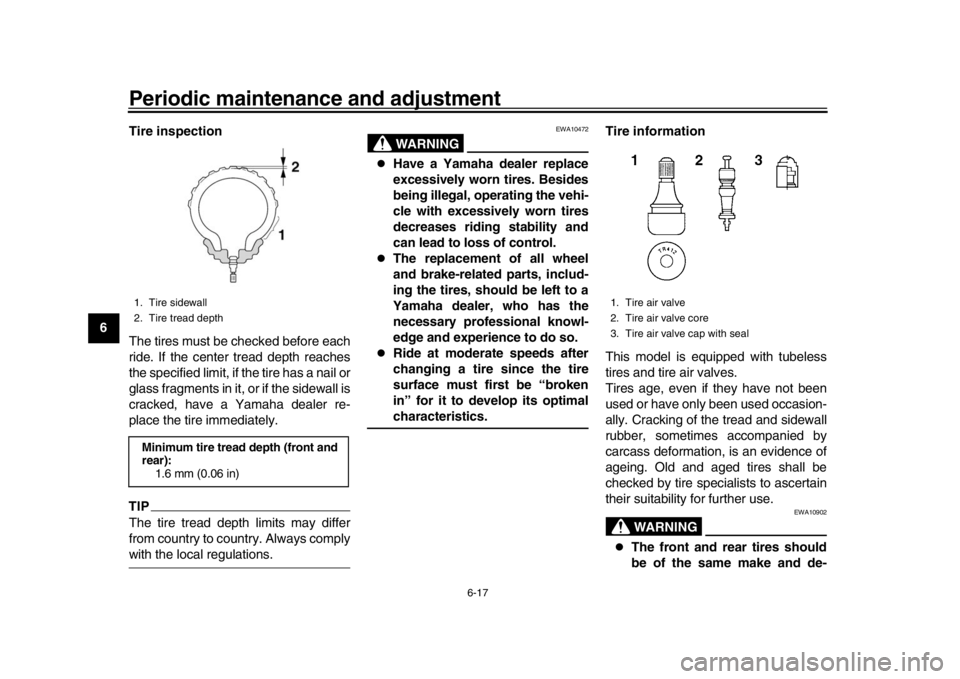
12 Tire inspection
The tires must be checked before each
ride. If the center tread depth reaches
the specified limit, if the tire has a nail or
glass fragments in it, or if the sidewall is
cracked, have a Yamaha dealer re-
place the tire immediately.
TIPThe tire tread depth limits may differ
from country to country. Always complywith the local regulations.
WARNING
EWA10472
Have a Yamaha dealer replace
excessively worn tires. Besides
being illegal, operating the vehi-
cle with excessively worn tires
decreases riding stability and
can lead to loss of control.
The replacement of all wheel
and brake-related parts, includ-
ing the tires, should be left to a
Yamaha dealer, who has the
necessary professional knowl-
edge and experience to do so.
Ride at moderate speeds after
changing a tire since the tire
surface must first be “broken
in” for it to develop its optimalcharacteristics.
Tire information
This model is equipped with tubeless
tires and tire air valves.
Tires age, even if they have not been
used or have only been used occasion-
ally. Cracking of the tread and sidewall
rubber, sometimes accompanied by
carcass deformation, is an evidence of
ageing. Old and aged tires shall be
checked by tire specialists to ascertain
their suitability for further use.
WARNING
EWA10902
The front and rear tires should
be of the same make and de-
1. Tire sidewall
2. Tire tread depthMinimum tire tread depth (front and
rear):
1.6 mm (0.06 in)
1. Tire air valve
2. Tire air valve core
3. Tire air valve cap with seal
B90-9-E0_1.book 17 ページ 2015年12月15日 火曜日 午後8時5分
Page 72 of 106
Periodic maintenance and adjustment
6-19
1
2
3
4
56
7
8
9
10
11
12
EAU22083
Adjusting the cl utch lever free
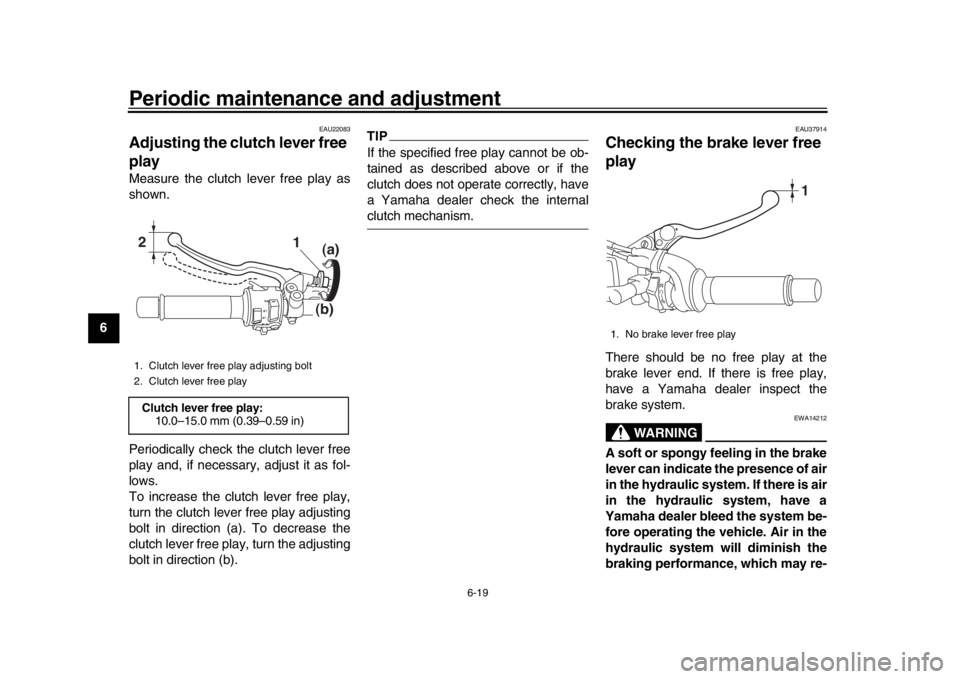
playMeasure the clutch lever free play as
shown.
Periodically check the clutch lever free
play and, if necessary, adjust it as fol-
lows.
To increase the clutch lever free play,
turn the clutch lever free play adjusting
bolt in direction (a). To decrease the
clutch lever free play, turn the adjusting
bolt in direction (b).
TIPIf the specified free play cannot be ob-
tained as described above or if the
clutch does not operate correctly, have
a Yamaha dealer check the internalclutch mechanism.
EAU37914
Checking the brake lever free
playThere should be no free play at the
brake lever end. If there is free play,
have a Yamaha dealer inspect the
brake system.
WARNING
EWA14212
A soft or spongy feeling in the brake
lever can indicate the presence of air
in the hydraulic system. If there is air
in the hydraulic system, have a
Yamaha dealer bleed the system be-
fore operating the vehicle. Air in the
hydraulic system will diminish the
braking performance, which may re-
1. Clutch lever free play adjusting bolt
2. Clutch lever free playClutch lever free play: 10.0–15.0 mm (0.39–0.59 in)2
1
(b)(a)
1. No brake lever free play
1
B90-9-E0_1.book 19 ページ 2015年12月15日 火曜日 午後8時5分
Page 73 of 106
Periodic maintenance and adjustment6-20
1
2
3
4
567
8
9
10
11
12
sult in loss of control and an acci-
dent.
EAU36504
Brake light switchesThe brake light, which is activated by
the brake pedal and brake lever, should
come on just before braking takes ef-
fect. If necessary, have a Yamaha deal-
er adjust the brake light switches.
EAU22393
Checking the front and rear
brake padsThe front and rear brake pads must be
checked for wear at the intervals spec-
ified in the periodic maintenance and
lubrication chart.
EAU36891
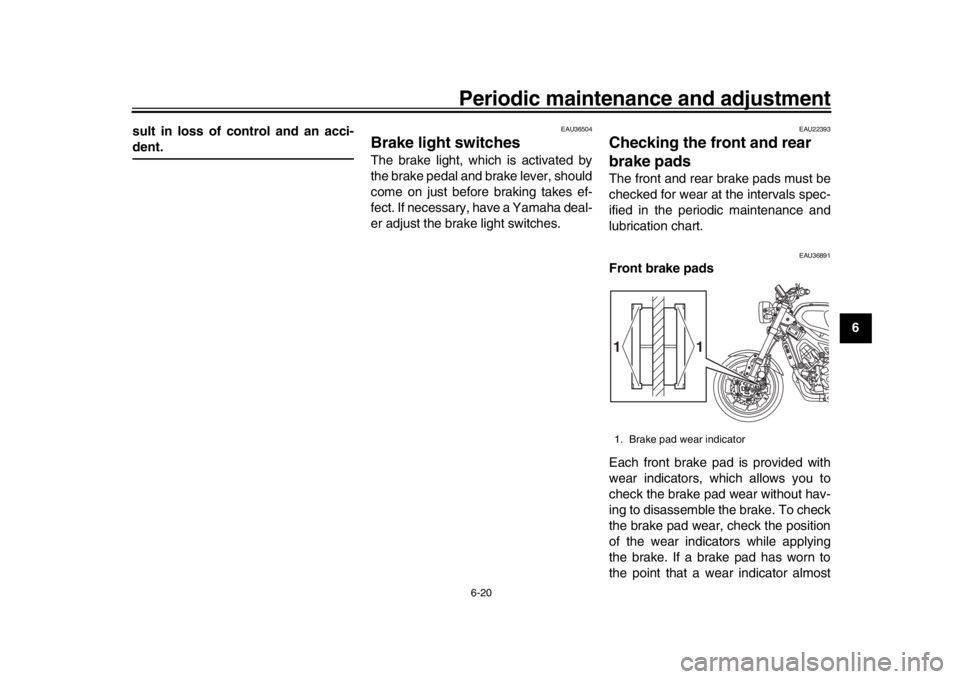
Front brake pads
Each front brake pad is provided with
wear indicators, which allows you to
check the brake pad wear without hav-
ing to disassemble the brake. To check
the brake pad wear, check the position
of the wear indicators while applying
the brake. If a brake pad has worn to
the point that a wear indicator almost1. Brake pad wear indicator
1
1
B90-9-E0_1.book 20 ページ 2015年12月15日 火曜日 午後8時5分