ESP YAMAHA XSR 900 2019 Owners Manual
[x] Cancel search | Manufacturer: YAMAHA, Model Year: 2019, Model line: XSR 900, Model: YAMAHA XSR 900 2019Pages: 102, PDF Size: 7.77 MB
Page 8 of 102

1-1
1
2
3
4
5
6
7
8
9
10
11
12
Safety information
EAU1028C
Be a Responsible Owner
As the vehicle’s owner, you are respon-
sible for the safe and proper operation
of your motorcycle.
Motorcycles are single-track vehicles.
Their safe use and operation are de-
pendent upon the use of proper riding
techniques as well as the expertise of
the operator. Every operator should
know the following requirements before
riding this motorcycle.
He or she should:
Obtain thorough instructions from
a competent source on all aspects
of motorcycle operation.
Observe the warnings and mainte-
nance requirements in this Own-
er’s Manual.
Obtain qualified training in safe
and proper riding techniques.
Obtain professional technical ser-
vice as indicated in this Owner’s
Manual and/or when made neces-
sary by mechanical conditions.
Never operate a motorcycle with-
out proper training or instruction. Take a training course. Beginners
should receive training from a cer-
tified instructor. Contact an autho-
rized motorcycle dealer to find out
about the training courses nearest
you.
Safe Riding
Perform the pre-operation checks each
time you use the vehicle to make sure it
is in safe operating condition. Failure to
inspect or maintain the vehicle properly
increases the possibility of an accident
or equipment damage. See page 4-1
for a list of pre-operation checks.
This motorcycle is designed to car-
ry the operator and a passenger.
The failure of motorists to detect
and recognize motorcycles in traf-
fic is the predominating cause of
automobile/motorcycle accidents.
Many accidents have been caused
by an automobile driver who did
not see the motorcycle. Making
yourself conspicuous appears to
be very effective in reducing the
chance of this type of accident.
Therefore:
Wear a brightly colored jacket. Use extra caution when you are
approaching and passing
through intersections, since in-
tersections are the most likely
places for motorcycle accidents
to occur.
Ride where other motorists can see you. Avoid riding in another
motorist’s blind spot.
Never maintain a motorcycle without proper knowledge. Con-
tact an authorized motorcycle
dealer to inform you on basic
motorcycle maintenance. Cer-
tain maintenance can only be
carried out by certified staff.
Many accidents involve inexperi-
enced operators. In fact, many op-
erators who have been involved in
accidents do not even have a cur-
rent motorcycle license.
Make sure that you are qualifiedand that you only lend your mo-
torcycle to other qualified opera-
tors.
Know your skills and limits. Staying within your limits may
help you to avoid an accident.
We recommend that you prac-
BAE-9-E0.book 1 ページ 2018年8月22日 水曜日 午後2時17分
Page 11 of 102
Safety information
1-4
12
3
4
5
6
7
8
9
10
11
12
dorse nor recommend the use of ac-
cessories not sold by Yamaha or
modifications not specifically recom-
mended by Yamaha, even if sold and
installed by a Yamaha dealer.
Aftermarket Parts, Accessories,
and Modifications
While you may find aftermarket prod-
ucts similar in design and quality to
genuine Yamaha accessories, recog-
nize that some aftermarket accessories
or modifications are not suitable be-
cause of potential safety hazards to you
or others. Installing aftermarket prod-
ucts or having other modifications per-
formed to your vehicle that change any
of the vehicle’s design or operation
characteristics can put you and others
at greater risk of serious injury or death.
You are responsible for injuries related
to changes in the vehicle.
Keep the following guidelines in mind,
as well as those provided under “Load-
ing” when mounting accessories.
Never install accessories or carry
cargo that would impair the perfor-
mance of your motorcycle. Care-
fully inspect the accessory before using it to make sure that it does
not in any way reduce ground
clearance or cornering clearance,
limit suspension travel, steering
travel or control operation, or ob-
scure lights or reflectors.
Accessories fitted to the handle-
bar or the front fork area can
create instability due to improper
weight distribution or aerody-
namic changes. If accessories
are added to the handlebar or
front fork area, they must be as
lightweight as possible and
should be kept to a minimum.
Bulky or large accessories may seriously affect the stability of
the motorcycle due to aerody-
namic effects. Wind may at-
tempt to lift the motorcycle, or
the motorcycle may become un-
stable in cross winds. These ac-
cessories may also cause
instability when passing or being
passed by large vehicles.
Certain accessories can dis- place the operator from his or
her normal riding position. This
improper position limits the free- dom of movement of the opera-
tor and may limit control ability,
therefore, such accessories are
not recommended.
Use caution when adding electri-
cal accessories. If electrical acces-
sories exceed the capacity of the
motorcycle’s electrical system, an
electric failure could result, which
could cause a dangerous loss of
lights or engine power.
Aftermarket Tires and Rims
The tires and rims that came with your
motorcycle were designed to match the
performance capabilities and to provide
the best combination of handling, brak-
ing, and comfort. Other tires, rims, siz-
es, and combinations may not be
appropriate. See page 6-16 for tire
specifications and for information on
servicing and replacing your tires.
Transporting the Motorcycle
Be sure to observe following instruc-
tions before transporting the motorcy-
cle in another vehicle.
Remove all loose items from the
motorcycle.
BAE-9-E0.book 4 ページ 2018年8月22日 水曜日 午後2時17分
Page 18 of 102
Instrument and control functions
3-3
1
23
4
5
6
7
8
9
10
11
12 To unlock the steering
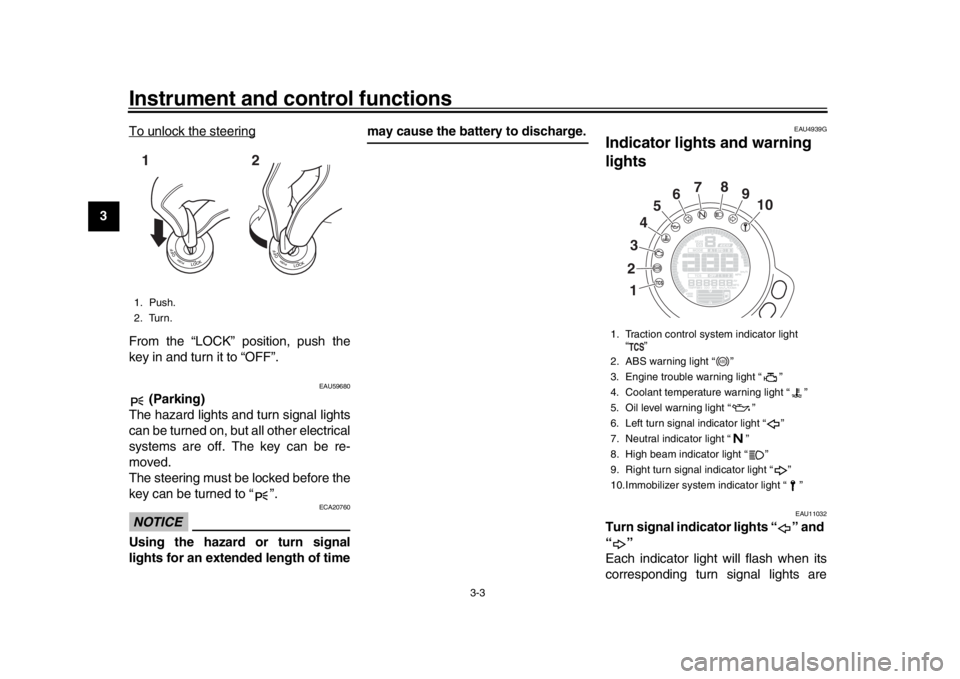
From the “LOCK” position, push the
key in and turn it to “OFF”.
EAU59680
(Parking)
The hazard lights and turn signal lights
can be turned on, but all other electrical
systems are off. The key can be re-
moved.
The steering must be locked before the
key can be turned to “ ”.NOTICE
ECA20760
Using the hazard or turn signal
lights for an extended length of time
may cause the battery to discharge.
EAU4939G
Indicator lights and warning
lights
EAU11032
Turn signal indicator lights “ ” and
“”
Each indicator light will flash when its
corresponding turn signal lights are
1. Push.
2. Turn.12
1. Traction control system indicator light “”
2. ABS warning light “ ”
3. Engine trouble warning light “ ”
4. Coolant temperature warning light “ ”
5. Oil level warning light “ ”
6. Left turn signal indicator light “ ”
7. Neutral indicator light “ ”
8. High beam indicator light “ ”
9. Right turn signal indicator light “ ”
10.Immobilizer system indicator light “ ”
2
13
4
5
6
7
8
9
10
ABS
BAE-9-E0.book 3 ページ 2018年8月22日 水曜日 午後2時17分
Page 22 of 102
Instrument and control functions
3-7
1
23
4
5
6
7
8
9
10
11
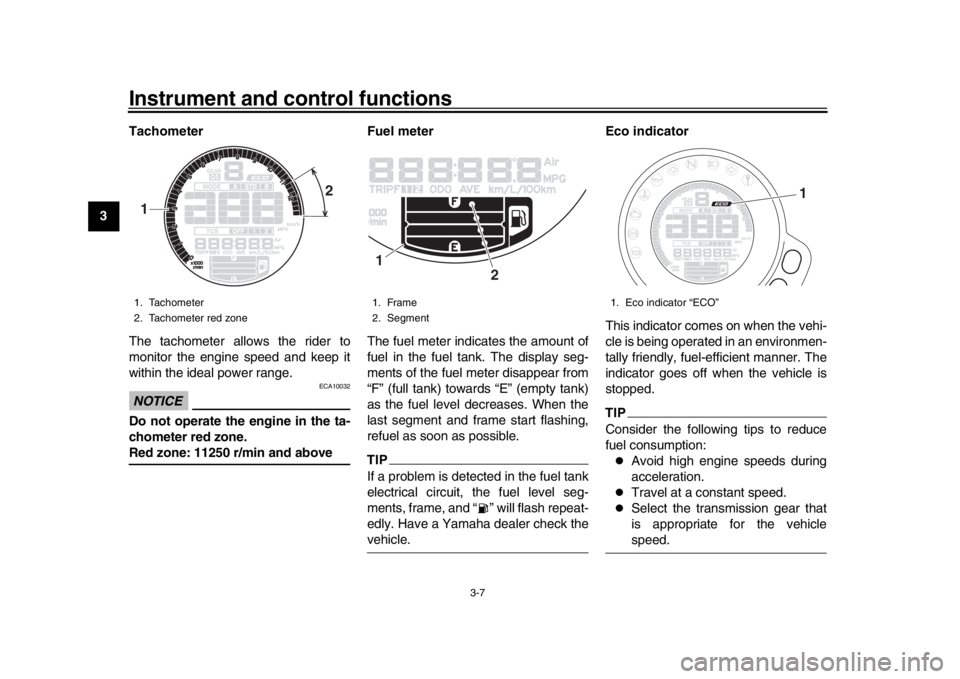
12 Tachometer
The tachometer allows the rider to
monitor the engine speed and keep it
within the ideal power range.
NOTICE
ECA10032
Do not operate the engine in the ta-
chometer red zone.Red zone: 11250 r/min and above
Fuel meter
The fuel meter indicates the amount of
fuel in the fuel tank. The display seg-
ments of the fuel meter disappear from
“F” (full tank) towards “E” (empty tank)
as the fuel level decreases. When the
last segment and frame start flashing,
refuel as soon as possible.
TIPIf a problem is detected in the fuel tank
electrical circuit, the fuel level seg-
ments, frame, and “ ” will flash repeat-
edly. Have a Yamaha dealer check thevehicle.Eco indicator
This indicator comes on when the vehi-
cle is being operated in an environmen-
tally friendly, fuel-efficient manner. The
indicator goes off when the vehicle is
stopped.
TIPConsider the following tips to reduce
fuel consumption:
Avoid high engine speeds during
acceleration.
Travel at a constant speed.
Select the transmission gear that
is appropriate for the vehiclespeed.
1. Tachometer
2. Tachometer red zone1
2
1. Frame
2. Segment1
2
1. Eco indicator “ECO”
1
BAE-9-E0.book 7 ページ 2018年8月22日 水曜日 午後2時17分
Page 27 of 102
Instrument and control functions
3-12
1
234
5
6
7
8
9
10
11
12
To adjust the brightness
1. Turn the main switch off.
2. Push and hold the bottom set but-
ton.
3. Turn the main switch on and con- tinue pushing the bottom set but-
ton until the display switches to the
brightness level display.
4. Push the top set button to set the brightness level.
5. Push the bottom set button to con- firm the selected brightness level
and exit the brightness level dis-
play.
EAU47636
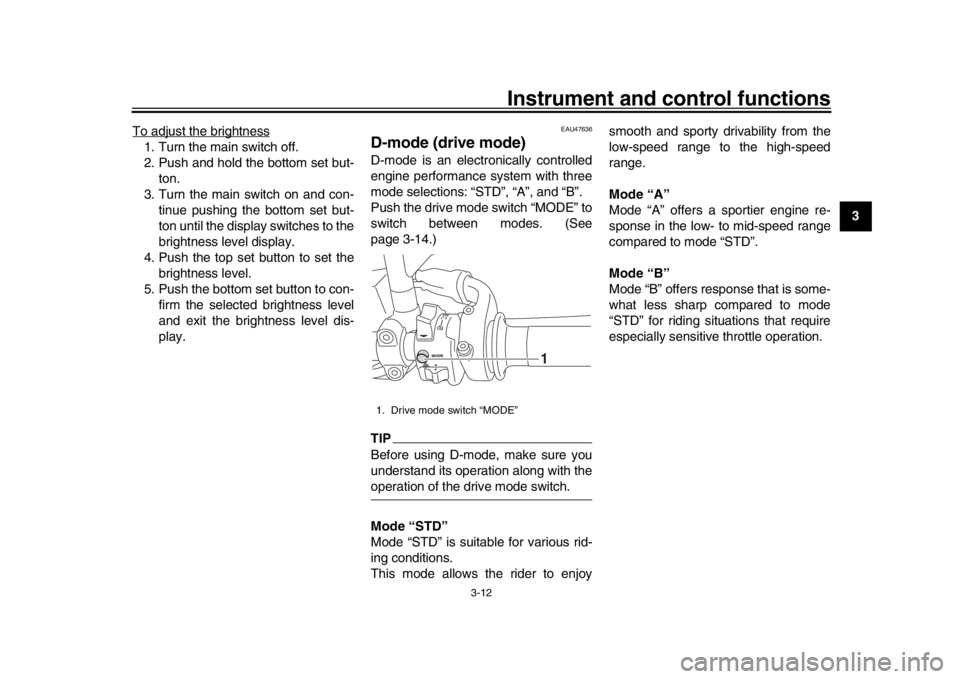
D-mode (drive mode)D-mode is an electronically controlled
engine performance system with three
mode selections: “STD”, “A”, and “B”.
Push the drive mode switch “MODE” to
switch between modes. (See
page 3-14.)TIPBefore using D-mode, make sure you
understand its operation along with theoperation of the drive mode switch.
Mode “STD”
Mode “STD” is suitable for various rid-
ing conditions.
This mode allows the rider to enjoy smooth and sporty drivability from the
low-speed range to the high-speed
range.
Mode “A”
Mode “A” offers a sportier engine re-
sponse in the low- to mid-speed range
compared to mode “STD”.
Mode “B”
Mode “B” offers response that is some-
what less sharp compared to mode
“STD” for riding sit
uations that require
especially sensitive throttle operation.1. Drive mode switch “MODE”
1
BAE-9-E0.book 12 ページ 2018年8月22日 水曜日 午後2時17分
Page 32 of 102
Instrument and control functions
3-17
1
23
4
5
6
7
8
9
10
11
12
EAU74351
Traction control systemThe traction control system (TCS)
helps maintain traction when accelerat-
ing on slippery surfaces, such as un-
paved or wet roads. If sensors detect
that the rear wheel is starting to slip (un-
controlled spinning), the traction control
system assists by regulating engine
power as needed until traction is re-
stored.
WARNING
EWA15433
The traction control system is not a
substitute for riding appropriately
for the conditions. Traction control
cannot prevent loss of traction due
to excessive speed when entering
turns, when accelerating hard at a
sharp lean angle, or while braking,
and cannot prevent front wheel slip-
ping. As with any vehicle, approach
surfaces that may be slippery with
caution and avoid especially slip-pery surfaces.
The “ ” indicator light flashes when
traction control has engaged. You may
notice slight changes in engine and ex- haust sounds when the system has en-
gaged.
In certain conditions, the traction con-
trol system may be automatically dis-
abled. Should this happen, the “ ”
indicator light and the “ ” warning
light will come on.
The TCS display (page 3-8) indicates
the current TCS setting. There are
three settings.
TCS “OFF”
TCS “OFF” turns the traction control
system off.
TCS “1”
TCS “1” minimizes traction control sys-
tem assist.
TCS “2”
TCS “2” maximizes traction control as-
sist; wheel spin is most strongly con-
trolled.
TIP
Use the traction control switch
(page 3-13) to change TCS set-
tings.
Traction control can be turned on
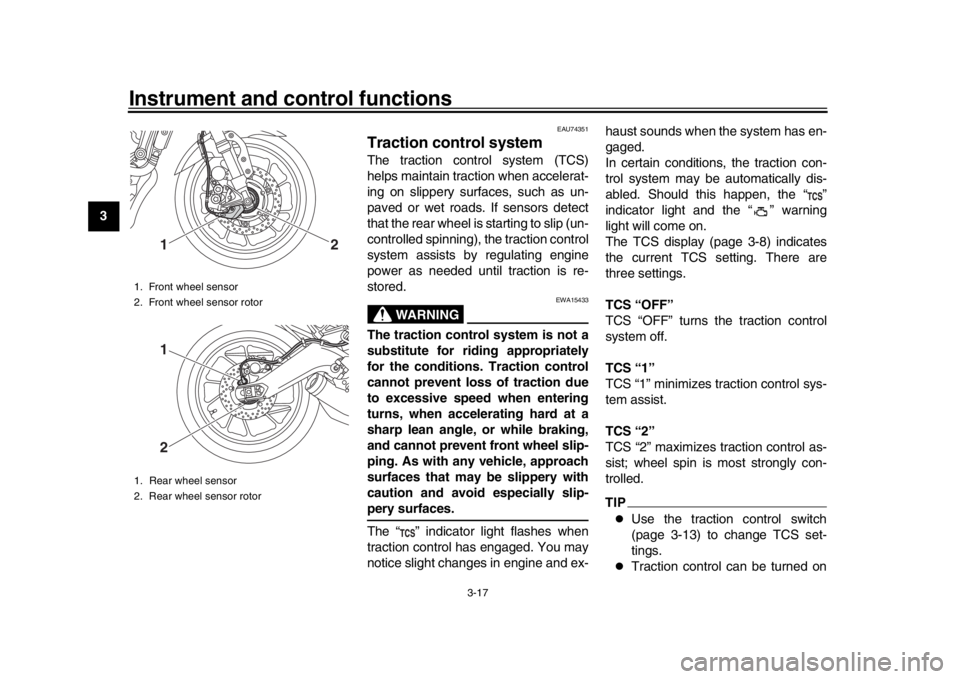
1. Front wheel sensor
2. Front wheel sensor rotor
1. Rear wheel sensor
2. Rear wheel sensor rotor
1
2
12
BAE-9-E0.book 17 ページ 2018年8月22日 水曜日 午後2時17分
Page 42 of 102
Instrument and control functions
3-27
1
23
4
5
6
7
8
9
10
11
12
EAU15306
SidestandThe sidestand is located on the left side
of the frame. Raise the sidestand or
lower it with your foot while holding the
vehicle upright.TIPThe built-in sidestand switch is part of
the ignition circuit cut-off system, which
cuts the ignition in certain situations.
(See the following section for an expla-
nation of the ignition circuit cut-off sys-tem.)
WARNING
EWA10242
The vehicle must not be ridden with
the sidestand down, or if the sides-
tand cannot be properly moved up
(or does not stay up), otherwise the
sidestand could contact the ground
and distract the operator, resulting
in a possible loss of control.
Yamaha’s ignition circuit cut-off
system has been designed to assist
the operator in fulfilling the respon-
sibility of raising the sidestand be-
fore starting off. Therefore, check
this system regularly and have a Yamaha dealer repair it if it does not
function properly.
EAU44895
Ignition circuit
cut-off systemThis system prevents in-gear engine
starts unless the clutch lever is pulled
and the sidestand is up. Also, it will stop
the running engine should the sides-
tand be lowered while the transmission
is in gear.
Periodically check the system via the
following procedure.TIP
This check is most reliable if per-
formed with a warmed-up engine.
See pages 3-2 and 3-13 for switchoperation information.
BAE-9-E0.book 27 ページ 2018年8月22日 水曜日 午後2時17分
Page 48 of 102
Operation and important riding points
5-2
1
2
3
45
6
7
8
9
10
11
12 a warning or indicator light remains
on, see page 3-3 for the correspond-
ing warning and indicator light cir-
cuit check.
The ABS warning light should
come on when the key is turned to
“ON”, and then go off after travel-
ing at a speed of 10 km/h (6 mi/h)
or higher.NOTICE
ECA17682
If the ABS warning light does not
come on and then go off as ex-
plained above, see page 3-3 for thewarning light circuit check.2. Shift the transmission into the neu- tral position. The neutral indicator
light should come on. If not, ask a
Yamaha dealer to check the elec-
trical circuit.
3. Start the engine by sliding the switch toward “ ”.
If the engine fails to start, release
the start/engine stop switch, wait a
few seconds, and then try again.
Each starting attempt should be as
short as possible to preserve the
battery. Do not crank the engine more than 10 seconds on any one
attempt.
NOTICE
ECA11043
For maximum engine life, never ac-
celerate hard when the engine iscold!
EAU16674
ShiftingShifting gears lets you control the
amount of engine power available for
starting off, accelerating, climbing hills,
etc.
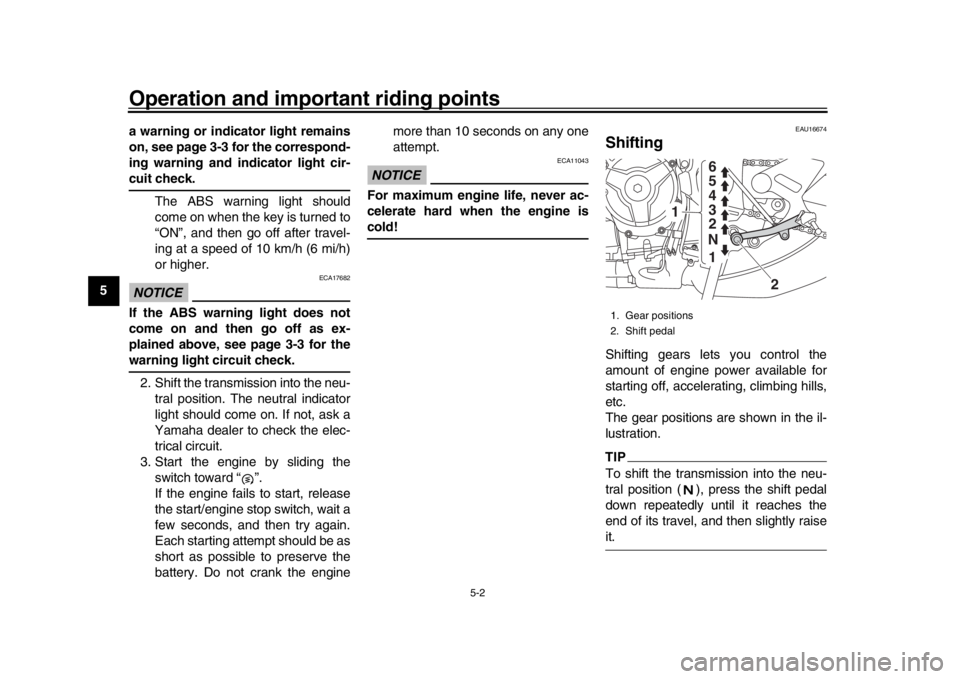
The gear positions are shown in the il-
lustration.TIPTo shift the transmission into the neu-
tral position ( ), press the shift pedal
down repeatedly until it reaches the
end of its travel, and then slightly raiseit.1. Gear positions
2. Shift pedal
1 2 3 4
5 6
N
1
2
BAE-9-E0.book 2 ページ 2018年8月22日 水曜日 午後2時17分
Page 74 of 102
Periodic maintenance and adjustment
6-24
1
2
3
4
56
7
8
9
10
11
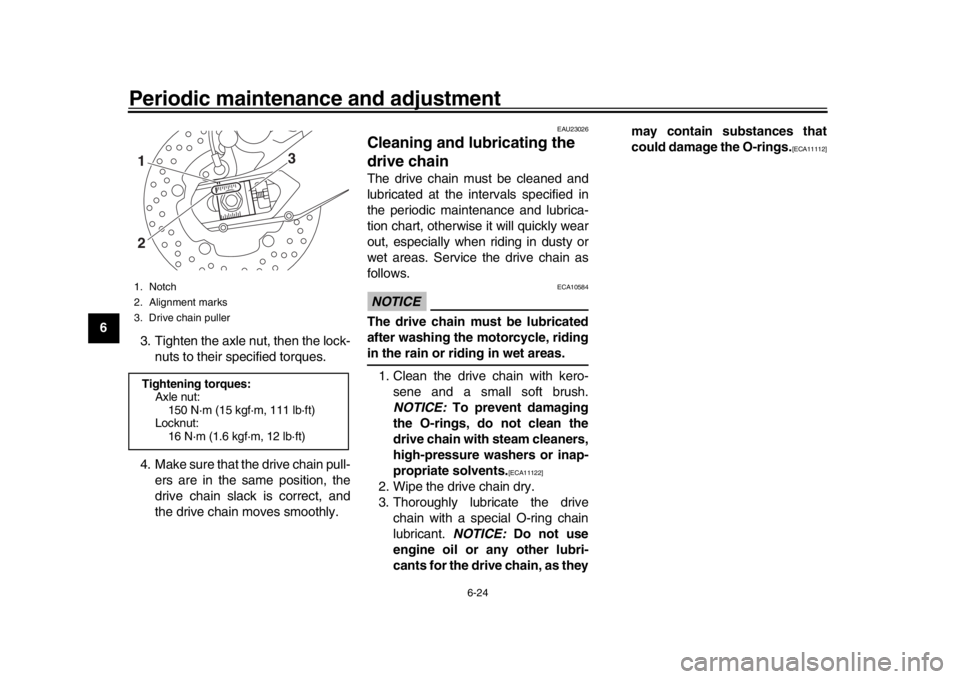
12 3. Tighten the axle nut, then the lock-
nuts to their specified torques.
4. Make sure that the drive chain pull- ers are in the same position, the
drive chain slack is correct, and
the drive chain moves smoothly.
EAU23026
Cleaning and lubricating the
drive chainThe drive chain must be cleaned and
lubricated at the intervals specified in
the periodic maintenance and lubrica-
tion chart, otherwise it will quickly wear
out, especially when riding in dusty or
wet areas. Service the drive chain as
follows.NOTICE
ECA10584
The drive chain must be lubricated
after washing the motorcycle, ridingin the rain or riding in wet areas.
1. Clean the drive chain with kero- sene and a small soft brush.
NOTICE: To prevent damaging
the O-rings, do not clean the
drive chain with steam cleaners,
high-pressure washers or inap-
propriate solvents.
[ECA11122]
2. Wipe the drive chain dry.
3. Thoroughly lubricate the drive chain with a special O-ring chain
lubricant. NOTICE: Do not use
engine oil or any other lubri-
cants for the drive chain, as they may contain substances that
could damage the O-rings.
[ECA11112]
1. Notch
2. Alignment marks
3. Drive chain pullerTightening torques:
Axle nut:150 N·m (15 kgf·m, 111 lb·ft)
Locknut:
16 N·m (1.6 kgf·m, 12 lb·ft)
3
12
BAE-9-E0.book 24 ページ 2018年8月22日 水曜日 午後2時17分
Page 90 of 102
7-1
1
2
3
4
5
67
8
9
10
11
12
Motorcycle care and storage
EAU37834
Matte color cautionNOTICE
ECA15193
Some models are equipped with
matte colored finished parts. Be
sure to consult a Yamaha dealer for
advice on what products to use be-
fore cleaning the vehicle. Using a
brush, harsh chemical products or
cleaning compounds when cleaning
these parts will scratch or damage
their surface. Wax also should not
be applied to any matte colored fin-ished parts.
EAU83443
CareFrequent, thorough cleaning of the ve-
hicle will not only enhance its appear-
ance but also will improve its general
performance and extend the useful life
of many components. Washing, clean-
ing, and polishing will also give you a
chance to inspect the condition of the
vehicle more frequently. Be sure to
wash the vehicle after riding in the rain
or near the sea, because salt is corro-
sive to metals.TIP
The roads of heavy snowfall areas
may be sprayed with salt as a
de-icing method. This salt can stay
on the roads well into spring, so be
sure to wash the underside and
chassis parts after riding in such
areas.
Genuine Yamaha care and main-
tenance products are sold under
the YAMALUBE brand in many
markets worldwide.
See your Yamaha dealer for addi-tional cleaning tips.
NOTICE
ECA26280
Improper cleaning can cause cos-
metic and mechanical damage. Do
not use:
high-pressure washers or
steam-jet cleaners. Excessive
water pressure may cause water
seepage and deterioration of
wheel bearings, brakes, trans-
mission seals and electrical de-
vices. Avoid high-pressure
detergent applications such as
those available in coin-operated
car washers.
harsh chemicals, including
strong acidic wheel cleaners,
especially on spoke or magne-
sium wheels.
harsh chemicals, abrasive
cleaning compounds, or wax on
matte-finished parts. Brushes
can scratch and damage the
matte-finish, use soft sponge or
towel only.
towels, sponges, or brushes
contaminated with abrasive
cleaning products or strong
chemicals such as, solvents,
BAE-9-E0.book 1 ページ 2018年8月22日 水曜日 午後2時17分