fuel YAMAHA XSR 900 2020 User Guide
[x] Cancel search | Manufacturer: YAMAHA, Model Year: 2020, Model line: XSR 900, Model: YAMAHA XSR 900 2020Pages: 102, PDF Size: 7.74 MB
Page 34 of 102
Instrument and control functions
3-19
1
23
4
5
6
7
8
9
10
11
12 3. Wipe up any spilled fuel immedi-
ately. NOTICE: Immediately wipe
off spilled fuel with a clean, dry,
soft cloth, since fuel may deteri-
orate painted surfaces or plastic
parts.
[ECA10072]
4. Be sure to securely close the fuel tank cap.
WARNING
EWA15152
Gasoline is poisonous and can
cause injury or death. Handle gaso-
line with care. Never siphon gaso-
line by mouth. If you should swallow
some gasoline or inhale a lot of gas-
oline vapor, or get some gasoline in your eyes, see your doctor immedi-
ately. If gasoline spills on your skin,
wash with soap and water. If gaso-
line spills on your clothing, change
your clothes.
EAU86072
Your Yamaha engine was designed to
use unleaded gasoline with a research
octane number of 95 or higher. If en-
gine knocking or pinging occurs, use a
gasoline of a different brand or higher
octane rating.
TIP
This mark identifies the recom-
mended fuel for this vehicle as
specified by European regulation
(EN228).
Confirm the gasoline pump nozzle
has the same fuel identificationmark.
Gasohol
There are two types of gasohol: gaso-
hol containing ethanol and that contain-
ing methanol. Gasohol containing
ethanol can be used if the ethanol con-
tent does not exceed 10% (E10). Gas-
ohol containing methanol is not
recommended by Yamaha because it
can cause damage to the fuel system
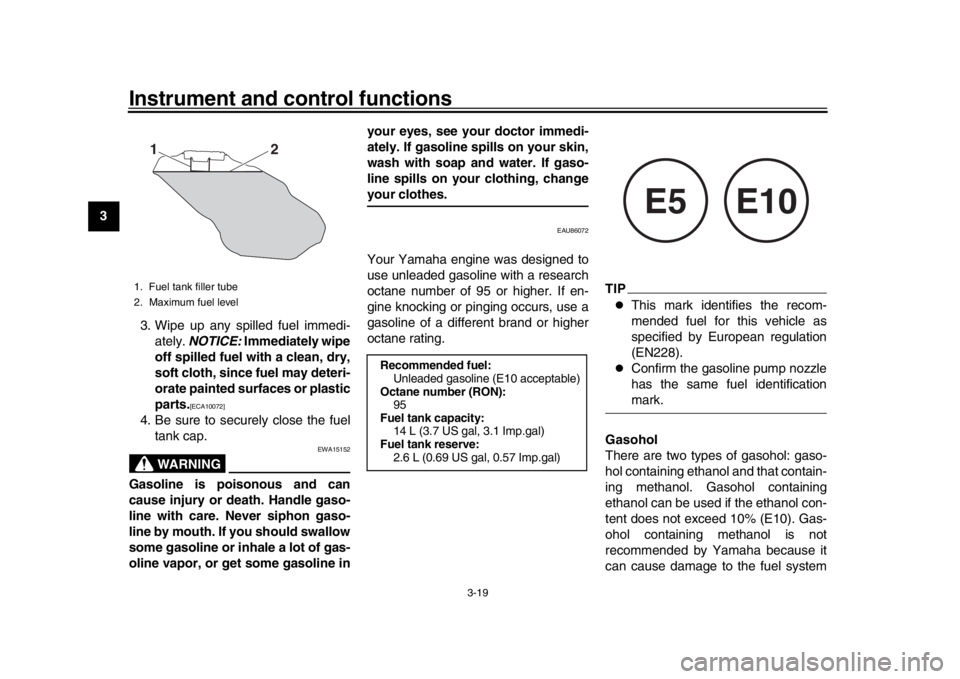
1. Fuel tank filler tube
2. Maximum fuel level
2
1
Recommended fuel: Unleaded gasoline (E10 acceptable)
Octane number (RON):
95
Fuel tank capacity: 14 L (3.7 US gal, 3.1 Imp.gal)
Fuel tank reserve: 2.6 L (0.69 US gal, 0.57 Imp.gal)
E5
E10
BAE-28199-E1.book 19 ページ 2019年8月23日 金曜日 午後3時56分
Page 35 of 102
Instrument and control functions
3-20
1
234
5
6
7
8
9
10
11
12
or vehicle performance problems.
NOTICE
ECA11401
Use only unleaded gasoline. The use
of leaded gasoline will cause severe
damage to internal engine parts,
such as the valves and piston rings,as well as to the exhaust system.
EAU80200
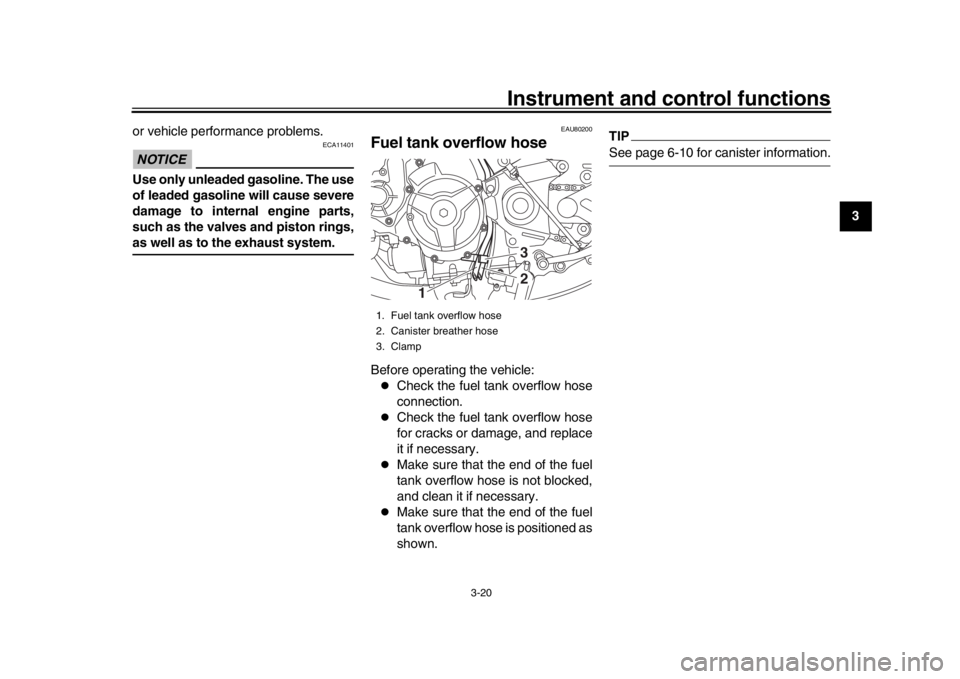
Fuel tank overflow hoseBefore operating the vehicle:
Check the fuel tank overflow hose
connection.
Check the fuel tank overflow hose
for cracks or damage, and replace
it if necessary.
Make sure that the end of the fuel
tank overflow hose is not blocked,
and clean it if necessary.
Make sure that the end of the fuel
tank overflow hos
e is positioned as
shown.
TIPSee page 6-10 for canister information.
1. Fuel tank overflow hose
2. Canister breather hose
3. Clamp
1
32
BAE-28199-E1.book 20 ページ 2019年8月23日 金曜日 午後3時56分
Page 44 of 102
4-1
1
2
34
5
6
7
8
9
10
11
12
For your safety – pre-operation checks
EAU15599
Inspect your vehicle each time you use it to make sure the vehi cle is in safe operating condition. Always follow the inspection
and maintenance procedures and schedules described in the Owner’s Manual.
WARNING
EWA11152
Failure to inspect or maintain the vehicle properly increases the possibility of an accident or equipment damage.
Do not operate the vehicle if you find any problem. If a problem cannot be corrected by the procedures provided inthis manual, have the vehicle inspected by a Yamaha dealer.
Before using this vehicle, check the following points:
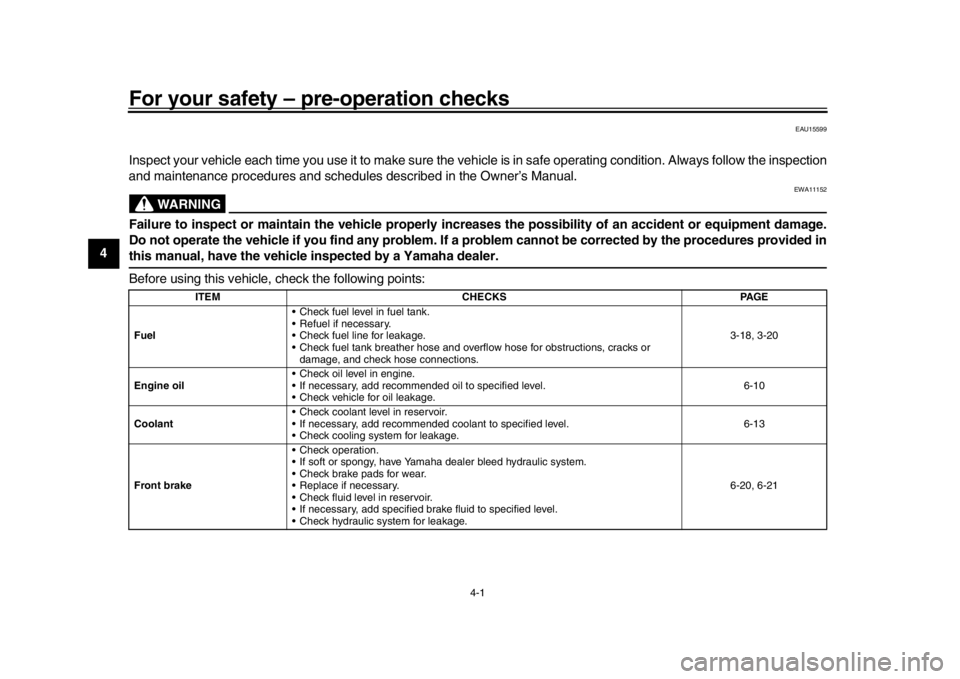
ITEM CHECKS PAGE
Fuel Check fuel level in fuel tank.
Refuel if necessary.
Check fuel line for leakage.
Check fuel tank breather hose and overflow hose for obstructions, cracks or
damage, and check hose connections. 3-18, 3-20
Engine oil Check oil level in engine.
If necessary, add recommended oil to specified level.
Check vehicle for oil leakage. 6-10
Coolant Check coolant level in reservoir.
If necessary, add recommended coolant to specified level.
Check cooling system for leakage. 6-13
Front brake Check operation.
If soft or spongy, have Yamaha dealer bleed hydraulic system.
Check brake pads for wear.
Replace if necessary.
Check fluid level in reservoir.
If necessary, add specified brake fluid to specified level.
Check hydraulic system for leakage. 6-20, 6-21
BAE-28199-E1.book 1 ページ 2019年8月23日 金曜日 午後3時56分
Page 49 of 102
Operation and important riding points
5-3
1
2
3
456
7
8
9
10
11
12
EAU16674
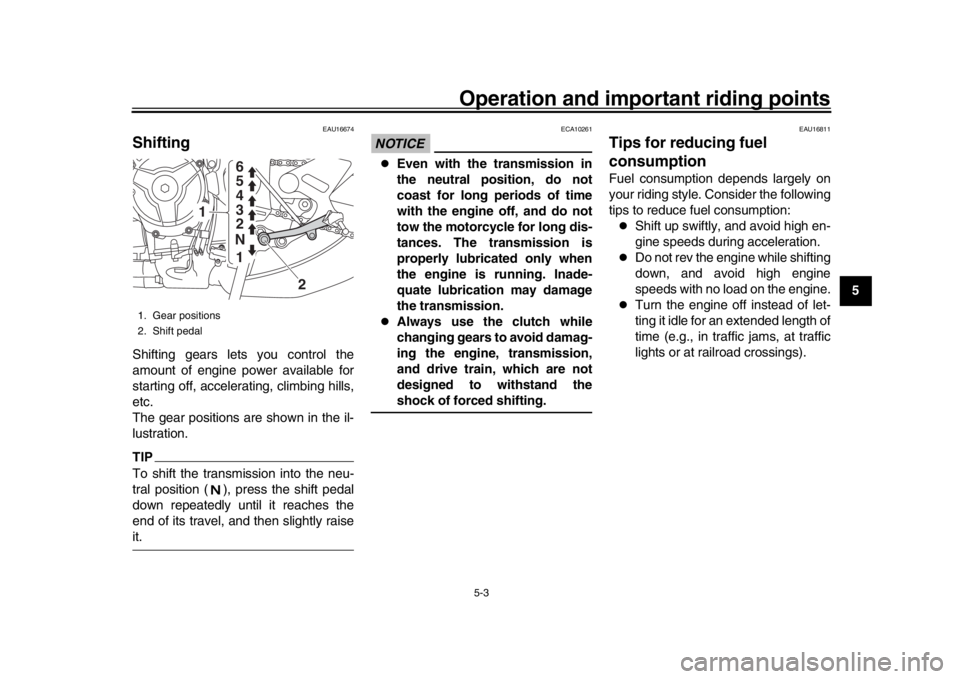
ShiftingShifting gears lets you control the
amount of engine power available for
starting off, accelerating, climbing hills,
etc.
The gear positions are shown in the il-
lustration.TIPTo shift the transmission into the neu-
tral position ( ), press the shift pedal
down repeatedly until it reaches the
end of its travel, and then slightly raiseit.
NOTICE
ECA10261
Even with the transmission in
the neutral position, do not
coast for long periods of time
with the engine off, and do not
tow the motorcycle for long dis-
tances. The transmission is
properly lubricated only when
the engine is running. Inade-
quate lubrication may damage
the transmission.
Always use the clutch while
changing gears to avoid damag-
ing the engine, transmission,
and drive train, which are not
designed to withstand theshock of forced shifting.
EAU16811
Tips for reducing fuel
consumptionFuel consumption depends largely on
your riding style. Consider the following
tips to reduce fuel consumption:
Shift up swiftly, and avoid high en-
gine speeds during acceleration.
Do not rev the engine while shifting
down, and avoid high engine
speeds with no load on the engine.
Turn the engine off instead of let-
ting it idle for an extended length of
time (e.g., in traffic jams, at traffic
lights or at railroad crossings).
1. Gear positions
2. Shift pedal
1 2 3 4
5 6
N
1
2
BAE-28199-E1.book 3 ページ 2019年8月23日 金曜日 午後3時56分
Page 50 of 102
Operation and important riding points
5-4
1
2
3
45
6
7
8
9
10
11
12
EAU17214
ParkingWhen parking, stop the engine, and
then remove the key from the main
switch.
WARNING
EWA10312
Since the engine and exhaust
system can become very hot,
park in a place where pedestri-
ans or children are not likely to
touch them and be burned.
Do not park on a slope or on soft
ground, otherwise the vehicle
may overturn, increasing the
risk of a fuel leak and fire.
Do not park near grass or other
flammable materials whichmight catch fire.
BAE-28199-E1.book 4 ページ 2019年8月23日 金曜日 午後3時56分
Page 53 of 102
Periodic maintenance and adjustment
6-3
1
2
3
4
567
8
9
10
11
12
EAU71033
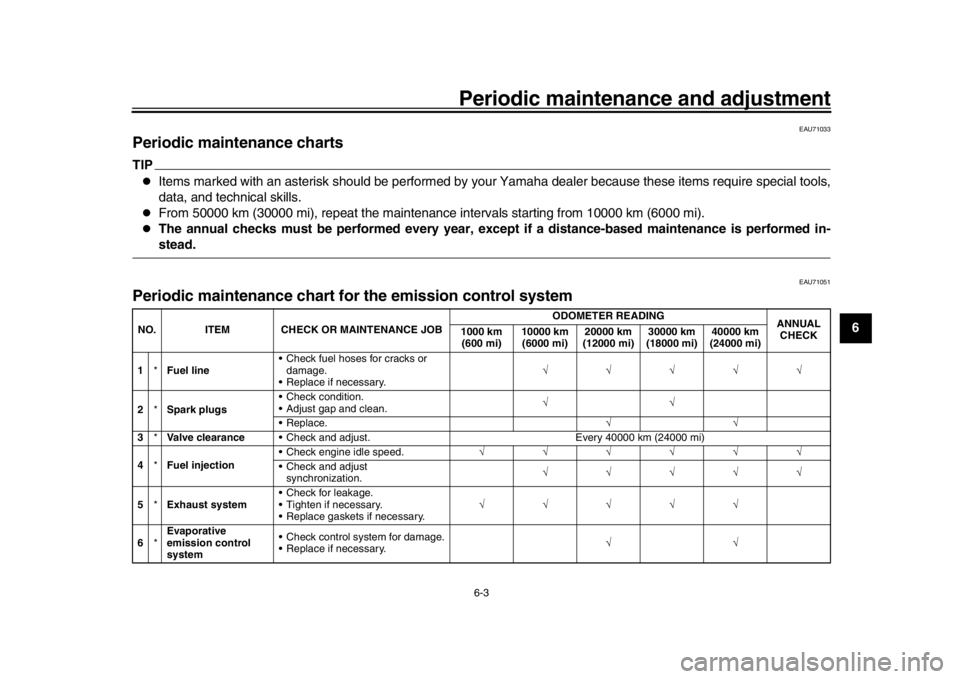
Periodic maintenance chartsTIP
Items marked with an asteri sk should be performed by your Yamaha dealer because these items require special tools,
data, and technical skills.
From 50000 km (30000 mi), repeat the maintenance intervals starting from 10000 km (6000 mi).
The annual checks must be performed every year, except if a distance-based maintenance is performed in-stead.
EAU71051
Periodic maintenance chart fo r the emission control systemNO. ITEM CHECK OR MAINTENANCE JOB ODOMETER READING
ANNUAL
CHECK
1000 km
(600 mi) 10000 km
(6000 mi) 20000 km
(12000 mi) 30000 km
(18000 mi) 40000 km
(24000 mi)
1 *Fuel line Check fuel hoses for cracks or
damage.
Replace if necessary.
2 *Spark plugs Check condition.
Adjust gap and clean.
Replace.
3 *Valve clearance Check and adjust. Every 40000 km (24000 mi)
4 *Fuel injection Check engine idle speed.
Check and adjust synchronization.
5 *Exhaust system Check for leakage.
Tighten if necessary.
Replace gaskets if necessary.
6 *Evaporative
emission control
system Check control system for damage.
Replace if necessary.
BAE-28199-E1.book 3 ページ 2019年8月23日 金曜日 午後3時56分
Page 60 of 102
Periodic maintenance and adjustment
6-10
1
2
3
4
56
7
8
9
10
11
12
EAU36112
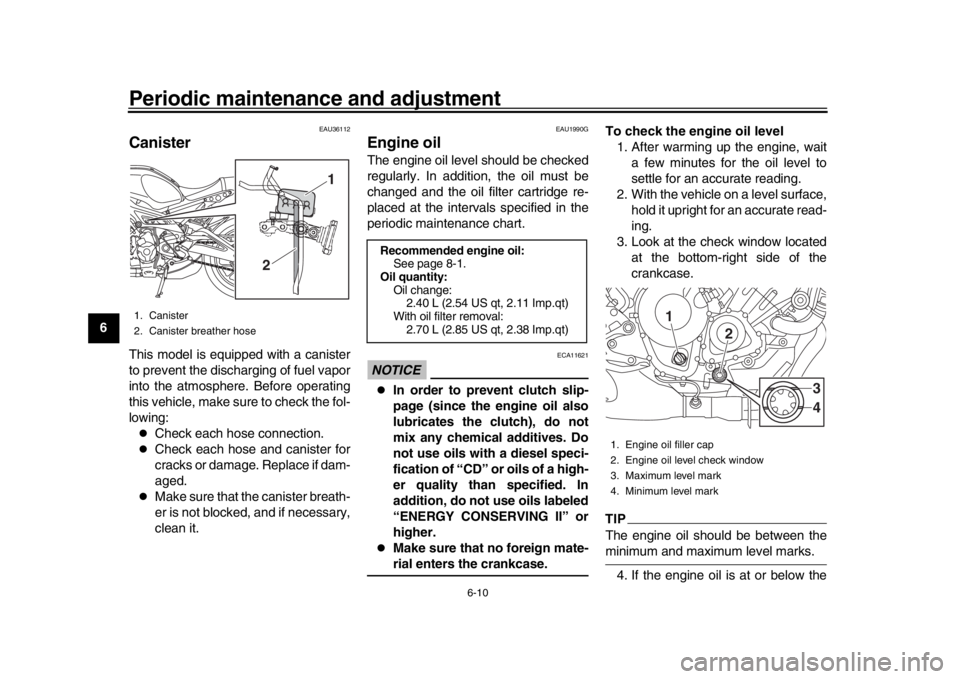
CanisterThis model is equipped with a canister
to prevent the discharging of fuel vapor
into the atmosphere. Before operating
this vehicle, make sure to check the fol-
lowing:
Check each hose connection.
Check each hose and canister for
cracks or damage. Replace if dam-
aged.
Make sure that the canister breath-
er is not blocked, and if necessary,
clean it.
EAU1990G
Engine oilThe engine oil level should be checked
regularly. In addition, the oil must be
changed and the oil filter cartridge re-
placed at the intervals specified in the
periodic maintenance chart.NOTICE
ECA11621
In order to prevent clutch slip-
page (since the engine oil also
lubricates the clutch), do not
mix any chemical additives. Do
not use oils with a diesel speci-
fication of “CD” or oils of a high-
er quality than specified. In
addition, do not use oils labeled
“ENERGY CONSERVING II” or
higher.
Make sure that no foreign mate-rial enters the crankcase. To check the engine oil level
1. After warming up the engine, wait a few minutes for the oil level to
settle for an accurate reading.
2. With the vehicle on a level surface, hold it upright for an accurate read-
ing.
3. Look at the check window located at the bottom-right side of the
crankcase.
TIPThe engine oil should be between theminimum and maximum level marks.
4. If the engine oil is at or below the
1. Canister
2. Canister breather hose
1
2
Recommended engine oil: See page 8-1.
Oil quantity: Oil change:2.40 L (2.54 US qt, 2.11 Imp.qt)
With oil filter removal: 2.70 L (2.85 US qt, 2.38 Imp.qt)
1. Engine oil filler cap
2. Engine oil level check window
3. Maximum level mark
4. Minimum level mark
1
2
34
BAE-28199-E1.book 10 ページ 2019年8月23日 金曜日 午後3時56分
Page 65 of 102
Periodic maintenance and adjustment6-15
1
2
3
4
567
8
9
10
11
12
EAU44735
Checking the engine idling
speedCheck the engine idling speed and, if
necessary, have it corrected by a
Yamaha dealer.
EAU21386
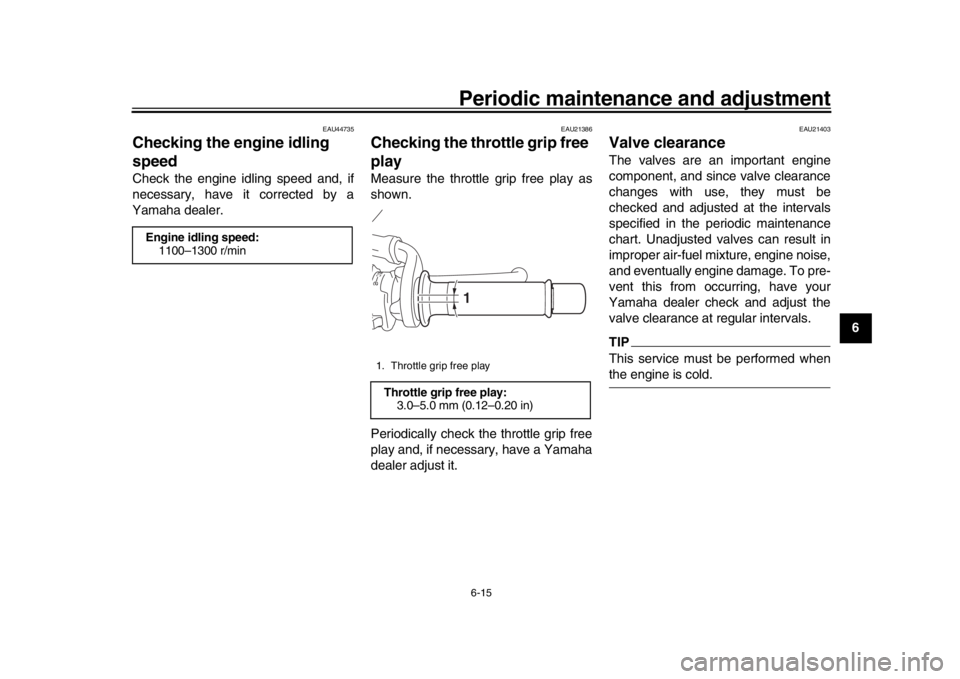
Checking the throttle grip free
playMeasure the throttle grip free play as
shown.
Periodically check the throttle grip free
play and, if necessary, have a Yamaha
dealer adjust it.
EAU21403
Valve clearanceThe valves are an important engine
component, and since valve clearance
changes with use, they must be
checked and adjusted at the intervals
specified in the periodic maintenance
chart. Unadjusted valves can result in
improper air-fuel mixture, engine noise,
and eventually engine damage. To pre-
vent this from occurring, have your
Yamaha dealer check and adjust the
valve clearance at regular intervals.TIPThis service must be performed whenthe engine is cold.
Engine idling speed: 1100–1300 r/min
1. Throttle grip free playThrottle grip free play:3.0–5.0 mm (0.12–0.20 in)
1
BAE-28199-E1.book 15 ページ 2019年8月23日 金曜日 午後3時56分
Page 81 of 102
Periodic maintenance and adjustment6-31
1
2
3
4
567
8
9
10
11
12
3. Place the panel and rubber cover
in the original position.
4. Install the nuts and bolt.
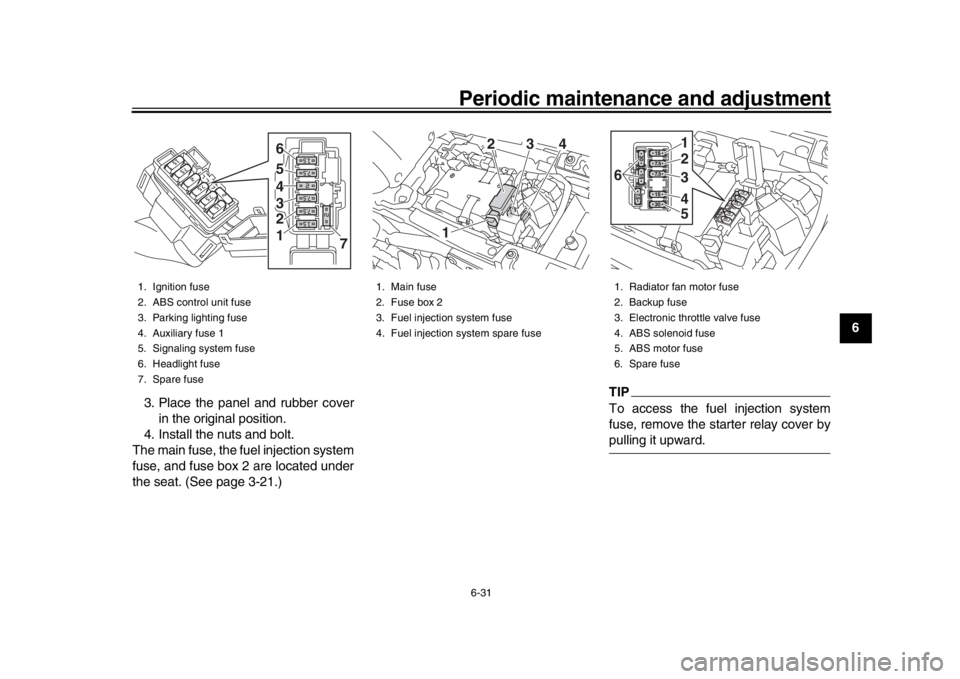
The main fuse, the fuel injection system
fuse, and fuse box 2 are located under
the seat. (See page 3-21.)
TIPTo access the fuel injection system
fuse, remove the starter relay cover bypulling it upward.
1. Ignition fuse
2. ABS control unit fuse
3. Parking lighting fuse
4. Auxiliary fuse 1
5. Signaling system fuse
6. Headlight fuse
7. Spare fuse
7
1 2 3 4 5 6
1. Main fuse
2. Fuse box 2
3. Fuel injection system fuse
4. Fuel injection system spare fuse
2
1 3
4
1. Radiator fan motor fuse
2. Backup fuse
3. Electronic throttle valve fuse
4. ABS solenoid fuse
5. ABS motor fuse
6. Spare fuse
15
1515
1
2
34
5
6
BAE-28199-E1.book 31 ページ 2019年8月23日 金曜日 午後3時56分
Page 82 of 102
Periodic maintenance and adjustment
6-32
1
2
3
4
56
7
8
9
10
11
12 If a fuse is blown, replace it as follows.
1. Turn the key to “OFF” and turn off the electrical circuit in question.
2. Remove the blown fuse, and then install a new fuse of the specified
amperage. WARNING! Do not
use a fuse of a higher amperage
rating than recommended to
avoid causing extensive dam-
age to the electrical system and
possibly a fire.
[EWA15132]
3. Turn the key to “ON” and turn on the electrical circuit in question to
check if the device operates.
4. If the fuse immediately blows again, have a Yamaha dealer check the electrical system.
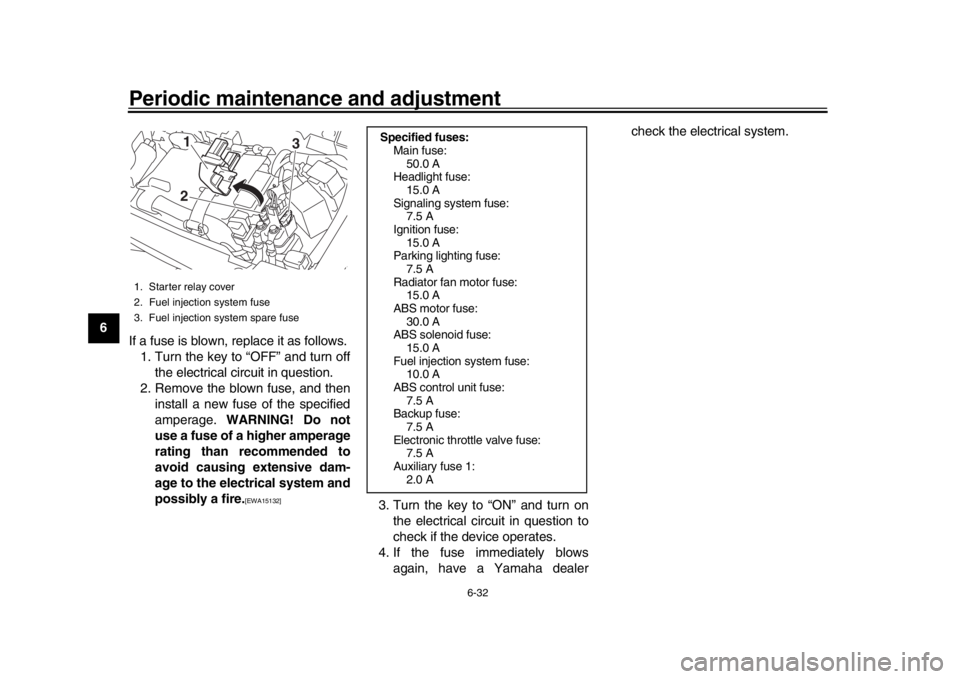
1. Starter relay cover
2. Fuel injection system fuse
3. Fuel injection system spare fuse
1
2 3
Specified fuses:
Main fuse:50.0 A
Headlight fuse:
15.0 A
Signaling system fuse: 7.5 A
Ignition fuse: 15.0 A
Parking lighting fuse:
7.5 A
Radiator fan motor fuse: 15.0 A
ABS motor fuse: 30.0 A
ABS solenoid fuse:
15.0 A
Fuel injection system fuse: 10.0 A
ABS control unit fuse: 7.5 A
Backup fuse:
7.5 A
Electronic throttle valve fuse: 7.5 A
Auxiliary fuse 1: 2.0 A
BAE-28199-E1.book 32 ページ 2019年8月23日 金曜日 午後3時56分