warning YAMAHA XT1200Z 2013 Owner's Guide
[x] Cancel search | Manufacturer: YAMAHA, Model Year: 2013, Model line: XT1200Z, Model: YAMAHA XT1200Z 2013Pages: 108, PDF Size: 2.86 MB
Page 70 of 108
PERIODIC MAINTENANCE AND ADJUSTMENT
6-14
6
EAU20016
Final gear oil The final gear case must be checked
for oil leakage before each ride. If any
leakage is found, have a Yamaha deal-
er check and repair the vehicle. In addi-
tion, the final gear oil level must be
checked and the oil changed as follows
at the intervals specified in the periodic
maintenance and lubrication chart.
WARNING
EWA10370
●
Make sure that no foreign mate-
rial enters the final gear case.
●
Make sure that no oil gets on the
tire or wheel.
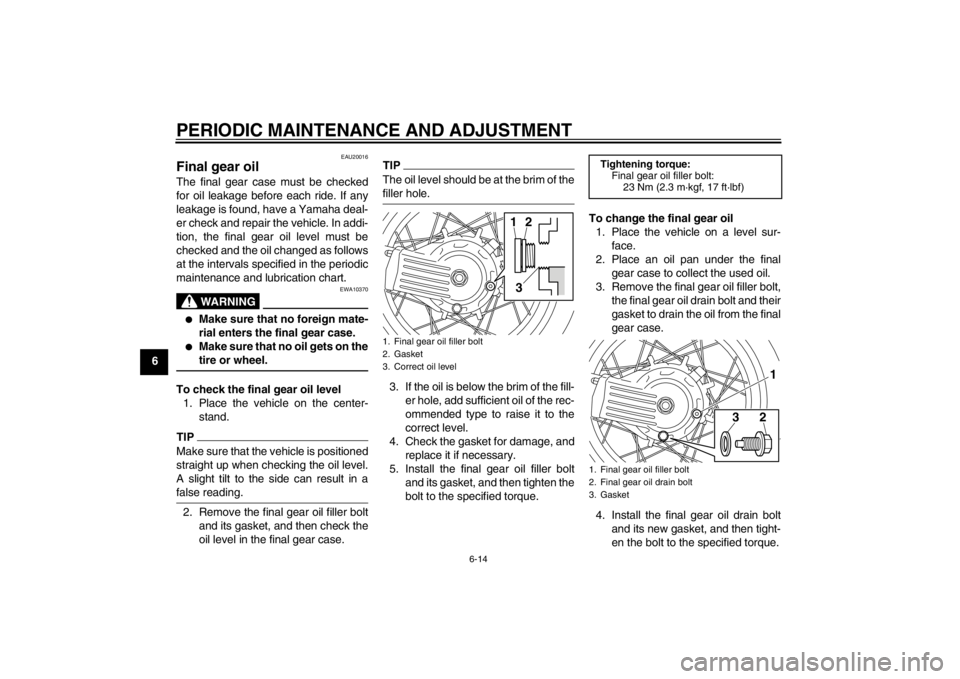
To check the final gear oil level1. Place the vehicle on the center- stand.TIPMake sure that the vehicle is positioned
straight up when checking the oil level.
A slight tilt to the side can result in a
false reading.2. Remove the final gear oil filler boltand its gasket, and then check the
oil level in the final gear case.
TIPThe oil level should be at the brim of the
filler hole.3. If the oil is below the brim of the fill-er hole, add sufficient oil of the rec-
ommended type to raise it to the
correct level.
4. Check the gasket for damage, and replace it if necessary.
5. Install the final gear oil filler bolt and its gasket, and then tighten the
bolt to the specified torque. To change the final gear oil
1. Place the vehicle on a level sur- face.
2. Place an oil pan under the final gear case to collect the used oil.
3. Remove the final gear oil filler bolt, the final gear oil drain bolt and their
gasket to drain the oil from the final
gear case.
4. Install the final gear oil drain bolt and its new gasket, and then tight-
en the bolt to the specified torque.1. Final gear oil filler bolt
2. Gasket
3. Correct oil level
1
2
3
Tightening torque: Final gear oil filler bolt:
23 Nm (2.3 m·kgf, 17 ft·lbf)1. Final gear oil filler bolt
2. Final gear oil drain bolt
3. Gasket
2
3
1
U23PE3E0.book Page 14 Monday, July 30, 2012 8:44 AM
Page 72 of 108

PERIODIC MAINTENANCE AND ADJUSTMENT
6-16
64. Add coolant or distilled water to
raise the coolant to the maximum
level mark, install the coolant res-
ervoir cap. WARNING! Remove
only the coolant reservoir cap.
Never attempt to remove the ra-
diator cap when the engine is
hot.
[EWA15161]
NOTICE: If coolant is
not available, use distilled water
or soft tap water instead. Do not
use hard water or salt water
since it is harmful to the engine.
If water has been used instead
of coolant, replace it with cool-
ant as soon as possible, other-
wise the cooling system will not
be protected against frost and
corrosion. If water has been
added to the coolant, have a
Yamaha dealer check the anti-
freeze content of the coolant as
soon as possible, otherwise the
effectiveness of the coolant will
be reduced. [ECA10472] EAU33031
Changing the coolant
The coolant must be changed at the in-
tervals specified in the periodic mainte-
nance and lubrication chart. Have a
Yamaha dealer change the coolant.
WARNING! Never attempt to remove the radiator cap when the engine is
hot.
[EWA10381] EAU36764
Air filter element The air filter element must be replaced
at the intervals specified in the periodic
maintenance and lubrication chart.
Have a Yamaha dealer replace the air
filter element.
Coolant reservoir capacity (up to
the maximum level mark):
0.26 L (0.27 US qt, 0.23 Imp.qt)
U23PE3E0.book Page 16 Monday, July 30, 2012 8:44 AM
Page 74 of 108
PERIODIC MAINTENANCE AND ADJUSTMENT
6-18
6
EAU49675
Tires Tires are the only contact between the
vehicle and the road. Safety in all con-
ditions of riding depends on a relatively
small area of road contact. Therefore, it
is essential to maintain the tires in good
condition at all times and replace them
at the appropriate time with the speci-
fied tires.
Tire air pressure
The tire air pressure should be checked
and, if necessary, adjusted before each
ride.
WARNING
EWA10503
Operation of this vehicle with im-
proper tire pressure may cause se-
vere injury or death from loss of
control.●
The tire air pressure must be
checked and adjusted on cold
tires (i.e., when the temperature
of the tires equals the ambient
temperature).
●
The tire air pressure must be ad-
justed in accordance with the
riding speed and with the totalweight of rider, passenger, car-
go, and accessories approved
for this model.
WARNING
EWA10511
Never overload your vehicle. Opera-
tion of an overloaded vehicle could
cause an accident.
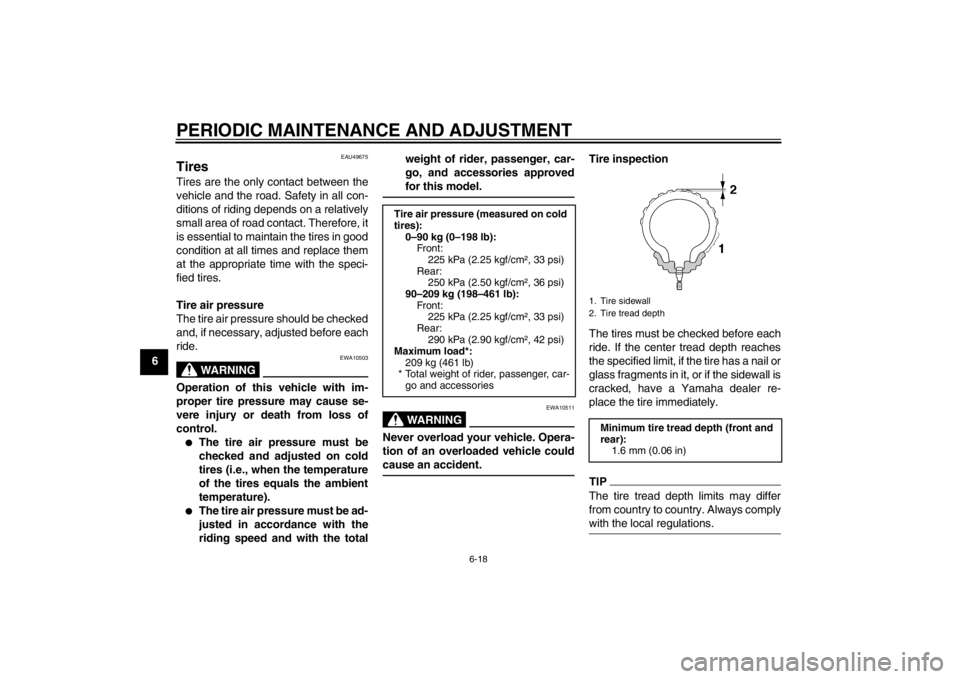
Tire inspection
The tires must be checked before each
ride. If the center tread depth reaches
the specified limit, if the tire has a nail or
glass fragments in it, or if the sidewall is
cracked, have a Yamaha dealer re-
place the tire immediately.TIPThe tire tread depth limits may differ
from country to country. Always comply
with the local regulations.
Tire air pressure (measured on cold
tires):
0–90 kg (0–198 lb):Front:
225 kPa (2.25 kgf/cm², 33 psi)
Rear: 250 kPa (2.50 kgf/cm², 36 psi)
90–209 kg (198–461 lb): Front:225 kPa (2.25 kgf/cm², 33 psi)
Rear: 290 kPa (2.90 kgf/cm², 42 psi)
Maximum load*:
209 kg (461 lb)
* Total weight of rider, passenger, car- go and accessories
1. Tire sidewall
2. Tire tread depthMinimum tire tread depth (front and
rear): 1.6 mm (0.06 in)
U23PE3E0.book Page 18 Monday, July 30, 2012 8:44 AM
Page 75 of 108
PERIODIC MAINTENANCE AND ADJUSTMENT
6-19
6
WARNING
EWA10471
●
Have a Yamaha dealer replace
excessively worn tires. Besides
being illegal, operating the vehi-
cle with excessively worn tires
decreases riding stability and
can lead to loss of control.
●
The replacement of all wheel
and brake-related parts, includ-
ing the tires, should be left to a
Yamaha dealer, who has the necessary professional knowl-
edge and experience to do so.
●
Ride at moderate speeds after
changing a tire since the tire
surface must first be “broken
in” for it to develop its optimal
characteristics.
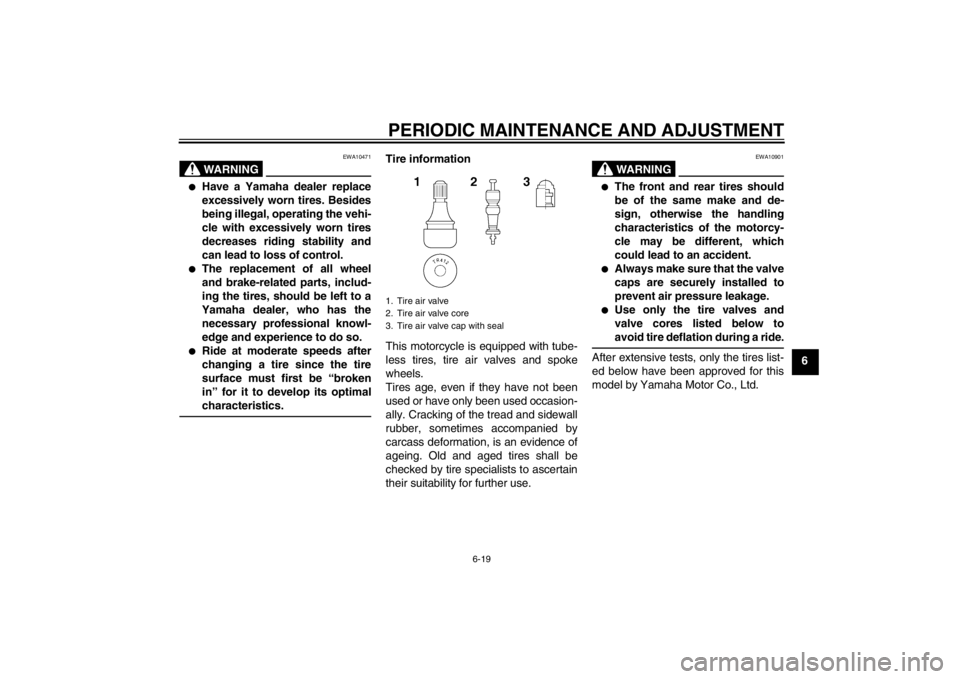
Tire information
This motorcycle is equipped with tube-
less tires, tire air valves and spoke
wheels.
Tires age, even if they have not been
used or have only been used occasion-
ally. Cracking of the tread and sidewall
rubber, sometimes accompanied by
carcass deformation, is an evidence of
ageing. Old and aged tires shall be
checked by tire specialists to ascertain
their suitability for further use.
WARNING
EWA10901
●
The front and rear tires should
be of the same make and de-
sign, otherwise the handling
characteristics of the motorcy-
cle may be different, which
could lead to an accident.
●
Always make sure that the valve
caps are securely installed to
prevent air pressure leakage.
●
Use only the tire valves and
valve cores listed below to
avoid tire deflation during a ride.
After extensive tests, only the tires list-
ed below have been approved for this
model by Yamaha Motor Co., Ltd.
1. Tire air valve
2. Tire air valve core
3. Tire air valve cap with seal
U23PE3E0.book Page 19 Monday, July 30, 2012 8:44 AM
Page 77 of 108
PERIODIC MAINTENANCE AND ADJUSTMENT
6-21
6
EAU37913
Checking the brake lever free
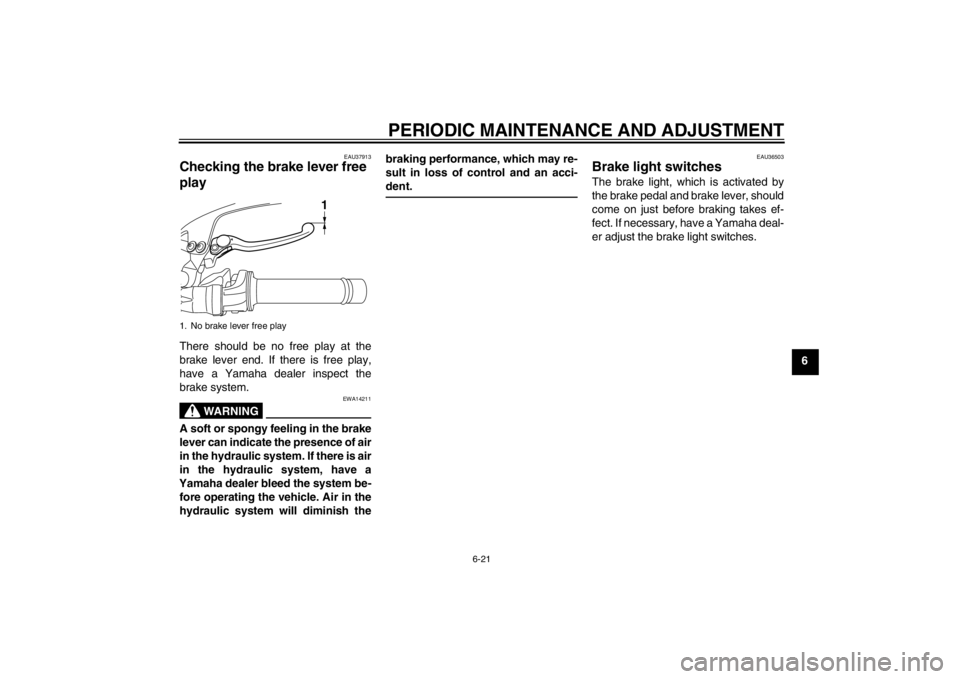
play There should be no free play at the
brake lever end. If there is free play,
have a Yamaha dealer inspect the
brake system.
WARNING
EWA14211
A soft or spongy feeling in the brake
lever can indicate the presence of air
in the hydraulic system. If there is air
in the hydraulic system, have a
Yamaha dealer bleed the system be- fore operating the vehicle. Air in the
hydraulic system will diminish the braking performance, which may re-
sult in loss of control and an acci-
dent.
EAU36503
Brake light switches The brake light, which is activated by
the brake pedal and brake lever, should
come on just before braking takes ef-
fect. If necessary, have a Yamaha deal-
er adjust the brake light switches.
1. No brake lever free play
1
U23PE3E0.book Page 21 Monday, July 30, 2012 8:44 AM
Page 79 of 108
PERIODIC MAINTENANCE AND ADJUSTMENT
6-23
6
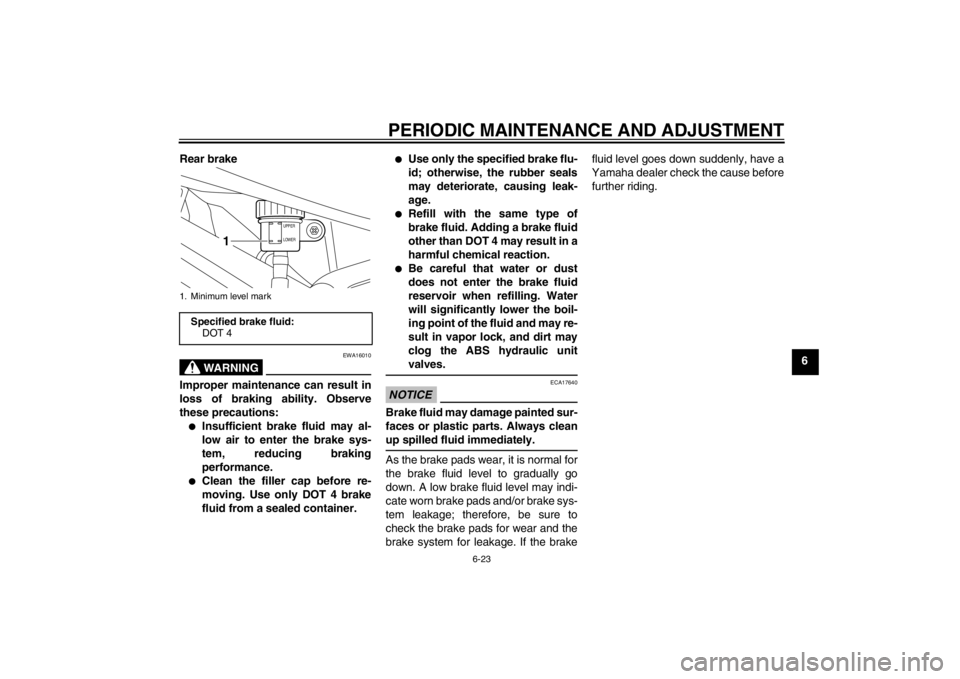
Rear brake
WARNING
EWA16010
Improper maintenance can result in
loss of braking ability. Observe
these precautions:●
Insufficient brake fluid may al-
low air to enter the brake sys-
tem, reducing braking
performance.
●
Clean the filler cap before re-
moving. Use only DOT 4 brake
fluid from a sealed container.
●
Use only the specified brake flu-
id; otherwise, the rubber seals
may deteriorate, causing leak-
age.
●
Refill with the same type of
brake fluid. Adding a brake fluid
other than DOT 4 may result in a
harmful chemical reaction.
●
Be careful that water or dust
does not enter the brake fluid
reservoir when refilling. Water
will significantly lower the boil-
ing point of the fluid and may re-
sult in vapor lock, and dirt may
clog the ABS hydraulic unit
valves.
NOTICE
ECA17640
Brake fluid may damage painted sur-
faces or plastic parts. Always clean
up spilled fluid immediately.As the brake pads wear, it is normal for
the brake fluid level to gradually go
down. A low brake fluid level may indi-
cate worn brake pads and/or brake sys-
tem leakage; therefore, be sure to
check the brake pads for wear and the
brake system for leakage. If the brake fluid level goes down suddenly, have a
Yamaha dealer check the cause before
further riding.
1. Minimum level markSpecified brake fluid:
DOT 4
UPPER
LOWER
1
U23PE3E0.book Page 23 Monday, July 30, 2012 8:44 AM
Page 82 of 108
PERIODIC MAINTENANCE AND ADJUSTMENT
6-26
6
EAU23213
Checking and lubricating the
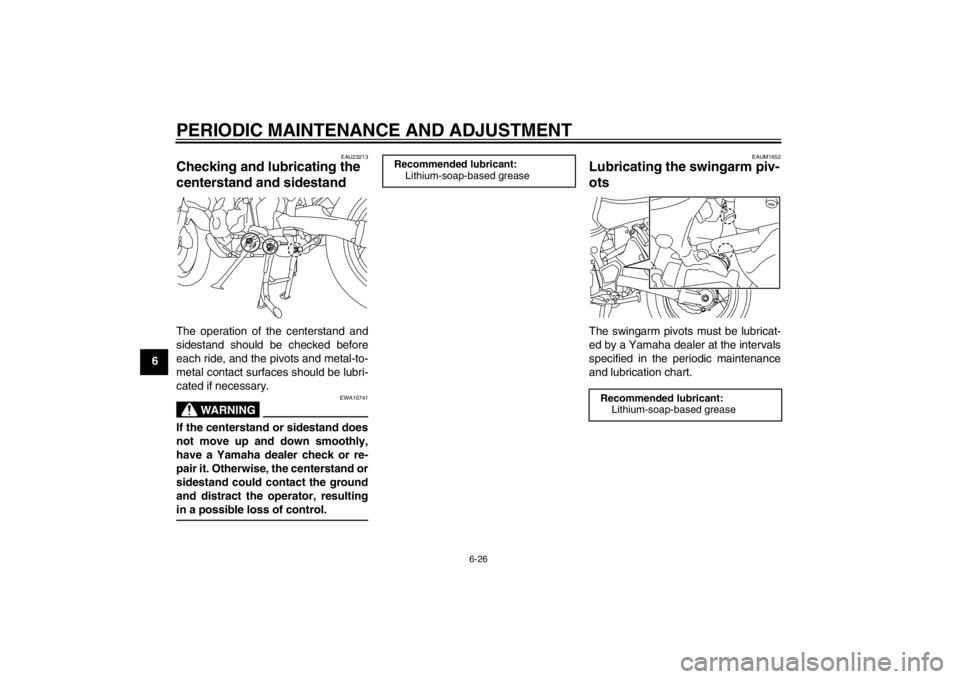
centerstand and sidestand The operation of the centerstand and
sidestand should be checked before
each ride, and the pivots and metal-to-
metal contact surfaces should be lubri-
cated if necessary.
WARNING
EWA10741
If the centerstand or sidestand does
not move up and down smoothly,
have a Yamaha dealer check or re-
pair it. Otherwise, the centerstand or
sidestand could contact the ground
and distract the operator, resulting
in a possible loss of control.
EAUM1652
Lubricating the swingarm piv-
ots The swingarm pivots must be lubricat-
ed by a Yamaha dealer at the intervals
specified in the periodic maintenance
and lubrication chart.
Recommended lubricant:
Lithium-soap-based grease
Recommended lubricant:Lithium-soap-based grease
U23PE3E0.book Page 26 Monday, July 30, 2012 8:44 AM
Page 83 of 108
PERIODIC MAINTENANCE AND ADJUSTMENT
6-27
6
EAU23272
Checking the front fork The condition and operation of the front
fork must be checked as follows at the
intervals specified in the periodic main-
tenance and lubrication chart.
To check the condition
Check the inner tubes for scratches,
damage and excessive oil leakage.
To check the operation1. Place the vehicle on a level sur- face and hold it in an upright posi-
tion. WARNING! To avoid injury,
securely support the vehicle so
there is no danger of it falling
over.
[EWA10751]
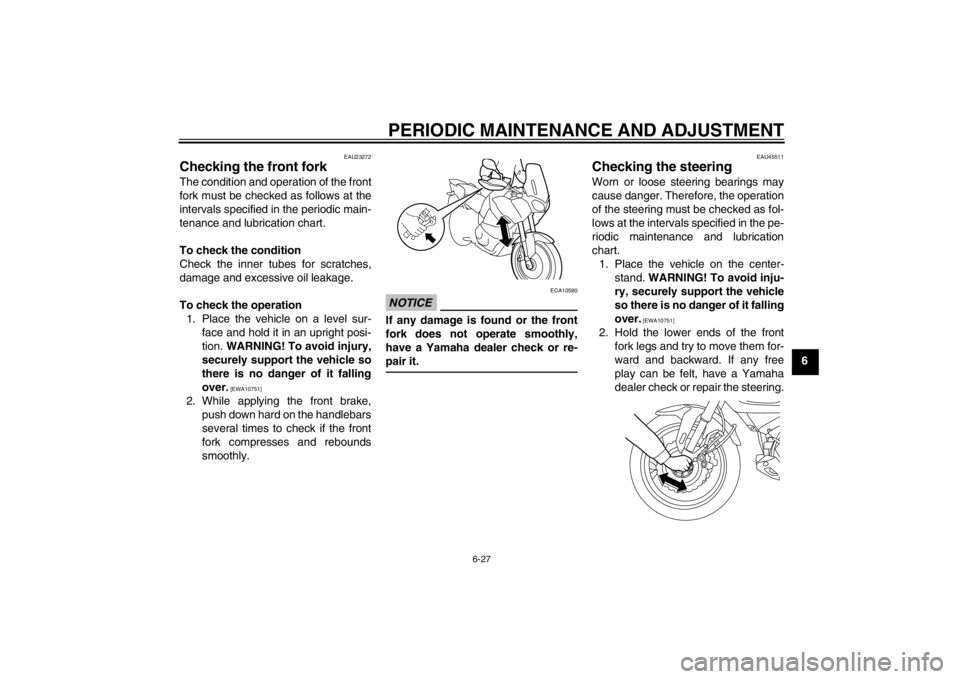
2. While applying the front brake, push down hard on the handlebars
several times to check if the front
fork compresses and rebounds
smoothly.
NOTICE
ECA10590
If any damage is found or the front
fork does not operate smoothly,
have a Yamaha dealer check or re-
pair it.
EAU45511
Checking the steering Worn or loose steering bearings may
cause danger. Therefore, the operation
of the steering must be checked as fol-
lows at the intervals specified in the pe-
riodic maintenance and lubrication
chart.1. Place the vehicle on the center- stand. WARNING! To avoid inju-
ry, securely support the vehicle
so there is no danger of it falling
over.
[EWA10751]
2. Hold the lower ends of the front fork legs and try to move them for-
ward and backward. If any free
play can be felt, have a Yamaha
dealer check or repair the steering.
U23PE3E0.book Page 27 Monday, July 30, 2012 8:44 AM
Page 84 of 108
PERIODIC MAINTENANCE AND ADJUSTMENT
6-28
6
EAU23291
Checking the wheel bearings The front and rear wheel bearings must
be checked at the intervals specified in
the periodic maintenance and lubrica-
tion chart. If there is play in the wheel
hub or if the wheel does not turn
smoothly, have a Yamaha dealer check
the wheel bearings.
EAU34225
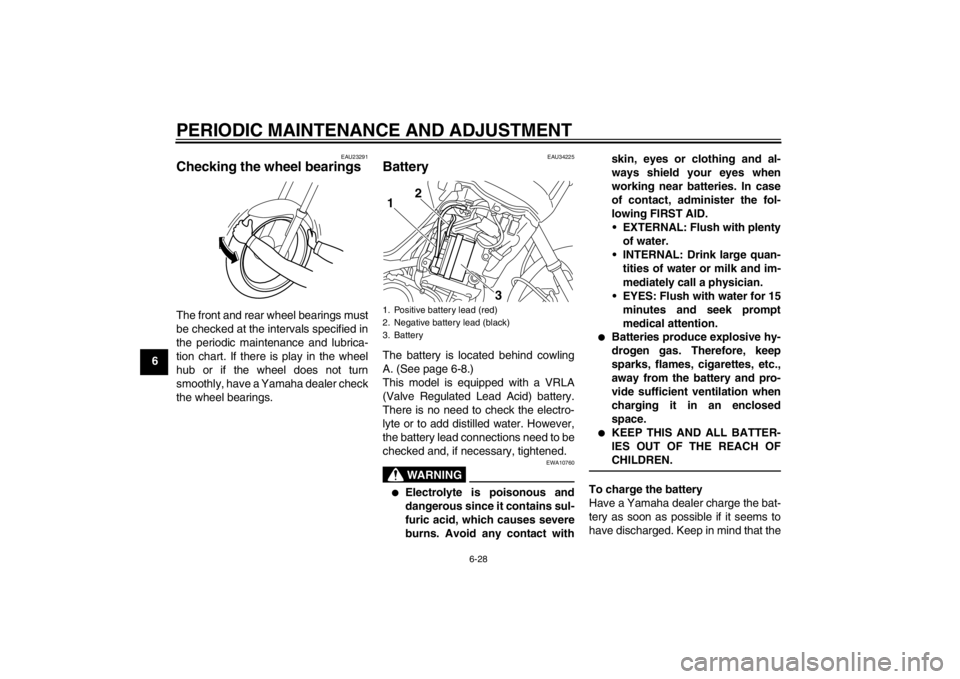
Battery The battery is located behind cowling
A. (See page 6-8.)
This model is equipped with a VRLA
(Valve Regulated Lead Acid) battery.
There is no need to check the electro-
lyte or to add distilled water. However,
the battery lead connections need to be
checked and, if necessary, tightened.
WARNING
EWA10760
●
Electrolyte is poisonous and
dangerous since it contains sul-
furic acid, which causes severe
burns. Avoid any contact withskin, eyes or clothing and al-
ways shield your eyes when
working near batteries. In case
of contact, administer the fol-
lowing FIRST AID.
EXTERNAL: Flush with plenty of water.
INTERNAL: Drink large quan- tities of water or milk and im-
mediately call a physician.
EYES: Flush with water for 15 minutes and seek prompt
medical attention.
●
Batteries produce explosive hy-
drogen gas. Therefore, keep
sparks, flames, cigarettes, etc.,
away from the battery and pro-
vide sufficient ventilation when
charging it in an enclosed
space.
●
KEEP THIS AND ALL BATTER-
IES OUT OF THE REACH OF
CHILDREN.
To charge the battery
Have a Yamaha dealer charge the bat-
tery as soon as possible if it seems to
have discharged. Keep in mind that the
1. Positive battery lead (red)
2. Negative battery lead (black)
3. Battery1
3
2
U23PE3E0.book Page 28 Monday, July 30, 2012 8:44 AM
Page 86 of 108
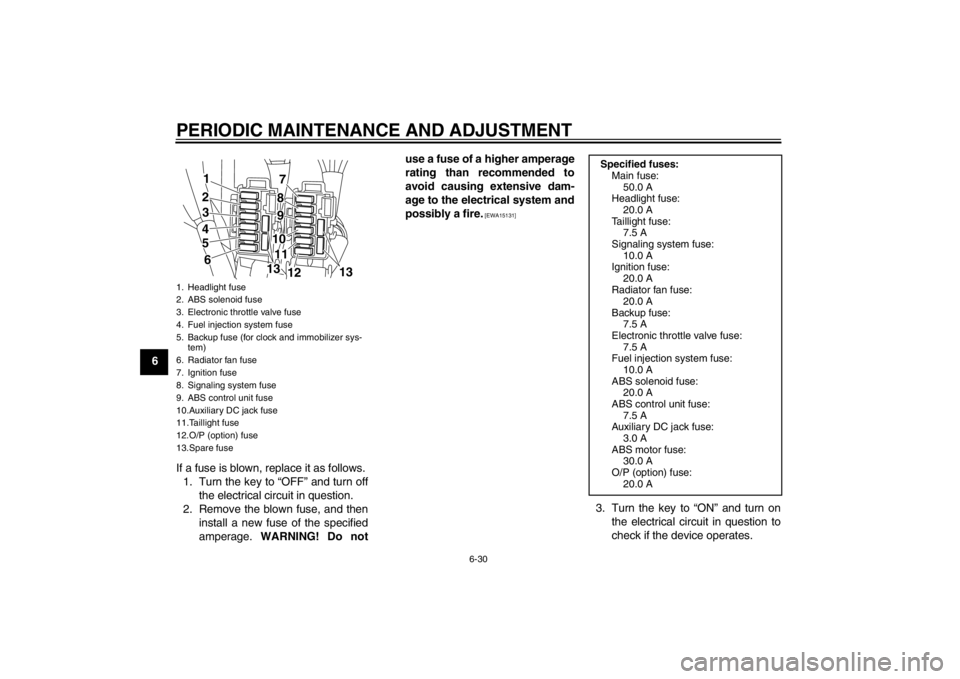
PERIODIC MAINTENANCE AND ADJUSTMENT
6-30
6If a fuse is blown, replace it as follows.1. Turn the key to “OFF” and turn off the electrical circuit in question.
2. Remove the blown fuse, and then install a new fuse of the specified
amperage. WARNING! Do not use a fuse of a higher amperage
rating than recommended to
avoid causing extensive dam-
age to the electrical system and
possibly a fire.
[EWA15131]
3. Turn the key to “ON” and turn on
the electrical circuit in question to
check if the device operates.
1. Headlight fuse
2. ABS solenoid fuse
3. Electronic throttle valve fuse
4. Fuel injection system fuse
5. Backup fuse (for clock and immobilizer sys-tem)
6. Radiator fan fuse
7. Ignition fuse
8. Signaling system fuse
9. ABS control unit fuse
10.Auxiliary DC jack fuse
11.Taillight fuse
12.O/P (option) fuse
13.Spare fuse
78912
13
13
1110
124563
Specified fuses: Main fuse:
50.0 A
Headlight fuse:
20.0 A
Taillight fuse: 7.5 A
Signaling system fuse: 10.0 A
Ignition fuse:
20.0 A
Radiator fan fuse: 20.0 A
Backup fuse: 7.5 A
Electronic throttle valve fuse:
7.5 A
Fuel injection system fuse: 10.0 A
ABS solenoid fuse: 20.0 A
ABS control unit fuse:
7.5 A
Auxiliary DC jack fuse: 3.0 A
ABS motor fuse: 30.0 A
O/P (option) fuse:
20.0 A
U23PE3E0.book Page 30 Monday, July 30, 2012 8:44 AM