engine oil YAMAHA XT1200Z 2017 Owners Manual
[x] Cancel search | Manufacturer: YAMAHA, Model Year: 2017, Model line: XT1200Z, Model: YAMAHA XT1200Z 2017Pages: 120, PDF Size: 3.32 MB
Page 5 of 120

Table of contents
Safety information ............................1-1
Description ........................................2-1
Left view ..........................................2-1
Right view........................................2-2
Controls and instruments ................2-3
Instrument an d control functions ....3-1
Immobilizer system .........................3-1
Main switch/steering lock ...............3-2
Indicator lights and warning lights ............................................3-4
Cruise control system .....................3-6
Multi-function meter unit .................3-9
D-mode (drive mode) ....................3-20
Handlebar switches.......................3-20
Clutch lever ...................................3-22
Shift pedal .....................................3-22
Brake lever ....................................3-23
Brake pedal ...................................3-24
ABS ...............................................3-24
Traction control system.................3-25
Fuel tank cap.................................3-27
Fuel................................................3-28
Fuel tank overflow hose ................3-29
Catalytic converter ........................3-30
Rider seat ......................................3-30
Adjusting the rider seat height ......3-31
Windshield.....................................3-33
Adjusting the front fork..................3-34
Adjusting the shock absorber assembly....................................3-36
Carriers..........................................3-38
Luggage strap holders ..................3-39
Sidestand ......................................3-39
Ignition circuit cut-off system........3-40
Auxiliary DC jack ...........................3-42
For your safety – pre-operation
checks ...............................................4-1
Operation an d important ri din g
points .................................................5-1
Starting the engine ..........................5-2
Shifting ............................................5-3 Tips for reducing fuel
consumption................................ 5-4
Engine break-in ............................... 5-4
Parking ............................................ 5-5
Perio dic maintenance an d
a d justment ........................................ 6-1
Owner’s tool kit ............................... 6-2
Periodic maintenance chart for the
emission control system.............. 6-3
General maintenance and
lubrication chart........................... 6-4
Removing and installing cowlings ...................................... 6-7
Checking the spark plugs ............... 6-9
Canister......................................... 6-10
Engine oil and oil filter cartridge ... 6-10
Final gear oil.................................. 6-14
Coolant ......................................... 6-16
Air filter element ............................ 6-17
Checking the engine idling speed......................................... 6-18
Checking the throttle grip free
play ............................................ 6-18
Valve clearance ............................. 6-19
Tires .............................................. 6-19
Spoke wheels ............................... 6-22
Clutch lever ................................... 6-22
Checking the brake lever free play ............................................ 6-23
Brake light switches ...................... 6-23
Checking the front and rear brake pads................................. 6-24
Checking the brake fluid level....... 6-25
Changing the brake and clutch fluids .......................................... 6-26
Checking and lubricating the throttle grip and cable ............... 6-26
Checking and lubricating the brake and shift pedals ............... 6-27
Checking and lubricating the
brake and clutch levers ............. 6-27
Checking and lubricating the sidestand ................................... 6-28
Lubricating the swingarm pivots... 6-28
Checking the front fork ................. 6-29
UBP8E0E0.book Page 1 Thursday, December 8, 2016 7:25 PM
Page 12 of 120
Description
2-1
2
EAU63371
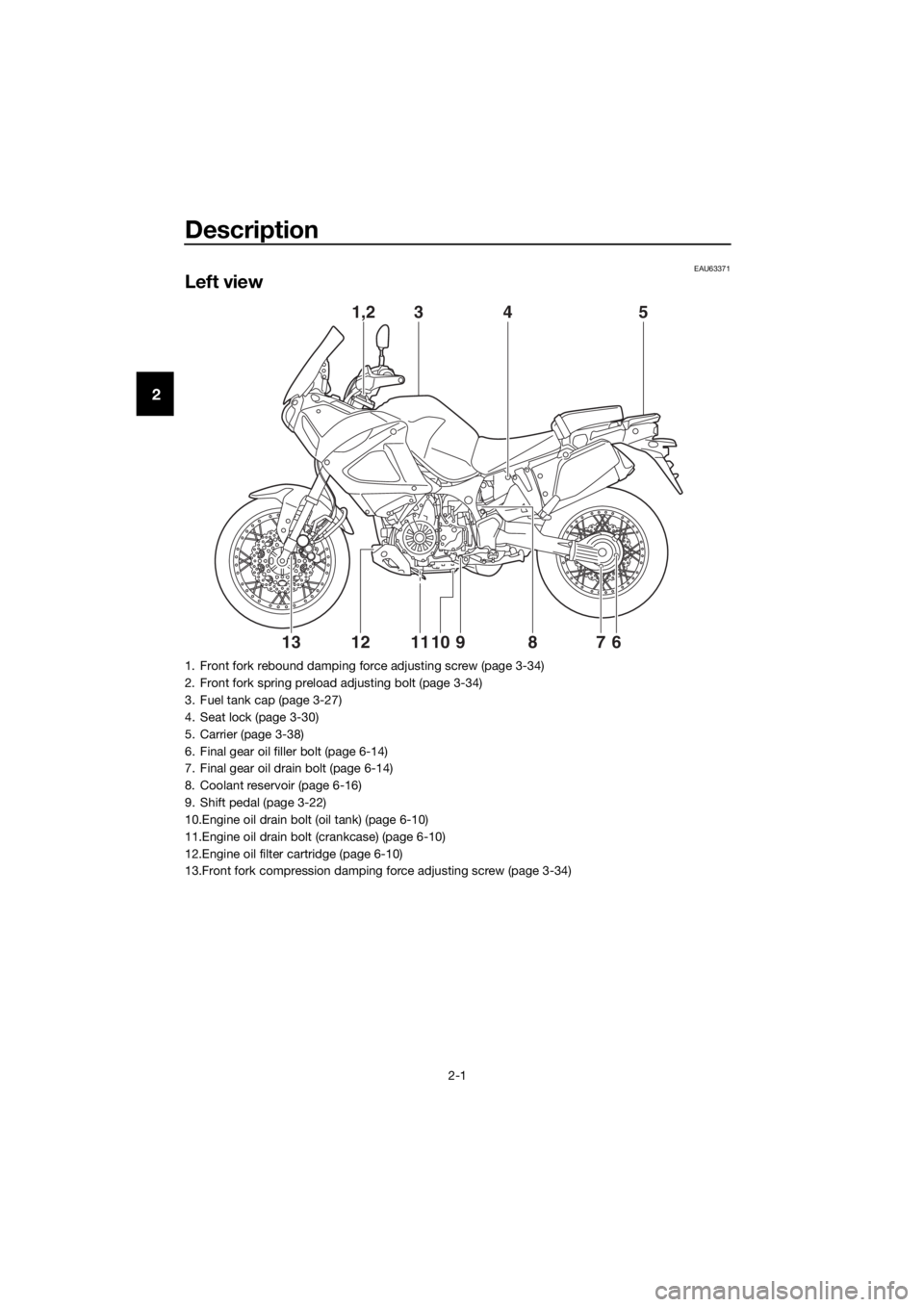
Left view
356
7891011
41,2
1213
1. Front fork rebound damping force adjusting screw (page 3-34)
2. Front fork spring preload adjusting bolt (page 3-34)
3. Fuel tank cap (page 3-27)
4. Seat lock (page 3-30)
5. Carrier (page 3-38)
6. Final gear oil filler bolt (page 6-14)
7. Final gear oil drain bolt (page 6-14)
8. Coolant reservoir (page 6-16)
9. Shift pedal (page 3-22)
10.Engine oil drain bolt (oil tank) (page 6-10)
11.Engine oil drain bolt (crankcase) (page 6-10)
12.Engine oil filter cartridge (page 6-10)
13.Front fork compression damping force adjusting screw (page 3-34)
UBP8E0E0.book Page 1 Thursday, December 8, 2016 7:25 PM
Page 13 of 120

Description
2-2
2
EAU63391
Right view
1
7
681112910
23,45
1. Rear brake fluid reservoir (page 6-25)
2. Shock absorber assembly spring preload adjusting knob (page 3-36)
3. Front fork rebound damping force adjusting screw (page 3-34)
4. Front fork spring preload adjusting bolt (page 3-34)
5. Fuses (page 6-32)
6. Front fork compression damping force adjusting screw (page 3-34)
7. Owner’s tool kit (page 6-2)
8. Battery (page 6-30)
9. Engine oil filler cap (page 6-10)
10.Engine oil level check window (page 6-10)
11.Brake pedal (page 3-24)
12.Shock absorber assembly rebound damping force adjusting knob (page 3-36)
UBP8E0E0.book Page 2 Thursday, December 8, 2016 7:25 PM
Page 18 of 120

Instrument and control functions
3-4
3
EAU4939C
In dicator li ghts and warning
li g hts
EAU11032Turn si gnal in dicator li ghts “ ”
an d“”
Each indicator light will flash when its
corresponding turn signal lights are
flashing.
EAU11061Neutral in dicator li ght “ ”
This indicator light comes on when the
transmission is in the neutral position.
EAU11081Hi gh beam in dicator li ght “ ”
This indicator light comes on when the
high beam of the headlight is switched
on.
EAU11256Oil level warnin g li ght “ ”
This warning light comes on if the en-
gine oil level is low.
The electrical circuit of the warning
light can be checked by turning the key
to “ON”. The warning light should
come on for a few seconds and then
go off.
If the warning light does not come on
initially when the key is turned to “ON”,
or if the warning light remains on after
confirming that the oil level is correct
(see page 6-10), have a Yamaha dealer
check the vehicle.
TIP
Even if the oil level is sufficient, the
warning light may flicker when rid-
ing on a slope or during sudden
acceleration or deceleration, but
this is not a malfunction.
This model is equipped with a self-
diagnosis device for the oil level
detection circuit. If a problem is
detected in the oil level detection
circuit, the oil level warning light
will flash repeatedly. If this occurs,
have a Yamaha dealer check the
vehicle.
EAU58401Cruise control in dicator
li g hts “ ”/“SET”
These indicator lights come on when
the cruise control system is activated.
See page 3-6 for a detailed explanation
of the function of these indicator lights.
The electrical circuit of these indicator
lights can be checked by turning the
key to “ON”. These indicator lights
should come on for a few seconds, and
then go off.
1. Left turn signal indicator light “ ”
2. Right turn signal indicator light “ ”
3. Oil level warning light “ ”
4. Engine trouble warning light “ ”
5. Anti-lock Brake System (ABS) warning light “ ”
6. Traction control system indicator light “ ”
7. Cruise control indicator lights “ ”/“SET”
8. High beam indicator light “ ”
9. Neutral indicator light “ ”
10.Immobilizer system indicator light “ ”
GEARN25A.TEMP ˚C
LoC.TEMP˚C
0:00TIME TRIP
345687910
12
ABS
UBP8E0E0.book Page 4 Thursday, December 8, 2016 7:25 PM
Page 57 of 120

For your safety – pre-operation checks
4-1
4
EAU63440
Inspect your vehicle each time you use it to make sure the vehicle is in safe oper-
ating condition. Always follow the inspection and maintenance procedures and
schedules described in the Owner’s Manual.
WARNING
EWA11152
Failure to inspect or maintain the vehicle properly increases the possibility
of an acci dent or equipment d amage. Do not operate the vehicle if you fin d
any prob lem. If a pro blem cannot be corrected b y the proce dures provi ded
in this manual, have the vehicle inspecte d b y a Yamaha d ealer.
Before using this vehicle, check the following points:
ITEM CHECKSPAGE
Fuel • Check fuel level in fuel tank.
• Refuel if necessary.
• Check fuel line for leakage.
• Check fuel tank breather hose and overflow hose for
obstructions, cracks or damage, and check hose con-
nections. 3-28,
3-29
En gine oil • Check oil level in engine.
• If necessary, add recommended oil to specified level.
• Check vehicle for oil leakage. 6-10
Final gear oil • Check vehicle for oil leakage. 6-14
Coolant • Check coolant level in reservoir.
• If necessary, add recommended coolant to specified
level.
• Check cooling system for leakage. 6-16
Front brake • Check operation.
• If soft or spongy, have Yamaha dealer bleed hydraulic
system.
• Check brake pads for wear.
• Replace if necessary.
• Check fluid level in reservoir.
• If necessary, add specified brake fluid to specified level.
• Check hydraulic system for leakage. 6-24,
6-25
Rear brake • Check operation.
• If soft or spongy, have Yamaha dealer bleed hydraulic
system.
• Check brake pads for wear.
• Replace if necessary.
• Check fluid level in reservoir.
• If necessary, add specified brake fluid to specified level.
• Check hydraulic system for leakage. 6-24,
6-25
Clutch • Check operation.
• If soft or spongy, have Yamaha dealer bleed hydraulic
system.
• Check hydraulic system for leakage. 6-22
UBP8E0E0.book Page 1 Thursday, December 8, 2016 7:25 PM
Page 60 of 120
Operation and important rid ing points
5-2
5
EAU54172
Startin g the en gine
In order for the ignition circuit cut-off
system to enable starting, one of the
following conditions must be met:
The transmission is in the neutral
position.
The transmission is in gear with
the clutch lever pulled and the
sidestand up.
See page 3-40 for more informa-
tion.
1. Turn the key to “ON” and make sure that the start/engine stop
switch is set to “ ”.
The following warning lights and
indicator lights should come on for
a few seconds, then go off. Oil level warning light
Engine trouble warning light
Traction control system indi-
cator light
Cruise control indicator lights
Immobilizer system indicator
light
NOTICE
ECA11834
If a warnin g or in dicator li ght does
not come on initially when the key is
turne d to “ON”, or if a warnin g or in-
d icator li ght remains on, see pag e
3-4 for the correspon din g warnin g
an d in dicator li ght circuit check.
The ABS warning light should
come on when the key is turned to
“ON”, and then go off after travel-
ing at a speed of 10 km/h (6 mi/h)
or higher.
NOTICE
ECA17682
If the ABS warnin g li ght does not
come on an d then g o off as ex-
plained above, see pag e 3-4 for the
warnin g lig ht circuit check.
2. Shift the transmission into the
neutral position. The neutral indi-
cator light should come on. If not,
ask a Yamaha dealer to check the
electrical circuit.
3. Start the engine by pushing the “ ” side of the start/engine
stop switch.
If the engine fails to start, release
the start/engine stop switch, wait
a few seconds, and then try again.
Each starting attempt should be
as short as possible to preserve
the battery. Do not crank the en-
gine more than 10 seconds on any
one attempt.
NOTICE
ECA11043
For maximum eng ine life, never ac-
celerate har d when the en gine is
col d!
UBP8E0E0.book Page 2 Thursday, December 8, 2016 7:25 PM
Page 62 of 120
Operation and important rid ing points
5-4
5
EAU16811
Tips for re ducin g fuel con-
sumption
Fuel consumption depends largely on
your riding style. Consider the follow-
ing tips to reduce fuel consumption:
Shift up swiftly, and avoid high en-
gine speeds during acceleration.
Do not rev the engine while shift-
ing down, and avoid high engine
speeds with no load on the en-
gine.
Turn the engine off instead of let-
ting it idle for an extended length
of time (e.g., in traffic jams, at traf-
fic lights or at railroad crossings).
EAU16842
Engine break-in
There is never a more important period
in the life of your engine than the period
between 0 and 1600 km (1000 mi). For
this reason, you should read the fol-
lowing material carefully.
Since the engine is brand new, do not
put an excessive load on it for the first
1600 km (1000 mi). The various parts in
the engine wear and polish themselves
to the correct operating clearances.
During this period, prolonged full-throt-
tle operation or any condition that
might result in engine overheating
must be avoided.
EAU58991
0–1000 km (0–600 mi)
Avoid prolonged operation above 3900
r/min. NOTICE: After 1000 km (600
mi) of operation, the en gine oil an d
final gear oil must be chan ged , an d
the oil filter cartri dge or element re-
placed .
[ECA10333]
1000–1600 km (600–1000 mi)
Avoid prolonged operation above 4700
r/min.
1600 km (1000 mi) an d b eyon d
The vehicle can now be operated nor-
mally.
NOTICE
ECA23060
Keep the en gine spee d out of
the tachometer hi gh-r/min zo-
ne.
UBP8E0E0.book Page 4 Thursday, December 8, 2016 7:25 PM
Page 68 of 120

Periodic maintenance an d a djustment
6-5
6
13 *Chassis fasteners • Make sure that all nuts, bolts
and screws are properly tight-
ened. √√√√√
14 Brake lever pivot
shaft
• Lubricate with silicone grease.
√√√√√
15 Brake pe
dal pivot
shaft • Lubricate with lithium-soap-
based grease. √√√√√
16 Clutch lever pivot
shaft • Lubricate with silicone grease.
√√√√√
17 Shift pe
dal pivot
shaft • Lubricate with lithium-soap-
based grease. √√√√√
18 Si destan d • Check operation.
• Lubricate with lithium-soap-
based grease. √√√√√
19 *Sidestan d switch • Check operation and replace if
necessary. √√√√√√
20 *Front fork • Check operation and for oil
leakage.
• Replace if necessary. √√√√
21 *Shock ab
sorber
assem bly • Check operation and for oil
leakage.
• Replace if necessary. √√√√
22 *Rear suspension
relay arm an
d con-
nectin g arm pivot-
in g points • Check operation.
√√√√
23 En gine oil • Change (warm engine before
draining).
• Check oil level and vehicle for oil leakage. √√√√√√
24 En
gine oil filter
cartri dge • Replace.
√√√
25 *Co
o
lin g system • Check coolant level and vehicle
for coolant leakage. √√√√√
• Change. Every 3 years
NO. ITEM
X 1000 km
CHECK OR
MAINTENANCE JOB
X 1000 mi ODOMETER
READINGS
ANNUAL CHECK
110203040
0.6 6 12 18 24
UBP8E0E0.book Page 5 Thursday, December 8, 2016 7:25 PM
Page 72 of 120
Periodic maintenance an d a djustment
6-9
6
EAU19653
Checkin g the spark plu gs
The spark plugs are important engine
components, which should be
checked periodically, preferably by a
Yamaha dealer. Since heat and depos- its will cause any spark plug to slowly
erode, they should be removed and
checked in accordance with the peri-
odic maintenance and lubrication
chart. In addition, the condition of the
spark plugs can reveal the condition of
the engine.
The porcelain insulator around the
center electrode of each spark plug
should be a medium-to-light tan (the
ideal color when the vehicle is ridden
normally), and all spark plugs installed
in the engine should have the same
color. If any spark plug shows a dis-
tinctly different color, the engine could
be operating improperly. Do not at-
tempt to diagnose such problems
yourself. Instead, have a Yamaha deal-
er check the vehicle.
If a spark plug shows signs of elec-
trode erosion and excessive carbon or
other deposits, it should be replaced.
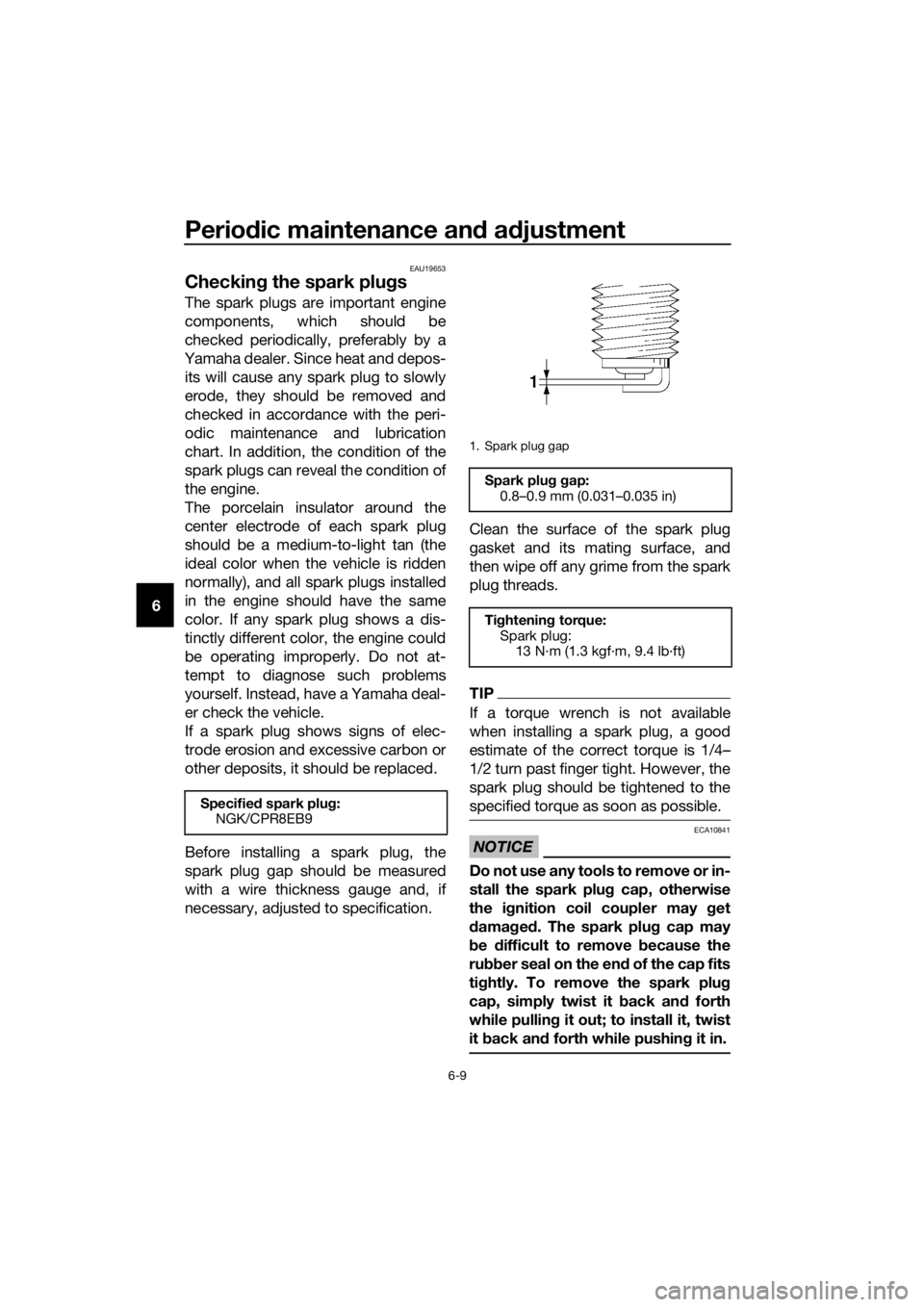
Before installing a spark plug, the
spark plug gap should be measured
with a wire thickness gauge and, if
necessary, adjusted to specification. Clean the surface of the spark plug
gasket and its mating surface, and
then wipe off any grime from the spark
plug threads.
TIP
If a torque wrench is not available
when installing a spark plug, a good
estimate of the correct torque is 1/4–
1/2 turn past finger tight. However, the
spark plug should be tightened to the
specified torque as soon as possible.
NOTICE
ECA10841
Do not use any tools to remove or in-
stall the spark plu
g cap, otherwise
the i gnition coil coupler may get
d amag ed . The spark plu g cap may
b e difficult to remove because the
ru bber seal on the en d of the cap fits
ti g htly. To remove the spark plu g
cap, simply twist it b ack and forth
while pullin g it out; to install it, twist
it back an d forth while pushin g it in.
Specifie d spark plu g:
NGK/CPR8EB9
1. Spark plug gap
Spark plu g g ap:
0.8–0.9 mm (0.031–0.035 in)
Ti ghtening torque:
Spark plug: 13 N·m (1.3 kgf·m, 9.4 lb·ft)
UBP8E0E0.book Page 9 Thursday, December 8, 2016 7:25 PM
Page 73 of 120
Periodic maintenance an d a djustment
6-10
6
EAU79401
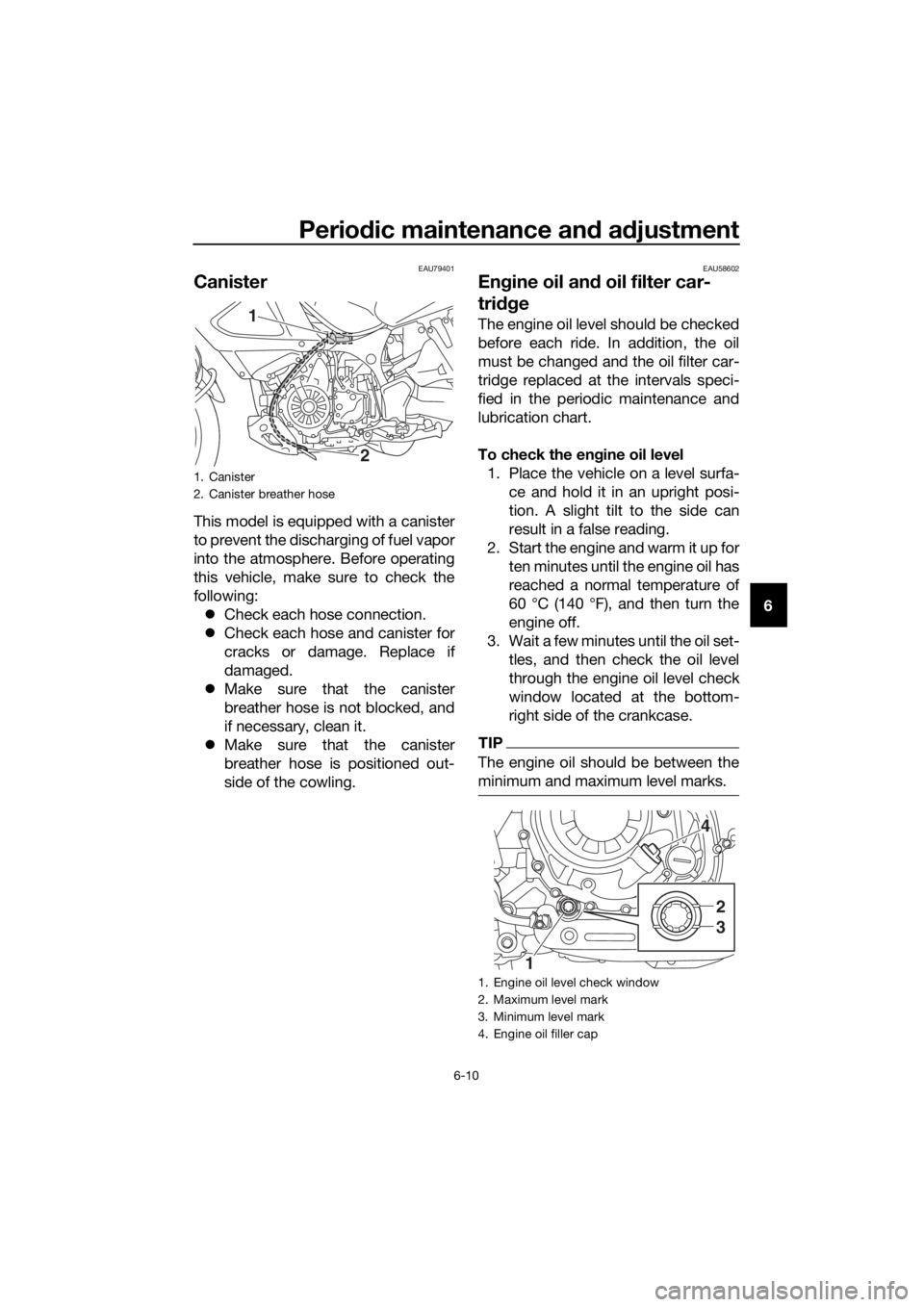
Canister
This model is equipped with a canister
to prevent the discharging of fuel vapor
into the atmosphere. Before operating
this vehicle, make sure to check the
following:
Check each hose connection.
Check each hose and canister for
cracks or damage. Replace if
damaged.
Make sure that the canister
breather hose is not blocked, and
if necessary, clean it.
Make sure that the canister
breather hose is positioned out-
side of the cowling.
EAU58602
Engine oil an d oil filter car-
tri dge
The engine oil level should be checked
before each ride. In addition, the oil
must be changed and the oil filter car-
tridge replaced at the intervals speci-
fied in the periodic maintenance and
lubrication chart.
To check the en gine oil level
1. Place the vehicle on a level surfa- ce and hold it in an upright posi-
tion. A slight tilt to the side can
result in a false reading.
2. Start the engine and warm it up for ten minutes until the engine oil has
reached a normal temperature of
60 °C (140 °F), and then turn the
engine off.
3. Wait a few minutes until the oil set- tles, and then check the oil level
through the engine oil level check
window located at the bottom-
right side of the crankcase.
TIP
The engine oil should be between the
minimum and maximum level marks.
1. Canister
2. Canister breather hose
2
1
1. Engine oil level check window
2. Maximum level mark
3. Minimum level mark
4. Engine oil filler cap
4
2
3
1
UBP8E0E0.book Page 10 Thursday, December 8, 2016 7:25 PM