ABS YAMAHA XT1200Z 2019 Owners Manual
[x] Cancel search | Manufacturer: YAMAHA, Model Year: 2019, Model line: XT1200Z, Model: YAMAHA XT1200Z 2019Pages: 118, PDF Size: 3.8 MB
Page 1 of 118
![YAMAHA XT1200Z 2019 Owners Manual DIC183
XT1200Z
XT1200Z
Super Ténéré ABS
OWNER’S MANUAL
BP8-28199-E1
MOTORCYCLE
[English (E)]
Read this manual carefully before oper-
ating this vehicle.](/img/51/53103/w960_53103-0.png "YAMAHA XT1200Z 2019 Owners Manual DIC183
XT1200Z
XT1200Z
Super Ténéré ABS
OWNER’S MANUAL
BP8-28199-E1
MOTORCYCLE
[English (E)]
Read this manual carefully before oper-
ating this vehicle.")
DIC183
XT1200Z
XT1200Z
Super Ténéré ABS
OWNER’S MANUAL
BP8-28199-E1
MOTORCYCLE
[English (E)]
Read this manual carefully before oper-
ating this vehicle.
Page 5 of 118

Table of contents
Safety information ............................1-1
Description ........................................2-1
Left view ..........................................2-1
Right view........................................2-2
Controls and instruments ................2-3
Instrument an d control functions ....3-1
Immobilizer system .........................3-1
Main switch/steering lock ...............3-2
Indicator lights and warning lights ............................................3-3
Cruise control system .....................3-6
Multi-function meter unit .................3-9
D-mode (drive mode) ....................3-19
Handlebar switches.......................3-20
Clutch lever ...................................3-22
Shift pedal .....................................3-22
Brake lever ....................................3-23
Brake pedal ...................................3-24
ABS ...............................................3-24
Traction control system.................3-25
Fuel tank cap.................................3-27
Fuel................................................3-28
Fuel tank overflow hose ................3-29
Catalytic converter ........................3-30
Rider seat ......................................3-30
Adjusting the rider seat height ......3-31
Windshield.....................................3-33
Adjusting the front fork..................3-34
Adjusting the shock absorber assembly....................................3-36
Carriers..........................................3-37
Luggage strap holders ..................3-38
Auxiliary DC jack ...........................3-39
Sidestand ......................................3-40
Ignition circuit cut-off system........3-40
For your safety – pre-operation
checks ...............................................4-1
Operation an d important ri din g
points .................................................5-1
Starting the engine ..........................5-2
Shifting ............................................5-3 Tips for reducing fuel
consumption................................ 5-4
Engine break-in ............................... 5-5
Parking ............................................ 5-6
Perio dic maintenance an d
a d justment ........................................ 6-1
Tool kit ............................................ 6-2
Periodic maintenance charts .......... 6-3
Periodic maintenance chart for the emission control system.............. 6-3
General maintenance and lubrication chart........................... 6-4
Removing and installing
cowlings ...................................... 6-7
Checking the spark plugs ............... 6-9
Canister......................................... 6-10
Engine oil ...................................... 6-10
Why Yamalube .............................. 6-13
Final gear oil.................................. 6-14
Coolant ......................................... 6-16
Air filter element ............................ 6-17
Checking the engine idling speed......................................... 6-18
Checking the throttle grip free play ............................................ 6-18
Valve clearance ............................. 6-19
Tires .............................................. 6-19
Spoke wheels ............................... 6-22
Clutch lever ................................... 6-22
Checking the brake lever free play ............................................ 6-23
Brake light switches ...................... 6-23
Checking the front and rear brake pads................................. 6-24
Checking the brake fluid level....... 6-25
Changing the brake and clutch fluids .......................................... 6-26
Checking and lubricating the throttle grip and cable ............... 6-26
Checking and lubricating the
brake and shift pedals ............... 6-27
Checking and lubricating the brake and clutch levers ............. 6-27
Checking and lubricating the
sidestand ................................... 6-28
UBP8E1E0.book Page 1 Friday, September 14, 2018 11:35 AM
Page 17 of 118
Instrument and control functions
3-3
3
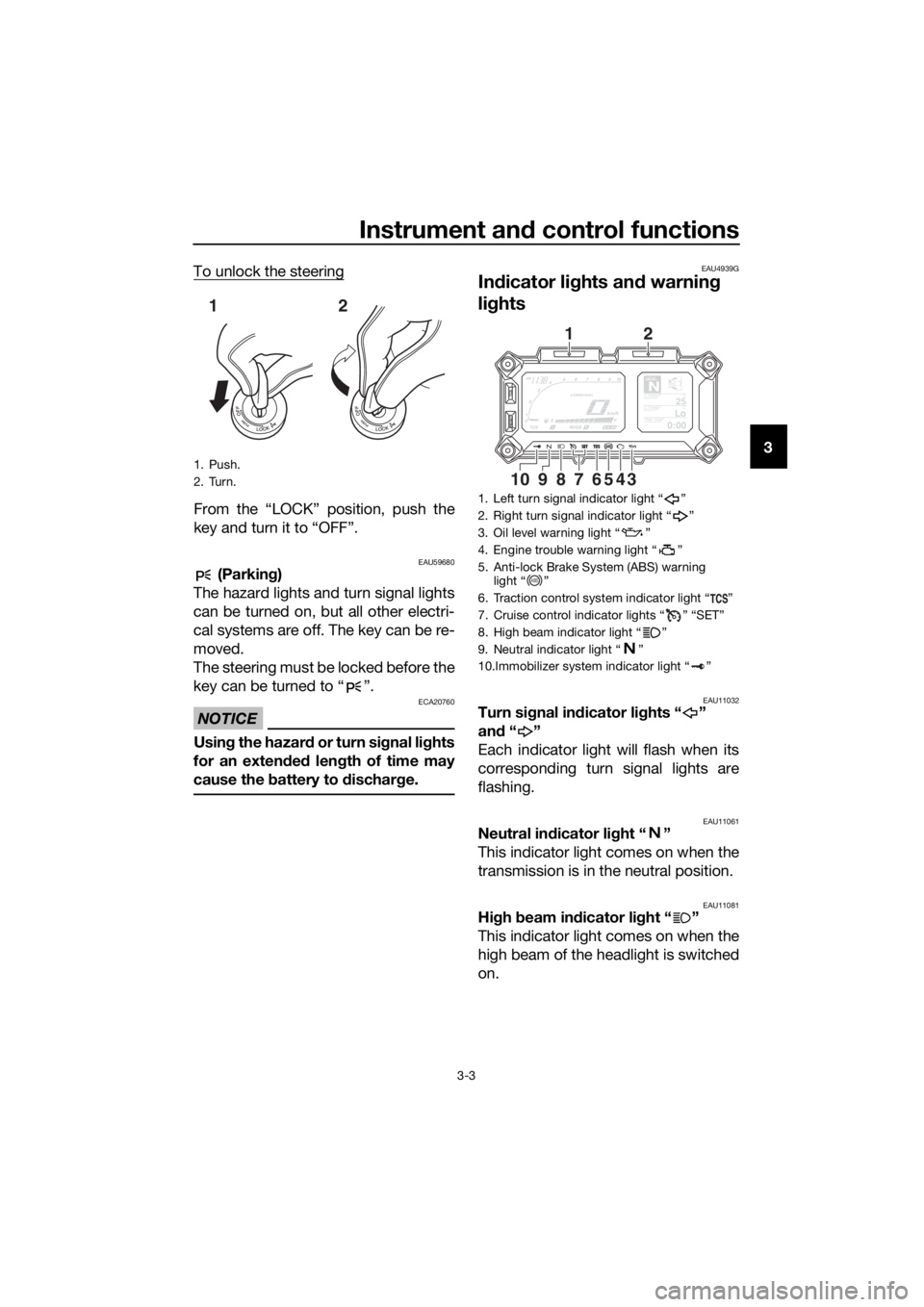
To unlock the steering
From the “LOCK” position, push the
key and turn it to “OFF”.
EAU59680 (Parkin
g)
The hazard lights and turn signal lights
can be turned on, but all other electri-
cal systems are off. The key can be re-
moved.
The steering must be locked before the
key can be turned to “ ”.
NOTICE
ECA20760
Usin g the hazar d o r t u r n s i gnal li ghts
for an exten ded len gth of time may
cause the battery to d ischarge.
EAU4939G
In dicator li ghts an d warnin g
lig hts
EAU11032Turn si gnal in dicator li ghts “ ”
an d“”
Each indicator light will flash when its
corresponding turn signal lights are
flashing.
EAU11061Neutral in dicator li ght “ ”
This indicator light comes on when the
transmission is in the neutral position.
EAU11081Hi gh beam in dicator li ght “ ”
This indicator light comes on when the
high beam of the headlight is switched
on.
1. Push.
2. Turn.
12
1. Left turn signal indicator light “ ”
2. Right turn signal indicator light “ ”
3. Oil level warning light “ ”
4. Engine trouble warning light “ ”
5. Anti-lock Brake System (ABS) warning light “ ”
6. Traction control system indicator light “ ”
7. Cruise control indicator lights “ ” “SET”
8. High beam indicator light “ ”
9. Neutral indicator light “ ”
10.Immobilizer system indicator light “ ”
GEARN25A.TEMP ˚C
LoC.TEMP˚C
0:00TIME TRIP
345687910
12
ABS
UBP8E1E0.book Page 3 Friday, September 14, 2018 11:35 AM
Page 18 of 118

Instrument and control functions
3-4
3
EAU11259Oil level warnin g li ght “ ”
This warning light comes on when the
engine oil level is low. To prevent en-
gine damage, replenish the engine oil
as soon as possible.
Even if the oil level is sufficient, the
warning light may flicker when riding
on a slope or during sudden accelera-
tion or deceleration, but this is not a
malfunction. If a problem is detected in
the oil level detection circuit, the oil lev-
el warning light will flash repeatedly. If
this occurs, have a Yamaha dealer
check the vehicle.
TIP
When the vehicle is turned on, the light
will come on for a few seconds and
then go off. If the light does not come
on, or if the light remains on after con-
firming that the oil level is correct (see
page 6-10), have a Yamaha dealer
check the vehicle.
EAU58402Cruise control in dicator li ghts “ ”
an d “SET”
These indicator lights come on when
the cruise control system is activated.
(See page 3-6.)
TIP
When the vehicle is turned on, these
lights should come on for a few sec-
onds and then go off. If the lights do
not come on, have a Yamaha dealer
check the vehicle.
EAU73172En gine trou ble warnin g lig ht “ ”
This warning light comes on if a prob-
lem is detected in the engine or other
vehicle control system. If this occurs,
have a Yamaha dealer check the on-
board diagnostic system.
TIP
When the vehicle is turned on, the light
will come on for a few seconds and
then go off. If the light does not come
on, or if the light remains on, have a
Yamaha dealer check the vehicle.
EAU69892ABS warnin g li ght “ ”
This warning light comes on when the
vehicle is first turned on, and goes off
after starting riding. If the warning light
comes on while riding, the anti-lock
brake system may not work correctly.
(See page 3-24.)
TIP
If the light does not come at all, or if the
light does not go off after traveling 10
km/h (6 mi/h), have a Yamaha dealer
check the vehicle.
WARNING
EWA16041
If the ABS warnin g li ght does not go
off after travelin g at a speed of 10
km/h (6 mi/h) or hi gher, or if the
warnin g li ght comes on or flashes
while ri din g, the b rake system re-
verts to conventional brakin g. If ei-
ther of the ab ove occurs, or if the
warnin g li ght does not come on at
all, use extra caution to avoi d possi-
b le wheel lock durin g emer gency
ABS
UBP8E1E0.book Page 4 Friday, September 14, 2018 11:35 AM
Page 38 of 118
Instrument and control functions
3-24
3
EAU49484
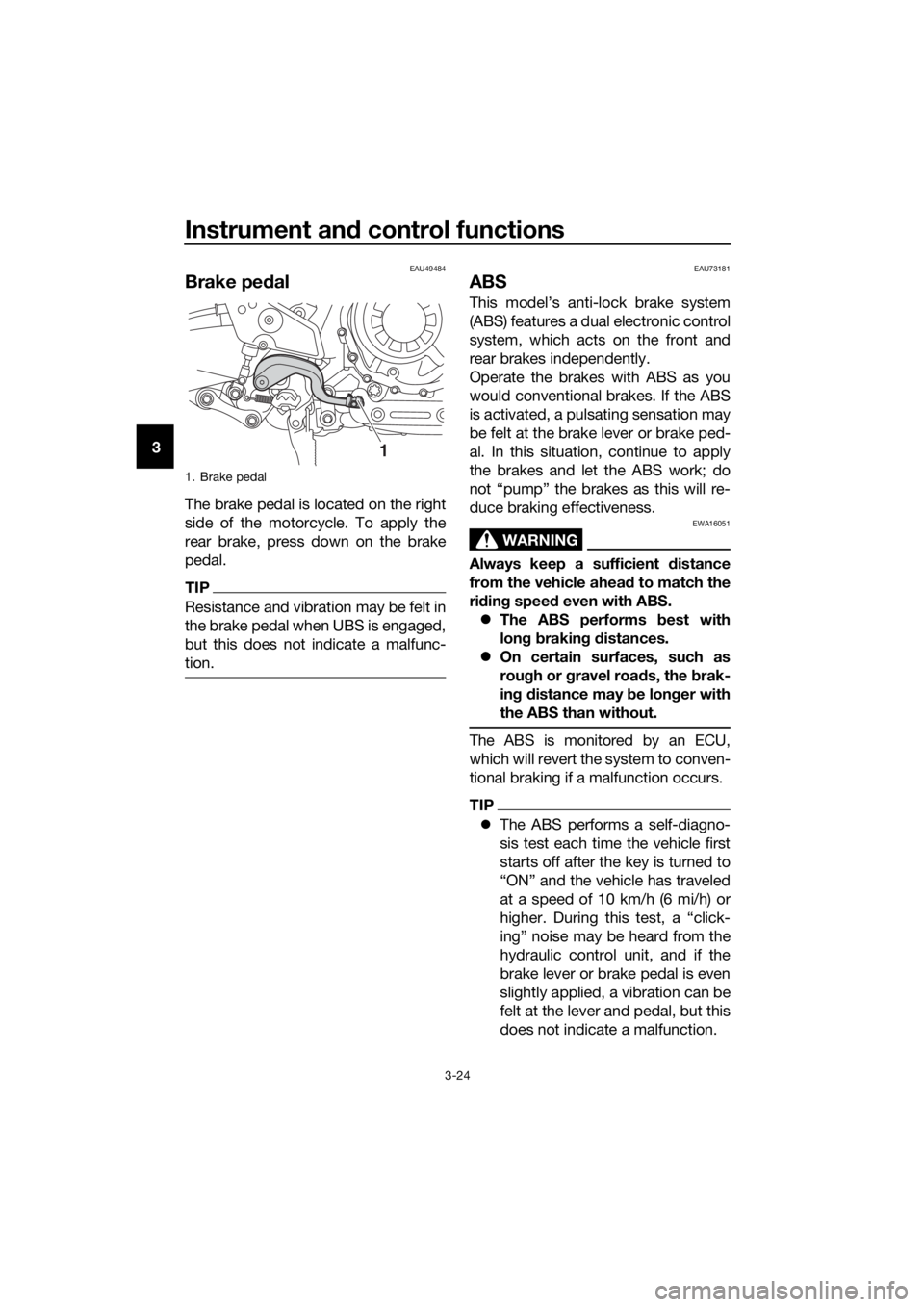
Brake ped al
The brake pedal is located on the right
side of the motorcycle. To apply the
rear brake, press down on the brake
pedal.
TIP
Resistance and vibration may be felt in
the brake pedal when UBS is engaged,
but this does not indicate a malfunc-
tion.
EAU73181
ABS
This model’s anti-lock brake system
(ABS) features a dual electronic control
system, which acts on the front and
rear brakes independently.
Operate the brakes with ABS as you
would conventional brakes. If the ABS
is activated, a pulsating sensation may
be felt at the brake lever or brake ped-
al. In this situation, continue to apply
the brakes and let the ABS work; do
not “pump” the brakes as this will re-
duce braking effectiveness.
WARNING
EWA16051
Always keep a sufficient d istance
from the vehicle ahead to match the
ri din g speed even with ABS.
The ABS performs b est with
lon g b rakin g d istances.
On certain surfaces, such as
rou gh or g ravel roa ds, the b rak-
in g d istance may be lon ger with
the ABS than without.
The ABS is monitored by an ECU,
which will revert the system to conven-
tional braking if a malfunction occurs.
TIP
The ABS performs a self-diagno-
sis test each time the vehicle first
starts off after the key is turned to
“ON” and the vehicle has traveled
at a speed of 10 km/h (6 mi/h) or
higher. During this test, a “click-
ing” noise may be heard from the
hydraulic control unit, and if the
brake lever or brake pedal is even
slightly applied, a vibration can be
felt at the lever and pedal, but this
does not indicate a malfunction.
1. Brake pedal
1
UBP8E1E0.book Page 24 Friday, September 14, 2018 11:35 AM
Page 39 of 118
Instrument and control functions
3-25
3
This ABS has a test mode which
allows the owner to experience
the pulsation at the brake lever or
brake pedal when the ABS is op-
erating. However, special tools are
required, so please consult your
Yamaha dealer.
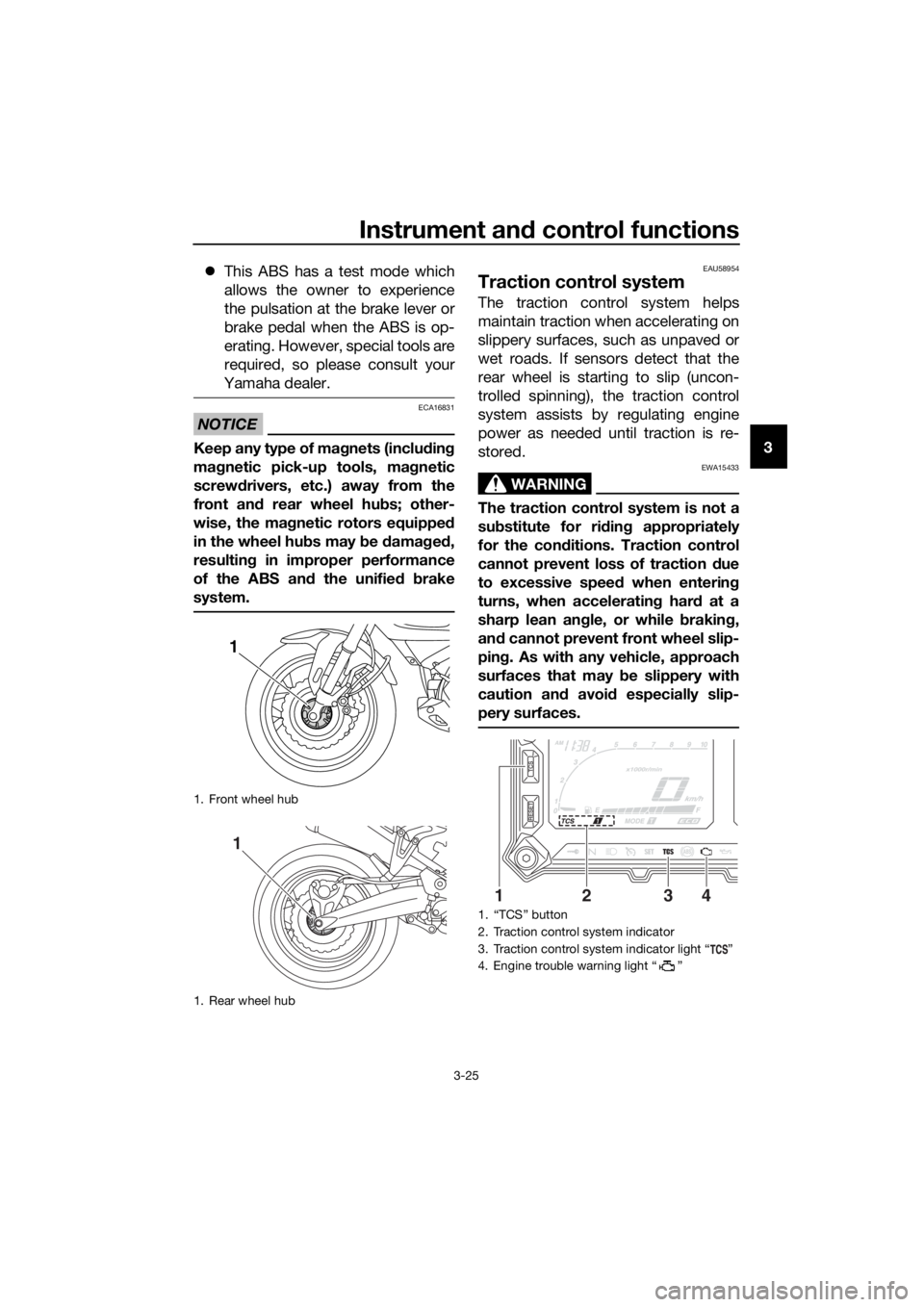
NOTICE
ECA16831
Keep any type of mag nets (includin g
ma gnetic pick-up tools, mag netic
screwd rivers, etc.) away from the
front an d rear wheel hu bs; other-
wise, the ma gnetic rotors equippe d
in the wheel hu bs may b e damag ed ,
resultin g in improper performance
of the ABS an d the unified b rake
system.
EAU58954
Traction control system
The traction control system helps
maintain traction when accelerating on
slippery surfaces, such as unpaved or
wet roads. If sensors detect that the
rear wheel is starting to slip (uncon-
trolled spinning), the traction control
system assists by regulating engine
power as needed until traction is re-
stored.
WARNING
EWA15433
The traction control system is not a
su bstitute for ri din g appropriately
for the con ditions. Traction control
cannot prevent loss of traction d ue
to excessive spee d when enterin g
turns, when acceleratin g har d at a
sharp lean an gle, or while b raking,
an d cannot prevent front wheel slip-
pin g. As with any vehicle, approach
surfaces that may be slippery with
caution an d avoi d especially slip-
pery surfaces.
1. Front wheel hub
1. Rear wheel hub
1
1
1. “TCS” button
2. Traction control system indicator
3. Traction control system indicator light “ ”
4. Engine trouble warning light “ ”
1324
UBP8E1E0.book Page 25 Friday, September 14, 2018 11:35 AM
Page 50 of 118
Instrument and control functions
3-36
3
EAU49693
A djustin g the shock a bsorb er
assem bly
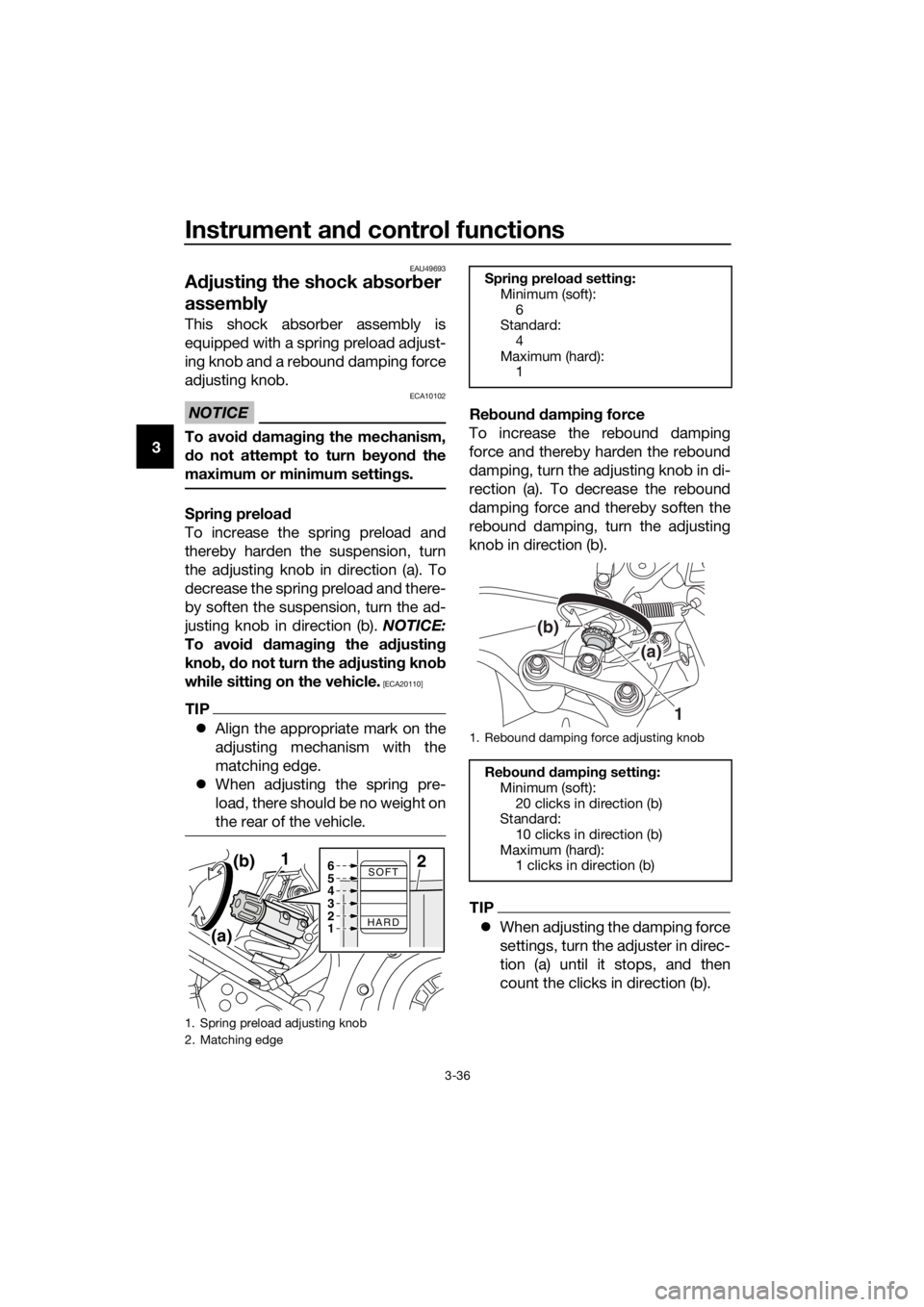
This shock absorber assembly is
equipped with a spring preload adjust-
ing knob and a rebound damping force
adjusting knob.
NOTICE
ECA10102
To avoi d d amag ing the mechanism,
d o not attempt to turn b eyond the
maximum or minimum settin gs.
Sprin g preloa d
To increase the spring preload and
thereby harden the suspension, turn
the adjusting knob in direction (a). To
decrease the spring preload and there-
by soften the suspension, turn the ad-
justing knob in direction (b). NOTICE:
To avoi d damag ing the a djustin g
kno b, d o not turn the a djustin g kno b
while sittin g on the vehicle.
[ECA20110]
TIP
Align the appropriate mark on the
adjusting mechanism with the
matching edge.
When adjusting the spring pre-
load, there should be no weight on
the rear of the vehicle.
Reboun d d ampin g force
To increase the rebound damping
force and thereby harden the rebound
damping, turn the adjusting knob in di-
rection (a). To decrease the rebound
damping force and thereby soften the
rebound damping, turn the adjusting
knob in direction (b).
TIP
When adjusting the damping force
settings, turn the adjuster in direc-
tion (a) until it stops, and then
count the clicks in direction (b).
1. Spring preload adjusting knob
2. Matching edge
SOFT
HARD1(b)
(a)
6
5
4
3
2
12
Sprin g preloa d settin g:
Minimum (soft): 6
Standard:
4
Maximum (hard): 1
1. Rebound damping force adjusting knob
Re boun d d ampin g settin g:
Minimum (soft): 20 clicks in direction (b)
Standard:
10 clicks in direction (b)
Maximum (hard): 1 clicks in direction (b)
1
(b)
(a)
UBP8E1E0.book Page 36 Friday, September 14, 2018 11:35 AM
Page 59 of 118
Operation and important ri din g points
5-2
5
EAU54174
Startin g the eng ine
In order for the ignition circuit cut-off
system (page 3-40) to enable starting,
one of the following conditions must be
met:
the transmission is in neutral.
the clutch lever is pulled and the
sidestand up.
To start the engine
1. Turn the main switch to “ON” and set the engine stop switch to “ ”.
2. Confirm the following lights come on for a few seconds, and then go
off. Oil level warning light
Engine trouble warning light
TCS indicator light
Cruise control indicator lights
Immobilizer system indicator
light
ABS warning light
Neutral indicator light
TIP
The ABS warning light should go
off when the vehicle reaches a
traveling speed of 10 km/h (6
mi/h).
The neutral indicator light should
be on when the transmission is in
neutral.
NOTICE
ECA24110
If a warnin g or in dicator li ght does
not work as descri bed a bove, have a
Yamaha dealer check the vehicle.
3. Shift the transmission into neutral.
4. Push the start switch, and release
it when the engine starts. If the engine does not start within
5 seconds of pressing the start
switch, wait 10 seconds before
pressing the switch again to allow
the battery voltage to restore.
NOTICE
ECA11043
For maximum en
gine life, never ac-
celerate har d when the en gine is
col d!
UBP8E1E0.book Page 2 Friday, September 14, 2018 11:35 AM
Page 88 of 118
Periodic maintenance an d a djustment
6-25
6
EAU40262
Checkin g the brake flui d level
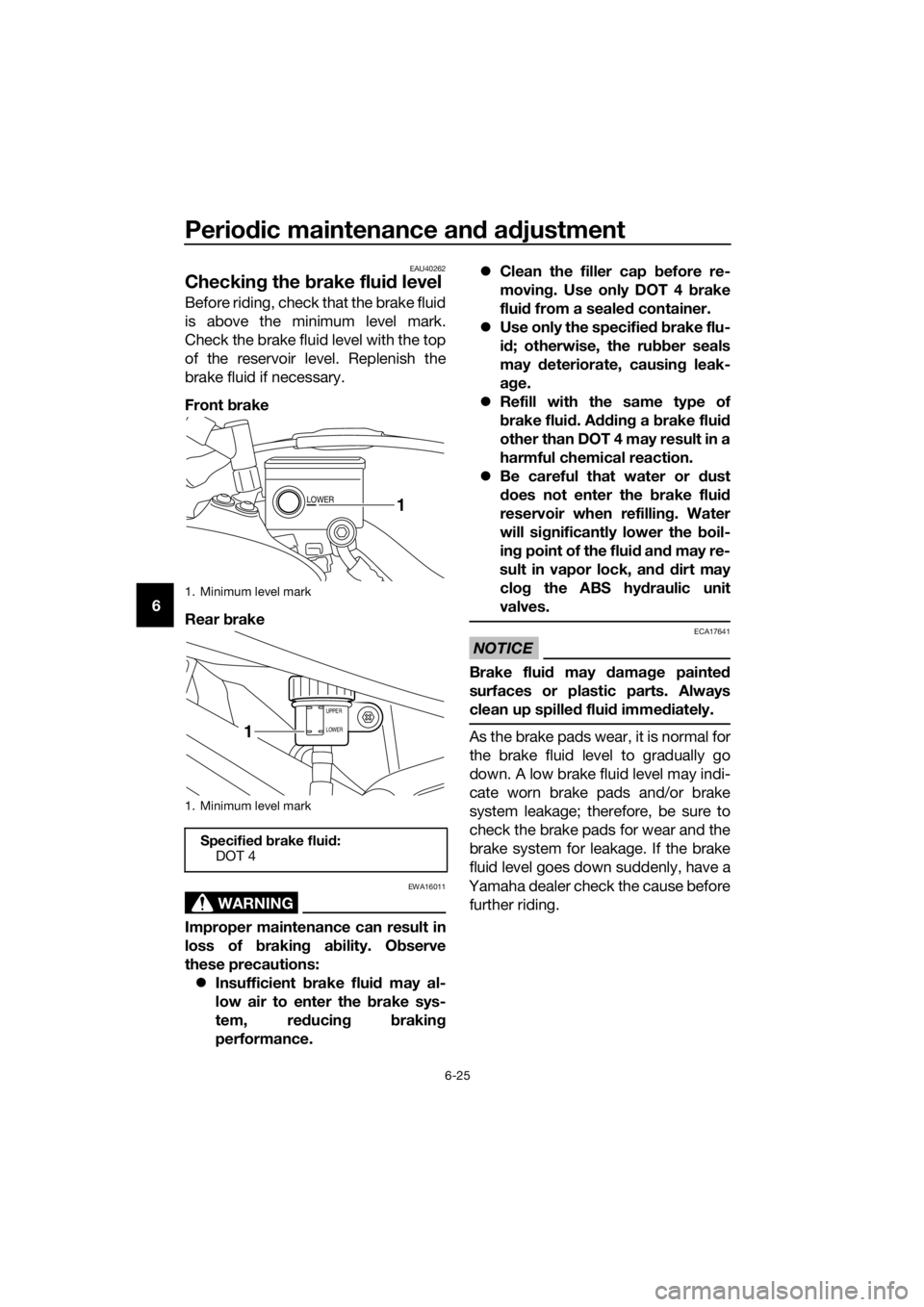
Before riding, check that the brake fluid
is above the minimum level mark.
Check the brake fluid level with the top
of the reservoir level. Replenish the
brake fluid if necessary.
Front brake
Rear brake
WARNING
EWA16011
Improper maintenance can result in
loss of b raking a bility. O bserve
these precautions: Insufficient brake flui d may al-
low air to enter the brake sys-
tem, re ducing brakin g
performance.
Clean the filler cap before re-
moving . Use only DOT 4 brake
flui d from a seale d container.
Use only the specified b rake flu-
i d ; otherwise, the ru bber seals
may deteriorate, causin g leak-
a g e.
Refill with the same type of
brake flui d. A ddin g a brake flui d
other than DOT 4 may result in a
harmful chemical reaction.
Be careful that water or dust
d oes not enter the brake flui d
reservoir when refillin g. Water
will si gnificantly lower the boil-
in g point of the flui d an d may re-
sult in vapor lock, an d d ir
t may
clo g the ABS hy draulic unit
valves.
NOTICE
ECA17641
Brake flui d may damag e painte d
surfaces or plastic parts. Always
clean up spille d flui d imme diately.
As the brake pads wear, it is normal for
the brake fluid level to gradually go
down. A low brake fluid level may indi-
cate worn brake pads and/or brake
system leakage; therefore, be sure to
check the brake pads for wear and the
brake system for leakage. If the brake
fluid level goes down suddenly, have a
Yamaha dealer check the cause before further riding.
1. Minimum level mark
1. Minimum level mark
Specifie d b rake flui d:
DOT 4
LOWER1
UPPER
LOWER
1
UBP8E1E0.book Page 25 Friday, September 14, 2018 11:35 AM
Page 95 of 118
Periodic maintenance an d a djustment
6-32
6
EAU58963
Replacin g the fuses
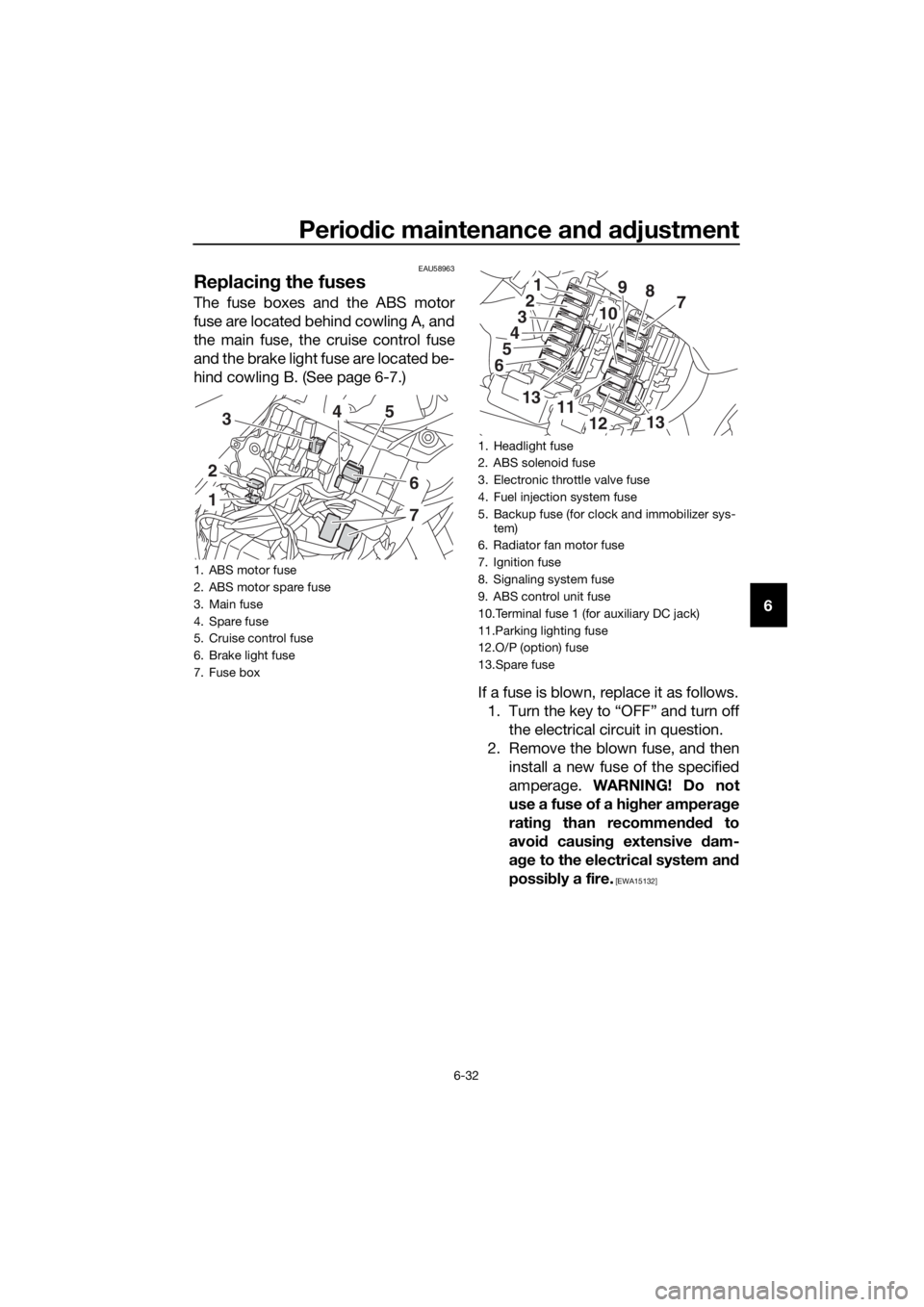
The fuse boxes and the ABS motor
fuse are located behind cowling A, and
the main fuse, the cruise control fuse
and the brake light fuse are located be-
hind cowling B. (See page 6-7.)
If a fuse is blown, replace it as follows.1. Turn the key to “OFF” and turn off the electrical circuit in question.
2. Remove the blown fuse, and then install a new fuse of the specified
amperage. WARNING! Do not
use a fuse of a hi gher ampera ge
ratin g than recommen ded to
avoi d causin g extensive dam-
a g e to the electrical system an d
possi bly a fire.
[EWA15132]
1. ABS motor fuse
2. ABS motor spare fuse
3. Main fuse
4. Spare fuse
5. Cruise control fuse
6. Brake light fuse
7. Fuse box
1
2
354
6
7
1. Headlight fuse
2. ABS solenoid fuse
3. Electronic throttle valve fuse
4. Fuel injection system fuse
5. Backup fuse (for clock and immobilizer sys-
tem)
6. Radiator fan motor fuse
7. Ignition fuse
8. Signaling system fuse
9. ABS control unit fuse
10.Terminal fuse 1 (for auxiliary DC jack)
11.Parking lighting fuse
12.O/P (option) fuse
13.Spare fuse
1
3
4
5
6
2789
10
1311
1213
UBP8E1E0.book Page 32 Friday, September 14, 2018 11:35 AM