suspension YAMAHA XT1200Z 2019 Owners Manual
[x] Cancel search | Manufacturer: YAMAHA, Model Year: 2019, Model line: XT1200Z, Model: YAMAHA XT1200Z 2019Pages: 118, PDF Size: 3.8 MB
Page 9 of 118

Safety information
1-3
1
Avoi
d Car bon Monoxi de Poisonin g
All engine exhaust contains carbon
monoxide, a deadly gas. Breathing
carbon monoxide can cause head-
aches, dizziness, drowsiness, nausea,
confusion, and eventually death.
Carbon Monoxide is a colorless, odor-
less, tasteless gas which may be pres-
ent even if you do not see or smell any
engine exhaust. Deadly levels of car-
bon monoxide can collect rapidly and
you can quickly be overcome and un-
able to save yourself. Also, deadly lev-
els of carbon monoxide can linger for
hours or days in enclosed or poorly
ventilated areas. If you experience any
symptoms of carbon monoxide poi-
soning, leave the area immediately, get
fresh air, and SEEK MEDICAL TREAT-
MENT. Do not run engine indoors. Even if
you try to ventilate engine exhaust
with fans or open windows and
doors, carbon monoxide can rap-
idly reach dangerous levels.
Do not run engine in poorly venti-
lated or partially enclosed areas
such as barns, garages, or car-
ports.
Do not run engine outdoors where
engine exhaust can be drawn into
a building through openings such
as windows and doors.
Loa din g
Adding accessories or cargo to your
motorcycle can adversely affect stabil-
ity and handling if the weight distribu-
tion of the motorcycle is changed. To
avoid the possibility of an accident, use
extreme caution when adding cargo or
accessories to your motorcycle. Use extra care when riding a motorcycle
that has added cargo or accessories.
Here, along with the information about
accessories below, are some general
guidelines to follow if loading cargo to
your motorcycle:
The total weight of the operator, pas-
senger, accessories and cargo must
not exceed the maximum load limit.
Operation of an overloa
ded vehicle
coul d cause an acci dent.
When loading within this weight limit,
keep the following in mind: Cargo and accessory weight
should be kept as low and close to
the motorcycle as possible. Se-
curely pack your heaviest items as
close to the center of the vehicle
as possible and make sure to dis-
tribute the weight as evenly as
possible on both sides of the mo-
torcycle to minimize imbalance or
instability.
Shifting weights can create a sud-
den imbalance. Make sure that
accessories and cargo are se-
curely attached to the motorcycle
before riding. Check accessory
mounts and cargo restraints fre-
quently.
• Properly adjust the suspension for your load (suspension-ad-
justable models only), and
check the condition and pres-
sure of your tires.
• Never attach any large or heavy items to the handlebar, front
fork, or front fender. These
items, including such cargo as
Maximum loa d:
212 kg (467 lb)
UBP8E1E0.book Page 3 Friday, September 14, 2018 11:35 AM
Page 10 of 118

Safety information
1-4
1sleeping bags, duffel bags, or
tents, can create unstable han-
dling or a slow steering re-
sponse.
This vehicle is not desi gne d to
pull a trailer or to be attached to
a si decar.
Genuine Yamaha Accessories
Choosing accessories for your vehicle
is an important decision. Genuine
Yamaha accessories, which are avail- able only from a Yamaha dealer, have
been designed, tested, and approved
by Yamaha for use on your vehicle.
Many companies with no connection
to Yamaha manufacture parts and ac-
cessories or offer other modifications
for Yamaha vehicles. Yamaha is not in
a position to test the products that
these aftermarket companies produce.
Therefore, Yamaha can neither en-
dorse nor recommend the use of ac-
cessories not sold by Yamaha or
modifications not specifically recom-
mended by Yamaha, even if sold and
installed by a Yamaha dealer.
Aftermarket Parts, Accessories, an d
Mo difications
While you may find aftermarket prod-
ucts similar in design and quality to
genuine Yamaha accessories, recog-
nize that some aftermarket accesso-
ries or modifications are not suitable
because of potential safety hazards to
you or others. Installing aftermarket
products or having other modifications
performed to your vehicle that change
any of the vehicle’s design or operation
characteristics can put you and others at greater risk of serious injury or
death. You are responsible for injuries
related to changes in the vehicle.
Keep the following guidelines in mind,
as well as those provided under “Load-
ing” when mounting accessories.
Never install accessories or carry
cargo that would impair the per-
formance of your motorcycle.
Carefully inspect the accessory
before using it to make sure that it
does not in any way reduce
ground clearance or cornering
clearance, limit suspension travel,
steering travel or control opera-
tion, or obscure lights or reflec-
tors.
• Accessories fitted to the han- dlebar or the front fork area can
create instability due to improp-
er weight distribution or aerody-
namic changes. If accessories
are added to the handlebar or
front fork area, they must be as
lightweight as possible and
should be kept to a minimum.
• Bulky or large accessories may seriously affect the stability of
the motorcycle due to aerody-
namic effects. Wind may at-
tempt to lift the motorcycle, or
the motorcycle may become
unstable in cross winds. These
accessories may also cause in-
stability when passing or being
passed by large vehicles.
• Certain accessories can dis- place the operator from his or
her normal riding position. This
improper position limits the
freedom of movement of the
UBP8E1E0.book Page 4 Friday, September 14, 2018 11:35 AM
Page 11 of 118

Safety information
1-5
1
operator and may limit control
ability, therefore, such accesso-
ries are not recommended.
Use caution when adding electri-
cal accessories. If electrical ac-
cessories exceed the capacity of
the motorcycle’s electrical sys-
tem, an electric failure could re-
sult, which could cause a
dangerous loss of lights or engine
power.
Aftermarket Tires an d Rims
The tires and rims that came with your
motorcycle were designed to match
the performance capabilities and to
provide the best combination of han-
dling, braking, and comfort. Other
tires, rims, sizes, and combinations
may not be appropriate. Refer to page
6-19 for tire specifications and more in-
formation on replacing your tires.
Transportin g the Motorcycle
Be sure to observe following instruc-
tions before transporting the motorcy-
cle in another vehicle. Remove all loose items from the
motorcycle.
Check that the fuel cock (if
equipped) is in the “OFF” position
and that there are no fuel leaks.
Point the front wheel straight
ahead on the trailer or in the truck
bed, and choke it in a rail to pre-
vent movement.
Shift the transmission in gear (for
models with a manual transmis-
sion).
Secure the motorcycle with tie-
downs or suitable straps that are
attached to solid parts of the mo- torcycle, such as the frame or up-
per front fork triple clamp (and not,
for example, to rubber-mounted
handlebars or turn signals, or
parts that could break). Choose
the location for the straps carefully
so the straps will not rub against
painted surfaces during transport.
The suspension should be com-
pressed somewhat by the tie-
downs, if possible, so that the mo-
torcycle will not bounce exces-
sively during transport.
UBP8E1E0.book Page 5 Friday, September 14, 2018 11:35 AM
Page 48 of 118
Instrument and control functions
3-34
3
EAU59141
A djustin g the front fork
WARNING
EWA10181
Always a djust both fork le gs equally,
otherwise poor han dlin g an d loss of
sta bility may result.
This front fork is equipped with spring
preload adjusting bolts, rebound
damping force adjusting screws and
compression damping force adjusting
screws.
NOTICE
ECA10102
To avoi d d amag ing the mechanism,
d o not attempt to turn b eyond the
maximum or minimum settin gs.
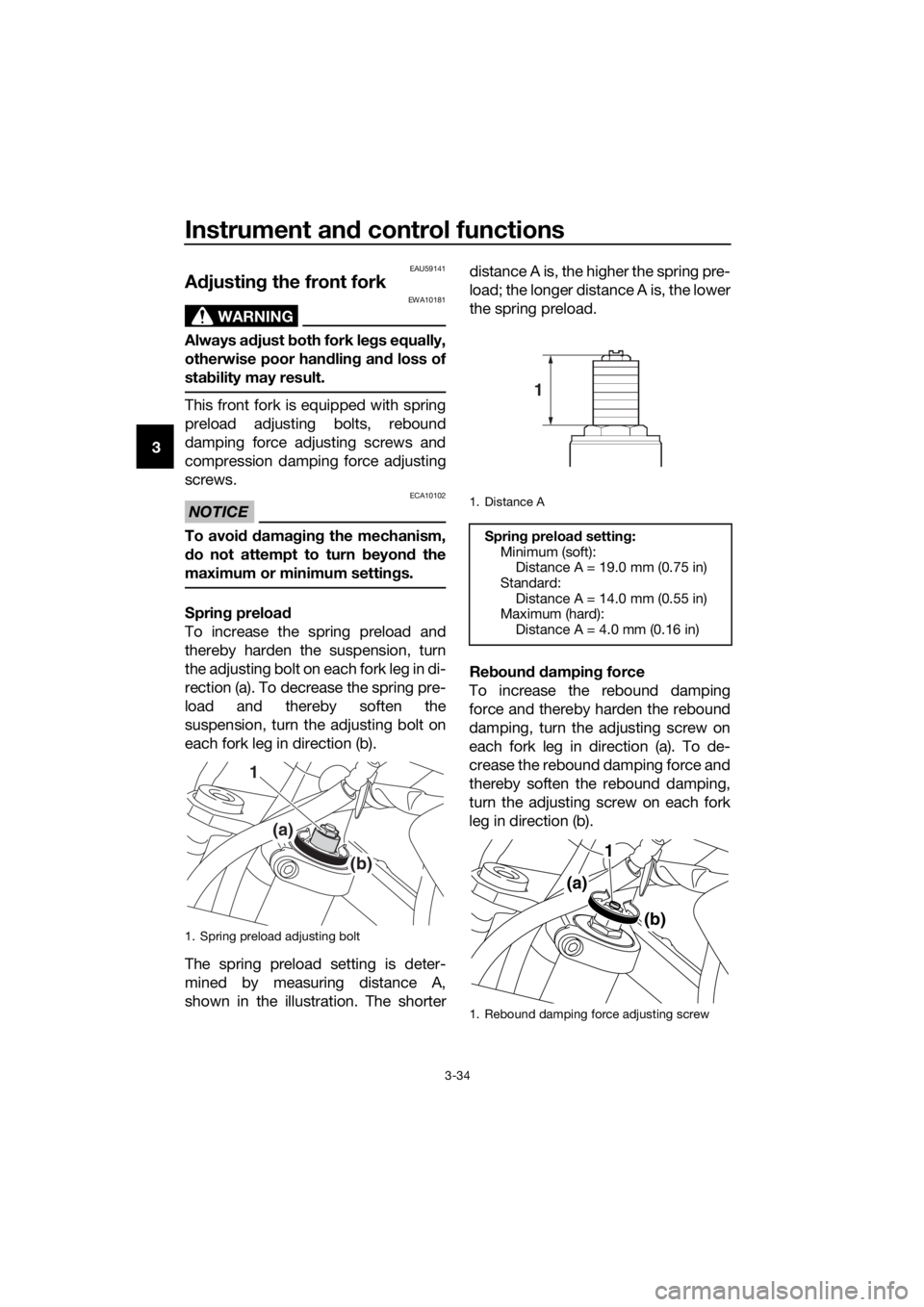
Sprin g preloa d
To increase the spring preload and
thereby harden the suspension, turn
the adjusting bolt on each fork leg in di-
rection (a). To decrease the spring pre-
load and thereby soften the
suspension, turn the adjusting bolt on
each fork leg in direction (b).
The spring preload setting is deter-
mined by measuring distance A,
shown in the illustration. The shorter distance A is, the higher the spring pre-
load; the longer distance A is, the lower
the spring preload.
Re
boun d d ampin g force
To increase the rebound damping
force and thereby harden the rebound
damping, turn the adjusting screw on
each fork leg in direction (a). To de-
crease the rebound damping force and
thereby soften the rebound damping,
turn the adjusting screw on each fork
leg in direction (b).
1. Spring preload adjusting bolt
1
(a) (b)
1. Distance A
Spring preloa d settin g:
Minimum (soft): Distance A = 19.0 mm (0.75 in)
Standard: Distance A = 14.0 mm (0.55 in)
Maximum (hard):
Distance A = 4.0 mm (0.16 in)
1. Rebound damping force adjusting screw
1
1
(a)
(b)
UBP8E1E0.book Page 34 Friday, September 14, 2018 11:35 AM
Page 49 of 118
Instrument and control functions
3-35
3
TIP
When adjusting the damping force set-
tings, turn the adjuster in direction (a)
until it stops, and then count the clicks
in direction (b).
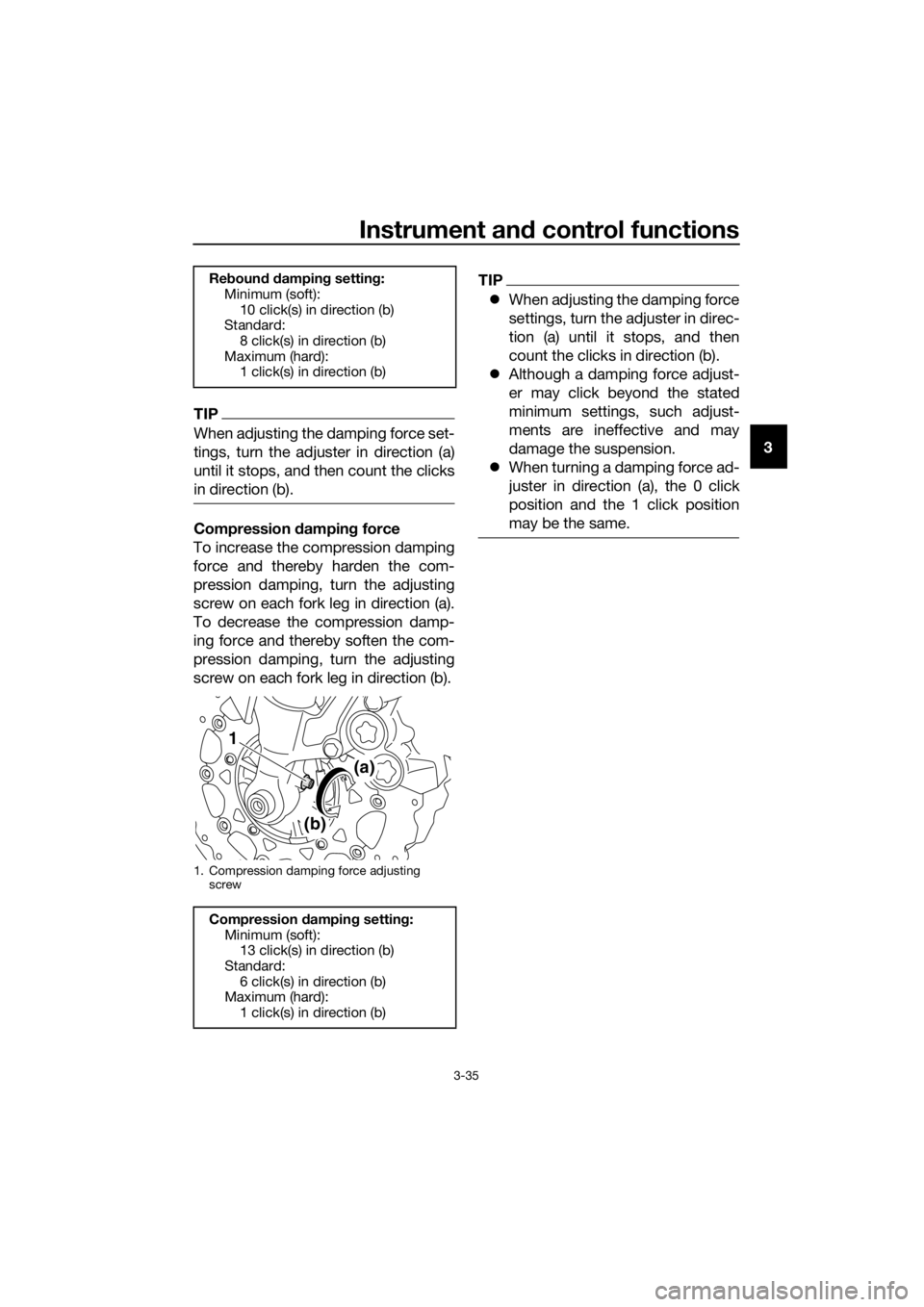
Compression dampin g force
To increase the compression damping
force and thereby harden the com-
pression damping, turn the adjusting
screw on each fork leg in direction (a).
To decrease the compression damp-
ing force and thereby soften the com-
pression damping, turn the adjusting
screw on each fork leg in direction (b).
TIP
When adjusting the damping force
settings, turn the adjuster in direc-
tion (a) until it stops, and then
count the clicks in direction (b).
Although a damping force adjust-
er may click beyond the stated
minimum settings, such adjust-
ments are ineffective and may
damage the suspension.
When turning a damping force ad-
juster in direction (a), the 0 click
position and the 1 click position
may be the same.
Reboun d d ampin g settin g:
Minimum (soft): 10 click(s) in direction (b)
Standard:
8 click(s) in direction (b)
Maximum (hard): 1 click(s) in direction (b)
1. Compression damping force adjusting
screw
Compression dampin g settin g:
Minimum (soft): 13 click(s) in direction (b)
Standard:
6 click(s) in direction (b)
Maximum (hard): 1 click(s) in direction (b)
1
(a)
(b)
UBP8E1E0.book Page 35 Friday, September 14, 2018 11:35 AM
Page 50 of 118
Instrument and control functions
3-36
3
EAU49693
A djustin g the shock a bsorb er
assem bly
This shock absorber assembly is
equipped with a spring preload adjust-
ing knob and a rebound damping force
adjusting knob.
NOTICE
ECA10102
To avoi d d amag ing the mechanism,
d o not attempt to turn b eyond the
maximum or minimum settin gs.
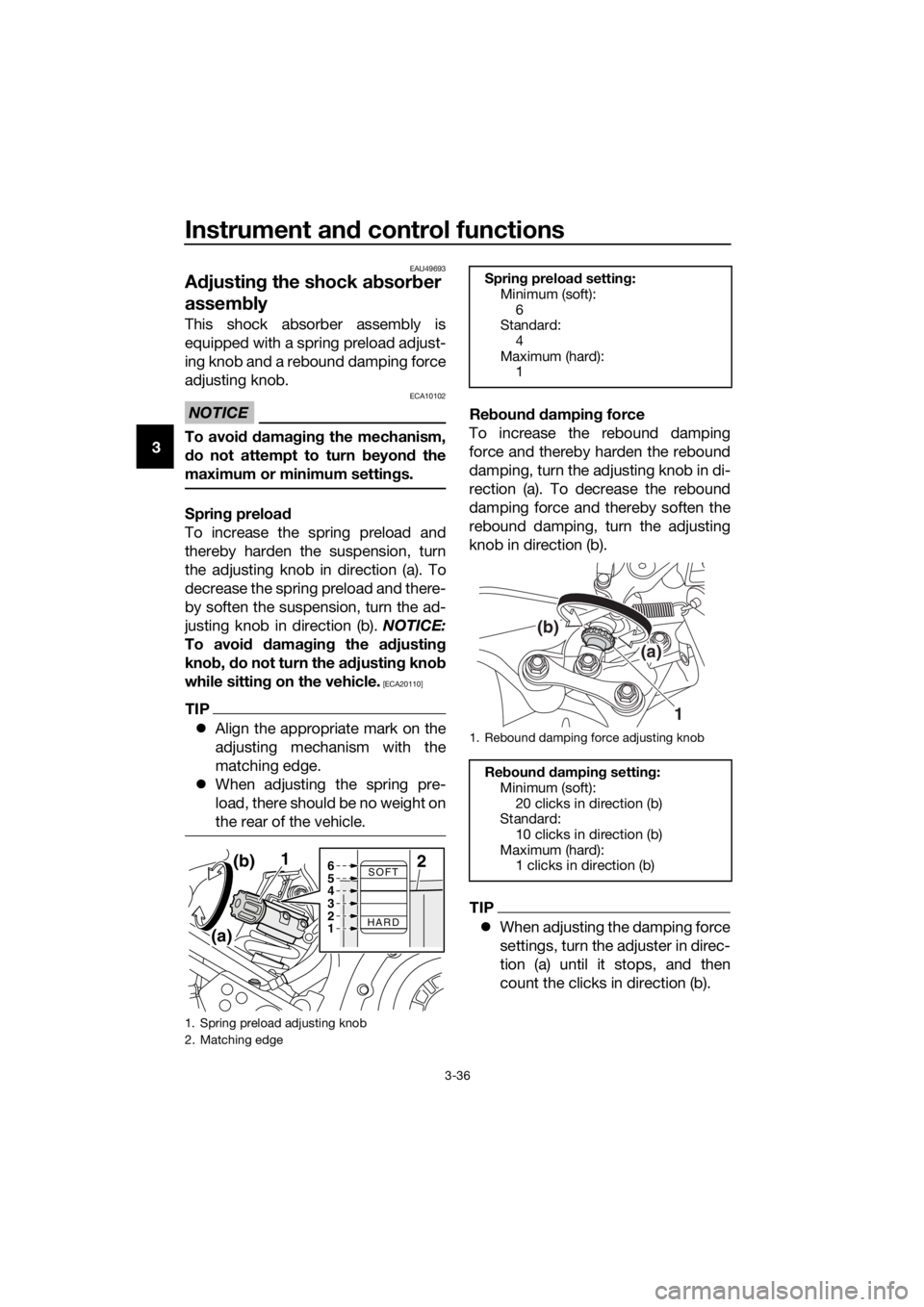
Sprin g preloa d
To increase the spring preload and
thereby harden the suspension, turn
the adjusting knob in direction (a). To
decrease the spring preload and there-
by soften the suspension, turn the ad-
justing knob in direction (b). NOTICE:
To avoi d damag ing the a djustin g
kno b, d o not turn the a djustin g kno b
while sittin g on the vehicle.
[ECA20110]
TIP
Align the appropriate mark on the
adjusting mechanism with the
matching edge.
When adjusting the spring pre-
load, there should be no weight on
the rear of the vehicle.
Reboun d d ampin g force
To increase the rebound damping
force and thereby harden the rebound
damping, turn the adjusting knob in di-
rection (a). To decrease the rebound
damping force and thereby soften the
rebound damping, turn the adjusting
knob in direction (b).
TIP
When adjusting the damping force
settings, turn the adjuster in direc-
tion (a) until it stops, and then
count the clicks in direction (b).
1. Spring preload adjusting knob
2. Matching edge
SOFT
HARD1(b)
(a)
6
5
4
3
2
12
Sprin g preloa d settin g:
Minimum (soft): 6
Standard:
4
Maximum (hard): 1
1. Rebound damping force adjusting knob
Re boun d d ampin g settin g:
Minimum (soft): 20 clicks in direction (b)
Standard:
10 clicks in direction (b)
Maximum (hard): 1 clicks in direction (b)
1
(b)
(a)
UBP8E1E0.book Page 36 Friday, September 14, 2018 11:35 AM
Page 51 of 118
Instrument and control functions
3-37
3
Although a damping force adjust-
er may click beyond the stated
minimum settings, such adjust-
ments are ineffective and may
damage the suspension.
When turning a damping force ad-
juster in direction (a), the 0 click
position and the 1 click position
may be the same.WARNING
EWA10222
This shock a bsor ber assem bly con-
tains hi ghly pressurize d nitro gen
g as. Rea d an d un derstan d the fol-
lowin g information before han dlin g
the shock a bsor ber assem bly.
Do not tamper with or attempt
to open the cylind er assembly.
Do not su bject the shock a b-
sor ber assem bly to an open
flame or other hi gh heat source.
This may cause the unit to ex-
plo de due to excessive g as
pressure.
Do not deform or damag e the
cylin der in any way. Cylin der
d amag e will result in poor
d ampin g performance.
Do not d ispose of a damag ed or
worn-out shock a bsor ber as-
sem bl
y yourself. Take the shock
a b sor ber assem bly to a Yamaha
d ealer for any service.
EAU49705
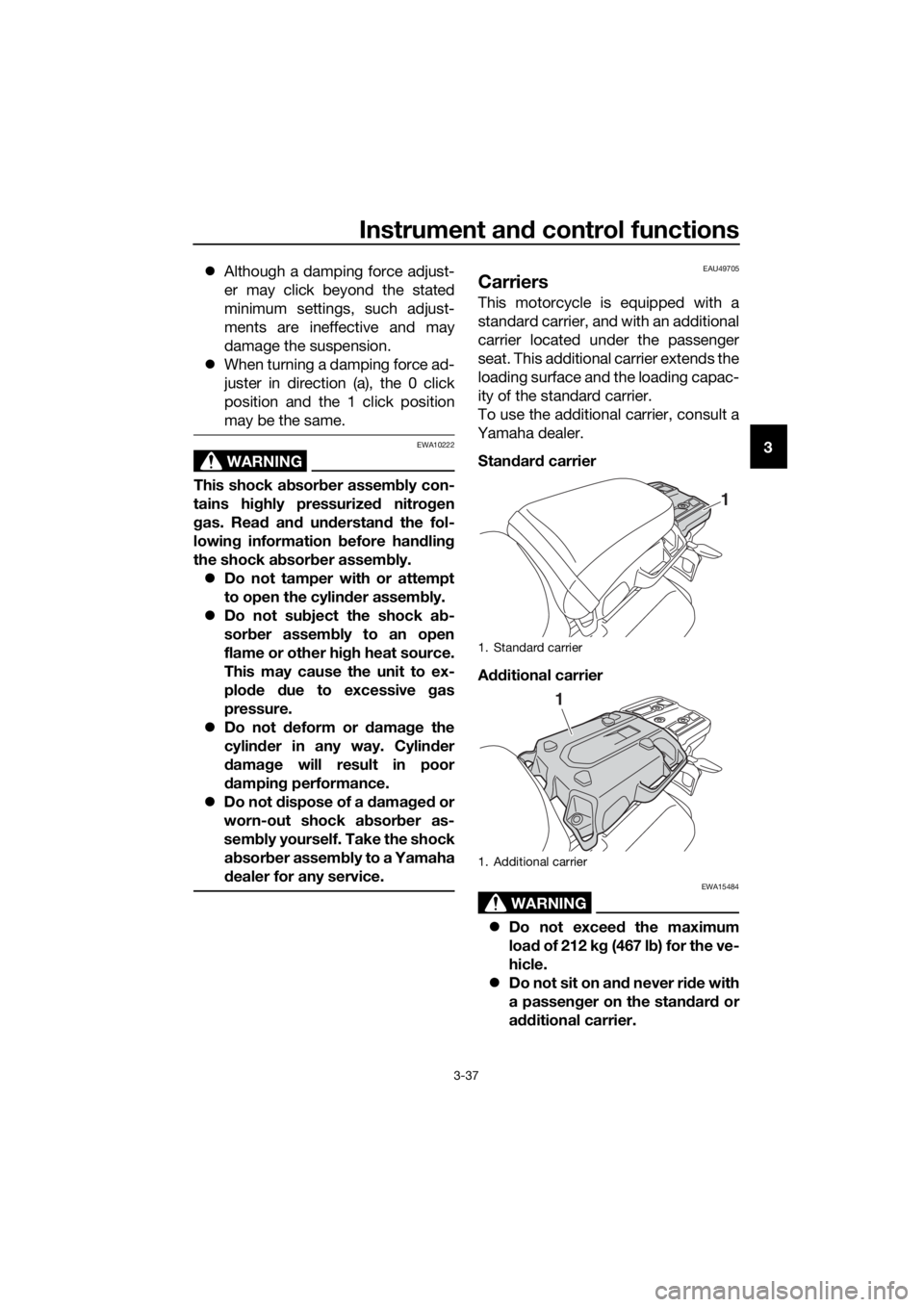
Carriers
This motorcycle is equipped with a
standard carrier, and with an additional
carrier located under the passenger
seat. This additional carrier extends the
loading surface and the loading capac-
ity of the standard carrier.
To use the additional carrier, consult a
Yamaha dealer.
Stan dar d carrier
A dditional carrier
WARNING
EWA15484
Do not exceed the maximum
loa d of 212 k g (467 l b) for the ve-
hicle.
Do not sit on an d never ri de with
a passen ger on the stan dar d or
a dd itional carrier.
1. Standard carrier
1. Additional carrier
1
1
UBP8E1E0.book Page 37 Friday, September 14, 2018 11:35 AM
Page 68 of 118

Periodic maintenance an d a djustment
6-5
6
13 *Chassis fasteners • Make sure that all nuts, bolts
and screws are properly tight-
ened. √√√√√
14 Brake lever pivot
shaft
• Lubricate with silicone grease.
√√√√√
15 Brake pe
dal pivot
shaft • Lubricate with lithium-soap-
based grease. √√√√√
16 Clutch lever pivot
shaft • Lubricate with silicone grease.
√√√√√
17 Shift pe
dal pivot
shaft • Lubricate with lithium-soap-
based grease. √√√√√
18 Si destan d • Check operation.
• Lubricate with lithium-soap-
based grease. √√√√√
19 *Sidestan d switch • Check operation and replace if
necessary. √√√√√√
20 *Front fork • Check operation and for oil
leakage.
• Replace if necessary. √√√√
21 *Shock ab
sorber
assem bly • Check operation and for oil
leakage.
• Replace if necessary. √√√√
22 *Rear suspension
relay arm an
d con-
nectin g arm pivot-
in g points • Check operation.
√√√√
23 En gine oil • Change (warm engine before
draining).
• Check oil level and vehicle for oil leakage. √√√√√√
24 En
gine oil filter
cartri dge • Replace.
√√√
25 *Co
olin g system • Check coolant level and vehicle
for coolant leakage. √√√√√
• Change. Every 3 years
NO. ITEM
X 1000 km
CHECK OR
MAINTENANCE JOB
X 1000 mi ODOMETER
READINGS
ANNUAL CHECK
110203040
0.6 6 12 18 24
UBP8E1E0.book Page 5 Friday, September 14, 2018 11:35 AM
Page 111 of 118

Specifications
8-2
8
Rear tire:
Type:Tubeless
Size:
150/70R17M/C 69V
Manufacturer/model: BRIDGESTONE/BW502
Loa din g:
Maximum load:
212 kg (467 lb)
(Total weight of rider, passenger, cargo
and accessories)
Unifie d b rake system:
Operation:
Activated by front brake
Front brake:
Type:
Hydraulic dual disc brake
Rear brake:
Type:
Hydraulic single disc brake
Front suspension:
Type:Telescopic fork
Rear suspension:
Type:Swingarm (link suspension)
Electrical system:
System voltage:
12 V
Battery:
Model:YTZ12S
Voltage, capacity:
12 V, 11.0 Ah (10 HR)
Hea dlig ht:
Bulb type:
Halogen bulb
Bul b watta ge:
Headlight:
H7, 55.0 W
Brake/tail light: LED
Front turn signal light:
LED
Rear turn signal light: LED
Auxiliary light: 5.0 W License plate light:
5.0 W
UBP8E1E0.book Page 2 Friday, September 14, 2018 11:35 AM