fuel YAMAHA XT500E 2002 User Guide
[x] Cancel search | Manufacturer: YAMAHA, Model Year: 2002, Model line: XT500E, Model: YAMAHA XT500E 2002Pages: 100, PDF Size: 2.1 MB
Page 33 of 100

1. Turn the fuel cock lever to “ON”.
2. Turn the key to “ON” and make
sure that the engine stop switch
is set to “#”.
3. Shift the transmission into the
neutral position.NOTE:
When the transmission is in the neu-
tral position, the neutral indicator light
should be on, otherwise have a
Yamaha dealer check the electrical
circuit.4. Turn the starter (choke) on and
completely close the throttle.
(See page 3-9 for starter (choke)
operation.)
5. Start the engine by pushing the
start switch.
5-1
EAU00372
OPERATION AND IMPORTANT RIDING POINTS
5
EAU00373
w8Become thoroughly familiar
with all operating controls and
their functions before riding.
Consult a Yamaha dealer
regarding any control or func-
tion that you do not thorough-
ly understand.
8Never start the engine or oper-
ate it in a closed area for any
length of time. Exhaust fumes
are poisonous, and inhaling
them can cause loss of con-
sciousness and death within a
short time. Always make sure
that there is adequate ventila-
tion.
8Before starting out, make sure
that the sidestand is up. If the
sidestand is not raised com-
pletely, it could contact the
ground and distract the opera-
tor, resulting in a possible loss
of control.
EAU03515
Starting the engineStarting the engineIn order for the ignition circuit cut-off
system to enable starting, one of the
following conditions must be met:
8The transmission is in the neutral
position.
8The transmission is in gear with
the clutch lever pulled and the
sidestand up.
EW000054
w8Before starting the engine,
check the function of the igni-
tion circuit cut-off system
according to the procedure
described on page 3-13.
8Never ride with the sidestand
down.
4PT-E7 (English) 6/29/01 9:13 AM Page 32
Page 36 of 100

5-4
OPERATION AND IMPORTANT RIDING POINTS
5
EAU00424
Tips for reducing fuel
consumptionFuel consumption, tips for reducingFuel consumption depends largely on
your riding style. Consider the follow-
ing tips to reduce fuel consumption:
8Thoroughly warm up the engine.
8Turn the starter (choke) off as
soon as possible.
8Shift up swiftly, and avoid high
engine speeds during accelera-
tion.
8Do not rev the engine while shift-
ing down, and avoid high engine
speeds with no load on the
engine.
8Turn the engine off instead of let-
ting it idle for an extended length
of time (e.g., in traffic jams, at
traffic lights or at railroad cross-
ings).
EAU01128
Engine break-inEngine break-inThere is never a more important peri-
od in the life of your engine than the
period between 0 and 1,600 km. For
this reason, you should read the fol-
lowing material carefully.
Since the engine is brand new, do
not put an excessive load on it for the
first 1,600 km. The various parts in
the engine wear and polish them-
selves to the correct operating clear-
ances. During this period, prolonged
full-throttle operation or any condition
that might result in engine overheat-
ing must be avoided.
EAU04315
0–1,000 km
Avoid prolonged operation above
4,000 r/min.
1,000–1,600 km
Avoid prolonged operation above
5,000 r/min.
ECA00058
cCAfter 1,000 km of operation, the
engine oil must be changed, and
the oil filter element replaced.1,600 km and beyond
The vehicle can now be operated
normally.
4PT-E7 (English) 6/29/01 9:13 AM Page 35
Page 37 of 100

5-5
OPERATION AND IMPORTANT RIDING POINTS
5
EC000053
cC8Keep the engine speed out of
the tachometer red zone.
8If any engine trouble should
occur during the engine break-
in period, immediately have a
Yamaha dealer check the vehi-
cle.
EAU00457
ParkingParkingWhen parking, stop the engine,
remove the key from the main switch,
and then turn the fuel cock lever to
“OFF”.
EW000058
w8Since the engine and exhaust
system can become very hot,
park in a place where pedestri-
ans or children are not likely
to touch them.
8Do not park on a slope or on
soft ground, otherwise the
motorcycle may overturn.
4PT-E7 (English) 6/29/01 9:13 AM Page 36
Page 41 of 100

6-3
PERIODIC MAINTENANCE AND MINOR REPAIR
6
EAU03685
Periodic maintenance and lubrication chart
Periodic maintenance and lubrication chartNOTE:
8The annual checks must be performed every year, except if a kilometer-based maintenance is performed instead.
8From 50,000 km, repeat the maintenance intervals starting from 10,000 km.
8Items marked with an asterisk should be performed by a Yamaha dealer as they require special tools, data and
technical skills.NO. ITEM CHECK OR MAINTENANCE JOBODOMETER READING (× 1,000 km)
ANNUAL
CHECK
1 10203040
1
*Fuel line•Check fuel hoses for cracks or damage.√√√√ √
2 Spark plug•Check condition.
•Clean and regap.√√
•Replace.√√
3*Valves•Check valve clearance.
•Adjust.√√√√
4 Air filter element•Clean.√√
•Replace.√√
5 Clutch•Check operation.
•Adjust.√√√√√
6*Front brake•Check operation, fluid level and vehicle for fluid leakage.
(See NOTE on page 6-5.)√√√√√ √
•Replace brake pads.Whenever worn to the limit
7*Rear brake•Check operation, fluid level and vehicle for fluid leakage.
(See NOTE on page 6-5.)√√√√√ √
•Replace brake pads.Whenever worn to the limit
4PT-E7 (English) 6/29/01 9:13 AM Page 40
Page 54 of 100
6-16
PERIODIC MAINTENANCE AND MINOR REPAIR
6
EAU00635
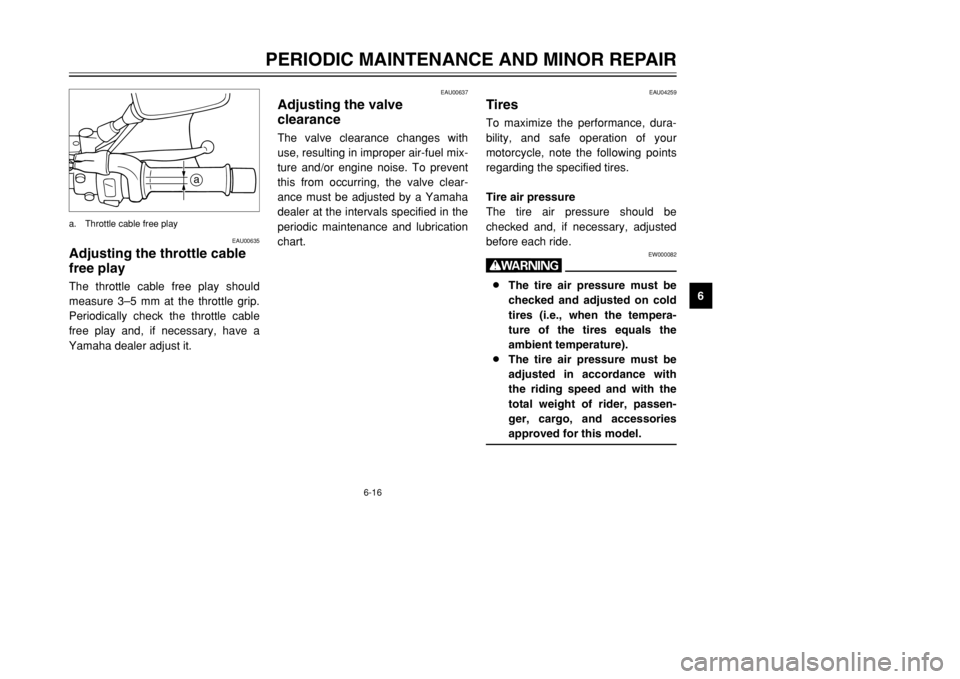
Adjusting the throttle cable
free playThrottle cable free play, adjustingThe throttle cable free play should
measure 3–5 mm at the throttle grip.
Periodically check the throttle cable
free play and, if necessary, have a
Yamaha dealer adjust it.
a
a. Throttle cable free play
EAU04259
TiresTiresTo maximize the performance, dura-
bility, and safe operation of your
motorcycle, note the following points
regarding the specified tires.
Tire air pressure
The tire air pressure should be
checked and, if necessary, adjusted
before each ride.
EW000082
w8The tire air pressure must be
checked and adjusted on cold
tires (i.e., when the tempera-
ture of the tires equals the
ambient temperature).
8The tire air pressure must be
adjusted in accordance with
the riding speed and with the
total weight of rider, passen-
ger, cargo, and accessories
approved for this model.
EAU00637
Adjusting the valve
clearanceValve clearance, adjustingThe valve clearance changes with
use, resulting in improper air-fuel mix-
ture and/or engine noise. To prevent
this from occurring, the valve clear-
ance must be adjusted by a Yamaha
dealer at the intervals specified in the
periodic maintenance and lubrication
chart.
4PT-E7 (English) 6/29/01 9:13 AM Page 53
Page 79 of 100

6-41
PERIODIC MAINTENANCE AND MINOR REPAIR
6
EAU01008
TroubleshootingTroubleshootingAlthough Yamaha motorcycles
receive a thorough inspection before
shipment from the factory, trouble
may occur during operation. Any
problem in the fuel, compression, or
ignition systems, for example, can
cause poor starting and loss of
power.
The following troubleshooting chart
represents a quick and easy proce-
dure for checking these vital systems
yourself. However, should your
motorcycle require any repair, take it
to a Yamaha dealer, whose skilled
technicians have the necessary tools,
experience, and know-how to service
the motorcycle properly.
Use only genuine Yamaha replace-
ment parts. Imitation parts may look
like Yamaha parts, but they are often
inferior, have a shorter service life
and can lead to expensive repair
bills. Tightening torque:
Axle nut:
105 Nm (10.5 m0kgf)
Brake caliper bracket bolt:
48 Nm (4.8 m0kgf)
Swingarm end bolt:
2.5 Nm (0.25 m0kgf)
4PT-E7 (English) 6/29/01 9:13 AM Page 78
Page 80 of 100

6-42
PERIODIC MAINTENANCE AND MINOR REPAIR
6
1. Fuel
2. Compression
3. Ignition
4. Battery
Use electric starter.
There is compression.
Go to ignition check.
No compression.
Ask a Yamaha dealer to inspect.Wet.
Dry.Wipe clean with dry cloth and
Ask a Yamaha dealer to inspect.
Check if there is fuel
Enough fuel
No fuel
Go to compression check.Supply fuel.
in the fuel tank.
Remove sparkelectrodes. plug and checkOpen throttle half-way and start the
Engine doesn’t start, go to batterycheck.engine. correct spark gap or replace spark plug.
Engine turns over
Engine turns overBattery good.
Check connections
quickly.
slowly. or recharge.Engine doesn’t start, ask a Yamaha
dealer to inspect.
Engine doesn’t start, go to compression check.
Use the electric
starter.
EAU01397
Troubleshooting chartTroubleshooting chart
EW000125
wKeep away open flames and do not smoke while checking or working on the fuel system.
4PT-E7 (English) 6/29/01 9:13 AM Page 79
Page 84 of 100

7-2
MOTORCYCLE CARE AND STORAGE
7 8 8
Do not use any harsh chemical
products on plastic parts. Be
sure to avoid using cloths or
sponges which have been in
contact with strong or abra-
sive cleaning products, sol-
vent or thinner, fuel (gasoline),
rust removers or inhibitors,
brake fluid, antifreeze or elec-
trolyte.
8 8
Do not use high-pressure
washers or steam-jet cleaners
since they cause water seep-
age and deterioration in the
following areas: seals (of
wheel and swingarm bearings,
fork and brakes), electric com-
ponents (couplers, connec-
tors, instruments, switches
and lights), breather hoses
and vents.8 8
For motorcycles equipped
with a windshield: Do not use
strong cleaners or hard
sponges as they will cause
dulling or scratching. Some
cleaning compounds for plas-
tic may leave scratches on the
windshield. Test the product
on a small hidden part of the
windshield to make sure that it
does not leave any marks. If
the windshield is scratched,
use a quality plastic polishing
compound after washing.
After normal useRemove dirt with warm water, a mild
detergent, and a soft, clean sponge,
and then rinse thoroughly with clean
water. Use a toothbrush or bottle-
brush for hard-to-reach areas.
Stubborn dirt and insects will come
off more easily if the area is covered
with a wet cloth for a few minutes
before cleaning.After riding in the rain, near the sea
or on salt-sprayed roadsSince sea salt or salt sprayed on
roads during winter are extremely
corrosive in combination with water,
carry out the following steps after
each ride in the rain, near the sea or
on salt-sprayed roads.NOTE:
Salt sprayed on roads in the winter
may remain well into spring.1. Clean the motorcycle with cold
water and a mild detergent, after
the engine has cooled down.
ECA00012
cCDo not use warm water since it
increases the corrosive action of
the salt.2. Apply a corrosion protection
spray on all metal, including
chrome- and nickel-plated, sur-
faces to prevent corrosion.
4PT-E7 (English) 6/29/01 9:13 AM Page 83
Page 86 of 100

7-4
MOTORCYCLE CARE AND STORAGE
7
StorageStorageShort-term
Always store your motorcycle in a
cool, dry place and, if necessary, pro-
tect it against dust with a porous
cover.
ECA00014
cC8Storing the motorcycle in a
poorly ventilated room or cov-
ering it with a tarp, while it is
still wet, will allow water and
humidity to seep in and cause
rust.
8To prevent corrosion, avoid
damp cellars, stables (because
of the presence of ammonia)
and areas where strong chemi-
cals are stored.
Long-term
Before storing your motorcycle for
several months:
1. Follow all the instructions in the
“Care” section of this chapter.
2. For motorcycles equipped with a
fuel cock that has an “OFF” posi-
tion: Turn the fuel cock lever to
“OFF”.
3. Drain the carburetor float cham-
ber by loosening the drain bolt;
this will prevent fuel deposits
from building up. Pour the
drained fuel into the fuel tank.
4. Fill up the fuel tank and add fuel
stabilizer (if available) to prevent
the fuel tank from rusting and the
fuel from deteriorating.
5. Perform the following steps to
protect the cylinder, piston rings,
etc. from corrosion.
a. Remove the spark plug cap
and spark plug.
b. Pour a teaspoonful of engine
oil into the spark plug bore.c. Install the spark plug cap onto
the spark plug, and then place
the spark plug on the cylinder
head so that the electrodes
are grounded. (This will limit
sparking during the next step.)
d. Turn the engine over several
times with the starter. (This
will coat the cylinder wall with
oil.)
e. Remove the spark plug cap
from the spark plug, and then
install the spark plug and the
spark plug cap.
EWA00003
wTo prevent damage or injury from
sparking, make sure to ground the
spark plug electrodes while turn-
ing the engine over.
4PT-E7 (English) 6/29/01 9:13 AM Page 85
Page 89 of 100

8-1
EAU01038
SPECIFICATIONS
8
SpecificationsSpecifications
Model XT500E/XT600E
Dimensions
Overall length 2,220 mm
2.295 mm (N, S, CH only)
Overall width 865 mm
825 mm (CH only)
Overall height 1,205 mm
Seat height 855 mm
Wheel base 1,440 mm
Ground clearance 230 mm
Minimum turning radius 2,300 mm
Basic weight (with oil and full
fuel tank)176 kg
172 kg (CH only)
Engine
Engine type Air-cooled 4-stroke, SOHC,
gasoline
Cylinder arrangement Forward inclined single
cylinder
Displacement 499 cm
3
595 cm
3
Bore ×Stroke 87.0 ×84.0 mm (XT500E)
95.0 ×84.0 mm (XT600E)
Compression ratio 8.5:1
Starting system Electric starter
Lubrication system Dry sump
Engine oil
Type
Recommended engine oil
classification API Service SE, SF, SG type
or highercCBe sure to use motor oils that do not contain anti-friction
modifiers. Passenger car motor oils (often labeled
“ENERGY CONSERVING II”) contain anti-friction additives
which will cause clutch and/or starter clutch slippage, result-
ing in reduced component life and poor engine performance.
Capacity
Without oil filter element
replacement 2.7 L
With oil filter element
replaced 2.8 L
Total amount (dry engine) 3.3 L
–10° 0° 10° 20° 30°
40°
SAE 10W/30
SAE 10W/40
SAE 20W/40
SAE 20W/50
–20°
SAE 15W/40 50°C
4PT-E7 (English) 6/29/01 9:13 AM Page 88