brake YAMAHA XVS650 2000 User Guide
[x] Cancel search | Manufacturer: YAMAHA, Model Year: 2000, Model line: XVS650, Model: YAMAHA XVS650 2000Pages: 101, PDF Size: 6.77 MB
Page 63 of 101
6-17
PERIODIC MAINTENANCE AND MINOR REPAIR
1
2
3
4
56
7
8
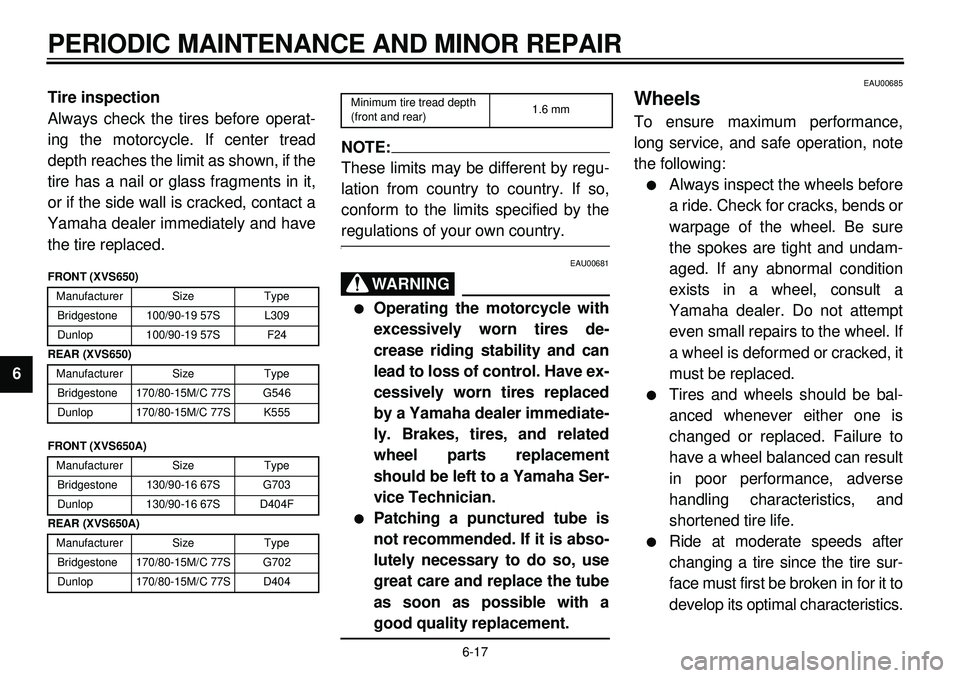
9Tire inspection
Always check the tires before operat-
ing the motorcycle. If center tread
depth reaches the limit as shown, if the
tire has a nail or glass fragments in it,
or if the side wall is cracked, contact a
Yamaha dealer immediately and have
the tire replaced.
COPY CE-10ECE-10E
CE-10EFRONT (XVS650)
Manufacturer Size Type
Bridgestone 100/90-19 57S L309
Dunlop 100/90-19 57S F24
REAR (XVS650)
Manufacturer Size Type
Bridgestone 170/80-15M/C 77S G546
Dunlop 170/80-15M/C 77S K555
FRONT (XVS650A)
Manufacturer Size Type
Bridgestone 130/90-16 67S G703
Dunlop 130/90-16 67S D404F
REAR (XVS650A)
Manufacturer Size Type
Bridgestone 170/80-15M/C 77S G702
Dunlop 170/80-15M/C 77S D404
CE-26ECE-26ENOTE:These limits may be different by regu-
lation from country to country. If so,
conform to the limits specified by theregulations of your own country.
EAU00681
WARNING
l
Operating the motorcycle with
excessively worn tires de-
crease riding stability and can
lead to loss of control. Have ex-
cessively worn tires replaced
by a Yamaha dealer immediate-
ly. Brakes, tires, and related
wheel parts replacement
should be left to a Yamaha Ser-
vice Technician.
l
Patching a punctured tube is
not recommended. If it is abso-
lutely necessary to do so, use
great care and replace the tube
as soon as possible with agood quality replacement.
Minimum tire tread depth
(front and rear)1.6 mm
EAU00685
WheelsTo ensure maximum performance,
long service, and safe operation, note
the following:l
Always inspect the wheels before
a ride. Check for cracks, bends or
warpage of the wheel. Be sure
the spokes are tight and undam-
aged. If any abnormal condition
exists in a wheel, consult a
Yamaha dealer. Do not attempt
even small repairs to the wheel. If
a wheel is deformed or cracked, it
must be replaced.
l
Tires and wheels should be bal-
anced whenever either one is
changed or replaced. Failure to
have a wheel balanced can result
in poor performance, adverse
handling characteristics, and
shortened tire life.
l
Ride at moderate speeds after
changing a tire since the tire sur-
face must first be broken in for it to
develop its optimal characteristics.
Page 65 of 101

6-19
PERIODIC MAINTENANCE AND MINOR REPAIR
1
2
3
4
56
7
8
9
1. Locknut
2. Adjusting bolt
EAU00696
Front brake lever free play
adjustmentThe free play at the front brake lever
should be 10 ~ 15 mm.
1. Loosen the locknut.
2. Turn the adjusting bolt in direction
a to increase free play or in di-
rection b to decrease free play.
3. After adjusting, tighten the lock-
nut.
a. Free play
EW000099
WARNING
l
Check the brake lever free play.
Be sure the brake is working
properly.
l
A soft or spongy feeling in the
brake lever can indicate the
presence of air in the brake
system. This air must be re-
moved by bleeding the brake
system before the motorcycle
is operated. Air in the system
will cause greatly diminished
braking capability and can re-
sult in loss of control and anaccident. Have a Yamaha dealer
inspect and bleed the system if
necessary.
Page 66 of 101

6-20
PERIODIC MAINTENANCE AND MINOR REPAIR
1
2
3
4
56
7
8
9
a. Pedal height
b. Free play
EAU00711
Rear brake pedal height and
free play adjustment
EW000104
WARNING
It is advisable to have a Yamahadealer make this adjustment.
The brake pedal height should be ad-
justed before adjusting the brake pedal
free play.
Pedal height
The brake pedal should be positioned
approximately 85 mm above the top of
the footrest.
1. Locknut
2. Adjusting bolta. Loosen the locknut.
b. Turn the adjusting bolt in direction
a to raise pedal height or in di-
rection b to lower pedal height.
c. Tighten the locknut.
1. Adjusting nut
EW000105
WARNING
After adjusting the pedal height ad-just brake pedal free play.
Free play
The brake pedal free play should be
adjusted to 20 ~ 30 mm at the brake
pedal end. Turn the adjusting nut on
the brake rod in direction a to in-
crease free play or in direction b to
decrease free play.
Page 67 of 101

6-21
PERIODIC MAINTENANCE AND MINOR REPAIR
1
2
3
4
56
7
8
9
1. Brake light switch
2. Adjusting nut
EAU00713
Brake light switch adjustmentThe rear brake light switch is activated
by the brake pedal and is properly ad-
justed when the brake light comes on
just before braking takes effect. To ad-
just the rear brake light switch, hold the
switch body so it does not rotate while
turning the adjusting nut. Turn the ad-
justing nut in direction a to make the
brake light come on earlier. Turn the
adjusting nut in direction b to make
the brake light come on later.
1. Wear indicator grooves
EAU00720
Checking the front brake
pads and rear brake shoes
EAU01119
Front brake
Wear indicator grooves are provided
on each brake pad. These indicators
allow checking of brake pad wear with-
out disassembling the brake. Inspect
the grooves. If they have almost disap-
peared, ask a Yamaha dealer to re-
place the pads.
1. Wear limit line
2. Wear indicator
EAU00727
Rear brake
Apply the brake and inspect the wear
indicator.
If the indicator reaches the wear limit
line, ask a Yamaha dealer to replace
the shoes.
Page 68 of 101

6-22
PERIODIC MAINTENANCE AND MINOR REPAIR
1
2
3
4
56
7
8
9
1. Minimum level mark
EAU00731
Inspecting the brake fluid
levelInsufficient brake fluid may let air enter
the brake system, possibly causing the
brakes to become ineffective.
Before riding, check that the brake flu-
id is above the minimum level and re-
plenish when necessary. Observe
these precautions:l
When checking the fluid level,
make sure the top of the master
cylinder is level by turning the
handlebars.
l
Use only the designated quality
brake fluid. Otherwise, the rubber
seals may deteriorate, causing
leakage and poor brake perfor-
mance.
l
Refill with the same type of brake
fluid. Mixing fluids may result in a
harmful chemical reaction and
lead to poor brake performance.
l
Be careful that water does not en-
ter the master cylinder when refill-
ing. Water will significantly lower
the boiling point of the fluid and
may result in vapor lock.
l
Brake fluid may deteriorate paint-
ed surfaces or plastic parts. Al-
ways clean up spilled fluid
immediately.
l
Have a Yamaha dealer check the
cause if the brake fluid level goes
down. Recommended brake fluid: DOT 4
EAU00742
Brake fluid replacementThe brake fluid should be replaced
only by trained Yamaha service per-
sonnel. Have the Yamaha dealer re-
place the following components during
periodic maintenance or when they are
damaged or leaking:l
oil seals (every two years)
l
brake hoses (every four years)
Page 69 of 101

6-23
PERIODIC MAINTENANCE AND MINOR REPAIR
1
2
3
4
56
7
8
9
EAU02962
Cable inspection and
lubrication
EW000112
WARNING
Damage to the outer housing of ca-
bles may lead to internal rusting
and interfere with the cable move-
ment. Replace damaged cables as
soon as possible to prevent unsafeconditions.
Lubricate the cables and cable ends. If
a cable does not operate smoothly,
ask a Yamaha dealer to replace it.
Recommended lubricant:
Engine oil
EAU00773
Throttle cable and grip lubri-
cationThe throttle twist grip assembly should
be greased at the time that the cable is
lubricated, since the grip must be re-
moved to get at the end of the throttle
cable. After removing the screws, hold
the end of the cable up in the air and
put in several drops of lubricant. With
the throttle grip disassembled, coat the
metal surface of the grip assembly with
a suitable all-purpose grease.
EAU02984
Brake and shift pedal
lubricationLubricate the pivoting parts.
Recommended lubricant:
Engine oil
Page 70 of 101

6-24
PERIODIC MAINTENANCE AND MINOR REPAIR
1
2
3
4
56
7
8
9
EAU02985
Brake and clutch lever
lubricationLubricate the pivoting parts.
Recommended lubricant:
Engine oil
EAU02986
Sidestand lubricationLubricate the sidestand pivoting point
and metal-to-metal contact surfaces.
Check that the sidestand moves up
and down smoothly.
EW000113
WARNING
If the sidestand does not movesmoothly, consult a Yamaha dealer.Recommended lubricant:
Engine oil
Page 71 of 101

6-25
PERIODIC MAINTENANCE AND MINOR REPAIR
1
2
3
4
56
7
8
9
EAU02939
Front fork inspectionVisual check
EW000115
WARNING
Securely support the motorcycle sothere is no danger of it falling over.
Check for scratches or damage on the
inner tube and excessive oil leakage
from the front fork.
Operation check
1. Place the motorcycle on a level
place.
2. Hold the motorcycle in an upright
position and apply the front brake.
3. Push down hard on the handle-
bars several times and check if
the fork rebounds smoothly.
EC000098
CAUTION:
If any damage or unsmooth move-
ment is found with the front fork,consult a Yamaha dealer.
EAU00794
Steering inspectionPeriodically inspect the condition of
the steering. Worn out or loose steer-
ing bearings may be dangerous. Place
a stand under the engine to raise the
front wheel off the ground. Hold the
lower end of the front forks and try to
move them forward and backward. If
any free play can be felt, ask a
Yamaha dealer to inspect and adjust
the steering. Inspection is easier if the
front wheel is removed.
EW000115
WARNING
Securely support the motorcycle sothere is no danger of it falling over.
Page 77 of 101

6-31
PERIODIC MAINTENANCE AND MINOR REPAIR
1
2
3
4
56
7
8
9
1. Speedometer cable
EAU00894
Front wheel removal
EW000122
WARNING
l
It is advisable to have a
Yamaha dealer service the
wheel.
l
Securely support the motor-
cycle so there is no danger of itfalling over.
1. Remove the speedometer cable
from the front wheel side.
1. Axle
2. Pinch bolt2. Loosen the pinch bolt and wheel
axle.
3. Elevate the front wheel by placing
a suitable stand under the en-
gine.
4. Remove the wheel axle and the
front wheel.NOTE:Do not depress the brake lever whenthe disc and caliper are separated.
1. Speedometer gear unit housing
EAU01394
Front wheel installation1. Install the speedometer gear unit
into the wheel hub. Make sure the
wheel hub and the speedometer
gear unit are installed with the
projections meshed into the slots.
2. Lift up the wheel between the
front fork legs and guide the brake
disc between the brake pads.
Make sure the slot in the speed-
ometer gear unit fits over the stop-
per on the front fork outer tube.
3. Install the wheel axle and let the
motorcycle down.
Page 78 of 101

6-32
PERIODIC MAINTENANCE AND MINOR REPAIR
1
2
3
4
56
7
8
9 4. Push down hard on the handle-
bars several times to check for
proper fork operation.
5. Tighten the wheel axle to the
specified torque.
6. Install the pinch bolt and tighten it
to the specified torque.
7. Install the speedometer cable.Tightening torque:
Wheel axle:
59 Nm (5.9 m·kg)
Pinch bolt:
20 Nm (2.0 m·kg)
1. Adjusting nut
2. Brake rod
3. Brake torque rod bolt (´ 2)
4. Brake torque rod
EAU01350*
Rear wheel removal
EW000122
WARNING
l
It is advisable to have a
Yamaha dealer service the
wheel.
l
Securely support the motor-
cycle so there is no danger of itfalling over.1. Loosen the axle nut. Do not re-
move it.
2. Remove the brake torque rod bolt
on the brake shoe plate side.
3. Loosen the brake torque rod bolt
on the swingarm side.
4. Remove the brake pedal free play
adjusting nut and then the brake
rod from the brake cam lever.
5. Remove panel A. (See page 6-5
for removal procedures.)