light YAMAHA XVZ1300TF 2001 Owner's Manual
[x] Cancel search | Manufacturer: YAMAHA, Model Year: 2001, Model line: XVZ1300TF, Model: YAMAHA XVZ1300TF 2001Pages: 132, PDF Size: 20.8 MB
Page 85 of 132
PERIODIC MAINTENANCE AND MINOR REPAIR
7-12
7
EAU01703
Engine oil and oil filter
cartridge The engine oil level should be checked
before each ride. In addition, the oil
must be changed and the oil filter car-
tridge replaced at the intervals speci-
fied in the periodic maintenance and
lubrication chart.
To check the engine oil level
1. Place the motorcycle on a level
surface and hold it in an upright
position.NOTE:Make sure that the motorcycle is posi-
tioned straight up when checking the oil
level. A slight tilt to the side can result in
a false reading. @2. Start the engine, warm it up for
several minutes, and then turn it
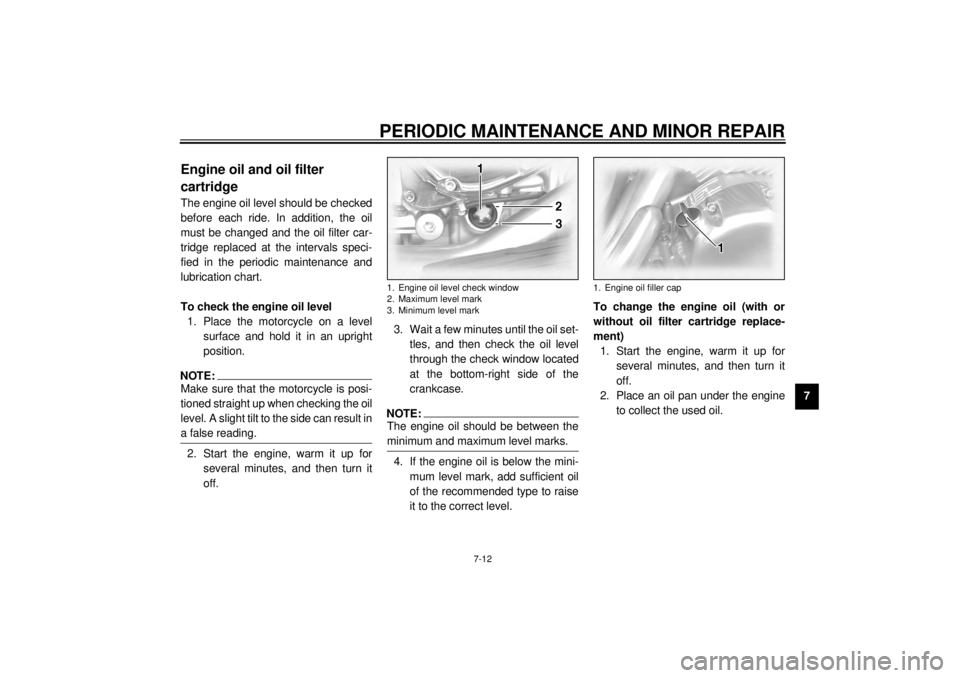
off.3. Wait a few minutes until the oil set-
tles, and then check the oil level
through the check window located
at the bottom-right side of the
crankcase.
NOTE:@ The engine oil should be between the
minimum and maximum level marks. @4. If the engine oil is below the mini-
mum level mark, add sufficient oil
of the recommended type to raise
it to the correct level.To change the engine oil (with or
without oil filter cartridge replace-
ment)
1. Start the engine, warm it up for
several minutes, and then turn it
off.
2. Place an oil pan under the engine
to collect the used oil.1. Engine oil level check window
2. Maximum level mark
3. Minimum level mark
1. Engine oil filler cap
E_5jc.book Page 12 Monday, January 22, 2001 12:12 PM
Page 87 of 132
PERIODIC MAINTENANCE AND MINOR REPAIR
7-14
7 8. Add the specified amount of the
recommended engine oil, and
then install and tighten the oil filler
cap.
EC000072
CAUTION:@ l
In order to prevent clutch slip-
page (since the engine oil also
lubricates the clutch), do not
mix any chemical additives with
the oil or use oils of a higher
grade than “CD”. In addition, do
not use oils labeled “ENERGY
CONSERVING II” or higher.
l
Make sure that no foreign mate-
rial enters the crankcase.
@9. Start the engine, and then let it idle
for several minutes while checking
it for oil leakage. If oil is leaking,
immediately turn the engine off
and check for the cause.NOTE:@ After the engine is started, the engine
oil level warning light should go off if the
oil level is sufficient. @
EC000067
CAUTION:@ If the oil level warning light flickers
or remains on, immediately turn the
engine off and have a Yamaha deal-
er check the vehicle. @10. Turn the engine off, and then
check the oil level and correct it if
necessary. Recommended engine oil:
See page 9-1.
Oil quantity:
Without oil filter cartridge
replacement:
3.5 L
With oil filter cartridge
replacement:
3.7 L
Total amount (dry engine):
4.3 L
E_5jc.book Page 14 Monday, January 22, 2001 12:12 PM
Page 88 of 132
PERIODIC MAINTENANCE AND MINOR REPAIR
7-15
7
EAU01220
Final gear oil The final gear case must be checked
for oil leakage before each ride. If any
leakage is found, have a Yamaha deal-
er check and repair the motorcycle. In
addition, have a Yamaha dealer
change the final gear oil at the intervals
specified in the periodic maintenance
and lubrication chart.
EAU03974
Checking the coolant level The coolant level should be checked as
follows before each ride. In addition,
the coolant must be changed at the in-
tervals specified in the periodic mainte-
nance and lubrication chart.
1. Place the motorcycle on a level
surface and hold it in an upright
position.
2. Remove panel A. (See page 7-9
for panel removal and installation
procedures.)NOTE:_ l
The coolant level must be checked
on a cold engine since the level
varies with engine temperature.
l
Make sure that the motorcycle is
positioned straight up when
checking the coolant level. A slight
tilt to the side can result in a false
reading.
_
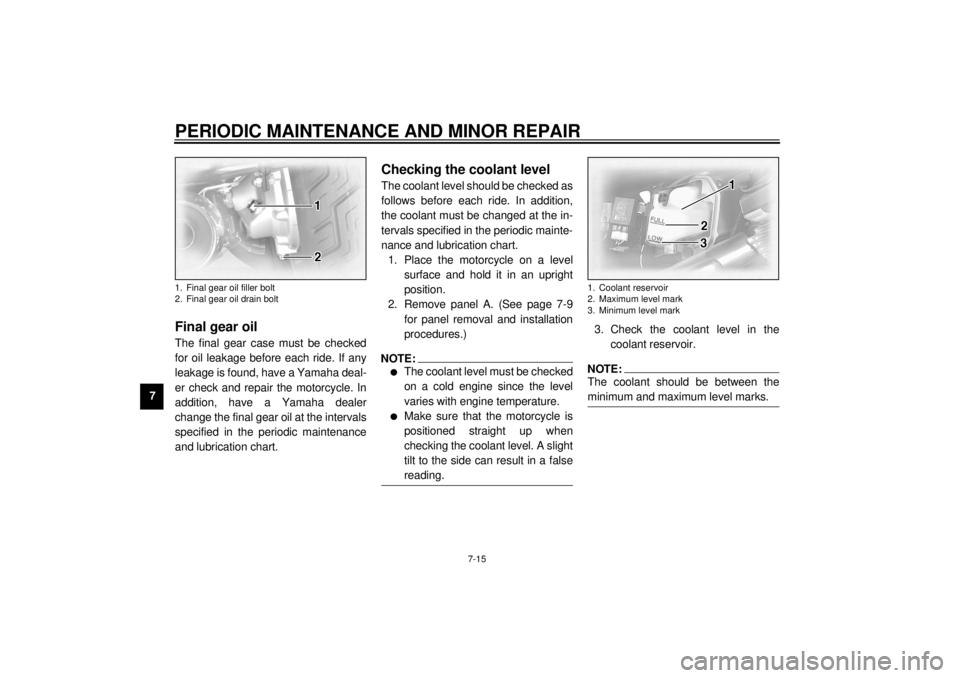
3. Check the coolant level in the
coolant reservoir.NOTE:_ The coolant should be between the
minimum and maximum level marks. _
1. Final gear oil filler bolt
2. Final gear oil drain bolt
1. Coolant reservoir
2. Maximum level mark
3. Minimum level mark
E_5jc.book Page 15 Monday, January 22, 2001 12:12 PM
Page 91 of 132
PERIODIC MAINTENANCE AND MINOR REPAIR
7-18
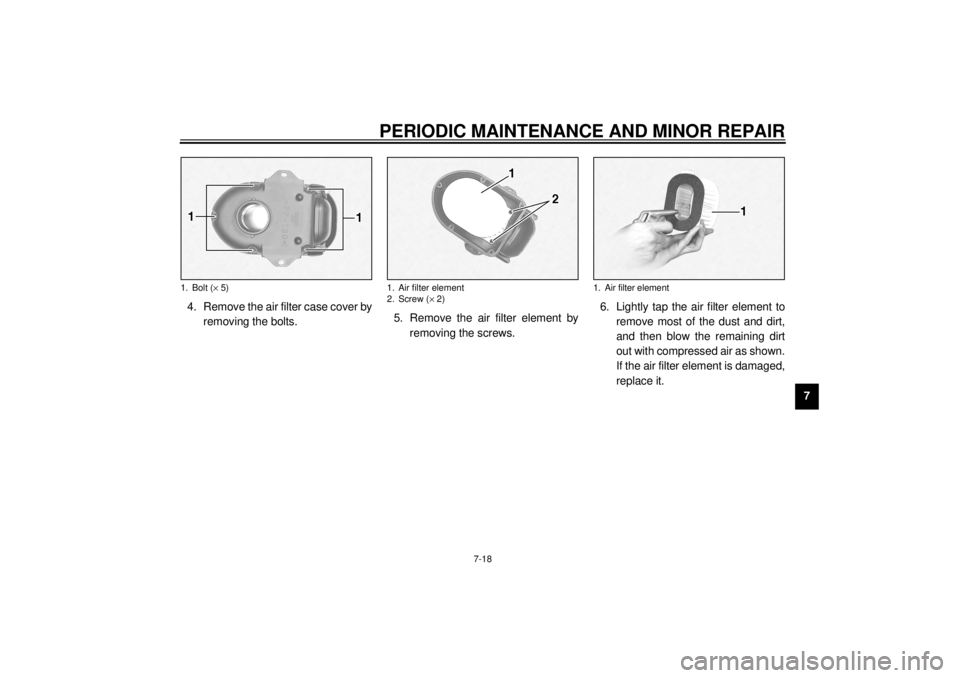
7 4. Remove the air filter case cover by
removing the bolts.5. Remove the air filter element by
removing the screws.6. Lightly tap the air filter element to
remove most of the dust and dirt,
and then blow the remaining dirt
out with compressed air as shown.
If the air filter element is damaged,
replace it.
1. Bolt (´ 5)
1. Air filter element
2. Screw (´ 2)
1. Air filter element
E_5jc.book Page 18 Monday, January 22, 2001 12:12 PM
Page 99 of 132
PERIODIC MAINTENANCE AND MINOR REPAIR
7-26
7
EAU01746
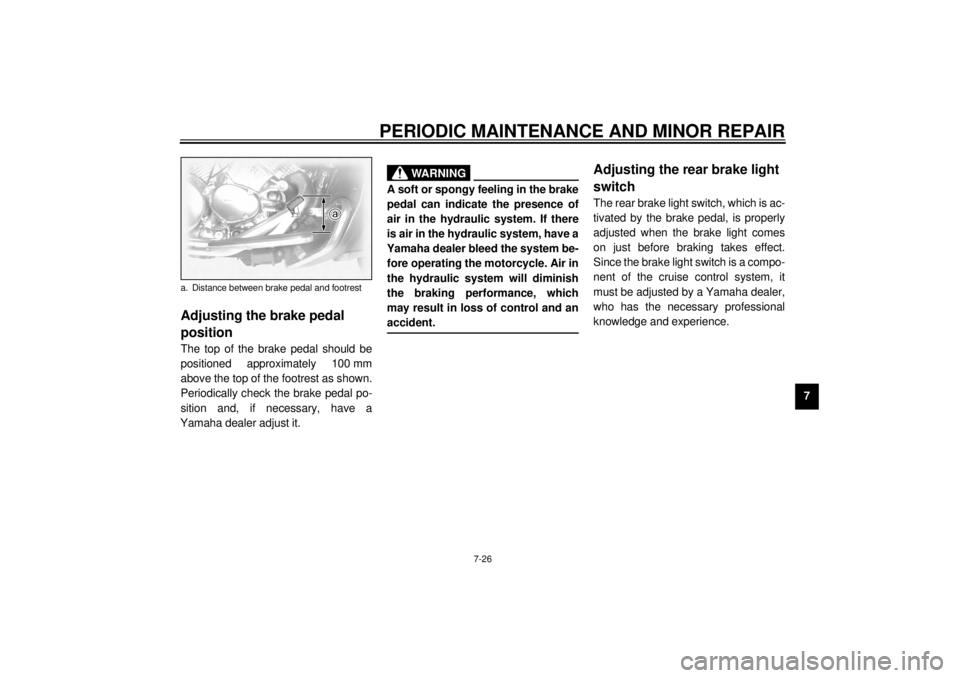
Adjusting the brake pedal
position The top of the brake pedal should be
positioned approximately 100 mm
above the top of the footrest as shown.
Periodically check the brake pedal po-
sition and, if necessary, have a
Yamaha dealer adjust it.
EW000109
WARNING
@ A soft or spongy feeling in the brake
pedal can indicate the presence of
air in the hydraulic system. If there
is air in the hydraulic system, have a
Yamaha dealer bleed the system be-
fore operating the motorcycle. Air in
the hydraulic system will diminish
the braking performance, which
may result in loss of control and an
accident. @
EAU01799
Adjusting the rear brake light
switch The rear brake light switch, which is ac-
tivated by the brake pedal, is properly
adjusted when the brake light comes
on just before braking takes effect.
Since the brake light switch is a compo-
nent of the cruise control system, it
must be adjusted by a Yamaha dealer,
who has the necessary professional
knowledge and experience.
a. Distance between brake pedal and footrest
E_5jc.book Page 26 Monday, January 22, 2001 12:12 PM
Page 107 of 132
PERIODIC MAINTENANCE AND MINOR REPAIR
7-34
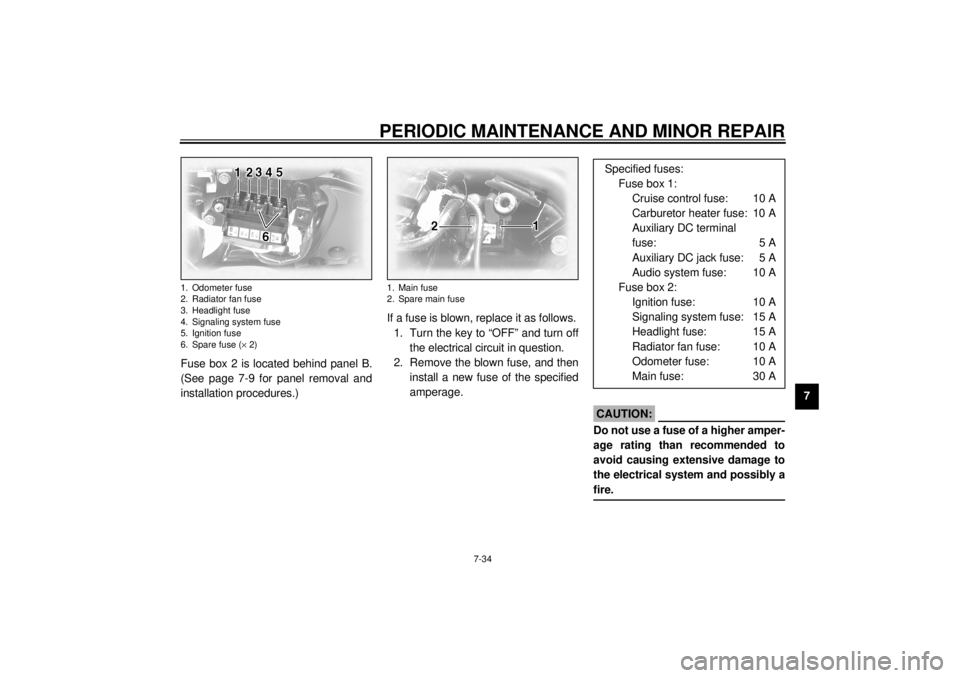
7 Fuse box 2 is located behind panel B.
(See page 7-9 for panel removal and
installation procedures.)If a fuse is blown, replace it as follows.
1. Turn the key to “OFF” and turn off
the electrical circuit in question.
2. Remove the blown fuse, and then
install a new fuse of the specified
amperage.
EC000103
CAUTION:@ Do not use a fuse of a higher amper-
age rating than recommended to
avoid causing extensive damage to
the electrical system and possibly a
fire. @
1. Odometer fuse
2. Radiator fan fuse
3. Headlight fuse
4. Signaling system fuse
5. Ignition fuse
6. Spare fuse (´ 2)
1. Main fuse
2. Spare main fuse
Specified fuses:
Fuse box 1:
Cruise control fuse: 10 A
Carburetor heater fuse: 10 A
Auxiliary DC terminal
fuse: 5 A
Auxiliary DC jack fuse: 5 A
Audio system fuse: 10 A
Fuse box 2:
Ignition fuse: 10 A
Signaling system fuse: 15 A
Headlight fuse: 15 A
Radiator fan fuse: 10 A
Odometer fuse: 10 A
Main fuse: 30 A
E_5jc.book Page 34 Monday, January 22, 2001 12:12 PM
Page 108 of 132
PERIODIC MAINTENANCE AND MINOR REPAIR
7-35
73. Turn the key to “ON” and turn on
the electrical circuit in question to
check if the device operates.
4. If the fuse immediately blows
again, have a Yamaha dealer
check the electrical system.
EAU01802
Replacing the headlight bulb This motorcycle is equipped with a
quartz bulb headlight. If the headlight
bulb burns out, replace it as follows.
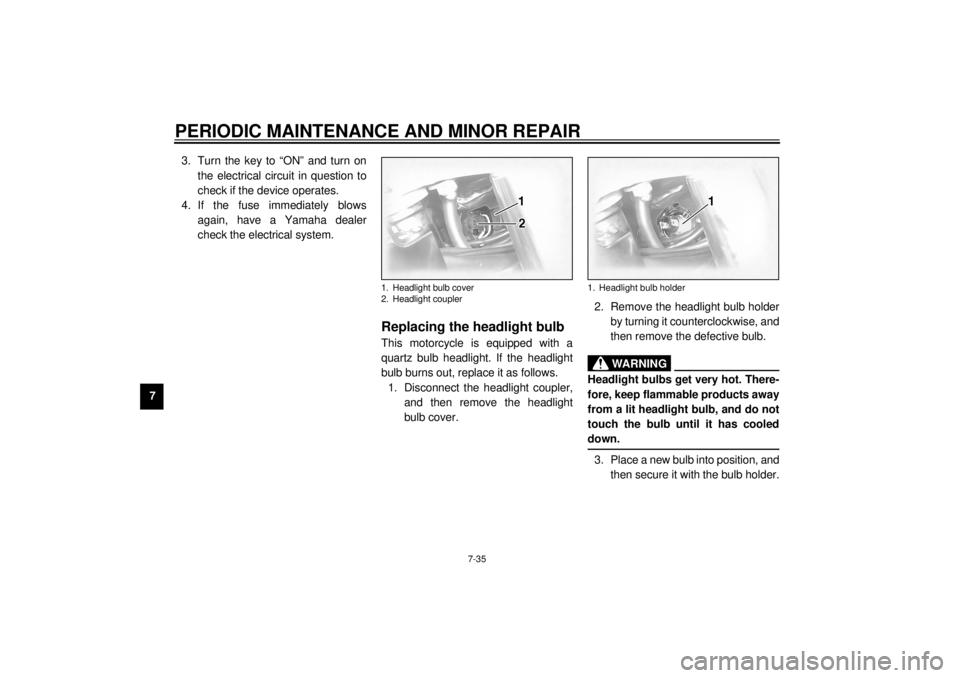
1. Disconnect the headlight coupler,
and then remove the headlight
bulb cover.2. Remove the headlight bulb holder
by turning it counterclockwise, and
then remove the defective bulb.
EW000119
WARNING
@ Headlight bulbs get very hot. There-
fore, keep flammable products away
from a lit headlight bulb, and do not
touch the bulb until it has cooled
down. @3. Place a new bulb into position, and
then secure it with the bulb holder.
1. Headlight bulb cover
2. Headlight coupler
1. Headlight bulb holder
E_5jc.book Page 35 Monday, January 22, 2001 12:12 PM
Page 109 of 132
PERIODIC MAINTENANCE AND MINOR REPAIR
7-36
7
EC000105
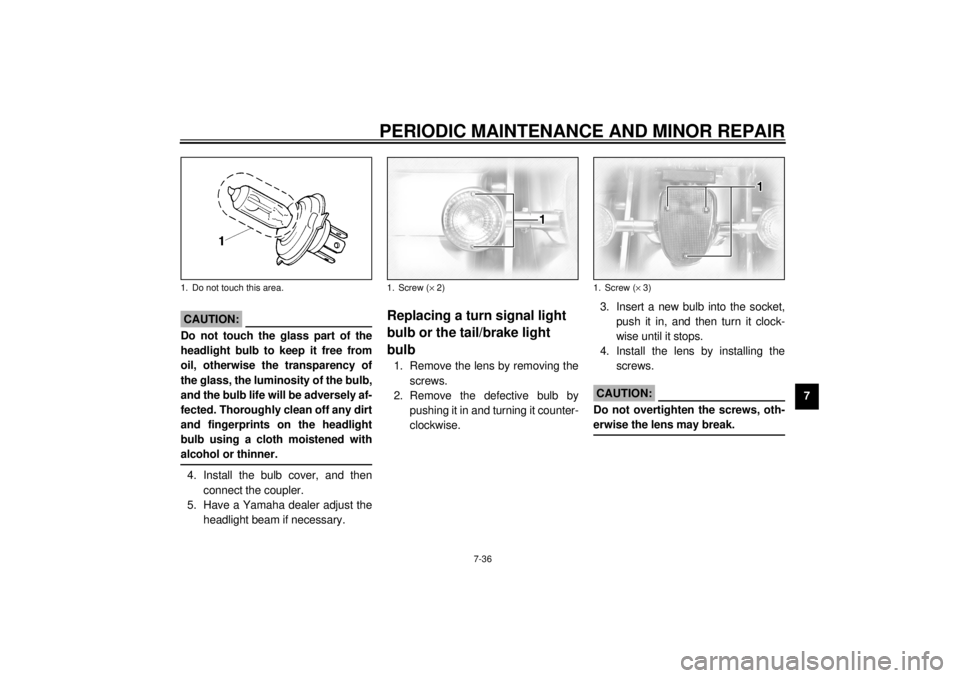
CAUTION:@ Do not touch the glass part of the
headlight bulb to keep it free from
oil, otherwise the transparency of
the glass, the luminosity of the bulb,
and the bulb life will be adversely af-
fected. Thoroughly clean off any dirt
and fingerprints on the headlight
bulb using a cloth moistened with
alcohol or thinner. @4. Install the bulb cover, and then
connect the coupler.
5. Have a Yamaha dealer adjust the
headlight beam if necessary.
EAU00855
Replacing a turn signal light
bulb or the tail/brake light
bulb 1. Remove the lens by removing the
screws.
2. Remove the defective bulb by
pushing it in and turning it counter-
clockwise.3. Insert a new bulb into the socket,
push it in, and then turn it clock-
wise until it stops.
4. Install the lens by installing the
screws.
EC000108
CAUTION:@ Do not overtighten the screws, oth-
erwise the lens may break. @
1. Do not touch this area.
1. Screw (´ 2)
1. Screw (´ 3)
E_5jc.book Page 36 Monday, January 22, 2001 12:12 PM
Page 110 of 132
PERIODIC MAINTENANCE AND MINOR REPAIR
7-37
7
EAU04040
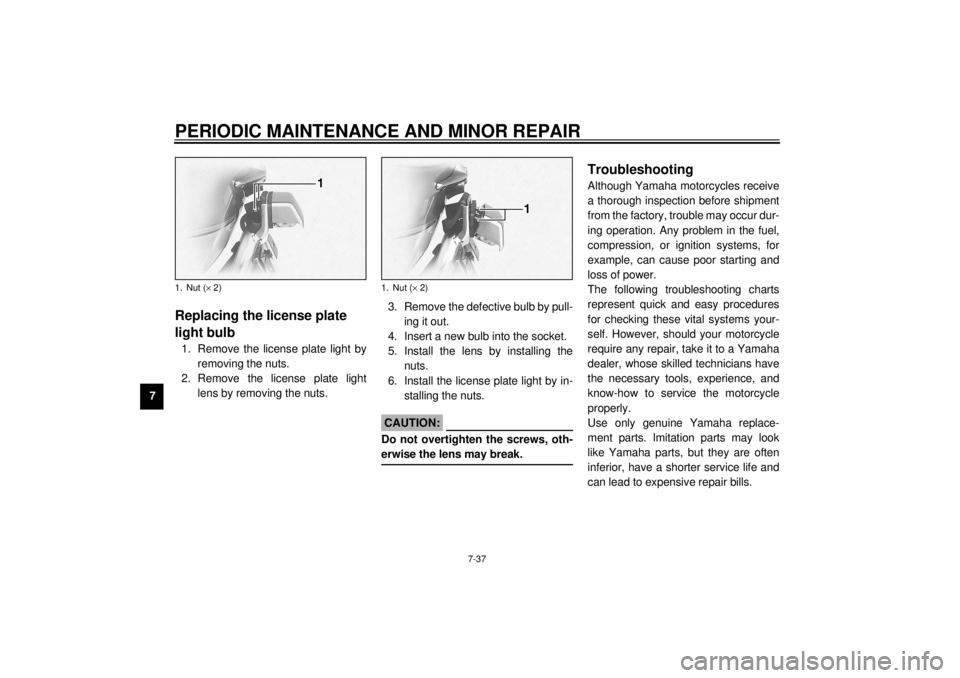
Replacing the license plate
light bulb 1. Remove the license plate light by
removing the nuts.
2. Remove the license plate light
lens by removing the nuts.3. Remove the defective bulb by pull-
ing it out.
4. Insert a new bulb into the socket.
5. Install the lens by installing the
nuts.
6. Install the license plate light by in-
stalling the nuts.
EC000108
CAUTION:_ Do not overtighten the screws, oth-
erwise the lens may break. _
EAU03087
Troubleshooting Although Yamaha motorcycles receive
a thorough inspection before shipment
from the factory, trouble may occur dur-
ing operation. Any problem in the fuel,
compression, or ignition systems, for
example, can cause poor starting and
loss of power.
The following troubleshooting charts
represent quick and easy procedures
for checking these vital systems your-
self. However, should your motorcycle
require any repair, take it to a Yamaha
dealer, whose skilled technicians have
the necessary tools, experience, and
know-how to service the motorcycle
properly.
Use only genuine Yamaha replace-
ment parts. Imitation parts may look
like Yamaha parts, but they are often
inferior, have a shorter service life and
can lead to expensive repair bills.
1. Nut (´ 2)
1. Nut (´ 2)
E_5jc.book Page 37 Monday, January 22, 2001 12:12 PM
Page 115 of 132
MOTORCYCLE CARE AND STORAGE
8-2
8 thinner, fuel (gasoline), rust re-
movers or inhibitors, brake flu-
id, antifreeze or electrolyte.
l
Do not use high-pressure wash-
ers or steam-jet cleaners since
they cause water seepage and
deterioration in the following ar-
eas: seals (of wheel and swing-
arm bearings, fork and brakes),
electric components (couplers,
connectors, instruments, switch-
es, lights, audio system and
speakers), sidecases, travel
trunk, breather hoses and vents.
l
For motorcycles equipped with
a windshield: Do not use strong
cleaners or hard sponges as
they will cause dulling or
scratching. Some cleaning
compounds for plastic may
leave scratches on the wind-
shield. Test the product on a
small hidden part of the wind-
shield to make sure that it does
not leave any marks. If the wind-
shield is scratched, use a quali-
ty plastic polishing compound
after washing.
_After normal useRemove dirt with warm water, a mild
detergent, and a soft, clean sponge,
and then rinse thoroughly with clean
water. Use a toothbrush or bottlebrush
for hard-to-reach areas. Stubborn dirt
and insects will come off more easily if
the area is covered with a wet cloth for
a few minutes before cleaning.After riding in the rain, near the sea or
on salt-sprayed roadsSince sea salt or salt sprayed on roads
during winter are extremely corrosive in
combination with water, carry out the
following steps after each ride in the
rain, near the sea or on salt-sprayed
roads.NOTE:_ Salt sprayed on roads in the winter may
remain well into spring. _1. Clean the motorcycle with cold
water and a mild detergent, after
the engine has cooled down.
ECA00012
CAUTION:_ Do not use warm water since it in-
creases the corrosive action of the
salt. _2. Apply a corrosion protection spray
on all metal, including chrome-
and nickel-plated, surfaces to pre-
vent corrosion.
E_5jc.book Page 2 Monday, January 22, 2001 12:12 PM