fuel YAMAHA YBR125 2004 User Guide
[x] Cancel search | Manufacturer: YAMAHA, Model Year: 2004, Model line: YBR125, Model: YAMAHA YBR125 2004Pages: 83, PDF Size: 3.16 MB
Page 35 of 83
4-7Always wipe off spilled fuel immediately with a dry and clean
soft cloth. Fuel may deteriorate painted surfaces or plastic
parts. Fuel
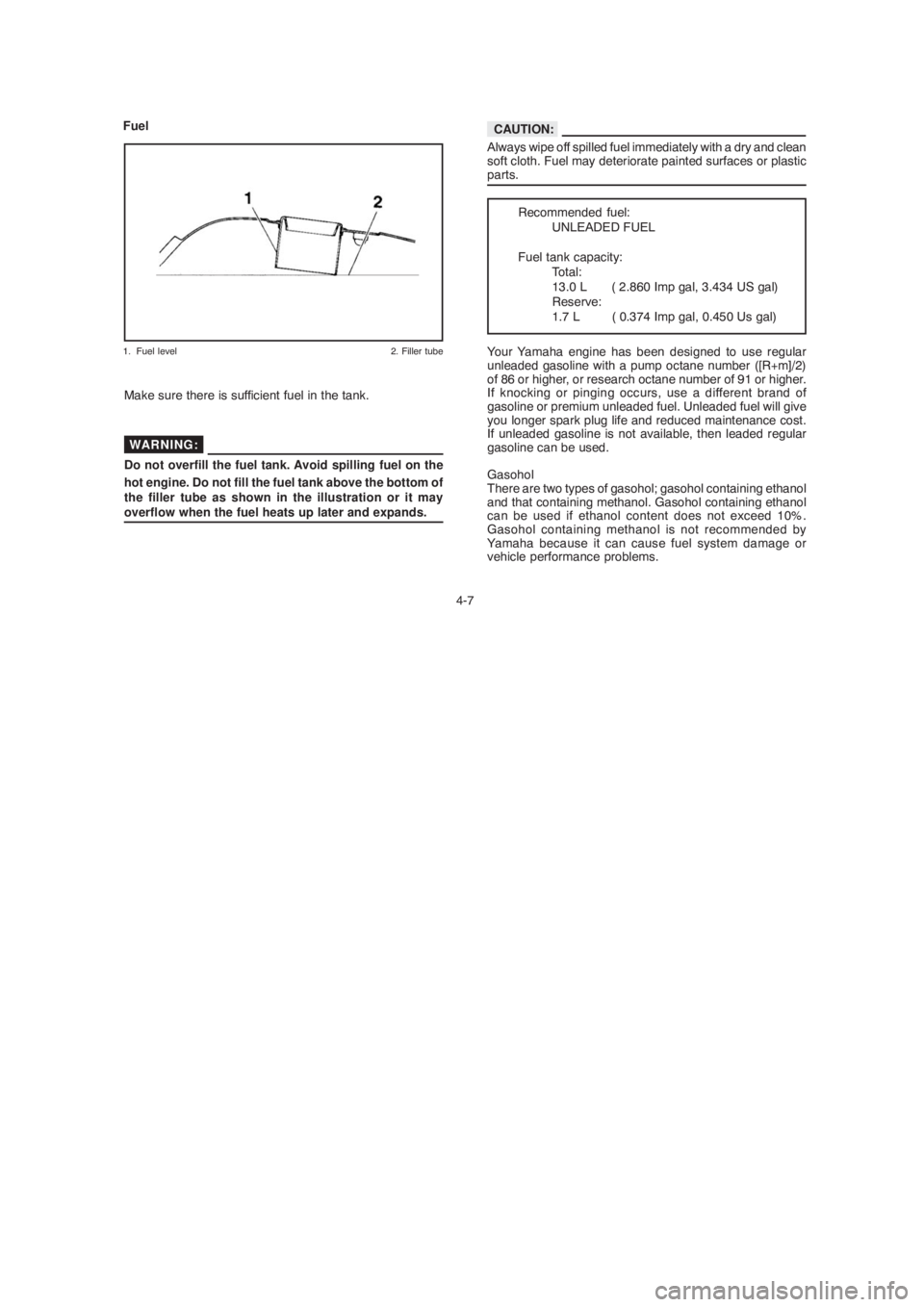
1. Fuel level 2. Filler tube
Make sure there is sufficient fuel in the tank.
Do not overfill the fuel tank. Avoid spilling fuel on the
hot engine. Do not fill the fuel tank above the bottom of
the filler tube as shown in the illustration or it may
overflow when the fuel heats up later and expands.
Recommended fuel:
UNLEADED FUEL
Fuel tank capacity:
Total:
13.0 L ( 2.860 Imp gal, 3.434 US gal)
Reserve:
1.7 L ( 0.374 Imp gal, 0.450 Us gal)
WARNING:
CAUTION:
Your Yamaha engine has been designed to use regular
unleaded gasoline with a pump octane number ([R+m]/2)
of 86 or higher, or research octane number of 91 or higher.
If knocking or pinging occurs, use a different brand of
gasoline or premium unleaded fuel. Unleaded fuel will give
you longer spark plug life and reduced maintenance cost.
If unleaded gasoline is not available, then leaded regular
gasoline can be used.
Gasohol
There are two types of gasohol; gasohol containing ethanol
and that containing methanol. Gasohol containing ethanol
can be used if ethanol content does not exceed 10%.
Gasohol containing methanol is not recommended by
Yamaha because it can cause fuel system damage or
vehicle performance problems.
4-7Always wipe off spilled fuel immediately with a dry and clean
soft cloth. Fuel may deteriorate painted surfaces or plastic
parts. Fuel
1. Fuel level 2. Filler tube
Make sure there is sufficient fuel in the tank.
Do not overfill the fuel tank. Avoid spilling fuel on the
hot engine. Do not fill the fuel tank above the bottom of
the filler tube as shown in the illustration or it may
overflow when the fuel heats up later and expands.
Recommended fuel:
UNLEADED FUEL
Fuel tank capacity:
Total:
13.0 L ( 2.860 Imp gal, 3.434 US gal)
Reserve:
1.7 L ( 0.374 Imp gal, 0.450 Us gal)
WARNING:
CAUTION:
Your Yamaha engine has been designed to use regular
unleaded gasoline with a pump octane number ([R+m]/2)
of 86 or higher, or research octane number of 91 or higher.
If knocking or pinging occurs, use a different brand of
gasoline or premium unleaded fuel. Unleaded fuel will give
you longer spark plug life and reduced maintenance cost.
If unleaded gasoline is not available, then leaded regular
gasoline can be used.
Gasohol
There are two types of gasohol; gasohol containing ethanol
and that containing methanol. Gasohol containing ethanol
can be used if ethanol content does not exceed 10%.
Gasohol containing methanol is not recommended by
Yamaha because it can cause fuel system damage or
vehicle performance problems.
Page 37 of 83

5-2 Starting a cold engine
1. Turn the fuel cock to ìONî.
2. Turn the main switch to ìONî and the engine stop switch
to ì ì.
3. Shift transmission into neutral.
NOTE:
When the transmission is in neutral, the neutral indicator
light should be on. If the light does not come on, ask a
Yamaha dealer to inspect it.
4. Fully open the starter (CHOKE) and completely close
the throttle grip.
5. Kick the starter to start the engine.
6. After starting the engine, turn back the starter to an
intermediate position.
NOTE:
To obtain maximum engine life and service, do not ever
thoroughly accelerate it while the engine is cold.
7. After warming up the engine, turn back the stater
(CHOKE) completely.
NOTE:
The engine is warm when it responds normally to the throttle
with the starter turned off.
Starting a warm engine
The starter lever is not required when the engine is warm.
CAUTION:
If the engine fails to start with the procedures above, try to
start again with the throttle grip opened 1/4 to 1/2.
Warming up the engine
For extended engine life always warm the engine up never
accelerate hard while the engine is cold. To check if engine
temperature is normal, rev the engine with the choke closed
and check to see if it responds normally.
CAUTION:
See the ìBreak-in sectionî prior to operating the motorcycle
for the first time.
5-2 Starting a cold engine
1. Turn the fuel cock to ìONî.
2. Turn the main switch to ìONî and the engine stop switch
to ì ì.
3. Shift transmission into neutral.
NOTE:
When the transmission is in neutral, the neutral indicator
light should be on. If the light does not come on, ask a
Yamaha dealer to inspect it.
4. Fully open the starter (CHOKE) and completely close
the throttle grip.
5. Kick the starter to start the engine.
6. After starting the engine, turn back the starter to an
intermediate position.
NOTE:
To obtain maximum engine life and service, do not ever
thoroughly accelerate it while the engine is cold.
7. After warming up the engine, turn back the stater
(CHOKE) completely.
NOTE:
The engine is warm when it responds normally to the throttle
with the starter turned off.
Starting a warm engine
The starter lever is not required when the engine is warm.
CAUTION:
If the engine fails to start with the procedures above, try to
start again with the throttle grip opened 1/4 to 1/2.
Warming up the engine
For extended engine life always warm the engine up never
accelerate hard while the engine is cold. To check if engine
temperature is normal, rev the engine with the choke closed
and check to see if it responds normally.
CAUTION:
See the ìBreak-in sectionî prior to operating the motorcycle
for the first time.
Page 39 of 83

5-4 Tips for reducing fuel consumption
Your motorcycleís fuel consumption depends to a large
extent on your riding style. The following tips can help reduce
fuel consumption.
1. Warm up the engine before riding.
2. Turn off the starter lever as soon as possible.
3. Shift up swiftly and avoid high engine speeds during
acceleration.
4. Do not double-clutch or rev the engine while shifting down
and avoid high engine speeds with no load engine.
5. Turn off the engine instead of letting it idle for an extended
lenght of time, i.e. in traffic jams, at traffic lights or railroad
crossings.Engine Break-in
There is never a more important period in the life of your
motorcycle than the period 1.000Km. For this reason we
ask that you carefully read the following material. Because
the engine is brand new, you must not put an excessive
load on it for the first several hours of running.
During this period, prolonged full throttle operation, or any
condition which might result in excessive heating of the
engine must be avoided.
1. 0 ~ 150 Km:
Avoid operation above 1/3 throttle. Stop the engine and
let it cool for 5 to 10 minutes after every hour of
operation. Vary the speed of the motorcycle from time
to time. Do not operate it at one set throttle position.
5-4 Tips for reducing fuel consumption
Your motorcycleís fuel consumption depends to a large
extent on your riding style. The following tips can help reduce
fuel consumption.
1. Warm up the engine before riding.
2. Turn off the starter lever as soon as possible.
3. Shift up swiftly and avoid high engine speeds during
acceleration.
4. Do not double-clutch or rev the engine while shifting down
and avoid high engine speeds with no load engine.
5. Turn off the engine instead of letting it idle for an extended
lenght of time, i.e. in traffic jams, at traffic lights or railroad
crossings.Engine Break-in
There is never a more important period in the life of your
motorcycle than the period 1.000Km. For this reason we
ask that you carefully read the following material. Because
the engine is brand new, you must not put an excessive
load on it for the first several hours of running.
During this period, prolonged full throttle operation, or any
condition which might result in excessive heating of the
engine must be avoided.
1. 0 ~ 150 Km:
Avoid operation above 1/3 throttle. Stop the engine and
let it cool for 5 to 10 minutes after every hour of
operation. Vary the speed of the motorcycle from time
to time. Do not operate it at one set throttle position.
Page 40 of 83
5-5 2. 150 ~ 500 Km:
Avoid prolonged operation above 1/2 throttle. Allow the
machine to rev freely through the gears, but do not use
full throttle at any time.
3. 500 ~ 1,000 Km:
Avoid cruising speeds in excess of 3/4 throttle.
After 1,000Km of operation, be sure to replace the engine
oil.
4. After 1,000 Km:
Avoid prolonged full throttle operation. Vary speeds
occasionally.
If any engine trouble should occur during the break-in
period, consult a Yamaha dealer immediately.Parking
When parking the motorcycle, stop the engine and remove
the ignition key. Turn the fuel cock to ìOFFî whenever
stopping the engine.
The muffler and exhaust pipe are hot. Park the
motorcycle in a place where pedestrians or children
are not likely to touch the motorcycle. Do not park the
motorcycle on a slope or soft ground; the motorcycle
may fall over.
CAUTION:
CAUTION:
WARNING:
5-5 2. 150 ~ 500 Km:
Avoid prolonged operation above 1/2 throttle. Allow the
machine to rev freely through the gears, but do not use
full throttle at any time.
3. 500 ~ 1,000 Km:
Avoid cruising speeds in excess of 3/4 throttle.
After 1,000Km of operation, be sure to replace the engine
oil.
4. After 1,000 Km:
Avoid prolonged full throttle operation. Vary speeds
occasionally.
If any engine trouble should occur during the break-in
period, consult a Yamaha dealer immediately.Parking
When parking the motorcycle, stop the engine and remove
the ignition key. Turn the fuel cock to ìOFFî whenever
stopping the engine.
The muffler and exhaust pipe are hot. Park the
motorcycle in a place where pedestrians or children
are not likely to touch the motorcycle. Do not park the
motorcycle on a slope or soft ground; the motorcycle
may fall over.
CAUTION:
CAUTION:
WARNING:
Page 43 of 83
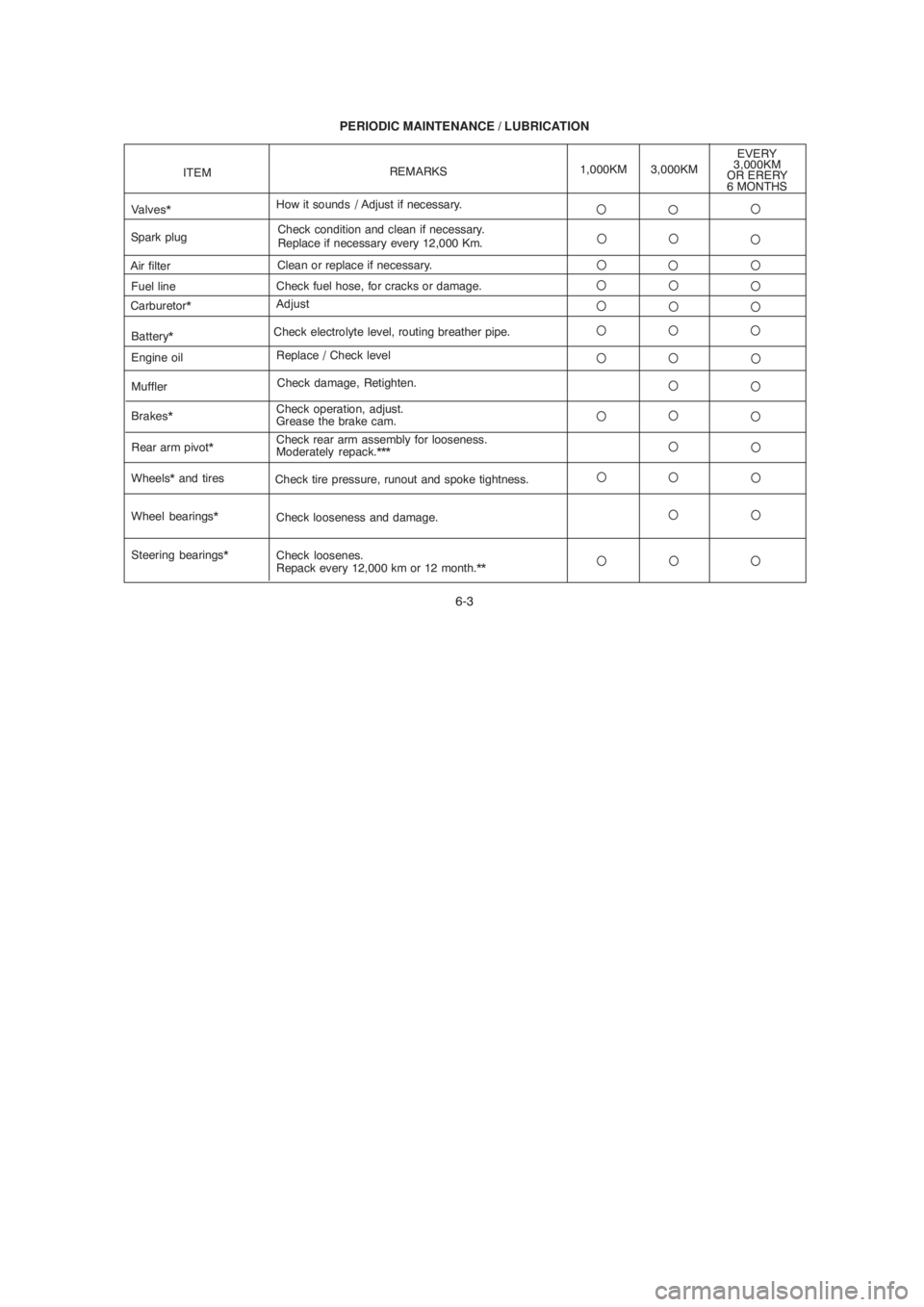
6-3 PERIODIC MAINTENANCE / LUBRICATION
Wheel bearings* Battery*
Check looseness and damage. Check electrolyte level, routing breather pipe.
ITEM
How it sounds
/ Adjust if necessary.
REMARKS1,000KM
Fuel line Air filter
Carburetor*Valves*
Muffler
Brakes* Engine oil
Steering bearings* Rear arm pivot*Check fuel hose, for cracks or damage.Clean or replace if necessary.
Adjust
Check damage, Retighten.
Check operation, adjust.
Grease the brake cam. Replace / Check level
Check loosenes.
Repack every 12,000 km or 12 month.** Check rear arm assembly for looseness.
Moderately repack.***
EVERY
3,000KM
OR ERERY
6 MONTHS
Wheels* and tires
Check tire pressure, runout and spoke tightness.
Spark plugCheck condition and clean if necessary.
Replace if necessary every 12,000 Km.
3,000KM
6-3 PERIODIC MAINTENANCE / LUBRICATION
Wheel bearings* Battery*
Check looseness and damage. Check electrolyte level, routing breather pipe.
ITEM
How it sounds
/ Adjust if necessary.
REMARKS1,000KM
Fuel line Air filter
Carburetor*Valves*
Muffler
Brakes* Engine oil
Steering bearings* Rear arm pivot*Check fuel hose, for cracks or damage.Clean or replace if necessary.
Adjust
Check damage, Retighten.
Check operation, adjust.
Grease the brake cam. Replace / Check level
Check loosenes.
Repack every 12,000 km or 12 month.** Check rear arm assembly for looseness.
Moderately repack.***
EVERY
3,000KM
OR ERERY
6 MONTHS
Wheels* and tires
Check tire pressure, runout and spoke tightness.
Spark plugCheck condition and clean if necessary.
Replace if necessary every 12,000 Km.
3,000KM
Page 52 of 83

Valve clearance adjustment
The correct valve clearance changes with use, resulting in
improper fuel/air supply or engine noise. To prevent this,
valve clearance must be adjusted regularly. This adjustment,
however, should be left to a professional Yamaha service
technician. Carburetor adjustment
The carburetor is a vital part of the engine. Adjusting should
be left to a Yamaha dealer who has the professional
knowledge, specialized data, and equipment to do so
properly. However, the following may be serviced by the
owner as part of routine maintenance.
The carburetor was set at Yamaha factory after many
tests. If the settings are changed, poor engine
performance and damage may result.
6-12
CAUTION:
Valve clearance adjustment
The correct valve clearance changes with use, resulting in
improper fuel/air supply or engine noise. To prevent this,
valve clearance must be adjusted regularly. This adjustment,
however, should be left to a professional Yamaha service
technician. Carburetor adjustment
The carburetor is a vital part of the engine. Adjusting should
be left to a Yamaha dealer who has the professional
knowledge, specialized data, and equipment to do so
properly. However, the following may be serviced by the
owner as part of routine maintenance.
The carburetor was set at Yamaha factory after many
tests. If the settings are changed, poor engine
performance and damage may result.
6-12
CAUTION:
Page 74 of 83

6-34 Troubleshooting
Although Yamaha motorcycles receive a rigid inspection
before shipment from the factory, trouble may occur during
operation. Any problem in the fuel, compression, or ignition
systems can cause poor starting and loss of power. The
troubleshooting chart describes a quick, easy, procedure
for making checks. If your motorcycle requires any repair,
bring it to a Yamaha dealer. The skilled technicians at a
Yamaha dealership have the tools, experience, and know-
how to properly service your motorcycle. Use only genuine
Yamaha parts on your motorcycle. Imitation parts may look
like Yamaha parts, but they are often inferior. Consequently,
they have a shorter service life and can lead to expensive
repair bills.
6-34 Troubleshooting
Although Yamaha motorcycles receive a rigid inspection
before shipment from the factory, trouble may occur during
operation. Any problem in the fuel, compression, or ignition
systems can cause poor starting and loss of power. The
troubleshooting chart describes a quick, easy, procedure
for making checks. If your motorcycle requires any repair,
bring it to a Yamaha dealer. The skilled technicians at a
Yamaha dealership have the tools, experience, and know-
how to properly service your motorcycle. Use only genuine
Yamaha parts on your motorcycle. Imitation parts may look
like Yamaha parts, but they are often inferior. Consequently,
they have a shorter service life and can lead to expensive
repair bills.
Page 75 of 83
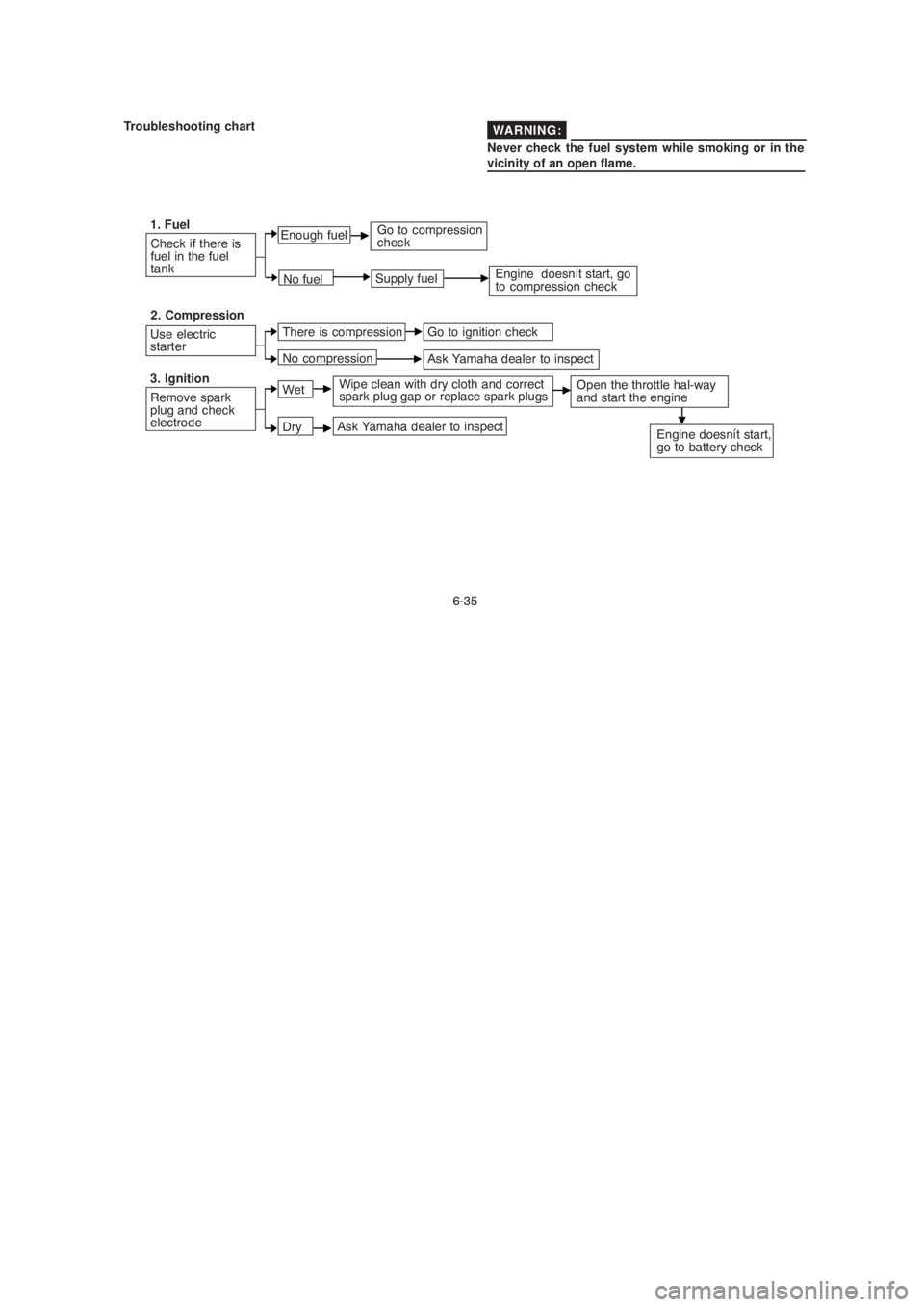
6-35Never check the fuel system while smoking or in the
vicinity of an open flame.
Check if there is
fuel in the fuel
tank
Use electric
starter
Remove spark
plug and check
electrode 1. Fuel
2. Compression
3. IgnitionEnough fuel
No fuel
There is compression
No compression
Wet
DrySupply fuel
Go to ignition check
Ask Yamaha dealer to inspect
Wipe clean with dry cloth and correct
spark plug gap or replace spark plugs
Ask Yamaha dealer to inspect
Troubleshooting chart
Go to compression
check
Engine doesnít start, go
to compression check
Open the throttle hal-way
and start the engine
Engine doesnít start,
go to battery check
WARNING:
6-35Never check the fuel system while smoking or in the
vicinity of an open flame.
Check if there is
fuel in the fuel
tank
Use electric
starter
Remove spark
plug and check
electrode 1. Fuel
2. Compression
3. IgnitionEnough fuel
No fuel
There is compression
No compression
Wet
DrySupply fuel
Go to ignition check
Ask Yamaha dealer to inspect
Wipe clean with dry cloth and correct
spark plug gap or replace spark plugs
Ask Yamaha dealer to inspect
Troubleshooting chart
Go to compression
check
Engine doesnít start, go
to compression check
Open the throttle hal-way
and start the engine
Engine doesnít start,
go to battery check
WARNING:
Page 77 of 83
7-2 B. STORAGE
Long term storage (30 days or more) of your machine will
require some preventive procedures to guard against
deterioration. After thoroughly cleaning the machine,
prepare for storage as follows:
1. Drain the fuel tank, fuel lines, and carburetor float
bowl(s).
2. Remove the spark plug(s), pour about one tablespoon
of SAE 20W50 motor oil in the spark plug hole(s) and
reinstall the spark plug(s).
Kick the engine over several times (with the
ignition off) to coat the cylinder walls with oil.
3. Remove the drive chain. Clean it thoroughly with
solvent and lubricate it.
Reinstall the chain or store it in a plastic bag
(tied to frame for safe-keeping).
4. Lubricate all control cables.
5. Block up the frame to raise both wheels off the
ground.
6. Tie a plastic bag over the exhaust pipe outlet to
prevent moisture from entering.7. If storing in a humid or salt-air atmosphere, coat
all exposed metal surfaces with a light film of
oil. Do not apply oil to any rubber parts or the
seat cover.
8. Remove the battery and charge it. Store it in a dry place
and recharge it once a month. Do not store the battery
in an excessively warm or cold place (less than 0∫C
(30∫F) or more than 30∫C (90∫F).
NOTE:
Make any necessary repairs before storing the machine.
7-2 B. STORAGE
Long term storage (30 days or more) of your machine will
require some preventive procedures to guard against
deterioration. After thoroughly cleaning the machine,
prepare for storage as follows:
1. Drain the fuel tank, fuel lines, and carburetor float
bowl(s).
2. Remove the spark plug(s), pour about one tablespoon
of SAE 20W50 motor oil in the spark plug hole(s) and
reinstall the spark plug(s).
Kick the engine over several times (with the
ignition off) to coat the cylinder walls with oil.
3. Remove the drive chain. Clean it thoroughly with
solvent and lubricate it.
Reinstall the chain or store it in a plastic bag
(tied to frame for safe-keeping).
4. Lubricate all control cables.
5. Block up the frame to raise both wheels off the
ground.
6. Tie a plastic bag over the exhaust pipe outlet to
prevent moisture from entering.7. If storing in a humid or salt-air atmosphere, coat
all exposed metal surfaces with a light film of
oil. Do not apply oil to any rubber parts or the
seat cover.
8. Remove the battery and charge it. Store it in a dry place
and recharge it once a month. Do not store the battery
in an excessively warm or cold place (less than 0∫C
(30∫F) or more than 30∫C (90∫F).
NOTE:
Make any necessary repairs before storing the machine.
Page 78 of 83
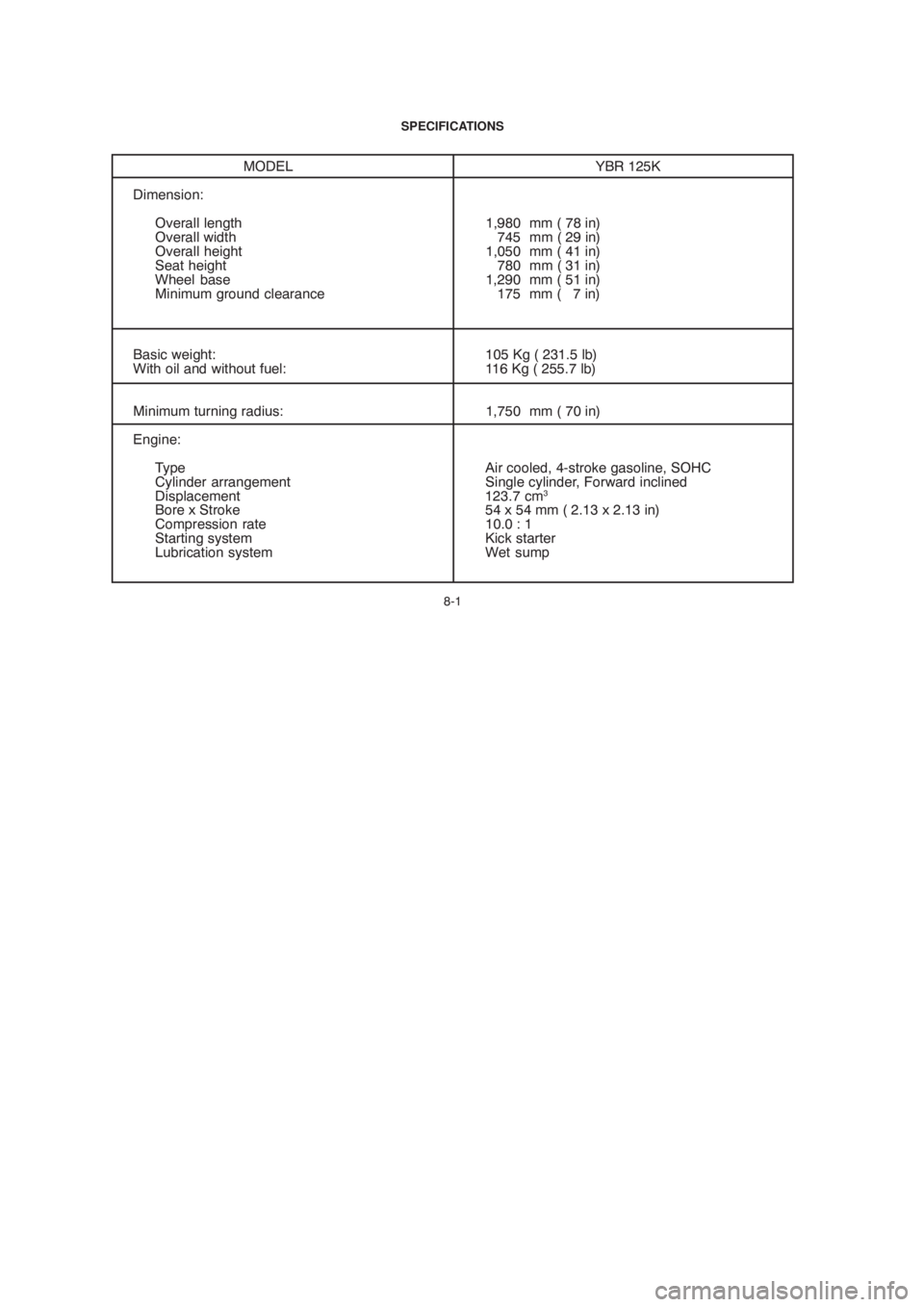
8-1 SPECIFICATIONS
MODEL YBR 125K
Dimension:
Overall length 1,980 mm ( 78 in)
Overall width 745 mm ( 29 in)
Overall height 1,050 mm ( 41 in)
Seat height 780 mm ( 31 in)
Wheel base 1,290 mm ( 51 in)
Minimum ground clearance 175 mm ( 7 in)
Basic weight: 105 Kg ( 231.5 lb)
With oil and without fuel: 116 Kg ( 255.7 lb)
Minimum turning radius: 1,750 mm ( 70 in)
Engine:
Type Air cooled, 4-stroke gasoline, SOHC
Cylinder arrangement Single cylinder, Forward inclined
Displacement 123.7 cm
3
Bore x Stroke 54 x 54 mm ( 2.13 x 2.13 in)
Compression rate 10.0 : 1
Starting system Kick starter
Lubrication system Wet sump
8-1 SPECIFICATIONS
MODEL YBR 125K
Dimension:
Overall length 1,980 mm ( 78 in)
Overall width 745 mm ( 29 in)
Overall height 1,050 mm ( 41 in)
Seat height 780 mm ( 31 in)
Wheel base 1,290 mm ( 51 in)
Minimum ground clearance 175 mm ( 7 in)
Basic weight: 105 Kg ( 231.5 lb)
With oil and without fuel: 116 Kg ( 255.7 lb)
Minimum turning radius: 1,750 mm ( 70 in)
Engine:
Type Air cooled, 4-stroke gasoline, SOHC
Cylinder arrangement Single cylinder, Forward inclined
Displacement 123.7 cm
3
Bore x Stroke 54 x 54 mm ( 2.13 x 2.13 in)
Compression rate 10.0 : 1
Starting system Kick starter
Lubrication system Wet sump