engine YAMAHA YBR125 2007 User Guide
[x] Cancel search | Manufacturer: YAMAHA, Model Year: 2007, Model line: YBR125, Model: YAMAHA YBR125 2007Pages: 79, PDF Size: 2.08 MB
Page 21 of 79

PRE-OPERATION CHECKS
4-1
Owners are personally responsible for their vehicle's condition. Your Motorcycle's vital functions can start to
deteriorate quickly and unexpectedly- even if it remains unused (for instance, if it is exposed to the elements). Any
damage. fluid leak or loss of tyre pressure could have serious consequence Therefore' it is very important that, in
addition to a thorough visual inspection, you check the following points before each ride.
PRE - OPERATION CHECK LIST
Brake and shift pedal shafts Engine oil
Control and meter cable Wheels and tyres Drive chain Clutch
Throttle grip and housing Rear brake Front brake
Lubricate if necessary.Check tyre pressure, wear, damage and spoke tightness.
Lubricate if necessary. Check for smooth operation. Lubricate if necessary.
Check for smooth operation. Tighten spokes if necessary. Adjust if necessary.
6-21
6-22 6-13 ~ 6-15 6-18 ~ 6-21
Check oil level.
Fill with oil if necessary.
Check chain slack and condition. Check operation, condition and free play.
Adjust if necessary.
Lubricate if necessary. Check for smooth operation. Adjust if necessary.
Check operation, condition and free play.Adjust if necessary. Check operation, condition and free play.
ITEM
CHECKS
6-8 ~ 6-9 6-12, 6-213-3, 6-16
3-4, 6-17
3-4, 6-16PAGE
Page 22 of 79

If any item in the Pre-Operation Check is not working properly, have it inspected and repaired before operating
the Motorcycle.WARNINGFuel gauge
Check for proper operation
/Function
3.2
PRE-OPERATION CHECKS
4-2
Fuel Tank Brake and clutch lever pivots
Battery Lights, signals and switches Chassis fasteners Center and sidestand pivot
Make sure that all nuts, bolts, and screws are properly tightened.
Tighten if necessary.
Check fuel level.
Fill with fuel if necessary.
Fill with distilled water if necessary. Check fluid level. Check for proper operation.
6-24~ 6-26 3-3, 6-27 ~ 6-283-5 ~ 3-7
Lubricate if necessary. Check for smooth operation.
Lubricate if necessary. Check for smooth operation.
ITEM CHECKS
6-22PAGE6-22
-
IF WAITING AT TRAFFIC SIGNAL IS FOR LONG, SWITCH OFF THE ENGINE
TO PROTECT THE ENVIRONMENT AND TO LOWER FUEL CONSUMPTION
Page 23 of 79

OPERATION AND IMPORTANT RIDING POINTS
1. Before riding this Motorcycle,
become thoroughly familiar
with all operating controls and
their functions. Consult a
YAMAHA dealer regarding any
control or function that you do
not thoroughly understand.
2. Never start your engine or let it
run for any length of time in a
closed area. The exhaust fumes
are poisonous and can cause
loss of consciousness.
Always operate your
Motorcycle in an area with
adequate ventilation.
3. Before starting out, always be
sure the side stand is up.
Failure to retract the side stand
completely can result in a
serious accident when you try
to turn a corner.
Starting and warming up a
cold engine1. Turn the fuel cock to "ON"
2. Turn the main switch to "ON."
3. Shift the transmission into
neutral.
When the transmission is in neutral,
the neutral indicator light should be on.
If the light does not come on, ask a
YAMAHA dealer to inspect it.
4 Fully open the Starter Lever and
completely close the throttle grip.
5. Kick the kick starter to start the
engine.
6. After starting the Engine, turn back
the Starter Lever to the Warming-
up Position (About Half way)7. After Warming-up the Engine,
turn off the Starter Lever
completely.
For better engine performance
always warm up the engine. before
take off. Never open throttle fully
when engine is cold, otherwise
engine tends to stop.
The engine is warm when it
responds normally to the throttle
with the Starter Lever in “OFF”
direction.
5-1
WARNING
NOTE :
NOTE :NOTE :
Page 24 of 79

OPERATION AND IMPORTANT RIDING POINTSStarting a warm engine.The Starter Lever may not be required
when the engine is warm.
See the "Running-in" section prior
to operating the Motorcycle for the
first time.
a Shift pedal
N. Neutral, 1,2,3,4 Gear Shift PositionShiftingThe transmission lets you control the
amount of power you have available
at a given speed for starting,
accelerating, climbing hills, etc. The
use of the shift pedal is shown in the
illustration.
To shift into neutral, depress the shift
pedal repeatedly until it reach- es
the end of its travel, then raise the
pedal slightly..
Do not ride downhill with
Ignition Switch in “OFF”
Position & in Neutral Gear.
Always ride motor cycle with
Ignition Switch in “ON”
Position & in Neutral Gear.
Always use the clutch when
changing gears. The engine,
transmission, and driveline are
not designed to withstand the
shock of forced shifting and
can be damaged by shifting
without using the clutch.
5-2
CAUTION :
CAUTION :
NEVER RIDE MOTORCYCLE WITH CLUTCH PARTIALLY ENGAGED.
Page 25 of 79

OPERATION AND IMPORTANT RIDING POINTS
Tips for reducing fuel
consumptionYour Motorcycle's fuel consumption
depends to a large extent on your
riding style. The following tips can
help reduce fuel consumption:
1. Warm up the engine before riding.
2. Move the strater Lever to “Off” as
soon as possible.
3. Shift up swiftly and avoid high
engine speeds during
acceleration.
4. Do not double-clutch or rev the
engine while shifting down and
avoid high engine speeds with no
load on the engine.
5. Turn off the engine instead of
letting it idle for an extended
length of time, i.e. in traffic jams, at
traffic lights or rail- road crossings.
6. Do not drive with excessive load
on the Motorcycle.
7. Plan your route in advance.
Running-inThere is never a more important
period in the life of your Motorcycle
than the period between zero and
1,000 kms. For this reason we ask
that you carefully read the following
material. Because the engine is brand
new, you must not put an excessive
load on it for the first 1,000 kms. The
various parts in the engine wear and
polish themselves to the correct
operating clearances. During this
period, prolonged full throttle
operation, or any condition which
might result in excessive heating of
the engine, must be avoided.Be sure to replace the engine
oil as per recommended
schedule.
1,000 kms and below :
Avoid prolonged full-throttle
operation. Vary speed
occasionally.
5-3
CAUTION :
8. Avoid frequent braking.
9. Always maintain your tyre
pressure as per recommendation
10. Get your motorcycle serviced
periodically after every 2000 kms.
If any engine trouble should occur
during the "Running-in" period,
consult a YAMAHA dealer
immediately.
CAUTION :
Page 26 of 79

OPERATION AND IMPORTANT RIDING POINTS
IT IS NOT RECOMMENDED TO RIDE THE MOTORCYCLE WITH
CONSTANT THROTTLE OPENING FOR VERY LONG DISTANCE
5-4
ParkingWhen parking the Motorcycle, stop
the engine and remove the ignition
key. Turn the fuel cock to "OFF"
whenever stopping the engine.
The exhaust system is hot. Park
the Motorcycle in a place where
pedestrians or children are not
likely to touch the Motorcycle. Do
not park the Motorcycle on a slope
or soft ground; the Motorcycle
may overturn.
WARNING
Page 29 of 79
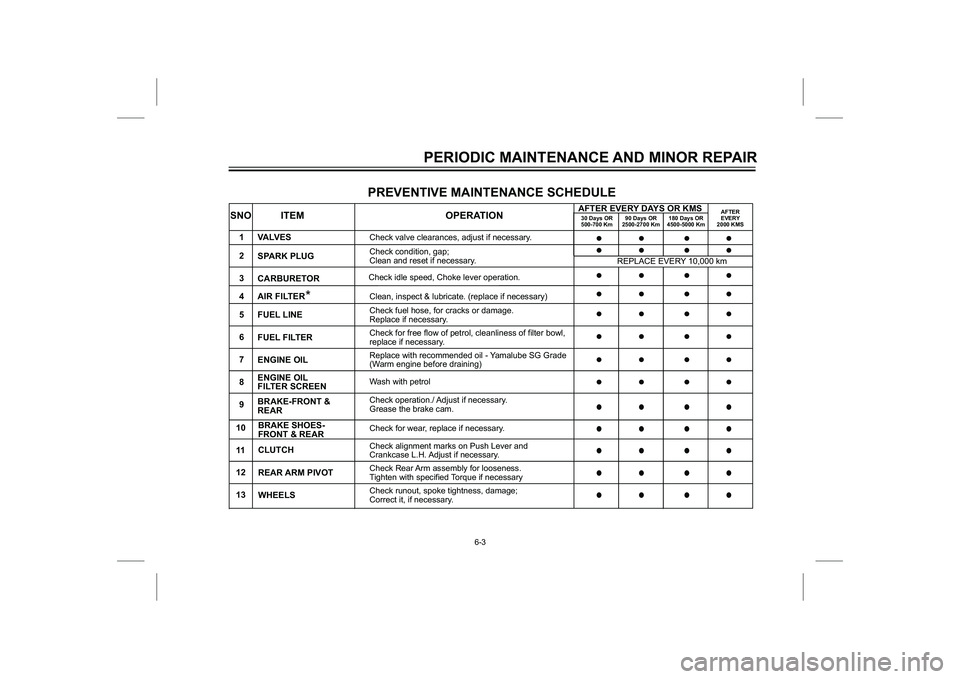
PERIODIC MAINTENANCE AND MINOR REPAIR
6-3
PREVENTIVE MAINTENANCE SCHEDULE
VA LV E S
SPARK PLUG
CARBURETOR
AIR FILTER
FUEL LINE
FUEL FILTER
ENGINE OIL
ENGINE OIL
FILTER SCREEN
BRAKE-FRONT &
REAR
Check valve clearances, adjust if necessary.
Check condition, gap;
Clean and reset if necessary.
Check idle speed, Choke lever operation.
Clean, inspect & lubricate. (replace if necessary)
Check fuel hose, for cracks or damage.
Replace if necessary.
Check for free flow of petrol, cleanliness of filter bowl,
replace if necessary.
Replace with recommended oil - Yamalube SG Grade
(Warm engine before draining)
Wash with petrol
Check operation./ Adjust if necessary.
Grease the brake cam.
ITEM OPERATION SNO
1
2
3
5 4
6
7
8
9
*
WHEELS 13FRONT & REAR
REAR ARM PIVOT CLUTCH
12 11BRAKE SHOES-
10
Check runout, spoke tightness, damage;
Correct it, if necessary. Check for wear, replace if necessary.
Check alignment marks on Push Lever and
Tighten with specified Torque if necessary Check Rear Arm assembly for looseness. Crankcase L.H. Adjust if necessary.
30 Days OR
500-700 KmAFTER EVERY DAYS OR KMS
REPLACE EVERY 10,000 km90 Days OR
2500-2700 Km180 Days OR
4500-5000 KmAFTER
EVERY
2000 KMS
Page 33 of 79

A. Spark plug gapSpark plug inspectionThe spark plug is an important engine
component and is easy to inspect.
The condition of the spark plug can
indicate the condition of the engine.
The ideal color on the white insulator
around the center electrode is a
medium-to-light tan color for a
Motorcycle that is being riddennormally. Do not attempt to diagnose
any problems yourself. Instead, take
the Motorcycle to a YAMAHA dealer.
You should periodically remove and
inspect the spark plug because heat
and deposits will cause the spark plug
to slowly break down and erode. If
electrode erosion becomes exces-
sive, or if carbon and other deposits
are excessive, you should replace the
spark plug with the specified plug.
Before installing the spark plug,
measure the electrode gap with a wire
thickness gauge; adjust the gap to
specification as necessary.
PERIODIC MAINTENANCE AND MINOR REPAIR
6-7
A.- Spark plug gap: 0.8 ±0.1 mm
When installing the plug, always
clean the gasket surface and use a
new gasket. Wipe off any grime from
the threads and tighten the spark plug
to the specified torque.
Tightening torque:
Spark plug:
12 ft-lb (1.75 m-kg)NOTE :If a torque wrench is not available
when you are installing a spark plug,
a good estimate of the correct
torque is 1/4 to 1/2 turn past finger
using a box spanner.
AALWAYS USE ONLY THE STANDARD RECOMMENDED MAKE AND TYPE OF
SPARK PLUG
Specified spark plug:
P-RA7HC-(CHAMPION)
Page 34 of 79

NOTE :
ALWAYS CHANGE ENGINE OIL AT RECOMMENDED INTERVALS
FOR OPTIMUM ENGINE PERFORMANCE AND ENGINE LIFE
1. Engine oil filler capEngine oil1. Oil level measurement
a. Place the Motorcycle on the
centerstand. Warm up the engine
for several minutes.
Be sure the Motorcycle is positioned
straight up when checking the oil
level. A slight tilt toward the side can
result in false readings.
1. Maximum level
2. Minimum levelWait a few minutes until the oil level
settles before checking.
b. Unscrew the dipstick and rest it
on the threads of the oil filler hole.
The oil level should be between
the minimum and maximum mark
on the dip- stick. If the level is low,
add oil to raise it to the specified
level.
PERIODIC MAINTENANCE AND MINOR REPAIR
6-8
NOTE :
1. Dipstick2. Engine oil replacement
a. Warm up the engine for a few
minutes.
b. Stop the engine. Place an oil pan
under the engine and remove the
dipstick.
1
1
Page 35 of 79
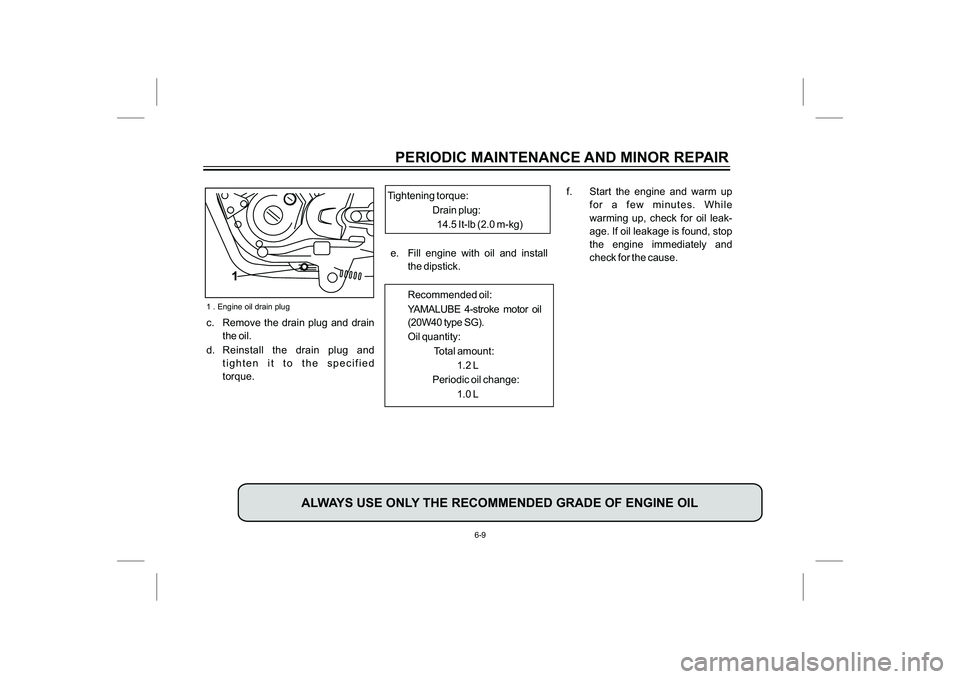
ALWAYS USE ONLY THE RECOMMENDED GRADE OF ENGINE OIL
1 . Engine oil drain plugc. Remove the drain plug and drain
the oil.
d. Reinstall the drain plug and
tighten it to the specified
torque.Tightening torque:
Drain plug:
14.5 It-lb (2.0 m-kg)
e. Fill engine with oil and install
the dipstick.
Recommended oil:
YAMALUBE 4-stroke motor oil
(20W40 type SG).
Oil quantity:
Total amount:
1.2 L
Periodic oil change:
1.0 L
PERIODIC MAINTENANCE AND MINOR REPAIR
6-9
f. Start the engine and warm up
for a few minutes. While
warming up, check for oil leak-
age. If oil leakage is found, stop
the engine immediately and
check for the cause.