fuel YAMAHA YBR125 2007 Owners Manual
[x] Cancel search | Manufacturer: YAMAHA, Model Year: 2007, Model line: YBR125, Model: YAMAHA YBR125 2007Pages: 79, PDF Size: 2.08 MB
Page 5 of 79

ROAD SAFETY TIPS....................................... 1-1
DESCRIPTION................................................ 2-1
Left view ........................................................ 2-1
Right view ...................................................... 2-2
Controls/Instruments................................... 2-3
INSTRUMENT AND CONTROL
FUNCTIONS.................................................... 3-1
Main switch cum steering lock ..................... 3-1
Speedometer................................................ 3-2
Fuel gauge .................................................... 3-2
Indicator lights .............................................. 3-2
Handlebar switches ..................................... 3-3
Clutch lever ................................................... 3-3
Shift pedal ..................................................... 3-4
Front brake lever ........................................... 3-4
Rear brake pedal .......................................... 3-4
Fuel tank cap ................................................ 3-5
Fuel............................................................... 3-5
Fuel cock ....................................................... 3-6
Starter Lever .................................................. 3-7
Kick starter .................................................... 3-7
Seat............................................................... 3-8Storage compartment .................................. 3-9
Rear shock absorber adjustment ............... 3-9
Handle Seat, Lifting Handle, stay Lock .......3-10
PRE-OPERATION CHECKS ........................... 4-1
Pre-operation check list ............................... 4-1
OPERATION AND IMPORTANT RIDING
POINTS............................................................ 5-1
Starting and warming up a
cold engine ................................................... 5-1
Starting a warm engine ................................ 5-2
Shifting.......................................................... 5-2
Tips for reducing fuel consumption ............. 5-3
Running-in.................................................... 5-3
Parking.......................................................... 5-4
PERIODIC MAINTENANCE AND MINOR
REPAIR ............................................................ 6-1
Tool kit ........................................................... 6-1
Preventive maintenance schedule .............. 6-3
Panel removal and installation .................... 6-5
Spark plug inspection .................................. 6-7
Engine OIl ..................................................... 6-8
1
4
23
65
TABLE OF CONTENTS
Libero5TS8.pmd11/3/2006, 8:50 PM 1
Page 8 of 79

DESCRIPTION
2-1
Left view
6. Toolkit (page 6-1)
7. Handle Seat(page 3-10)
8. Drive chain free play check window (page 6-19)
9. Side panel (L.H.) lock (page 6-5)
10. Shift pedal (page 3-4) 1. Fuel cock (page 3-6)
2. Starter Lever (page 3-7)
3. Fuse(page 6-26)
4. Battery(page 6-24)
5. Storage Compartment(page 3-9)
STANDARD VEHICLE
134
2
8
9107 56
Libero5TS8.pmd11/3/2006, 8:50 PM 4
Page 10 of 79
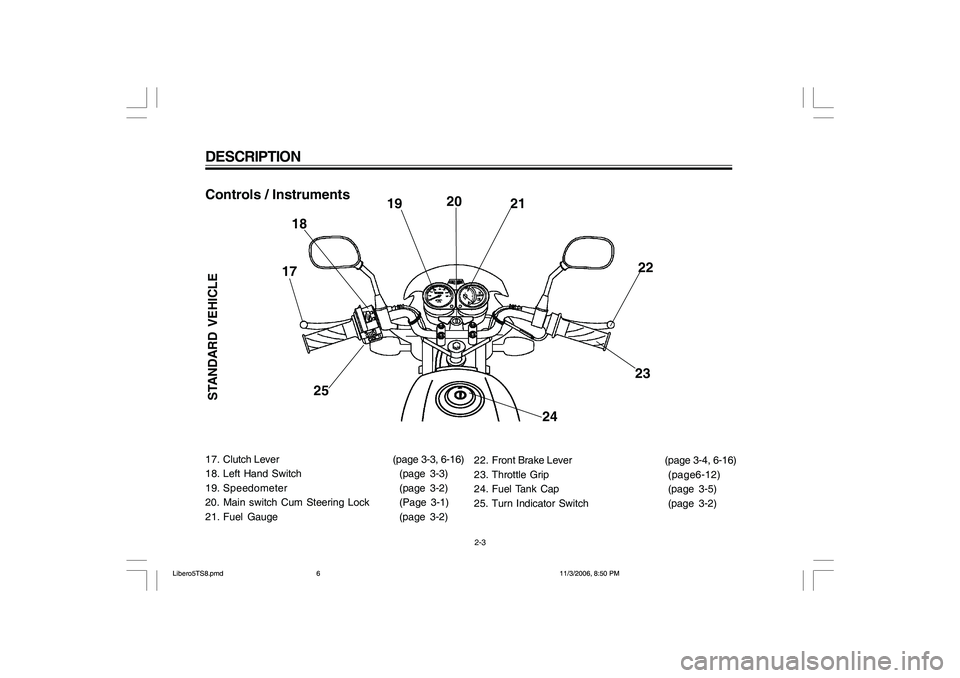
17. Clutch Lever (page 3-3, 6-16)
18. Left Hand Switch (page 3-3)
19. Speedometer(page 3-2)
20. Main switch Cum Steering Lock (Page 3-1)
21. Fuel Gauge (page 3-2)22. Front Brake Lever (page 3-4, 6-16)
23. Throttle Grip(page6-12)
24. Fuel Tank Cap (page 3-5)
25. Turn Indicator Switch (page 3-2)Controls / InstrumentsDESCRIPTION
STANDARD VEHICLE
2-3
24 17181920
21
23
25
22
Libero5TS8.pmd11/3/2006, 8:50 PM 6
Page 12 of 79

INSTRUMENT AND CONTROL FUNCTIONS
3-2
1. Turn indicator light “ ”
2. Neutral ”N”
3. High beam.Indicator light “ ” 1. Speedometer
2. Odometer1. Fuel gauge
1
1
2SpeedometerThe speedometer shows riding
speed.
This speedometer is equipped with
an odometer.
Fuel gaugeThe fuel gauge indicates the quantity
of the remaining petrol in the fuel tank.
The gauge needle moves from “F”
(Full) to"E”(Empty) as the fuel level
decreases.
When the needle comes below “E”
please refill the fuel tank at the
earliest.
Indicator lights1. Turn indicator light " "
2. Neutral indicator light "N"
3. High beam indicator light " "The indicator flashes when the
turn switch is moved to the left or
right. .
This indicator comes on when the
transmission is in neutral.
This indicator comes on when the
headlight high beam is used.
1
2
3
Page 15 of 79

This tank cap cannot be closed
unless the key is in the lock. The key
cannot be removed if the cap is not
locked properly.
Be sure the cap is properly
installed and locked in place
before riding the Motorcycle.WARNING
1. Filler tube
2. Fuel levelFuelMake sure there is sufficient fuel in the
tank. Fill the fuel tank to the bottom of
the filler tube as shown in the
illustration.
Do not overfill the fuel tank. Avoid
spilling fuel on the hot engine. Do
not fill the fuel tank above the
bottom of the filler tube to avoid
Spillage
1. OpenFuel tank capTO OPEN:
Insert the key and turn it 1/4 turn
clockwise. The lock will be released
and the cap can be opened.
TO CLOSE:
Push the tank cap into position with
the key inserted. To remove the key,
turn it counterclockwise to the
original position.
Ensure the arrow on fuel tank is
towards the Front of the bike when
inserting Fuel Tank Cap in Fuel
Tank.
INSTRUMENT AND CONTROL FUNCTIONS
NOTE :
3-5
WARNING
WARNING
1
2
1
1. Arrow
1¿
Page 16 of 79

Always wipe off spilled fuel
immediately with a dry and clean
soft cloth. Fuel may deteriorate
painted surfaces or plastic parts.
Recommended Fuel :
Fuel tank capacity :Regular gasoline (Petrol)
Total :
13.0 L
Reserve :
1.7 L
1. Arrow markFuel cockThe fuel cock supplies fuel from the
tank to the carburetor while filtering it
also.
The fuel cock has three positions,
which should be set as shown in the
illustrations.
OFF: With the fuel cock in this
position, fuel will not flow.
Always set the fuel cock to this
position when the engine is not
running.
1. Arrow markON: With the fuel cock in this
position, fuel flows to the
carburettor. Set the fuel cock to
this position when starting the
engine and while riding.
INSTRUMENT AND CONTROL FUNCTIONS
3-6
CAUTION :
IT IS A GOOD PRACTICE TO RETURN THE FUEL COCK LEVER TO
"Off" POSITION WHEN ENGINE IS NOT RUNNING
OFF
1
1
ON
Page 17 of 79

1. Arrow markRES: This indicates reserve. If you
run out of fuel while riding, set
the fuel cock to this position.
Fill the tank at the first
opportunity. Be sure to set the
fuel cock back to "ON" after
refueling
1. Kick starterKick-starterRaise the right Pillion footrest, and
rotate the kick starter away from the
engine. Push the starter down
lightly with your foot Kick until the
gears engage, then kick smoothly and
forcefully to start the engine. This
model has a primary-coupled kick
starter so the engine can be started in
any gear if the clutch is disengaged.
However, shifting to neutral before
starting is recommended.kick
INSTRUMENT AND CONTROL FUNCTIONS
3-7
NEVER MIX OIL IN PETROL1. Starter leverStarter leverStarting a cold engine requires a
richer air-fuel mixture. A separate
starter circuit supplies this mixture.
Move the Starter Lever in
Direction a to Turn on the Starter
Move the Starter Lever in
Direction b to Turn Off the Starter
RES
1
Page 22 of 79

If any item in the Pre-Operation Check is not working properly, have it inspected and repaired before operating
the Motorcycle.WARNINGFuel gauge
Check for proper operation
/Function
3.2
PRE-OPERATION CHECKS
4-2
Fuel Tank Brake and clutch lever pivots
Battery Lights, signals and switches Chassis fasteners Center and sidestand pivot
Make sure that all nuts, bolts, and screws are properly tightened.
Tighten if necessary.
Check fuel level.
Fill with fuel if necessary.
Fill with distilled water if necessary. Check fluid level. Check for proper operation.
6-24~ 6-26 3-3, 6-27 ~ 6-283-5 ~ 3-7
Lubricate if necessary. Check for smooth operation.
Lubricate if necessary. Check for smooth operation.
ITEM CHECKS
6-22PAGE6-22
-
IF WAITING AT TRAFFIC SIGNAL IS FOR LONG, SWITCH OFF THE ENGINE
TO PROTECT THE ENVIRONMENT AND TO LOWER FUEL CONSUMPTION
Page 23 of 79

OPERATION AND IMPORTANT RIDING POINTS
1. Before riding this Motorcycle,
become thoroughly familiar
with all operating controls and
their functions. Consult a
YAMAHA dealer regarding any
control or function that you do
not thoroughly understand.
2. Never start your engine or let it
run for any length of time in a
closed area. The exhaust fumes
are poisonous and can cause
loss of consciousness.
Always operate your
Motorcycle in an area with
adequate ventilation.
3. Before starting out, always be
sure the side stand is up.
Failure to retract the side stand
completely can result in a
serious accident when you try
to turn a corner.
Starting and warming up a
cold engine1. Turn the fuel cock to "ON"
2. Turn the main switch to "ON."
3. Shift the transmission into
neutral.
When the transmission is in neutral,
the neutral indicator light should be on.
If the light does not come on, ask a
YAMAHA dealer to inspect it.
4 Fully open the Starter Lever and
completely close the throttle grip.
5. Kick the kick starter to start the
engine.
6. After starting the Engine, turn back
the Starter Lever to the Warming-
up Position (About Half way)7. After Warming-up the Engine,
turn off the Starter Lever
completely.
For better engine performance
always warm up the engine. before
take off. Never open throttle fully
when engine is cold, otherwise
engine tends to stop.
The engine is warm when it
responds normally to the throttle
with the Starter Lever in “OFF”
direction.
5-1
WARNING
NOTE :
NOTE :NOTE :
Page 25 of 79

OPERATION AND IMPORTANT RIDING POINTS
Tips for reducing fuel
consumptionYour Motorcycle's fuel consumption
depends to a large extent on your
riding style. The following tips can
help reduce fuel consumption:
1. Warm up the engine before riding.
2. Move the strater Lever to “Off” as
soon as possible.
3. Shift up swiftly and avoid high
engine speeds during
acceleration.
4. Do not double-clutch or rev the
engine while shifting down and
avoid high engine speeds with no
load on the engine.
5. Turn off the engine instead of
letting it idle for an extended
length of time, i.e. in traffic jams, at
traffic lights or rail- road crossings.
6. Do not drive with excessive load
on the Motorcycle.
7. Plan your route in advance.
Running-inThere is never a more important
period in the life of your Motorcycle
than the period between zero and
1,000 kms. For this reason we ask
that you carefully read the following
material. Because the engine is brand
new, you must not put an excessive
load on it for the first 1,000 kms. The
various parts in the engine wear and
polish themselves to the correct
operating clearances. During this
period, prolonged full throttle
operation, or any condition which
might result in excessive heating of
the engine, must be avoided.Be sure to replace the engine
oil as per recommended
schedule.
1,000 kms and below :
Avoid prolonged full-throttle
operation. Vary speed
occasionally.
5-3
CAUTION :
8. Avoid frequent braking.
9. Always maintain your tyre
pressure as per recommendation
10. Get your motorcycle serviced
periodically after every 2000 kms.
If any engine trouble should occur
during the "Running-in" period,
consult a YAMAHA dealer
immediately.
CAUTION :