wheel YAMAHA YFM400F 2001 User Guide
[x] Cancel search | Manufacturer: YAMAHA, Model Year: 2001, Model line: YFM400F, Model: YAMAHA YFM400F 2001Pages: 426, PDF Size: 21.5 MB
Page 218 of 426
7-41
Yuki_Data:Yuki_data:Yuki:Yuki_1:ATV:HM00B061_YFM400FWA-61:YFM600-7.frame
EL
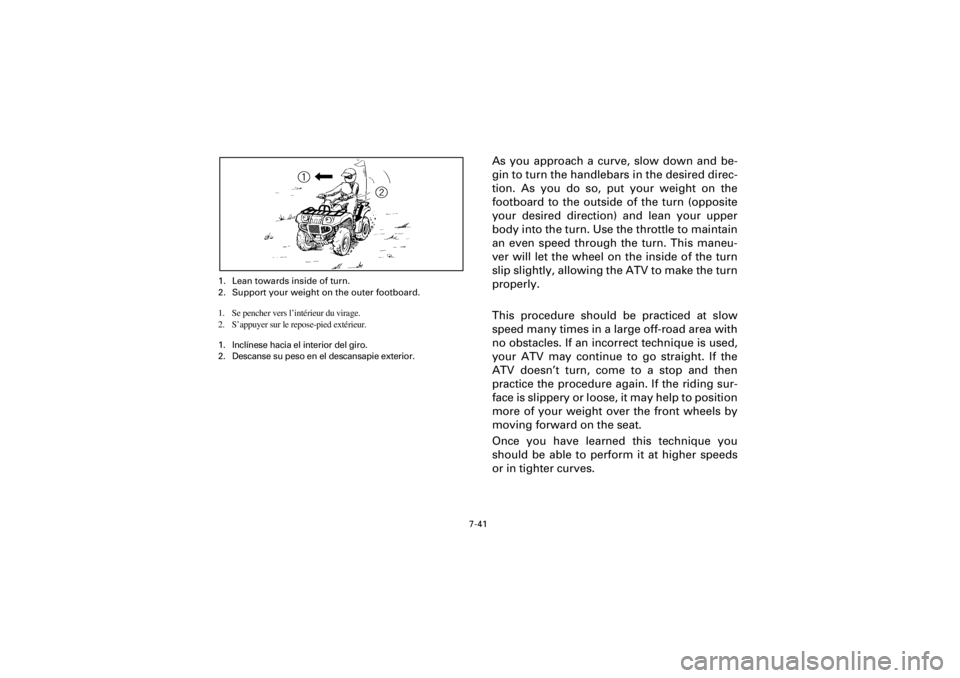
1. Lean towards inside of turn.
2. Support your weight on the outer footboard.
1. Se pencher vers l’intérieur du virage.
2. S’appuyer sur le repose-pied extérieur.
1. Inclínese hacia el interior del giro.
2. Descanse su peso en el descansapie exterior.
As you approach a curve, slow down and be-
gin to turn the handlebars in the desired direc-
tion. As you do so, put your weight on the
footboard to the outside of the turn (opposite
your desired direction) and lean your upper
body into the turn. Use the throttle to maintain
an even speed through the turn. This maneu-
ver will let the wheel on the inside of the turn
slip slightly, allowing the ATV to make the turn
properly.
This procedure should be practiced at slow
speed many times in a large off-road area with
no obstacles. If an incorrect technique is used,
your ATV may continue to go straight. If the
ATV doesn’t turn, come to a stop and then
practice the procedure again. If the riding sur-
face is slippery or loose, it may help to position
more of your weight over the front wheels by
moving forward on the seat.
Once you have learned this technique you
should be able to perform it at higher speeds
or in tighter curves.
Page 228 of 426

7-51
Yuki_Data:Yuki_data:Yuki:Yuki_1:ATV:HM00B061_YFM400FWA-61:YFM600-7.frame
EL
If your ATV has stalled or stopped and you be-
lieve you can continue up the hill, restart care-
fully to make sure you do not lift the front
wheels which could cause you to lose control.
If you are unable to continue up the hill, dis-
mount the ATV on the uphill side. Physically
turn the ATV around and then descend the hill.
If you start to roll backwards, DO NOT apply ei-
ther brake abruptly. If you are in 2WD, apply
only the front brake. When this ATV is in 4WD,
all wheels (front and rear) are interconnected
by the drive train. This means that applying ei-
ther the front brake or the rear brake will brake
all wheels. When descending hills, using either
brake lever or the brake pedal will brake the
wheels on the downhill side. Avoid sudden ap-
plication of either the front or rear brake be-
cause the wheels on the uphill side could come
off the ground. The ATV could easily tip over
backwards. Apply both the front and rear
brakes gradually, or dismount the ATV imme-
diately on the uphill side.
Page 232 of 426

7-55
Yuki_Data:Yuki_data:Yuki:Yuki_1:ATV:HM00B061_YFM400FWA-61:YFM600-7.frame
EL
RIDING DOWNHILL
When riding your ATV downhill, shift your
weight as far to the rear and uphill side of the
ATV as possible. Move back on the seat and sit
with your arms straight. Engine compression
will do most of the braking for you. For maxi-
mum engine compression braking effect, se-
lect low range and change to 4WD before
beginning to descend the hill. Improper brak-
ing may cause a loss of traction.
Use caution while descending a hill with loose
or slippery surfaces. Braking ability and trac-
tion may be adversely affected by these surfac-
es. Improper braking may also cause a loss of
traction.
When this ATV is in 4WD, all wheels (front and
rear) are interconnected by the drive train. This
means that applying either the front brake or
the rear brake will brake all wheels. When de-
scending hills, using either brake lever or the
brake pedal will brake the wheels on the down-
hill side. Avoid sudden application of either the
front or rear brake because the wheels on the
uphill side could come off the ground. Apply
both the front and rear brakes gradually.
Page 236 of 426

7-59
Yuki_Data:Yuki_data:Yuki:Yuki_1:ATV:HM00B061_YFM400FWA-61:YFM600-7.frame
EL
CROSSING A SLOPE
Traversing a sloping surface on your ATV re-
quires you to properly position your weight to
maintain proper balance. Be sure that you
have learned the basic riding skills on flat
ground before attempting to cross a sloping
surface. Avoid slopes with slippery surfaces or
rough terrain that may upset your balance.
As you travel across a slope, lean your body in
the uphill direction. It may be necessary to cor-
rect the steering when riding on loose surfaces
by pointing the front wheels slightly uphill.
When riding on slopes be sure not to make
sharp turns either up or down hill.
Page 248 of 426
7-71
Yuki_Data:Yuki_data:Yuki:Yuki_1:ATV:HM00B061_YFM400FWA-61:YFM600-7.frame
EL
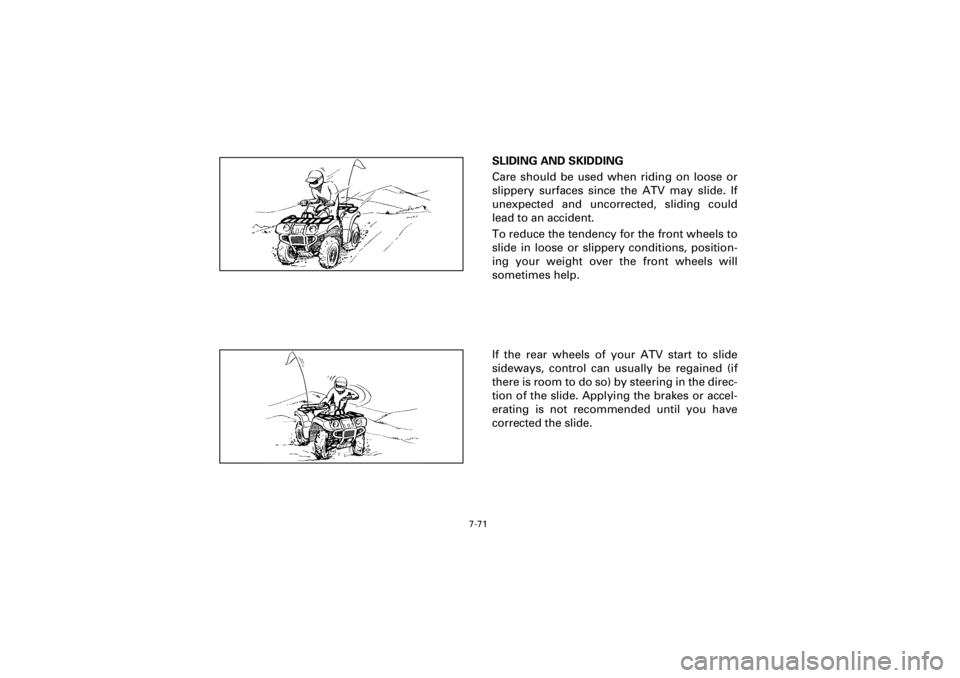
SLIDING AND SKIDDING
Care should be used when riding on loose or
slippery surfaces since the ATV may slide. If
unexpected and uncorrected, sliding could
lead to an accident.
To reduce the tendency for the front wheels to
slide in loose or slippery conditions, position-
ing your weight over the front wheels will
sometimes help.
If the rear wheels of your ATV start to slide
sideways, control can usually be regained (if
there is room to do so) by steering in the direc-
tion of the slide. Applying the brakes or accel-
erating is not recommended until you have
corrected the slide.
Page 252 of 426

7-75
Yuki_Data:Yuki_data:Yuki:Yuki_1:ATV:HM00B061_YFM400FWA-61:YFM600-7.frame
EL
WHAT TO DO IF...
This section is designed to be a reference
guide only. Be sure to read each section on
riding techniques completely.
WHAT TO DO...l
If your ATV doesn’t turn when you want it
to:
Bring the ATV to a stop and practice the
turning maneuvers again. Be sure you are
putting your weight on the footboard to the
outside of the turn. Position your weight
over the front wheels for better control.
(See pages 7-39 ~ 7-43.)
l
If your ATV begins to tip while turning:
Lean more into the turn to regain balance. If
necessary, gradually let off the throttle
and/or steer to the outside of the turn. (See
pages 7-39 ~ 7-43.)
l
If your ATV starts to slide sideways:
Steer in the direction of the slide if you have
the room. Applying the brakes or accelerat-
ing is not recommended until you have cor-
rected the slide. (See pages 7-71 ~ 7-73.)
Page 265 of 426
Yuki_Data:Yuki_data:Yuki:Yuki_1:ATV:HM00B061_YFM400FWA-61:YFM600-8.frame
ER
8-8
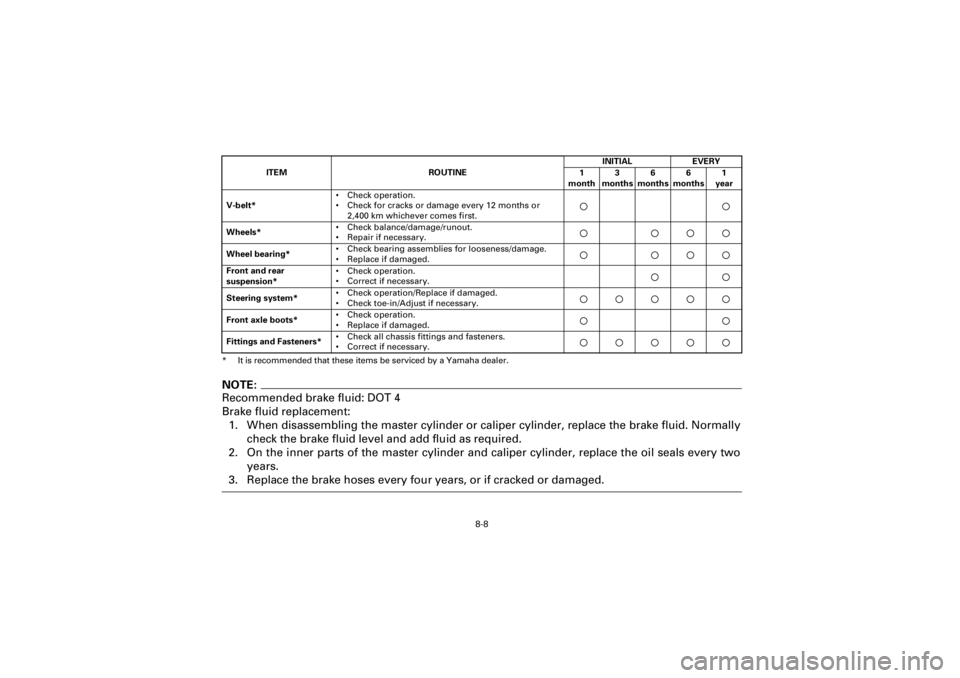
* It is recommended that these items be serviced by a Yamaha dealer.NOTE:
Recommended brake fluid: DOT 4
Brake fluid replacement:
1. When disassembling the master cylinder or caliper cylinder, replace the brake fluid. Normally
check the brake fluid level and add fluid as required.
2. On the inner parts of the master cylinder and caliper cylinder, replace the oil seals every two
years.
3. Replace the brake hoses every four years, or if cracked or damaged.
V-belt*
• Check operation.
• Check for cracks or damage every 12 months or
2,400 km whichever comes first.
Wheels*
• Check balance/damage/runout.
• Repair if necessary.
Wheel bearing*
• Check bearing assemblies for looseness/damage.
• Replace if damaged.
Front and rear
suspension*
• Check operation.
• Correct if necessary.
Steering system*
• Check operation/Replace if damaged.
• Check toe-in/Adjust if necessary.
Front axle boots*
• Check operation.
• Replace if damaged.
Fittings and Fasteners*
• Check all chassis fittings and fasteners.
• Correct if necessary.
ITEM ROUTINEINITIAL EVERY
1
month3
months6
months6
months1
year
Page 346 of 426
8-89
Yuki_Data:Yuki_data:Yuki:Yuki_1:ATV:HM00B061_YFM400FWA-61:YFM600-8.frame
EL
EBU00312
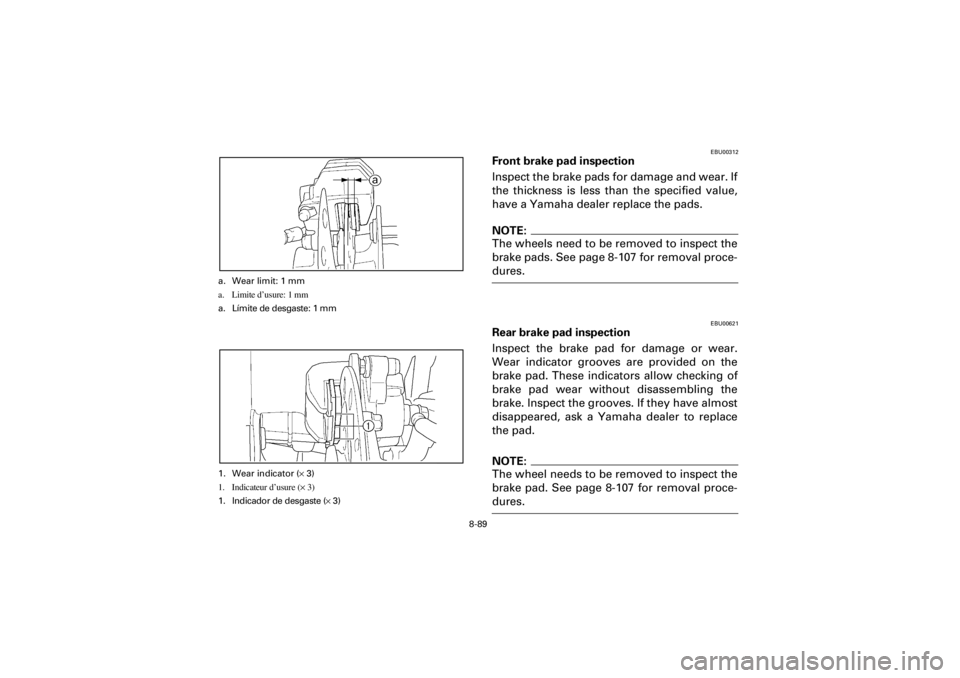
Front brake pad inspection
Inspect the brake pads for damage and wear. If
the thickness is less than the specified value,
have a Yamaha dealer replace the pads.NOTE:The wheels need to be removed to inspect the
brake pads. See page 8-107 for removal proce-dures.
EBU00621
Rear brake pad inspection
Inspect the brake pad for damage or wear.
Wear indicator grooves are provided on the
brake pad. These indicators allow checking of
brake pad wear without disassembling the
brake. Inspect the grooves. If they have almost
disappeared, ask a Yamaha dealer to replace
the pad.NOTE:The wheel needs to be removed to inspect the
brake pad. See page 8-107 for removal proce-dures.
a. Wear limit: 1 mm
a. Limite d’usure: 1 mm
a. Límite de desgaste: 1 mm1. Wear indicator (´ 3)
1. Indicateur d’usure (´ 3)
1. Indicador de desgaste (´ 3)
Page 364 of 426
8-107
Yuki_Data:Yuki_data:Yuki:Yuki_1:ATV:HM00B061_YFM400FWA-61:YFM600-8.frame
EL
EBU00373
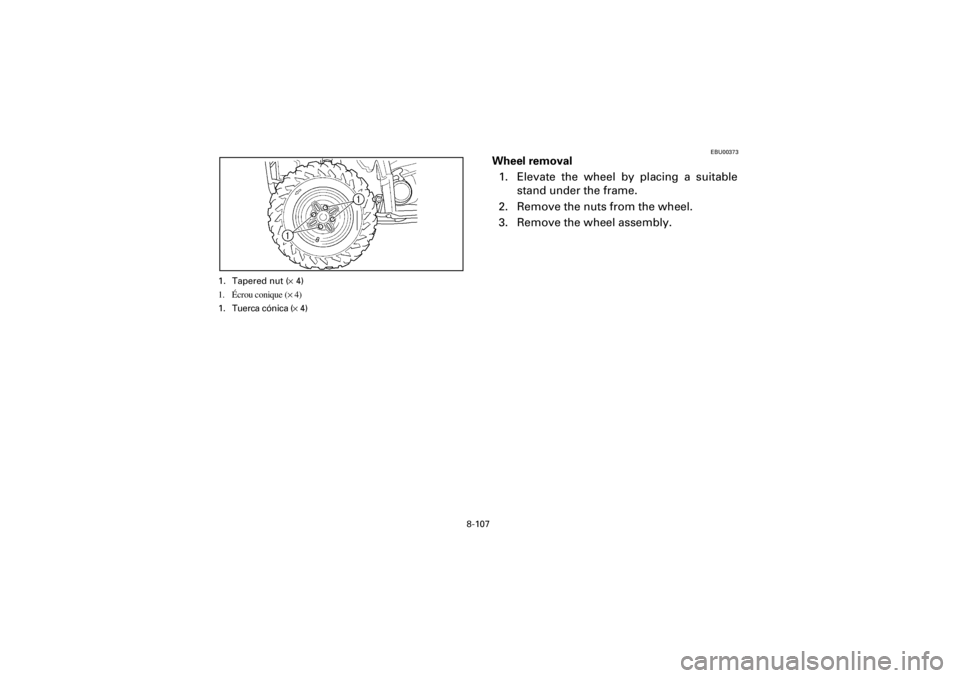
Wheel removal
1. Elevate the wheel by placing a suitable
stand under the frame.
2. Remove the nuts from the wheel.
3. Remove the wheel assembly.
1. Tapered nut (´ 4)
1. Écrou conique (´ 4)
1. Tuerca cónica (´ 4)
Page 366 of 426
8-109
Yuki_Data:Yuki_data:Yuki:Yuki_1:ATV:HM00B061_YFM400FWA-61:YFM600-8.frame
EL
EBU00702
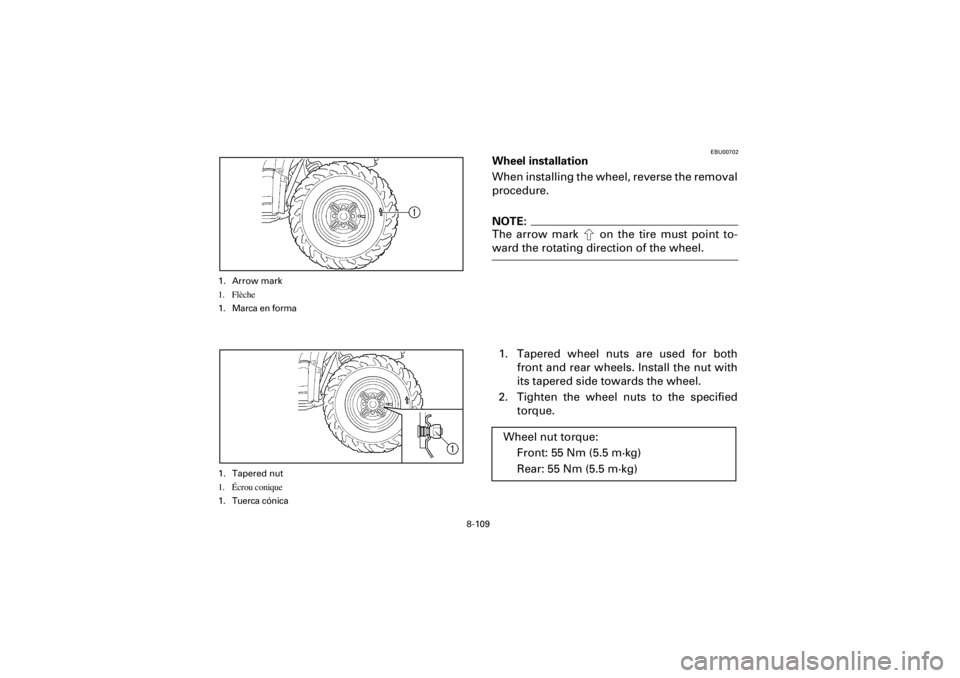
Wheel installation
When installing the wheel, reverse the removal
procedure.NOTE:The arrow mark on the tire must point to-ward the rotating direction of the wheel.
1. Tapered wheel nuts are used for both
front and rear wheels. Install the nut with
its tapered side towards the wheel.
2. Tighten the wheel nuts to the specified
torque.
Wheel nut torque:
Front: 55 Nm (5.5 m·kg)
Rear: 55 Nm (5.5 m·kg)
1. Arrow mark
1. Flèche
1. Marca en forma1. Tapered nut
1. Écrou conique
1. Tuerca cónica