clutch YAMAHA YFM700R 2013 User Guide
[x] Cancel search | Manufacturer: YAMAHA, Model Year: 2013, Model line: YFM700R, Model: YAMAHA YFM700R 2013Pages: 162, PDF Size: 3.81 MB
Page 65 of 162
6-4
6
erly lubricated only when the engine is run-
ning. Inadequate lubrication may damage
the transmission.
●Always use the clutch when changing gears.
The engine, transmission and drive train are
not designed to withstand the shock of
forced shifting and can be damaged by shift-
ing without using the clutch.EBU20501Operating the revers
e knob and driving
in reverse
WARNING
EWB00720Improper operation in reverse could make you
hit an obstacle or even a person behind you,
resulting in serious injury. When you shift into
reverse, make sure there are no people or ob-
stacles behind you. When it is safe to proceed,
go slowly.NOTICEECB00170Before shifting, stop the ATV, otherwise the
transmission may be damaged.
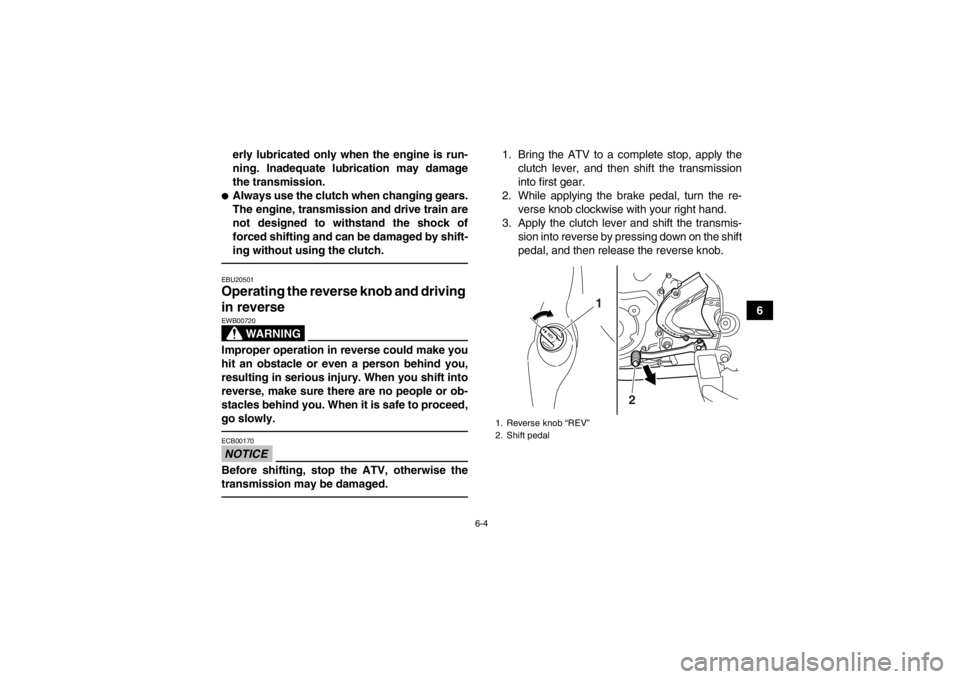
1. Bring the ATV to a complete stop, apply the
clutch lever, and then shift the transmission
into first gear.
2. While applying the brake pedal, turn the re- verse knob clockwise with your right hand.
3. Apply the clutch lever and shift the transmis- sion into reverse by pressing down on the shift
pedal, and then release the reverse knob.1. Reverse knob “REV”
2. Shift pedal
2
1
U1PE60E0.book Page 4 Friday, March 2, 2012 1:22 PM
Page 66 of 162
6-5
6
TIPWhen in reverse, the reverse indicator light should
come on. If the indicator light does not come on,
have a Yamaha dealer check the electrical circuit.4. Check behind you for people or obstacles,and then release the brake pedal.
5. Open the throttle lever gradually and release the clutch lever slowly. Continue to watch to
the rear while backing.EBU20672Engine break-in TIP●For ATVs equipped with an odometer or an hour
meter, follow the figures given in km (mi) or the
figures given in hours.●For ATVs not equipped with an odometer or
hour meter, follow the figures given in hours.There is never a more important period in the life of
your engine than the first 320 km (200 mi) or 20
hours of riding. For this reason, you should read
the following material carefully. Since the engine is brand new, do not put an ex-
cessive load on it for the first 320 km (200 mi) or 20
hours. The various parts in the engine wear and
polish themselves to the correct operating clear-
ances. During this period, prolonged full-throttle
operation or any condition that might result in en-
gine overheating must be avoided.
0–160 km (0–100 mi) or 0–10 hours
Avoid prolonged operation above 1/2 throttle. Vary
the speed of the ATV regularly. Do not operate it at
one set throttle position.
160–320 km (100–200 mi) or 10–20 hours
Avoid prolonged operation above 3/4 throttle. Rev
the engine through the gears freely, but do not use
full throttle at any time.
320 km (200 mi) or 20 hours and beyond
The ATV can now be operated normally.
NOTICEECB00220If any engine trouble should occur during the
engine break-in period, immediately have a
Yamaha dealer check the ATV.
U1PE60E0.book Page 5 Friday, March 2, 2012 1:22 PM
Page 80 of 162
7-11
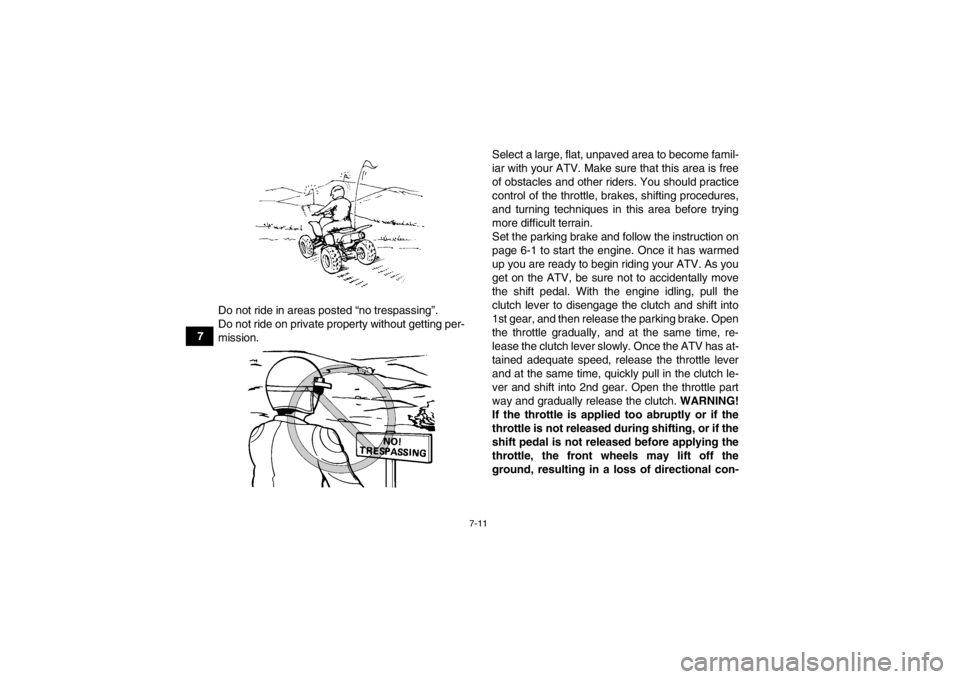
7Do not ride in areas posted “no trespassing”.
Do not ride on private property without getting per-
mission. Select a large, flat, unpaved area to become famil-
iar with your ATV. Make sure that this area is free
of obstacles and other riders. You should practice
control of the throttle, brakes, shifting procedures,
and turning techniques in this area before trying
more difficult terrain.
Set the parking brake and follow the instruction on
page 6-1 to start the engine. Once it has warmed
up you are ready to begin riding your ATV. As you
get on the ATV, be sure not to accidentally move
the shift pedal. With the engine idling, pull the
clutch lever to disengage the clutch and shift into
1st gear, and then release the parking brake. Open
the throttle gradually, and at the same time, re-
lease the clutch lever slowly. Once the ATV has at-
tained adequate speed, release the throttle lever
and at the same time, quickly pull in the clutch le-
ver and shift into 2nd gear. Open the throttle part
way and gradually release the clutch.
WARNING!
If the throttle is applied too abruptly or if the
throttle is not released during shifting, or if the
shift pedal is not released before applying the
throttle, the front wheels may lift off the
ground, resulting in a loss of directional con-
U1PE60E0.book Page 11 Friday, March 2, 2012 1:22 PM
Page 97 of 162
8-5
8
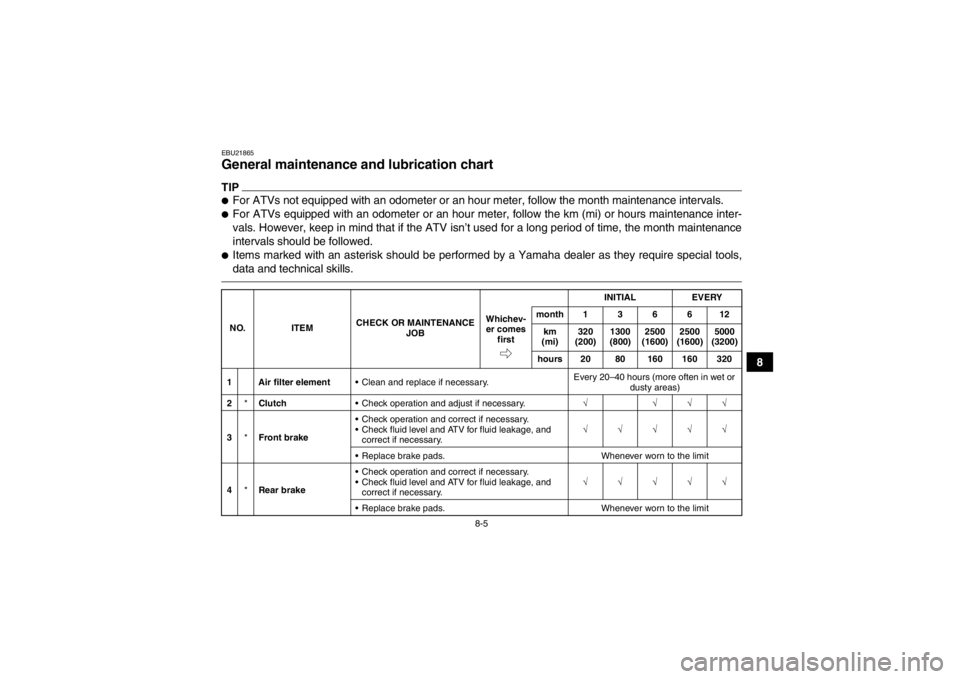
EBU21865General maintenance and lubrication chart TIP●For ATVs not equipped with an odometer or an hour meter, follow the month maintenance intervals.●For ATVs equipped with an odometer or an hour meter, follow the km (mi) or hours maintenance inter-
vals. However, keep in mind that if the ATV isn’t used for a long period of time, the month maintenance
intervals should be followed.●Items marked with an asterisk should be performed by a Yamaha dealer as they require special tools,
data and technical skills.NO.ITEM CHECK OR MAINTENANCE
JOB INITIAL
EVERY
Whichev- er comes first month136612
km
(mi) 320
(200) 1300
(800) 2500
(1600) 2500
(1600) 5000
(3200)
hours 20 80 160 160 320
1 Air filter element Clean and replace if necessary. Every 20–40 hours (more often in wet or
dusty areas)
2 *Clutch Check operation and adjust if necessary. √ √√√
3 *Front brake Check operation and correct if necessary.
Check fluid level and ATV for fluid leakage, and
correct if necessary. √√√√√
Replace brake pads. Whenever worn to the limit
4 *Rear brake Check operation and correct if necessary.
Check fluid level and ATV for fluid leakage, and
correct if necessary. √√√√√
Replace brake pads. Whenever worn to the limit
U1PE60E0.book Page 5 Friday, March 2, 2012 1:22 PM
Page 109 of 162

8-17
8
14. Remove the engine oil tank filler cap, and then
gradually fill the oil tank with the remaining oil
quantity while regularly checking the oil level
on the dipstick.
15. Install and tighten the engine oil tank filler cap.
TIPBe sure to wipe off spilled oil on any parts after the
engine and exhaust system have cooled down.NOTICEECB00300●In order to prevent clutch slippage (since the
engine oil also lubricates the clutch), do not
mix any chemical additives. Do not use oils
with a diesel specification of “CD” or oils of a higher quality than specified. In addition,
do not use oils labeled “ENERGY CONSERV-
ING II” or higher.
●Make sure that no foreign material enters the
crankcase.16. Start the engine, and then let it idle for several
minutes while checking it for oil leakage. If oil
is leaking, immediately turn the engine off and
check for the cause.
17. Turn the engine off, and then check the oil lev- el and correct it if necessary.EBU23470Coolant The coolant level should be checked before each
ride. In addition, the coolant must be changed at
the intervals specified in the periodic maintenance
and lubrication chart.EBU27942To check the coolant level1. Place the ATV on a level surface.
Recommended oil:
See page 10-1.
Oil quantity: Without oil filter element replacement:1.75 L (1.85 US qt, 1.54 Imp.qt)
With oil filter element replacement: 1.85 L (1.96 US qt, 1.63 Imp.qt)
U1PE60E0.book Page 17 Friday, March 2, 2012 1:22 PM
Page 129 of 162
8-37
8
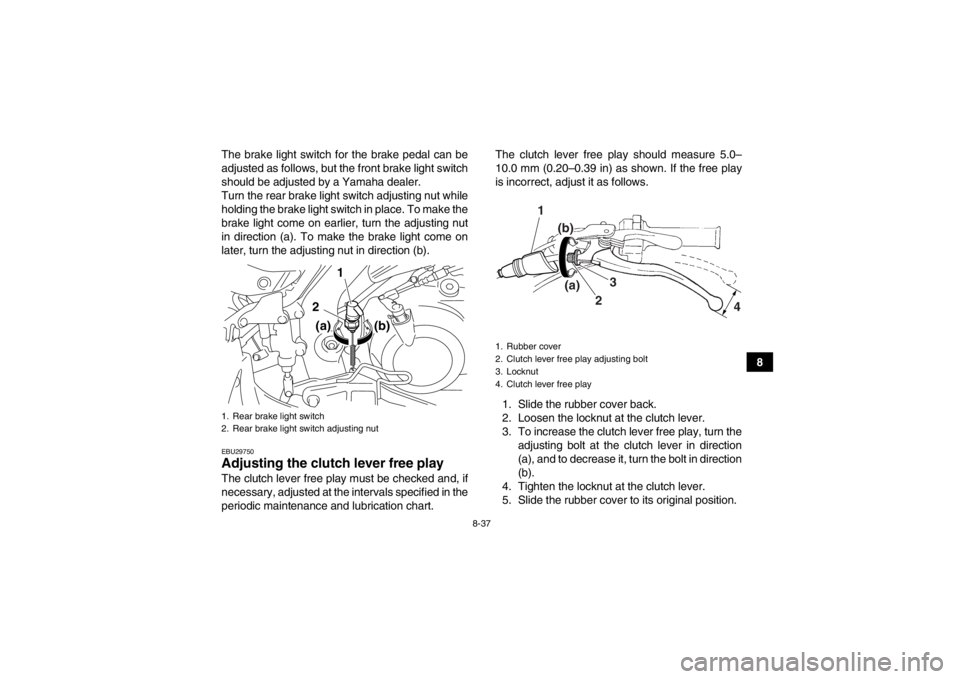
The brake light switch for the brake pedal can be
adjusted as follows, but the front brake light switch
should be adjusted by a Yamaha dealer.
Turn the rear brake light switch adjusting nut while
holding the brake light switch in place. To make the
brake light come on earlier, turn the adjusting nut
in direction (a). To make the brake light come on
later, turn the adjusting nut in direction (b).
EBU29750Adjusting the clutch lever free play The clutch lever free play must be checked and, if
necessary, adjusted at the intervals specified in the
periodic maintenance and lubrication chart. The clutch lever free play should measure 5.0–
10.0 mm (0.20–0.39 in) as shown. If the free play
is incorrect, adjust it as follows.
1. Slide the rubber cover back.
2. Loosen the locknut at the clutch lever.
3. To increase the clutch lever free play, turn the adjusting bolt at the clutch lever in direction
(a), and to decrease it, turn the bolt in direction
(b).
4. Tighten the locknut at the clutch lever.
5. Slide the rubber cover to its original position.1. Rear brake light switch
2. Rear brake light switch adjusting nut
1
2
(a)
(b)
1. Rubber cover
2. Clutch lever free play adjusting bolt
3. Locknut
4. Clutch lever free play
3
1
2
(a)
(b)
4
U1PE60E0.book Page 37 Friday, March 2, 2012 1:22 PM
Page 130 of 162
8-38
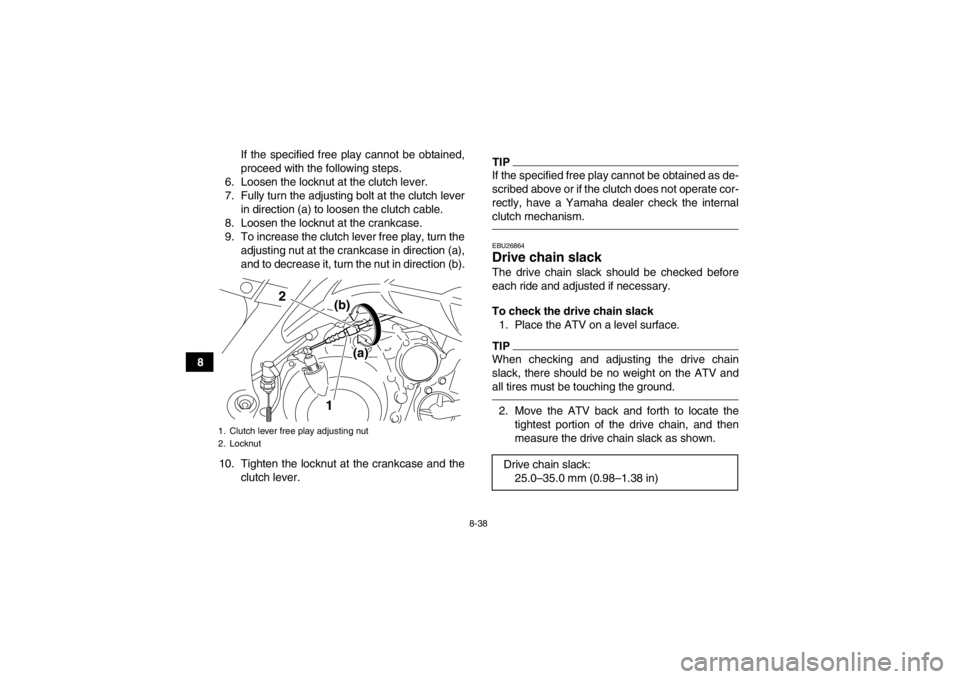
8If the specified free play cannot be obtained,
proceed with the following steps.
6. Loosen the locknut at the clutch lever.
7. Fully turn the adjusting bolt at the clutch lever in direction (a) to loosen the clutch cable.
8. Loosen the locknut at the crankcase.
9. To increase the clutch lever free play, turn the adjusting nut at the crankcase in direction (a),
and to decrease it, turn the nut in direction (b).
10. Tighten the locknut at the crankcase and the clutch lever.
TIPIf the specified free play cannot be obtained as de-
scribed above or if the clutch does not operate cor-
rectly, have a Yamaha dealer check the internal
clutch mechanism.EBU26864Drive chain slack The drive chain slack should be checked before
each ride and adjusted if necessary.
To check the drive chain slack1. Place the ATV on a level surface.TIPWhen checking and adjusting the drive chain
slack, there should be no weight on the ATV and
all tires must be touching the ground.2. Move the ATV back and forth to locate the tightest portion of the drive chain, and then
measure the drive chain slack as shown.
1. Clutch lever free play adjusting nut
2. Locknut
1
2
(a)
(b)
Drive chain slack:
25.0–35.0 mm (0.98–1.38 in)
U1PE60E0.book Page 38 Friday, March 2, 2012 1:22 PM
Page 134 of 162
8-42
8
EBU24922Checking and lubricating the brake and
clutch levers The operation of the brake and clutch levers
should be checked before each ride, and the lever
pivots should be lubricated if necessary.EBUM0170Checking the shift pedal The operation of the shift pedal should be checked
before each ride. If operation is not smooth, have
a Yamaha dealer check the vehicle.EBU28871Checking and lubricating the brake
pedal The operation of the brake pedal should be
checked before each ride, and the pedal pivot
should be lubricated if necessary.
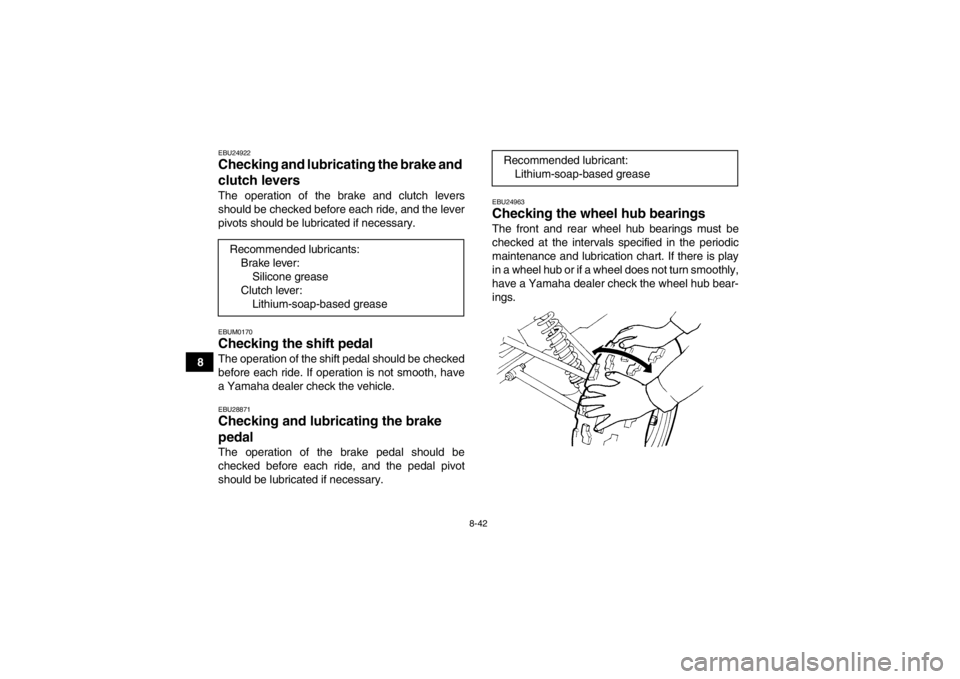
EBU24963Checking the wheel hub bearings The front and rear wheel hub bearings must be
checked at the intervals specified in the periodic
maintenance and lubrication chart. If there is play
in a wheel hub or if a wheel does not turn smoothly,
have a Yamaha dealer check the wheel hub bear-
ings.
Recommended lubricants:
Brake lever:Silicone grease
Clutch lever: Lithium-soap-based greaseRecommended lubricant:Lithium-soap-based grease
U1PE60E0.book Page 42 Friday, March 2, 2012 1:22 PM
Page 153 of 162
10-2
10
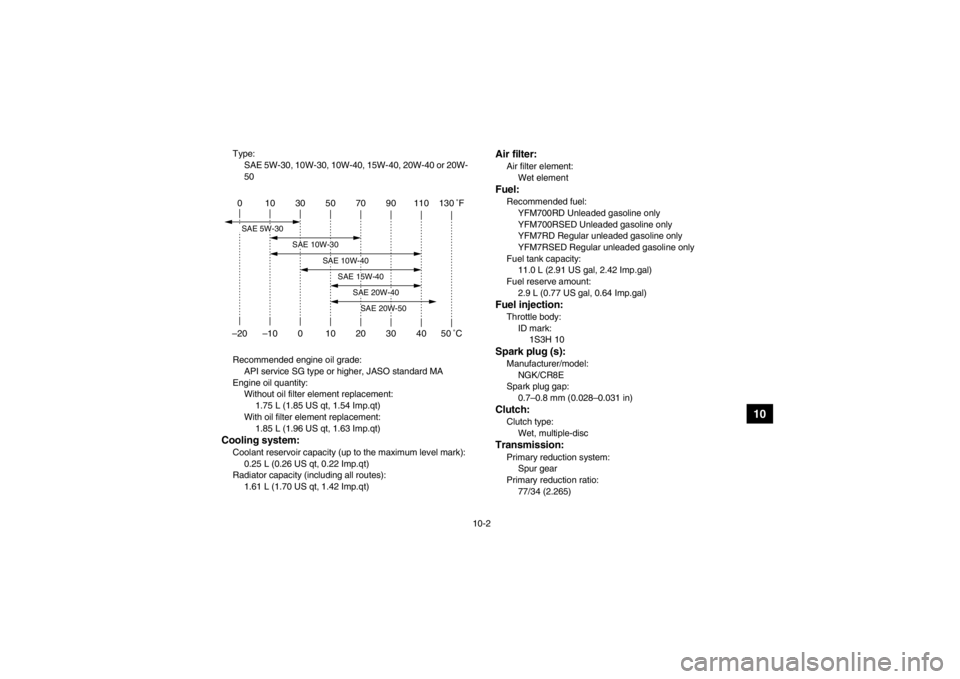
Type:SAE 5W-30, 10W-30, 10W-40, 15W-40, 20W-40 or 20W-
50
Recommended engine oil grade: API service SG type or higher, JASO standard MA
Engine oil quantity: Without oil filter element replacement:
1.75 L (1.85 US qt, 1.54 Imp.qt)
With oil filter element replacement: 1.85 L (1.96 US qt, 1.63 Imp.qt)Cooling system:Coolant reservoir capacity (up to the maximum level mark):
0.25 L (0.26 US qt, 0.22 Imp.qt)
Radiator capacity (including all routes): 1.61 L (1.70 US qt, 1.42 Imp.qt)
Air filter:Air filter element:Wet elementFuel:Recommended fuel:YFM700RD Unleaded gasoline only
YFM700RSED Unleaded gasoline only
YFM7RD Regular unleaded gasoline only
YFM7RSED Regular unleaded gasoline only
Fuel tank capacity: 11.0 L (2.91 US gal, 2.42 Imp.gal)
Fuel reserve amount:
2.9 L (0.77 US gal, 0.64 Imp.gal)Fuel injection:Throttle body:ID mark:1S3H 10Spark plug (s):Manufacturer/model:
NGK/CR8E
Spark plug gap: 0.7–0.8 mm (0.028–0.031 in)Clutch:Clutch type:
Wet, multiple-discTransmission:Primary reduction system:Spur gear
Primary reduction ratio:
77/34 (2.265)
0 10 30 50 70 90 110 130 F
–20 –10 0 10 20 30 40 50 CSAE 5W-30
SAE 10W-30
SAE 10W-40
SAE 15W-40
SAE 20W-40SAE 20W-50
U1PE60E0.book Page 2 Friday, March 2, 2012 1:22 PM
Page 159 of 162

INDEX
AAccessories and loading ................................................ 6-7
Air filter element, cleaning ............................................ 8-21BBattery .......................................................................... 8-46
Brake and clutch levers, checking and lubricating ....... 8-42
Brake fluid, changing ................................................... 8-34
Brake fluid level, checking ........................................... 8-31
Brake lever free play, checking the front ...................... 8-34
Brake lever (YFM7RD/YFM700RD) ............................... 4-6
Brake lever (YFM7RSED/YFM700RSED) ..................... 4-7
Brake light switches ..................................................... 8-36
Brake pads, checking the front and rear ...................... 8-30
Brake pedal .................................................................... 4-7
Brake pedal, checking and lubricating ......................... 8-42
Brake pedal height, checking ....................................... 8-34
Brakes .......................................................................... 8-29
Brakes, front and rear .................................................... 5-4CCables, checking and lubricating ................................. 8-41
Chassis fasteners .......................................................... 5-7
Cleaning ......................................................................... 9-1
Clutch lever .................................................................... 4-6
Clutch lever free play, adjusting ................................... 8-37
Coolant .................................................................. 5-4, 8-17
Coolant temperature warning light ................................. 4-2DDrive chain ..................................................................... 5-5Drive chain, lubricating ................................................ 8-40
Drive chain slack .......................................................... 8-38
EEngine break-in .............................................................. 6-5
Engine idling speed ..................................................... 8-27
Engine oil ....................................................................... 5-4
Engine oil and oil filter element .................................... 8-13
Engine, start ................................................................... 6-1
Engine stop switch ......................................................... 4-4
Engine trouble warning light .......................................... 4-3FFuel ....................................................................... 4-10, 5-4
Fuel level warning light .................................................. 4-3
Fuel tank cap ............................................................... 4-10
Fuses, replacing .......................................................... 8-48HHandlebar switches ....................................................... 4-4
Headlight beam, adjusting ........................................... 8-52
Headlight bulb, replacing ............................................. 8-50IIdentification numbers .................................................. 11-1
Indicator lights and warning lights .................................. 4-2
Instruments, lights and switches .................................... 5-7LLabel locations ............................................................... 1-1
Light switch .................................................................... 4-4MMain switch .................................................................... 4-1
U1PE60E0.book Page 1 Friday, March 2, 2012 1:22 PM