warning YAMAHA YFM700R 2018 Owner's Manual
[x] Cancel search | Manufacturer: YAMAHA, Model Year: 2018, Model line: YFM700R, Model: YAMAHA YFM700R 2018Pages: 158, PDF Size: 3.7 MB
Page 47 of 158
4-21
4
EBU30992Rear shock absorber (YFM70RSXJ)This shock absorber assembly is equipped with a
spring preload adjusting nut, a rebound damping
force adjusting screw, with a compression damp-
ing force adjusting bolt (for fast compression
damping), and a compression damping force ad-
justing screw (for slow compression damping).
WARNING
EWB02681Suspension components become hot during
operation. Never touch the compression
damping force adjusting bolt and screw, the
rebound damping force adjusting screw or the
oil reservoir with your bare hand or skin until
the suspension components have cooled. NOTICEECB00091Never turn an adjusting mechanism beyond
the minimum and maximum settings. TIPAlthough the total number of clicks or turns of a
damping force adjusting mechanism may not ex-
actly match the following specifications due to
small differences in production, the actual number of clicks or turns always represents the entire ad-
justing range. To obtain a precise adjustment, it
would be advisable to check the number of clicks
or turns of each damping force adjusting mecha-
nism and to modify the specifications as neces-
sary.
Spring preload
1. Loosen the locknut.
2. Turn the spring preload adjusting nut in direc- tion (a) to increase the spring preload and
thereby harden the suspension, and in direc-
tion (b) to decrease the spring preload and
thereby soften the suspension.
U2LS63E0.book Page 21 Friday, March 31, 2017 8:42 AM
Page 51 of 158
4-25
4
WARNING
EWB00431This shock absorber assembly contains highly
pressurized nitrogen gas. Read and under-
stand the following information before han-
dling the shock absorber assembly.
Do not tamper with or attempt to open the
cylinder assembly.
Do not subject the shock absorber assembly
to an open flame or other high heat source.
This may cause the unit to explode due to ex-
cessive gas pressure.
Do not deform or damage the cylinder in any
way. Cylinder damage will result in poor
damping performance.
Do not dispose of a damaged or worn out
shock absorber assembly yourself. Take the
shock absorber assembly to a Yamaha deal-
er for any service. U2LS63E0.book Page 25 Friday, March 31, 2017 8:42 AM
Page 52 of 158
5-1
5
EBU19203
PRE-OPERATION CHECKS
EBU19226Inspect your vehicle each time you use it to make sure the vehicle is in safe operating condition. Always
follow the inspection and maintenance procedures and schedules described in the Owner’s Manual.
WARNING
EWB00482Failure to inspect or maintain the vehicle properly increases the possibility of an accident or equip-
ment damage. Do not operate the vehicle if you find any problem. If a problem cannot be corrected
by the procedures provided in this manual, have the vehicle inspected by a Yamaha dealer. Before using this vehicle, check the following points:
ITEMROUTINE PAGE
Fuel • Check fuel level in fuel tank,
and add recommended fuel if neces-
sary.
• Check fuel line for leakage. Correct if necessary. 4-9, 5-4
Engine oil • Check oil level in engine oil
tank, and add recommended oil to
specified level if necessary.
• Check ATV for oil leakage. Correct if necessary. 5-4, 8-13
Coolant • Check coolant level in reservoir, and add recommended coolant to
specified level if necessary.
• Check cooling system for leakage. Correct if necessary. 5-4, 8-18
U2LS63E0.book Page 1 Friday, March 31, 2017 8:42 AM
Page 56 of 158

5-5
5Brake operation
Test the brakes at slow speed after starting out to
make sure they are working properly. If the brakes
do not provide proper braking performance,
check the brake pads for wear. (See page 8-30.)
EBU19762Throttle leverCheck the operation of the throttle lever. It must
open smoothly and spring back to the idle position
when released. Have a Yamaha dealer correct if
necessary.EBU19771Drive chainCheck the condition of the drive chain and check
the drive chain slack. Lubricate and adjust the
drive chain as necessary. (See page 8-39.)EBU19816TiresCheck tire pressure regularly to make sure it is at
the recommended specifications. Also check for
wear and damage. Tire pressure
Use a tire pressure gauge to check and adjust tire
air pressure when the tires are cold. The tire air
pressure must be equal on both sides.
WARNING! Operation of this vehicle with im- proper tire pressure may cause severe injury or
death from loss of control or rollover. Tire
pressure below the minimum specified could
also cause the tire to dislodge from the rim un-
der severe riding conditions.
[EWB02542]
Recommended tire pressure: Front27.5 kPa (0.275 kgf/cm², 4.0 psi)
Rear 27.5 kPa (0.275 kgf/cm², 4.0 psi)
Minimum tire pressure: Front24.5 kPa (0.245 kgf/cm², 3.6 psi)
Rear 24.5 kPa (0.245 kgf/cm², 3.6 psi)
Maximum tire seating pressure: Front250 kPa (2.5 kgf/cm², 36 psi)
Rear 250 kPa (2.5 kgf/cm², 36 psi)
U2LS63E0.book Page 5 Friday, March 31, 2017 8:42 AM
Page 57 of 158
5-6
5
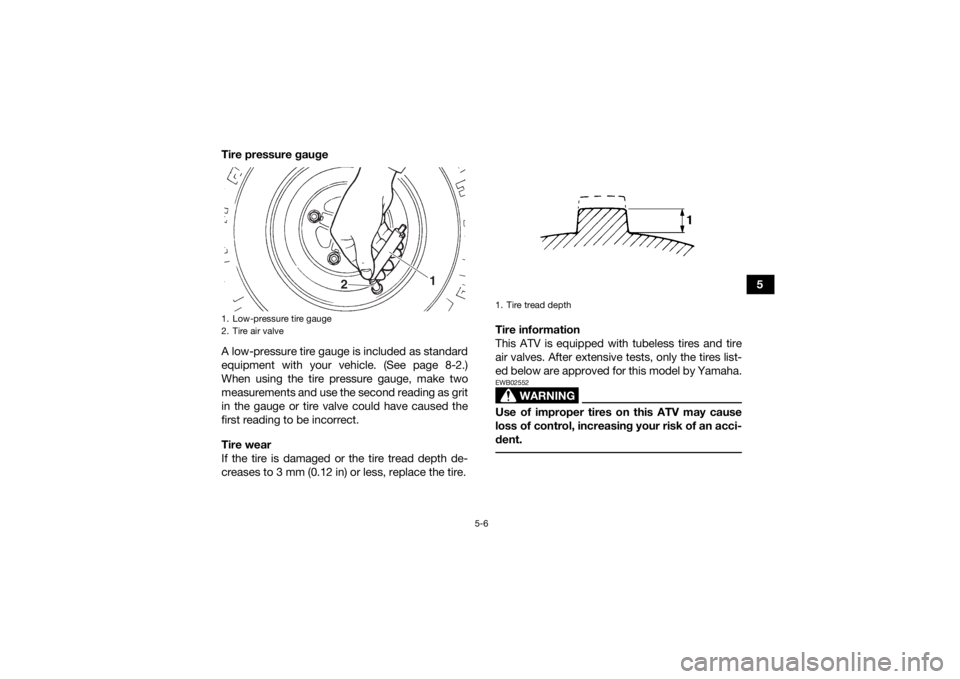
Tire pressure gauge
A low-pressure tire gauge is included as standard
equipment with your vehicle. (See page 8-2.)
When using the tire pressure gauge, make two
measurements and use the second reading as grit
in the gauge or tire valve could have caused the
first reading to be incorrect.
Tire wear
If the tire is damaged or the tire tread depth de-
creases to 3 mm (0.12 in) or less, replace the tire. Tire information
This ATV is equipped with tubeless tires and tire
air valves. After extensive tests, only the tires list-
ed below are approved for this model by Yamaha.
WARNING
EWB02552Use of improper tires on this ATV may cause
loss of control, increasing your risk of an acci-
dent.
1. Low-pressure tire gauge
2. Tire air valve
1
2
1. Tire tread depth
U2LS63E0.book Page 6 Friday, March 31, 2017 8:42 AM
Page 59 of 158
6-1
6
EBU19882
OPERATION
EBU19902Read the Owner’s Manual carefully before riding
the ATV. If there is a control or function you do not
understand, ask your Yamaha dealer.
WARNING
EWB00632Read the Owner’s Manual carefully to become
familiar with all controls in order to help pre-
vent any loss of control, which could cause an
accident or injury. EBU29954Starting the engineNOTICEECB00151See the “Engine break-in” section on page 6-5
prior to operating the engine for the first time. 1. Set the parking brake.
2. Turn the key to “ ” (on) and the engine stopswitch to “ ”.
The following warning lights should come on
for a few seconds, then go off.
Coolant temperature warning light
Fuel level warning light
Engine trouble warning light
NOTICEECB00826To avoid possible damage, do not operate the
ATV if a warning light does not work as de-
scribed above. 3. Shift the transmission into neutral. The neutral
indicator light should come on, if it does not
come on, have a Yamaha dealer check the
electrical circuit.TIPThis model is equipped with an ignition circuit cut-
off system. The engine can be started under the
following conditions.
The transmission is in neutral.
The clutch is disengaged with the transmission
in gear. However, it is recommended to shift
into neutral before starting the engine. 4. Completely close the throttle lever and start
the engine by pushing the start switch.
U2LS63E0.book Page 1 Friday, March 31, 2017 8:42 AM
Page 61 of 158
6-3
6
4. Open the throttle gradually and at the same
time, release the clutch lever slowly.
WARNING! Opening the throttle abruptly or releasing the clutch lever too quickly
could make the ATV wheelie, which would
increase the chance of an accident, in-
cluding an overturn.
[EWB00732]
5. Once the ATV has attained adequate speed, release the throttle, and at the same time,
quickly pull in the clutch lever.
6. Shift the transmission into second gear. (Make sure not to shift the transmission into
neutral.)
7. Open the throttle part way and gradually re- lease the clutch lever.
8. Follow the same procedure when shifting to the next higher gear.EBU20653To decelerate
When slowing down or stopping, release the
throttle and apply the brakes smoothly and evenly.
As you slow down, shift to a lower gear. Be sure
that the engine has sufficiently slowed before en-
gaging a lower gear. Improper use of the brakes or shifting can cause the tires to lose traction, reduc-
ing control and increasing the possibility of an ac-
cident.
WARNING
EWB00712Make sure the engine has sufficiently slowed
before shifting to a lower gear. Engaging a low-
er gear when the engine speed is too high
could make the wheels stop rotating and lose
traction. This could cause loss of control, an
accident and injury. It could also cause engine
or drivetrain damage. NOTICEECB00181
Even with the transmission in the neutral po-
sition, do not coast for long periods of time
with the engine off, and do not tow the ATV
for long distances. The transmission is prop-
erly lubricated only when the engine is run-
ning. Inadequate lubrication may damage
the transmission.
U2LS63E0.book Page 3 Friday, March 31, 2017 8:42 AM
Page 62 of 158
6-4
6
Always use the clutch when changing gears.
The engine, transmission and drive train are
not designed to withstand the shock of
forced shifting and can be damaged by shift-
ing without using the clutch.
EBU20503Operating the reverse knob and driving
in reverse
WARNING
EWB00721Improper operation in reverse could make you
hit an obstacle or even a person behind you,
resulting in serious injury. When you shift into
reverse, make sure there are no people or ob-
stacles behind you. When it is safe to proceed,
go slowly. NOTICEECB00171Before shifting, stop the ATV, otherwise the
transmission may be damaged. 1. Bring the ATV to a complete stop, apply the
clutch lever, and then shift the transmission
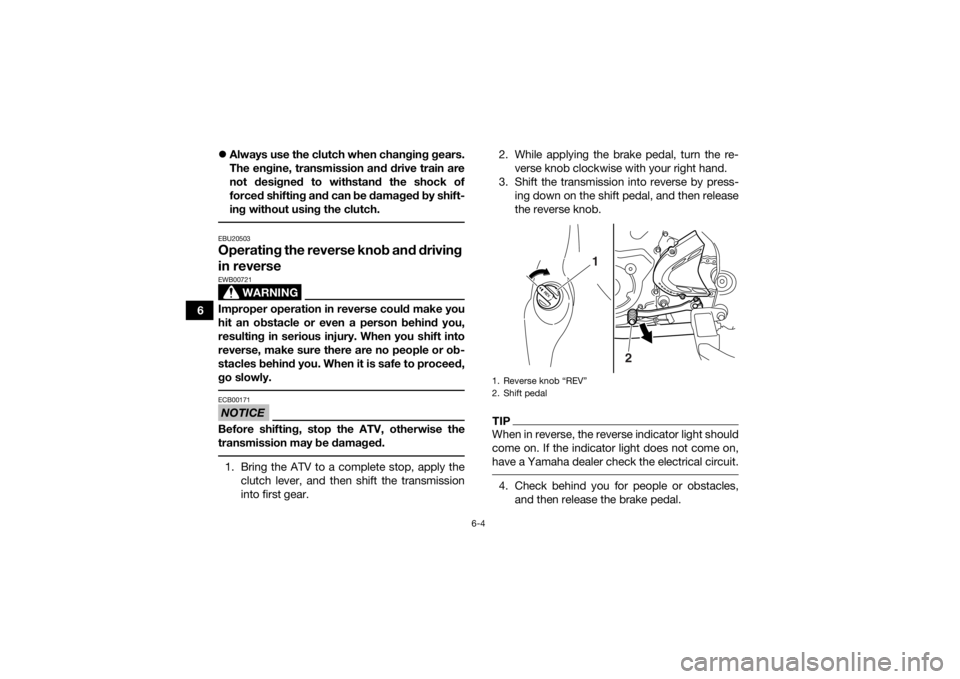
into first gear. 2. While applying the brake pedal, turn the re-
verse knob clockwise with your right hand.
3. Shift the transmission into reverse by press- ing down on the shift pedal, and then release
the reverse knob.
TIPWhen in reverse, the reverse indicator light should
come on. If the indicator light does not come on,
have a Yamaha dealer check the electrical circuit. 4. Check behind you for people or obstacles,and then release the brake pedal.1. Reverse knob “REV”
2. Shift pedal
2
1
U2LS63E0.book Page 4 Friday, March 31, 2017 8:42 AM
Page 64 of 158
6-6
6
EBU20907Parking on a slope
WARNING
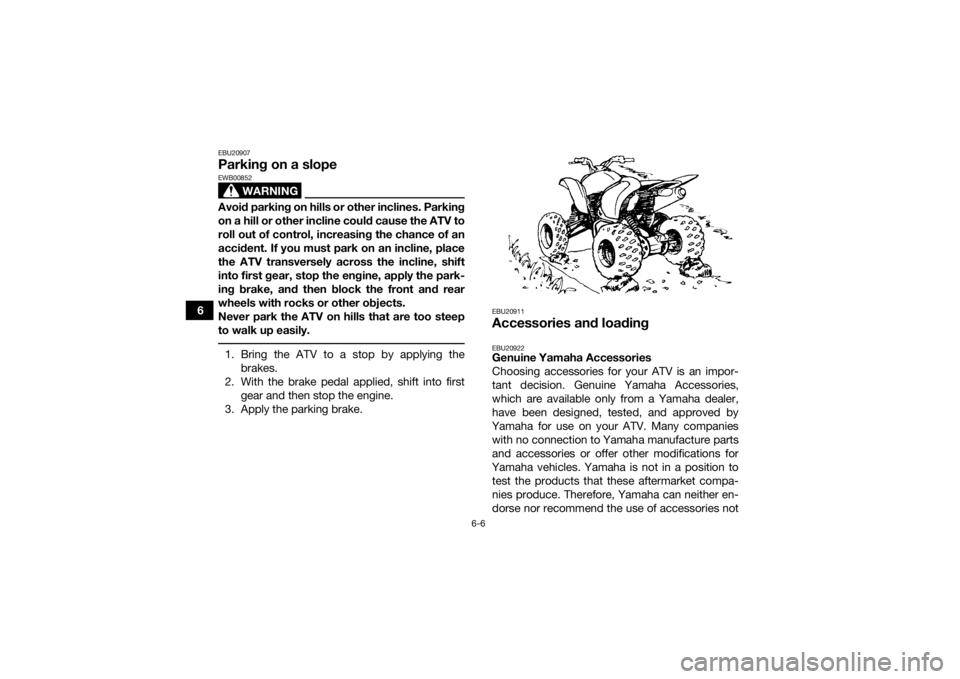
EWB00852Avoid parking on hills or other inclines. Parking
on a hill or other incline could cause the ATV to
roll out of control, increasing the chance of an
accident. If you must park on an incline, place
the ATV transversely across the incline, shift
into first gear, stop the engine, apply the park-
ing brake, and then block the front and rear
wheels with rocks or other objects.
Never park the ATV on hills that are too steep
to walk up easily. 1. Bring the ATV to a stop by applying thebrakes.
2. With the brake pedal applied, shift into first gear and then stop the engine.
3. Apply the parking brake.
EBU20911Accessories and loadingEBU20922Genuine Yamaha Accessories
Choosing accessories for your ATV is an impor-
tant decision. Genuine Yamaha Accessories,
which are available only from a Yamaha dealer,
have been designed, tested, and approved by
Yamaha for use on your ATV. Many companies with no connection to Yamaha manufacture parts
and accessories or offer other modifications for
Yamaha vehicles. Yamaha is not in a position to test the products that these aftermarket compa-
nies produce. Therefore, Yamaha can neither en-
dorse nor recommend the use of accessories not
U2LS63E0.book Page 6 Friday, March 31, 2017 8:42 AM
Page 65 of 158
6-7
6
sold by Yamaha or modifications not specifically
recommended by Yamaha, even if sold and in-
stalled by a Yamaha dealer.
Aftermarket parts, accessories, and modifica-
tions
While you may find aftermarket products similar in
design and quality to genuine Yamaha Accesso-
ries, recognize that some aftermarket accessories
or modifications are not suitable because of po-
tential safety hazards to you or others. Installing
aftermarket products or having other modifica-
tions performed to your ATV that change any of
the vehicle’s design or operation characteristics
can put you and others at greater risk of serious
injury or death. You are responsible for injuries re-
lated to changes in the vehicle.
Keep the following in mind when considering an
accessory or operating an ATV which has acces-
sories.
Accessories should be rigidly and securely
mounted. An accessory which can shift position
or come off while you are riding could affect
your ability to control the ATV.
Do not mount an accessory where it could inter-
fere with your ability to control the ATV. Exam-
ples include (but are not limited to) a heavy or bulky object attached to the handlebars which
could make steering difficult, an accessory that
limits your ability to move around on the seat, or
one that limits your view.
Use extra caution when riding an ATV with ac-
cessories. The ATV may handle differently than
it does without accessories.
EBU20942Loading
WARNING
EWB00821Never exceed the stated load capacity for this
ATV. Overloading this ATV or carrying or tow-
ing cargo improperly could cause changes in
ATV handling which could lead to an accident.
Cargo should be properly distributed and se-
curely attached. Reduce speed when carrying
cargo or pulling a trailer. Allow greater dis-
tance for braking. As originally equipped, this ATV is not designed to
carry cargo or tow a trailer. If you choose to add
accessories so that you can carry cargo or tow a
trailer, you must use common sense and good
U2LS63E0.book Page 7 Friday, March 31, 2017 8:42 AM