fuel cap YAMAHA YFM90R 2009 Owners Manual
[x] Cancel search | Manufacturer: YAMAHA, Model Year: 2009, Model line: YFM90R, Model: YAMAHA YFM90R 2009Pages: 120, PDF Size: 9.14 MB
Page 9 of 120
TABLE OF CONTENTS
SAFETY INFORMATION..............................1-1
LOCATION OF THE WARNING AND
SPECIFICATION LABELS............................2-1DESCRIPTION ..............................................3-1 Left view.....................................................3-1Right view...................................................3-1
Controls and instruments...........................3-2
INSTRUMENT AND CONTROL
FUNCTIONS..................................................4-1 Main switch...............................................4-1
Handlebar switches ................................... 4-2
Throttle lever ............................................. 4-3
Speed limiters............................................. 4-3
Front brake lever ........................................ 4-6
Rear brake lever ....................................... 4-6
Parking brake ............................................ 4-7
Fuel tank cap ............................................ 4-8 Fuel ........................................................... 4-8
Fuel cock .............................................. 4-10
Choke ..................................................... 4-11
Seat ........................................................ 4-11
PRE-OPERATION CHECKS.........................5-1 Pre-operation check list............................5-1
Fuel ........................................................... 5-3
Engine oil .................................................. 5-3
Final transmission oil ................................ 5-3
Front and rear brakes ............................... 5-3
Throttle lever ............................................. 5-4
Tires .......................................................... 5-4
Measuring the tire pressure ...................... 5-5
Tire wear limit ........................................... 5-6
Chassis fasteners ..................................... 5-7
Instruments and switches ......................... 5-7
OPERATION................................................6-1 Starting a cold engine ............................... 6-1
Starting a warm engine ............................. 6-3
Engine break-in ........................................ 6-4
Parking ..................................................... 6-4
Parking on a slope ................................... 6-5
Accessories and loading .......................... 6-6
Vehicle speed limiter ................................. 4-4
Engine speed limiter plate.......................... 4-5 Kick starter
............................................. 4-12
Page 14 of 120

1-3
1
Avoid crossing the side of a steep hill if possible.Always use proper procedures if you stall or roll
backwards when climbing a hill. To avoid stall-
ing, use the proper gear and maintain a steady
speed when climbing a hill. If you stall or roll
backwards, follow the special procedure for
braking described in this manual. Dismount on
the uphill side or to a side if pointed straight up-
hill. Turn the ATV around and remount, following
the procedure described in this manual.Always check for obstacles before operating in a
new area.Never attempt to operate over large obstacles,
such as large rocks or fallen trees. Always follow
proper procedures when operating over obsta-
cles as described in this manual.Always be careful when skidding or sliding.
Learn to safely control skidding or sliding by
practicing at low speeds and on level, smooth
terrain. On extremely slippery surfaces, such as
ice, go slowly and be very cautious in order to re-
duce the chance of skidding or sliding out of con-
trol.Never operate an ATV in fast flowing water or in
water deeper than that recommended in this
manual. Remember that wet brakes may havereduced stopping ability. Test your brakes after
leaving water. If necessary, apply them several
times to let friction dry out the linings.
Always use the size and type of tires specified in
this manual.Always maintain proper tire pressure as de-
scribed in this manual.Never modify an ATV through improper installa-
tion or use of accessories.Never exceed the stated load capacity for an
ATV. Cargo should be properly distributed and
securely attached. Reduce speed and follow in-
structions in this manual for carrying cargo or
pulling a trailer. Allow greater distance for brak-
ing.
WARNING
Always turn off the engine when refueling.Do not refuel right after the engine has been
running and is still very hot.Do not spill gasoline on the engine or ex-
haust pipe/muffler when refueling. Never re-
fuel while smoking, or in the vicinity of
sparks, open flames, or other sources of ig-
nition such as the pilot lights of water heat-
ers and clothes dryers. Gasoline can catch
Page 20 of 120
3-2
3
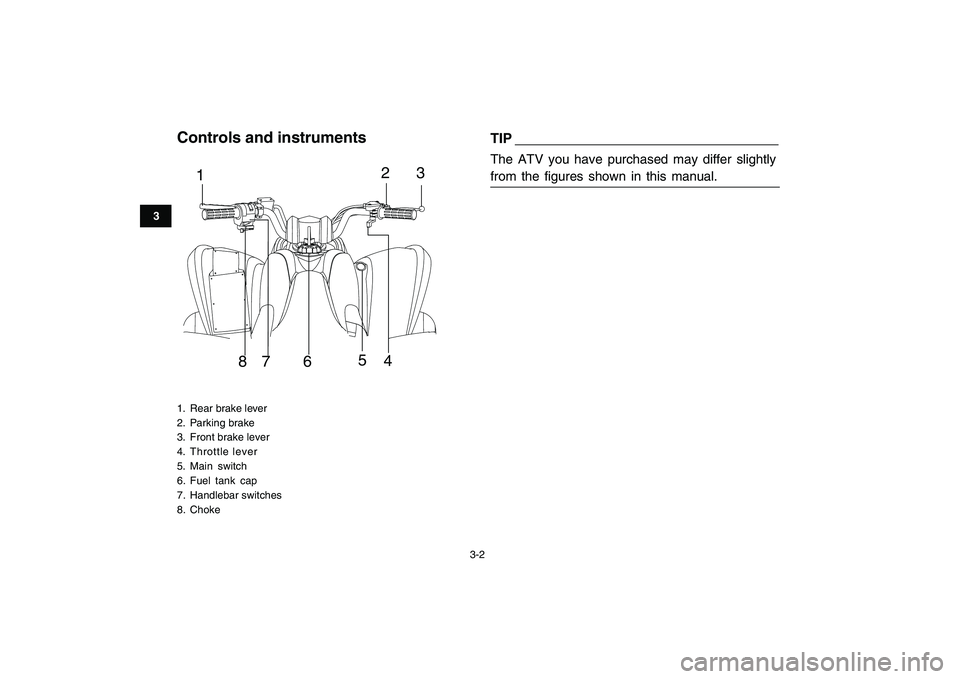
Controls and instruments1. Rear brake lever
2. Parking brake
3. Front brake lever
4. Throttle lever
5. Main switch6. Fuel tank cap7. Handlebar switches
8. Choke
1 2 3
8 7 6 5
4
TIPThe ATV you have purchased may differ slightly
from the figures shown in this manual.
Page 28 of 120
4-8
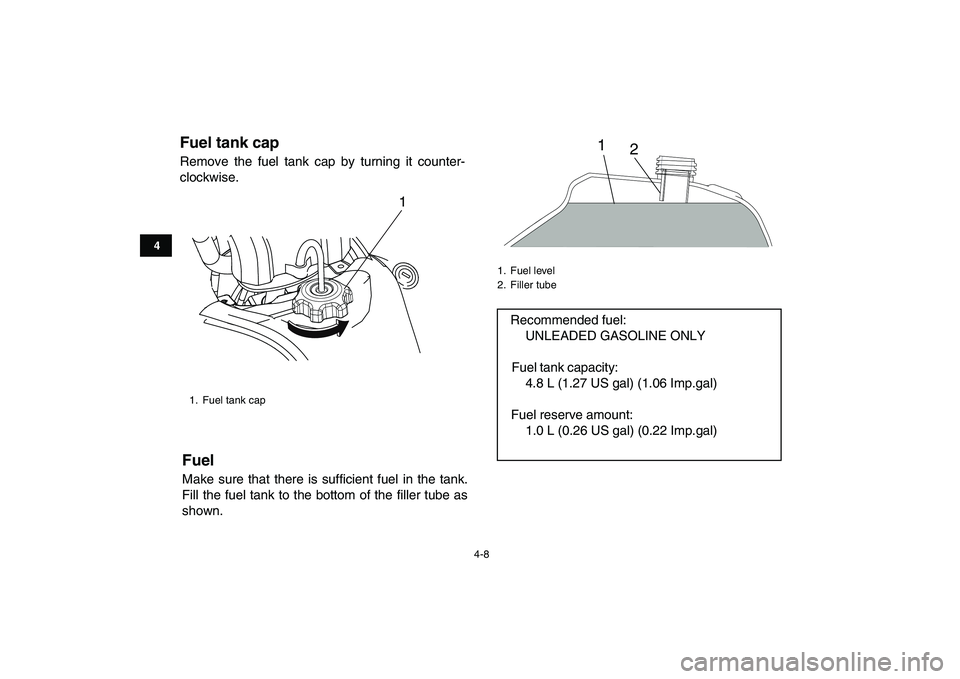
Fuel tank cap Remove the fuel tank cap by turning it counter-
clockwise.FuelMake sure that there is sufficient fuel in the tank.
Fill the fuel tank to the bottom of the filler tube as
shown.1.Fuel tank cap 1. Fuel level
2. Filler tube
Recommended fuel:
UNLEADED GASOLINE ONLY
Fuel tank capacity: 4.8 L (1.27 US gal) (1.06 Imp.gal)
Fuel reserve amount: 1.0 L (0.26 US gal) (0.22 Imp.gal)
4
1
1 2
Page 29 of 120
4-9
N O T I C EUse only unleaded gasoline. The use of leaded
gasoline will cause severe damage to internal
engine parts, such as the valves and pistonrings, as well as to the exhaust system.
4
WARNING
Do not overfill the fuel tank. Fuel expands
when it heats up. If the fuel tank is overfilled,
fuel could spill out due to heat from the en-
gine or the sun.Be careful not to spill fuel, especially on the
engine or exhaust pipe which can cause a
fire and severe injury. Wipe up any spilled
fuel immediately.Do not refuel right after the engine has been
running and is still very hot.Be sure the fuel tank cap is closed securely.
Page 35 of 120

5-3
FuelMake sure that there is sufficient fuel in the tank.
(See page 4-8.)
Engine oilMake sure that the engine oil is at the specified lev-
el. Add oil as necessary. (See page 8-11.)
Final transmission oilMake sure that the final transmission oil is at the
specified level. Add oil as necessary.
(See page 8-14.)Front and rear brakesRecommended brake fluid:
DOT4
3
Brake fluid leakage
Check to see if any brake fluid is leaking out of the
pipe joint or brake fluid reservoir. Apply the brake
firmly for one minute. If there is any leakage, have a
Yamaha dealer check the brake system.Brake leversCheck for correct free play in the brake levers. If
the free play is incorrect, adjust it. (See pages
8-23 and 8-26.)Check operation of the levers. They should
move smoothly and there should be a firm feel-
ATV checked by a Yamaha dealer.
6
Brake fluid level
Check the brake fluid level. Add fluid if necessary.
(See page 8-25.)
15
WARNING
Do not overfill the fuel tank. Fuel expands
when it heats up. If the fuel tank is overfilled,
fuel could spill out due to heat from the en-
gine or the sun.Be careful not to spill fuel, especially on the
engine or exhaust pipe which can cause a
fire and severe injury. Wipe up any spilled
fuel immediately.Do not refuel right after the engine has been
running and is still very hot.Be sure the fuel tank cap is closed securely.
ing when the brakes are applied. If not, have the
Page 110 of 120
9-2
StorageShort-term
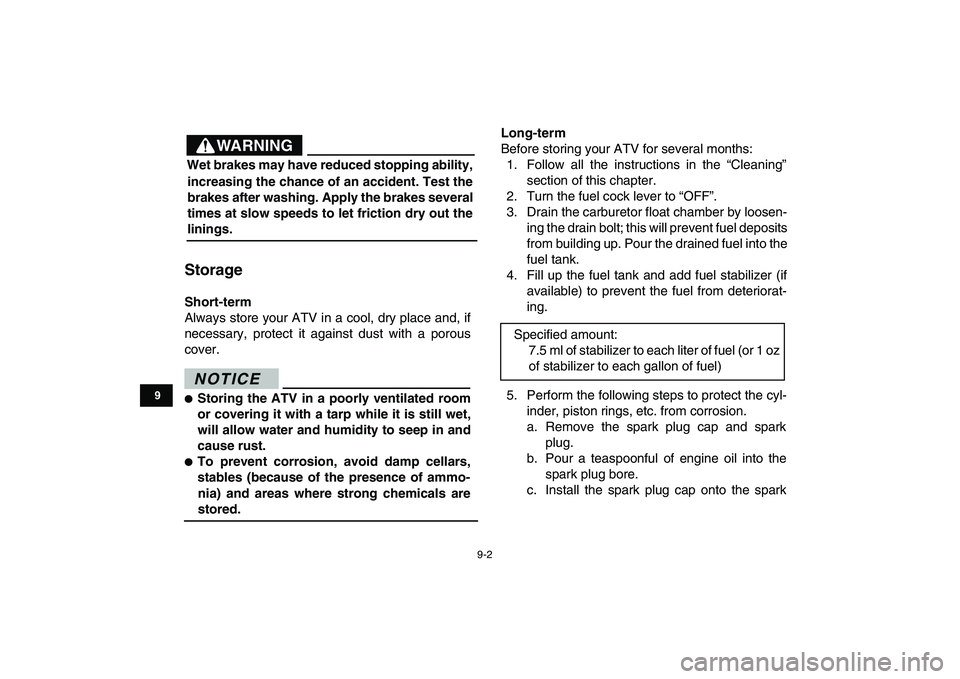
Always store your ATV in a cool, dry place and, if
necessary, protect it against dust with a porous
cover.N O T I C EStoring the ATV in a poorly ventilated room
or covering it with a tarp while it is still wet,
will allow water and humidity to seep in and
cause rust.To prevent corrosion, avoid damp cellars,
stables (because of the presence of ammo-nia) and areas where strong chemicals arestored. Long-term
Before storing your ATV for several months:
1. Follow all the instructions in the “Cleaning” section of this chapter.
2. Turn the fuel cock lever to “OFF”.
3. Drain the carburetor float chamber by loosen- ing the drain bolt; this will prevent fuel deposits
from building up. Pour the drained fuel into the
fuel tank.
4. Fill up the fuel tank and add fuel stabilizer (if available) to prevent the fuel from deteriorat-
ing.
5. Perform the following steps to protect the cyl- inder, piston rings, etc. from corrosion.
a. Remove the spark plug cap and sparkplug.
b. Pour a teaspoonful of engine oil into the spark plug bore.
c. Install the spark plug cap onto the spark
Specified amount:
7.5 ml of stabilizer to each liter of fuel (or 1 oz
of stabilizer to each gallon of fuel)
9
WARNING
Wet brakes may have reduced stopping ability,
increasing the chance of an accident. Test the
brakes after washing. Apply the brakes several
times at slow speeds to let friction dry out thelinings.
Page 113 of 120
10
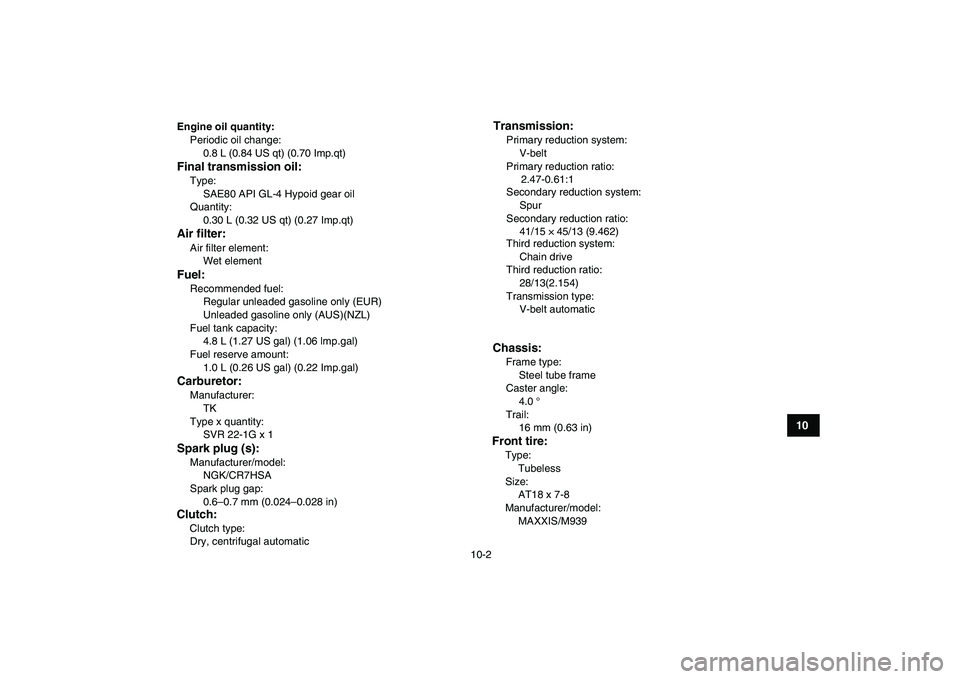
Engine oil quantity:Periodic oil change: 0.8 L (0.84 US qt) (0.70 Imp.qt)Final transmission oil:Type:SAE80 API GL-4 Hypoid gear oil
Quantity: 0.30 L (0.32 US qt) (0.27 Imp.qt)Air filter:Air filter element: Wet elementFuel:Recommended fuel: Regular unleaded gasoline only (EUR)
Unleaded gasoline only (AUS)(NZL)
Fuel tank capacity: 4.8 L (1.27 US gal) (1.06 lmp.gal)
Fuel reserve amount: 1.0 L (0.26 US gal) (0.22 Imp.gal)Carburetor:Manufacturer:TK
Type x quantity: SVR 22-1G x 1Spark plug (s):Manufacturer/model:NGK/CR7HSA
Spark plug gap: 0.6–0.7 mm (0.024–0.028 in)
Chassis:Frame type: Steel tube frame
Caster angle: 4.0 °
Trail: 16 mm (0.63 in)
Front tire:Type:Tubeless
Size: AT18 x 7-8
Manufacturer/model: MAXXIS/M939
Clutch:Clutch type: Dry, centrifugal automatic
Transmission:Primary reduction system: V-belt
Primary reduction ratio:
2.47-0.61:1
Secondary reduction system: Spur
Secondary reduction ratio: 41/15 × 45/13 (9.462)
Third reduction system:
Chain drive
Third reduction ratio: 28/13(2.154)
Transmission type: V-belt automatic
10
10-2
Page 118 of 120

INDEX
AAccessories and loading ................................................ 6-6
Air filter element, cleaning ............................................ 8-15BBattery ........................................................................\
...8-28
Brake lever, front.............................................................4-6Brake lever, rear............................................................4-6
Brake lever free play, checking the rear........................8-26
Brake levers, checking and lubricating .............. .......... 8-27
Brakes, front and rear....................................................5-3
Brake pads, checking the rear.......................................8-25
Brake fluid level, checking the rear...............................8-25
Brake fluid level, changing the rear..............................8-26 Brake lever free play, adjusting the front......................8-23CCables, checking and lubricating ................................. 8-27
Carburetor, adjusting.................................................... 8-20
Chassis fasteners........................................................... 5-7
Cleaning..........................................................................9-1EEngine break-in .............................................................. 6-4
Engine, cold start...........................................................6-1
Engine idling speed ...................................................... 8-20 Engine oil............................................................5-3, 8-11
Engine, starting a warm................................................6-3
Engine stop switch.......................................................4-2
Fuel........................................................................4-8, 5-3
Fuel cock......................................................................4-10
Fuel tank cap..................................................................4-8
Fuse, replacing.............................................................8-30
F
KKey identification number ............................................. 11-1LLabel locations...............................................................2-1HHandlebar switches ........................................................ 4-2IIdentification numbers .................................................. 11-1
Instruments and switches.............................................5-7MMain switch .................................................................... 4-1
Maintenance and lubrication chart.................................8-5
Maintenance chart, emission control system.................8-3
Model label...................................................................11-2
Choke ............................................................................ 4-11 Brake shoes, checking the front .................................. 8-22
Final transmission oil ........................................... 5-3, 8-14
Engine speed limiter plate............................................ 4-5
Kick starter ................................................................. 4-12