lock YAMAHA YFZ450R 2018 User Guide
[x] Cancel search | Manufacturer: YAMAHA, Model Year: 2018, Model line: YFZ450R, Model: YAMAHA YFZ450R 2018Pages: 150, PDF Size: 3.89 MB
Page 60 of 150
6-5
6
EBU20907Parking on a slope
WARNING
EWB00852Avoid parking on hills or other inclines. Parking
on a hill or other incline could cause the ATV to
roll out of control, increasing the chance of an
accident. If you must park on an incline, place
the ATV transversely across the incline, shift
into first gear, stop the engine, apply the park-
ing brake, and then block the front and rear
wheels with rocks or other objects.Never park the ATV on hills that are too steep
to walk up easily.
1. Bring the ATV to a stop by applying the
brakes.
2. With the brake pedal applied, shift into first gear and then stop the engine.
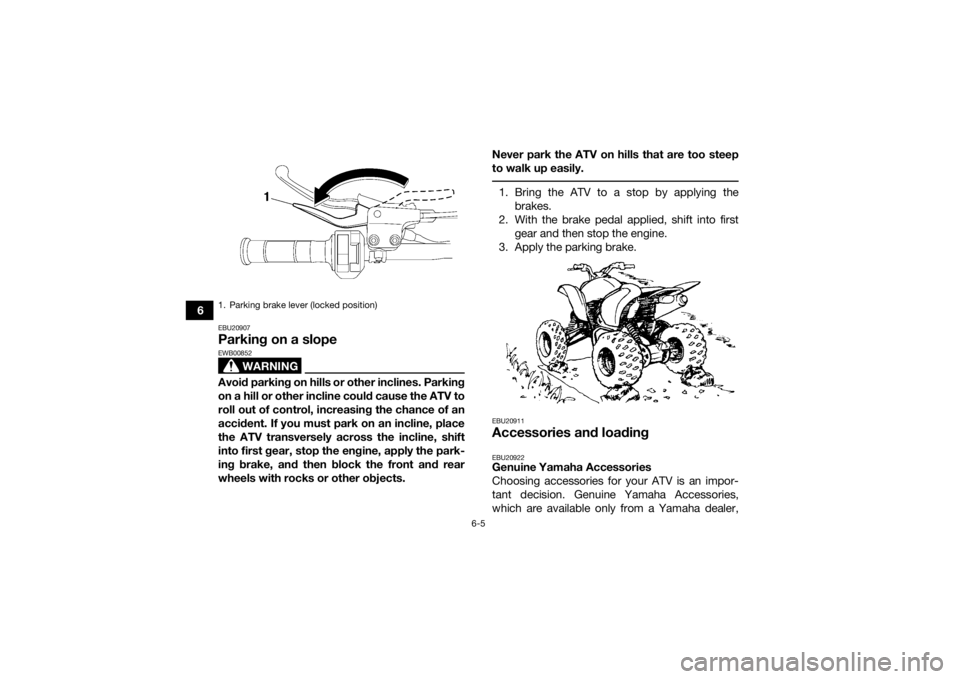
3. Apply the parking brake.EBU20911Accessories and loadingEBU20922Genuine Yamaha Accessories
Choosing accessories for your ATV is an impor-
tant decision. Genuine Yamaha Accessories,
which are available only from a Yamaha dealer,
1. Parking brake lever (locked position)UBW261E0.book Page 5 Friday, May 26, 2017 9:38 AM
Page 67 of 150
7-5
7
Pre-operation checks
Always inspect your ATV each time you use it to
make sure the ATV is in safe operating condition.
Perform the pre-operation checks listed on page
5-1. Always follow the inspection and mainte-
nance procedures and schedules described in the
Owner’s Manual.
WARNING! Failure to inspect
the ATV before riding it or failure to maintain it
properly increases the possibility of an acci-
dent and equipment damage.
[EWB01433]
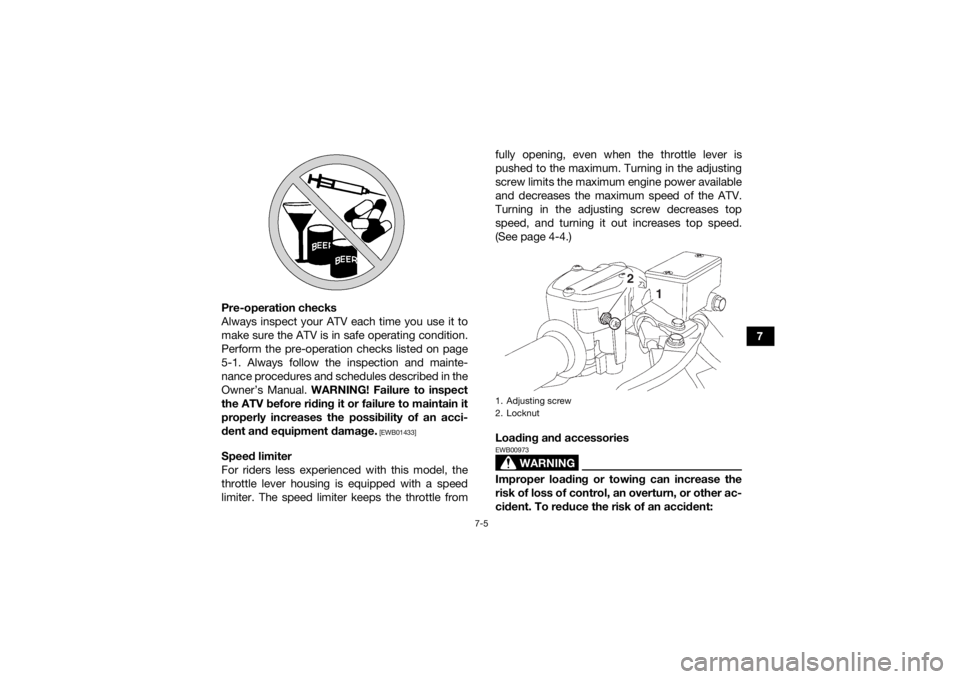
Speed limiter
For riders less experienced with this model, the
throttle lever housing is equipped with a speed
limiter. The speed limiter keeps the throttle from fully opening, even when the throttle lever is
pushed to the maximum. Turning in the adjusting
screw limits the maximum engine power available
and decreases the maximum speed of the ATV.
Turning in the adjusting screw decreases top
speed, and turning it out increases top speed.
(See page 4-4.)
Loading and accessories
WARNING
EWB00973Improper loading or towing can increase the
risk of loss of control, an overturn, or other ac-
cident. To reduce the risk of an accident:1. Adjusting screw
2. Locknut
2
1
UBW261E0.book Page 5 Friday, May 26, 2017 9:38 AM
Page 77 of 150

7-15
7
It is important when climbing a hill to make sure
that your weight is transferred forward on the ATV.
This can be accomplished by leaning forward and,
on steeper inclines, standing on the footrests and
leaning forward over the handlebars. Whenever
possible, ride straight up hills.
Slow down when you reach the crest of the hill if
you cannot see clearly what is on the other side –
there could be another person, an obstacle, or a
sharp drop-off. Use common sense and remem-
ber that some hills are too steep for you to climb
or descend.
If you are climbing a hill and you find that you have
not properly judged your ability to make it to the
top, you should turn the ATV around while you still
have forward motion (provided you have the room
to do so) and go down the hill.
If your ATV has stalled or stopped and you believe
you can continue up the hill, restart carefully to
make sure you do not lift the front wheels which
could cause you to lose control. If you are unable
to continue up the hill, dismount the ATV on the
uphill side. Physically turn the ATV around and
then descend the hill. If you start to roll backwards, DO NOT apply the
rear brake, and apply the front brake gradually.
The ATV could easily tip over backwards. When
fully stopped, apply the rear brake as well, and
then lock the parking brake. Dismount the ATV im-
mediately on the uphill side or to a side if pointed
straight uphill. Turn the ATV around and remount,
following the procedure described in the Owner’s
Manual.
WARNING! Stalling, rolling backwards
or improperly dismounting while climbing a hill
could result in ATV overturning. If you cannot
control the ATV, dismount immediately on the
uphill side.
[EWB01803]
UBW261E0.book Page 15 Friday, May 26, 2017 9:38 AM
Page 94 of 150
8-10
8
EBU30131Removing and installing the cowling
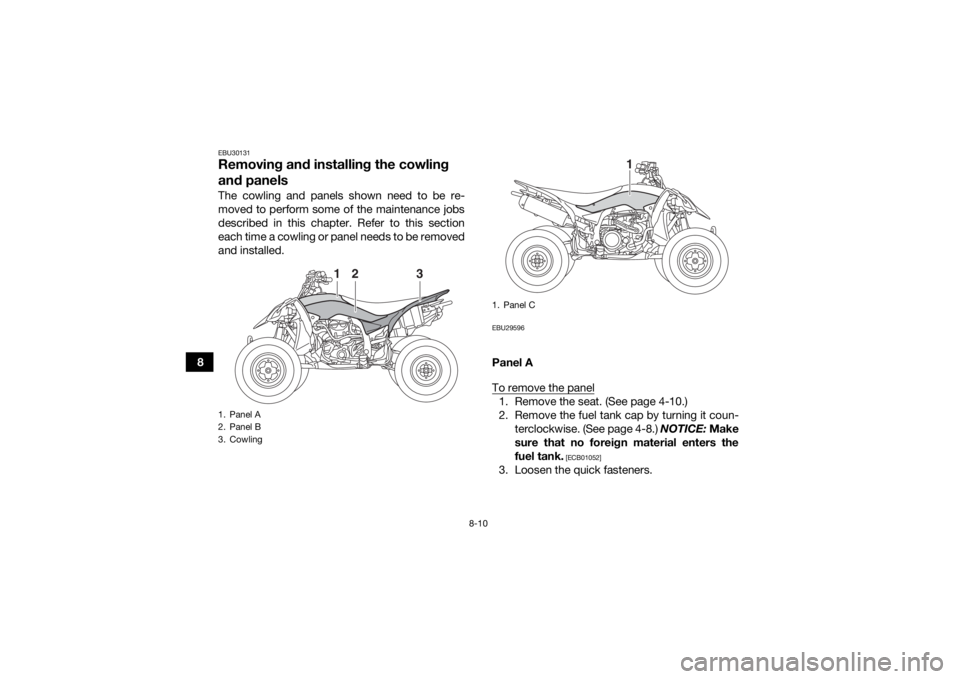
and panelsThe cowling and panels shown need to be re-
moved to perform some of the maintenance jobs
described in this chapter. Refer to this section
each time a cowling or panel needs to be removed
and installed.
EBU29596Panel A
To remove the panel1. Remove the seat. (See page 4-10.)
2. Remove the fuel tank cap by turning it coun-terclockwise. (See page 4-8.) NOTICE: Make
sure that no foreign material enters the
fuel tank.
[ECB01052]
3. Loosen the quick fasteners.
1. Panel A
2. Panel B
3. Cowling
1
2
3
1. Panel C
1
UBW261E0.book Page 10 Friday, May 26, 2017 9:38 AM
Page 95 of 150
8-11
8
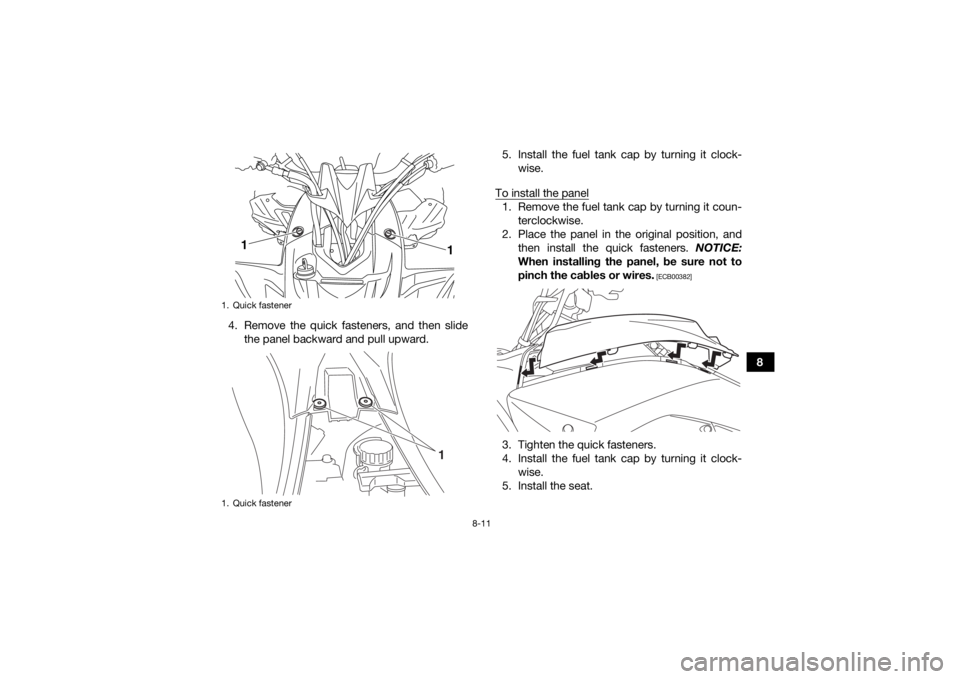
4. Remove the quick fasteners, and then slide
the panel backward and pull upward. 5. Install the fuel tank cap by turning it clock-
wise.
To install the panel
1. Remove the fuel tank cap by turning it coun- terclockwise.
2. Place the panel in the original position, and then install the quick fasteners. NOTICE:
When installing the panel, be sure not to
pinch the cables or wires.
[ECB00382]
3. Tighten the quick fasteners.
4. Install the fuel tank cap by turning it clock- wise.
5. Install the seat.
1. Quick fastener
1. Quick fastener
1 1
1
UBW261E0.book Page 11 Friday, May 26, 2017 9:38 AM
Page 111 of 150
8-27
8
WARNING
EWB02342Always let the exhaust system cool prior to
touching exhaust components.
Do not start the engine with the spark arrester
removed. Sparks or exhaust particulate can
cause eye injury, burns, or start a fire.
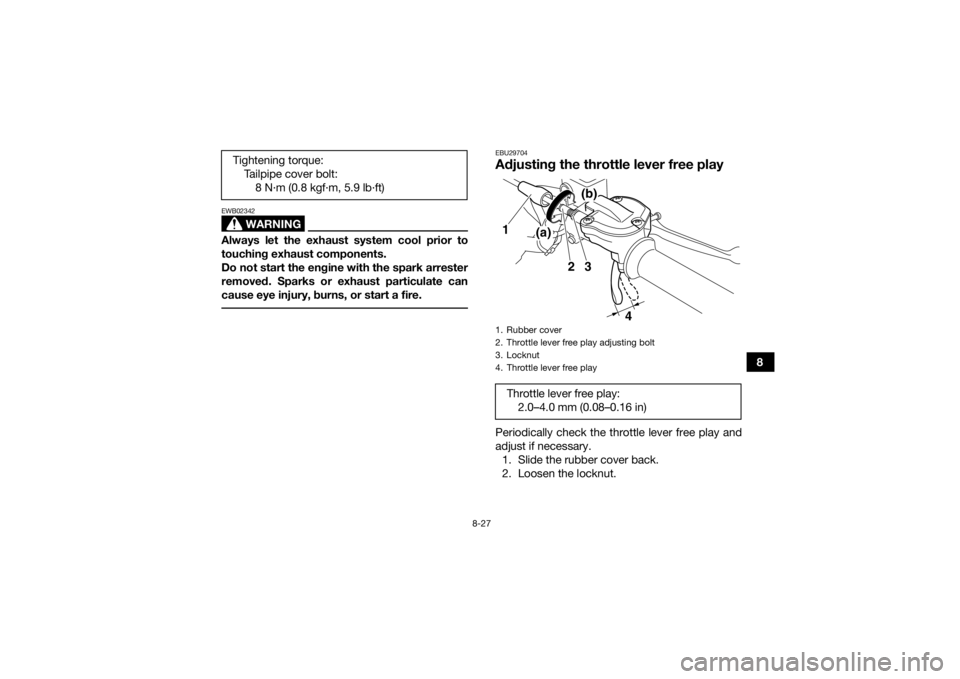
EBU29704Adjusting the throttle lever free playPeriodically check the throttle lever free play and
adjust if necessary.1. Slide the rubber cover back.
2. Loosen the locknut.
Tightening torque:
Tailpipe cover bolt:8 N·m (0.8 kgf·m, 5.9 lb·ft)1. Rubber cover
2. Throttle lever free play adjusting bolt
3. Locknut
4. Throttle lever free playThrottle lever free play: 2.0–4.0 mm (0.08–0.16 in)
32
4
(a)(b)
1
UBW261E0.book Page 27 Friday, May 26, 2017 9:38 AM
Page 112 of 150
8-28
83. To increase the throttle lever free play, turn
the throttle lever free play adjusting bolt in di-
rection (a). To decrease the throttle lever free
play, turn the adjusting bolt in direction (b).
4. Tighten the locknut.
5. Slide the rubber cover to its original position.
EBU24061Valve clearanceThe valve clearance changes with use, resulting in
improper air-fuel mixture and/or engine noise. To
prevent this from occurring, the valve clearance
must be adjusted by a Yamaha dealer at the inter-
vals specified in the periodic maintenance and lu-
brication chart.EBU29602BrakesReplacement of brake components requires pro-
fessional knowledge. Brake service should be
performed by a Yamaha dealer.
WARNING
EWB02572Operating with improperly serviced or adjust-
ed brakes could lead to a loss in braking ability
and an accident.
EBU24131Checking the front and rear brake padsThe front and rear brake pads must be checked
for wear at the intervals specified in the periodic
maintenance and lubrication chart.EBU29561Front brake pads
Each brake pad is provided with wear indicator
grooves, which allow you to check the brake pad
wear without having to disassemble the brake. To
check the brake pad wear, check the wear indica-
tor grooves. If a brake pad has worn to the point
that the wear indicator grooves have almost dis-
appeared, have a Yamaha dealer replace the
brake pads as a set.
UBW261E0.book Page 28 Friday, May 26, 2017 9:38 AM
Page 115 of 150
8-31
8
Be careful that water does not enter the
brake fluid reservoir when refilling. Water will
significantly lower the boiling point of the flu-
id and may result in vapor lock.
NOTICEECB01161Brake fluid may damage painted surfaces or
plastic parts. Always clean up spilled fluid im-
mediately. As the brake pads wear, it is normal for the brake
fluid level to gradually go down. A low brake fluid
level may indicate worn brake pads and/or brake
system leakage; therefore, be sure to check the
brake pads for wear and the brake system for
leakage. If the brake fluid level goes down sud-
denly, have a Yamaha dealer check the cause be-
fore further riding.EBU24293Changing the brake fluidHave a Yamaha dealer change the brake fluid at
the intervals specified in the periodic maintenance
and lubrication chart. In addition, have the oil seals of the master cylinders and calipers as well as the
brake hoses replaced at the intervals listed below
or whenever they are damaged or leaking.
Oil seals: Replace every two years.
Brake hoses: Replace every four years.
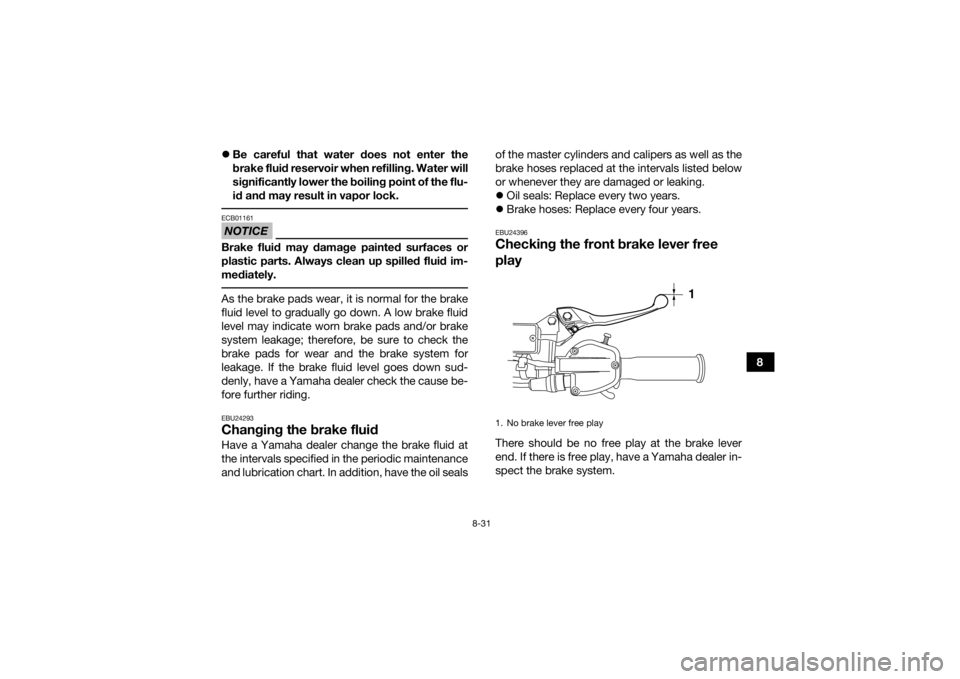
EBU24396Checking the front brake lever free
playThere should be no free play at the brake lever
end. If there is free play, have a Yamaha dealer in-
spect the brake system.1. No brake lever free play
1
UBW261E0.book Page 31 Friday, May 26, 2017 9:38 AM
Page 116 of 150
8-32
8
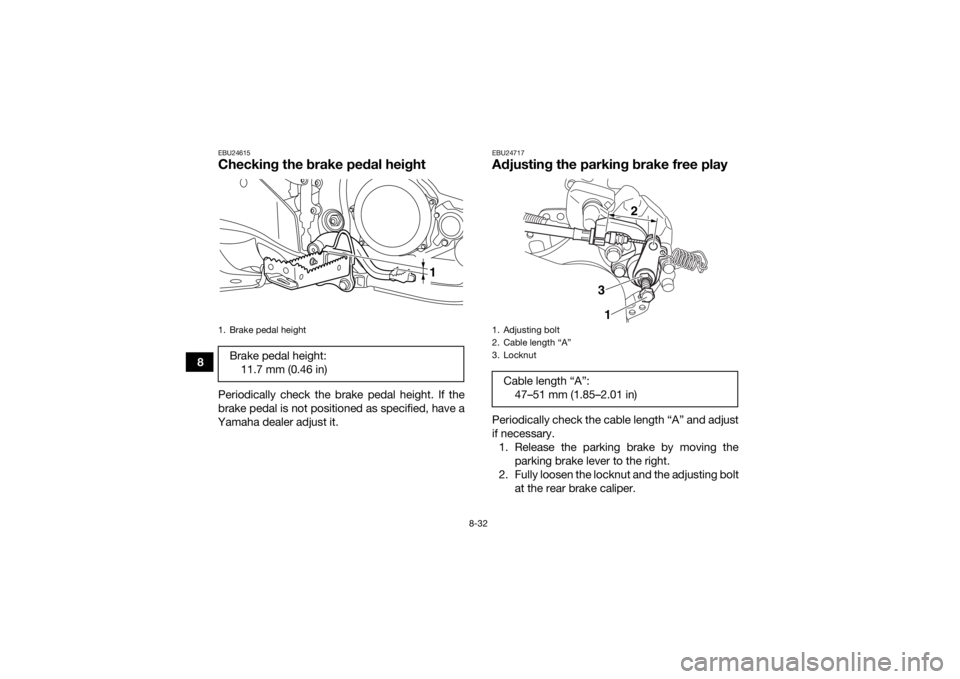
EBU24615Checking the brake pedal heightPeriodically check the brake pedal height. If the
brake pedal is not positioned as specified, have a
Yamaha dealer adjust it.
EBU24717Adjusting the parking brake free playPeriodically check the cable length “A” and adjust
if necessary. 1. Release the parking brake by moving the parking brake lever to the right.
2. Fully loosen the locknut and the adjusting bolt at the rear brake caliper.
1. Brake pedal heightBrake pedal height:11.7 mm (0.46 in)
1
1. Adjusting bolt
2. Cable length “A”
3. LocknutCable length “A”:47–51 mm (1.85–2.01 in)
1
2
3
UBW261E0.book Page 32 Friday, May 26, 2017 9:38 AM
Page 117 of 150
8-33
8
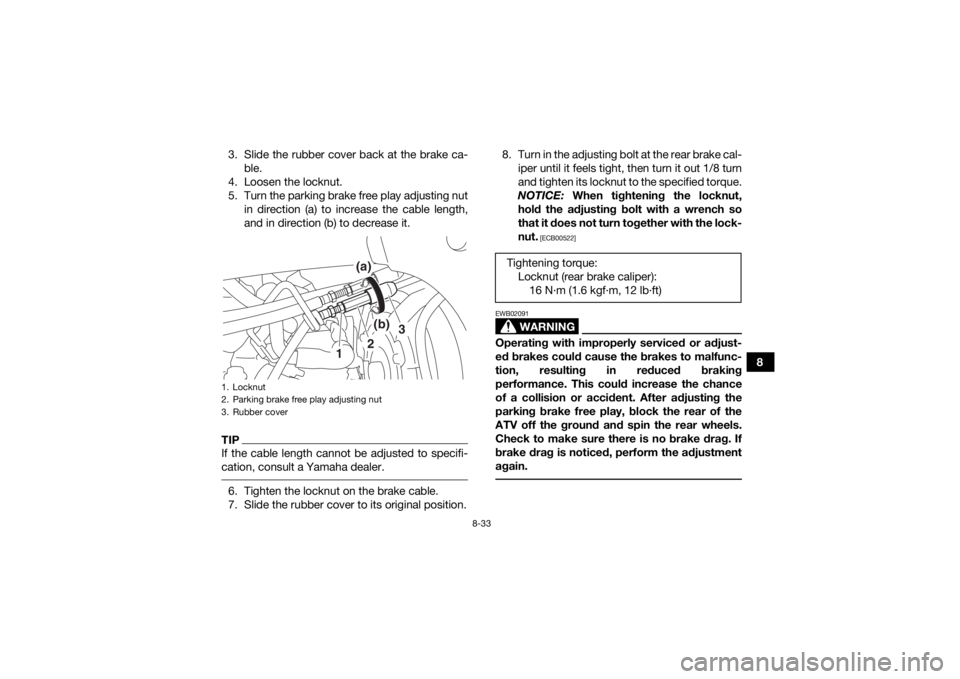
3. Slide the rubber cover back at the brake ca-
ble.
4. Loosen the locknut.
5. Turn the parking brake free play adjusting nut in direction (a) to increase the cable length,
and in direction (b) to decrease it.
TIPIf the cable length cannot be adjusted to specifi-
cation, consult a Yamaha dealer. 6. Tighten the locknut on the brake cable.
7. Slide the rubber cover to its original position. 8. Turn in the adjusting bolt at the rear brake cal-
iper until it feels tight, then turn it out 1/8 turn
and tighten its locknut to the specified torque.
NOTICE: When tightening the locknut,
hold the adjusting bolt with a wrench so
that it does not turn together with the lock-
nut.
[ECB00522]
WARNING
EWB02091Operating with improperly serviced or adjust-
ed brakes could cause the brakes to malfunc-
tion, resulting in reduced braking
performance. This could increase the chance
of a collision or accident. After adjusting the
parking brake free play, block the rear of the
ATV off the ground and spin the rear wheels.
Check to make sure there is no brake drag. If
brake drag is noticed, perform the adjustment
again.
1. Locknut
2. Parking brake free play adjusting nut
3. Rubber cover
1
2
3
(b)
(a)
Tightening torque: Locknut (rear brake caliper):16 N·m (1.6 kgf·m, 12 lb·ft)
UBW261E0.book Page 33 Friday, May 26, 2017 9:38 AM