warning YAMAHA YFZ450R 2018 User Guide
[x] Cancel search | Manufacturer: YAMAHA, Model Year: 2018, Model line: YFZ450R, Model: YAMAHA YFZ450R 2018Pages: 150, PDF Size: 3.89 MB
Page 31 of 150
4-7
4
WARNING
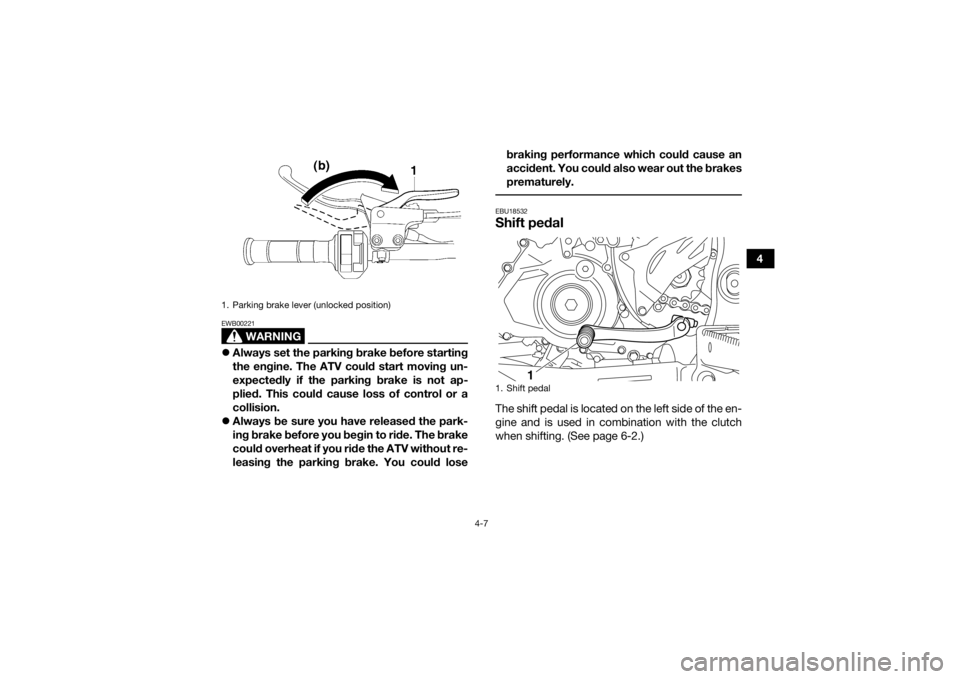
EWB00221Always set the parking brake before starting
the engine. The ATV could start moving un-
expectedly if the parking brake is not ap-
plied. This could cause loss of control or a
collision.
Always be sure you have released the park-
ing brake before you begin to ride. The brake
could overheat if you ride the ATV without re-
leasing the parking brake. You could lose braking performance which could cause an
accident. You could also wear out the brakes
prematurely.
EBU18532Shift pedalThe shift pedal is located on the left side of the en-
gine and is used in combination with the clutch
when shifting. (See page 6-2.)
1. Parking brake lever (unlocked position)
1. Shift pedal
1
UBW261E0.book Page 7 Friday, May 26, 2017 9:38 AM
Page 32 of 150
4-8
4
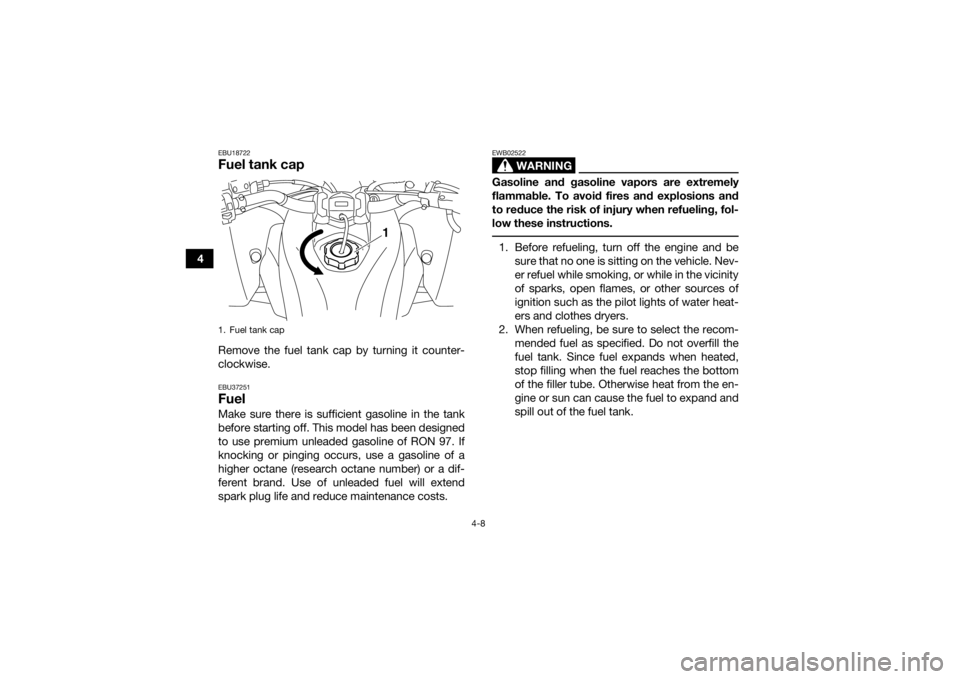
EBU18722Fuel tank capRemove the fuel tank cap by turning it counter-
clockwise.EBU37251FuelMake sure there is sufficient gasoline in the tank
before starting off. This model has been designed
to use premium unleaded gasoline of RON 97. If
knocking or pinging occurs, use a gasoline of a
higher octane (research octane number) or a dif-
ferent brand. Use of unleaded fuel will extend
spark plug life and reduce maintenance costs.
WARNING
EWB02522Gasoline and gasoline vapors are extremely
flammable. To avoid fires and explosions and
to reduce the risk of injury when refueling, fol-
low these instructions. 1. Before refueling, turn off the engine and besure that no one is sitting on the vehicle. Nev-
er refuel while smoking, or while in the vicinity
of sparks, open flames, or other sources of
ignition such as the pilot lights of water heat-
ers and clothes dryers.
2. When refueling, be sure to select the recom- mended fuel as specified. Do not overfill the
fuel tank. Since fuel expands when heated,
stop filling when the fuel reaches the bottom
of the filler tube. Otherwise heat from the en-
gine or sun can cause the fuel to expand and
spill out of the fuel tank.
1. Fuel tank cap
1
UBW261E0.book Page 8 Friday, May 26, 2017 9:38 AM
Page 34 of 150
4-10
43. After refueling, return the nozzle and then
close the fuel tank cap fully by turning it
clockwise. Make sure the fuel tank cap is se-
curely closed.
4. Wipe up any spilled fuel immediately. NOTICE: Immediately wipe off spilled fuel
with a clean, dry, soft cloth, since fuel may
deteriorate painted surfaces or plastic
parts.
[ECB00982]
WARNING
EWB02532Gasoline is poisonous and can cause injury or
death. Handle gasoline with care. Never siphon
gasoline by mouth. If you should swallow some
gasoline or inhale a lot of gasoline vapor, or get
some gasoline in your eyes, see your doctor
immediately. If gasoline spills on your skin,
wash with soap and water. If gasoline spills on
your clothing, change your clothes.
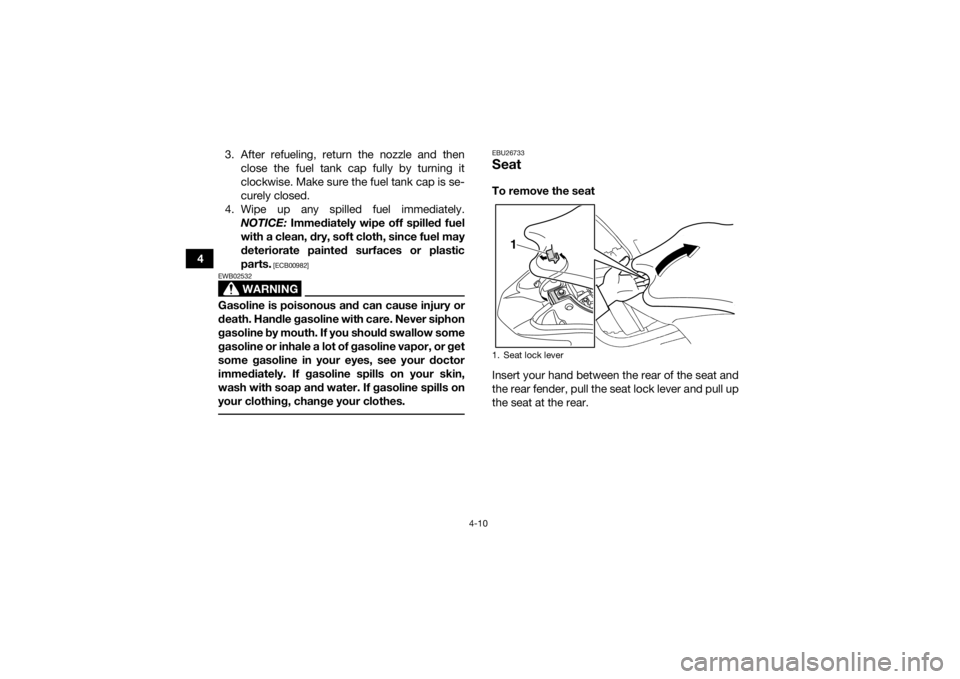
EBU26733SeatTo remove the seat
Insert your hand between the rear of the seat and
the rear fender, pull the seat lock lever and pull up
the seat at the rear.1. Seat lock lever
1
UBW261E0.book Page 10 Friday, May 26, 2017 9:38 AM
Page 35 of 150
4-11
4
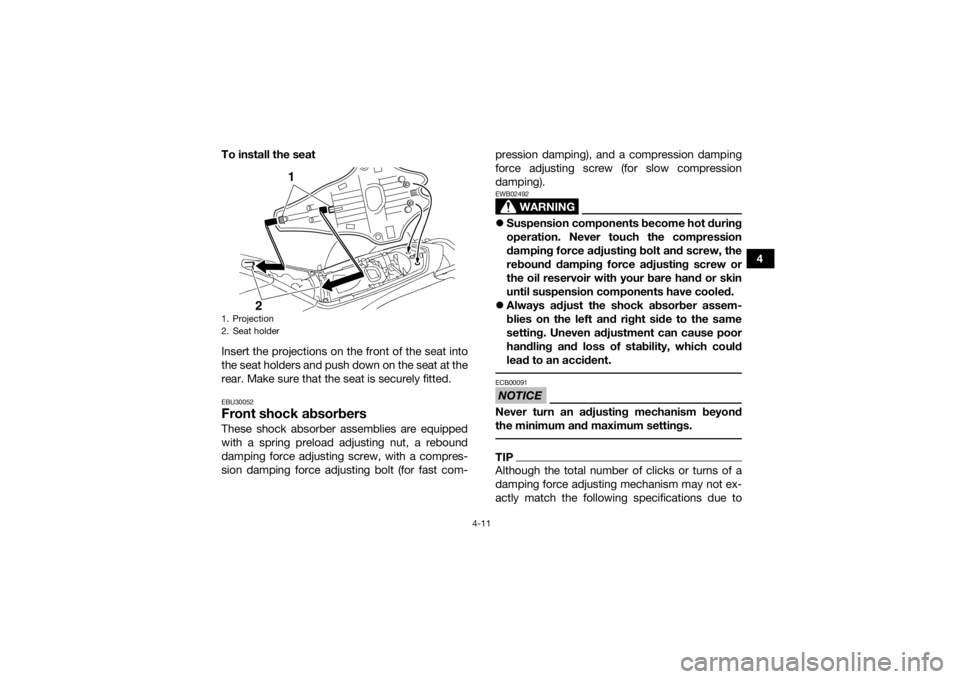
To install the seat
Insert the projections on the front of the seat into
the seat holders and push down on the seat at the
rear. Make sure that the seat is securely fitted.
EBU30052Front shock absorbersThese shock absorber assemblies are equipped
with a spring preload adjusting nut, a rebound
damping force adjusting screw, with a compres-
sion damping force adjusting bolt (for fast com- pression damping), and a compression damping
force adjusting screw (for slow compression
damping).
WARNING
EWB02492
Suspension components become hot during
operation. Never touch the compression
damping force adjusting bolt and screw, the
rebound damping force adjusting screw or
the oil reservoir with your bare hand or skin
until suspension components have cooled.
Always adjust the shock absorber assem-
blies on the left and right side to the same
setting. Uneven adjustment can cause poor
handling and loss of stability, which could
lead to an accident. NOTICEECB00091Never turn an adjusting mechanism beyond
the minimum and maximum settings. TIPAlthough the total number of clicks or turns of a
damping force adjusting mechanism may not ex-
actly match the following specifications due to
1. Projection
2. Seat holder
1
2
UBW261E0.book Page 11 Friday, May 26, 2017 9:38 AM
Page 39 of 150
4-15
4
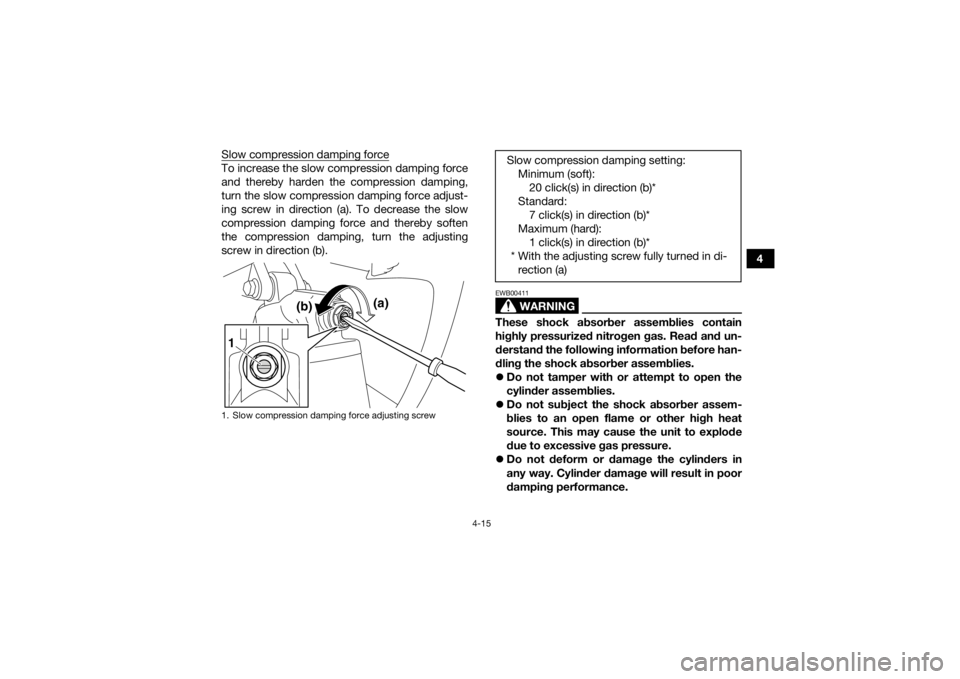
Slow compression damping force
To increase the slow compression damping force
and thereby harden the compression damping,
turn the slow compression damping force adjust-
ing screw in direction (a). To decrease the slow
compression damping force and thereby soften
the compression damping, turn the adjusting
screw in direction (b).
WARNING
EWB00411These shock absorber assemblies contain
highly pressurized nitrogen gas. Read and un-
derstand the following information before han-
dling the shock absorber assemblies.
Do not tamper with or attempt to open the
cylinder assemblies.
Do not subject the shock absorber assem-
blies to an open flame or other high heat
source. This may cause the unit to explode
due to excessive gas pressure.
Do not deform or damage the cylinders in
any way. Cylinder damage will result in poor
damping performance.
1. Slow compression damping force adjusting screw
(a)
(b)
1
Slow compression damping setting:
Minimum (soft):20 click(s) in direction (b)*
Standard: 7 click(s) in direction (b)*
Maximum (hard): 1 click(s) in direction (b)*
* With the adjusting screw fully turned in di- rection (a)
UBW261E0.book Page 15 Friday, May 26, 2017 9:38 AM
Page 40 of 150
4-16
4
Do not dispose of a damaged or worn out
shock absorber assembly yourself. Take the
shock absorber assembly to a Yamaha deal-
er for any service.
EBU30143Rear shock absorbersThis shock absorber assembly is equipped with a
spring preload adjusting nut, a rebound damping
force adjusting screw, a compression damping
force adjusting bolt (for fast compression damp-
ing), and a compression damping force adjusting
screw (for slow compression damping).
WARNING
EWB02681Suspension components become hot during
operation. Never touch the compression
damping force adjusting bolt and screw, the
rebound damping force adjusting screw or the
oil reservoir with your bare hand or skin until
the suspension components have cooled. NOTICEECB00091Never turn an adjusting mechanism beyond
the minimum and maximum settings.
TIPAlthough the total number of clicks or turns of a
damping force adjusting mechanism may not ex-
actly match the following specifications due to
small differences in production, the actual number
of clicks or turns always represents the entire ad-
justing range. To obtain a precise adjustment, it
would be advisable to check the number of clicks
or turns of each damping force adjusting mecha-
nism and to modify the specifications as neces-
sary. Spring preload
1. Remove the cowling. (See page 8-10.)
2. Remove the clip from the hose holder, re- move the bolt, and then move the blow-by
gas chamber away from the vehicle.
UBW261E0.book Page 16 Friday, May 26, 2017 9:38 AM
Page 47 of 150
4-23
4
WARNING
EWB00431This shock absorber assembly contains highly
pressurized nitrogen gas. Read and under-
stand the following information before han-
dling the shock absorber assembly.
Do not tamper with or attempt to open the
cylinder assembly.
Do not subject the shock absorber assembly
to an open flame or other high heat source.
This may cause the unit to explode due to ex-
cessive gas pressure.
Do not deform or damage the cylinder in any
way. Cylinder damage will result in poor
damping performance.
Do not dispose of a damaged or worn out
shock absorber assembly yourself. Take the
shock absorber assembly to a Yamaha deal-
er for any service. EBU29403Handlebar positionThe handlebar can be adjusted to one of two po-
sitions to suit the rider’s preference. Have a
Yamaha dealer adjust the position of the handle- bar.
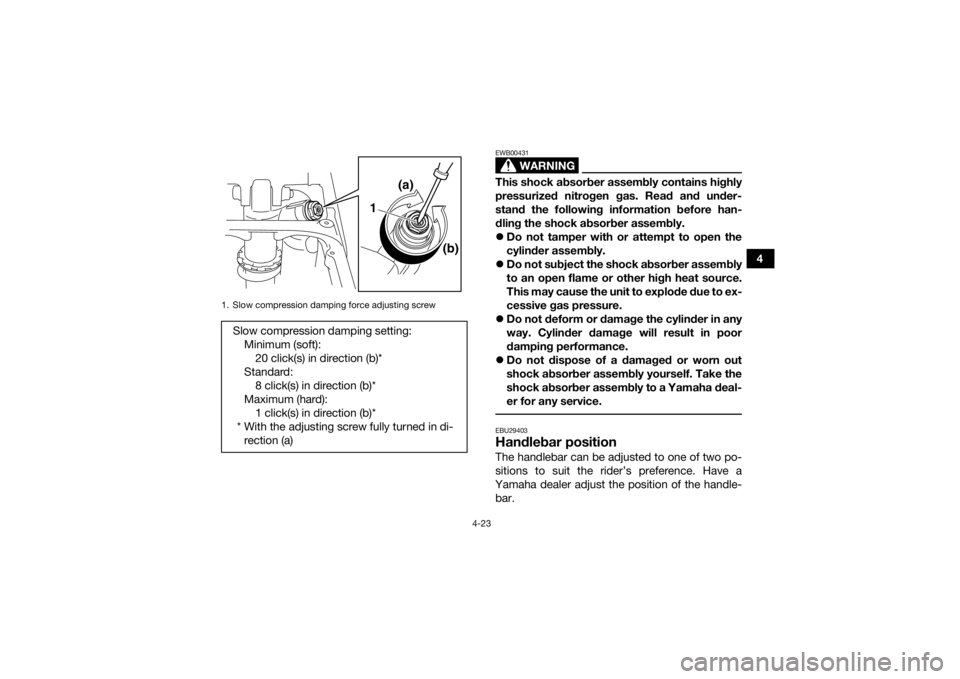
1. Slow compression damping force adjusting screwSlow compression damping setting: Minimum (soft):20 click(s) in direction (b)*
Standard: 8 click(s) in direction (b)*
Maximum (hard): 1 click(s) in direction (b)*
* With the adjusting screw fully turned in di- rection (a)
(a)
(b)
1
UBW261E0.book Page 23 Friday, May 26, 2017 9:38 AM
Page 49 of 150
5-1
5
EBU19203
PRE-OPERATION CHECKS
EBU19226Inspect your vehicle each time you use it to make sure the vehicle is in safe operating condition. Always
follow the inspection and maintenance procedures and schedules described in the Owner’s Manual.
WARNING
EWB00482Failure to inspect or maintain the vehicle properly increases the possibility of an accident or equip-
ment damage. Do not operate the vehicle if you find any problem. If a problem cannot be corrected
by the procedures provided in this manual, have the vehicle inspected by a Yamaha dealer. Before using this vehicle, check the following points:
ITEMROUTINE PAGE
Fuel • Check fuel level in fuel tank,
and add recommended fuel if neces-
sary.
• Check fuel line for leakage. Correct if necessary. 4-8, 5-4
Engine oil • Check oil level in engine oil tank, and add recommended oil to
specified level if necessary.
• Check ATV for oil leakage. Correct if necessary. 5-4, 8-14
Coolant • Check coolant level in reservoir, and add recommended coolant to
specified level if necessary.
• Check cooling system for leakage. Correct if necessary. 5-4, 8-20
UBW261E0.book Page 1 Friday, May 26, 2017 9:38 AM
Page 53 of 150

5-5
5
Brake operation
Test the brakes at slow speed after starting out to
make sure they are working properly. If the brakes
do not provide proper braking performance,
check the brake pads for wear. (See page 8-28.)
EBU19762Throttle leverCheck the operation of the throttle lever. It must
open smoothly and spring back to the idle position
when released. Have a Yamaha dealer correct if
necessary.EBU19771Drive chainCheck the condition of the drive chain and check
the drive chain slack. Lubricate and adjust the
drive chain as necessary. (See page 8-35.)EBU19816TiresCheck tire pressure regularly to make sure it is at
the recommended specifications. Also check for
wear and damage. Tire pressure
Use a tire pressure gauge to check and adjust tire
air pressure when the tires are cold. The tire air
pressure must be equal on both sides.
WARNING! Operation of this vehicle with im- proper tire pressure may cause severe injury or
death from loss of control or rollover. Tire
pressure below the minimum specified could
also cause the tire to dislodge from the rim un-
der severe riding conditions.
[EWB02542]
Recommended tire pressure: Front35.0 kPa (0.350 kgf/cm², 5.0 psi)
Rear 35.0 kPa (0.350 kgf/cm², 5.0 psi)
Minimum tire pressure: Front32.0 kPa (0.320 kgf/cm², 4.6 psi)
Rear 32.0 kPa (0.320 kgf/cm², 4.6 psi)
Maximum tire seating pressure: Front250 kPa (2.5 kgf/cm², 36 psi)
Rear 250 kPa (2.5 kgf/cm², 36 psi)
UBW261E0.book Page 5 Friday, May 26, 2017 9:38 AM
Page 54 of 150
5-6
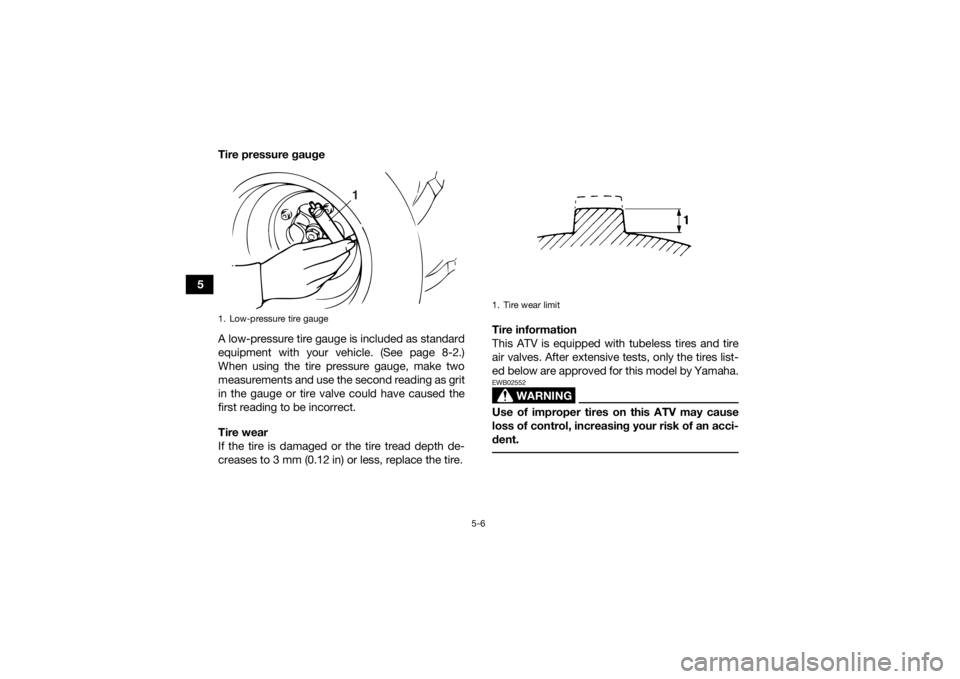
5Tire pressure gauge
A low-pressure tire gauge is included as standard
equipment with your vehicle. (See page 8-2.)
When using the tire pressure gauge, make two
measurements and use the second reading as grit
in the gauge or tire valve could have caused the
first reading to be incorrect.
Tire wear
If the tire is damaged or the tire tread depth de-
creases to 3 mm (0.12 in) or less, replace the tire.
Tire information
This ATV is equipped with tubeless tires and tire
air valves. After extensive tests, only the tires list-
ed below are approved for this model by Yamaha.
WARNING
EWB02552Use of improper tires on this ATV may cause
loss of control, increasing your risk of an acci-
dent.
1. Low-pressure tire gauge
1
1. Tire wear limit
UBW261E0.book Page 6 Friday, May 26, 2017 9:38 AM