steering YAMAHA YXZ1000R 2016 Owner's Manual
[x] Cancel search | Manufacturer: YAMAHA, Model Year: 2016, Model line: YXZ1000R, Model: YAMAHA YXZ1000R 2016Pages: 200, PDF Size: 4.58 MB
Page 95 of 200

6-8
6
TIPWhen the knob is set to “DIFF LOCK” or “4WD ”, the drive mode icon and the indicator light
will flash until the differential gear is completely locked or unlocked.
Turning the steering wheel back and forth will help the differential gear lock to engage or dis-
engage.
To protect the drivetrain from damage, vehicle speed is limited until the differential gear lock
has properly transitioned. U2HC7LE0.book Page 8 Wednesday, October 7, 2015 12:09 PM
Page 107 of 200
7-11
7
Floorboard
The floorboard allows you to brace your feet,
which helps you keep your body in the vehicle
in the event of an accident or rollover. Keep
your feet on the floorboard during operation.
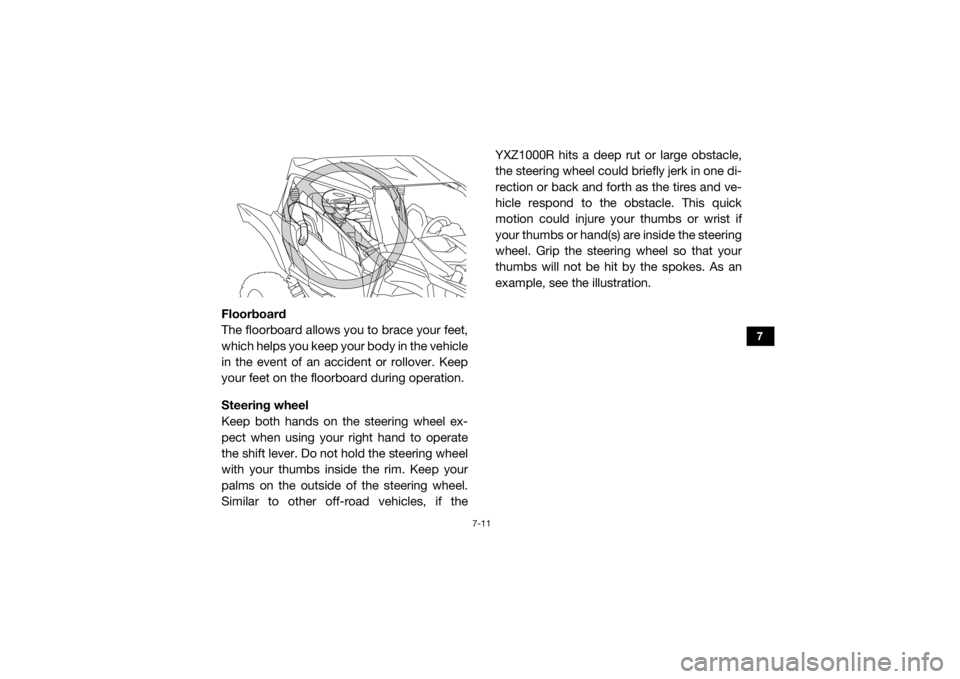
Steering wheel
Keep both hands on the steering wheel ex-
pect when using your right hand to operate
the shift lever. Do not hold the steering wheel
with your thumbs inside the rim. Keep your
palms on the outside of the steering wheel.
Similar to other off-road vehicles, if the YXZ1000R hits a deep rut or large obstacle,
the steering wheel could briefly jerk in one di-
rection or back and forth as the tires and ve-
hicle respond to the obstacle. This quick
motion could injure your thumbs or wrist if
your thumbs or hand(s) are inside the steering
wheel. Grip the steering wheel so that your
thumbs will not be hit by the spokes. As an
example, see the illustration.U2HC7LE0.book Page 11 Wednesday, October 7, 2015 12:09 PM
Page 109 of 200

7-13
7
Eye protection (goggles, helmet face shield,
or protective eyewear)
Over-the-ankle boots, gloves, long-sleeved
shirt or jacket, and long pants
An approved helmet and other personal pro-
tective equipment can help in a variety of
ways, including:
Reduce the severity of injuries if any part of
you is outside the vehicle or protective
structure during a rollover.
Help protect you if outside objects intrude
inside the vehicle during operation.
Help protect you in the event of impact with
an obstacle or other vehicle.
Wear eye protection when operating or riding
the vehicle to reduce the risk of a serious ac-
cident or injury. Eye protection, such as a face
shield or goggles, may reduce the risk of for-
eign material getting in your eyes and help
prevent loss of vision. Practice for new Yamaha YXZ1000R users
Become familiar with the performance char-
acteristics of the vehicle in a large, flat area
that is free of obstacles and other vehicles.
Practice controlling the accelerator pedal,
clutch, brakes, steering, and shift lever. Drive
at slow speeds with gradual acceleration and
smooth turns. Practice applying the accelera-
tor pedal smoothly. Practice slowing down
before turning. Practice maintaining a steady
amount of throttle (accelerator pedal position)
through the turn. Avoid higher speeds until
you are thoroughly famili
ar with the operation
and handling of the vehicle. Remember, driv-
ing aggressively or making abrupt maneuvers
even on flat, open areas can cause side roll-
overs.U2HC7LE0.book Page 13 Wednesday, October 7, 2015 12:09 PM
Page 110 of 200

7-14
7
Become familiar with the way the vehicle han-
dles in the various drive modes. Start off with
two-wheel drive “2WD”, then four-wheel drive
“4WD”, and finally four-wheel drive with the
differential locked “DIFF LOCK”. Steering
may take more effort in four-wheel drive with
the differential locked “DIFF LOCK”. Also
practice driving in reverse.TIPTake the time to learn basic operation of the
vehicle before driving at higher speeds or at-
tempting more difficult maneuvers.
Getting ready to ride
Perform the pre-operation checks on page
5-1. Follow the instructions on page 6-2 when
starting the engine.
Turning
Use care in turns — turning the steering wheel
too far or too fast can result in loss of control
or a rollover. Slow down before entering
turns. When making tight turns from a stand-
still or at slow speeds, avoid sudden or hard
acceleration. Driving aggressively or making
abrupt maneuvers even on flat, open areas
can cause side rollovers. Avoid sideways slid-
ing, skidding, or back-wheel sliding, and nev-
er do donuts. If you feel the vehicle begin to
slide sideways or the back wheels slide dur-
ing a turn, steer into the direction of the slide,
if possible, and gradually let off the accelera-
tor pedal to regain directional control and
avoid rollover. For example, if you feel the
back of the vehicle start to slide to your right,
steer to the right.
U2HC7LE0.book Page 14 Wednesday, October 7, 2015 12:09 PM
Page 111 of 200

7-15
7
If you think or feel that the vehicle may tip or
roll, keep your body completely inside the
protective structure of the vehicle:
Brace yourself by pressing your feet firmly
on the floorboard and keep a firm grip on
the steering wheel or passenger handhold.
Do not put your hands or feet outside of the
vehicle for any reason. Do not try to stop a
tipover using your arm or leg.
Accelerating
Avoid higher speeds and sudden or hard ac-
celeration until you are thoroughly familiar
with the operation of your vehicle. Avoid sud-
den or hard acceleration in any turn. Never
drive faster than is safe for current conditions.
Shifting
Follow the instructions on pages 6-2 and 6-3
for shifting, downshifting, and shifting into re-
verse until you are thoroughly familiar with
each operation. Braking
When slowing down or stopping, take your
foot off the accelerator pedal and press the
brake pedal smoothly. Abrupt or improper
use of the brakes can cause the tires to lose
traction, reducing control of the vehicle and
increasing the possibility of an accident.
Braking ability is affected by type of terrain. In
most cases, gradual application of the brakes
is more effective than
abrupt braking, partic-
ularly on loose surfaces, such as gravel. Al-
ways allow for greater braking distance on
rough, loose, or slippery surfaces.
Engine compression braking will also help
slow the vehicle down. With the transmission
still in gear, take your foot off the accelerator
and allow the drivetrain and engine to absorb
vehicle speed. Downshift as necessary. Ap-
plication of the brakes provides additional
stopping power.U2HC7LE0.book Page 15 Wednesday, October 7, 2015 12:09 PM
Page 113 of 200
![YAMAHA YXZ1000R 2016 Owners Manual 7-17
7
TIPYou may need to turn the steering wheel left
and right or release the clutch slightly to help
the differential lock into place. 3. Stop the engine (turn the key to “ ”[off]).
4. With the](/img/51/53895/w960_53895-112.png "YAMAHA YXZ1000R 2016 Owners Manual 7-17
7
TIPYou may need to turn the steering wheel left
and right or release the clutch slightly to help
the differential lock into place. 3. Stop the engine (turn the key to “ ”[off]).
4. With the")
7-17
7
TIPYou may need to turn the steering wheel left
and right or release the clutch slightly to help
the differential lock into place. 3. Stop the engine (turn the key to “ ”[off]).
4. With the brake pedal still being applied, set the parking brake.
5. Finally, get out of the vehicle and block
the front and rear wheels with rocks or
other objects.
Loading
Be aware that vehicle load includes the total
combined weight of the operator, passenger,
any installed accessories, and any luggage or
cargo brought on board or stored in the cargo
bed. Make sure that the gross vehicle weight
(vehicle load plus weight of the vehicle itself)
never exceeds 1025 kg (2260 lb). Vehicle loading can affect handling as well as
the recommended tire pressure. See “Load-
ing” on page 6-9 and “Tire pressure” on page
5-8.
EBU35572Operation on different surfaces and
terrainsGo slowly and proceed with caution when op-
erating on an unfamiliar surface or terrain.
This vehicle may handle differently in certain
types of terrains or on certain surfaces. You
may come upon hidden rocks, bumps, or
holes without enough time to react. To avoid
loss of control or rollover, always be alert to
changing surfaces or terrain when operating
the vehicle.
Your Yamaha YXZ1000R has higher ground
clearance and other features to handle rug-
ged terrain, and as a result, can overturn in
situations where some vehicles may not.
Abrupt maneuvers or aggressive driving can
cause loss of control, including rollovers –
U2HC7LE0.book Page 17 Wednesday, October 7, 2015 12:09 PM
Page 114 of 200
7-18
7
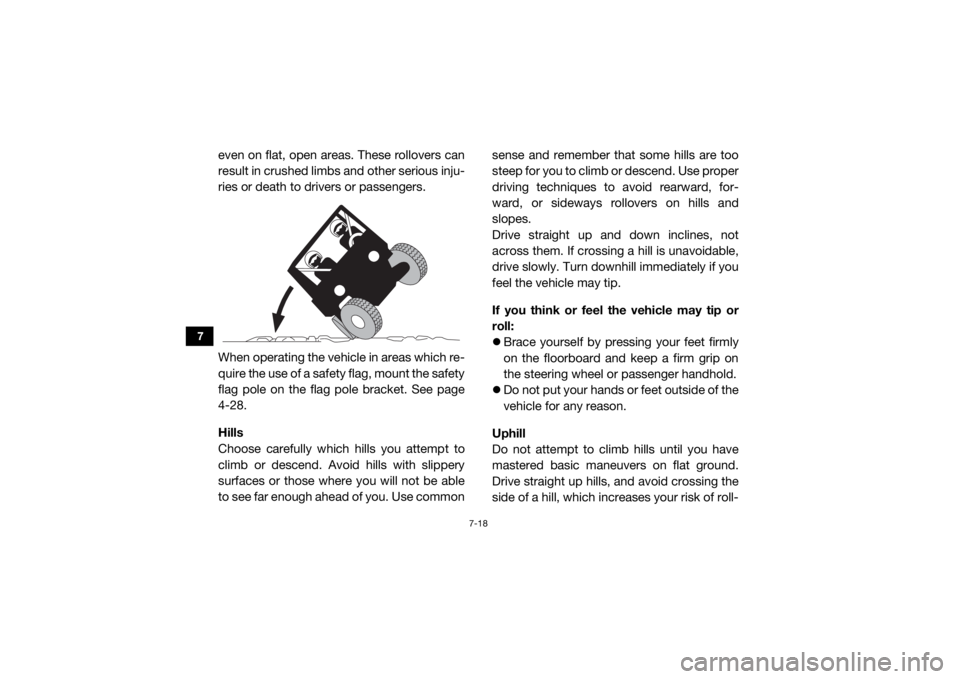
even on flat, open areas. These rollovers can
result in crushed limbs and other serious inju-
ries or death to drivers or passengers.
When operating the vehicle in areas which re-
quire the use of a safety flag, mount the safety
flag pole on the flag pole bracket. See page
4-28.
Hills
Choose carefully which hills you attempt to
climb or descend. Avoid hills with slippery
surfaces or those where you will not be able
to see far enough ahead of you. Use commonsense and remember that some hills are too
steep for you to climb or descend. Use proper
driving techniques to avoid rearward, for-
ward, or sideways rollovers on hills and
slopes.
Drive straight up and down inclines, not
across them. If crossing a hill is unavoidable,
drive slowly. Turn downhill immediately if you
feel the vehicle may tip.
If you think or feel the vehicle may tip or
roll:
Brace yourself by pressing your feet firmly
on the floorboard and keep a firm grip on
the steering wheel or passenger handhold.
Do not put your hands or feet outside of the
vehicle for any reason.
Uphill
Do not attempt to climb hills until you have
mastered basic maneuvers on flat ground.
Drive straight up hills, and avoid crossing the
side of a hill, which increases your risk of roll-U2HC7LE0.book Page 18 Wednesday, October 7, 2015 12:09 PM
Page 126 of 200

8-8
8
14*Wheels • Check balance, runout, and for damage.
• Balance wheel if necessary.
• Replace wheel if damaged or if runout is
over specified limits. √ √√√
• Check and tighten the bead lock (for equipped models). Every 500 km (300 mi)
15 *Wheel bearings • Check bearing assemblies for loose-
ness/damage.
• Replace if damaged. √ √√√
16 *Front and rear
suspension • Check operation and for oil leakage.
• Correct if necessary.
√√
17 *Steering system • Check operation and for looseness. Replace
if damaged.
• Check toe-in. Adjust if necessary. √√√√√
18 *Stabilizer bushes • Check for cracks or other damage, and re-
place if necessary. √√√
19 *Upper and lower
arm pivots • Lubricate with lithium-soap-based grease.
√√√
20 *Rear knuckle up-
per and lower piv-
ots • Lubricate with lithium-soap-based grease.
√√√
NO. ITEM ROUTINE
INITIAL EVERY
Whichev- er comes first month136612
km
(mi) 320
(200) 1300
(800) 2500
(1600) 2500
(1600) 5000
(3200)
hours 20 80 160 160 320U2HC7LE0.book Page 8 Wednesday, October 7, 2015 12:09 PM
Page 171 of 200
8-53
8
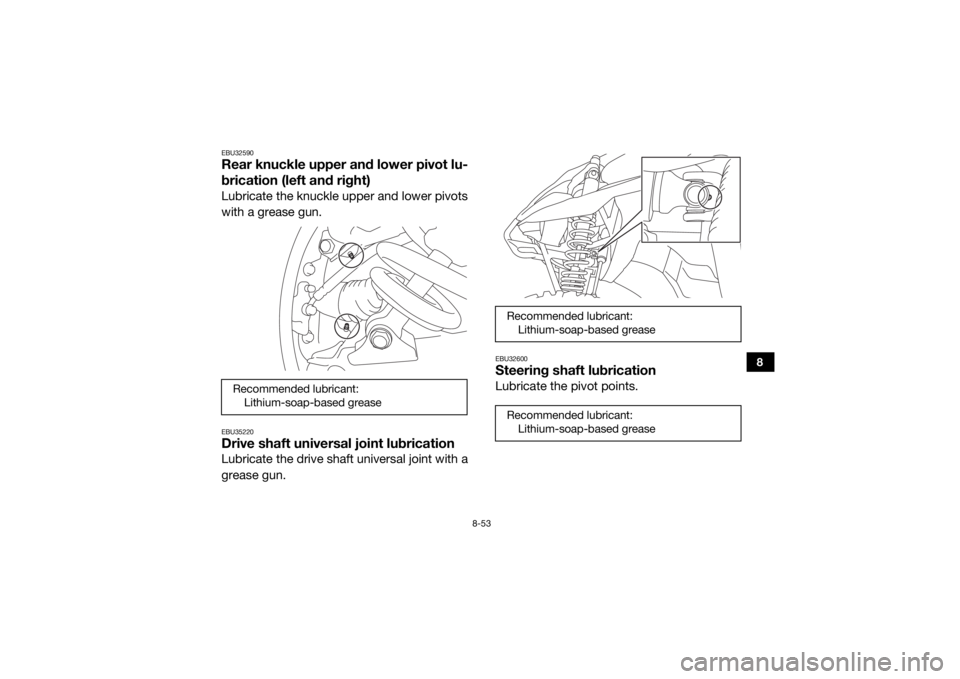
EBU32590Rear knuckle upper and lower pivot lu-
brication (left and right)Lubricate the knuckle upper and lower pivots
with a grease gun.EBU35220Drive shaft universal joint lubricationLubricate the drive shaft universal joint with a
grease gun.
EBU32600Steering shaft lubricationLubricate the pivot points.
Recommended lubricant:Lithium-soap-based grease
Recommended lubricant:Lithium-soap-based grease
Recommended lubricant: Lithium-soap-based grease
U2HC7LE0.book Page 53 Wednesday, October 7, 2015 12:09 PM
Page 197 of 200

12-2
12
Hood ............................................................................ 8-10IIdentification number records ...................................... 11-1
Indicator lights and warning lights ................................. 4-2
Instruments, lights and switches, Pre-operation check ........................................................................... 5-8JJump-starting .............................................................. 8-59LLabel locations ............................................................... 1-1
Light switch .................................................................. 4-15
Loading .......................................................................... 6-9MMain switch .................................................................... 4-1
Maintenance and lubrication chart ................................ 8-6
Maintenance chart, emission control system ................ 8-4
Model label .................................................................. 11-1
Multi-function meter unit ............................................... 4-6NNeutral indicator light ..................................................... 4-2OOn-Command drive knob ............................................ 4-15
Owner’s manual and tool kit .......................................... 8-2PPanels .......................................................................... 8-10
Parking ........................................................................... 6-9
Parking brake indicator light .......................................... 4-3
Parking brake lever ...................................................... 4-18
Parking brake lever free play, adjusting ....................... 8-49
Parking brake pads, checking ..................................... 8-44
Passenger handhold, Pre-operation check ................... 5-7 Pedal, lubrication ......................................................... 8-51
RRear knuckle upper and lower pivot, lubrication ......... 8-53
Reverse gear lock lever ............................................... 4-16
Reverse indicator light ................................................... 4-2SSafety information .......................................................... 2-1
Seat belt indicator light .................................................. 4-6
Seat belts ..................................................................... 4-23
Seat belts, Pre-operation check .................................... 5-7
Seats ............................................................................ 4-20
Shift lever ..................................................................... 4-19
Shift lever operation and reverse driving ....................... 6-3
Shift lever, Pre-operation check .................................... 5-8
Shift timing indicator light .............................................. 4-3
Shock absorber assemblies, adjusting the front ......... 4-28
Shock absorber assemblies, adjusting the rear .......... 4-33
Spark arrester, cleaning ............................................... 8-42
Spark plugs, checking ................................................. 8-35
Specifications .............................................................. 10-1
Stabilizer bushes, checking ..........
............................... 8-51
Starting the engine ........................................................ 6-2
Steering, Pre-operation check ....................................... 5-7
Steering shaft, lubrication ............................................ 8-53
Steering wheel position ............................................... 4-22
Storage .......................................................................... 9-2
Storage compartments ................................................ 4-24TTail/brake light ............................................................. 8-63
Tire, replacing .............................................................. 8-54
Tires, Pre-operation check ............................................ 5-8
Transmission oil ........................................................... 8-25
U2HC7LE0.book Page 2 Wednesday, October 7, 2015 12:09 PM