lock YAMAHA YXZ1000R 2016 Owner's Guide
[x] Cancel search | Manufacturer: YAMAHA, Model Year: 2016, Model line: YXZ1000R, Model: YAMAHA YXZ1000R 2016Pages: 200, PDF Size: 4.58 MB
Page 115 of 200

7-19
7
over. Practice first on gentle slopes before at-
tempting steeper hills. Always check the
terrain carefully before attempting any hill.
To climb a hill, you need traction, momentum,
and steady throttle. For more traction and
control for climbing steeper and/or rougher
slopes, shift into low gear and select “4WD”
or “DIFF LOCK”. Travel fast enough to main-
tain momentum, but not so fast that you can-
not react to changes in the terrain as you
climb.
Slow down when you reach the crest of the
hill if you cannot see clearly what is on the
other side – there could be another person, an
obstacle, or a sharp drop-off.
If you start to lose traction or momentum
when climbing, and decide you will be unable
to continue, use the brakes to stop. Do not at-
tempt to turn the vehicle around. With your
foot on the brake pedal, look behind you and
plan your descent. Press the clutch pedal and
shift the transmission into reverse so you can
use engine braking to slow your descent. Re- lease the brake and clutch, and then begin to
coast down the hill. Use engine braking as
much as possible, gently applying the brakes
when necessary.
Downhill
Check the terrain carefully before going
downhill. When possible, choose a path that
lets you drive your vehicle straight downhill.
Choose your path carefully and drive slowly
enough to be able to react to obstacles that
you encounter.
For more traction and control, before going
down steeper and/or rougher slopes, shift
into low gear and select “4WD” or “DIFF
LOCK”. Engine braking will help you go
downhill slowly. Go as slowly as possible. If
you begin to go too fast, apply the brakes
gently. Avoid hard application of the brakes,
which could cause the vehicle to slide.U2HC7LE0.book Page 19 Wednesday, October 7, 2015 12:09 PM
Page 125 of 200

8-7
8
7*Clutch • Check operation and for fluid leakage.
• Correct if necessary. √√√√√
8 *Brake system • Check operation, brake pad wear, and for
fluid leakage.
• Correct if necessary, replace pads if worn to the limit. √√√√√
9 *Parking brake • Check operation and free play/brake pad
wear.
• Correct if necessary. Replace pads if worn to the limit. √√√√√
10 *Brake fluid and
internals • Change the brake fluid.
• Replace internal components of master cyl-
inder and calipers. Every 2 years
11 *Brake hoses • Replace. Every 4 years
12 *Accelerator pedal • Check operation and free play. √√√√√
13 *Reverse lock re-
lease cable • Check operation and adjust or replace if
necessary. √√√
NO. ITEM ROUTINE
INITIAL EVERY
Whichev- er comes first month 1 3 6 6 12
km
(mi) 320
(200) 1300
(800) 2500
(1600) 2500
(1600) 5000
(3200)
hours 20 80 160 160 320
U2HC7LE0.book Page 7 Wednesday, October 7, 2015 12:09 PM
Page 126 of 200

8-8
8
14*Wheels • Check balance, runout, and for damage.
• Balance wheel if necessary.
• Replace wheel if damaged or if runout is
over specified limits. √ √√√
• Check and tighten the bead lock (for equipped models). Every 500 km (300 mi)
15 *Wheel bearings • Check bearing assemblies for loose-
ness/damage.
• Replace if damaged. √ √√√
16 *Front and rear
suspension • Check operation and for oil leakage.
• Correct if necessary.
√√
17 *Steering system • Check operation and for looseness. Replace
if damaged.
• Check toe-in. Adjust if necessary. √√√√√
18 *Stabilizer bushes • Check for cracks or other damage, and re-
place if necessary. √√√
19 *Upper and lower
arm pivots • Lubricate with lithium-soap-based grease.
√√√
20 *Rear knuckle up-
per and lower piv-
ots • Lubricate with lithium-soap-based grease.
√√√
NO. ITEM ROUTINE
INITIAL EVERY
Whichev- er comes first month136612
km
(mi) 320
(200) 1300
(800) 2500
(1600) 2500
(1600) 5000
(3200)
hours 20 80 160 160 320U2HC7LE0.book Page 8 Wednesday, October 7, 2015 12:09 PM
Page 156 of 200
8-38
8
Additionally, the fuel injection system
would be affected, resulting in poor engine
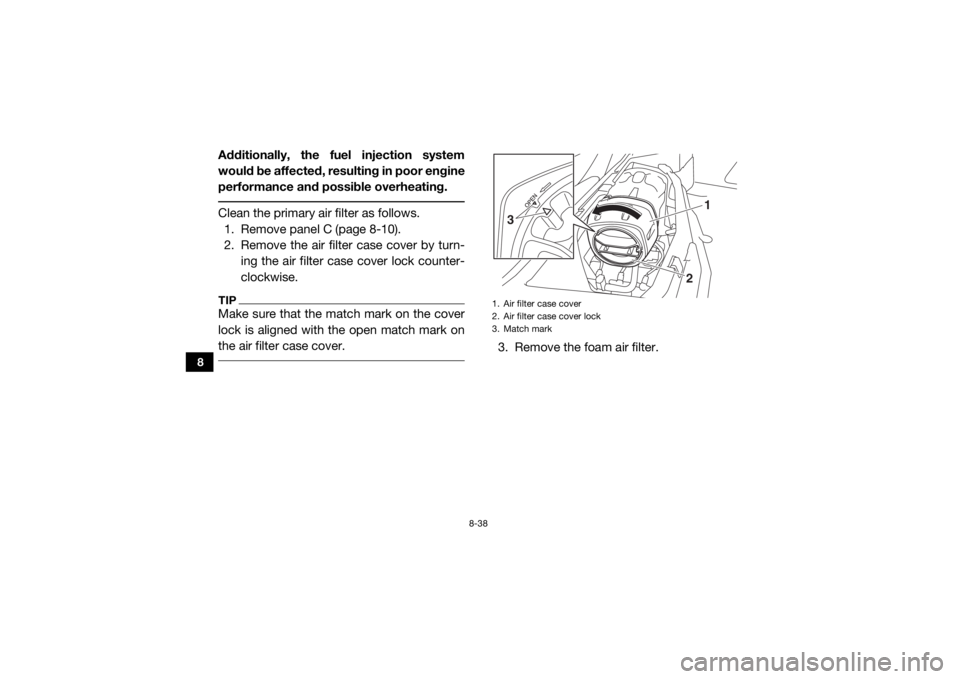
performance and possible overheating. Clean the primary air filter as follows.1. Remove panel C (page 8-10).
2. Remove the air filter case cover by turn- ing the air filter case cover lock counter-
clockwise.TIPMake sure that the match mark on the cover
lock is aligned with the open match mark on
the air filter case cover.
3. Remove the foam air filter.1. Air filter case cover
2. Air filter case cover lock
3. Match mark
2 1
3
U2HC7LE0.book Page 38 Wednesday, October 7, 2015 12:09 PM
Page 158 of 200
8-40
8
7. Wash the foam material in warm soapywater to remove remaining solvent, then
rinse thoroughly with plain warm water.
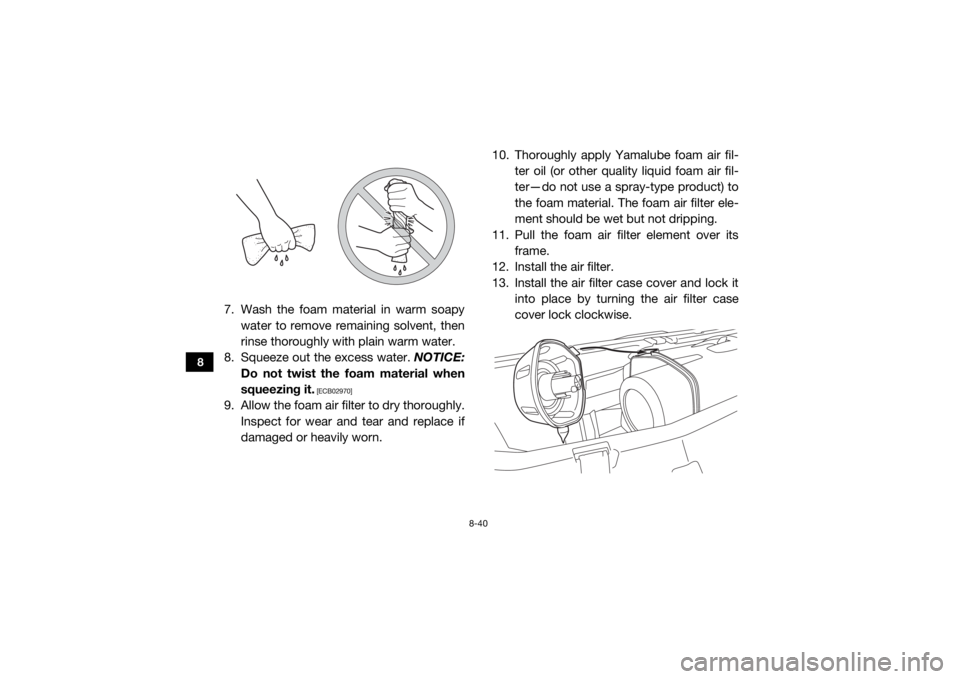
8. Squeeze out the excess water. NOTICE:
Do not twist the foam material when
squeezing it.
[ECB02970]
9. Allow the foam air filter to dry thoroughly. Inspect for wear and tear and replace if
damaged or heavily worn. 10. Thoroughly apply Yamalube foam air fil-
ter oil (or other quality liquid foam air fil-
ter—do not use a spray-type product) to
the foam material. The foam air filter ele-
ment should be wet but not dripping.
11. Pull the foam air filter element over its frame.
12. Install the air filter.
13. Install the air filter case cover and lock it
into place by turning the air filter case
cover lock clockwise.U2HC7LE0.book Page 40 Wednesday, October 7, 2015 12:09 PM
Page 159 of 200
8-41
8
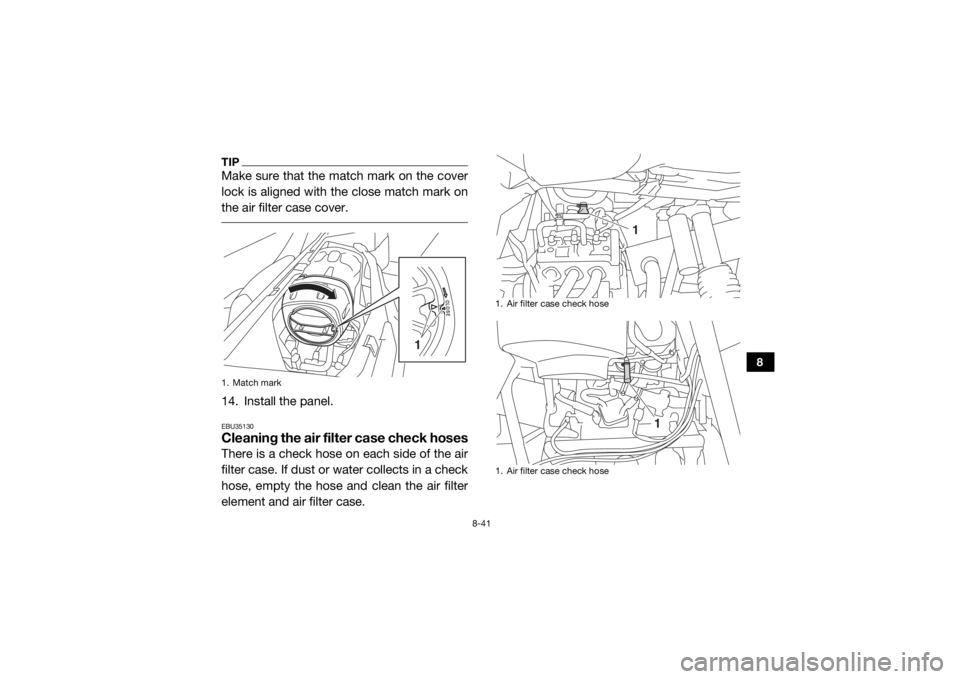
TIPMake sure that the match mark on the cover
lock is aligned with the close match mark on
the air filter case cover. 14. Install the panel.EBU35130Cleaning the air filter case check hosesThere is a check hose on each side of the air
filter case. If dust or water collects in a check
hose, empty the hose and clean the air filter
element and air filter case.1. Match mark
1
1. Air filter case check hose
1. Air filter case check hose
1
1
U2HC7LE0.book Page 41 Wednesday, October 7, 2015 12:09 PM
Page 164 of 200
8-46
8
WARNING
EWB03910Improper maintenance can result in loss of
braking ability or clutch operation. Ob-
serve these precautions:
Insufficient brake or clutch fluid may al-
low air to enter the brake or clutch sys-
tem, reducing braking or clutch
performance.
Clean the filler caps before removing.
Use only DOT 4 brake fluid from a sealed
container.
Use only the specified brake fluid; other-
wise, the rubber seals may deteriorate,
causing leakage.
Refill with the same type of brake fluid.
Adding a brake fluid other than DOT 4
may result in a harmful chemical reac-
tion.
Be careful that water or dust does not
enter the brake or clutch fluid reservoir
when refilling. Water will significantly
lower the boiling point of the fluid and
may result in vapor lock.
NOTICEECB01161Brake fluid may damage painted surfaces
or plastic parts. Always clean up spilled
fluid immediately. As the brake pads wear, it is normal for the
brake fluid level to gradually go down. A low
brake fluid level may indicate worn brake
pads or brake system leakage; therefore, be
sure to check the brake pads for wear and the
brake system for leakage. A low clutch fluid
level may indicate clutch system leakage;
therefore, be sure to check the clutch system
for leakage. If the brake or clutch fluid level
goes down suddenly, have a Yamaha dealer
check and repair the vehicle before any fur-
ther operation.
U2HC7LE0.book Page 46 Wednesday, October 7, 2015 12:09 PM
Page 167 of 200
8-49
8
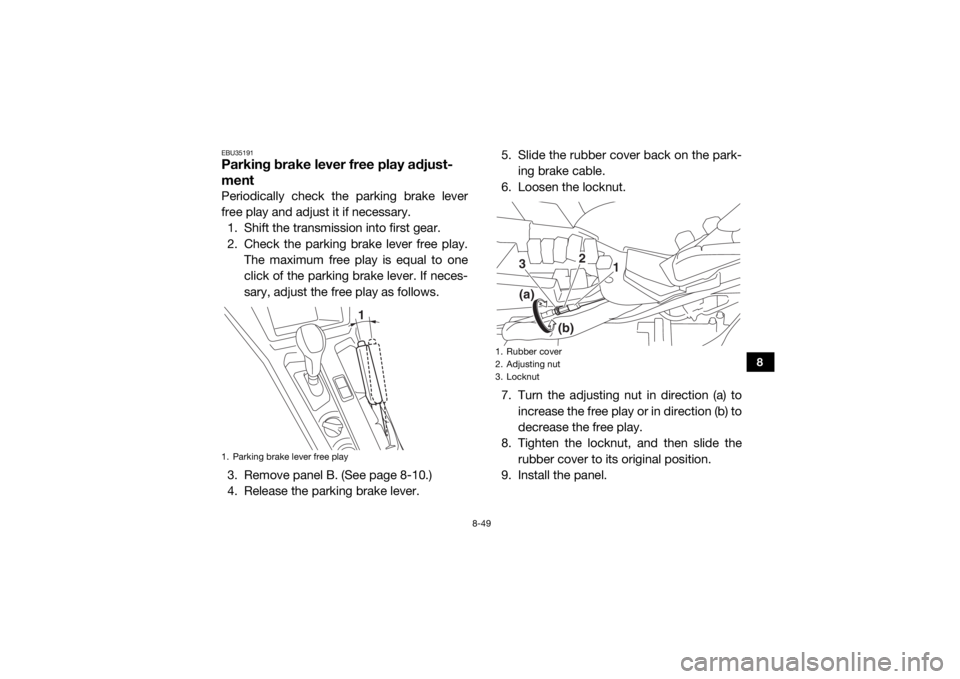
EBU35191Parking brake lever free play adjust-
mentPeriodically check the parking brake lever
free play and adjust it if necessary.1. Shift the transmission into first gear.
2. Check the parking brake lever free play. The maximum free play is equal to one
click of the parking brake lever. If neces-
sary, adjust the free play as follows.
3. Remove panel B. (See page 8-10.)
4. Release the parking brake lever. 5. Slide the rubber cover back on the park-
ing brake cable.
6. Loosen the locknut.
7. Turn the adjusting nut in direction (a) to increase the free play or in direction (b) to
decrease the free play.
8. Tighten the locknut, and then slide the
rubber cover to its original position.
9. Install the panel.1. Parking brake lever free play
1
1. Rubber cover
2. Adjusting nut
3. Locknut
1
(b)
(a)
3
2
U2HC7LE0.book Page 49 Wednesday, October 7, 2015 12:09 PM
Page 179 of 200
8-61
8
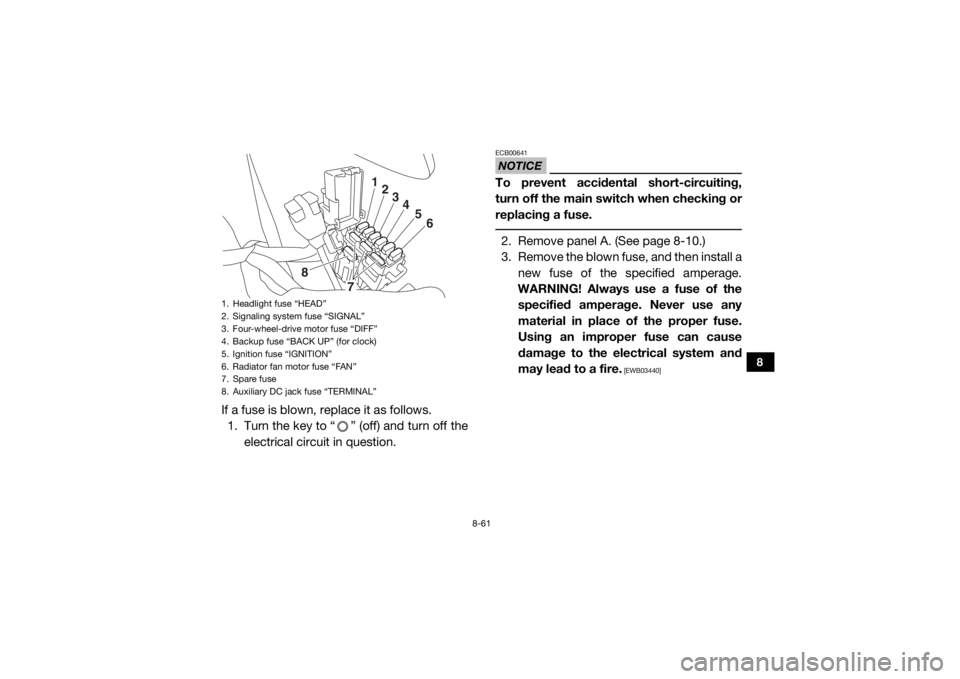
If a fuse is blown, replace it as follows.1. Turn the key to “ ” (off) and turn off the
electrical circuit in question.
NOTICEECB00641To prevent accidental short-circuiting,
turn off the main switch when checking or
replacing a fuse. 2. Remove panel A. (See page 8-10.)
3. Remove the blown fuse, and then install anew fuse of the specified amperage.
WARNING! Always use a fuse of the specified amperage. Never use any
material in place of the proper fuse.
Using an improper fuse can cause
damage to the electrical system and
may lead to a fire.
[EWB03440]
1. Headlight fuse “HEAD”
2. Signaling system fuse “SIGNAL”
3. Four-wheel-drive motor fuse “DIFF”
4. Backup fuse “BACK UP” (for clock)
5. Ignition fuse “IGNITION”
6. Radiator fan motor fuse “FAN”
7. Spare fuse
8. Auxiliary DC jack fuse “TERMINAL”
1 234
5
6
7
8
U2HC7LE0.book Page 61 Wednesday, October 7, 2015 12:09 PM
Page 185 of 200

9-1
9
EBU32720
CLEANING AND STORAGE
EBU35920CleaningFrequent, thorough cleaning of your vehicle
will not only enhance its appearance but will
improve its general performance and extend
the useful life of many components.1. Before cleaning the vehicle: a. Block off the end of the exhaust pipeto prevent water entry. A plastic bag
and strong rubber band may be used.
b. Make sure the spark plugs and all filler caps are properly installed.
2. If the engine case is excessively greasy, apply degreaser with a paint brush. Do
not apply degreaser to the wheel axles.
3. Rinse the dirt and degreaser off with a garden hose. Use only enough pressure
to do the job. WARNING! Test the
brakes after washing. Apply the
brakes several times at slow speeds to
let friction dry the brakes. Wet brakes may have reduced stopping ability, in-
creasing the chance of an accident.
[EWB03471]
NOTICE: Excessive water pres-
sure may cause water seepage and
deterioration of wheel bearings,
brakes, transmission seals and electri-
cal devices. Many expensive repair
bills have resulted from improper high-
pressure detergent applications such
as those available in coin-operated car
washers.
[ECB00712]
4. Once the majority of the dirt has been hosed off, wash all surfaces with warm
water and mild, detergent-type soap. An
old toothbrush or bottle brush is handy
for hard-to-get-at places.
5. Rinse the vehicle off immediately with
clean water and dry all surfaces with a
clean chamois towel or soft, absorbent
cloth.
6. Clean the seats with a vinyl upholstery cleaner to keep the covers pliable and
glossy.
U2HC7LE0.book Page 1 Wednesday, October 7, 2015 12:09 PM