starting YAMAHA YXZ1000R 2016 Owners Manual
[x] Cancel search | Manufacturer: YAMAHA, Model Year: 2016, Model line: YXZ1000R, Model: YAMAHA YXZ1000R 2016Pages: 200, PDF Size: 4.58 MB
Page 7 of 200

FOR YOUR SAFETY –
PRE-OPERATION CHECKS .................... 5-1Front and rear brakes ........................... 5-3
Clutch ................................................... 5-3
Fuel ....................................................... 5-4
Engine oil .............................................. 5-5
Transmission ........................................ 5-6
Coolant ................................................. 5-6
Final gear .............................................. 5-6
Differential gear .................................... 5-7
Accelerator pedal ................................. 5-7
Seat belts ............................................. 5-7
Passenger handhold ............................ 5-7
Steering ................................................ 5-7
Shift lever.............................................. 5-8
Fittings and fasteners ........................... 5-8
Instruments, lights and switches .......... 5-8
Control cables ...................................... 5-8
Tires ...................................................... 5-8
OPERATION ............................................ 6-1 Engine break-in .................................... 6-1
Starting the engine ............................... 6-2 Shift lever operation and reverse
driving .................................................6-3
Selecting the drive mode ......................6-7
Parking ..................................................6-9
Loading .................................................6-9
BASIC GUIDE FOR SAFE USE ...............7-1 KNOW YOUR VEHICLE ........................7-1
LEARNING TO OPERATE YOUR VEHICLE ...........................................7-12
PERIODIC MAINTENANCE AND
ADJUSTMENT .........................................8-1 Owner’s manual and tool kit .................8-2
Periodic maintenance chart for the emission control system .....................8-4
General maintenance and lubrication chart ....................................................8-6
Hood ...................................................8-10
Panels .................................................8-10
Engine oil and oil filter.........................8-15
Transmission oil ..................................8-25
Final gear oil .......................................8-28U2HC7LE0.book Page 2 Wednesday, October 7, 2015 12:09 PM
Page 8 of 200

Differential gear oil ............................. 8-30
Coolant ............................................... 8-33
Axle boots .......................................... 8-34
Checking the spark plugs .................. 8-35
Air filter maintenance.......................... 8-37
Cleaning the air filter case check hoses ................................................ 8-41
Cleaning the spark arrester ................ 8-42
Valve clearance .................................. 8-43
Brakes ................................................ 8-43
Checking the front and rear brake
pads.................................................. 8-44
Checking the parking brake pads ...... 8-44
Checking the brake and clutch fluid levels................................................. 8-45
Brake and clutch fluid replacement ... 8-47
Checking the clutch pedal ................. 8-47
Checking the brake pedal .................. 8-47
Checking the accelerator pedal ......... 8-48
Parking brake lever free play adjustment........................................ 8-49
Brake light switch adjustment ............ 8-50
Cable inspection and lubrication........ 8-50 Pedal lubrication .................................8-51
Checking the stabilizer bushes...........8-51
Upper and lower arm pivot
lubrication (left and right) ..................8-52
Rear knuckle upper and lower pivot
lubrication (left and right) ..................8-53
Drive shaft universal joint lubrication .........................................8-53
Steering shaft lubrication....................8-53
Wheel removal ....................................8-54
Tire replacement .................................8-54
Wheel installation................................8-55
Battery ................................................8-55
Jump-starting .....................................8-59
Fuse replacement ...............................8-60
Headlights...........................................8-62
Headlight beam adjustment ...............8-63
Tail/brake light ....................................8-63
Troubleshooting ..................................8-63
Troubleshooting charts .......................8-65
CLEANING AND STORAGE ....................9-1 Cleaning................................................9-1
U2HC7LE0.book Page 3 Wednesday, October 7, 2015 12:09 PM
Page 43 of 200

4-5
4
After restarting, make sure that the
warning light is out. Continuous use
while this warning light is on may cause
damage to the engine. EBU31340Engine trouble warning light “ ”
This warning light comes on or flashes if a
problem is detected in the electrical circuit
monitoring the engine. When this occurs,
have a Yamaha dealer check the self-diagno-
sis system. (See page 4-12 for an explanation
of the self-diagnosis device.)
The electrical circuit of the warning light can
be checked by turning the key to “ ” (on). If
the warning light does not come on initially
when the key is turned to “ ” (on), or if the
warning light remains on, have a Yamaha
dealer check the electrical circuit.
EBU33041Electric Power Steering warning light
“EPS”
This warning light comes on when the key is
turned to “ ” (on), and then goes off once
the engine is started. If the warning light re-
mains on or comes on after the engine is
started, the EPS system may not be working
correctly. When this occurs, have a Yamaha
dealer check the EPS system.
The electrical circuit of the warning light can
be checked by turning the key to “ ” (on). If
the warning light does not come on, have a
Yamaha dealer check the electrical circuit.TIPIf the steering load is too heavy (e.g., exces-
sive steering use at slow speed or when op-
erating in deep mud, sand, or snow), the
power assist is reduced to protect the EPS
motor from overheating.
U2HC7LE0.book Page 5 Wednesday, October 7, 2015 12:09 PM
Page 54 of 200

4-16
4
“2WD” (two-wheel drive): Power is supplied
to the rear wheels only.
“4WD” (four-wheel drive): Power is sup-
plied to the rear and front wheels.
“DIFF LOCK” (four-wheel drive with the dif-
ferential gear locked): Power is supplied to
the rear and front wheels with the differen-
tial gear locked. Unlike the “4WD” mode, all
wheels turn at the same speed regardless
of traction.EBU34961Reverse gear lock lever “REV.”To prevent the transmission from being acci-
dently shifted into reverse, this model is
equipped with a reverse gear lock mecha-
nism. To release the lock and be able to shift
the transmission into reverse, pull this lever
towards you.TIPSee page 6-5 for information on driving in re-
verse.
EBU31411Accelerator pedalPress the accelerator pedal to increase en-
gine speed. Spring tension returns the pedal
to the rest position when released. Always
check that the accelerator pedal returns nor-
mally before starting the engine.1. Reverse gear lock lever “REV.”
1
U2HC7LE0.book Page 16 Wednesday, October 7, 2015 12:09 PM
Page 59 of 200
4-21
4
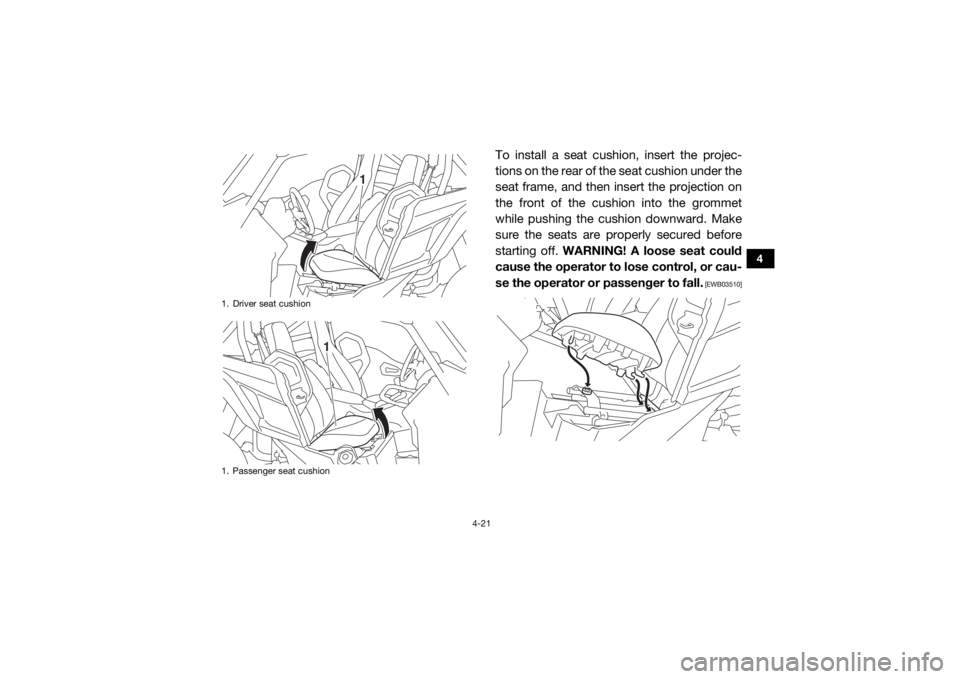
To install a seat cushion, insert the projec-
tions on the rear of the seat cushion under the
seat frame, and then insert the projection on
the front of the cushion into the grommet
while pushing the cushion downward. Make
sure the seats are properly secured before
starting off. WARNING! A loose seat could
cause the operator to lose control, or cau-
se the operator or passenger to fall.
[EWB03510]
1. Driver seat cushion
1. Passenger seat cushion
1
1
U2HC7LE0.book Page 21 Wednesday, October 7, 2015 12:09 PM
Page 60 of 200
4-22
4
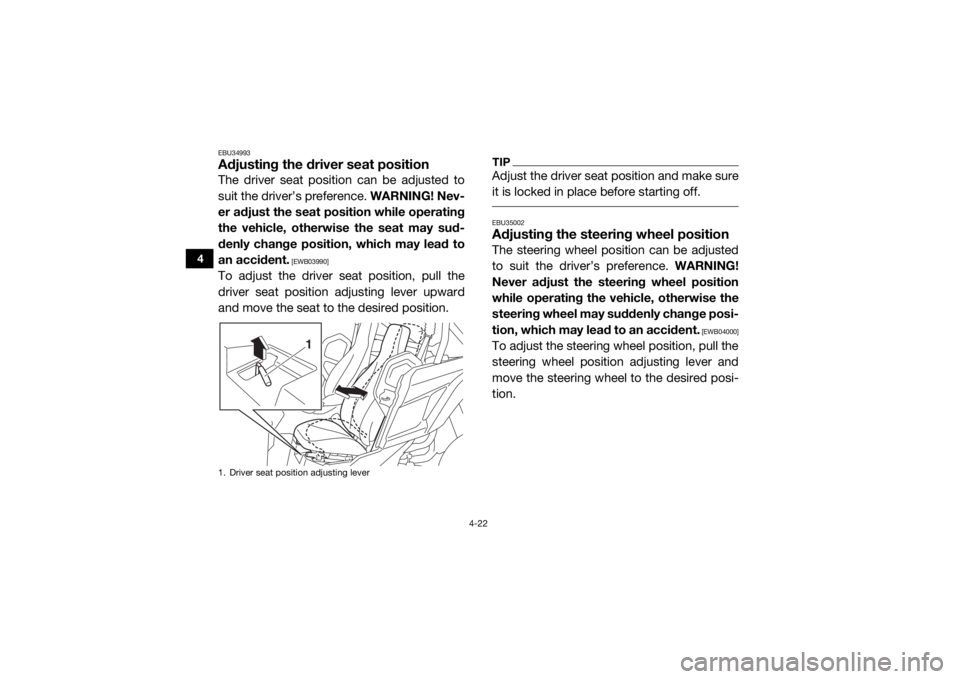
EBU34993Adjusting the driver seat positionThe driver seat position can be adjusted to
suit the driver’s preference. WARNING! Nev-
er adjust the seat position while operating
the vehicle, otherwise the seat may sud-
denly change position, which may lead to
an accident.
[EWB03990]
To adjust the driver seat position, pull the
driver seat position adjusting lever upward
and move the seat to the desired position.
TIPAdjust the driver seat position and make sure
it is locked in place before starting off. EBU35002Adjusting the steering wheel positionThe steering wheel position can be adjusted
to suit the driver’s preference. WARNING!
Never adjust the steering wheel position
while operating the vehicle, otherwise the
steering wheel may suddenly change posi-
tion, which may lead to an accident.
[EWB04000]
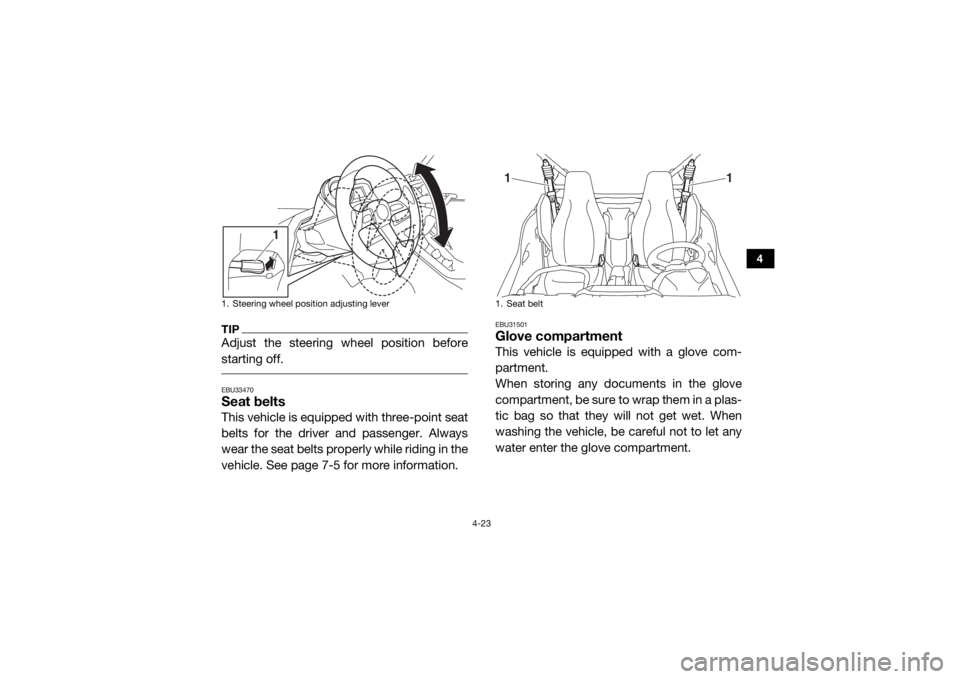
To adjust the steering wheel position, pull the
steering wheel position adjusting lever and
move the steering wheel to the desired posi-
tion.
1. Driver seat position adjusting lever
1
U2HC7LE0.book Page 22 Wednesday, October 7, 2015 12:09 PM
Page 61 of 200
4-23
4
TIPAdjust the steering wheel position before
starting off. EBU33470Seat beltsThis vehicle is equipped with three-point seat
belts for the driver and passenger. Always
wear the seat belts properly while riding in the
vehicle. See page 7-5 for more information.
EBU31501Glove compartmentThis vehicle is equipped with a glove com-
partment.
When storing any documents in the glove
compartment, be sure to wrap them in a plas-
tic bag so that they will not get wet. When
washing the vehicle, be careful not to let any
water enter the glove compartment.
1. Steering wheel position adjusting lever
1
1. Seat belt
1
1
U2HC7LE0.book Page 23 Wednesday, October 7, 2015 12:09 PM
Page 80 of 200

5-3
5
EBU31730Front and rear brakesBrake pedal
Check that there is no free play in the brake
pedal. If there is free play, have a Yamaha
dealer check the brake system. (See page
8-47.)
Check the operation of the brake pedal. It
should move smoothly and there should be
a firm feeling when the brakes are applied.
If not, have the vehicle inspected by a
Yamaha dealer.
Brake fluid level
Check the brake fluid level. Add fluid if neces-
sary. (See page 8-45.) Brake fluid leakage
Check to see if any brake fluid is leaking out
of the pipe joints or the brake fluid reservoir.
Apply the brakes firmly for one minute. If there
is any leakage, have the vehicle inspected by
a Yamaha dealer.
Brake operation
Check the operation of the brakes at the start
of every ride. Test the brakes at slow speed
after starting out to make sure they are work-
ing properly. If the brakes do not provide
proper braking performance, inspect the
brake system. (See page 8-43.)
EBU35491ClutchClutch pedal
Check the operation of the clutch pedal. The
pedal should move smoothly and there
should be some resistance when the clutch
pedal is depressed.
Specified brake fluid: DOT 4
U2HC7LE0.book Page 3 Wednesday, October 7, 2015 12:09 PM
Page 85 of 200

5-8
5
EBU35690Shift leverThe shift lever should move smoothly both
forward and backwards and return to its orig-
inal position after a gear change is made.
Check the shift lever and transmission for
roughness before starting off.TIPThe engine may need to be started for the
transmission to engage gears. EBU35700Fittings and fastenersAlways check the tightness of chassis and
wheel fittings and fasteners before starting
off. Take the vehicle to a Yamaha dealer or re-
fer to the Service Manual for correct tighten-
ing torque.EBU31840Instruments, lights and switchesCheck that all instruments, lights and switch-
es are working properly. Correct if necessary.
EBU31851Control cablesWhen driving in cold weather, always make
sure all control cables work smoothly before
starting off. WARNING! Control cables can
freeze in cold weather and you could be
unable to control the vehicle.
[EWB03280]
EBU35331
TiresCheck tire pressure regularly to make sure it
is at the recommended specifications. Also
check for wear and damage.
Tire pressure
Use the tire pressure gauge to check and ad-
just tire pressures when the tires are cold. Tire
pressures must be equal on both sides.
WARNING! Operation of this vehicle with improper tire pressure may cause severe
injury or death from loss of control or roll-
over. Tire pressure below the minimum
U2HC7LE0.book Page 8 Wednesday, October 7, 2015 12:09 PM
Page 89 of 200

6-2
6
10–20 hours:
Avoid prolonged operation above 6300 r/min.
After break-in:
The vehicle may now be operated normally.EBU35341Starting the engine1. Turn the key to “ ” (on).NOTICEECB02290The coolant temperature warning light and
engine trouble warning light should come
on, then go off.
The EPS warning light should come on,
then go off when the engine is started.
If a warning light does not go off, see page
4-2 for the corresponding warning light
circuit check. 2. Press the brake pedal.
3. Shift the transmission into neutral.
When the transmission is in the neutral
position, the transmission gear display
shows “N” and the neutral indicator
light should come on.
The engine can be started in any gear if
the clutch pedal is applied. However, it
is recommended to shift into neutral
before starting the engine.
4. With your foot off the accelerator pedal, start the engine by turning the key to “ ”
(start).
If the engine fails to start, release the key, and
then try starting it again. Wait a few seconds
before the next attempt. Each attempt should
be as short as possible, to preserve battery
energy. NOTICE: Do not crank the engine
more than 5 seconds on each attempt, or
starter damage could occur. Wait at least
5 seconds between each operation of the
electric starter to let it cool.
[ECB02140]
Do not turn the key to the “ ” (start) position
with the engine running; otherwise, damage
to the electric starter may result.
U2HC7LE0.book Page 2 Wednesday, October 7, 2015 12:09 PM