lock YAMAHA YXZ1000R 2017 Owner's Guide
[x] Cancel search | Manufacturer: YAMAHA, Model Year: 2017, Model line: YXZ1000R, Model: YAMAHA YXZ1000R 2017Pages: 218, PDF Size: 5.08 MB
Page 130 of 218

7-16
7
Leaving the vehicle
Do not get out of the vehicle while the engine
is running. Take the key with when you leave
the vehicle. There is a serious risk of injury or
death because:
Children or other unauthorized persons
may attempt to operate the vehicle.
Objects tossed into the vehicle may strike
the shift lever and accidently engage the
transmission.
The parking brake may not keep the vehicle
from moving.
Parking on a flat area
Even when parking on a seemingly flat area, it
is good practice to leave the transmission in
gear to prevent the vehicle from rolling.
Therefore, shift into first or reverse gear, stop
the engine and always apply the parking
brake. Parking on a slope
The parking brake is loca
ted on the rear drive
shaft. When the drivetrain is in “2WD” mode,
only the rear wheels will be locked. Therefore,
switch the drive mode to “DIFF LOCK” before
stopping the engine to lock all four wheels
when parking. In addition to the parking
brake, leave the transmi ssion in gear to help
prevent the vehicle from rolling.
If you park on a hill that is too steep, the vehi-
cle may roll out of control. Never park on hills
that are so steep you cannot walk up them
easily. If you must park on an incline, follow
these instructions: 1. First, bring the vehicle to a stop and con- tinue to apply the brake pedal.
2. Switch the drive mode to “DIFF LOCK”
and shift into first gear when parking up-
hill, or reverse gear when parking down-
hill.UB577AE0.book Page 16 Wednesday, June 8, 2016 9:35 AM
Page 131 of 218
![YAMAHA YXZ1000R 2017 Owners Guide 7-17
7
TIPYou may need to turn the steering wheel left
and right to help the differential lock into pla-
ce. 3. Stop the engine (turn the key to “ ”[off]).
4. With the brake pedal still being appl](/img/51/53892/w960_53892-130.png "YAMAHA YXZ1000R 2017 Owners Guide 7-17
7
TIPYou may need to turn the steering wheel left
and right to help the differential lock into pla-
ce. 3. Stop the engine (turn the key to “ ”[off]).
4. With the brake pedal still being appl")
7-17
7
TIPYou may need to turn the steering wheel left
and right to help the differential lock into pla-
ce. 3. Stop the engine (turn the key to “ ”[off]).
4. With the brake pedal still being applied, set the parking brake.
5. Finally, get out of the vehicle and block
the front and rear wheels with rocks or
other objects.
Loading
Be aware that vehicle load includes the total
combined weight of the operator, passenger,
any installed accessories, and any luggage or
cargo brought on board or stored in the cargo
bed. Make sure that the gross vehicle weight
(vehicle load plus weight of the vehicle itself)
never exceeds 1025 kg (2260 lb). Vehicle loading can affect handling as well as
the recommended tire pressure. See “Load-
ing” on page 6-11 and “Tire pressure” on
page 5-8.
EBU36680Operation on different surfaces and
terrainsGo slowly and proceed with caution when op-
erating on an unfamiliar surface or terrain.
This vehicle may handle differently in certain
types of terrains or on certain surfaces. You
may come upon hidden rocks, bumps, or
holes without enough time to react. To avoid
loss of control or rollover, always be alert to
changing surfaces or terrain when operating
the vehicle.
Your Yamaha YXZ1000R has higher ground
clearance and other features to handle rug-
ged terrain, and as a result, can overturn in
situations where some vehicles may not.
Abrupt maneuvers or aggressive driving can
cause loss of control, including rollovers –
UB577AE0.book Page 17 Wednesday, June 8, 2016 9:35 AM
Page 133 of 218

7-19
7
over. Practice first on gentle slopes before at-
tempting steeper hills. Always check the
terrain carefully before attempting any hill.
To climb a hill, you need traction, momentum,
and steady throttle. For more traction and
control for climbing steeper and/or rougher
slopes, shift into low gear and select “4WD”
or “DIFF LOCK”. Travel fast enough to main-
tain momentum, but not so fast that you can-
not react to changes in the terrain as you
climb.
Slow down when you reach the crest of the
hill if you cannot see clearly what is on the
other side – there could be another person, an
obstacle, or a sharp drop-off.
If you start to lose traction or momentum
when climbing, and decide you will be unable
to continue, use the brakes to stop. Do not at-
tempt to turn the vehicle around. With your
foot on the brake pedal, look behind you and
plan your descent. Shift the transmission into
reverse so you can use engine braking to
slow your descent. Release the brake, and then begin to coast down the hill. Use engine
braking as much as possible, gently applying
the brakes when necessary.
Downhill
Check the terrain carefully before going
downhill. When possible, choose a path that
lets you drive your vehicle straight downhill.
Choose your path carefully and drive slowly
enough to be able to react to obstacles that
you encounter.
For more traction and control, before going
down steeper and/or rougher slopes, shift
into low gear and select “4WD” or “DIFF
LOCK”. Engine braking will help you go
downhill slowly. Go as slowly as possible. If
you begin to go too fast, apply the brakes
gently. Avoid hard application of the brakes,
which could cause the vehicle to slide.UB577AE0.book Page 19 Wednesday, June 8, 2016 9:35 AM
Page 143 of 218

8-7
8
7*YCC-S clutch • Check operation and for fluid leakage.
• Correct if necessary. √√√√√
8 *Brake system • Check operation, brake pad wear, and for
fluid leakage.
• Correct if necessary, replace pads if worn to the limit. √√√√√
9 *Parking brake • Check operation and free play/brake pad
wear.
• Correct if necessary. Replace pads if worn to the limit. √√√√√
10 *Brake fluid and
internals • Change the brake fluid.
• Replace internal components of master cyl-
inder and calipers. Every 2 years
11 *Brake hoses • Replace. Every 4 years
12 *Accelerator pedal • Check operation and free play. √√√√√
13 *Wheels • Check balance, runout, and for damage.
• Balance wheel if necessary.
• Replace wheel if damaged or if runout is
over specified limits. √√√√
• Check and tighten the bead lock (for equipped models). Every 500 km (300 mi)
NO. ITEM ROUTINE
INITIAL EVERY
Whichev- er comes first month 1 3 6 6 12
km
(mi) 320
(200) 1300
(800) 2500
(1600) 2500
(1600) 5000
(3200)
hours 20 80 160 160 320
UB577AE0.book Page 7 Wednesday, June 8, 2016 9:35 AM
Page 174 of 218

8-38
8
TIPService the air filters more frequently when
operating in wet or dusy environments. Whenever air filter maintenance is performed:
check the air inlet for obstructions and the
air filter case for dirt and foreign matter.
check the air filter case check hoses for dirt
or water and clean as necessary.
check the air filter cas e joints and the rub-
ber joints to and from the throttle body for
proper fit and sealing.
tighten all fittings securely to avoid the pos-
sibility of unfiltered air entering the engine.NOTICEECB02270Never operate the engine with the air filter
element removed. Doing so would allow
unfiltered air to enter, causing rapid en-
gine wear and possible engine damage. Additionally, the fuel injection system
would be affected, resulting in poor engine
performance and possible overheating.
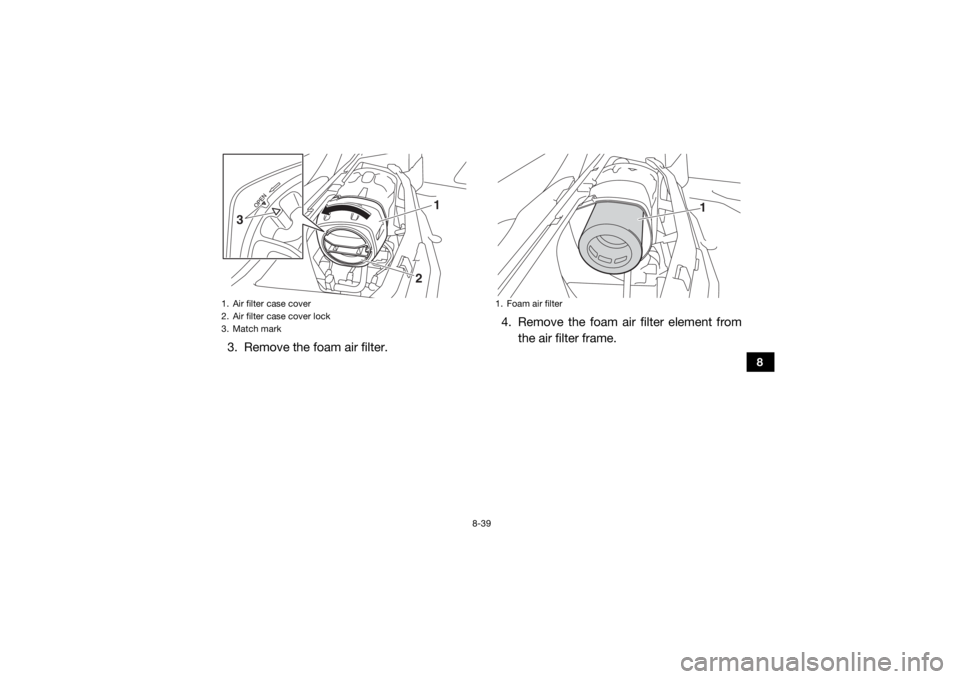
Clean the primary air filter as follows.
1. Remove panel C (page 8-10).
2. Remove the air filter case cover by turn- ing the air filter case cover lock counter-
clockwise.TIPMake sure that the match mark on the cover
lock is aligned with the open match mark on
the air filter case cover.
UB577AE0.book Page 38 Wednesday, June 8, 2016 9:35 AM
Page 175 of 218
8-39
8
3. Remove the foam air filter.4. Remove the foam air filter element from
the air filter frame.1. Air filter case cover
2. Air filter case cover lock
3. Match mark
2 1
3
1. Foam air filter
1
UB577AE0.book Page 39 Wednesday, June 8, 2016 9:35 AM
Page 177 of 218

8-41
8
10. Thoroughly apply Yamalube foam air fil-ter oil (or other quality liquid foam air fil-
ter—do not use a spray-type product) to
the foam material. The foam air filter ele-
ment should be wet but not dripping.
11. Pull the foam air filter element over its frame.
12. Install the air filter.
13. Install the air filter case cover and lock it
into place by turning the air filter case
cover lock clockwise.
TIPMake sure that the match mark on the cover
lock is aligned with the close match mark on
the air filter case cover. 14. Install the panel.EBU35130Cleaning the air filter case check hosesThere is a check hose on each side of the air
filter case. If dust or water collects in a check
hose, empty the hose and clean the air filter
element and air filter case.1. Match mark
1
UB577AE0.book Page 41 Wednesday, June 8, 2016 9:35 AM
Page 183 of 218

8-47
8
Be careful that water or dust does not
enter the brake or YCC-S clutch fluid
reservoir when refilling. Water will signif-
icantly lower the boiling point of the fluid
and may result in vapor lock. NOTICEECB01161Brake fluid may damage painted surfaces
or plastic parts. Always clean up spilled
fluid immediately. As the brake pads wear, it is normal for the
brake fluid level to gradually go down. A low
brake fluid level may indicate worn brake
pads or brake system l eakage; therefore, be
sure to check the brake pads for wear and the
brake system for leakage. A low YCC-S
clutch fluid level may indicate YCC-S clutch
system leakage; therefore, be sure to check
the YCC-S clutch system for leakage. If the
brake or YCC-S clutch fluid level goes down suddenly, have a Yamaha dealer check and
repair the vehicle before any further opera-
tion.
EBU36550Brake and YCC-S clutch fluid replace-
mentComplete fluid replacement should be done
only by trained Yamaha service personnel.
Have a Yamaha dealer replace the following
components during periodic maintenance or
when they are damaged or leaking.
Replace the oil seals every two years.
Replace the brake and YCC-S clutch hoses
every four years.EBU36540YCC-S clutchThis model is equipped with a hydraulic
clutch, therefore, it is necessary to check the
YCC-S clutch fluid level and check the hy-
draulic system for leakage before each drive.
If the YCC-S clutch plates wear out, shifting
becomes rough or clutch slippage will occur,
UB577AE0.book Page 47 Wednesday, June 8, 2016 9:35 AM
Page 185 of 218
8-49
8
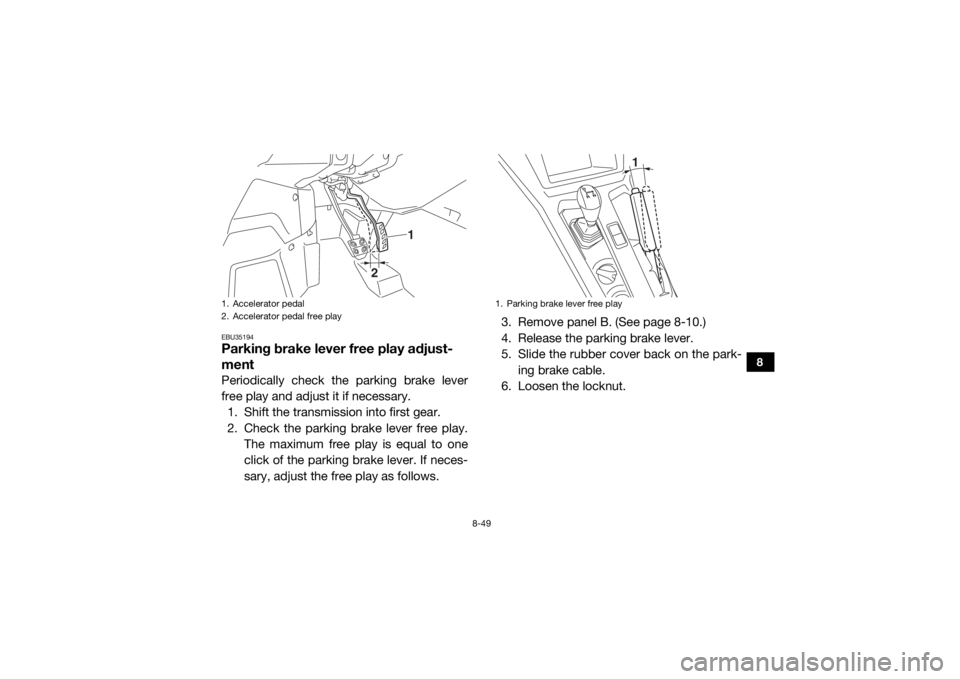
EBU35194Parking brake lever free play adjust-
mentPeriodically check the parking brake lever
free play and adjust it if necessary.1. Shift the transmission into first gear.
2. Check the parking brake lever free play.
The maximum free play is equal to one
click of the parking brake lever. If neces-
sary, adjust the free play as follows. 3. Remove panel B.
(See page 8-10.)
4. Release the parking brake lever.
5. Slide the rubber cover back on the park- ing brake cable.
6. Loosen the locknut.1. Accelerator pedal
2. Accelerator pedal free play
2
1
1. Parking brake lever free play
1
UB577AE0.book Page 49 Wednesday, June 8, 2016 9:35 AM
Page 186 of 218
8-50
8
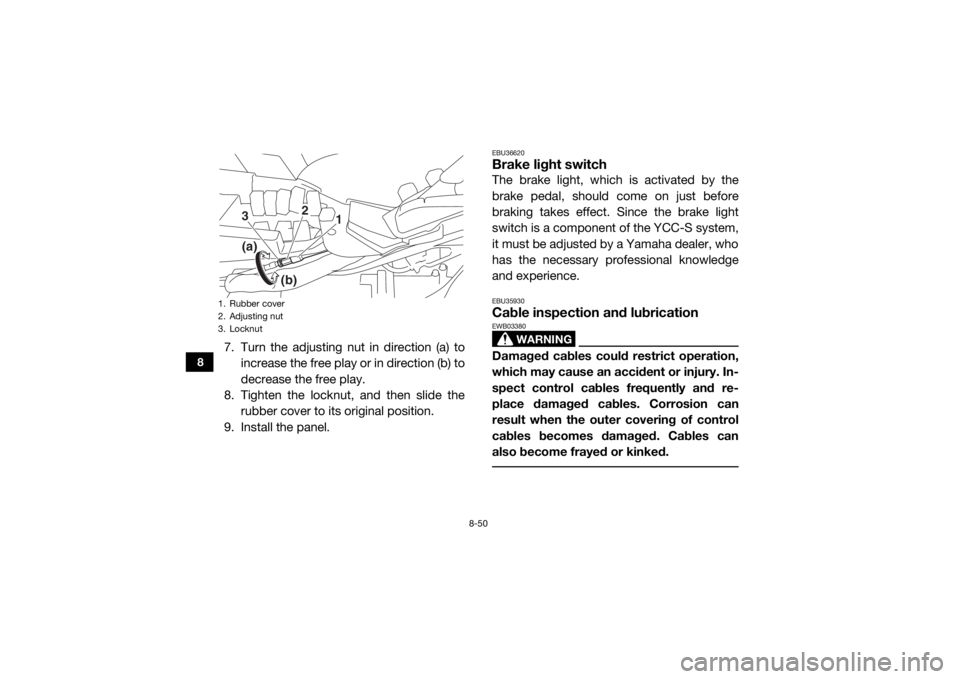
7. Turn the adjusting nut in direction (a) toincrease the free play or in direction (b) to
decrease the free play.
8. Tighten the locknut, and then slide the
rubber cover to its original position.
9. Install the panel.
EBU36620Brake light switchThe brake light, which is activated by the
brake pedal, should come on just before
braking takes effect. Since the brake light
switch is a component of the YCC-S system,
it must be adjusted by a Yamaha dealer, who
has the necessary professional knowledge
and experience.EBU35930Cable inspection and lubrication
WARNING
EWB03380Damaged cables could restrict operation,
which may cause an accident or injury. In-
spect control cables frequently and re-
place damaged cables. Corrosion can
result when the outer covering of control
cables becomes damaged. Cables can
also become frayed or kinked.
1. Rubber cover
2. Adjusting nut
3. Locknut
1
(b)
(a)
3
2
UB577AE0.book Page 50 Wednesday, June 8, 2016 9:35 AM