light YAMAHA YXZ1000R 2018 Owner's Manual
[x] Cancel search | Manufacturer: YAMAHA, Model Year: 2018, Model line: YXZ1000R, Model: YAMAHA YXZ1000R 2018Pages: 224, PDF Size: 5.68 MB
Page 59 of 224

4-21
4
EBU31402On–Command drive knob
“2WD/4WD/DIFF LOCK”Stop the vehicle and move the On–Command
drive knob to change the drive mode to two–
wheel drive, four–wheel drive, or four–wheel
drive with differential lock. Select the appro-
priate drive according to the terrain and driv-
ing conditions.
“2WD” (two–wheel drive): Power is sup-
plied to the rear wheels only.
“4WD” (four–wheel drive): Power is sup-
plied to the front and rear wheels.
1. Interior light switch “ ”
(a)(b)
1
1. On-Command drive knob “2WD/4WD/DIFF LOCK”
1
UB0F7AE0.book Page 21 Monday, November 6, 2017 2:30 PM
Page 61 of 224
4-23
4
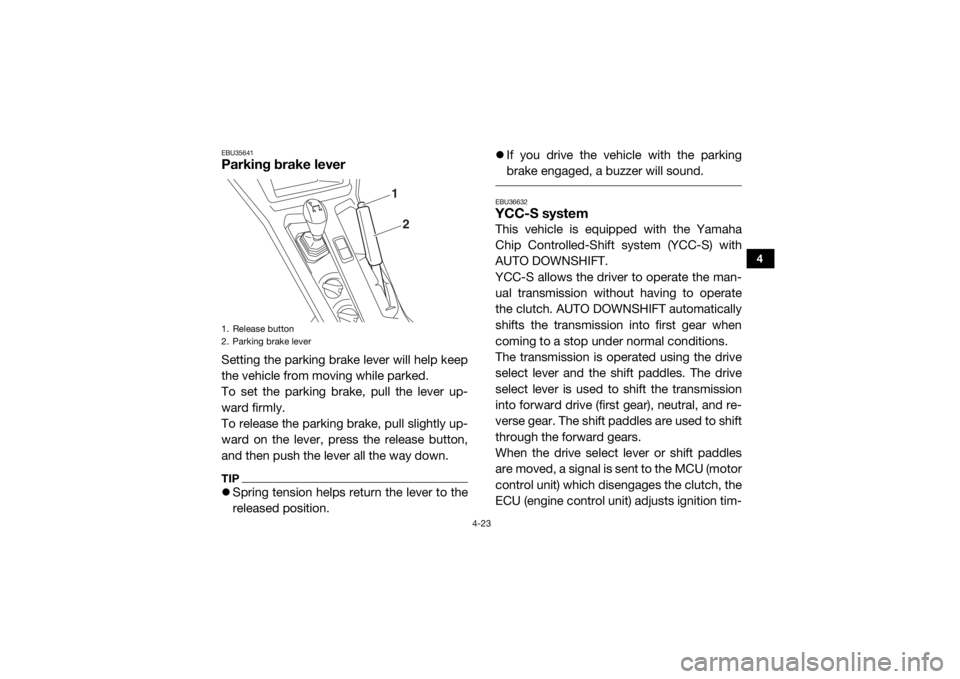
EBU35641Parking brake leverSetting the parking brake lever will help keep
the vehicle from moving while parked.
To set the parking brake, pull the lever up-
ward firmly.
To release the parking brake, pull slightly up-
ward on the lever, press the release button,
and then push the lever all the way down.TIPSpring tension helps return the lever to the
released position.
If you drive the vehicle with the parking
brake engaged, a buzzer will sound.
EBU36632YCC-S systemThis vehicle is equipped with the Yamaha
Chip Controlled-Shift system (YCC-S) with
AUTO DOWNSHIFT.
YCC-S allows the driver to operate the man-
ual transmission without having to operate
the clutch. AUTO DOWNSHIFT automatically
shifts the transmission into first gear when
coming to a stop under normal conditions.
The transmission is operated using the drive
select lever and the shift paddles. The drive
select lever is used to shift the transmission
into forward drive (first gear), neutral, and re-
verse gear. The shift paddles are used to shift
through the forward gears.
When the drive select lever or shift paddles
are moved, a signal is sent to the MCU (motor
control unit) which disengages the clutch, the
ECU (engine control unit) adjusts ignition tim-
1. Release button
2. Parking brake lever
12
UB0F7AE0.book Page 23 Monday, November 6, 2017 2:30 PM
Page 68 of 224
4-30
4
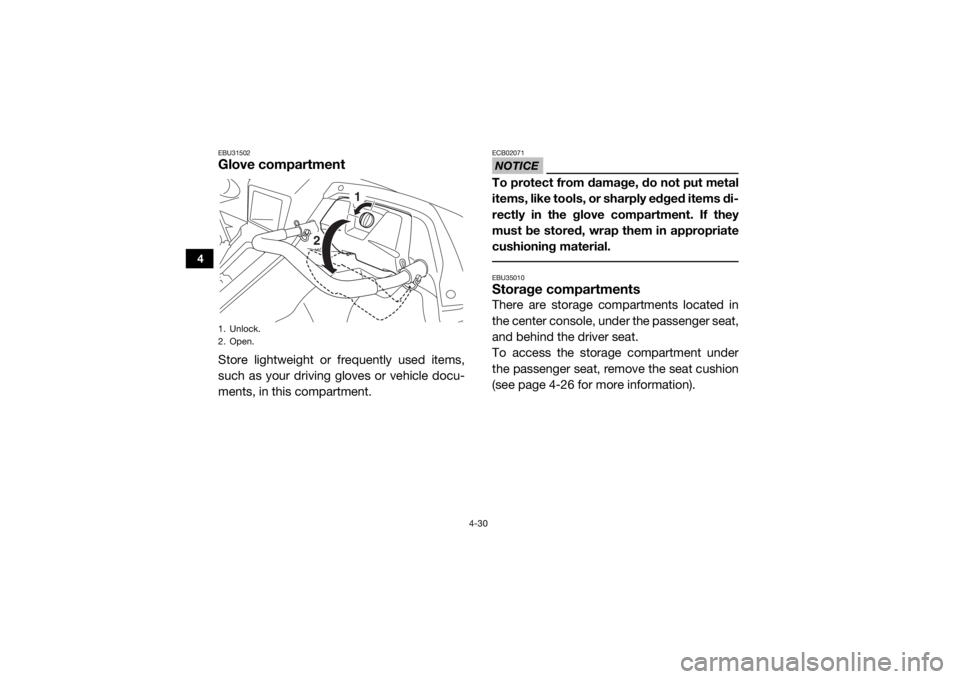
EBU31502Glove compartmentStore lightweight or frequently used items,
such as your driving gloves or vehicle docu-
ments, in this compartment.
NOTICEECB02071To protect from damage, do not put metal
items, like tools, or sharply edged items di-
rectly in the glove compartment. If they
must be stored, wrap them in appropriate
cushioning material. EBU35010Storage compartmentsThere are storage compartments located in
the center console, under the passenger seat,
and behind the driver seat.
To access the storage compartment under
the passenger seat, remove the seat cushion
(see page 4-26 for more information).
1. Unlock.
2. Open.
1
2
UB0F7AE0.book Page 30 Monday, November 6, 2017 2:30 PM
Page 93 of 224

4-55
4
Do not deform or damage the cylinders
in any way. Cylinder damage will result in
poor damping performance.
Do not dispose of a damaged or worn
out shock absorber assembly yourself.
Take the shock absorber assembly to a
Yamaha dealer for any service. EBU35053Auxiliary DC jack
This model has an auxiliary DC jack located at
the left side of the glove compartment. A 12-
V accessory with the proper plug, such as a
radio or smartphone charger, can be used
when the engine is running and the headlights
are off.
1. Start the engine. (See page 6-2.)
2. Turn the headlights off. (See page 4-20.)
3. Open the auxiliary DC jack cap.
4. Turn the accessory off.
5. Insert the accessory power plug.
6. Turn the accessory on.TIP When inserting or removing the accessory
power plug, turn the accessory off.
When the auxiliary DC jack is not being
used, cover it with the cap.
1. Auxiliary DC jack cap
2. Auxiliary DC jack
2
1
Auxiliary DC jack maximum capacity:
10 A (120 W)
UB0F7AE0.book Page 55 Monday, November 6, 2017 2:30 PM
Page 94 of 224

4-56
4
NOTICEECB02250Do not use accessories requiring more
than the stated maximum capacity. Do-
ing so may overload the circuit and cau-
se the fuse to blow.
If accessories are used without the en-
gine running, the battery may discharge.
Do not use an automotive cigarette light-
er or other accessories with a plug that
gets hot, because the jack can be dam-
aged. UB0F7AE0.book Page 56 Monday, November 6, 2017 2:30 PM
Page 96 of 224

5-2
5
Drivetrain• Check front differential, transmission case, and rear final
gear for leakage. 5-6, 5-6, 5-6, 8-27,
8-29, 8-32
Coolant • Check coolant level in reservoir.
• Fill with coolant if necessary. 5-6, 8-34
Accelerator pedal • Check free play and for proper operation. 5-6
Seat belts • Check for proper operation and belt wear. 5-7
Passenger handhold • Check for stability and proper fastening. 5-7, 7-8
Steering • Check for proper operation. 5-7
Drive select lever and
shift paddles • Check for proper operation. 5-7
YCC-S clutch • Check operation.
• Check fluid level in reservoir.
• If necessary, add specified brake fluid to specified level.
• Check hydraulic system for leakage.
5-8
Fittings and fasteners • Check all fittings and fasteners. 5-8
Instruments, lights and
switches • Check for proper operation. 3-3, 4-2, 5-8, 8-65,
8-65
Wheels and tires • Check tire pressure and for wear and damage. 5-8, 8-55, 8-57
Axle boots • Check for damage. 8-36
ITEM ROUTINE PAGEUB0F7AE0.book Page 2 Monday, November 6, 2017 2:30 PM
Page 98 of 224

5-4
5
WARNING
EWB02522Gasoline and gasoline vapors are ex-
tremely flammable. To avoid fires and ex-
plosions and to reduce the risk of injury
when refueling, follow these instructions. 1. Before refueling, turn off the engine andbe sure that no one is sitting in the vehi-
cle.
Never refuel while smoking, or while in
the vicinity of sparks, open flames, or
other sources of ignition such as the pilot
lights of water heaters and clothes dry-
ers.
2. Do not overfill the fuel tank. Because fuel expands when it heats up, heat from the
engine or the sun can cause fuel to spill
out of the fuel tank.
3. Wipe up any spilled fuel immediately.
4. Be sure the fuel tank cap is closed se-
curely.
WARNING
EWB02532Gasoline is poisonous and can cause inju-
ry or death. Handle gasoline with care.
Never siphon gasoline by mouth. If you
should swallow some gasoline or inhale a
lot of gasoline vapor, or get some gasoline
in your eyes, see your doctor immediately.
If gasoline spills on your skin, wash with
soap and water. If gasoline spills on your
clothing, change your clothes. Your Yamaha engine has been designed to
use regular unleaded gasoline with a research
octane number of 91 or higher (95 or higher
for Europe). If knocking or pinging occurs,
use a different brand of gasoline or premium
unleaded gasoline. Unleaded fuel will give
you longer spark plug life and reduced main-
tenance cost.
UB0F7AE0.book Page 4 Monday, November 6, 2017 2:30 PM
Page 102 of 224

5-8
5
EBU36672YCC-S clutchCheck the YCC-S clutch fluid level and cor-
rect if necessary. (See page 8-46.)
Check the operation of the drive select lever
and shift paddles at the start of each drive.TIPIf the YCC-S clutch fluid level was low, be
sure to check the clutch system for leak-
age.
If any leakage is found, or if shifting is not
smooth, have a Yamaha dealer service the
vehicle. EBU35700Fittings and fastenersAlways check the tightness of chassis and
wheel fittings and fasteners before starting
off. Take the vehicle to a Yamaha dealer or re-
fer to the Service Manual for correct tighten-
ing torque.
EBU31840Instruments, lights and switchesCheck that all instruments, lights and switch-
es are working properly. Correct if necessary.EBU31851Control cablesWhen driving in cold weather, always make
sure all control cables work smoothly before
starting off. WARNING! Control cables can
freeze in cold weather and you could be
unable to control the vehicle.
[EWB03280]
EBU35332
TiresCheck tire pressure regularly to make sure it
is at the recommended specifications. Also
check for wear and damage.
Tire pressure
Use the tire pressure gauge to check and ad-
just tire pressures when the tires are cold. Tire
pressures must be equal on both sides.
WARNING! Operation of this vehicle with improper tire pressure may cause severe
UB0F7AE0.book Page 8 Monday, November 6, 2017 2:30 PM
Page 106 of 224

6-2
6
10–20 hours:
Avoid prolonged operation above 6300 r/min.
After break-in:
The vehicle may now be operated normally.EBU36560Starting the engine1. Turn the key to “ ” (on).NOTICEECB03340The coolant temperature warning light,
YCC-S system warning light, and engine
trouble warning light should come on, then
go off.
The EPS warning light should come on,
then go off when the engine is started.
To avoid possible damage, do not operate
the vehicle if a warning light does not work
as described above. 2. Press the brake pedal.
3. Shift the transmission into neutral.
When the transmission is in the neutral
position, the transmission gear display
shows “N” and the neutral indicator
light should come on.
The engine can be started in any gear if
the brake pedal is applied. However, it
is recommended to shift into neutral
before starting the engine.
4. With your foot off the accelerator pedal, start the engine by turning the key to “ ”
(start).
If the engine fails to start, release the key, and
then try starting it again. Wait a few seconds
before the next attempt. Each attempt should
be as short as possible, to preserve battery
energy. NOTICE: Do not crank the engine
more than 5 seconds on each attempt, or
starter damage could occur. Wait at least
5 seconds between each operation of the
electric starter to let it cool.
[ECB02140]
Do not turn the key to the “ ” (start) position
with the engine running; otherwise, damage
to the electric starter may result.
UB0F7AE0.book Page 2 Monday, November 6, 2017 2:30 PM
Page 110 of 224

6-6
6
To drive in reverse
WARNING
EWB03300Before you shift into reverse, make sure
there are no obstacles or people behind
you. When it is safe to proceed, go slowly.
Hitting an obstacle or person could result
in serious injury or death. 1. Stop the vehicle and continue to apply the brake pedal.
2. Check behind you.
3. Shift the transmission into reverse.
TIP To shift into reverse, the engine must be
running and at idle speed.
When in reverse, the transmission gear dis-
play should show “R” and the reverse indi-
cator light should come on.
The reverse buzzer will sound while the
transmission is in reverse. 4. Release the parking brake (if applied).1. Drive select lever
2. Reverse gear
1
2
UB0F7AE0.book Page 6 Monday, November 6, 2017 2:30 PM