warning YAMAHA YXZ1000R 2018 Workshop Manual
[x] Cancel search | Manufacturer: YAMAHA, Model Year: 2018, Model line: YXZ1000R, Model: YAMAHA YXZ1000R 2018Pages: 224, PDF Size: 5.68 MB
Page 190 of 224
8-51
8
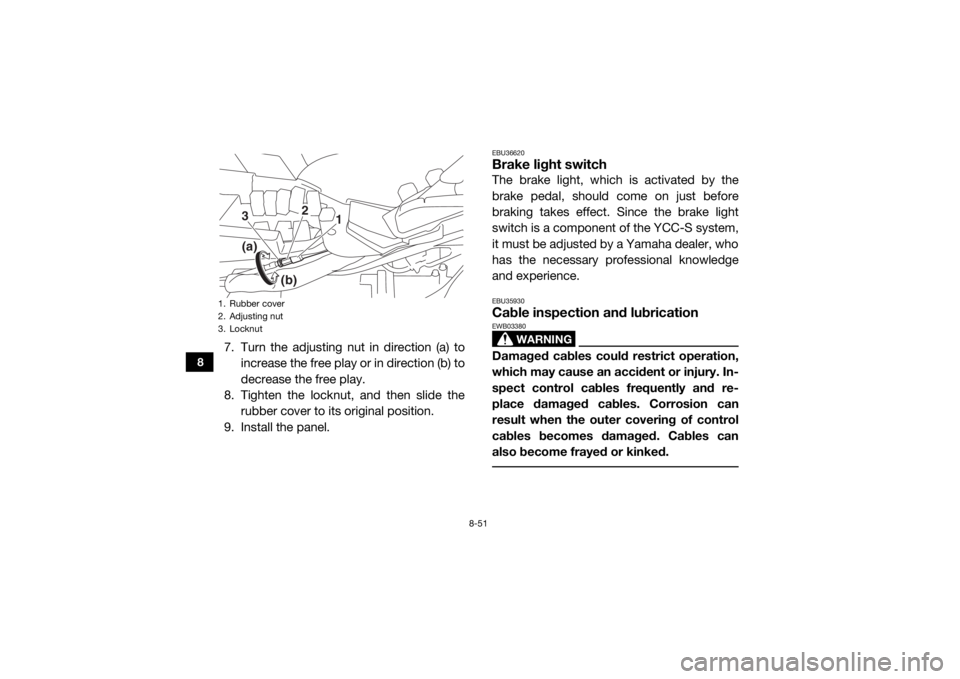
7. Turn the adjusting nut in direction (a) toincrease the free play or in direction (b) to
decrease the free play.
8. Tighten the locknut, and then slide the
rubber cover to its original position.
9. Install the panel.
EBU36620Brake light switchThe brake light, which is activated by the
brake pedal, should come on just before
braking takes effect. Since the brake light
switch is a component of the YCC-S system,
it must be adjusted by a Yamaha dealer, who
has the necessary professional knowledge
and experience.EBU35930Cable inspection and lubrication
WARNING
EWB03380Damaged cables could restrict operation,
which may cause an accident or injury. In-
spect control cables frequently and re-
place damaged cables. Corrosion can
result when the outer covering of control
cables becomes damaged. Cables can
also become frayed or kinked.
1. Rubber cover
2. Adjusting nut
3. Locknut
1
(b)
(a)
3
2
UB0F7AE0.book Page 51 Monday, November 6, 2017 2:30 PM
Page 195 of 224

8-56
8
Tighten the bead lock bolts to the specified
torque in a crisscross pattern.EBU32620Tire replacementAlways use the same size and type of tires
recommended in this owner’s manual. The
tires that came with your Yamaha YXZ1000Rwere designed to match the performance ca-
pabilities and to provide the best combination
of handling, braking, and comfort. It is best to
replace all four tires at the same time. If that is
not possible, you must replace the tires in
pairs (front or rear) with tires of the same size
and type as the origin
als. Never replace just
one tire.
WARNING
EWB03390Installing improper tires on your Yamaha
YXZ1000R can affect handling and stabili-
ty. This can cause a loss of control. The tires listed below have been approved by
Yamaha Motor Manufacturing Corporation of America for this model.
1. Bead lock
2. BoltTightening torque: Bead lock bolts:17 N·m (1.7 kgf·m, 13 lb·ft)1
2
22 2
UB0F7AE0.book Page 56 Monday, November 6, 2017 2:30 PM
Page 196 of 224

8-57
8
EBU33090Wheel installation1. Install the wheel and the nuts.
2. Lower the vehicle so that the wheel is onthe ground.
3. Tighten the wheel nuts in a crisscross pattern to the specified torque.
WARNING
EWB03400Do not reverse the rims on your Yamaha
YXZ1000R to widen the track width. In-
stalling wheels improperly increases the
risk of wheel failure and accidents. EBU35232BatteryThis model is equipped with a 12–volt VRLA
(valve–regulated lead–acid) battery. There is
no need to check the electrolyte or to add dis-
tilled water. However, the battery lead con-
nections need to be checked and tightened,
and the battery terminals cleaned if corroded.
If the battery seems to have discharged, re-
charge it as soon as possible.
Front tire:Size:27 x 9.00R-14NHS
Manufacturer/model: MAXXIS/MU09 (YXZ10YEXJ)
MAXXIS/MU9Y (YXZ10YESJ)
Rear tire: Size:27 x 11.00R-14NHS
Manufacturer/model: MAXXIS/MU10 (YXZ10YEXJ)
MAXXIS/MU9Y (YXZ10YESJ)
Tightening torques:Front wheel nut:75 N·m (7.5 kgf·m, 55 lb·ft)
Rear wheel nut: 75 N·m (7.5 kgf·m, 55 lb·ft)
UB0F7AE0.book Page 57 Monday, November 6, 2017 2:30 PM
Page 197 of 224

8-58
8
WARNING
EWB03410Avoid battery contact with skin, eyes, or
clothing. Shield eyes when working near
batteries. Keep out of reach of children.
You could be poisoned or severely burned
by the sulfuric acid in battery electrolyte. In
case of accidental contact with battery
electrolyte:
EXTERNAL: Flush with water.
INTERNAL: Drink large quantities of water
or milk. Follow with milk of magnesia,
beaten egg, or vegetable oil. Get prompt
medical attention.
EYES: Flush with water for 15 minutes and
get prompt medical attention.
WARNING
EWB03420Batteries may produce explosive gases.
Ventilate when charging or using in a
closed space. Keep batteries away from
sparks, flames, cigarettes, or other sourc-
es of ignition. To remove the battery1. Turn the key to “ ” (off).
2. Remove panel A. (See page 8-11.)
3. Remove the battery holding plate by re- moving the bolts.
UB0F7AE0.book Page 58 Monday, November 6, 2017 2:30 PM
Page 200 of 224

8-61
8
3. Install the battery holding plate by install-ing the bolts.
4. Install the panel.TIP Make sure the battery leads are installed as
shown.
Fully charge the battery before installing it.
EBU35244Jump-startingJump-starting the vehicle should be avoided.
The battery should be removed and charged
instead.
WARNING
EWB03430To avoid battery explosion and/or serious
damage to the electrical system:
Do not connect the negative lead of the
jumper cable to the negative terminal of
the battery.
Do not touch the positive lead of the
jumper cable to the negative lead.
Do not reverse the polarity of the jumper
cables when connecting to the batteries. However, if the vehicle must be jump-started,
proceed as follows.
1. Turn the key to “ ” (off).
2. Remove panel A. (See page 8-11.)
3. Remove the passenger seat cushion. (See page 4-26.)
1. Positive battery lead (red)
2. Negative battery lead (black)
3. Battery
1
2
3
UB0F7AE0.book Page 61 Monday, November 6, 2017 2:30 PM
Page 203 of 224
8-64
8
NOTICEECB00641To prevent accidental short-circuiting,
turn off the main switch when checking or
replacing a fuse. 2. Remove panel A. (See page 8-11.)
3. Remove the blown fuse, and then install anew fuse of the specified amperage.
WARNING! Always use a fuse of the specified amperage. Never use any
material in place of the proper fuse.
Using an improper fuse can cause
damage to the electrical system and
may lead to a fire.
[EWB03440]
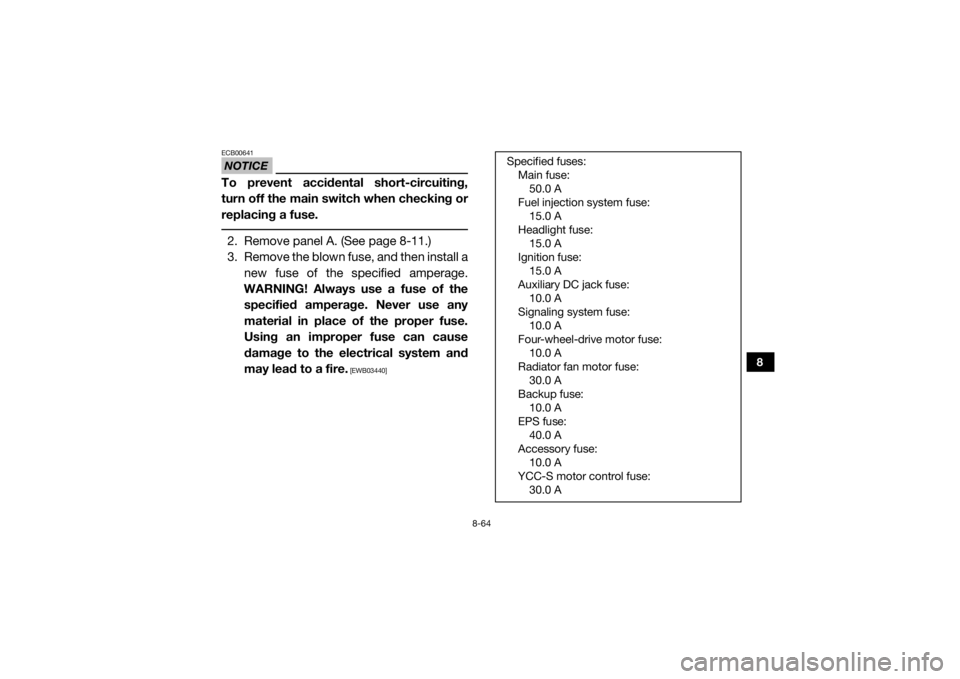
Specified fuses: Main fuse:50.0 A
Fuel injection system fuse: 15.0 A
Headlight fuse: 15.0 A
Ignition fuse: 15.0 A
Auxiliary DC jack fuse: 10.0 A
Signaling system fuse: 10.0 A
Four-wheel-drive motor fuse: 10.0 A
Radiator fan motor fuse: 30.0 A
Backup fuse: 10.0 A
EPS fuse: 40.0 A
Accessory fuse: 10.0 A
YCC-S motor control fuse: 30.0 A
UB0F7AE0.book Page 64 Monday, November 6, 2017 2:30 PM
Page 206 of 224

8-67
8
they are often inferior. Consequently, they
have a shorter service life and can lead to ex-
pensive repair bills.
WARNING
EWB03450When checking the fuel system, do not
smoke and make sure there are no open
flames or sparks in the area, including pilot
lights from water heaters or furnaces.
Gasoline or gasoline vapors can ignite or
explode, causing severe injury or property
damage. UB0F7AE0.book Page 67 Monday, November 6, 2017 2:30 PM
Page 208 of 224

8-69
8
Engine overheating
Wait for the engine to cool before removing the radiator cap. WARNING! If the engine is not
cool when removing the radiator cap, hot fluid and steam could blow out under pressure
and burn you.
[EWB03460]
Place a thick rag over the cap and remove the cap slowly to allow any re-
maining pressure to escape.
TIP Tap water can be used in an emergency. Ch ange to the recommended coolant as soon as
possible.
The engine will tend to overheat if the radiator is caked with mud, or if air was not properly bled
from the cooling system. Wait until the
engine has cooled.
Check the coolant le vel in the
coolant reservoir and/or radiator.
Level is OK.Level is low, check the
cooling system for leakage.
No
leakage.Leakage.
Ask a Yamaha dealer to inspect
and repair the cooling system.Add coolant. (See TIP.)
Restart the engine. If the engine o verheats again, ask a
Yamaha dealer to inspect and/or repair the cooling system.
UB0F7AE0.book Page 69 Monday, November 6, 2017 2:30 PM
Page 209 of 224

9-1
9
EBU32720
CLEANING AND STORAGE
EBU35920CleaningFrequent, thorough cleaning of your vehicle
will not only enhance its appearance but will
improve its general performance and extend
the useful life of many components.1. Before cleaning the vehicle: a. Block off the end of the exhaust pipeto prevent water entry. A plastic bag
and strong rubber band may be used.
b. Make sure the spark plugs and all filler caps are properly installed.
2. If the engine case is excessively greasy, apply degreaser with a paint brush. Do
not apply degreaser to the wheel axles.
3. Rinse the dirt and degreaser off with a garden hose. Use only enough pressure
to do the job. WARNING! Test the
brakes after washing. Apply the
brakes several times at slow speeds to
let friction dry the brakes. Wet brakes may have reduced stopping ability, in-
creasing the chance of an accident.
[EWB03471]
NOTICE: Excessive water pres-
sure may cause water seepage and
deterioration of wheel bearings,
brakes, transmission seals and electri-
cal devices. Many expensive repair
bills have resulted from improper high-
pressure detergent applications such
as those available in coin-operated car
washers.
[ECB00712]
4. Once the majority of the dirt has been hosed off, wash all surfaces with warm
water and mild, detergent-type soap. An
old toothbrush or bottle brush is handy
for hard-to-get-at places.
5. Rinse the vehicle off immediately with
clean water and dry all surfaces with a
clean chamois towel or soft, absorbent
cloth.
6. Clean the seats with a vinyl upholstery cleaner to keep the covers pliable and
glossy.
UB0F7AE0.book Page 1 Monday, November 6, 2017 2:30 PM
Page 216 of 224

10-5
10
Spring/shock absorber type:Coil spring/gas-oil damper
Wheel travel: 432 mm (17.0 in)Electrical system:Ignition system:TCI
Charging system: AC magnetoBattery:Model:U1-H11L
Voltage, capacity: 12 V, 28.0 AhBulb voltage, wattage × quantity:Headlight:
LED
Interior light: LED (for equipped models)
Tail/brake light:
LED
Neutral indicator light: LED
High beam indicator light: LED
Reverse indicator light:
LED
Coolant temperature warning light: LED
Engine trouble warning light: LED Parking brake indicator light:
LED
Differential gear lock indicator light: LED
EPS warning light:
LED
Helmet/Seat belt indicator light: 14 V, 0.85 W × 2
Shift timing indicator light: LED
Half clutch indicator light:
LED
Launch system indicator light: LED
YCC-S system warning light: LED
Fuses:Main fuse:50.0 A
Fuel injection system fuse: 15.0 A
EPS fuse:
40.0 A
Headlight fuse: 15.0 A
Signaling system fuse: 10.0 A
Ignition fuse:
15.0 A
Auxiliary DC jack fuse: 10.0 A
UB0F7AE0.book Page 5 Monday, November 6, 2017 2:30 PM