transmission YAMAHA YXZ1000R SS 2020 User Guide
[x] Cancel search | Manufacturer: YAMAHA, Model Year: 2020, Model line: YXZ1000R SS, Model: YAMAHA YXZ1000R SS 2020Pages: 212, PDF Size: 9.36 MB
Page 94 of 212

7-2
7
10–20 hours:
Avoid prolonged operation above 6300 r/min.
After break-in:
The vehicle may now be operated normally.EBU36560Starting the engine1. Turn the key to “ ” (on).NOTICEECB03340The coolant temperature warning light,
YCC-S system warning light, and engine
trouble warning light should come on, then
go off.
The EPS warning light should come on,
then go off when the engine is started.
To avoid possible damage, do not operate
the vehicle if a warning light does not work
as described above. 2. Press the brake pedal.
3. Shift the transmission into neutral.
When the transmission is in the neutral
position, the transmission gear display
shows “N” and the neutral indicator
light should come on.
The engine can be started in any gear if
the brake pedal is applied. However, it
is recommended to shift into neutral
before starting the engine.
4. With your foot off the accelerator pedal, start the engine by turning the key to “ ”
(start).
If the engine fails to start, release the key, and
then try starting it again. Wait a few seconds
before the next attempt. Each attempt should
be as short as possible, to preserve battery
energy. NOTICE: Do not crank the engine
more than 5 seconds on each attempt, or
starter damage could occur. Wait at least
5 seconds between each operation of the
electric starter to let it cool.
[ECB02140]
Do not turn the key to the “ ” (start) position
with the engine running; otherwise, damage
to the electric starter may result.
UBAS7AE0.book Page 2 Wednesday, June 19, 2019 11:51 AM
Page 95 of 212

7-3
7
TIPFor maximum engine life, never accelerate
hard when the engine is cold! EBU36723Shifting and reverse drivingThis vehicle is equipped with a 5-speed for-
ward and 1-speed reverse manual transmis-
sion with YCC-S (see page 5-23). The
transmission allows you to control the
amount of power you have available at a giv-
en speed for starting off, accelerating, climb-
ing hills, engine braking, etc.
Shift gears using the drive select lever and the
shift paddles; clutch operation is automatic.
Use the drive select lever to shift the trans-
mission into forward drive (first gear), neutral,
and reverse gear as shown. Use the shift pad-
dles to shift through the forward gears as
shown.
1. Drive select lever
2. Neutral position
1. Shift paddle “ ”
2. Shift paddle “ ”
1
2
2
1
1
2
3
4
5
5
4
3
2
1
UBAS7AE0.book Page 3 Wednesday, June 19, 2019 11:51 AM
Page 96 of 212
![YAMAHA YXZ1000R SS 2020 User Guide 7-4
7
TIPTo use the drive select lever, you must be
pressing the brake pedal and be stopped
(be traveling less than 5 km/h [3 mph]), and
the engine should be at idle speed.
You can shift betwee](/img/51/53897/w960_53897-95.png "YAMAHA YXZ1000R SS 2020 User Guide 7-4
7
TIPTo use the drive select lever, you must be
pressing the brake pedal and be stopped
(be traveling less than 5 km/h [3 mph]), and
the engine should be at idle speed.
You can shift betwee")
7-4
7
TIPTo use the drive select lever, you must be
pressing the brake pedal and be stopped
(be traveling less than 5 km/h [3 mph]), and
the engine should be at idle speed.
You can shift between forward (first gear)
and reverse gear directly - it is not neces-
sary to shift into neutral.
When using the shift paddles, YCC-S may
not complete the upshift if engine or vehicle
speed is too low, nor complete the down-
shift if engine or vehicle speed is too high.
When AUTO DOWNSHIFT is downshifting
gears, do not operate the shift paddles or
accelerator pedal.
During an emergency stop or sudden brak-
ing, AUTO DOWNSHIFT will not downshift
the transmission to first gear. Use the shift
paddle “ ” to downshift, and then apply
the accelerator pedal to resume normal op-
eration.
NOTICEECB03370Even with the transmission in the neutral
position, do not coast for long periods of
time with the engine off. The transmission
is properly lubricated only when the engine
is running. Inadequate lubrication may
damage the transmission. To start out and accelerate
1. Take your foot off the accelerator pedal
and apply the brake pedal. NOTICE: Al-
ways take your foot off the accelerator
pedal before operating the drive select
lever, otherwise damage to the engine
and drivetrain may result.
[ECB03360]
2. Release the parking brake (if applied).
3. Shift into first gear using the drive select lever (the transmission gear display
should show “1”).
4. Release the brake pedal and press the accelerator pedal gradually.
UBAS7AE0.book Page 4 Wednesday, June 19, 2019 11:51 AM
Page 98 of 212

7-6
7
To drive in reverse
WARNING
EWB03300Before you shift into reverse, make sure
there are no obstacles or people behind
you. When it is safe to proceed, go slowly.
Hitting an obstacle or person could result
in serious injury or death. 1. Stop the vehicle and continue to apply the brake pedal.
2. Check behind you.
3. Shift the transmission into reverse.
TIP To shift into reverse, the engine must be
running and at idle speed.
When in reverse, the transmission gear dis-
play should show “R” and the reverse indi-
cator light should come on.
The reverse buzzer will sound while the
transmission is in reverse. 4. Release the parking brake (if applied).1. Drive select lever
2. Reverse gear
1
2
UBAS7AE0.book Page 6 Wednesday, June 19, 2019 11:51 AM
Page 99 of 212

7-7
7
5. Check behind you, then release the brake
pedal and press the accelerator pedal
gradually.
6. Continue to watch to the rear while driv-
ing in reverse.EBU37790Dynamic clutch engagementWhen driving up a steep hill or over rocky ter-
rain at very slow speed in 1st gear, or when
stuck in a rut and extra “oomph” is needed to
climb up and over the obstacle, use this fea-
ture as follows.
1. With the transmission in 1st gear, fully de- press the accelerator pedal.
2. After a few moments, YCC-S will fully en-
gage the clutch thereby transmitting full
power to the drive wheels.
3. Release the accelerator pedal as needed
and resume normal driving.TIPCorrect accelerator pedal free play is nec-
essary for proper operation.
Dynamic clutch engagement works in 1st
gear only.
Time to engagement will vary depending on
conditions.
NOTICEECB03740Do not use repeatedly in a short period of
time. Otherwise, the clutch system may be
damaged. EBU36733Launch system operationThe launch system allows you to start off at a
higher engine speed, and thus have a higher
initial acceleration rate than normal operation.
Only use the launch system on level ground
with a clear and safe path ahead of you.TIPThe launch system will be prevented from op-
erating if any of the following conditions are
present:
UBAS7AE0.book Page 7 Wednesday, June 19, 2019 11:51 AM
Page 100 of 212
7-8
7
the engine is not warmed up or is overheat-
ing.
the driver seat belt is not latched.
the differential gear is locked (“DIFF LOCK”
is selected) or the differential gear lock indi-
cator is flashing.
the parking brake is applied.
an engine or system malfunction is detect-
ed (a warning light is on). To activate the launch system1. Confirm that the front wheels and steer-
ing wheel are pointed straight ahead.
2. Shift the transmission into first gear.
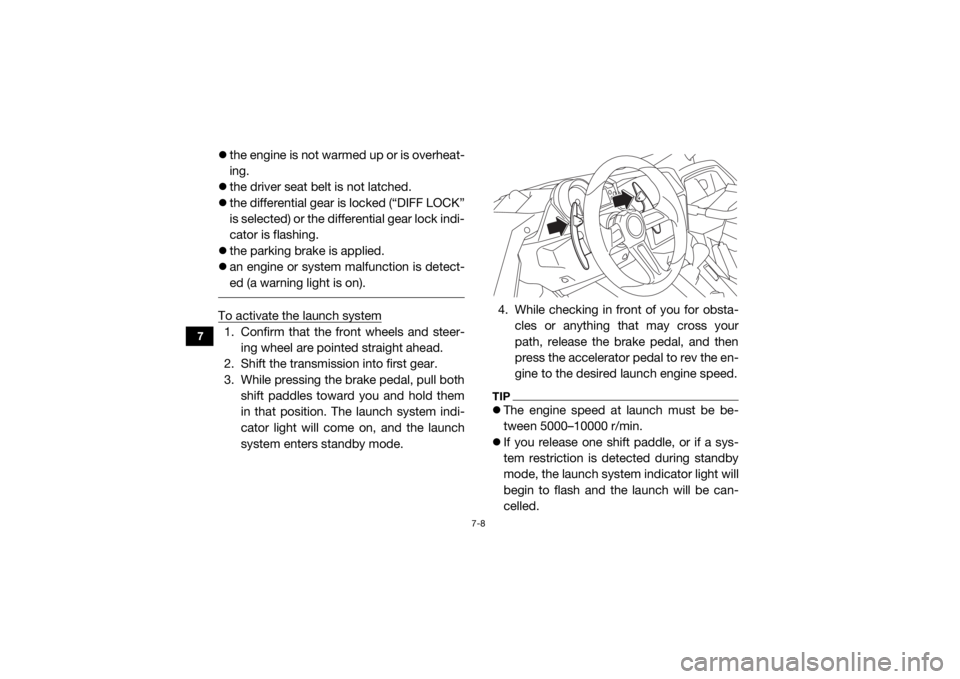
3. While pressing the brake pedal, pull both
shift paddles toward you and hold them
in that position. The launch system indi-
cator light will come on, and the launch
system enters standby mode. 4. While checking in front of you for obsta-
cles or anything that may cross your
path, release the brake pedal, and then
press the accelerator pedal to rev the en-
gine to the desired launch engine speed.
TIPThe engine speed at launch must be be-
tween 5000–10000 r/min.
If you release one shift paddle, or if a sys-
tem restriction is detected during standby
mode, the launch system indicator light will
begin to flash and the launch will be can-
celled.
UBAS7AE0.book Page 8 Wednesday, June 19, 2019 11:51 AM
Page 120 of 212

8-15
8
Braking
When slowing down or stopping, take your
foot off the accelerator pedal and press the
brake pedal smoothly. Abrupt or improper
use of the brakes can cause the tires to lose
traction, reducing control of the vehicle and
increasing the possibility of an accident.
Braking ability is affected by type of terrain. In
most cases, gradual application of the brakes
is more effective than abrupt braking, partic-
ularly on loose surfaces, such as gravel. Al-
ways allow for greater braking distance on
rough, loose, or slippery surfaces.
Engine compression braking will also help
slow the vehicle down. With the transmission
still in gear, take your foot off the accelerator
and allow the drivetrain and engine to absorb
vehicle speed. Downshift as necessary. Ap-
plication of the brakes provides additional
stopping power. Leaving the vehicle
Do not get out of the vehicle while the engine
is running. Take the key with when you leave
the vehicle. There is a serious risk of injury or
death because:
Children or other unauthorized persons
may attempt to operate the vehicle.
Objects tossed into the vehicle may strike
the shift lever and accidently engage the
transmission.
The parking brake may not keep the vehicle
from moving.
Parking on a flat area
Even when parking on a seemingly flat area, it
is good practice to leave the transmission in
gear to prevent the vehicle from rolling.
Therefore, shift into first or reverse gear, stop
the engine and always apply the parking
brake.UBAS7AE0.book Page 15 Wednesday, June 19, 2019 11:51 AM
Page 121 of 212

8-16
8
Parking on a slope
The parking brake is located on the rear drive
shaft. When the drivetrain is in “2WD” mode,
only the rear wheels will be locked. Therefore,
switch the drive mode to “DIFF LOCK” before
stopping the engine to lock all four wheels
when parking. In addition to the parking
brake, leave the transmission in gear to help
prevent the vehicle from rolling.
If you park on a hill that is too steep, the vehi-
cle may roll out of control. Never park on hills
that are so steep you cannot walk up them
easily. If you must park on an incline, follow
these instructions:1. First, bring the vehicle to a stop and con- tinue to apply the brake pedal.
2. Switch the drive mode to “DIFF LOCK”
and shift into first gear when parking up-
hill, or reverse gear when parking down-
hill.
TIPYou may need to turn the steering wheel left
and right to help the differential lock into pla-
ce. 3. Stop the engine (turn the key to “ ”[off]).
4. With the brake pedal still being applied, set the parking brake.
5. Finally, get out of the vehicle and block
the front and rear wheels with rocks or
other objects.
Loading
Be aware that vehicle load includes the total
combined weight of the operator, passenger,
any installed accessories, and any luggage or
cargo brought on board or stored in the cargo
bed. Make sure that the gross vehicle weight
(vehicle load plus weight of the vehicle itself)
never exceeds 1065 kg (2348 lb).
UBAS7AE0.book Page 16 Wednesday, June 19, 2019 11:51 AM
Page 123 of 212

8-18
8
sense and remember that some hills are too
steep for you to climb or descend. Use proper
driving techniques to avoid rearward, for-
ward, or sideways rollovers on hills and
slopes.
Drive straight up and down inclines, not
across them. If crossing a hill is unavoidable,
drive slowly. Turn downhill immediately if you
feel the vehicle may tip.
If you think or feel the vehicle may tip or
roll:
Brace yourself by pressing your feet firmly
on the floorboard and keep a firm grip on
the steering wheel or passenger handhold.
Do not put your hands or feet outside of the
vehicle for any reason.
Uphill
Do not attempt to climb hills until you have
mastered basic maneuv ers on flat ground.
Drive straight up hills, and avoid crossing the
side of a hill, which increases your risk of roll- over. Practice first on gentle slopes before at-
tempting steeper hills. Always check the
terrain carefully before attempting any hill.
To climb a hill, you need traction, momentum,
and steady throttle. For more traction and
control for climbing steeper and/or rougher
slopes, shift into low gear and select “4WD”
or “DIFF LOCK”. Travel fast enough to main-
tain momentum, but not so fast that you can-
not react to changes in the terrain as you
climb.
Slow down when you reach the crest of the
hill if you cannot see clearly what is on the
other side – there could be another person, an
obstacle, or a sharp drop-off.
If you start to lose traction or momentum
when climbing, and decide you will be unable
to continue, use the brakes to stop. Do not at-
tempt to turn the vehicle around. With your
foot on the brake pedal, look behind you and
plan your descent. Shift the transmission into
reverse so you can use engine braking to
slow your descent. Release the brake, andUBAS7AE0.book Page 18 Wednesday, June 19, 2019 11:51 AM
Page 133 of 212

9-6
9
EBU35802General maintenance and lubrication chartNO. ITEMROUTINE INITIAL
EVERY
Whichev- er comes first month 1 3 6 6 12
km
(mi) 240
(150) 1300
(800) 2500
(1600) 2500
(1600) 5000
(3200)
hours 20 80 160 160 320
1 *Cooling system • Check coolant leakage.
• Repair if necessary.
√√√√√
• Change coolant. Every 2 years
2 Primary air filter
(foam)
•Clean.
• Replace if necessary. Every 300–600 km (200–400 mi)
(more often in wet or dusty condi-
tions)
* Secondary air fil-
ter (paper)
• Replace. Every 2000–5000 km (1200–3000
mi)
(more often in wet or dusty condi-
tions)
3Engine oil • Change (warm engine before draining). √√√√
4 Engine oil filter
cartridge • Replace.
√√√
5 Transmission oil • Check oil level and for leakage.
√√√√√
• Change. √√√√
6 Final gear oil • Check oil level.
√√√√√
• Change. √√
UBAS7AE0.book Page 6 Wednesday, June 19, 2019 11:51 AM