ABS YAMAHA YZ125LC 2011 User Guide
[x] Cancel search | Manufacturer: YAMAHA, Model Year: 2011, Model line: YZ125LC, Model: YAMAHA YZ125LC 2011Pages: 166, PDF Size: 8.49 MB
Page 56 of 166
3-15
CHASSIS
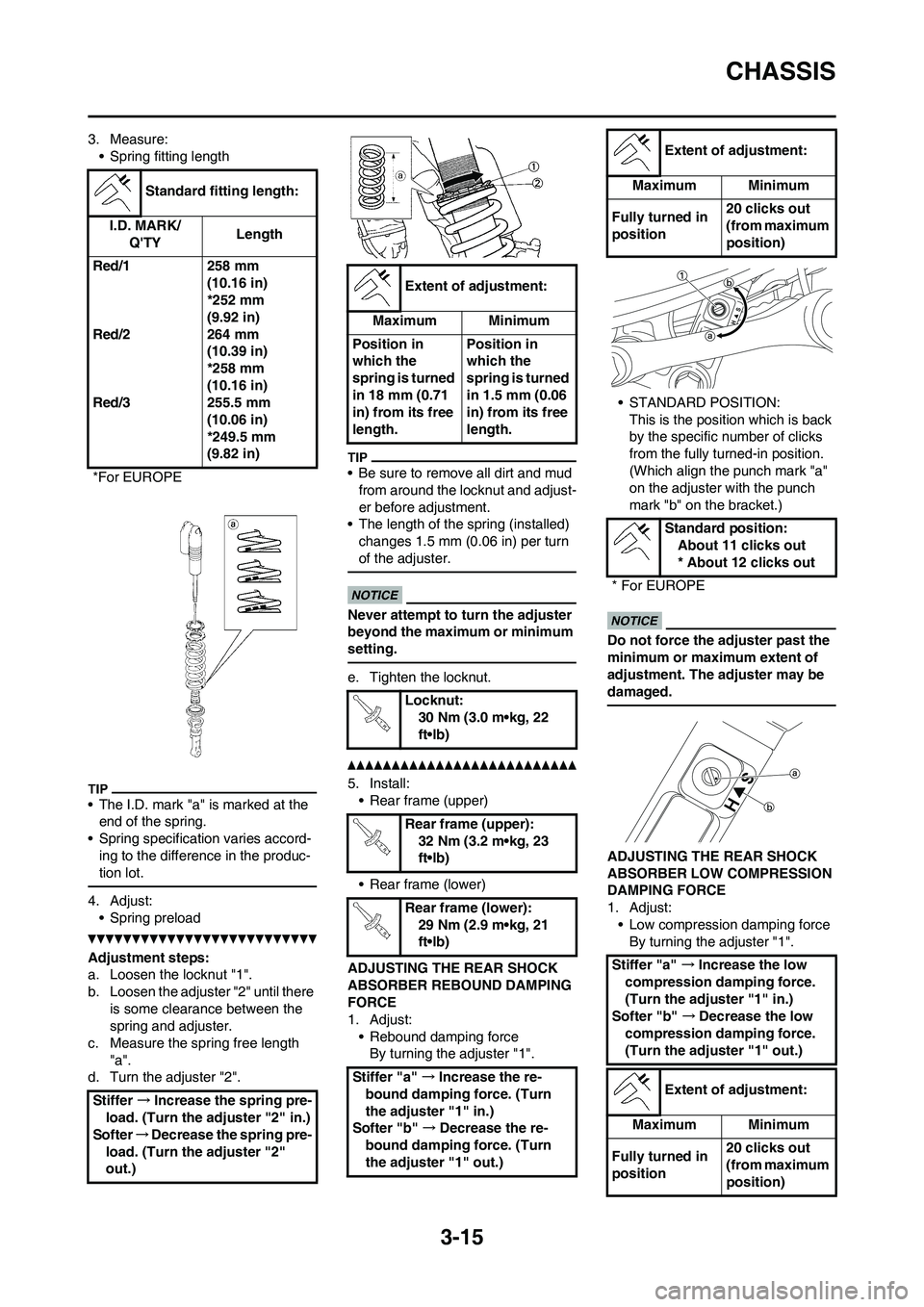
3. Measure:
• Spring fitting length
• The I.D. mark "a" is marked at the
end of the spring.
• Spring specification varies accord-
ing to the difference in the produc-
tion lot.
4. Adjust:
• Spring preload
Adjustment steps:
a. Loosen the locknut "1".
b. Loosen the adjuster "2" until there
is some clearance between the
spring and adjuster.
c. Measure the spring free length
"a".
d. Turn the adjuster "2".
• Be sure to remove all dirt and mud
from around the locknut and adjust-
er before adjustment.
• The length of the spring (installed)
changes 1.5 mm (0.06 in) per turn
of the adjuster.
Never attempt to turn the adjuster
beyond the maximum or minimum
setting.
e. Tighten the locknut.
5. Install:
• Rear frame (upper)
• Rear frame (lower)
ADJUSTING THE REAR SHOCK
ABSORBER REBOUND DAMPING
FORCE
1. Adjust:
• Rebound damping force
By turning the adjuster "1".• STANDARD POSITION:
This is the position which is back
by the specific number of clicks
from the fully turned-in position.
(Which align the punch mark "a"
on the adjuster with the punch
mark "b" on the bracket.)
Do not force the adjuster past the
minimum or maximum extent of
adjustment. The adjuster may be
damaged.
ADJUSTING THE REAR SHOCK
ABSORBER LOW COMPRESSION
DAMPING FORCE
1. Adjust:
• Low compression damping force
By turning the adjuster "1". Standard fitting length:
I.D. MARK/
Q'TYLength
Red/1
Red/2
Red/3258 mm
(10.16 in)
*252 mm
(9.92 in)
264 mm
(10.39 in)
*258 mm
(10.16 in)
255.5 mm
(10.06 in)
*249.5 mm
(9.82 in)
*For EUROPE
Stiffer →Increase the spring pre-
load. (Turn the adjuster "2" in.)
Softer→Decrease the spring pre-
load. (Turn the adjuster "2"
out.)
Extent of adjustment:
Maximum Minimum
Position in
which the
spring is turned
in 18 mm (0.71
in) from its free
length.Position in
which the
spring is turned
in 1.5 mm (0.06
in) from its free
length.
Locknut:
30 Nm (3.0 m•kg, 22
ft•lb)
Rear frame (upper):
32 Nm (3.2 m•kg, 23
ft•lb)
Rear frame (lower):
29 Nm (2.9 m•kg, 21
ft•lb)
Stiffer "a" →Increase the re-
bound damping force. (Turn
the adjuster "1" in.)
Softer "b" →Decrease the re-
bound damping force. (Turn
the adjuster "1" out.)
Extent of adjustment:
Maximum Minimum
Fully turned in
position20 clicks out
(from maximum
position)
Standard position:
About 11 clicks out
* About 12 clicks out
* For EUROPE
Stiffer "a" →Increase the low
compression damping force.
(Turn the adjuster "1" in.)
Softer "b" →Decrease the low
compression damping force.
(Turn the adjuster "1" out.)
Extent of adjustment:
Maximum Minimum
Fully turned in
position20 clicks out
(from maximum
position)
Page 57 of 166
3-16
CHASSIS
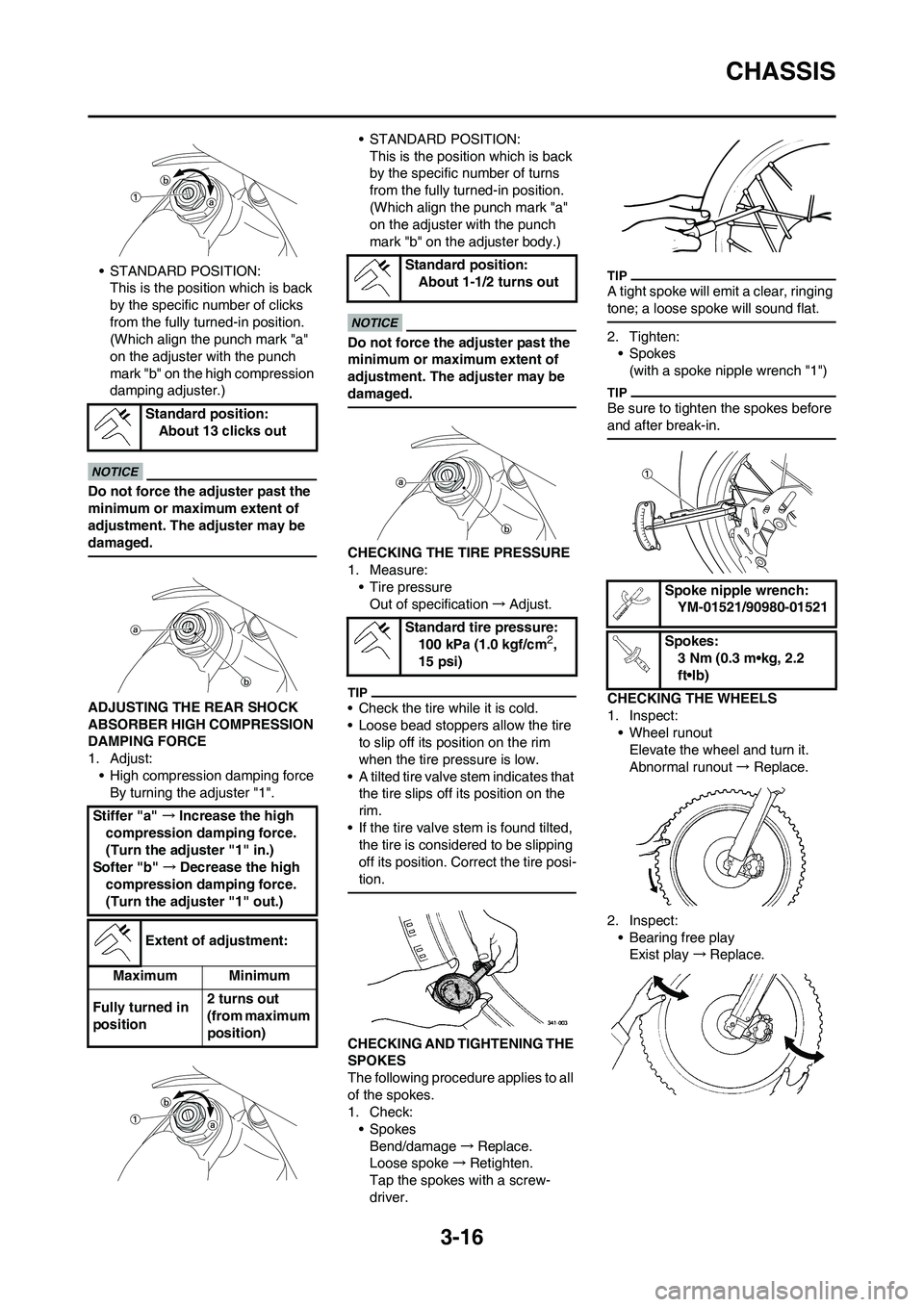
• STANDARD POSITION:
This is the position which is back
by the specific number of clicks
from the fully turned-in position.
(Which align the punch mark "a"
on the adjuster with the punch
mark "b" on the high compression
damping adjuster.)
Do not force the adjuster past the
minimum or maximum extent of
adjustment. The adjuster may be
damaged.
ADJUSTING THE REAR SHOCK
ABSORBER HIGH COMPRESSION
DAMPING FORCE
1. Adjust:
• High compression damping force
By turning the adjuster "1".• STANDARD POSITION:
This is the position which is back
by the specific number of turns
from the fully turned-in position.
(Which align the punch mark "a"
on the adjuster with the punch
mark "b" on the adjuster body.)
Do not force the adjuster past the
minimum or maximum extent of
adjustment. The adjuster may be
damaged.
CHECKING THE TIRE PRESSURE
1. Measure:
• Tire pressure
Out of specification→Adjust.
• Check the tire while it is cold.
• Loose bead stoppers allow the tire
to slip off its position on the rim
when the tire pressure is low.
• A tilted tire valve stem indicates that
the tire slips off its position on the
rim.
• If the tire valve stem is found tilted,
the tire is considered to be slipping
off its position. Correct the tire posi-
tion.
CHECKING AND TIGHTENING THE
SPOKES
The following procedure applies to all
of the spokes.
1. Check:
• Spokes
Bend/damage→Replace.
Loose spoke→Retighten.
Tap the spokes with a screw-
driver.
A tight spoke will emit a clear, ringing
tone; a loose spoke will sound flat.
2. Tighten:
• Spokes
(with a spoke nipple wrench "1")
Be sure to tighten the spokes before
and after break-in.
CHECKING THE WHEELS
1. Inspect:
• Wheel runout
Elevate the wheel and turn it.
Abnormal runout→ Replace.
2. Inspect:
• Bearing free play
Exist play→Replace. Standard position:
About 13 clicks out
Stiffer "a" →Increase the high
compression damping force.
(Turn the adjuster "1" in.)
Softer "b" →Decrease the high
compression damping force.
(Turn the adjuster "1" out.)
Extent of adjustment:
Maximum Minimum
Fully turned in
position2 turns out
(from maximum
position)
Standard position:
About 1-1/2 turns out
Standard tire pressure:
100 kPa (1.0 kgf/cm
2,
15 psi)
Spoke nipple wrench:
YM-01521/90980-01521
Spokes:
3 Nm (0.3 m•kg, 2.2
ft•lb)
Page 120 of 166
5-14
FRONT BRAKE AND REAR BRAKE
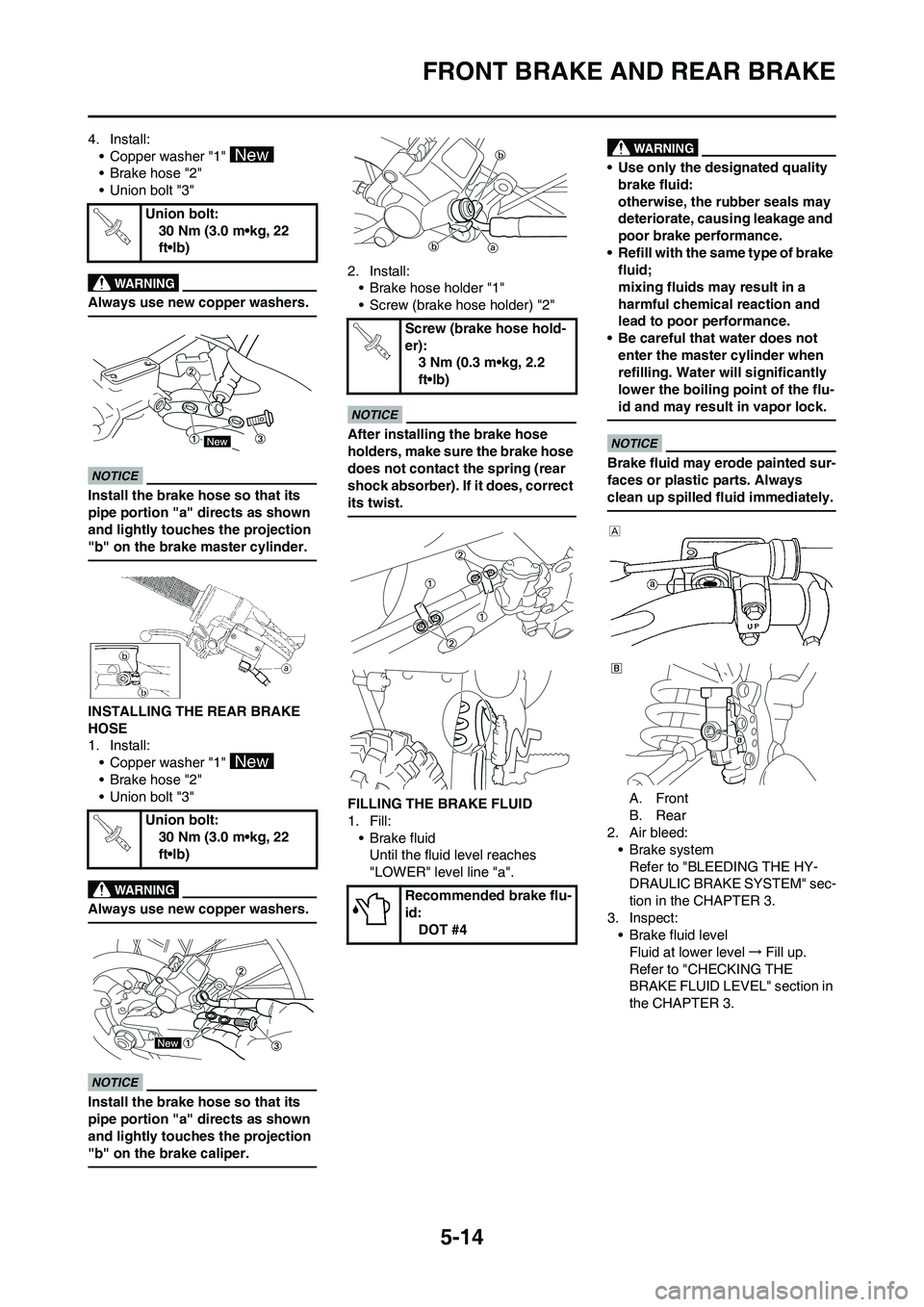
4. Install:
• Copper washer "1"
• Brake hose "2"
• Union bolt "3"
Always use new copper washers.
Install the brake hose so that its
pipe portion "a" directs as shown
and lightly touches the projection
"b" on the brake master cylinder.
INSTALLING THE REAR BRAKE
HOSE
1. Install:
• Copper washer "1"
• Brake hose "2"
• Union bolt "3"
Always use new copper washers.
Install the brake hose so that its
pipe portion "a" directs as shown
and lightly touches the projection
"b" on the brake caliper.
2. Install:
• Brake hose holder "1"
• Screw (brake hose holder) "2"
After installing the brake hose
holders, make sure the brake hose
does not contact the spring (rear
shock absorber). If it does, correct
its twist.
FILLING THE BRAKE FLUID
1. Fill:
•Brake fluid
Until the fluid level reaches
"LOWER" level line "a".
• Use only the designated quality
brake fluid:
otherwise, the rubber seals may
deteriorate, causing leakage and
poor brake performance.
• Refill with the same type of brake
fluid;
mixing fluids may result in a
harmful chemical reaction and
lead to poor performance.
• Be careful that water does not
enter the master cylinder when
refilling. Water will significantly
lower the boiling point of the flu-
id and may result in vapor lock.
Brake fluid may erode painted sur-
faces or plastic parts. Always
clean up spilled fluid immediately.
A. Front
B. Rear
2. Air bleed:
• Brake system
Refer to "BLEEDING THE HY-
DRAULIC BRAKE SYSTEM" sec-
tion in the CHAPTER 3.
3. Inspect:
• Brake fluid level
Fluid at lower level→Fill up.
Refer to "CHECKING THE
BRAKE FLUID LEVEL" section in
the CHAPTER 3. Union bolt:
30 Nm (3.0 m•kg, 22
ft•lb)
Union bolt:
30 Nm (3.0 m•kg, 22
ft•lb)
Screw (brake hose hold-
er):
3 Nm (0.3 m•kg, 2.2
ft•lb)
Recommended brake flu-
id:
DOT #4
Page 139 of 166
5-33
SWINGARM
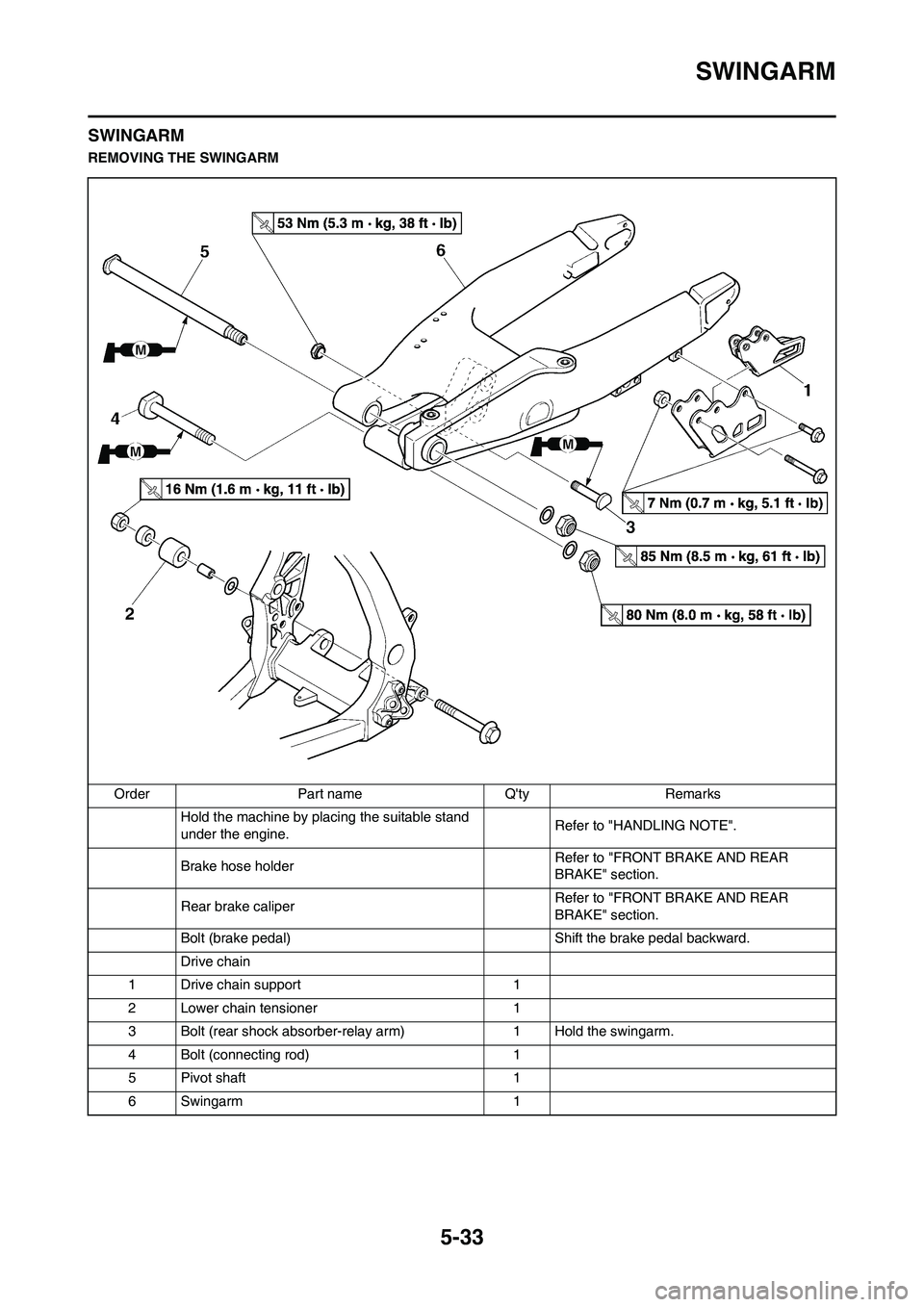
SWINGARM
REMOVING THE SWINGARM
Order Part name Q'ty Remarks
Hold the machine by placing the suitable stand
under the engine.Refer to "HANDLING NOTE".
Brake hose holder Refer to "FRONT BRAKE AND REAR
BRAKE" section.
Rear brake caliperRefer to "FRONT BRAKE AND REAR
BRAKE" section.
Bolt (brake pedal) Shift the brake pedal backward.
Drive chain
1 Drive chain support 1
2 Lower chain tensioner 1
3 Bolt (rear shock absorber-relay arm) 1 Hold the swingarm.
4 Bolt (connecting rod) 1
5 Pivot shaft 1
6 Swingarm 1
Page 142 of 166
5-36
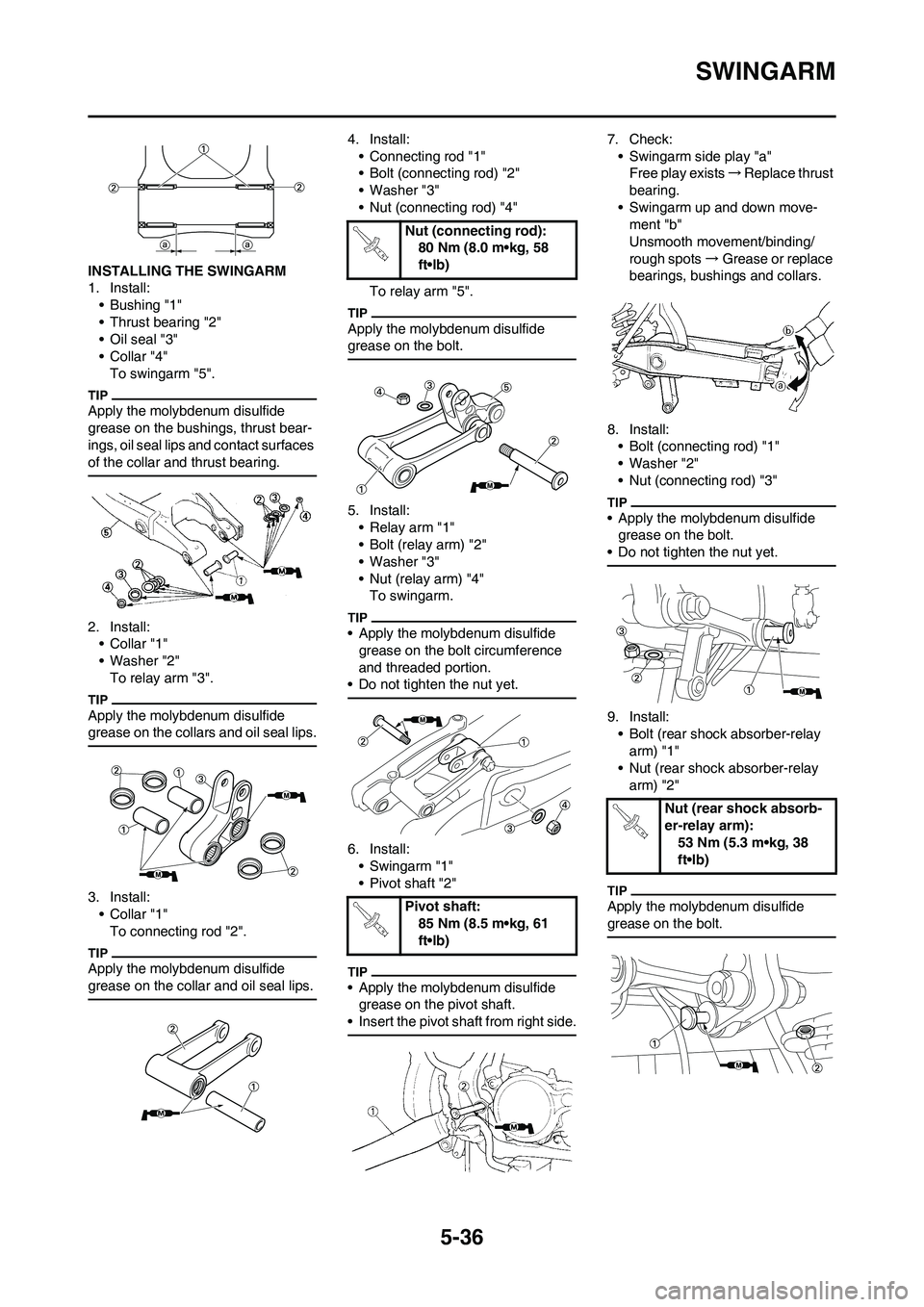
SWINGARM
INSTALLING THE SWINGARM
1. Install:
• Bushing "1"
• Thrust bearing "2"
• Oil seal "3"
•Collar "4"
To swingarm "5".
Apply the molybdenum disulfide
grease on the bushings, thrust bear-
ings, oil seal lips and contact surfaces
of the collar and thrust bearing.
2. Install:
•Collar "1"
• Washer "2"
To relay arm "3".
Apply the molybdenum disulfide
grease on the collars and oil seal lips.
3. Install:
•Collar "1"
To connecting rod "2".
Apply the molybdenum disulfide
grease on the collar and oil seal lips.
4. Install:
• Connecting rod "1"
• Bolt (connecting rod) "2"
• Washer "3"
• Nut (connecting rod) "4"
To relay arm "5".
Apply the molybdenum disulfide
grease on the bolt.
5. Install:
• Relay arm "1"
• Bolt (relay arm) "2"
• Washer "3"
• Nut (relay arm) "4"
To swingarm.
• Apply the molybdenum disulfide
grease on the bolt circumference
and threaded portion.
• Do not tighten the nut yet.
6. Install:
• Swingarm "1"
• Pivot shaft "2"
• Apply the molybdenum disulfide
grease on the pivot shaft.
• Insert the pivot shaft from right side.
7. Check:
• Swingarm side play "a"
Free play exists→Replace thrust
bearing.
• Swingarm up and down move-
ment "b"
Unsmooth movement/binding/
rough spots →Grease or replace
bearings, bushings and collars.
8. Install:
• Bolt (connecting rod) "1"
• Washer "2"
• Nut (connecting rod) "3"
• Apply the molybdenum disulfide
grease on the bolt.
• Do not tighten the nut yet.
9. Install:
• Bolt (rear shock absorber-relay
arm) "1"
• Nut (rear shock absorber-relay
arm) "2"
Apply the molybdenum disulfide
grease on the bolt.
Nut (connecting rod):
80 Nm (8.0 m•kg, 58
ft•lb)
Pivot shaft:
85 Nm (8.5 m•kg, 61
ft•lb)
Nut (rear shock absorb-
er-relay arm):
53 Nm (5.3 m•kg, 38
ft•lb)
Page 144 of 166
5-38
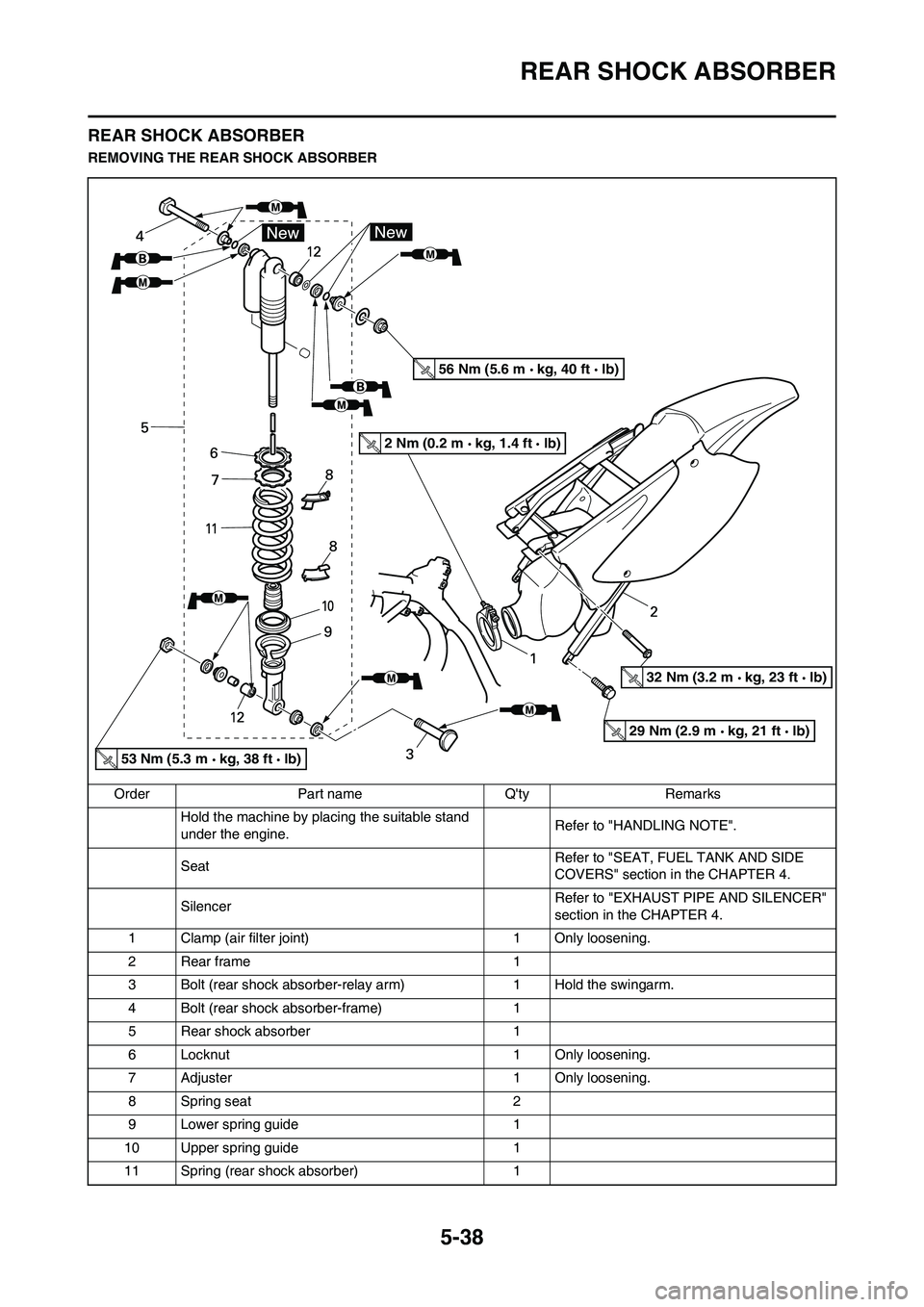
REAR SHOCK ABSORBER
REAR SHOCK ABSORBER
REMOVING THE REAR SHOCK ABSORBER
Order Part name Q'ty Remarks
Hold the machine by placing the suitable stand
under the engine.Refer to "HANDLING NOTE".
Seat Refer to "SEAT, FUEL TANK AND SIDE
COVERS" section in the CHAPTER 4.
Silencer Refer to "EXHAUST PIPE AND SILENCER"
section in the CHAPTER 4.
1 Clamp (air filter joint) 1 Only loosening.
2Rear frame 1
3 Bolt (rear shock absorber-relay arm) 1 Hold the swingarm.
4 Bolt (rear shock absorber-frame) 1
5 Rear shock absorber 1
6 Locknut 1 Only loosening.
7 Adjuster 1 Only loosening.
8 Spring seat 2
9 Lower spring guide 1
10 Upper spring guide 1
11 Spring (rear shock absorber) 1
53 Nm (5.3 m kg, 38 ft lb)
56 Nm (5.6 m kg, 40 ft lb)
2 Nm (0.2 m kg, 1.4 ft lb)
32 Nm (3.2 m kg, 23 ft lb)
29 Nm (2.9 m kg, 21 ft lb)
Page 145 of 166
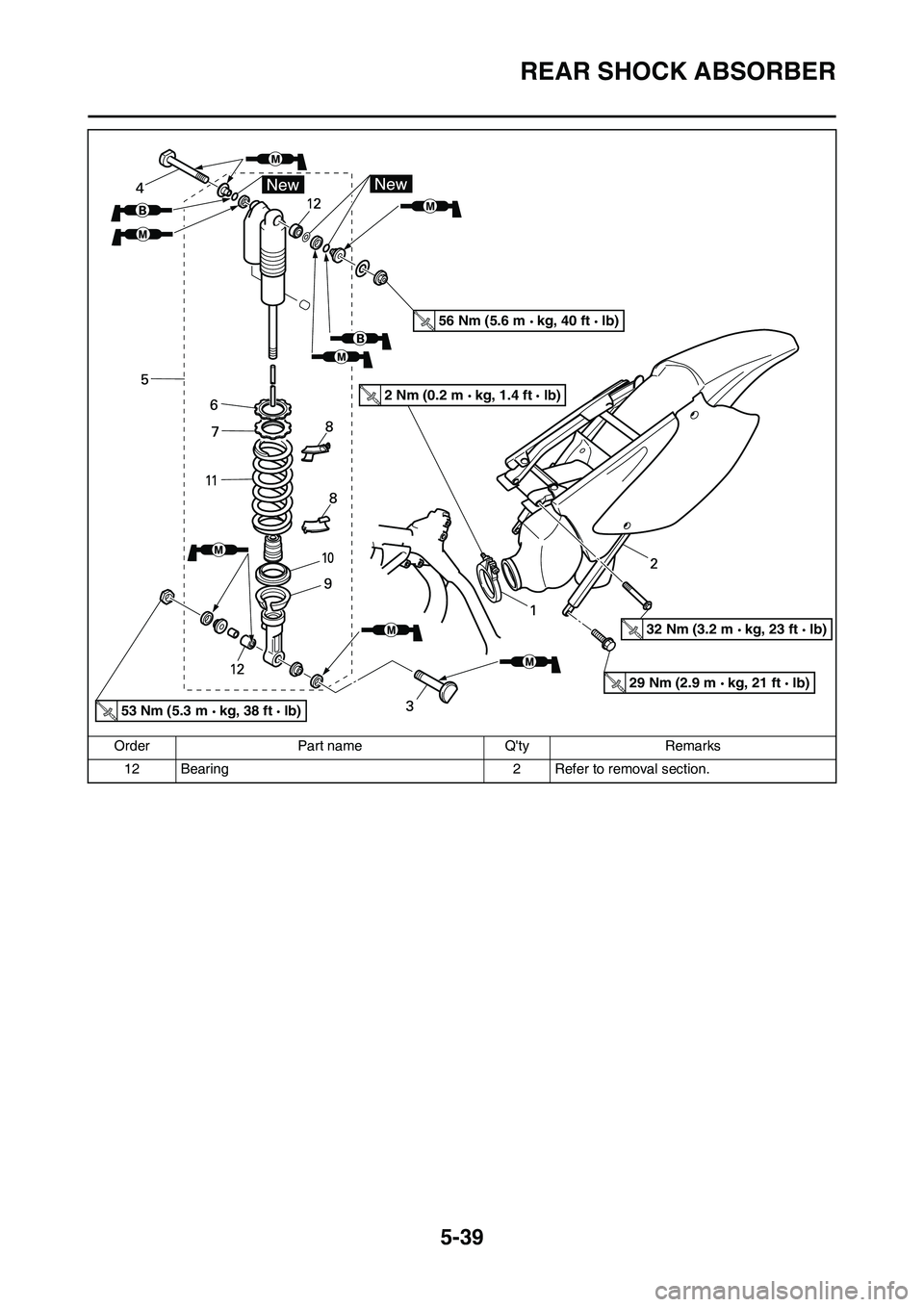
5-39
REAR SHOCK ABSORBER
12 Bearing 2 Refer to removal section. Order Part name Q'ty Remarks
53 Nm (5.3 m kg, 38 ft lb)
56 Nm (5.6 m kg, 40 ft lb)
2 Nm (0.2 m kg, 1.4 ft lb)
32 Nm (3.2 m kg, 23 ft lb)
29 Nm (2.9 m kg, 21 ft lb)
Page 146 of 166
5-40
REAR SHOCK ABSORBER
HANDLING NOTE
• Support the machine securely so
there is no danger of it falling
over.
• This rear shock absorber is pro-
vided with a separate type tank
filled with high-pressure nitro-
gen gas. To prevent the danger
of explosion, read and under-
stand the following information
before handling the shock ab-
sorber. The manufacturer can
not be held responsible for prop-
erty damage or personal injury
that may result from improper
handling.
• Never tamper or attempt to dis-
assemble the cylinder or the
tank.
• Never throw the rear shock ab-
sorber into an open flame or
other high heat. The rear shock
absorber may explode as a re-
sult of nitrogen gas expansion
and/ or damage to the hose.
• Be careful not to damage any
part of the gas tank. A damaged
gas tank will impair the damp-
ing performance or cause a
malfunction.
• Take care not to scratch the
contact surface of the piston
rod with the cylinder; or oil
could leak out.
• Never attempt to remove the
plug at the bottom of the nitro-
gen gas tank. It is very danger-
ous to remove the plug.
• When scrapping the rear shock
absorber, follow the instruc-
tions on disposal.
NOTES ON DISPOSAL (YAMAHA
DEALERS ONLY)
Before disposing the rear shock ab-
sorber, be sure to extract the nitrogen
gas from valve "1". Wear eye protec-
tion to prevent eye damage from es-
caping gas and/or metal chips.
To dispose of a damaged or worn-
out rear shock absorber, take the
unit to your Yamaha dealer for this
disposal procedure.
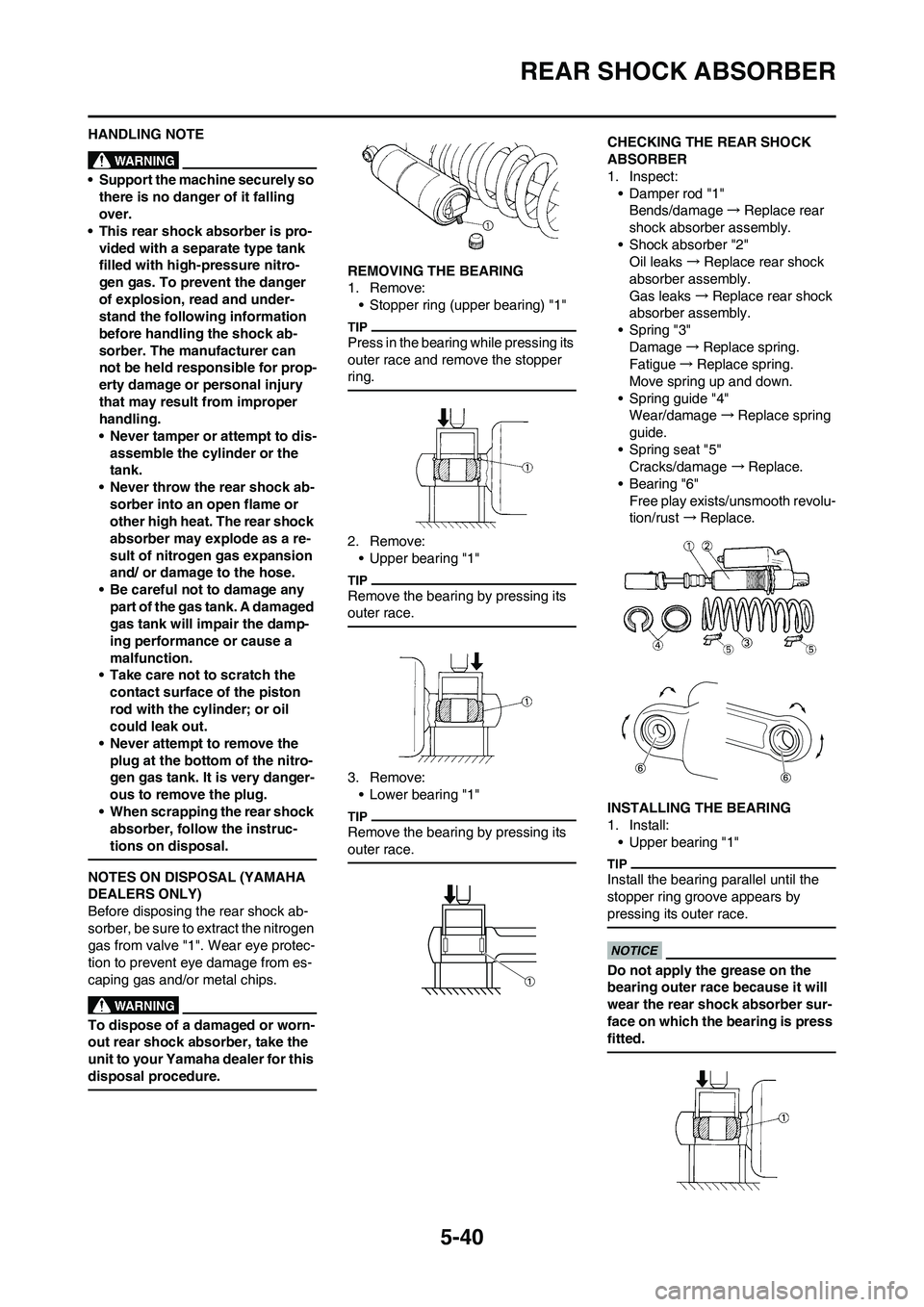
REMOVING THE BEARING
1. Remove:
• Stopper ring (upper bearing) "1"
Press in the bearing while pressing its
outer race and remove the stopper
ring.
2. Remove:
• Upper bearing "1"
Remove the bearing by pressing its
outer race.
3. Remove:
• Lower bearing "1"
Remove the bearing by pressing its
outer race.
CHECKING THE REAR SHOCK
ABSORBER
1. Inspect:
• Damper rod "1"
Bends/damage→Replace rear
shock absorber assembly.
• Shock absorber "2"
Oil leaks→Replace rear shock
absorber assembly.
Gas leaks→Replace rear shock
absorber assembly.
• Spring "3"
Damage→Replace spring.
Fatigue→Replace spring.
Move spring up and down.
• Spring guide "4"
Wear/damage→Replace spring
guide.
• Spring seat "5"
Cracks/damage →Replace.
• Bearing "6"
Free play exists/unsmooth revolu-
tion/rust →Replace.
INSTALLING THE BEARING
1. Install:
• Upper bearing "1"
Install the bearing parallel until the
stopper ring groove appears by
pressing its outer race.
Do not apply the grease on the
bearing outer race because it will
wear the rear shock absorber sur-
face on which the bearing is press
fitted.
Page 147 of 166
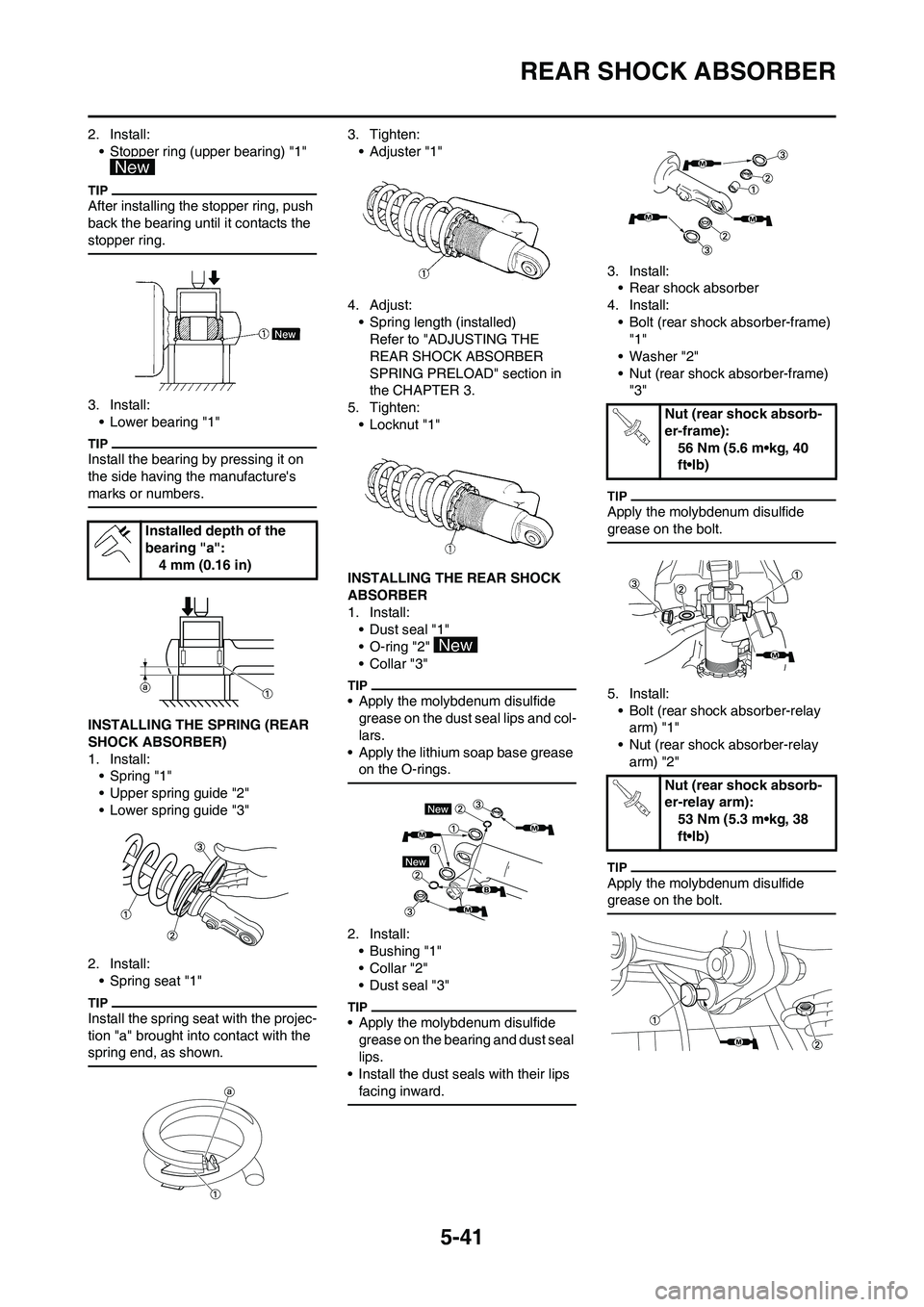
5-41
REAR SHOCK ABSORBER
2. Install:
• Stopper ring (upper bearing) "1"
After installing the stopper ring, push
back the bearing until it contacts the
stopper ring.
3. Install:
• Lower bearing "1"
Install the bearing by pressing it on
the side having the manufacture's
marks or numbers.
INSTALLING THE SPRING (REAR
SHOCK ABSORBER)
1. Install:
• Spring "1"
• Upper spring guide "2"
• Lower spring guide "3"
2. Install:
• Spring seat "1"
Install the spring seat with the projec-
tion "a" brought into contact with the
spring end, as shown.
3. Tighten:
•Adjuster "1"
4. Adjust:
• Spring length (installed)
Refer to "ADJUSTING THE
REAR SHOCK ABSORBER
SPRING PRELOAD" section in
the CHAPTER 3.
5. Tighten:
• Locknut "1"
INSTALLING THE REAR SHOCK
ABSORBER
1. Install:
• Dust seal "1"
• O-ring "2"
• Collar "3"
• Apply the molybdenum disulfide
grease on the dust seal lips and col-
lars.
• Apply the lithium soap base grease
on the O-rings.
2. Install:
• Bushing "1"
• Collar "2"
• Dust seal "3"
• Apply the molybdenum disulfide
grease on the bearing and dust seal
lips.
• Install the dust seals with their lips
facing inward.
3. Install:
• Rear shock absorber
4. Install:
• Bolt (rear shock absorber-frame)
"1"
• Washer "2"
• Nut (rear shock absorber-frame)
"3"
Apply the molybdenum disulfide
grease on the bolt.
5. Install:
• Bolt (rear shock absorber-relay
arm) "1"
• Nut (rear shock absorber-relay
arm) "2"
Apply the molybdenum disulfide
grease on the bolt.
Installed depth of the
bearing "a":
4 mm (0.16 in)
Nut (rear shock absorb-
er-frame):
56 Nm (5.6 m•kg, 40
ft•lb)
Nut (rear shock absorb-
er-relay arm):
53 Nm (5.3 m•kg, 38
ft•lb)
Page 148 of 166
![YAMAHA YZ125LC 2011 User Guide 5-42
REAR SHOCK ABSORBER
6. Install:
• Rear frame "1"
• Bolt [rear frame (upper)] "2"
• Bolt [rear frame (lower)] "3"
7. Tighten:
• Bolt (air filter joint) "1"Bolt [rear frame (upper)]:
32 Nm](/img/51/53908/w960_53908-147.png "YAMAHA YZ125LC 2011 User Guide 5-42
REAR SHOCK ABSORBER
6. Install:
• Rear frame \"1\"
• Bolt [rear frame (upper)] \"2\"
• Bolt [rear frame (lower)] \"3\"
7. Tighten:
• Bolt (air filter joint) \"1\"Bolt [rear frame (upper)]:
32 Nm")
5-42
REAR SHOCK ABSORBER
6. Install:
• Rear frame "1"
• Bolt [rear frame (upper)] "2"
• Bolt [rear frame (lower)] "3"
7. Tighten:
• Bolt (air filter joint) "1"Bolt [rear frame (upper)]:
32 Nm (3.2 m•kg, 23
ft•lb)
Bolt [rear frame (lower)]:
29 Nm (2.9 m•kg, 21
ft•lb)
Bolt (air filter joint):
2 Nm (0.2 m•kg, 1.4
ft•lb)