stop start YAMAHA YZ125LC 2012 User Guide
[x] Cancel search | Manufacturer: YAMAHA, Model Year: 2012, Model line: YZ125LC, Model: YAMAHA YZ125LC 2012Pages: 168, PDF Size: 8.27 MB
Page 89 of 168
4-27
KICK SHAFT AND SHIFT SHAFT
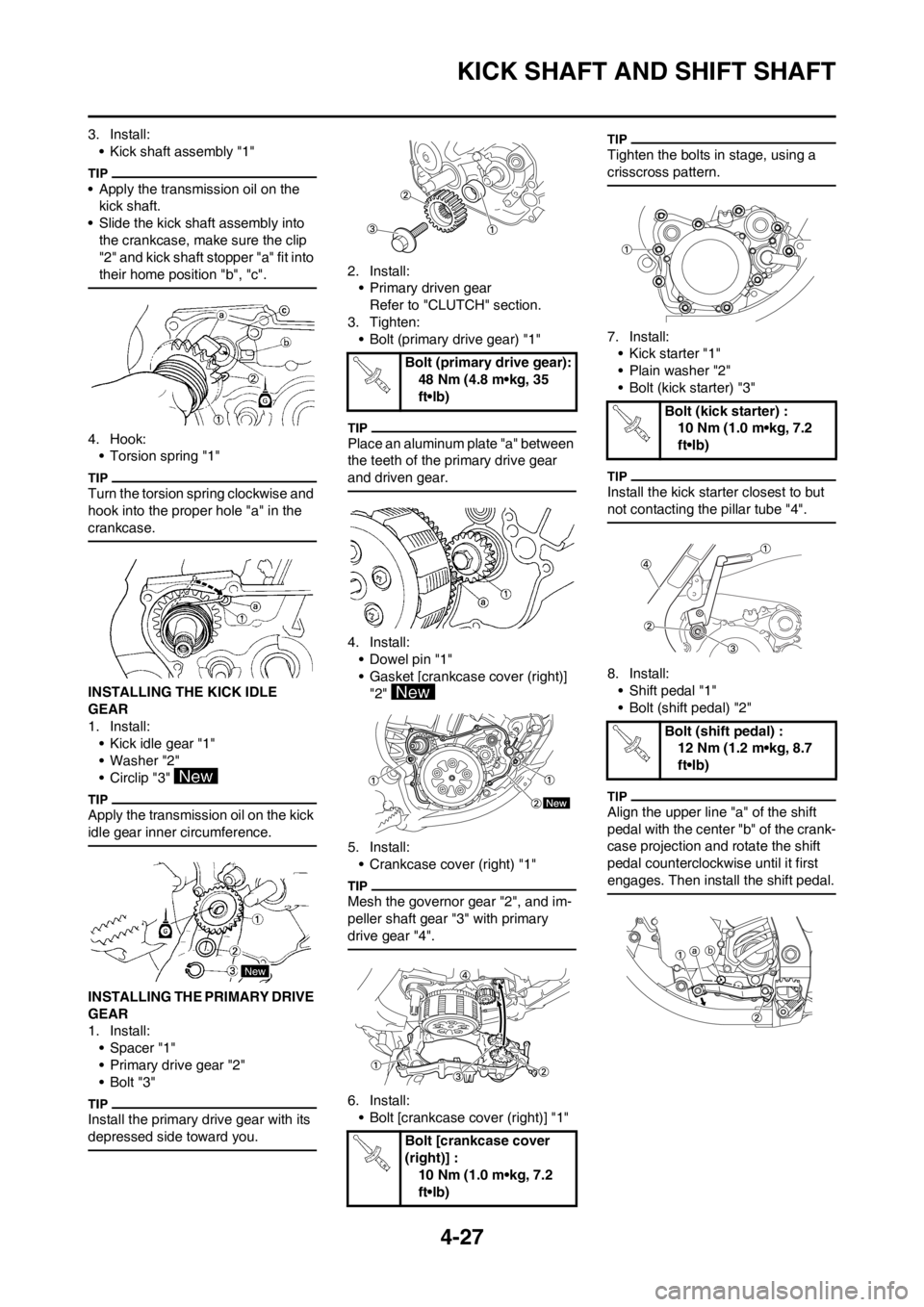
3. Install:
• Kick shaft assembly "1"
• Apply the transmission oil on the
kick shaft.
• Slide the kick shaft assembly into
the crankcase, make sure the clip
"2" and kick shaft stopper "a" fit into
their home position "b", "c".
4. Hook:
• Torsion spring "1"
Turn the torsion spring clockwise and
hook into the proper hole "a" in the
crankcase.
INSTALLING THE KICK IDLE
GEAR
1. Install:
• Kick idle gear "1"
• Washer "2"
• Circlip "3"
Apply the transmission oil on the kick
idle gear inner circumference.
INSTALLING THE PRIMARY DRIVE
GEAR
1. Install:
• Spacer "1"
• Primary drive gear "2"
•Bolt "3"
Install the primary drive gear with its
depressed side toward you.
2. Install:
• Primary driven gear
Refer to "CLUTCH" section.
3. Tighten:
• Bolt (primary drive gear) "1"
Place an aluminum plate "a" between
the teeth of the primary drive gear
and driven gear.
4. Install:
• Dowel pin "1"
• Gasket [crankcase cover (right)]
"2"
5. Install:
• Crankcase cover (right) "1"
Mesh the governor gear "2", and im-
peller shaft gear "3" with primary
drive gear "4".
6. Install:
• Bolt [crankcase cover (right)] "1"
Tighten the bolts in stage, using a
crisscross pattern.
7. Install:
• Kick starter "1"
• Plain washer "2"
• Bolt (kick starter) "3"
Install the kick starter closest to but
not contacting the pillar tube "4".
8. Install:
• Shift pedal "1"
• Bolt (shift pedal) "2"
Align the upper line "a" of the shift
pedal with the center "b" of the crank-
case projection and rotate the shift
pedal counterclockwise until it first
engages. Then install the shift pedal.
Bolt (primary drive gear):
48 Nm (4.8 m•kg, 35
ft•lb)
Bolt [crankcase cover
(right)] :
10 Nm (1.0 m•kg, 7.2
ft•lb)
Bolt (kick starter) :
10 Nm (1.0 m•kg, 7.2
ft•lb)
Bolt (shift pedal) :
12 Nm (1.2 m•kg, 8.7
ft•lb)
Page 103 of 168
4-41
CRANKCASE AND CRANKSHAFT
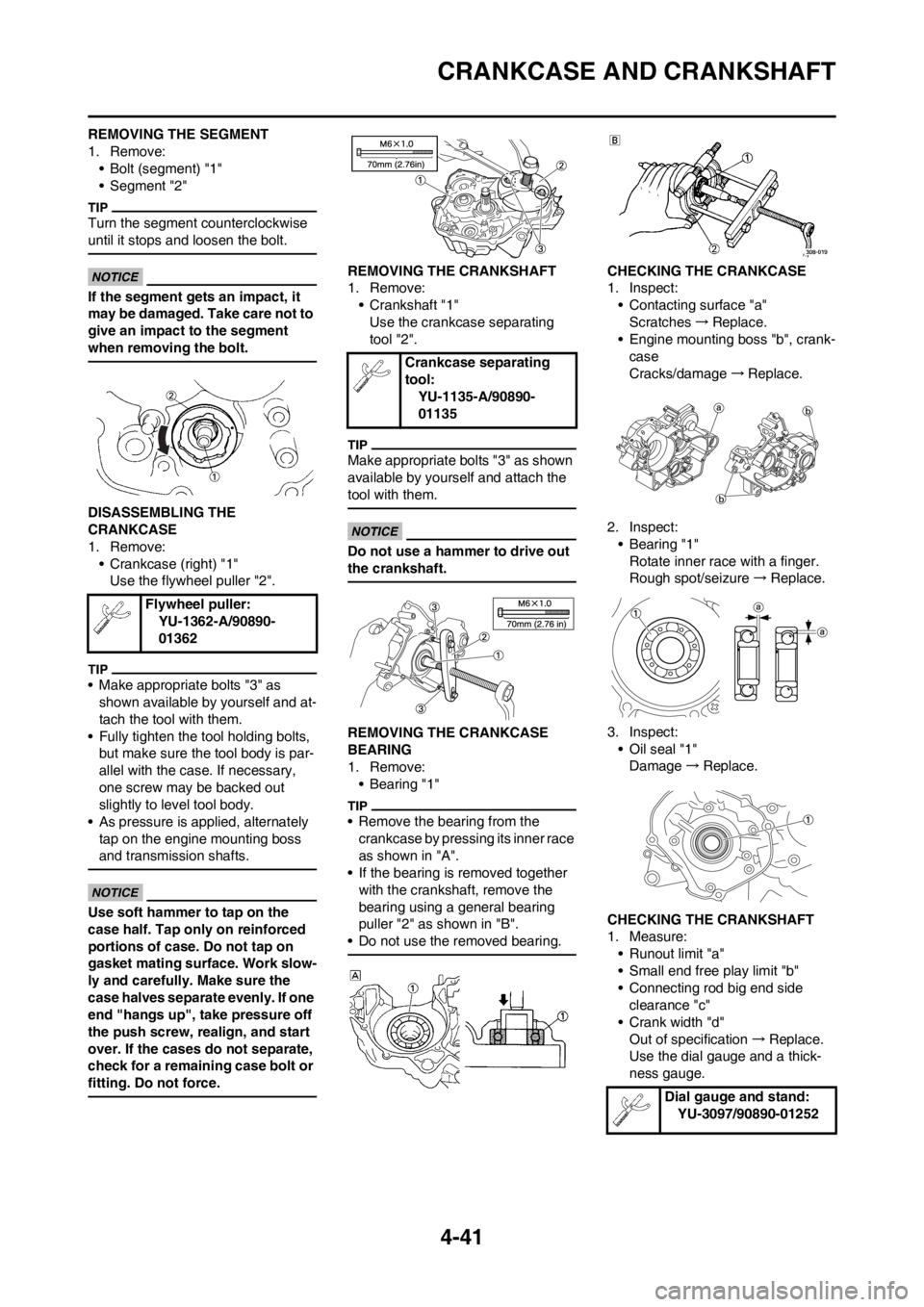
REMOVING THE SEGMENT
1. Remove:
• Bolt (segment) "1"
• Segment "2"
Turn the segment counterclockwise
until it stops and loosen the bolt.
If the segment gets an impact, it
may be damaged. Take care not to
give an impact to the segment
when removing the bolt.
DISASSEMBLING THE
CRANKCASE
1. Remove:
• Crankcase (right) "1"
Use the flywheel puller "2".
• Make appropriate bolts "3" as
shown available by yourself and at-
tach the tool with them.
• Fully tighten the tool holding bolts,
but make sure the tool body is par-
allel with the case. If necessary,
one screw may be backed out
slightly to level tool body.
• As pressure is applied, alternately
tap on the engine mounting boss
and transmission shafts.
Use soft hammer to tap on the
case half. Tap only on reinforced
portions of case. Do not tap on
gasket mating surface. Work slow-
ly and carefully. Make sure the
case halves separate evenly. If one
end "hangs up", take pressure off
the push screw, realign, and start
over. If the cases do not separate,
check for a remaining case bolt or
fitting. Do not force.
REMOVING THE CRANKSHAFT
1. Remove:
• Crankshaft "1"
Use the crankcase separating
tool "2".
Make appropriate bolts "3" as shown
available by yourself and attach the
tool with them.
Do not use a hammer to drive out
the crankshaft.
REMOVING THE CRANKCASE
BEARING
1. Remove:
•Bearing "1"
• Remove the bearing from the
crankcase by pressing its inner race
as shown in "A".
• If the bearing is removed together
with the crankshaft, remove the
bearing using a general bearing
puller "2" as shown in "B".
• Do not use the removed bearing.
CHECKING THE CRANKCASE
1. Inspect:
• Contacting surface "a"
Scratches→Replace.
• Engine mounting boss "b", crank-
case
Cracks/damage→Replace.
2. Inspect:
• Bearing "1"
Rotate inner race with a finger.
Rough spot/seizure→Replace.
3. Inspect:
• Oil seal "1"
Damage→Replace.
CHECKING THE CRANKSHAFT
1. Measure:
• Runout limit "a"
• Small end free play limit "b"
• Connecting rod big end side
clearance "c"
• Crank width "d"
Out of specification→Replace.
Use the dial gauge and a thick-
ness gauge. Flywheel puller:
YU-1362-A/90890-
01362
Crankcase separating
tool:
YU-1135-A/90890-
01135
Dial gauge and stand:
YU-3097/90890-01252
Page 154 of 168
6-4
IGNITION SYSTEM
SPARK GAP TEST
1. Disconnect the spark plug cap
from spark plug.
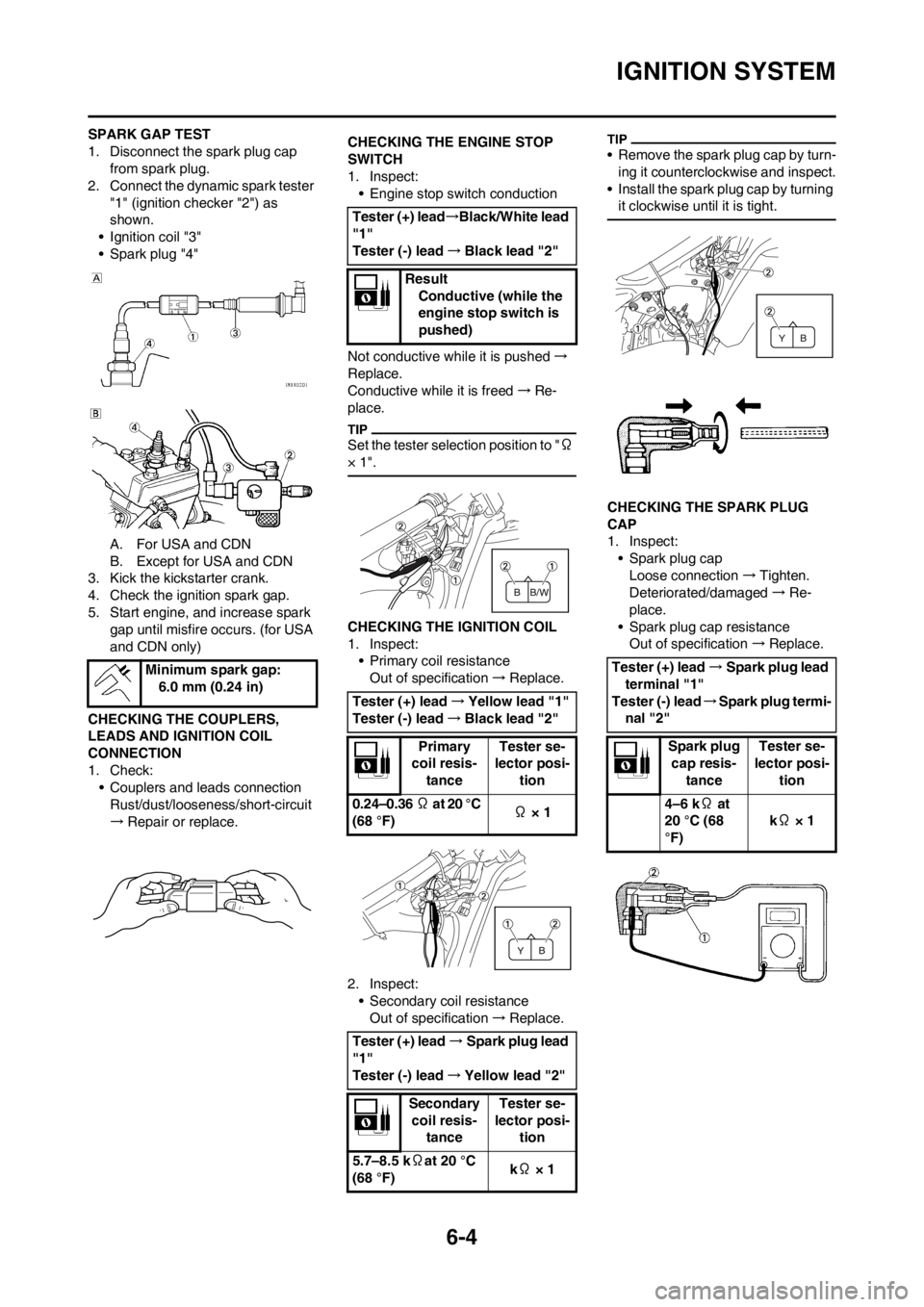
2. Connect the dynamic spark tester
"1" (ignition checker "2") as
shown.
• Ignition coil "3"
• Spark plug "4"
A. For USA and CDN
B. Except for USA and CDN
3. Kick the kickstarter crank.
4. Check the ignition spark gap.
5. Start engine, and increase spark
gap until misfire occurs. (for USA
and CDN only)
CHECKING THE COUPLERS,
LEADS AND IGNITION COIL
CONNECTION
1. Check:
• Couplers and leads connection
Rust/dust/looseness/short-circuit
→Repair or replace.CHECKING THE ENGINE STOP
SWITCH
1. Inspect:
• Engine stop switch conduction
Not conductive while it is pushed→
Replace.
Conductive while it is freed→Re-
place.
Set the tester selection position to "Ω
× 1".
CHECKING THE IGNITION COIL
1. Inspect:
• Primary coil resistance
Out of specification→Replace.
2. Inspect:
• Secondary coil resistance
Out of specification→Replace.
• Remove the spark plug cap by turn-
ing it counterclockwise and inspect.
• Install the spark plug cap by turning
it clockwise until it is tight.
CHECKING THE SPARK PLUG
CAP
1. Inspect:
• Spark plug cap
Loose connection→Tighten.
Deteriorated/damaged→Re-
place.
• Spark plug cap resistance
Out of specification→Replace.
Minimum spark gap:
6.0 mm (0.24 in)
Tester (+) lead→Black/White lead
"1"
Tester (-) lead→Black lead "2"
Result
Conductive (while the
engine stop switch is
pushed)
Tester (+) lead→Yellow lead "1"
Tester (-) lead→Black lead "2"
Primary
coil resis-
tanceTester se-
lector posi-
tion
0.24–0.36 Ω a t 2 0 ° C
(68 °F) Ω × 1
Tester (+) lead→Spark plug lead
"1"
Tester (-) lead→Yellow lead "2"
Secondary
coil resis-
tanceTester se-
lector posi-
tion
5.7–8.5 kΩat 20 °C
(68 °F) kΩ × 1
Tester (+) lead→Spark plug lead
terminal "1"
Tester (-) lead→Spark plug termi-
nal "2"
Spark plug
cap resis-
tanceTester se-
lector posi-
tion
4–6 kΩ at
20 °C (68
°F) kΩ × 1