fuel YAMAHA YZ125LC 2013 Owners Manual
[x] Cancel search | Manufacturer: YAMAHA, Model Year: 2013, Model line: YZ125LC, Model: YAMAHA YZ125LC 2013Pages: 168, PDF Size: 8.19 MB
Page 6 of 168
FOREWORD
INTRODUCTION
Congratulations on your purchase of
a Yamaha YZ series. This model is
the culmination of Yamaha's vast ex-
perience in the production of paceset-
ting racing machines. It represents
the highest grade of craftsmanship
and reliability that have made Yama-
ha a leader.
This manual explains operation, in-
spection, basic maintenance and tun-
ing of your machine. If you have any
questions about this manual or your
machine, please contact your Yama-
ha dealer.
Yamaha continually seeks advance-
ments in product design and quality.
Therefore, while this manual contains
the most current product information
available at the time of printing, there
may be minor discrepancies between
your machine and this manual. If you
have any questions concerning this
manual, please consult your Yamaha
dealer.
PLEASE READ THIS MANUAL
CAREFULLY AND COMPLETELY
BEFORE OPERATING THIS MA-
CHINE. DO NOT ATTEMPT TO OP-
ERATE THIS MACHINE UNTIL YOU
HAVE ATTAINED A SATISFACTO-
RY KNOWLEDGE OF ITS CON-
TROLS AND OPERATING
FEATURES AND UNTIL YOU HAVE
BEEN TRAINED IN SAFE AND
PROPER RIDING TECHNIQUES.
REGULAR INSPECTIONS AND
CAREFUL MAINTENANCE,
ALONG WITH GOOD RIDING
SKILLS, WILL ENSURE THAT YOU
SAFETY ENJOY THE CAPABILI-
TIES AND THE RELIABILITY OF
THIS MACHINE.
IMPORTANT MANUAL
INFORMATION
Particularly important information is
distinguished in this manual by the
following notations.
This is the safety alert symbol. It is
used to alert you to potential per-
sonal injury hazards. Obey all safe-
ty messages that follow this
symbol to avoid possible injury or
death.
A WARNING indicates a hazardous
situation which, if not avoided,
could result in death or serious in-
jury.
A NOTICE indicates special pre-
cautions that must be taken to
avoid damage to the vehicle or oth-
er property.
A TIP provides key information to
make procedures easier or clearer.
SAFETY INFORMATION
THIS MACHINE IS DESIGNED
STRICTLY FOR COMPETITION
USE, ONLY ON A CLOSED
COURSE. It is illegal for this machine
to be operated on any public street,
road, or highway. Off-road use on
public lands may also be illegal.
Please check local regulations before
riding.
• THIS MACHINE IS TO BE OPER-
ATED BY AN EXPERIENCED RID-
ER ONLY.
Do not attempt to operate this ma-
chine at maximum power until you
are totally familiar with its character-
istics.
• THIS MACHINE IS DESIGNED TO
BE RIDDEN BY THE OPERATOR
ONLY.
Do not carry passengers on this
machine.
• ALWAYS WEAR PROTECTIVE
APPAREL.
When operating this machine, al-
ways wear an approved helmet with
goggles or a face shield. Also wear
heavy boots, gloves, and protective
clothing. Always wear proper fitting
clothing that will not be caught in
any of the moving parts or controls
of the machine.• ALWAYS MAINTAIN YOUR MA-
CHINE IN PROPER WORKING
ORDER.
For safety and reliability, the ma-
chine must be properly maintained.
Always perform the pre-operation
checks indicated in this manual.
Correcting a mechanical problem
before you ride may prevent an ac-
cident.
• GASOLINE IS HIGHLY FLAMMA-
BLE.
Always turn off the engine while re-
fueling. Take care to not spill any
gasoline on the engine or exhaust
system. Never refuel in the vicinity
of an open flame, or while smoking.
• GASOLINE CAN CAUSE INJURY.
If you should swallow some gaso-
line, inhale excess gasoline vapors,
or allow any gasoline to get into
your eyes, contact a doctor immedi-
ately. If any gasoline spills onto
your skin or clothing, immediately
wash skin areas with soap and wa-
ter, and change your clothes.
• ONLY OPERATE THE MACHINE
IN AN AREA WITH ADEQUATE
VENTILATION.
Never start the engine or let it run
for any length of time in an enclosed
area. Exhaust fumes are poison-
ous. These fumes contain carbon
monoxide, which by itself is odor-
less and colorless. Carbon monox-
ide is a dangerous gas which can
cause unconsciousness or can be
lethal.
• PARK THE MACHINE CAREFUL-
LY; TURN OFF THE ENGINE.
Always turn off the engine if you are
going to leave the machine. Do not
park the machine on a slope or soft
ground as it may fall over.
• THE ENGINE, EXHAUST PIPE,
MUFFLER, AND OIL TANK WILL
BE VERY HOT AFTER THE EN-
GINE HAS BEEN RUN.
Be careful not to touch them or to
allow any clothing item to contact
them during inspection or repair.
• PROPERLY SECURE THE MA-
CHINE BEFORE TRANSPORTING
IT.
When transporting the machine in
another vehicle, always be sure it is
properly secured and in an upright
position and that the fuel cock is in
the "OFF" position. Otherwise, fuel
may leak out of the carburetor or
fuel tank.
Page 10 of 168

CONTENTS
CHAPTER 1GENERAL
INFORMATION
LOCATION OF IMPORTANT
LABELS............................ 1-1
DESCRIPTION ................. 1-5
CONSUMER
INFORMATION................. 1-6
INCLUDED PARTS .......... 1-6
IMPORTANT
INFORMATION................. 1-6
CHECKING OF
CONNECTION .................. 1-7
SPECIAL TOOLS ............. 1-8
CONTROL
FUNCTIONS ................... 1-11
STARTING AND
BREAK-IN ...................... 1-12
TORQUE-CHECK
POINTS........................... 1-13
CLEANING AND
STORAGE ...................... 1-14
CHAPTER 2
SPECIFICATIONS
GENERAL
SPECIFICATIONS ............ 2-1
MAINTENANCE
SPECIFICATIONS ............ 2-2
TIGHTENING TORQUES . 2-7
CABLE ROUTING
DIAGRAM ....................... 2-13
CHAPTER 3
REGULAR INSPEC-
TION AND AD-JUSTMENTS
MAINTENANCE
INTERVALS ...................... 3-1
PRE-OPERATION
INSPECTION AND
MAINTENANCE................ 3-5
ENGINE ............................ 3-6
CHASSIS .......................... 3-9
ELECTRICAL ................. 3-19
CHAPTER 4 ENGINE
SEAT, FUEL TANK AND
SIDE COVERS.................. 4-1
EXHAUST PIPE AND
SILENCER ........................ 4-3
RADIATOR ....................... 4-5
CARBURETOR AND
REED VALVE ................... 4-7
CYLINDER HEAD, CYLIN-
DER AND PISTON ......... 4-12
CLUTCH ......................... 4-19
KICK SHAFT AND
SHIFT SHAFT ................. 4-23
YPVS GOVERNOR......... 4-28
WATER PUMP................ 4-30
CDI MAGNETO............... 4-33
ENGINE REMOVAL ....... 4-35
CRANKCASE AND
CRANKSHAFT ............... 4-39
TRANSMISSION, SHIFT
CAM AND SHIFT FORK. 4-44
CHAPTER 5CHASSIS
FRONT WHEEL AND REAR
WHEEL .............................5-1
FRONT BRAKE AND
REAR BRAKE ..................5-6
FRONT FORK .................5-16
HANDLEBAR..................5-24
STEERING ......................5-29
SWINGARM ....................5-33
REAR SHOCK
ABSORBER ....................5-38
CHAPTER 6
ELECTRICAL
ELECTRICAL COMPO-
NENTS AND WIRING DIA-
GRAM ...............................6-2
IGNITION SYSTEM...........6-3
CHAPTER 7 TUNING
ENGINE.............................7-1
CHASSIS ..........................7-6
Page 15 of 168
1-5
DESCRIPTION
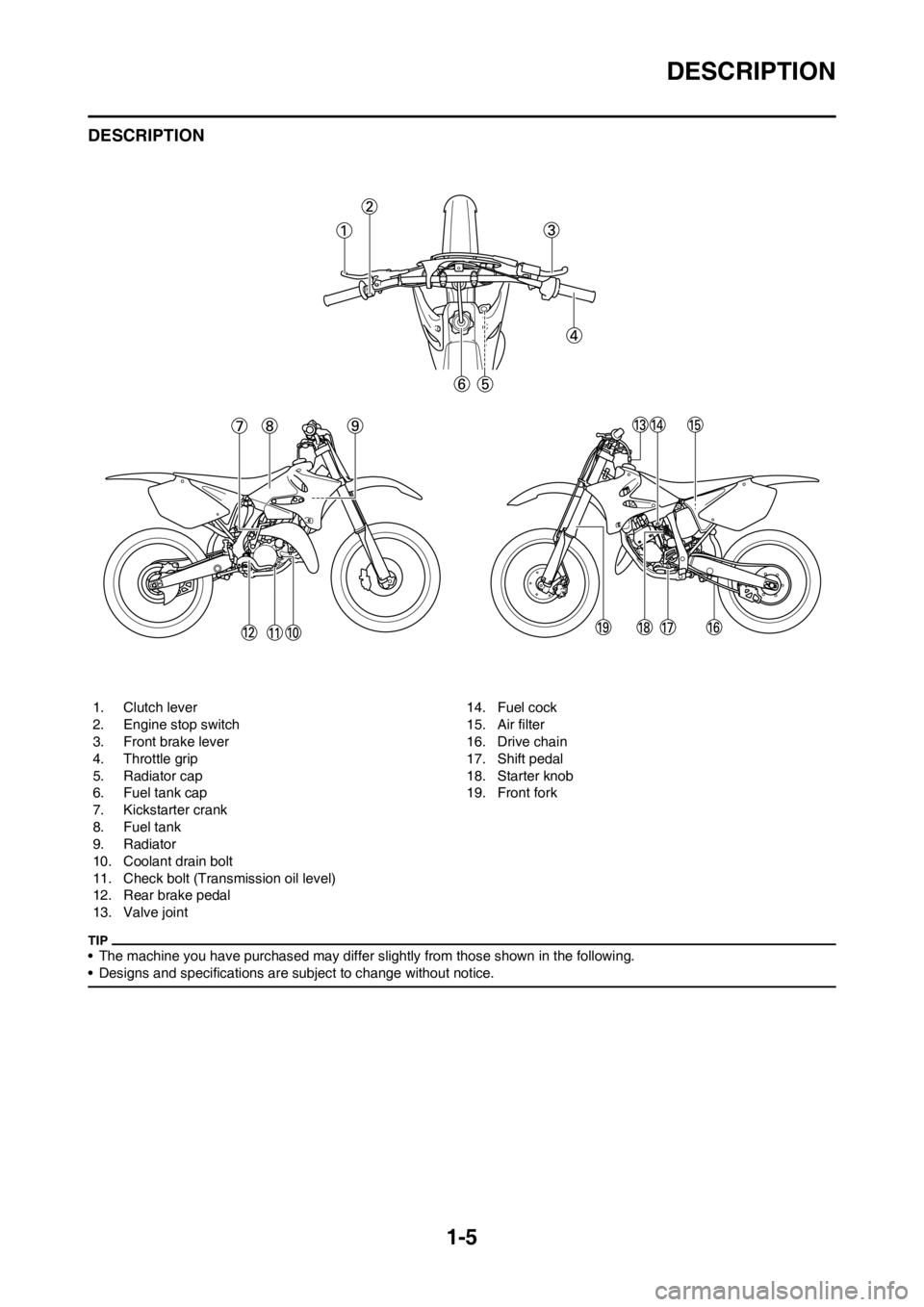
DESCRIPTION
• The machine you have purchased may differ slightly from those shown in the following.
• Designs and specifications are subject to change without notice.
1. Clutch lever
2. Engine stop switch
3. Front brake lever
4. Throttle grip
5. Radiator cap
6. Fuel tank cap
7. Kickstarter crank
8. Fuel tank
9. Radiator
10. Coolant drain bolt
11. Check bolt (Transmission oil level)
12. Rear brake pedal
13. Valve joint14. Fuel cock
15. Air filter
16. Drive chain
17. Shift pedal
18. Starter knob
19. Front fork
Page 16 of 168
1-6
CONSUMER INFORMATION
CONSUMER INFORMATION
There are two significant reasons for
knowing the serial number of your
machine:
1. When ordering parts, you can
give the number to your Yamaha
dealer for positive identification of
the model you own.
2. If your machine is stolen, the au-
thorities will need the number to
search for and identify your ma-
chine.
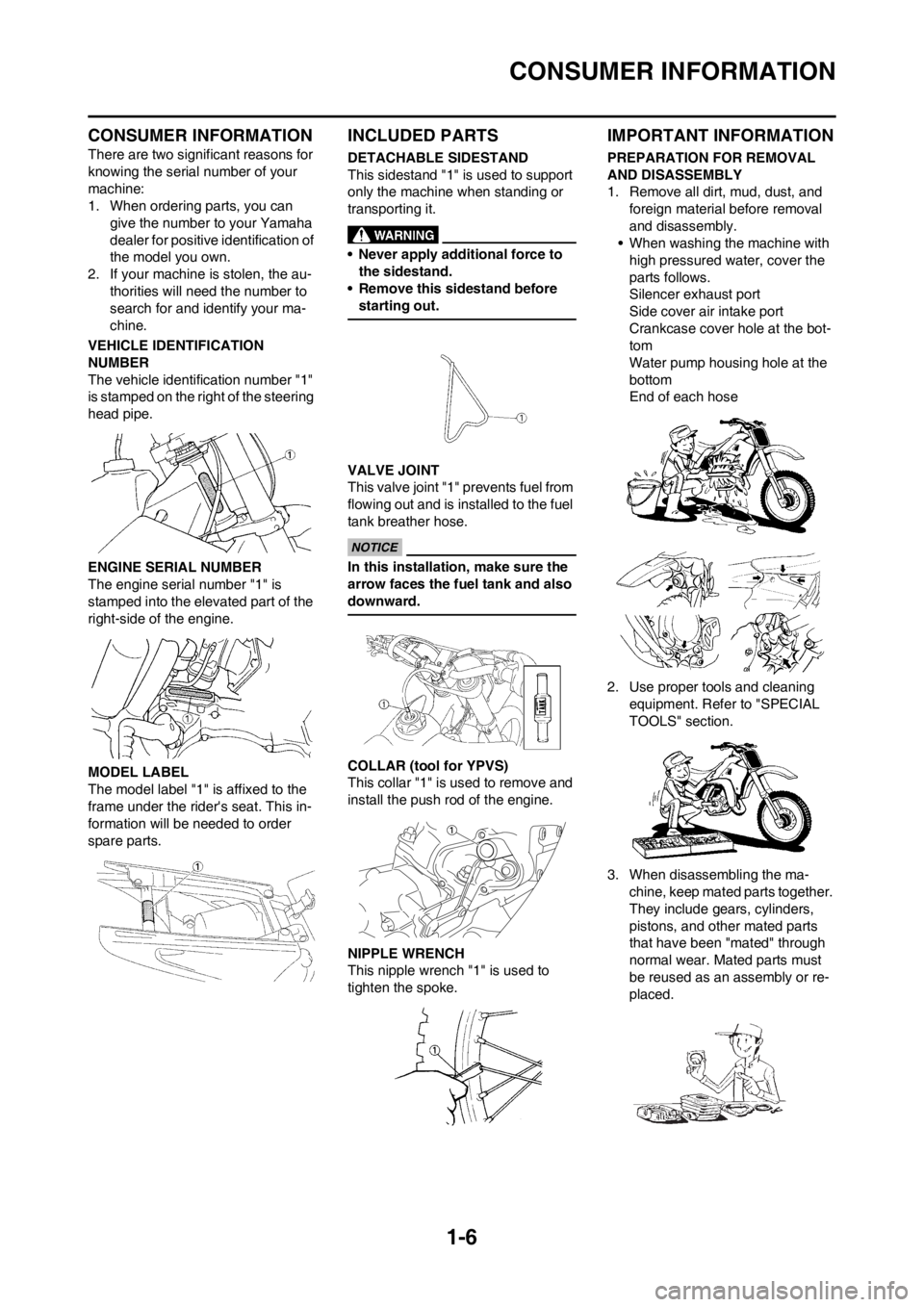
VEHICLE IDENTIFICATION
NUMBER
The vehicle identification number "1"
is stamped on the right of the steering
head pipe.
ENGINE SERIAL NUMBER
The engine serial number "1" is
stamped into the elevated part of the
right-side of the engine.
MODEL LABEL
The model label "1" is affixed to the
frame under the rider's seat. This in-
formation will be needed to order
spare parts.
INCLUDED PARTS
DETACHABLE SIDESTAND
This sidestand "1" is used to support
only the machine when standing or
transporting it.
• Never apply additional force to
the sidestand.
• Remove this sidestand before
starting out.
VALVE JOINT
This valve joint "1" prevents fuel from
flowing out and is installed to the fuel
tank breather hose.
In this installation, make sure the
arrow faces the fuel tank and also
downward.
COLLAR (tool for YPVS)
This collar "1" is used to remove and
install the push rod of the engine.
NIPPLE WRENCH
This nipple wrench "1" is used to
tighten the spoke.
IMPORTANT INFORMATION
PREPARATION FOR REMOVAL
AND DISASSEMBLY
1. Remove all dirt, mud, dust, and
foreign material before removal
and disassembly.
• When washing the machine with
high pressured water, cover the
parts follows.
Silencer exhaust port
Side cover air intake port
Crankcase cover hole at the bot-
tom
Water pump housing hole at the
bottom
End of each hose
2. Use proper tools and cleaning
equipment. Refer to "SPECIAL
TOOLS" section.
3. When disassembling the ma-
chine, keep mated parts together.
They include gears, cylinders,
pistons, and other mated parts
that have been "mated" through
normal wear. Mated parts must
be reused as an assembly or re-
placed.
Page 19 of 168
1-9
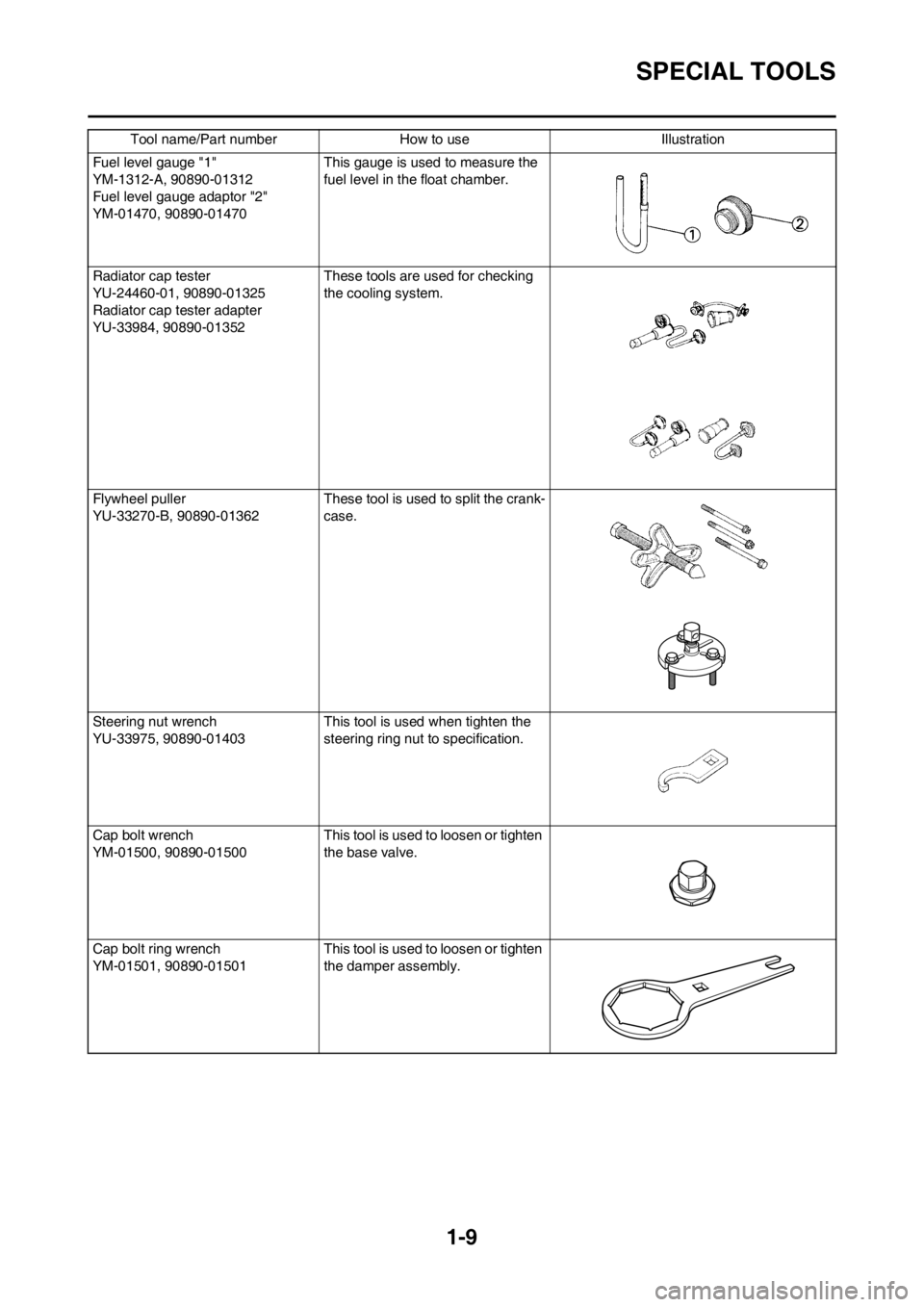
SPECIAL TOOLS
Fuel level gauge "1"
YM-1312-A, 90890-01312
Fuel level gauge adaptor "2"
YM-01470, 90890-01470This gauge is used to measure the
fuel level in the float chamber.
Radiator cap tester
YU-24460-01, 90890-01325
Radiator cap tester adapter
YU-33984, 90890-01352These tools are used for checking
the cooling system.
Flywheel puller
YU-33270-B, 90890-01362 These tool is used to split the crank-
case.
Steering nut wrench
YU-33975, 90890-01403 This tool is used when tighten the
steering ring nut to specification.
Cap bolt wrench
YM-01500, 90890-01500This tool is used to loosen or tighten
the base valve.
Cap bolt ring wrench
YM-01501, 90890-01501This tool is used to loosen or tighten
the damper assembly. Tool name/Part number How to use Illustration
Page 21 of 168
1-11
CONTROL FUNCTIONS
CONTROL FUNCTIONS
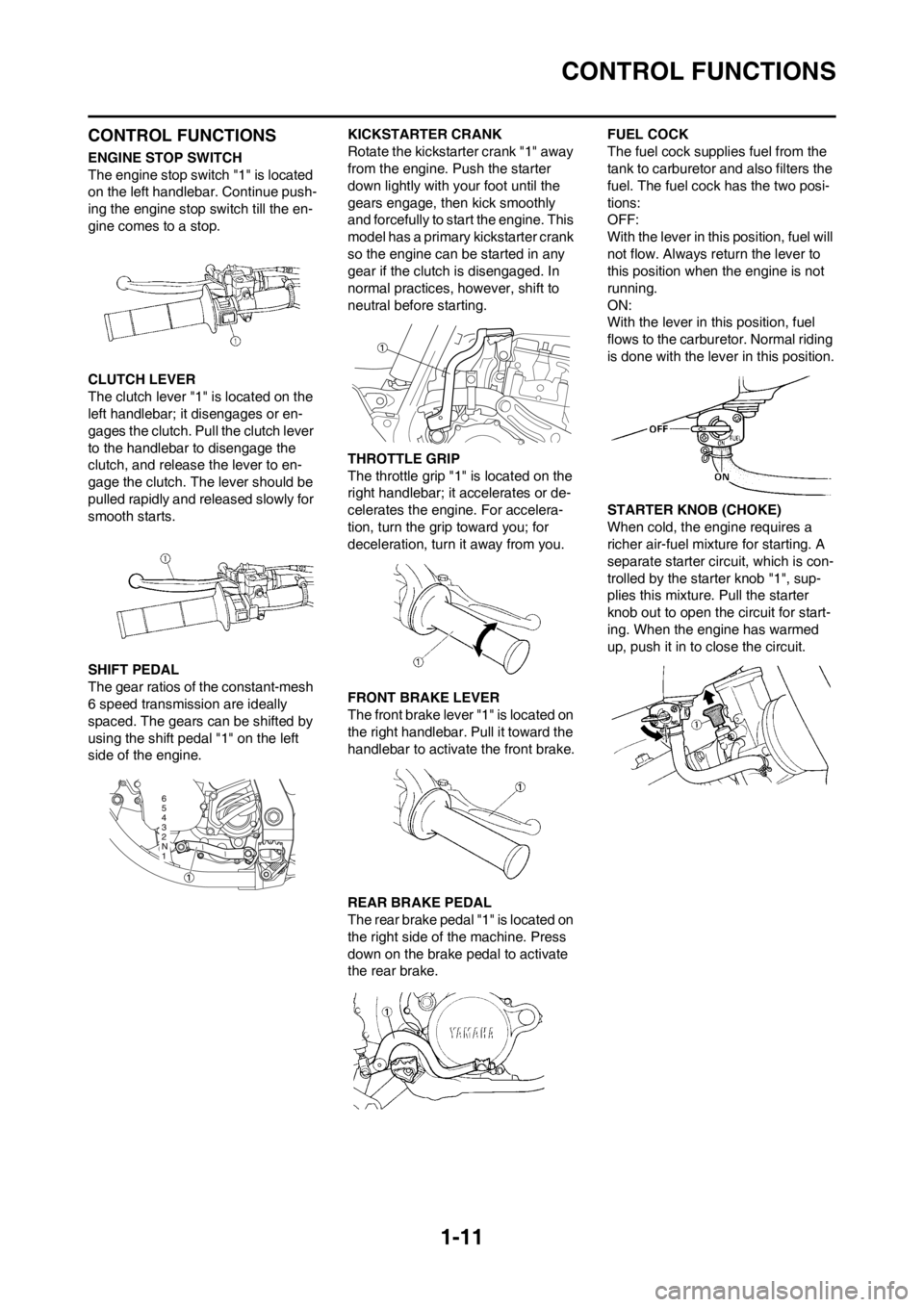
ENGINE STOP SWITCH
The engine stop switch "1" is located
on the left handlebar. Continue push-
ing the engine stop switch till the en-
gine comes to a stop.
CLUTCH LEVER
The clutch lever "1" is located on the
left handlebar; it disengages or en-
gages the clutch. Pull the clutch lever
to the handlebar to disengage the
clutch, and release the lever to en-
gage the clutch. The lever should be
pulled rapidly and released slowly for
smooth starts.
SHIFT PEDAL
The gear ratios of the constant-mesh
6 speed transmission are ideally
spaced. The gears can be shifted by
using the shift pedal "1" on the left
side of the engine.KICKSTARTER CRANK
Rotate the kickstarter crank "1" away
from the engine. Push the starter
down lightly with your foot until the
gears engage, then kick smoothly
and forcefully to start the engine. This
model has a primary kickstarter crank
so the engine can be started in any
gear if the clutch is disengaged. In
normal practices, however, shift to
neutral before starting.
THROTTLE GRIP
The throttle grip "1" is located on the
right handlebar; it accelerates or de-
celerates the engine. For accelera-
tion, turn the grip toward you; for
deceleration, turn it away from you.
FRONT BRAKE LEVER
The front brake lever "1" is located on
the right handlebar. Pull it toward the
handlebar to activate the front brake.
REAR BRAKE PEDAL
The rear brake pedal "1" is located on
the right side of the machine. Press
down on the brake pedal to activate
the rear brake.FUEL COCK
The fuel cock supplies fuel from the
tank to carburetor and also filters the
fuel. The fuel cock has the two posi-
tions:
OFF:
With the lever in this position, fuel will
not flow. Always return the lever to
this position when the engine is not
running.
ON:
With the lever in this position, fuel
flows to the carburetor. Normal riding
is done with the lever in this position.
STARTER KNOB (CHOKE)
When cold, the engine requires a
richer air-fuel mixture for starting. A
separate starter circuit, which is con-
trolled by the starter knob "1", sup-
plies this mixture. Pull the starter
knob out to open the circuit for start-
ing. When the engine has warmed
up, push it in to close the circuit.
Page 22 of 168
1-12
STARTING AND BREAK-IN
STARTING AND BREAK-IN
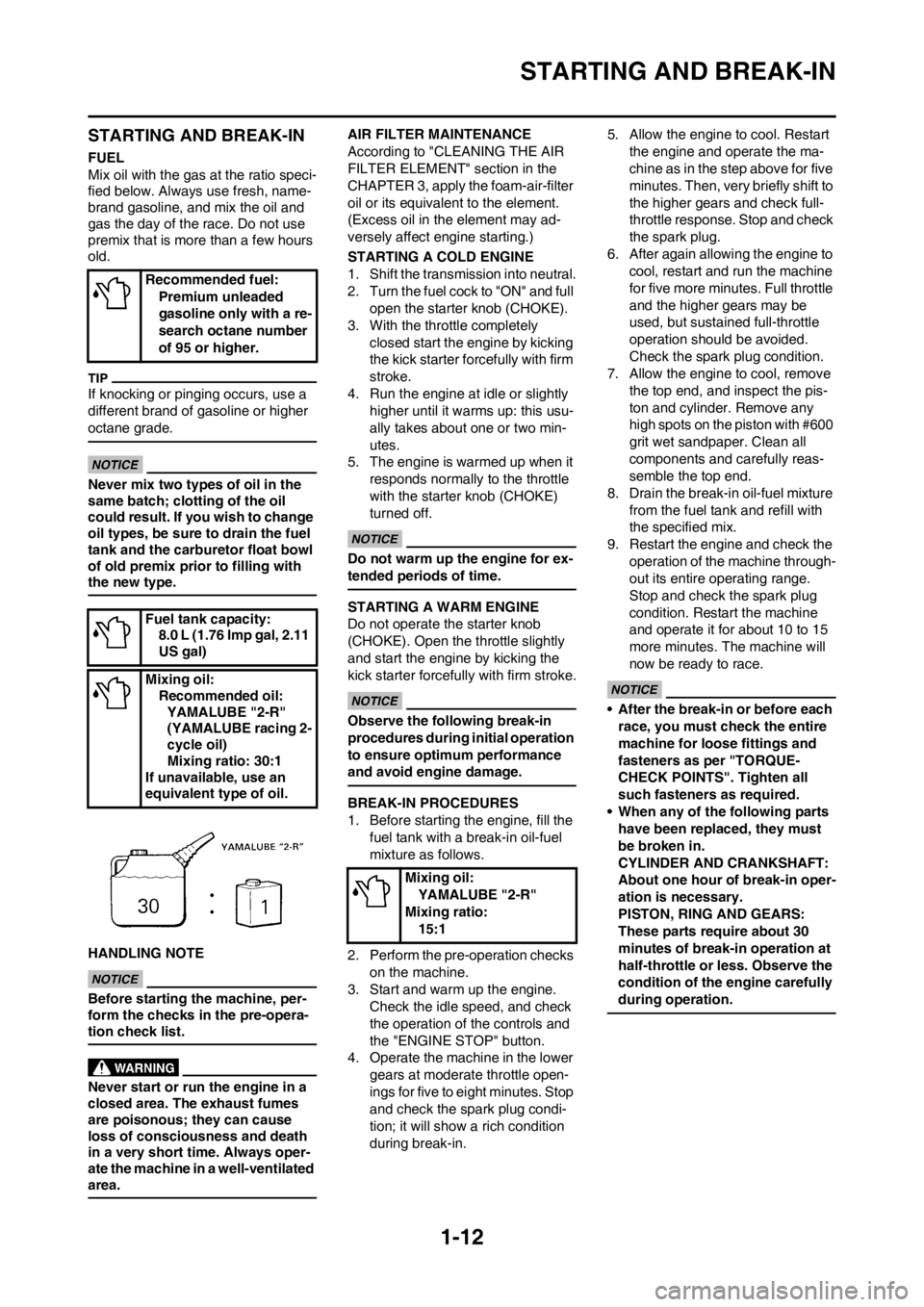
FUEL
Mix oil with the gas at the ratio speci-
fied below. Always use fresh, name-
brand gasoline, and mix the oil and
gas the day of the race. Do not use
premix that is more than a few hours
old.
If knocking or pinging occurs, use a
different brand of gasoline or higher
octane grade.
Never mix two types of oil in the
same batch; clotting of the oil
could result. If you wish to change
oil types, be sure to drain the fuel
tank and the carburetor float bowl
of old premix prior to filling with
the new type.
HANDLING NOTE
Before starting the machine, per-
form the checks in the pre-opera-
tion check list.
Never start or run the engine in a
closed area. The exhaust fumes
are poisonous; they can cause
loss of consciousness and death
in a very short time. Always oper-
ate the machine in a well-ventilated
area.
AIR FILTER MAINTENANCE
According to "CLEANING THE AIR
FILTER ELEMENT" section in the
CHAPTER 3, apply the foam-air-filter
oil or its equivalent to the element.
(Excess oil in the element may ad-
versely affect engine starting.)
STARTING A COLD ENGINE
1. Shift the transmission into neutral.
2. Turn the fuel cock to "ON" and full
open the starter knob (CHOKE).
3. With the throttle completely
closed start the engine by kicking
the kick starter forcefully with firm
stroke.
4. Run the engine at idle or slightly
higher until it warms up: this usu-
ally takes about one or two min-
utes.
5. The engine is warmed up when it
responds normally to the throttle
with the starter knob (CHOKE)
turned off.
Do not warm up the engine for ex-
tended periods of time.
STARTING A WARM ENGINE
Do not operate the starter knob
(CHOKE). Open the throttle slightly
and start the engine by kicking the
kick starter forcefully with firm stroke.
Observe the following break-in
procedures during initial operation
to ensure optimum performance
and avoid engine damage.
BREAK-IN PROCEDURES
1. Before starting the engine, fill the
fuel tank with a break-in oil-fuel
mixture as follows.
2. Perform the pre-operation checks
on the machine.
3. Start and warm up the engine.
Check the idle speed, and check
the operation of the controls and
the "ENGINE STOP" button.
4. Operate the machine in the lower
gears at moderate throttle open-
ings for five to eight minutes. Stop
and check the spark plug condi-
tion; it will show a rich condition
during break-in.5. Allow the engine to cool. Restart
the engine and operate the ma-
chine as in the step above for five
minutes. Then, very briefly shift to
the higher gears and check full-
throttle response. Stop and check
the spark plug.
6. After again allowing the engine to
cool, restart and run the machine
for five more minutes. Full throttle
and the higher gears may be
used, but sustained full-throttle
operation should be avoided.
Check the spark plug condition.
7. Allow the engine to cool, remove
the top end, and inspect the pis-
ton and cylinder. Remove any
high spots on the piston with #600
grit wet sandpaper. Clean all
components and carefully reas-
semble the top end.
8. Drain the break-in oil-fuel mixture
from the fuel tank and refill with
the specified mix.
9. Restart the engine and check the
operation of the machine through-
out its entire operating range.
Stop and check the spark plug
condition. Restart the machine
and operate it for about 10 to 15
more minutes. The machine will
now be ready to race.
• After the break-in or before each
race, you must check the entire
machine for loose fittings and
fasteners as per "TORQUE-
CHECK POINTS". Tighten all
such fasteners as required.
• When any of the following parts
have been replaced, they must
be broken in.
CYLINDER AND CRANKSHAFT:
About one hour of break-in oper-
ation is necessary.
PISTON, RING AND GEARS:
These parts require about 30
minutes of break-in operation at
half-throttle or less. Observe the
condition of the engine carefully
during operation.
Recommended fuel:
Premium unleaded
gasoline only with a re-
search octane number
of 95 or higher.
Fuel tank capacity:
8.0 L (1.76 Imp gal, 2.11
US gal)
Mixing oil:
Recommended oil:
YAMALUBE "2-R"
(YAMALUBE racing 2-
cycle oil)
Mixing ratio: 30:1
If unavailable, use an
equivalent type of oil.
Mixing oil:
YAMALUBE "2-R"
Mixing ratio:
15:1
Page 23 of 168

1-13
TORQUE-CHECK POINTS
TORQUE-CHECK POINTS
Concerning the tightening torque, refer to "TIGHTENING TORQUES" section in the CHAPTER 2.
Frame construction Frame to rear frame
Combined seat and fuel tank Fuel tank to frame
Exhaust system Silencer to rear frame
Engine mounting Frame to engine
Engine bracket to engine
Engine bracket to frame
Steering Steering stem to handlebar Steering stem to frame
Steering stem to upper bracket
Upper bracket to handlebar
Suspension Front Steering stem to front fork Front fork to upper bracket
Front fork to lower bracket
Rear For link type Assembly of links
Link to frame
Link to rear shock absorber
Link to swingarm
Installation of rear shock absorber Rear shock absorber to frame
Installation of swingarm Tightening of pivot shaft
Wheel Installation of wheel Front Tightening of wheel axle
Tightening of axle holder
Rear Tightening of wheel axle
Wheel to rear wheel sprocket
Brake Front Brake caliper to front fork
Brake disc to wheel
Tightening of union bolt
Brake master cylinder to handlebar
Tightening of bleed screw
Tightening of brake hose holder
Rear Brake pedal to frame
Brake disc to wheel
Tightening of union bolt
Brake master cylinder to frame
Tightening of bleed screw
Tightening of brake hose holder
Fuel system Fuel tank to fuel cock
Page 24 of 168
1-14
CLEANING AND STORAGE
CLEANING AND STORAGE
CLEANING
Frequent cleaning of your machine
will enhance its appearance, maintain
good overall performance, and ex-
tend the life of many components.
1. Before washing the machine,
block off the end of the exhaust
pipe to prevent water from enter-
ing. A plastic bag secured with a
rubber band may be used for this
purpose.
2. If the engine is excessively
greasy, apply some degreaser to
it with a paint brush. Do not apply
degreaser to the chain, sprockets,
or wheel axles.
3. Rinse the dirt and degreaser off
with a garden hose; use only
enough pressure to do the job.
Do not use high-pressure washers
or steam-jet cleaners since they
cause water seepage and deterio-
ration seals.
4. After the majority of the dirt has
been hosed off, wash all surfaces
with warm water and a mild deter-
gent. Use an old toothbrush to
clean hard-to-reach places.
5. Rinse the machine off immediate-
ly with clean water, and dry all
surfaces with a soft towel or cloth.
6. Immediately after washing, re-
move excess water from the
chain with a paper towel and lubri-
cate the chain to prevent rust.
7. Clean the seat with a vinyl uphol-
stery cleaner to keep the cover
pliable and glossy.
8. Automotive wax may be applied
to all painted or chromed surfac-
es. Avoid combination cleaner-
waxes, as they may contain abra-
sives.
9. After completing the above, start
the engine and allow it to idle for
several minutes.STORAGE
If your machine is to be stored for 60
days or more, some preventive mea-
sures must be taken to avoid deterio-
ration. After cleaning the machine
thoroughly, prepare it for storage as
follows:
1. Drain the fuel tank, fuel lines, and
the carburetor float bowl.
2. Remove the spark plug, pour a ta-
blespoon of SAE 10W-40 motor
oil in the spark plug hole, and re-
install the plug. With the engine
stop switch pushed in, kick the en-
gine over several times to coat the
cylinder walls with oil.
3. Remove the drive chain, clean it
thoroughly with solvent, and lubri-
cate it. Reinstall the chain or store
it in a plastic bag tied to the frame.
4. Lubricate all control cables.
5. Block the frame up to raise the
wheels off the ground.
6. Tie a plastic bag over the exhaust
pipe outlet to prevent moisture
from entering.
7. If the machine is to be stored in a
humid or salt-air environment,
coat all exposed metal surfaces
with a film of light oil. Do not apply
oil to rubber parts or the seat cov-
er.
Make any necessary repairs before
the machine is stored.
Page 25 of 168

2-1
GENERAL SPECIFICATIONS
SPECIFICATIONS
GENERAL SPECIFICATIONS
Model name:YZ125D (USA, CDN, AUS, NZ)
YZ125 (EUROPE, ZA)
Model code number: 1SR5 (USA, CDN)
1SR6 (EUROPE)
1SR8 (AUS, NZ, ZA)
Dimensions: USA, AUS, NZ, ZAEUROPE, CDN
Overall length 2,135 mm (84.1 in) 2,139 mm (84.2 in)
Overall width 827 mm (32.6 in)←
Overall height 1,315 mm (51.8 in) 1,318 mm (51.9 in)
Seat height 997 mm (39.3in)998 mm (39.3 in)
Wheelbase 1,443 mm (56.8 in)←
Minimum ground clearance 386 mm (15.2 in)388 mm (15.3 in)
Weight: Curb weight 94 kg (207 lb)
Engine: Engine type Liquid cooled 2-stroke, gasoline
Cylinder arrangement Single cylinder
Displacement 124 cm
3 (4.36 Imp oz, 4.19 US oz)
Bore × stroke 54 × 54.5 mm (2.1 × 2.1 in)
Compression ratio 8.6–10.7 : 1
Starting system Kick starter
Lubrication system: Premix (30 : 1)(YAMALUBE 2-R)
Oil type or grade (2-stroke): Transmission oil Recommended brand: YAMALUBE SAE10W-40
API service SG type or higher
JASO standard MA
Periodic oil change 0.66 L (0.58 Imp qt, 0.69 US qt)
Total amount 0.70 L (0.62 Imp qt, 0.74 US qt)
Coolant capacity (including all routes): 0.9 L (0.79 Imp qt, 0.95 US qt)
Air filter: Wet type element
Fuel: Type Premium unleaded gasoline on ly with a research octane
number of 95 or higher.
Tank capacity 8.0 L (1.76 Imp gal, 2.11 US gal)
Carburetor: Type/Manufacturer TMX χ38SS/MIKUNI
Spark plug: Type/Manufacturer BR9EVX/NGK (resistance type)
Gap 0.6–0.7 mm (0.024–0.028 in)
Clutch type: Wet, multiple-disc
2