width YAMAHA YZ250F 2008 Owners Manual
[x] Cancel search | Manufacturer: YAMAHA, Model Year: 2008, Model line: YZ250F, Model: YAMAHA YZ250F 2008Pages: 192, PDF Size: 7.03 MB
Page 23 of 192

2-1
GENERAL SPECIFICATIONS
SPECIFICATIONS
GENERAL SPECIFICATIONS
Model name:YZ250FX (USA, CDN, AUS, NZ)
YZ250F (EUROPE, ZA)
Model code number: 5XCL (USA,CDN)
5XCM (EUROPE)
5XCP (AUS, NZ, ZA)
Dimensions: USA, CDN, ZA, AUS, NZEUROPE
Overall length 2,162 mm (85.12 in) 2,165 mm (85.24 in)
Overall width 825 mm (32.48 in)
←
Overall height1,300 mm (51.18 in)←
Seat height 985 mm (38.78 in)997 mm (39.25 in)
Wheelbase 1,469 mm (57.83 in)
←
Minimum ground clearance370 mm (14.57 in)372 mm (14.65 in)
Dry weight: Without oil and fuel 92.7 kg (204 lb)
Engine: Engine type Liquid cooled 4-stroke, DOHC
Cylinder arrangement Single cylinder, forward inclined
Displacement 249 cm
3 (8.76 Imp oz, 8.42 US oz)
Bore × stroke 77.0 × 53.6 mm (3.03 × 2.11 in)
Compression ratio 13.5 : 1
Starting system Kickstarter
Lubrication system: Dry sump
Oil type or grade: Engine oil (For USA and CDN)
Yamalube 4, SAE10W30 or SAE20W40
Yamalube 4-R, SAE10W50
API service SG type or higher,
JASO standard MA
(Except for USA and CDN)
SAE10W30, SAE10W40, SAE15W40,
SAE20W40 or SAE20W50
API service SG type or higher,
JASO standard MA
Oil capacity: Engine oilPeriodic oil change 1.05 L (0.92 Imp qt, 1.11 US qt)
With oil filter replacement 1.15 L (1.01 Imp qt, 1.22 US qt)
Total amount 1.30 L (1.14 Imp qt, 1.37 US qt)
Coolant capacity (including all routes): 0.99 L (0.87 Imp qt, 1.05 US qt)
Air filter: Wet type element
2
Page 26 of 192
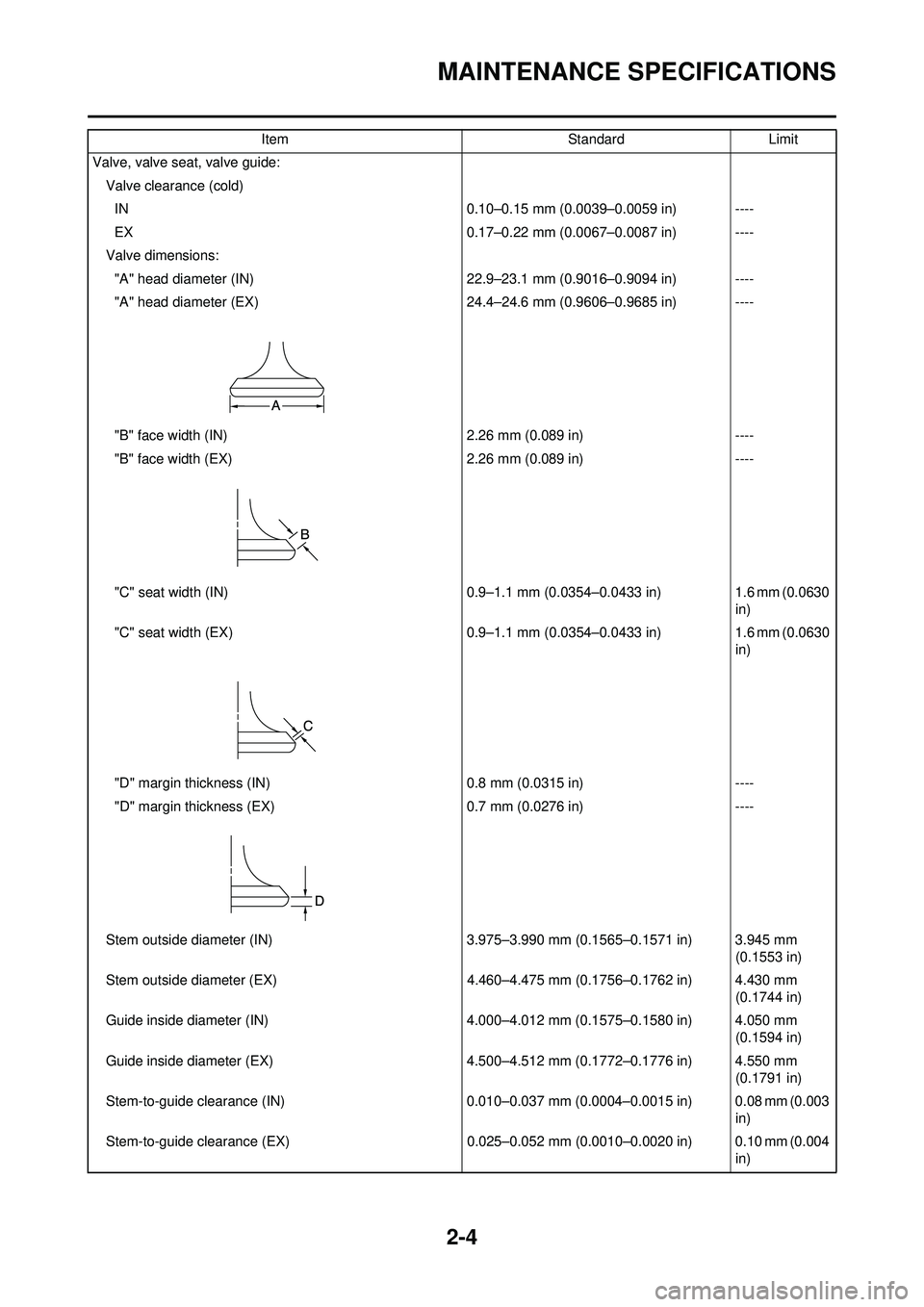
2-4
MAINTENANCE SPECIFICATIONS
Valve, valve seat, valve guide:Valve clearance (cold)IN 0.10–0.15 mm (0.0039–0.0059 in) ----
EX 0.17–0.22 mm (0.0067–0.0087 in) ----
Valve dimensions: "A" head diameter (IN) 22.9–23.1 mm (0.9016–0.9094 in) ----
"A" head diameter (EX) 24.4–24.6 mm (0.9606–0.9685 in) ----
"B" face width (IN) 2.26 mm (0.089 in)----
"B" face width (EX) 2.26 mm (0.089 in)----
"C" seat width (IN) 0.9–1.1 mm (0.0354–0.0433 in)1.6 mm (0.0630
in)
"C" seat width (EX) 0.9–1.1 mm (0.0354–0.0433 in)1.6 mm (0.0630
in)
"D" margin thickness (IN) 0.8 mm (0.0315 in)----
"D" margin thickness (EX) 0.7 mm (0.0276 in)----
Stem outside diameter (IN) 3.975–3.990 mm (0.1565–0.1571 in) 3.945 mm
(0.1553 in)
Stem outside diameter (EX) 4.460–4.475 mm (0.1756–0.1762 in) 4.430 mm
(0.1744 in)
Guide inside diameter (IN) 4.000–4.012 mm (0.1575–0.1580 in) 4.050 mm
(0.1594 in)
Guide inside diameter (EX) 4.500–4.512 mm (0.1772–0.1776 in) 4.550 mm
(0.1791 in)
Stem-to-guide clearance (IN) 0.010–0.037 mm (0.0004–0.0015 in) 0.08 mm (0.003
in)
Stem-to-guide clearance (EX) 0.025–0.052 mm (0.0010–0.0020 in) 0.10 mm (0.004
in)
Item
StandardLimit
Page 27 of 192

2-5
MAINTENANCE SPECIFICATIONS
Stem runout limit----0.01 mm
(0.0004 in)
Valve seat width (IN) 0.9–1.1 mm (0.0354–0.0433 in)1.6 mm (0.0630
in)
Valve seat width (EX) 0.9–1.1 mm (0.0354–0.0433 in)1.6 mm (0.0630
in)
Valve spring: Free length (IN) 37.81 mm (1.49 in)36.81 mm (1.45
in)
Free length (EX) 37.54 mm (1.48 in)36.54 mm (1.44
in)
Set length (valve closed) (IN) 29.13 mm (1.15 in)----
Set length (valve closed) (EX) 29.30 mm (1.15 in)----
Compressed force (installed) (IN) 99–114 N at 29.13 mm (9.9–11.4 kg at
29.13 mm, 22.27–25.57 lb at 1.15 in) ----
Compressed force (installed) (EX) 126–144 N at 29.30 mm (12.6–14.4 kg at
29.30 mm, 28.44–32.41 lb at 1.15 in) ----
Tilt limit* (IN) ----2.5°/1.7 mm
(2.5°/0.067 in)
Tilt limit* (EX) ----2.5°/1.6 mm
(2.5°/0.063 in)
Direction of winding (top view) (IN) Clockwise----
Direction of winding (top view) (EX) Clockwise----
Piston: Piston to cylinder clearance 0.030–0.055 mm (0.0012–0.0022 in) 0.1 mm (0.004
in)
Piston size "D" 76.955–76.970 mm (3.0297–3.0303 in) ----
Measuring point "H" 8 mm (0.31 in)----
Piston off-set 0.5 mm (0.020 in)/IN-side----
Piston pin bore inside diameter 16.002–16.013 mm (0.6300–0.6304 in) 16.043 mm
(0.6316 in)
Item
StandardLimit
Page 28 of 192

2-6
MAINTENANCE SPECIFICATIONS
Piston pin outside diameter15.991–16.000 mm (0.6296–0.6299 in) 15.971 mm
(0.6288 in)
Piston rings: Top ring:
Type Barrel----
Dimensions (B × T) 0.90 × 2.75 mm (0.04 × 0.11 in)----
End gap (installed) 0.15–0.25 mm (0.006–0.010 in)0.50 mm (0.020
in)
Side clearance (installed) 0.030–0.065 mm (0.0012–0.0026 in) 0.12 mm (0.005
in)
2nd ring:
Type Taper----
Dimensions (B × T) 0.80 × 2.75 mm (0.03 × 0.11 in)----
End gap (installed) 0.30–0.45 mm (0.012–0.018 in)0.80 mm (0.031
in)
Side clearance 0.020–0.055 mm (0.0008–0.0022 in) 0.12 mm (0.005
in)
Oil ring:
Dimensions (B × T) 1.50 × 2.25 mm (0.06 × 0.09 in)----
End gap (installed) 0.10–0.40 mm (0.004–0.016 in)----
Crankshaft: Crank width "A" 55.95–56.00 mm (2.203–2.205 in) ----
Runout limit "C" 0.03 mm (0.0012 in)0.05 mm (0.002
in)
Big end side clearance "D" 0.15–0.45 mm (0.0059–0.0177 in) 0.50 mm (0.02
in)
Small end free play "F" 0.4–1.0 mm (0.02–0.04 in)2.0 mm (0.08
in)
Clutch: Friction plate thickness 2.9–3.1 mm (0.114–0.122 in)2.8 mm (0.110
in)
Quantity 9----
Clutch plate thickness 1.1–1.3 mm (0.043–0.051 in)----
Item
StandardLimit
Page 29 of 192
2-7
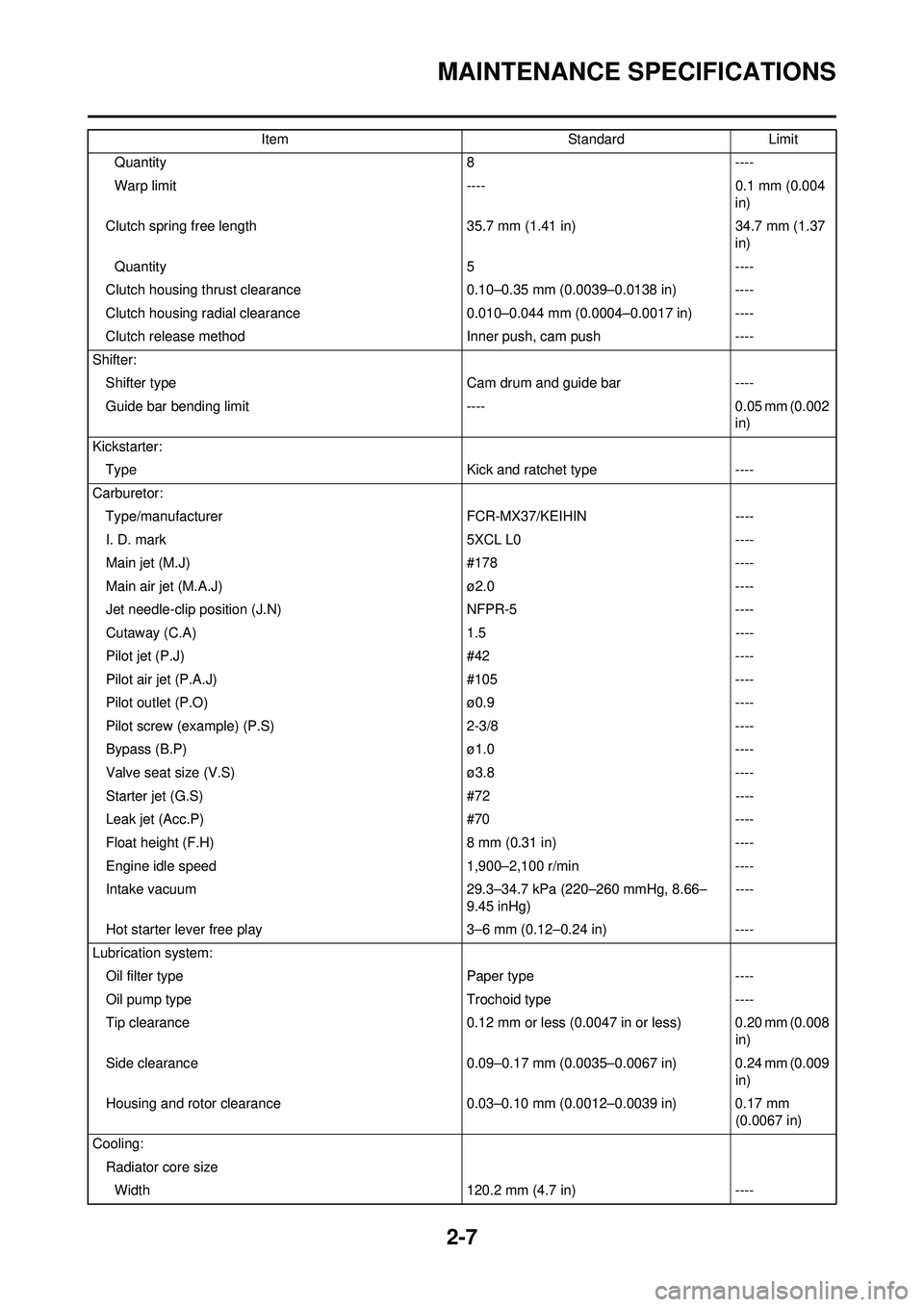
MAINTENANCE SPECIFICATIONS
Quantity8----
Warp limit ----0.1 mm (0.004
in)
Clutch spring free length 35.7 mm (1.41 in)34.7 mm (1.37
in)
Quantity 5----
Clutch housing thrust clearance 0.10–0.35 mm (0.0039–0.0138 in) ----
Clutch housing radial clearance 0.010–0.044 mm (0.0004–0.0017 in) ----
Clutch release method Inner push, cam push----
Shifter: Shifter type Cam drum and guide bar----
Guide bar bending limit ----0.05 mm (0.002
in)
Kickstarter: Type Kick and ratchet type----
Carburetor: Type/manufacturer FCR-MX37/KEIHIN----
I. D. mark 5XCL L0----
Main jet (M.J) #178----
Main air jet (M.A.J) ø2.0----
Jet needle-clip position (J.N) NFPR-5----
Cutaway (C.A) 1.5----
Pilot jet (P.J) #42----
Pilot air jet (P.A.J) #105----
Pilot outlet (P.O) ø0.9----
Pilot screw (example) (P.S) 2-3/8----
Bypass (B.P) ø1.0----
Valve seat size (V.S) ø3.8----
Starter jet (G.S) #72----
Leak jet (Acc.P) #70----
Float height (F.H) 8 mm (0.31 in)----
Engine idle speed 1,900–2,100 r/min----
Intake vacuum 29.3–34.7 kPa (220–260 mmHg, 8.66–
9.45 inHg) ----
Hot starter lever free play 3–6 mm (0.12–0.24 in)----
Lubrication system: Oil filter type Paper type----
Oil pump type Trochoid type----
Tip clearance 0.12 mm or less (0.0047 in or less) 0.20 mm (0.008
in)
Side clearance 0.09–0.17 mm (0.0035–0.0067 in) 0.24 mm (0.009
in)
Housing and rotor clearance 0.03–0.10 mm (0.0012–0.0039 in) 0.17 mm
(0.0067 in)
Cooling: Radiator core sizeWidth 120.2 mm (4.7 in)----
Item
StandardLimit
Page 86 of 192

4-17
CAMSHAFTS
4. Measure:• Camshaft-to-cap clearanceOut of specification
→Measure
camshaft outside diameter.
Measurement steps:
a. Install the camshaft onto the cylin-
der head.
b. Position a strip of Plastigauge
®
"1" onto the camshaft.
c. Install the clip, dowel pins and camshaft caps.
• Tighten the bolts (camshaft cap) in a crisscross pattern from innermost
to outer caps.
• Do not turn the camshaft when measuring clearance with the Plas-
tigauge
®.
d. Remove the camshaft caps and measure the width of the Plasti-
gauge
® "1".
5. Measure:• Camshaft outside diameter "a"Out of specification
→Replace
the camshaft.
Within specification
→Replace
camshaft case and camshaft
caps as a set. CHECKING THE CAMSHAFT
SPROCKET
1. Inspect:
• Camshaft sprocket "1"
Wear/damage
→Replace the
camshaft assembly and timing
chain as a set.
CHECKING THE
DECOMPRESSION SYSTEM
1. Check: • Decompression system
Checking steps:
a. Check that the decompression mechanism cam "1" moves
smoothly.
b. Check that the decompression
mechanism cam lever pin "2"
projects from the camshaft.
CHECKING THE TIMING CHAIN
TENSIONER
1. Check:• While pressing the tensioner rod
lightly with fingers, use a thin
screwdriver "1" and wind the ten-
sioner rod up fully clockwise.
• When releasing the screwdriver by pressing lightly with fingers,
make sure that the tensioner rod
will come out smoothly.
• If not, replace the tensioner as- sembly. INSTALLING THE CAMSHAFT
1. Install:
• Exhaust camshaft "1"
• Intake camshaft "2"
Installation steps:
a. Turn the crankshaft counterclock- wise with a wrench.
• Apply the molybdenum disulfide oil
on the camshafts.
• Apply the engine oil on the decom- pression system.
• Squeezing the decompression le- ver allows the crankshaft to be
turned easily.
b. Align the T.D.C. mark "a" on the rotor with the align mark "b" on the
crankcase cover when piston is at
T.D.C. on compression stroke.
Camshaft-to-cap clear-
ance:
0.028–0.062 mm
(0.0011–0.0024 in)
in)
Bolt (camshaft cap): 10 Nm (1.0 m•kg, 7.2
ft•lb)
Camshaft outside diame-
ter: 21.959–21.972 mm
(0.8645–0.8650 in)
Page 91 of 192
4-22
VALVES AND VALVE SPRINGS
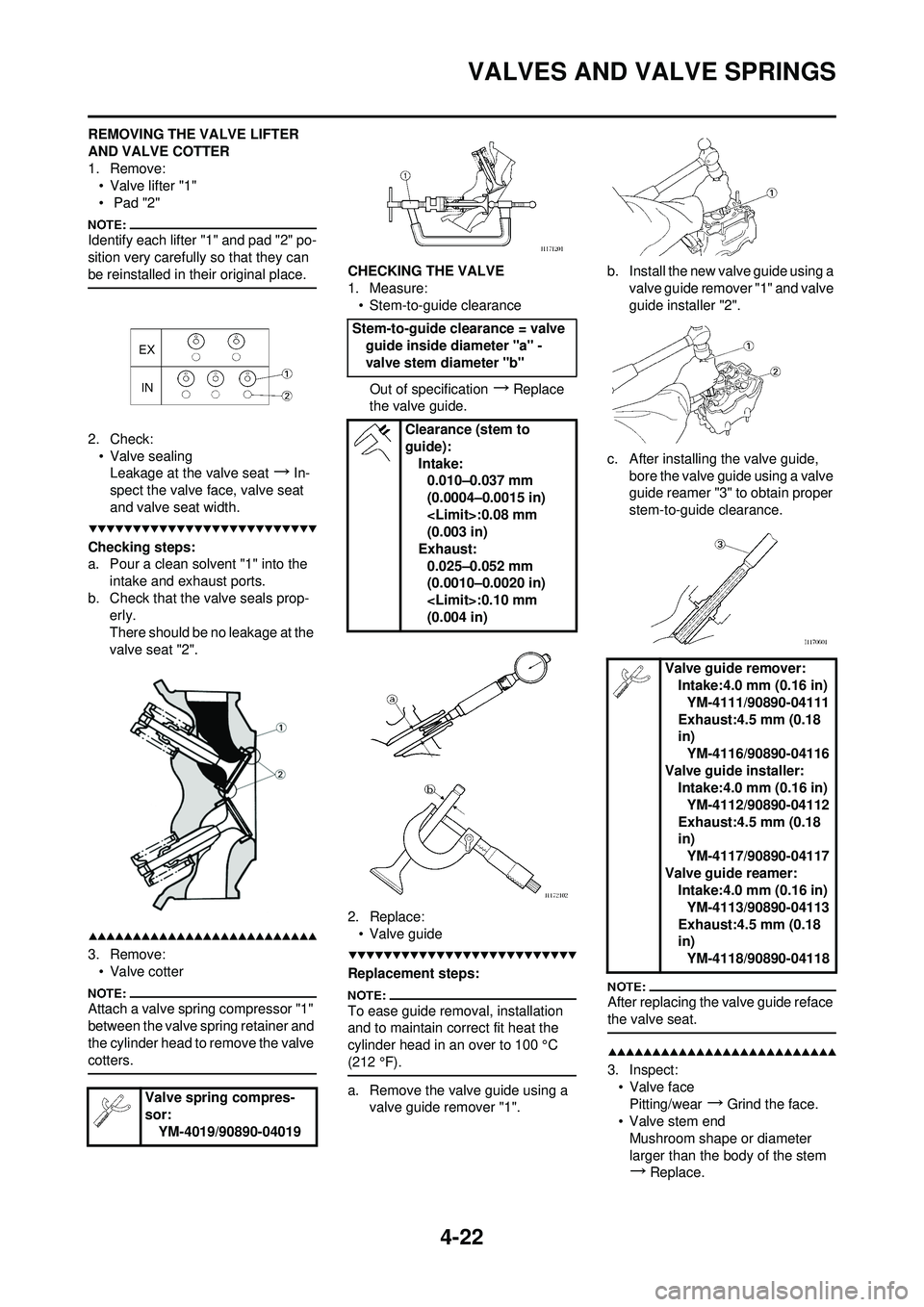
REMOVING THE VALVE LIFTER
AND VALVE COTTER
1. Remove:• Valve lifter "1"
• Pad "2"
Identify each lifter "1" and pad "2" po-
sition very carefully so that they can
be reinstalled in their original place.
2. Check:
•Valve sealingLeakage at the valve seat
→In-
spect the valve face, valve seat
and valve seat width.
Checking steps:
a. Pour a clean solvent "1" into the intake and exhaust ports.
b. Check that the valve seals prop- erly.
There should be no leakage at the
valve seat "2".
3. Remove:
• Valve cotter
Attach a valve spring compressor "1"
between the valve spring retainer and
the cylinder head to remove the valve
cotters.
CHECKING THE VALVE
1. Measure:• Stem-to-guide clearance
Out of specification
→Replace
the valve guide.
2. Replace: • Valve guide
Replacement steps:
To ease guide removal, installation
and to maintain correct fit heat the
cylinder head in an over to 100 °C
(212 °F).
a. Remove the valve guide using a valve guide remover "1". b. Install the new valve guide using a
valve guide remover "1" and valve
guide installer "2".
c. After installing the valve guide, bore the valve guide using a valve
guide reamer "3" to obtain proper
stem-to-guide clearance.
After replacing the valve guide reface
the valve seat.
3. Inspect:• Valve facePitting/wear
→Grind the face.
• Valve stem end
Mushroom shape or diameter
larger than the body of the stem
→Replace.
Valve spring compres-
sor:
YM-4019/90890-04019
Stem-to-guide clearance = valve guide inside diameter "a" -
valve stem diameter "b"
Clearance (stem to
guide):Intake:0.010–0.037 mm
(0.0004–0.0015 in)
(0.003 in)
Exhaust: 0.025–0.052 mm
(0.0010–0.0020 in)
(0.004 in)
Valve guide remover: Intake:4.0 mm (0.16 in)
YM-4111/90890-04111
Exhaust:4.5 mm (0.18
in) YM-4116/90890-04116
Valve guide installer: Intake:4.0 mm (0.16 in)
YM-4112/90890-04112
Exhaust:4.5 mm (0.18
in) YM-4117/90890-04117
Valve guide reamer: Intake:4.0 mm (0.16 in)
YM-4113/90890-04113
Exhaust:4.5 mm (0.18
in) YM-4118/90890-04118
Page 92 of 192
4-23
VALVES AND VALVE SPRINGS
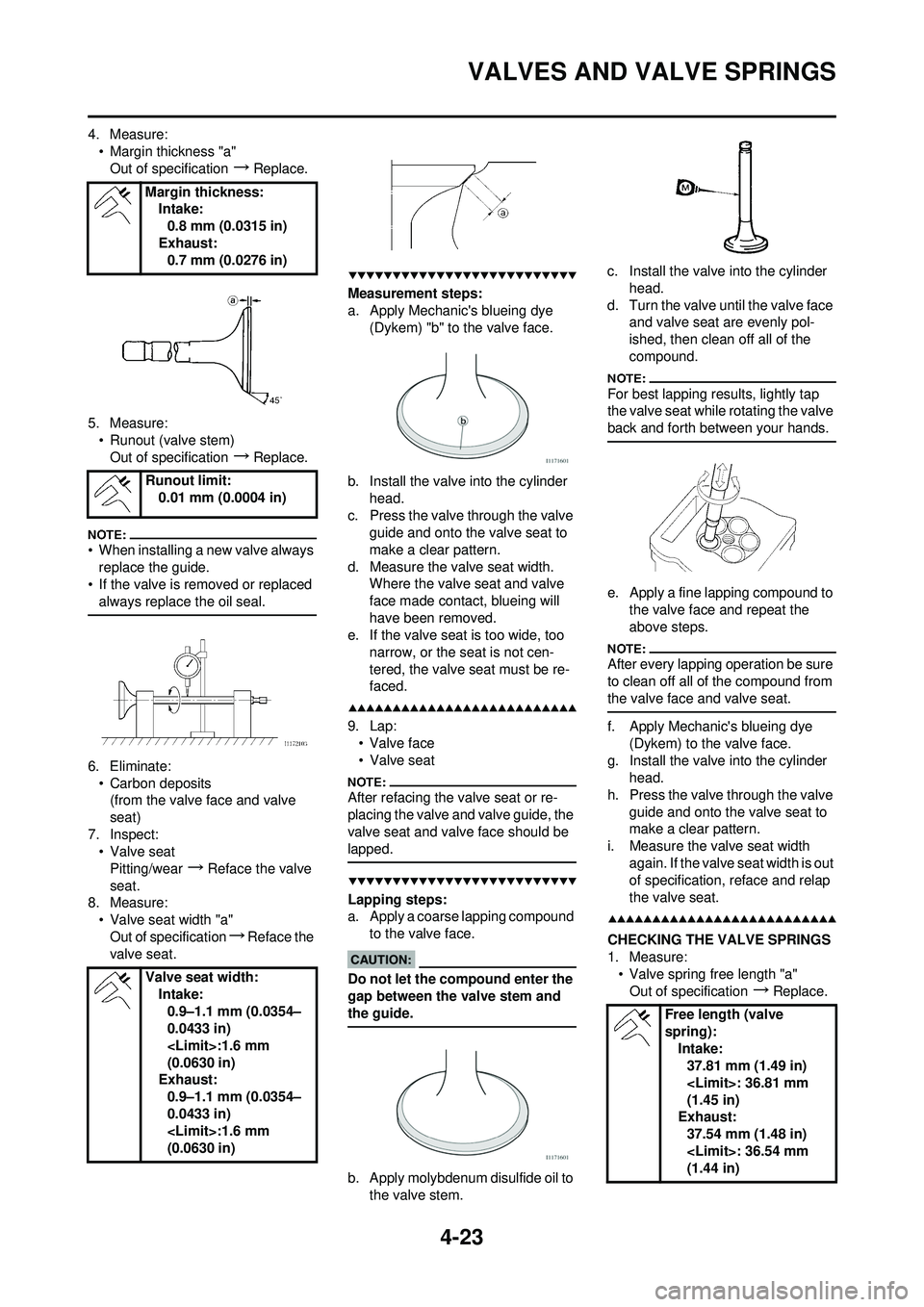
4. Measure:• Margin thickness "a"Out of specification
→Replace.
5. Measure: • Runout (valve stem)Out of specification
→Replace.
• When installing a new valve always
replace the guide.
• If the valve is removed or replaced
always replace the oil seal.
6. Eliminate:• Carbon deposits(from the valve face and valve
seat)
7. Inspect: •Valve seat
Pitting/wear
→Reface the valve
seat.
8. Measure:
• Valve seat width "a"Out of specification
→Reface the
valve seat.
Measurement steps:
a. Apply Mechanic's blueing dye
(Dykem) "b" to the valve face.
b. Install the valve into the cylinder head.
c. Press the valve through the valve guide and onto the valve seat to
make a clear pattern.
d. Measure the valve seat width. Where the valve seat and valve
face made contact, blueing will
have been removed.
e. If the valve seat is too wide, too
narrow, or the seat is not cen-
tered, the valve seat must be re-
faced.
9. Lap:• Valve face
• Valve seat
After refacing the valve seat or re-
placing the valve and valve guide, the
valve seat and valve face should be
lapped.
Lapping steps:
a. Apply a coarse lapping compound to the valve face.
Do not let the compound enter the
gap between the valve stem and
the guide.
b. Apply molybdenum disulfide oil to the valve stem. c. Install the valve into the cylinder
head.
d. Turn the valve until the valve face and valve seat are evenly pol-
ished, then clean off all of the
compound.
For best lapping results, lightly tap
the valve seat while rotating the valve
back and forth between your hands.
e. Apply a fine lapping compound to the valve face and repeat the
above steps.
After every lapping operation be sure
to clean off all of the compound from
the valve face and valve seat.
f. Apply Mechanic's blueing dye
(Dykem) to the valve face.
g. Install the valve into the cylinder head.
h. Press the valve through the valve guide and onto the valve seat to
make a clear pattern.
i. Measure the valve seat width again. If the valve seat width is out
of specification, reface and relap
the valve seat.
CHECKING THE VALVE SPRINGS
1. Measure:• Valve spring free length "a"Out of specification
→Replace.
Margin thickness:
Intake:
0.8 mm (0.0315 in)
Exhaust: 0.7 mm (0.0276 in)
Runout limit: 0.01 mm (0.0004 in)
Valve seat width: Intake:0.9–1.1 mm (0.0354–
0.0433 in)
(0.0630 in)
Exhaust:
0.9–1.1 mm (0.0354–
0.0433 in)
(0.0630 in)
Free length (valve
spring): Intake:37.81 mm (1.49 in)
(1.45 in)
Exhaust:
37.54 mm (1.48 in)
(1.44 in)
Page 105 of 192
4-36
OIL FILTER ELEMENT AND WATER PUMP
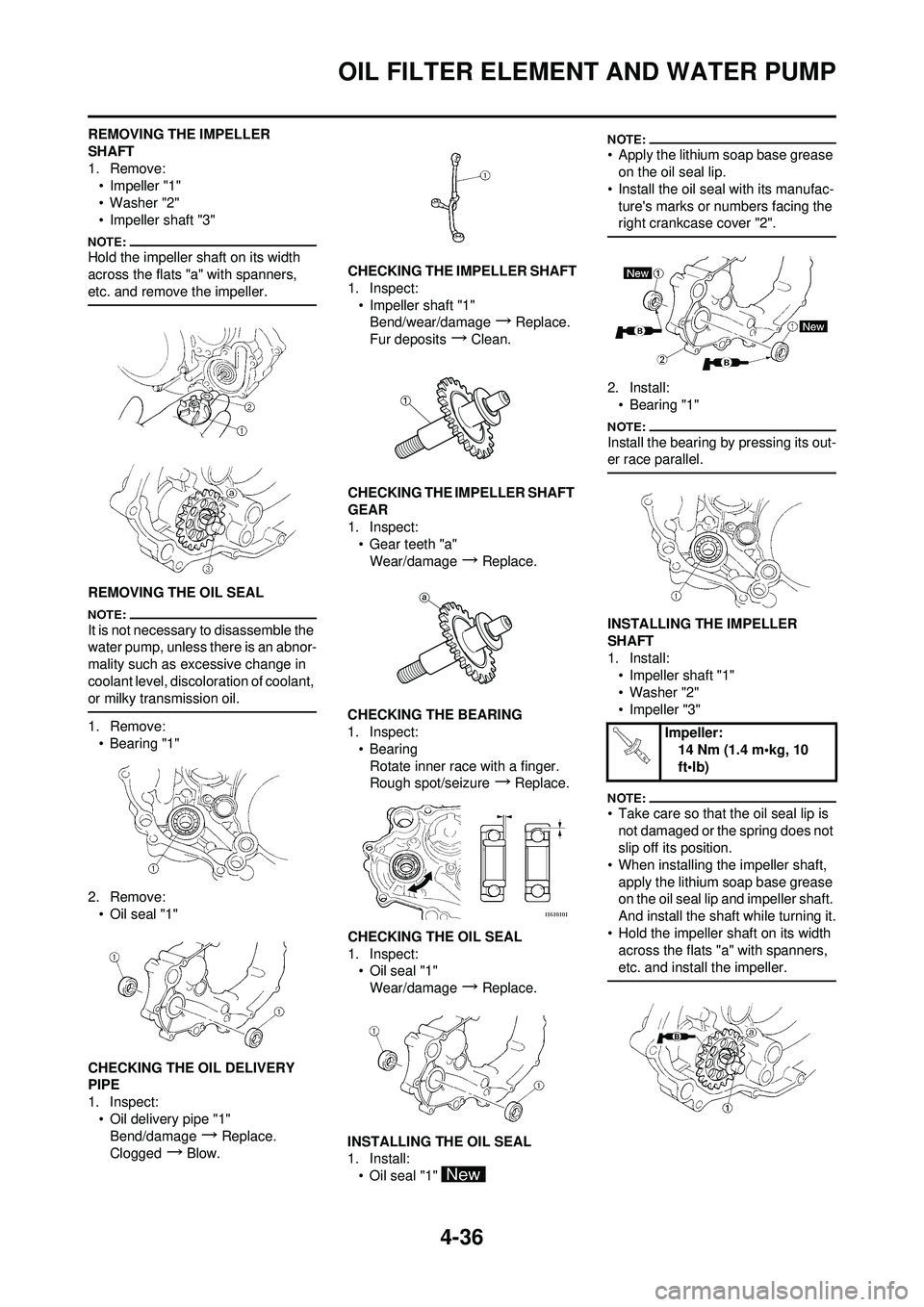
REMOVING THE IMPELLER
SHAFT
1. Remove:•Impeller "1"
• Washer "2"
• Impeller shaft "3"
Hold the impeller shaft on its width
across the flats "a" with spanners,
etc. and remove the impeller.
REMOVING THE OIL SEAL
It is not necessary to disassemble the
water pump, unless there is an abnor-
mality such as excessive change in
coolant level, discoloration of coolant,
or milky transmission oil.
1. Remove:
• Bearing "1"
2. Remove: •Oil seal "1"
CHECKING THE OIL DELIVERY
PIPE
1. Inspect: • Oil delivery pipe "1"Bend/damage
→Replace.
Clogged
→Blow. CHECKING THE IMPELLER SHAFT
1. Inspect:
• Impeller shaft "1"Bend/wear/damage
→Replace.
Fur deposits
→Clean.
CHECKING THE IMPELLER SHAFT
GEAR
1. Inspect: • Gear teeth "a"Wear/damage
→Replace.
CHECKING THE BEARING
1. Inspect: • BearingRotate inner race with a finger.
Rough spot/seizure
→Replace.
CHECKING THE OIL SEAL
1. Inspect: • Oil seal "1"
Wear/damage
→Replace.
INSTALLING THE OIL SEAL
1. Install: • Oil seal "1"
• Apply the lithium soap base grease on the oil seal lip.
• Install the oil seal with its manufac- ture's marks or numbers facing the
right crankcase cover "2".
2. Install:• Bearing "1"
Install the bearing by pressing its out-
er race parallel.
INSTALLING THE IMPELLER
SHAFT
1. Install:• Impeller shaft "1"
• Washer "2"
• Impeller "3"
• Take care so that the oil seal lip is
not damaged or the spring does not
slip off its position.
• When installing the impeller shaft, apply the lithium soap base grease
on the oil seal lip and impeller shaft.
And install the shaft while turning it.
• Hold the impeller shaft on its width across the flats "a" with spanners,
etc. and install the impeller.
Impeller: 14 Nm (1.4 m•kg, 10
ft•lb)
Page 127 of 192
4-58
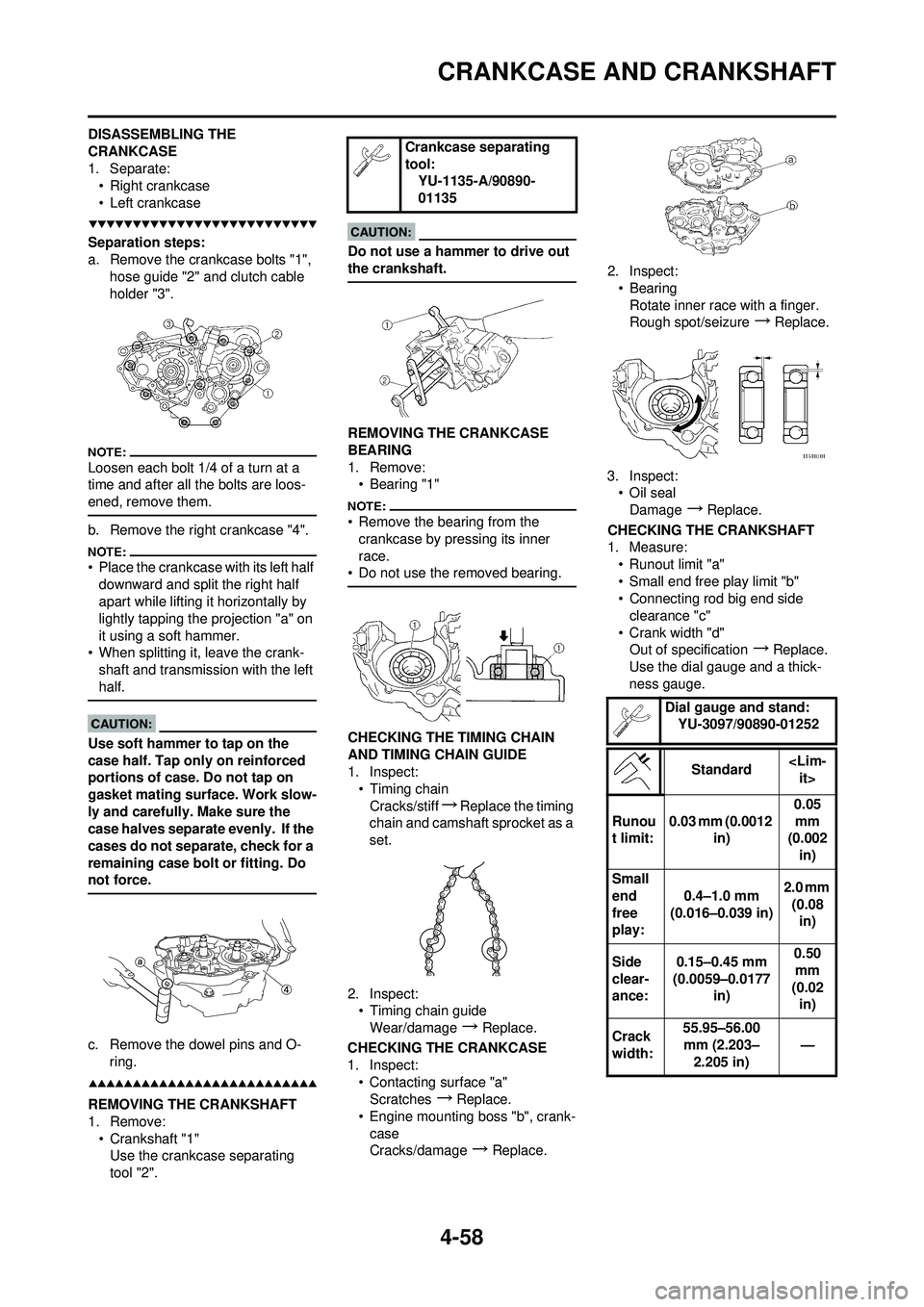
CRANKCASE AND CRANKSHAFT
DISASSEMBLING THE
CRANKCASE
1. Separate:• Right crankcase
• Left crankcase
Separation steps:
a. Remove the crankcase bolts "1", hose guide "2" and clutch cable
holder "3".
Loosen each bolt 1/4 of a turn at a
time and after all the bolts are loos-
ened, remove them.
b. Remove the right crankcase "4".
• Place the crankcase with its left half
downward and split the right half
apart while lifting it horizontally by
lightly tapping the projection "a" on
it using a soft hammer.
• When splitting it, leave the crank-
shaft and transmission with the left
half.
Use soft hammer to tap on the
case half. Tap only on reinforced
portions of case. Do not tap on
gasket mating surface. Work slow-
ly and carefully. Make sure the
case halves separate evenly. If the
cases do not separate, check for a
remaining case bolt or fitting. Do
not force.
c. Remove the dowel pins and O- ring.
REMOVING THE CRANKSHAFT
1. Remove:• Crankshaft "1"Use the crankcase separating
tool "2".
Do not use a hammer to drive out
the crankshaft.
REMOVING THE CRANKCASE
BEARING
1. Remove:• Bearing "1"
• Remove the bearing from the
crankcase by pressing its inner
race.
• Do not use the removed bearing.
CHECKING THE TIMING CHAIN
AND TIMING CHAIN GUIDE
1. Inspect:
•Timing chainCracks/stiff
→Replace the timing
chain and camshaft sprocket as a
set.
2. Inspect: • Timing chain guide
Wear/damage
→Replace.
CHECKING THE CRANKCASE
1. Inspect: • Contacting surface "a"Scratches
→Replace.
• Engine mounting boss "b", crank- case
Cracks/damage
→Replace. 2. Inspect:
• BearingRotate inner race with a finger.
Rough spot/seizure
→Replace.
3. Inspect: •Oil seal
Damage
→Replace.
CHECKING THE CRANKSHAFT
1. Measure: • Runout limit "a"
• Small end free play limit "b"
• Connecting rod big end side clearance "c"
• Crank width "d" Out of specification
→Replace.
Use the dial gauge and a thick-
ness gauge.
Crankcase separating
tool: YU-1135-A/90890-
01135
Dial gauge and stand:YU-3097/90890-01252
Standard
Runou
t limit: 0.03 mm (0.0012
in) 0.05
mm
(0.002
in)
Small
end
free
play: 0.4–1.0 mm
(0.016–0.039 in) 2.0 mm
(0.08 in)
Side
clear-
ance: 0.15–0.45 mm
(0.0059–0.0177 in) 0.50
mm
(0.02 in)
Crack
width: 55.95–56.00
mm (2.203– 2.205 in) —